In this article, I’ll talk about the Top Alternative Credit Investment Platforms for 2026 that provide access to private lending, real estate debt, corporate financing and consumer credit opportunities. Alternative credit platforms are getting noticed as investors look for alternatives to stocks and bonds.
They offer income-focused investment strategies and a diversified set of lending opportunities. I’ll be comparing the top platforms on investment options, minimum requirements, expected returns, fees, investor eligibility, risk management and liquidity to give readers a sense of how they differ from one another.
What Are Alternative Credit Investment Platforms?
Definition: Alternative credit investment platforms are digital platforms or investment providers that connect investors with non-traditional lending opportunities, such as private loans, corporate debt, real estate financing and consumer credit.
Private Credit Investments: These platforms offer access to privately negotiated loans to businesses, property developers and other borrowers outside of traditional public bond markets.

Real Estate Debt: Some platforms allow investors to fund residential and commercial property projects via property-backed loans, mortgage debt, and real estate investment funds.
Consumer Lending: Some platforms match investors with personal loan opportunities, letting them earn interest from investments based on consumer borrowing and repayment behavior.
Business Lending: Investors can access business financing opportunities, including middle-market loans, small business lending, working capital and privately originated business debt.
Income Generation: Alternative credit investments are generally intended to generate income from interest payments, loan repayments, and distributions from funds. Actual returns depend on borrower performance and market conditions.
Investment Accessibility: Platforms provide varying entry thresholds, from lower minimums for eligible retail investors to higher investment levels for accredited and institutional investors.
Liquidity/Risk: These investments involve risks of default, interest rate fluctuations, and potential loss of principal. Many private credit products have limited liquidity, limited withdrawals, or a fixed maturity.
How to Choose the Best Alternative Credit Investment Platform?
Investment Opportunities: Explore platforms offering private credit, real estate debt, corporate lending, and consumer loans. Select investment options that match your financial objectives and the amount of credit exposure you desire.
Minimum Investment Amount: Look for the minimum investment to access individual loans, private credit funds or alternative lending opportunities. Choose platforms that correspond to the investment capital you’ve got.
Expected Returns: Review historical performance, target yields, interest rates and distribution rates. Compare the likely returns carefully. Don’t assume the advertized returns are a guaranty of future investment performance.
Fees and Charges: Check management fees, servicing costs, transaction charges and performance-based expenses. Transparent fee structures help investors understand total investment costs and how they affect returns.
Investor’s Eligibility: Verify the requirements for accreditation, income levels, net worth limitations, residency limitations and account requirements. Before you commit capital, make sure the platform accepts your investor category.
Risk Management: Assess the quality of the borrower, collateral arrangements, default rates, underwriting standards and portfolio diversity. Good risk assessment practices educate investors on the possibility of losing their capital.
Liquidity Choices: Examine investment maturities, redemption terms, withdrawal restrictions, and secondary-market availability. Select platforms with liquidity arrangements that suit your investment horizon and need for cash.
Platform Reputation: Management experience, regulatory disclosures, financial reporting, operational transparency and customer support. Reliable documentation enables investors to assess the reliability of the platform before making investment decisions.
Key Points: Top 10 Alternative Credit Investment Platforms
| Platform | Core Investment Focus | Key Features | Best Known For |
|---|---|---|---|
| Percent | Private credit and asset-backed lending | Individual credit deals, short-term investments, diversified notes | Direct private credit investment opportunities |
| Groundfloor | Real estate debt and property-backed loans | Real estate-backed notes, short-term lending, fractional investment options | Accessible real estate debt investing |
| Fundrise | Private real estate and private credit | Managed funds, income-focused investments, digital portfolio management | Retail access to alternative investments |
| Willow Wealth | Private credit and alternative assets | Private market offerings, structured investments, managed portfolios | Multiple alternative investment strategies |
| iCapital | Private credit and private market funds | Fund marketplace, portfolio management, investment reporting | Alternative investment access for wealth managers |
| CAIS | Private credit and alternative funds | Advisor investment marketplace, fund access, due diligence resources | Alternative investment distribution for financial advisors |
| Blackstone Private Credit Fund (BCRED) | Direct lending and private corporate credit | Diversified private loans, income distributions, periodic repurchase program | Institutional-scale private credit exposure |
| Blue Owl Credit Income Corp (OCIC) | Corporate direct lending | Middle-market loans, income-focused strategy, diversified borrowers | Middle-market private credit |
| Apollo Debt Solutions BDC | Private corporate debt | Direct lending, diversified credit portfolio, income distributions | Private lending opportunities |
| Prosper | Consumer and personal loans | Peer-to-peer lending, borrower risk assessment, loan investments | Consumer lending marketplace |
1. Percent
Percent is a private credit investment marketplace that gives accredited investors access to alternative lending opportunities. Investment Opportunities: It targets asset-backed securities, small business loans, consumer receivables, trade finance and working capital financing. Minimum Investment: Investors can begin with $500 for individual deals, while Blended Notes typically require $5,000.
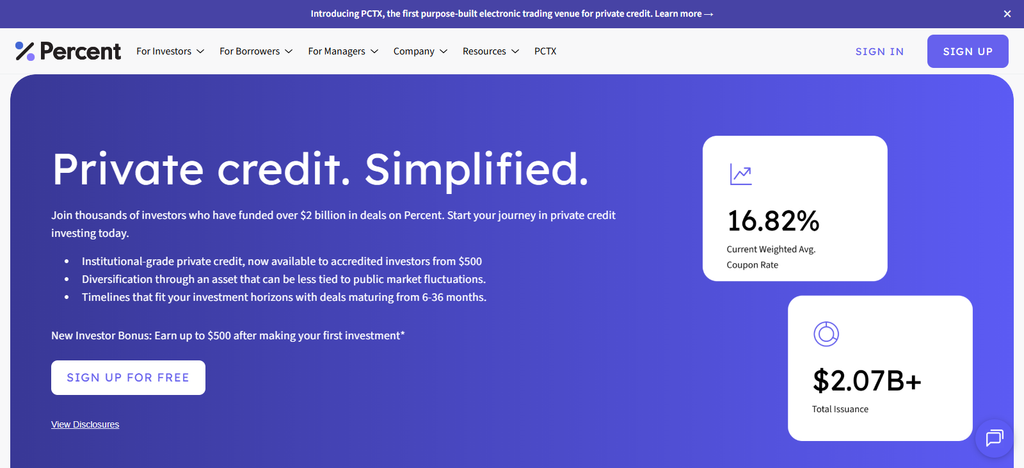
Coupons vary per deal, some opportunities advertize 12% or higher. Fees and charges Direct investments will be charged fees on the interest earned. Blended Notes will have different fees. Investor Eligibility: Only Qualified Investors. Risk and Liquidity: These investments typically mature from 6 to 36 months and are subject to borrower-default risk and liquidity risk.
Main Features
- Private Credit Marketplace: Offers accredited investors access to privately originated credit opportunities including asset-backed securities and specialty lending transactions.
- Different Types of Investments: Provides access to small business financing, consumer receivables, invoice factoring, trade finance and healthcare receivables.
- Flexible Investment Terms: It offers deal-specific investment periods typically ranging from 6 to 24 months depending on the deal.
- Investment Transparency: Provides information on the borrower, collateral, offering documents, credit metrics and investment performance.
- Portfolio Management: Offers investment tracking and payment tracking and reporting tools to help investors manage multiple credit positions.
What Makes It Different
- Low Entry Investment: Individual private credit deals are available with minimum investments of $500.
- Dutch Auction Pricing : Uses a book building process based on demand to set terms and yields for investments.
- Direct Deal Selection: Enables investors to assess specific deals rather than just investing in pooled funds.
- Secondary Market: Qualified investors also have the option to indicate their interest in buying or selling existing positions before maturity, subject to availability.
2. Groundfloor (web)
Groundfloor is a real estate investment platform that gives investors access to short-term property-backed loans and alternative private market opportunities. The platform is open to accredited and non-accredited investors, making it available to a large audience. With a minimum investment amount of just $10, it’s one of the lowest-entry real estate investment platforms out there.
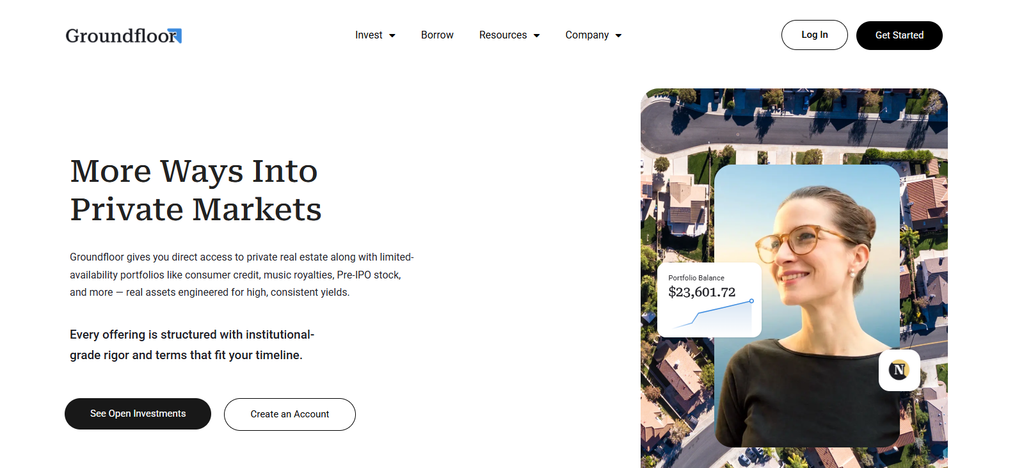
Typical target returns have been in the range of 6% to 12%+, based on the particular investments selected. Most investments are for relatively short periods of time, usually 6 to 18 months. Groundfloor has extremely low investor fees, though some managed portfolios have a fee of about 1%. Return is dependent on borrower repayment and real estate market conditions, so risk is medium to high. Liquidity is limited until the loan matures.
Special Features
- Real Estate Lending: Provides investment opportunities secured by short-term residential real estate loans.
- Fractional Investment: Allows investors to participate in eligible real estate debt investments without the need to fully fund a property loan.
- Fixed-Income Notes: Issues Notes that are designed to pay fixed interest installments as per their terms.
- Loan-Level Information: Information on property projects, borrower financing, loan terms and related collateral.
- Online Investment Management: The digital platform allows investors to browse offerings, manage investments, and track repayment activity.
What Makes It Different
- Low Barrier of Entry: Certain real estate loan investments have minimums as low as $10.
- Property-Backed Exposure: This is exposure to lending backed by residential real estate and not just corporate lending.
- Non-accredited Access: Provides investment opportunities for the non-accredited investors who qualify.
- Multiple Investment Structures: Provides various entry points into real estate debt, from individual loans to fixed-income Notes.
3. Fundrise
Fundrise is one of the most popular real estate investing platforms online, giving investors access to a diversified portfolio of private real estate assets. The platform caters to long-term investors who want passive exposure to residential and commercial properties. Investors can start with as little as $10 in a taxable account, although retirement accounts often have higher minimums.
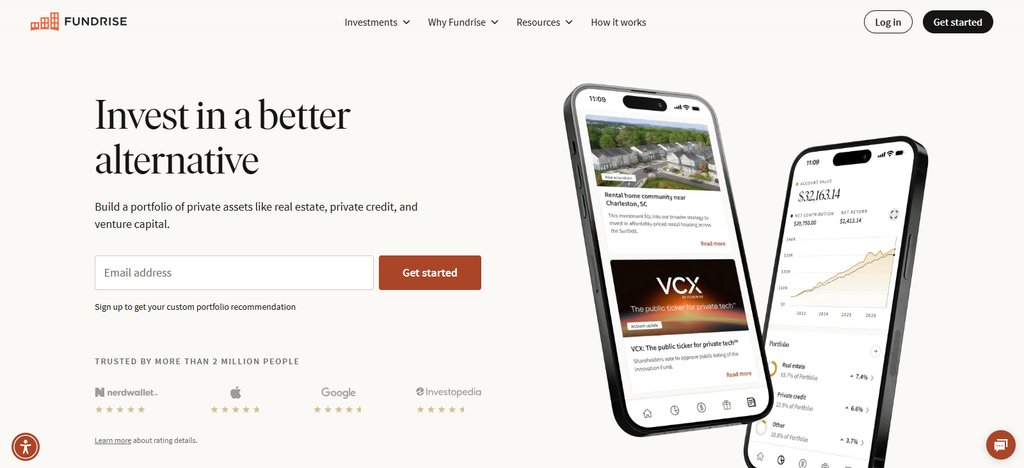
Fundrise typically aims for 6%–12% annual returns over the long term, but performance will differ depending on market conditions. The fees are pretty cheap, usually about 1% per year. It is open to non-accredited investors making it very accessible. This diversification reduces some risk, but the investments remain vulnerable to fluctuations in the real estate market. The investments are meant to be held for multi-year periods, which limits the liquidity.
Key Features
- Alternative Investment Funds: Offers professionally managed investment vehicles for private real estate and private market opportunities.
- Private Credit Exposure: Its Income Fund invests in real estate-related debt and other income-producing credit opportunities.
- Diversified Portfolios: A variety of investments to gain exposure to properties, borrowers, and underlying assets.
- Portfolio Management (Digital): Provides online account management, investment tracking, performance reporting and portfolio information.
- Recurring Investment Options: Facilitates the ability to make recurring contributions to build alternative investment portfolios over time.
What makes it different
- Low Entry Investment: Allows you to start investing with as little as $10 in qualifying standard accounts.
- Managed Investment Model: Offers professionally managed funds rather than asking investors to select individual loans.
- Multi-Asset Classes: Includes real estate, private credit and other private market investment strategies.
- Retail Investor Focus: Provides eligible non-accredited investors with select private market opportunities
4. Willow Wealth
Willow Wealth is a digital wealth management platform specializing in providing personalized investment solutions and financial planning services. It usually blends traditional portfolio management with technology-driven investment strategies to help investors build long-term wealth. Minimum investment requirements vary by advisory program selected but are generally targeted to mass affluent investors.

Your earnings in a year will depend on how you have invested your money and how the markets do, but the average return over the long term is somewhere in the range of 5% to 10%. Fees are typically based on assets under management, and can range from .5% to 1.5% per year. Account type and jurisdiction are factors in investor eligibility.
The risks are related to the movements in the stock and bond markets, and the liquidity is typically greater than that of private-market investments because the assets can generally be sold during trading hours.
Main Features
- Alternative Investment Marketplace: Access to private market opportunities in several types of alternative investments.
- Private Credit Opportunities: Access to private lending and income-oriented investment strategies via select offerings.
- Real Estate Investments: Access to real estate investment opportunities and financing structures.
- Investments in Funds: Provides collective investment schemes, enabling investors to invest in a managed portfolio.
- Investment Reporting: Portfolio information, investment updates, performance reporting and relevant offering documentation.
What Makes It Stand Out
- Alternative Asset Diversity: Offers investment opportunities not only in private credit but also in real estate, private equity, and other alternative investment strategies.
- Varied Investment Structures: Provides individual investment offerings and select diversified fund opportunities.
- Professional Investment Management: Access to opportunities managed by investment professionals and third party managers.
- Different Investor Needs: Supports different investment eligibility categories based on the offering and regulatory requirements.
5. iCapital
iCapital is a leading platform for alternative investments, offering access to private equity, private credit, hedge funds and structured products to high net worth individuals and financial advisors. The platform provides institutional quality investment opportunities previously available only to large investors.
Minimum investment requirements usually start at $25,000 to $100,000 or more, depending on the fund. Expected returns for investment strategy are very wide ranging. Private credit and private equity (often) target annualized returns of 8% to 15%+.
Fees may include management fees and expenses of underlying funds. Eligibility is generally restricted to accredited or qualified investors for investors. Illiquidity, market volatility and fund-specific risks represent risks, with liquidity generally being limited by long holding periods of investments.
Main Features
- Alternative Investment Marketplace: Connects private market investments with wealth managers and financial professionals.
- Access to Private Credit: Access to private debt funds, direct lending strategies and other credit-oriented investment products.
- Investment Research: Supports investment analysis with fund information, manager documentation and due diligence tools.
- Digital Subscription Management: Assists financial professionals in managing investment subscriptions and associated administrative tasks.
- Portfolio Reporting: Offers technology for investment monitoring, document management and alternative asset reporting.
The Difference
- Institutional Investment Access: Provides qualified investors with access to alternative investment managers and institutional quality investment opportunities.
- Advisor-Centric Infrastructure: Primarily caters to wealth managers, financial advisors, and financial institutions.
- Technology Integration: Connects investment access with subscription processing, reporting, and operational tools.
- Broad Alternative Exposure: Includes private credit and private equity, real assets, hedge funds and structured investments.
6. CAIS
CAIS is a private market investment platform which provides financial advisors with access to a wide range of private market investments. The platform offers private equity, private credit, real estate and hedge fund solutions from leading asset managers. Minimum investments are typically $25,000-$100,000+, depending on the strategy you choose. Alternative investments have a range of expected returns, but are generally in the 7% to 15%+ per year range.
Investors may be charged management fees, performance fees, and expenses of the fund’s operation. Access is typically restricted to accredited investors and qualified buyers. Leverage, illiquidity and market uncertainty add to the risk levels compared to traditional public market investments. The structure of the investments underlying them may limit liquidity for a number of years.
Features
- Alternative Investment Marketplace: Offers financial advisors access to alternative investment products from various asset managers.
- Private Credit Strategies: Encompasses private lending, direct lending, and other private debt investment opportunities.
- Investment Due Diligence: Provides investment information, manager resources and educational materials to help evaluate funds.
- Subscription Processing: Provides a digital platform for processing alternative investment subscriptions and related documentation.
- Advisor Portfolio Support: Assists financial professionals in weaving alternative investments into client portfolios and investment strategies.
What Makes It Unique
- Financial Advisor Oriented: For independent financial advisors and wealth management companies.
- Manager Network: Links advisors to alternative investment managers with a range of private market strategies.
- Investment Education: Offers educational resources to help advisors understand alternative assets and investment structures.
- Operational efficiency – Centralized technology enhances investment research, subscriptions and administrative processes.
7. BCRED
Blackstone Private Credit Fund (BCRED) is a private credit investment vehicle managed by Blackstone, one of the world’s largest alternative asset managers. The fund’s investment objective is to seek to generate regular income and preserve capital by investing primarily in senior secured loans to middle-market and large corporate borrowers. Typically, minimum investments range from $2,500 to $25,000 depending on the share class and distribution channel.
The fund typically aims for annual returns in the 8% to 12% range, but performance may differ. You will pay management and operating fees. BCRED is typically available to eligible investors via approved advisors and platforms. Risks include credit default, changes in interest rates and a downturn in the economy. Liquidity is limited relative to public securities. There are periodic redemption programs.
Features
- Private Corporate Lending: Primarily invests in privately originated loans to established companies across a variety of industries.
- Diversified Credit Portfolio: Offers exposure to a wide spectrum of borrowers, industries and corporate credit investments.
- Income-Driven Approach: Seeks to produce current income from interest received on the underlying portfolio investments.
- Professional Credit Management: Leverages Blackstone’s credit investment expertise to identify, underwrite and manage investments.
- Portfolio Monitoring: Tracks borrower financial performance, credit quality and portfolio exposure to mitigate lending risks.
What Makes it Unique
- Blackstone Management Utilizes Blackstone’s investment management platform and private credit expertise.
- Corporate Credit Orientation: Focuses mainly on private negotiated corporate lending opportunities.
- Non-Traded BDC Structure: Offers private credit exposure through a non-exchange-listed business development company.
- Periodic Repurchase Program: Provides for limited periodic share repurchases, subject to the terms of the fund and available capacity.
8. Blue Owl Credit Income Corp. (OCIC)
Blue Owl Credit Income Corp (OCIC) is a non-traded business development company (BDC) that provides direct loans to private middle-market companies. The fund aims to provide attractive income through a diversified portfolio of private credit investments. The minimum investment is usually $2,500 or more depending on the channel of distribution. OCIC has historically aimed for annual returns of 8% to 12% primarily from interest income.
Investors pay for management and fund operating expenses. Generally, individual investors can access the investment through financial advisors. Risks include borrower defaults, recessions, and interest rate fluctuations. The fund does have some periodic liquidity features, but investors should view OCIC as a medium to long-term investment, and one that has limited liquidity relative to publicly traded stocks.
Features
- Middle-Market Lending: Concentrates on lending to middle-market companies across multiple business sectors.
- Direct Credit Investments: Primarily invests in corporate debt and senior secured loans that are privately originated.
- Income Generation: Aims to generate recurring income through interest payments from its underlying credit portfolio.
- Portfolio Diversification: Spreads investments across a variety of borrowers, industries and corporate lending opportunities.
- Professional Credit Management: Utilizes Blue Owl’s credit investment expertise to source, underwrite and monitor portfolio investments.
Why It’s Special
- Middle-Market Focus: Focuses on lending to established middle-market businesses, as opposed to consumer borrowers.
- Corporate Credit: Invests in senior secured loans as part of its corporate credit strategy.
- Perpetual-Life Structure: Rather than a traditional fixed-term private credit fund, it operates as a non-traded perpetual-life BDC.
- Periodic Liquidity Feature: Permits quarterly share repurchases, subject to limits, board approval and liquidity
9. Apollo Debt Solutions BDC
Apollo Debt Solution BDC is an Apollo Global Management sponsored business development company that focuses on direct lending opportunities in the private credit market. The fund invests in secured loans and debt instruments issued by middle-market companies that seek to generate consistent income and preserve capital.
Minimum investments are usually from around $2,500 up to $25,000 depending on the investment channel. Returns are expected to be in the 8% to 12%+ range annually, in line with private credit market yields. Investors should consider the management fees, operating costs and any possible expenses associated with distributions.
Qualification criteria differ, but usually include standards of suitability. Risks include the credit quality of the borrower, general economic conditions and limited redemption opportunities. This fund is best suited for longer-term investors and has a periodic, rather than daily, liquidity.
Features at a Glance
- Direct Lending Strategy: Offers financing to privately held companies via directly originated corporate loans.
- Senior Debt Investments: Concentrates on senior secured loans and other corporate debt instruments.
- Broadened Borrower Exposure: Invests in a variety of companies, industries and credit opportunities.
- Income Portfolio: Aims to generate current income through the interest paid on the underlying debt investments.
- Professional Credit Underwriting: Leverages Apollo’s investment management expertise to assess borrowers, structure loans, and manage credit risk.
What’s Special About It
- Apollo Credit Expertise: Leverages Apollo’s proven private credit investment and underwriting expertise.
- Corporate Borrower Focus: It provides financing to businesses rather than consumer peer-to-peer lending.
- Non-Traded BDC Structure: Exposure to private corporate credit, via a non-listed investment vehicle.
- Portfolio Level Management: Provides a diversified exposure through a professionally managed portfolio, instead of the investor having to select individual loans.
10. Flourish
Prosper is one of the largest peer-to-peer lending platforms in the U.S. and enables investors to fund personal loans made to individual borrowers. The platform offers exposure to consumer credit investments that can generate attractive income relative to traditional savings products. In the past, the minimum investments have been low, enabling investors to spread their money across a number of loans with relatively small amounts.

Expected returns are generally 5% to 10%+, depending on loan grades and economic conditions. Investor servicing and management-related fees impact net returns. Prosper is available to qualified investors in eligible jurisdictions. Risks include borrower defaults, economic slowdowns and deterioration in credit quality. The investments are still tied to the loan repayment schedules so liquidity is limited.
Main Features
- Peer-to-Peer Lending: Connects eligible borrowers looking for personal loans with investors looking for consumer credit opportunities.
- Personal Loan Investments: Notes linked to underlying unsecured personal loans are available.
- Fractional loan investing: Allows investors to invest in portions of eligible loans instead of funding an entire loan.
- Borrower Credit Assessment: Borrower credit data and risk assessment processes are used to support loan underwriting.
- Online Account Management: Tools are provided to monitor investments, track payments, review account activity and manage eligible Notes.
What makes it special
- Consumer Credit Focus: Focused on personal lending, not corporate or real estate-backed private credit.
- Low Investment Entry: Eligible investors can invest in certain Notes beginning at $25.
- Fractional Participation: Investors can allocate their capital across the loans of multiple borrowers.
- Marketplace Lending Model: Connects consumer borrowers with investors through an online lending platform.
Conclusion
Alternative credit investment platforms provide investors with access to private lending, real estate debt, corporate financing and consumer credit opportunities that are not available through traditional investments. Platforms like Percent, Groundfloor, Fundrise, Willow Wealth, iCapital and Prosper provide varying investment structures, credit strategies and accessibility.
Meanwhile, BCRED, OCIC and Apollo Debt Solutions BDC provide exposure to professionally managed private credit portfolios. Before investing compare minimum requirements, expected returns, fees, investor eligibility, risk and liquidity. Ultimately, the choice of the best platform will depend on your financial objectives, risk tolerance, investment budget, and how long you want to invest for.
FAQ
What Are Alternative Credit Investment Platforms?
Alternative credit investment platforms provide access to non-traditional lending opportunities, including private credit, real estate debt, corporate loans, and consumer financing outside conventional banking channels.
Which Are the Best Alternative Credit Investment Platforms in 2026?
Popular options include Percent, Groundfloor, Fundrise, Willow Wealth, iCapital, CAIS, Blackstone Private Credit Fund, Blue Owl Credit Income Corp., Apollo Debt Solutions BDC, and Prosper.
How Much Money Do You Need to Start Alternative Credit Investing?
Minimum investments vary by platform and offering. Some opportunities start at $10 or $25, while private credit funds and institutional investment products may require substantially larger commitments.
Are Alternative Credit Investment Platforms Safe?
These platforms involve credit, liquidity, and market risks. Borrower defaults, economic changes, and investment losses can affect returns. Investors should review offering documents and risk disclosures.
Can Beginners Invest in Alternative Credit Platforms?
Yes, some platforms offer accessible investment options for eligible retail investors. However, certain private credit funds and investment opportunities require accredited investor status or specific financial qualifications.