
Revenue-based financing is an interesting alternative investment approach for investors looking beyond traditional stocks, bonds and equity markets. These platforms match growing businesses with funding opportunities and allow capital providers to earn returns through revenue-linked repayment arrangements.
Choosing the right platform means knowing its financing model, who can invest, what returns to expect, how repayment works and how it manages risk. In this article, I’ll cover the best revenue-based financing platforms for investors, emphasizing their main features and things to consider before investing.
Why Should Investors Consider Revenue-Based Financing?
Potential Returns: Investors can get returns on revenue-based financing through pre-arranged revenue-sharing agreements. This creates a different avenue to earn money from businesses without taking ownership of the company.
Portfolio Diversification: By investing in businesses spanning multiple sectors such as SaaS, e-commerce, technology, healthcare, and consumer products, investors can diversify their portfolios and lessen their dependence on traditional investments.

Business Growth Potential: Investors can fund growing businesses that need capital for inventory, marketing, expansion, and operations and benefit from the business’s increasing revenue.
Repayments Based on Revenue: Repayments are typically based on a percentage of the business’s revenue, so payment amounts can vary based on the actual performance of the business.
Non-dilutive financing model: Revenue-based financing allows businesses to grow without founders giving up equity, attractive for companies needing capital but wanting to retain ownership.
Alternative Investment Exposure: Investors can seek out private financing opportunities outside of conventional stocks, bonds, and mutual funds to gain exposure to companies with unique growth and revenue profiles.
Defined Repayment Agreements: Fixed repayment caps and contractual terms are common in many revenue-based financing agreements, providing investors with a clear view of the agreed repayment structure and potential period for capital recovery.
Access to Emerging Businesses: Investors can get involved with emerging startups, digital brands and established small businesses, with the possibility of realizing gains from financing opportunities across developing commercial sectors.
Key Factors to Evaluate Before Choosing a Revenue-Based Financing Platform
Platform Credibility: Check the platform’s operational history, business reputation, funding partners and track record to gage its reliability and its ability to professionally handle financing arrangements.
Investor Eligibility: Check the investor eligibility of the platform, i.e. does it accept individual, accredited or institutional investors. Be aware of its geographical restrictions, qualification requirements and regulatory conditions before making an investment.
Minimum Investment: Review the minimum investment and capital commitment requirements to ensure the platform aligns with your investment budget and financial objectives.
Expected Returns Look at potential returns, revenue-sharing percentages, repayment caps and investment costs to know how earnings are calculated and what kind of financial outcomes are realistically possible.
Revenue Verification: Find out how the platform verifies business revenues, reviews financial statements, and assesses sales performance before approving financing opportunities for potential borrowers.
Risk Management: Explore underwriting standards, borrower credit evaluations, default prevention strategies, and repayment monitoring to understand how the platform identifies and handles financing risks.
Investment Duration: Consider repayment schedules, anticipated investment periods, prepayment terms, and capital recovery timelines to understand how long your money may be tied up.
Fees and Transparency: Review management fees, transaction costs, contractual obligations, reporting processes, and withdrawal conditions to assess potential costs and the level of transparency provided by the platform.
Key Points: 10 Best Revenue-Based Financing Platforms
| Platform | Primary Investment / Financing Focus | Key Point |
|---|---|---|
| Klub | Revenue-based financing for businesses | Connects businesses with capital through structured financing opportunities. |
| GetVantage | Startups, D2C and e-commerce businesses | Uses business revenue and performance data to evaluate financing opportunities. |
| Recur Club | Startup and SME debt financing | Provides a marketplace connecting businesses with financing sources. |
| Velocity | D2C and e-commerce financing | Focuses on growth capital for online businesses with established revenue. |
| N+1 Capital | Revenue-linked growth capital | Provides businesses with capital in exchange for a share of future revenue. |
| Pipe | Recurring revenue financing | Provides capital solutions based on predictable recurring revenue streams. |
| Capchase | SaaS and subscription businesses | Specializes in financing against recurring and contracted software revenue. |
| Clearco | E-commerce and digital businesses | Offers non-dilutive funding solutions for business growth and marketing. |
| Lighter Capital | Technology and SaaS startups | Provides revenue-based growth financing for technology companies. |
| Wayflyer | E-commerce and consumer brands | Provides sales-linked financing for inventory, marketing, and expansion. |
1. Klub
Klub is an India-based fintech platform that provides digital-first brands and SMEs with fast, flexible, non-dilutive growth capital. It employs a revenue-based financing model in which the business receives upfront capital and repays it by giving an agreed percentage of future gross revenue until reaching a set return cap.

Usually, the funding is between ₹2 lakh and ₹30 crore for marketing, inventory and capital expenditure. Klub has the backing of institutional and startup investors, including 9Unicorns and Sequoia Surge and has said it will deploy ₹500 crore. We are focused on qualifying digital businesses with meaningful and recurring revenues. Approvals are data driven and don’t require equity dilution.
Main Features :
- Revenue-Based Financing: Non-dilutive growth capital for digital-first businesses and consumer brands.
- Flexible Repayment: Depends on an agreed percentage of business revenue rather than fixed monthly repayments.
- Flexible Financing Options: Provides financing solutions for businesses of different sizes and stages of growth.
- Industry Coverage: Serves D2C, e-commerce, fashion, beauty, wellness, food and other consumer-facing businesses.
- Data-Driven Financing: Funding opportunities are evaluated on the basis of historical revenue, cash flow, business growth and operating performance.
Risk Management
- Revenue Assessment: Capital is provided based on the analysis of previous revenue and business performance.
- Cash Flow Monitoring: Analyzes cash flow and revenue patterns to evaluate repayment capacity.
- Business Eligibility: Examines operating history, margins, scalability and financial health.
- Diversify your investment: Investors should look at exposure across industries and individual companies, not put all capital in one company.
2. Get Vantage
GetVantage is an Indian embedded finance and capital gateway providing equity-free, collateral-free funding to startups, MSMEs and digital-first businesses. It provides capital through its RBI licensed NBFC GetGrowth Capital and partner banks and institutional investors. It finances on the basis of live operational data – revenue, cash flow and financial performance – rather than on mostly collateral or fixed EMIs.
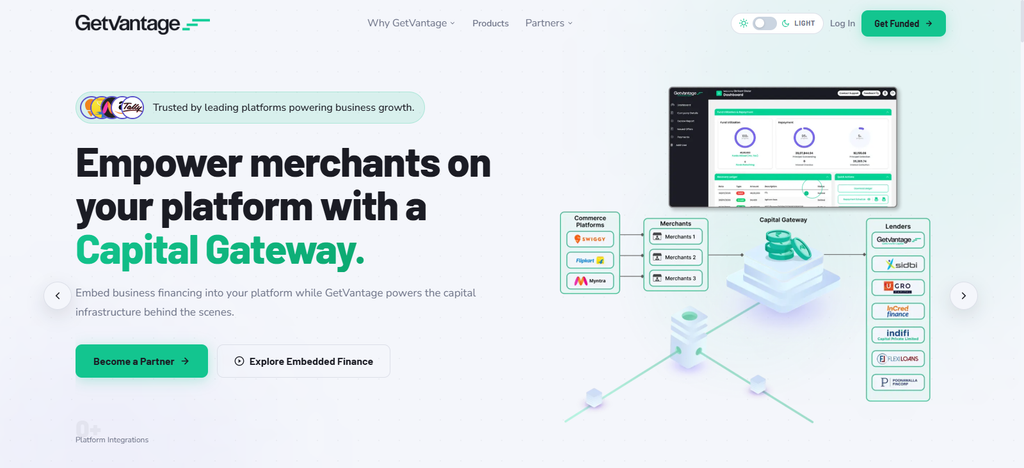
Funding is repaid in flexible structures that match the business cash flows, generally revenue linked rather than equity based. GetVantage provides same-day eligibility decisions and maintains 100% founder ownership. Eligibility is usually based on positive operating margins and proven revenue performance. It is suitable for growing D2C, SaaS and MSME businesses.
Features:
- Non-Dilutive Capital: Business financing that doesn’t require founders to give up any ownership in their company.
- Revenue-based repayment: Repayments are tied to business revenue performance and cash flow.
- Fast Funding: Eligible businesses can receive a funding disbursement in as little as 72 hours.
- Diverse Business Segments: Serves D2C brands, e-commerce companies, SaaS firms, and digital-first businesses.
- Data-Driven Underwriting: Uses business performance data and financial information to assess funding requests.
Risk Management
- Financial Analysis: Assesses revenue and cash flow, and overall business performance before financing approval.
- Digital Verification: Enables underwriting through connected business platforms and financial information.
- Simple Financing Terms: Shows amounts of funding, flat fees, and repayment terms before acceptance.- Structured Funding: Enable funding through its RBI registered NBFC structure and institutional lending partners.
3. Recur Club
Recur Club is an AI-native debt marketplace in India, connecting startups and SMEs with 125+ lenders for non-dilutive capital. It offers revenue based financing, venture debt, invoice discounting, working-capital, structured debt and lease financing. RBF provides a company with capital that is repaid as a flexible percentage of monthly revenue until a pre-agreed amount is repaid (often 1.3x to 2x the principal).
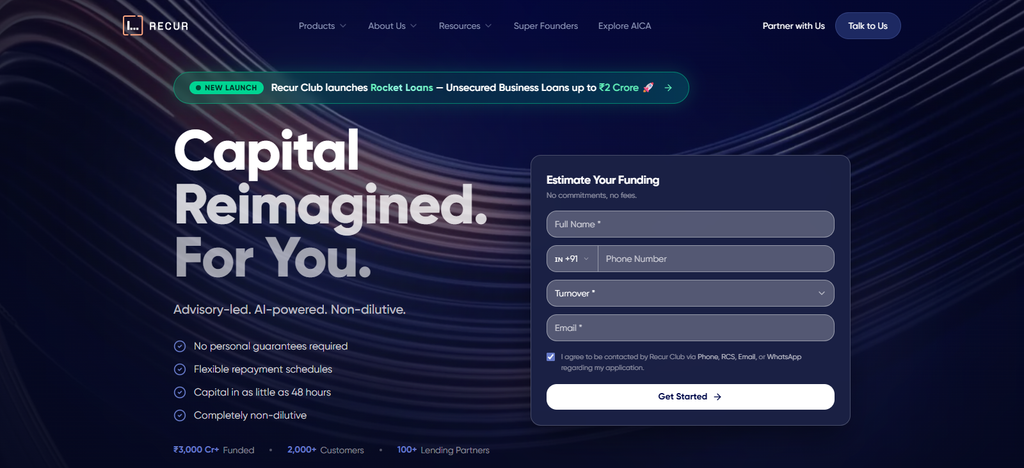
Funding is available from ₹2 crore to ₹250 crore across products and unsecured loans can be given up to ₹2 crore. Investors: Partner lenders and financial institutions. Recur Club recently raised $50 million including $8 million equity led by InfoEdge Ventures. Eligibility Usually requires revenue of ₹1 crore per year, runway of at least three months, GST filings, and predictable revenue.
Key Features
- Recurring Revenue Financing: Offers capital for businesses with consistent, repeated revenue.
- A variety of financing solutions: Provides working capital financing, recurring revenue financing, venture debt and other debt products.
- Flexibility in Funding Amounts: Its recurring revenue financing offering claims up to ₹10 crore funding.
- AI-Driven Assessment: Utilizes business financial data and AI-powered analysis to assess funding needs.
- Lender Network: Connects businesses with a network of funding partners to review appropriate capital options.
Risk Management
- Revenue Analysis: Looks at recurring revenue and performance before aligning the business for financing.
- Business Eligibility Checks: Company revenue, operating history and financial requirements review.
- Repayment Planning: Finances structured to business cash flow and repayment ability.
- Lender Due Diligence: Businesses should examine the lender’s terms, repayment requirements and cost of finance before agreeing to an offer.
4. Velocity
Velocity is an Indian revenue based financing platform serving digital businesses including e-commerce brands, restaurants, edtech companies and B2B SaaS companies. It gives you money up front either for a percentage of your future revenues or a fixed monthly repayment, and charges a fixed fee of between 5% and 8%. Depending on their performance and funding needs, businesses can raise from about ₹10 lakh to ₹10 crore.
Velocity’s investor participation is mainly through its own financing platform and capital partners rather than general public crowdfunding. A good revenue track record and minimum revenue of ₹10 lakh per month should be there. Founders can get working capital without giving up equity or pledging collateral
Main Features
- eCommerce Finance: Provides funding to online sellers and digital-first businesses.
- Revenue Based Capital: Non-dilutive financing based on your business sales and revenue milestones.
- Inventory Financing – Helps businesses buy inventory and have products in stock.
- Marketing Support: Delivers growth capital for marketing and customer acquisition.
- Business Growth Funding: Helps D2C brands and online merchants who need more working capital.
Control of Risk
- Sales Track Record: Evaluates the stability of historical sales and revenue prior to financing.
- Cash Flow Assessment: Considers business cash flow and repayment capability.
- Business Model Assessment: Reviews online sales channels and business performance to determine eligibility for financing.- Repayment Affordability: If you’re a business or investor, evaluate repayment percentages, total repayment caps, and financing costs.
5. N+1 Capital
N+1 Capital is a revenue-based growth-capital firm based out of India that invests in start-ups and established businesses without taking equity or collateral. It injects capital in exchange for a predictable future income . Repayment is through a fixed percentage of revenue per month , usually 2 % to 9 % , until the agreed upon amount is repaid .
Reports say funding can be up to 4x a company’s average monthly revenue, with advances from $134,000 to $1.5 million or more. N+1 is based on an AIF structure and has partners like LetsVenture. It even had a $100-million debut fund in the pipeline. They must have an annual revenue of more than ₹12 crore, a gross margin of 25% or more and a growth trajectory. The earlier criteria was monthly revenue of ₹50 lakh.
Features at a Glance**
- Revenue-Based Growth Capital: Provides financing to businesses in return for a percentage of future revenue.
- Flexible Repayment Structure: Monthly repayment obligations are tied to the business’s revenue performance.
- Sector-Neutral Investments: This involves businesses from various sectors that have started generating revenue.
- Growth Driven Funding: Financing revenue generating activities like marketing, inventory, hiring, and business expansion.
- Data-Driven Investment Decisions: Uses technology-driven risk scoring and financial analysis to evaluate potential investments.
Control of Risk
- Revenue Threshold Requirements: Focuses on businesses with a proven track record of operation and established annual revenue.
- Gross Margin Assessment: Evaluates investment opportunities based on the gross margins of the business.
- Existing Debt Analysis: Looks for companies that have little or no debt in place already.
- Revenue Recovery: Repayments are structured around an agreed percentage of revenue with a mutually agreed repayment cap.
6. Pipe
Pipe is a US fintech platform that allows companies to transform future sources of income into upfront working capital. Pipe’s product is set up as a merchant cash advance rather than a traditional loan. The business sells part of its future revenue for cash now, and repays a fixed percentage of ongoing sales with no monthly minimum payment.
This allows for flexibility in repayment when revenues are low. Pipe’s financing is mostly embedded in partner platforms, which enable software companies and marketplaces to provide capital to their business customers. No dilution of equity and no personal guaranties required. Eligibility is not based on a universal public funding threshold but on the business’s revenue quality, transaction history and predictability, and the partner platform.
Special Features
- Revenue Based Capital: Provides working capital solutions with financing products based on business transaction activity.
Multi-Draw Funding: Qualifying businesses can receive additional funds in multiple draws. - Embedded Financing: Allows business platforms and partners to provide capital solutions to their customers.
- Transaction Data Analysis: Leverages payment and transaction data to inform financing decisions.
- Automated Financing Infrastructure: Digital underwriting, financing operations and customer management.
Managing Risk
- Real-Time Risk Intelligence: Uses transaction data to inform real-time risk assessment.
- Payment Data Underwriting: Processes data from various payment streams.
- Compliance Monitoring: Risk and compliance infrastructure for financing partners.
- Continual Portfolio Assessment: Maintains ongoing review of financing eligibility and further funding offers.
7. Capchase,
Capchase is a U.S. based financing provider for subscription and recurring revenue businesses, with a focus on the software-as-a-service (SaaS) space. It provides non-diluted capital through Capchase Grow by providing advances based on future contracted or recurring revenue. The businesses pay back the amount in scheduled payments over a period of time ( typically 3-24 months ).
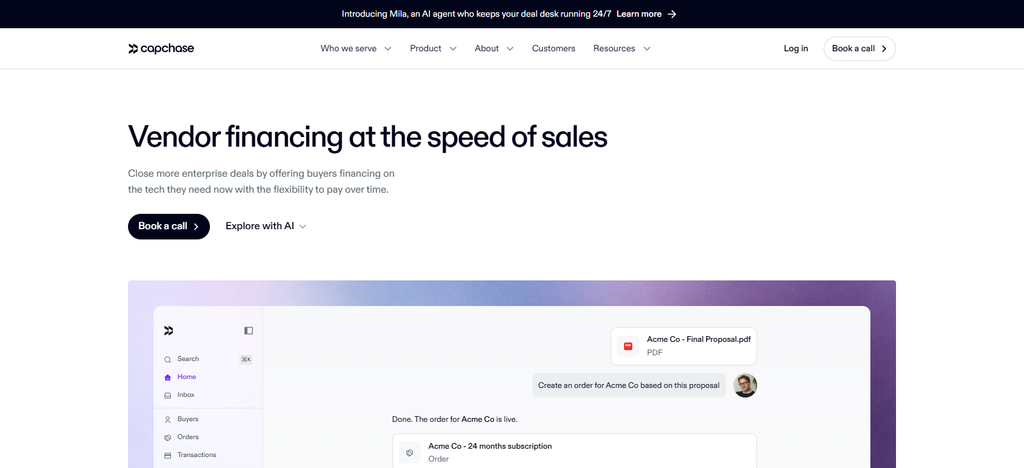
Pricing is typically a flat fee ( i.e. 10-12 % ). Funding is typically available to companies with at least $150,000 in annual recurring revenue, although the final limits depend on the quality of revenue and contract structure. Investors don’t take equity in customer companies, but instead participate in Capchase’s capital structure. This platform is for founders looking for growth capital, who want to keep ownership and avoid traditional bank-debt requirements.
Highlights
- SaaS Financing: Offers financing solutions for software companies and companies with recurring revenue.
- Review of Recurring Revenue: Leverages subscription and contracted revenue information to evaluate financing opportunities.
- Flexible Financing: Accommodates different financing structures based on business needs.
- Automated Underwriting: Uses technology and financial information to make financing decisions easier.
- Payment Management: Provides the financing infrastructure including billing, collections and payment management.
Management of Risk
- Buyer Credit Assessment: Provides an assessment of the buyer’s creditworthiness, with business and CRM data available.
- Revenue Verification considers recurring revenue and contracted payment details.
- Financing Approval Controls: Applies underwriting processes to determine financing eligibility and transaction suitability.
- Payment Tracking: Gives visibility into payment status, billing and collection activities.
8. Clearco
Clearco (formerly Clearbanc) is a global financing platform for e-commerce and SaaS businesses that need funding for inventory, advertising and growth. Its cash-advance model offers upfront capital in exchange for a percentage of future revenue. The business pays back a percentage of daily sales until the advance and a fixed fee are paid back.

Funding can be as high as ~3x monthly recurring revenue and fees are typically quoted between 6% and 12%. Clearco raises capital from institutional investors and deploys it via its financing programs.
You usually have to have a minimum of $10,000 in revenue for every month and a trading history of six months. This can be especially helpful for online sellers who sell consistently but don’t have access to traditional credit.
Main Characteristics
- E-Commerce Financing: Focuses on financing e-commerce, D2C and consumer product businesses.
- Non-Dilutive Funding: Grants capital to business without the founders giving up equity.
- Inventory Financing: Assists companies in financing their inventory purchases and paying their suppliers.
- Marketing Capital: Supports advertising spend and customer acquisition activities.
- Revolving Funding Capacity: Eligible businesses can draw down available credit lines as repayments are made.
Risk Management
- Business Performance Assessment: Rates financing and availability of capital based on business performance.
- Multi-Channel Evaluation: Takes into account sales activity across various business channels.
- Fixed pricing: Tied to business performance fixed pricing frameworks.
- Repayment Monitoring: Determines access to additional financing capacity based on repayment performance.
9. Lighter Capital
Lighter Capital is a U.S.-based lender that specializes in revenue-based loans for software, SaaS and other recurring revenue technology companies. It provides you with upfront capital that’s paid back as a percentage of monthly revenue until a repayment cap—generally 1.3x to 1.5x of the funded amount—is hit. It also provides term loans with fixed monthly payments.
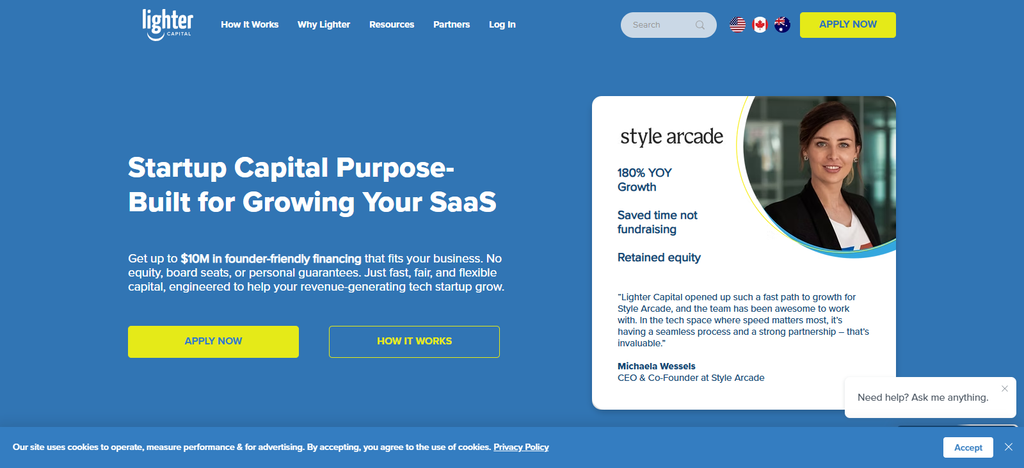
Funding can be up to $4 million per round and up to $10 million overall, depending on the revenue and growth profile of the company. Lighter Capital is backed by institutional capital and requires no equity, board seats, collateral or personal guaranties. Companies generally need to have at least $200,000 ARR or $15,000 MRR, be based in the U.S., Canada or Australia, and have a durable recurring-revenue model to qualify.
Main Features
- SaaS Startup Funding: Focused on non-dilutive funding for technology and software companies.
- Revenue-Based Repayment: A revenue-based financing option that ties repayment to a percentage of monthly revenue.
- Diverse Financing Structures: Revenue-based, term-based and contract-based financing.
- Growth Capital: Provides capital to companies to fund hiring, marketing, expansion and operational needs.
- Follow-On Financing: Offers qualifying businesses the chance to secure additional financing as their revenue increases.
Risk Management
- Recurring Revenue Analysis: Examines recurring revenue and business financial performance.
Customer Diversification: The extent to which revenues are dependent on a limited number of customers. - Financial Due Diligence: Reviews financial data related to the matter prior to granting financing approval.
- Repayment Cap Structure: The total repayment obligation is calculated using a pre-determined repayment cap.
10. Wayflyer
Wayflyer is a global financing platform that primarily works with e-commerce brands, providing capital to buy inventory, advertising, and operational growth. It offers cash advances or term loans and often the repayment is a percentage of revenue; the revenue-based repayment is meant to flex with sales performance. Funding is in the range of £10,000 to £20 million, depending on the market and performance of the business.
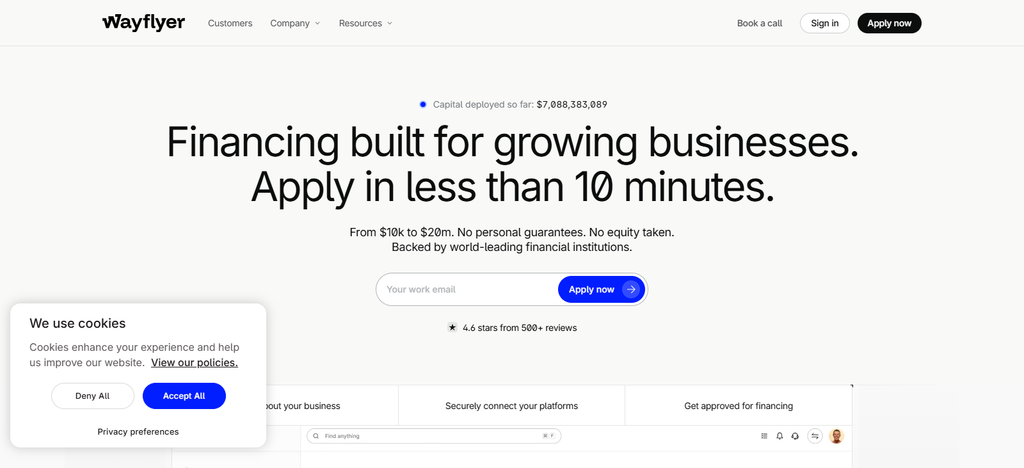
Instead of charging interest like a traditional loan, Wayflyer usually charges a one-time, fixed fee agreed upfront. It raises money from institutional investors to fund customer advances. However, you typically need at least six months of trading history and a minimum of £10,000 or $20,000 in monthly sales to qualify. Availability depends on the country and risk profile.
Key Features
- E-Commerce Growth Financing: Focuses on financing for e-commerce and direct to consumer businesses.
- Flexible Repayment: Variable and fixed repayment structures according to the financing offer, revenue-based.
- Inventory Financing: Helps fund the purchase of inventory and prepare for seasonal demand.
- Marketing Financing: Assists with advertising, acquiring new customers, and expanding the business.
- Flexible Payment Frequency: Eligible businesses can choose from daily, weekly, bi-weekly or monthly repayment schedules depending on the offer.
Risk Management
- Analysis of sales performance: Analyzes business sales to determine financing needs.
- Revenue-linked repayment: Repayments vary based on actual business revenue.
- Cash flow protection: Lower sales could lead to lower repayments under the variable repayment option.
- Business Data Verification: Employs connected sales, banking and accounting data to help finance decisions.
Conclusion
Revenue-based financing platforms provide investors with an alternative method to explore business financing opportunities and potentially earn returns through revenue sharing arrangements. Then there are platforms like Klub, GetVantage, Recur Club, Pipe, Capchase and Wayflyer that are designed to meet the business financing needs across industries.
However, before putting their money in, investors should look at the credibility of the platform, the eligibility of the investors, the repayment structures, the expected returns, the fees and the risk management practices.
It is also important to understand the revenue performance, default risks and the time you have to invest. Ultimately, choosing the right platform comes down to doing your due diligence, having realistic expectations of return, and weighing your personal financial objectives.
FAQ
What Is Revenue-Based Financing for Investors?
Revenue-based financing is an alternative funding model where investors or financing providers supply capital to businesses in exchange for an agreed percentage of future revenue until a predetermined repayment amount is reached.
How Do Investors Make Money From Revenue-Based Financing?
Investors can earn returns through revenue-sharing agreements, where businesses repay funding using a percentage of their generated revenue according to agreed contractual terms.
Are Revenue-Based Financing Platforms Safe for Investors?
These platforms carry risks, including business defaults, declining revenue, and limited liquidity. Investors should evaluate platform credibility, underwriting standards, financial transparency, and borrower performance before investing.
What Returns Can Investors Expect From Revenue-Based Financing?
Returns depend on the financing agreement, repayment cap, business revenue, fees, and investment duration. Actual returns are