
Agriculture is becoming a more important investment sector as investor interest continues to be piqued by global food demand, farmland values, sustainable farming and agribusiness opportunities. In this article I will cover the Top Agricultural Investment Companies to watch in 2026, highlighting companies that are making investments in farmland, food production, forestry, and agricultural businesses.
I will also talk about their main features, investment strategies, possible risks and what investors should look out for when choosing an agricultural investment company for long term opportunities.
Why Should Investors Consider Agricultural Investment Companies?
Rising Global Food Demand: Growing global populations mean higher demand for food production, agricultural commodities, and farming resources. This presents investment opportunities around the world in farmland, food processing, and agribusiness industries.
Portfolio Diversification: Investing in agriculture gives investors exposure to farmland, forestry, food production and natural resources, diversifying away from traditional stocks, bonds and other conventional financial market investments.

Long-Term Investment Potential: Farmland and agricultural assets can provide long-term investment opportunities through land appreciation, agricultural production, and increasing demand for essential food-related resources.
Inflation Protection Opportunities: Agricultural assets may provide some protection against inflation as farmland values, rental income, and agricultural commodity prices react to changing economic conditions.
Exposure to Agribusiness Growth: Agricultural investment companies provide exposure to companies involved in food processing, farming equipment, distribution, storage, and agricultural supply chains across a range of markets.
Opportunities for Sustainable Investment: Investors can gain exposure to sustainable farming, regenerative agriculture, forestry and responsible land management, while supporting projects that focus on environmental performance and resource efficiency.
Agricultural Technology Development: There is increasing adoption of precision farming, automation, irrigation systems and agricultural technology and opportunities to invest in businesses which improve productivity and resource management.
Access to Professional Management: Agricultural investment companies provide investors with professionally managed investment strategies, industry knowledge, asset selection and operational oversight, giving access to complex agricultural markets without direct farm management.
How to Choose the Best Agricultural Investment Company?
Assess the Investment Approach: Determine if the company is invested in farmland, agribusiness, forestry, food production, or agricultural technology. Choose an investment strategy that matches your financial objectives and risk appetite.
Review Assets Under Management. Review the company’s assets under management (AUM) to understand its investment scale, portfolio size and experience in managing agricultural assets in different markets.
Investment Portfolio Review: Review current investments, agricultural businesses, farmland holdings, and portfolio diversification to identify where the company is investing its capital and generating potential investment returns.
Historical Performance Evaluation: Evaluate available historical fund performance, investment returns, and asset valuations. Look at its performance in different market conditions and not just recent investment results.
Compare Fees and Costs: Understand management fees, performance fees, transaction costs and other fees that accompany investments.
Check Geographic Exposure: Check the countries and regions where the company is investing. Consider local agricultural conditions, land regulations, political stability, currency exposure and market opportunities.
Review Sustainability Practices: When evaluating long-term agricultural investment opportunities, review the company’s approach to water conservation, soil management, biodiversity, regenerative agriculture, and environmental responsibility.
Understand Your Liquidity and Qualification: Look at the minimum investment and liquidity constraints, investment duration, fund structure and accepted investors to see if the company fits your investment profile, investment horizon and funds.
Key Points
| Company | Headquarters | Capital Raised (2021–2025) | Key Investment Focus |
|---|---|---|---|
| Butterfly Equity | Beverly Hills, USA | $4.333 billion | Food production, food businesses, and agricultural supply chains |
| BTG Pactual | São Paulo, Brazil | $4.169 billion | Agriculture, farmland, agribusiness, and natural resources |
| Manulife Investment Management | Boston, USA | $4.110 billion | Farmland, timberland, and natural capital investments |
| JPMorgan Natural Capital | Portland, USA | $3.581 billion | Farmland, natural resources, and sustainable land investments |
| Paine Schwartz Partners | New York, USA | $3.432 billion | Food and agribusiness investments across the value chain |
| New Forests | Sydney, Australia | $3.234 billion | Forestry, timberland, and sustainable natural capital |
| DCP Capital | Beijing, China | $2.685 billion | Private equity and agriculture-related business investments |
| Stafford Capital Partners | London, UK | $2.306 billion | Agriculture, forestry, and natural capital investments |
| Vision Ridge Partners | Boulder, USA | $1.771 billion | Sustainable real assets, natural resources, and climate-focused investments |
| Tiverton | Raleigh, USA | $1.701 billion | Agricultural assets, farmland, and agribusiness investments |
1. Butterfly Capital
Butterfly Equity is a Los Angeles-based private-equity firm founded in 2016 that exclusively invests in the global food and beverage sector, which it estimates is worth around $28 trillion. It pursues a strategy of control and growth investments in category-leading companies in food production, ingredients, packaging, nutrition, restaurants and food distribution and applies operational expertise to improve performance.

It has included ePac Flexible Packaging, The Duckhorn Portfolio, Rise Baking, Chosen Foods, Pete & Gerry’s, Orgain, businesses related to Bolthouse Farms and QDOBA. The firm says it has about $9 billion in enterprise value across investments. So, Butterfly is relevant to agriculture because of its ownership in food-chain businesses, not in the farmland funds themselves.
Main Features
- Focuses on private equity investments across the food and beverage value chain.
- Invests in food production, agricultural inputs and food-related business services.
- Assists branded food and beverage companies in growing their business and improving operations.
- Offers growth capital and buyout investment opportunities in food-sector businesses.
- Addresses the whole food value chain, connecting agricultural production to consumer markets.
Major Risks
- Food businesses are affected by changing consumer preferences and this can affect their revenue and profitability.
- Operating costs can be increased by rises in prices of agricultural commodities and raw materials.
- Investments in private equity typically involve lower liquidity and longer investment holding periods.
- Concerns regarding food safety, disruptions in the supply chain and regulatory changes may affect portfolio companies.
2. BTG Pactual
BTG Pactual Timberland Investment Group (TIG) is the timberland and natural-capital investment arm of Brazilian investment bank BTG Pactual, offering fully integrated timberland investment management to institutional investors. It owns commercial forests throughout the United States and Latin America and combines land acquisitions, forest operations, timber sales, land management and increasingly carbon and conservation strategies.
As of 2025, TIG had $8.5 billion in assets under management and 3.5 million acres under management, and planted 41 million trees. The company’s portfolio is focused on sustainably managed timberland in the U.S., Brazil, Chile and Uruguay, and recent activity includes the purchase of approximately 90,000 acres of U.S. timberland from Jamestown and development of high-rated reforestation carbon projects in Brazil.
Main Features**
1.Offers institutional investment opportunities via its Timberland Investment Group.
2. Emphasis on commercial timberland, sustainable forestry and forest restoration projects.
3. Provides exposure to forestry assets in the Latin American and international market.
4. Invests in projects for reforestation and sustainable forest management.
5. Merges natural resource investments with long-term institutional asset management strategies.
Main Risks
- Forest fires, drought, pests, and extreme weather are risks to Timberland assets.
- Changes in timber prices and demand levels can impact investment valuations.
- Environmental regulations and land use restrictions can raise operating costs.
- The forestry investment is a long-term investment and may have low liquidity.
3. Manulife IM
Manulife Investment Management is a leading global natural-capital manager, with a timberland and agriculture platform that offers institutional investors diversified exposure to productive land assets. Its agricultural strategy is based on vertically integrated farmland operations across commodities and geographies and its timber business manages forests across North America, Australasia and South America.

The firm reported more than $16 billion in natural-capital assets under management, including some $4.2-4.3 billion in agriculture and almost 400,000 acres of prime farmland in the United States, Canada, Chile and Australia. Sustainability focuses include certified forests, Leading Harvest farmland standard, carbon projects, water stewardship and long-term land-productivity management.
Key Features:
- Provides institutional investment strategies focused on farmland and timberland assets.
- Manages agricultural properties in a range of international markets.
- Employs integrated property management to increase agricultural productivity and asset performance.
- Focuses on sustainable agriculture, responsible stewardship of land and investments in natural capital.
- Offers a diversified exposure to agricultural commodities, farmland and forestry assets.
KEY RISK
- Changes in climate, drought, floods and extreme temperatures can impact the productivity of agriculture.
- Changes in farmland values and commodity prices can impact the return on investment.
- Water availability and environmental regulations can be operational challenges.
- Agricultural and timberland assets may be difficult to sell quickly.
4. JPMorgan’s Natural Capital
J.P. Morgan Natural Capital, previously known as Campbell Global, is based in Portland, Oregon and is the global forestland and nature-based-assets investment manager for J.P. Morgan Asset Management. It manages timberland and other natural capital investments for pensions, foundations, family offices and other institutions with more than 40 years of operating history.
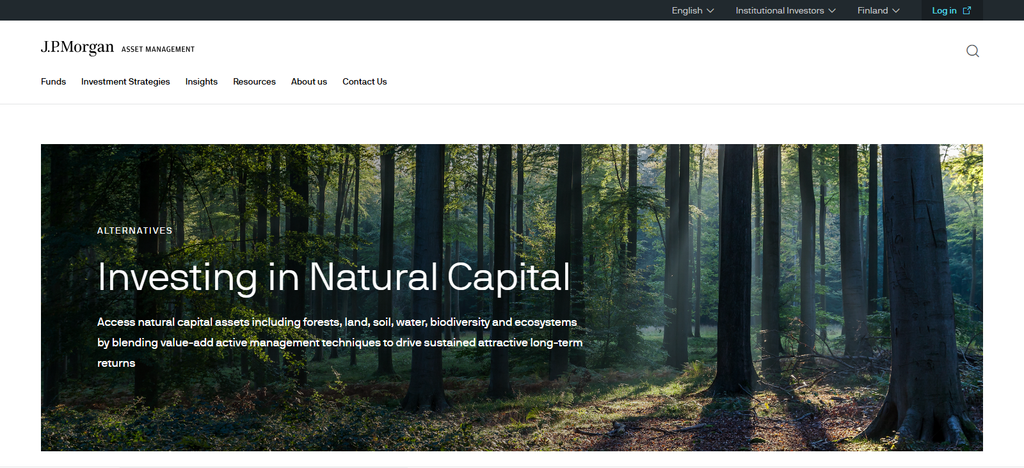
The platform oversees 1.5 million acres across three continents and $11 billion in assets under supervision. Its strategy is centered on sustainable timber production, land appreciation, conservation, carbon and nature-based solutions, with exposure to agriculture typically coming from integrated land-use and natural-capital opportunities rather than a dedicated farmland fund.
Highlights
- Focus on institutional investment in forestland and nature based assets.
- Builds on the forestry investment experience of its former platform, Campbell Global.
- Emphasizes sustainable management of timberlands and long-term forest productivity.
- Seeks opportunities in carbon assets, biodiversity and natural resource management.
- Utilizes active asset management to enhance forest health and investment value.
Major Risks
- Managed properties can be damaged by wildfires, invasive species and forest diseases.
- Harvesting revenue and asset valuations may be affected by timber market volatility.
- Changes in the carbon credit market could affect additional revenue opportunities.
- Forestry investment cycles are long and may pose challenges in liquidity and valuation.
5. Paine Schwartz Partners
Paine Schwartz Partners is a private-equity firm with over 20 years of experience and $6.5 billion of assets under management focused on sustainable food-chain investing. It invests across the food and agribusiness value chain making thesis-driven control and growth investments underpinned by operational value creation.
The two main themes are “productivity and sustainability” and “health and wellness,” focusing on crop inputs, food processing, animal health, produce, ingredients and sustainable agriculture technologies.
The firm said it invested $6.1 billion in food and agriculture, making 107 investments, including 34 platforms. Its latest Food & Agribusiness Fund VI closed at $1.7 billion, demonstrating its scale in food-system private equity.
Main Features**
- Focuses on private equity investments in the worldwide food and agribusiness sectors.
- Target sustainable food-chain and agriculture-related businesses.
- Invests in different stages of the food production and distribution ecosystem.
- Offers operational improvements and business development assistance to portfolio companies.
- Seeks opportunities for improved productivity, resource efficiency and food-system performance.
Key Risks
- Agricultural commodity price volatility may affect the profitability of companies in the portfolio.
- Food safety issues and recalls of products may affect business performance.
- Private equity investments may have long holding periods and limited liquidity.
- Consumer demand and food regulations may influence investment valuations.
6. New Forest
New Forests is a global investment manager investing in nature-based real assets such as sustainable forestry, agriculture, conservation, carbon projects, timber processing and related infrastructure. It manages around AUD 10.6 billion (USD 7.3 billion) across more than 5.2 million hectares (12.9 million acres) as of June 2026.
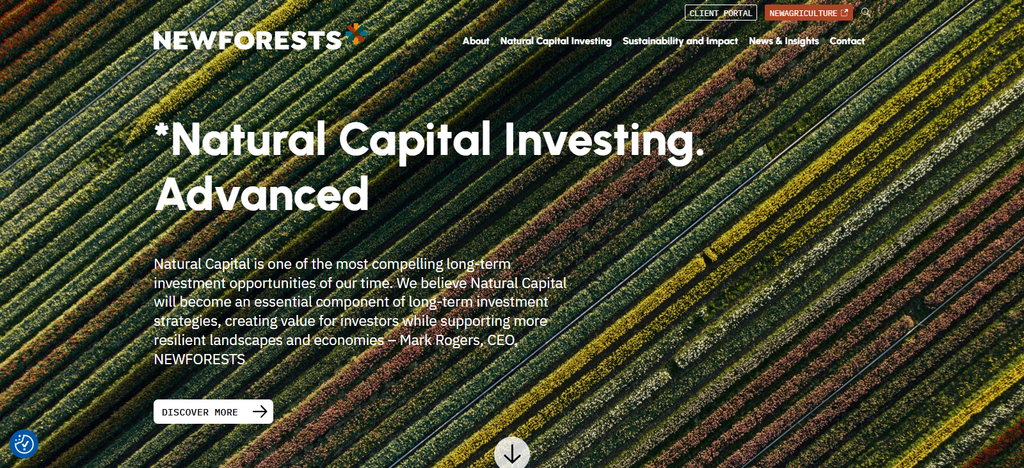
Its agriculture strategy, implemented since 2010, concentrates on row crops, horticulture, livestock and agroforestry and aims for diversification across commodities, geographies, production systems and sources of income.
The firm has a significant presence in the Asia-Pacific region, especially in Australia and New Zealand, with investments in North America. Its sustainability strategy integrates productive land use with biodiversity, certification, carbon markets and climate resilience.
Main Features
- Invests in forestry, agriculture and other real assets in nature.
- Gives institutional investors access to a diversified, land-based investment platform.
- Invests in diversified agricultural activities such as row cropping, horticulture and livestock.
- Integrates carbon markets, biodiversity and conservation within its natural capital strategies.
- Concentrates on sustainable land management, soil health and long-term asset productivity.
Major risks
- Reduced agricultural and forestry productivity from climate change and extreme weather.
- Land use restrictions and environmental regulations may affect investment operations.
- Variability in price and demand for carbon and biodiversity credits.
- Land-based investments usually require large capital and long investment horizons.
7. DCP Capital (DCP)
DCP Capital is a Beijing-based private equity firm, with a primary focus on China and cross-border investments connecting international companies to Chinese markets. It focuses on growth equity and buyout transactions, with sector interests including consumer businesses, healthcare, industrial technology, financial services, business services, and agriculture and food.
Its agriculture-related portfolio includes Mengniu Dairy, a leading Chinese dairy company; COFCO Joycome, a vertically integrated pork producer; and Sunner, a vertically integrated broiler breeding and processing business. Instead of owning farmland, DCP typically invests in companies that process and produce food on a large scale, including dairy and protein.
The firm-wide AUM is less consistently disclosed on a public verification basis, although third-party estimates put the figure at around $5.5 billion.
Features
- Functions as a private equity investment company with food and agribusiness exposure.
- Invests in agricultural production and food processing companies.
- Understands the ecosystem of food and agriculture business in China.
- It has a portfolio, which includes Sun Valley Food in poultry breeding and meat processing.
- Uses private equity investment approaches to promote business growth and operational development.
Major risks
- Changes in Chinese agricultural policy could impact portfolio company operations.
- Outbreaks of livestock diseases may interfere with poultry production and meat processing.
- Operating margins can be affected by feed costs and agricultural commodity prices.
- Liquidity, valuation and exit are uncertainties in private equity investments.
8. Stafford Capital Partners
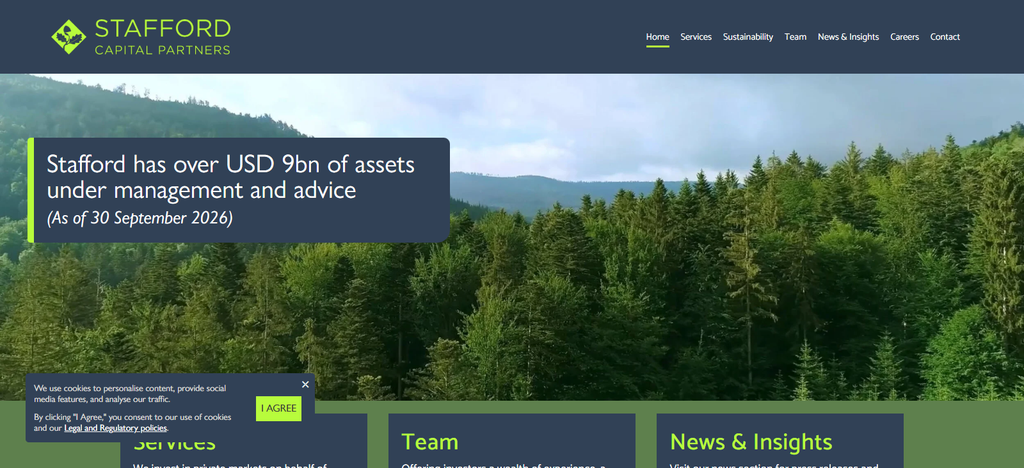
Stafford Capital Partners is an independent private markets investment and advisory firm founded in 2000, managing or advising approximately USD 8.8-9 billion on behalf of more than 150 institutional clients.
The Agriculture & Food strategy offers fund management and advisory services through primaries, secondaries and co-investments into agriculture funds, agribusinesses and food companies, investing in these companies. Stafford is seeking global diversification with a local presence in Australasia, Europe, Latin America and North America.
It combines specialist manager selection, portfolio construction and access to established agriculture operators Responsibility investment practices embed sustainability in its timberland, agriculture, infrastructure and sustainable private equity strategies.
Main Features
- Concentrate on private markets and real asset investment strategies.
- Provides institutional investors exposure to global timberland portfolios.
- Uses secondaries, primary fund commitments and co-investment opportunities.
- Invests in the Americas, Europe-related markets and the Asia-Pacific across proven forestry markets.
- Explores forestry opportunities linked to carbon through reforestation and better forest management.
Principal Risks
1. Timberland investments can be damaged by forest fires, storms and biological threats.
2. Secondary fund investments can have complex valuations and limited exit options.
3. The demand and price of timber can affect investment income.
4. The carbon credit regulations and verification requirements can affect the economics of the project.
9. Vision Ridge Partners
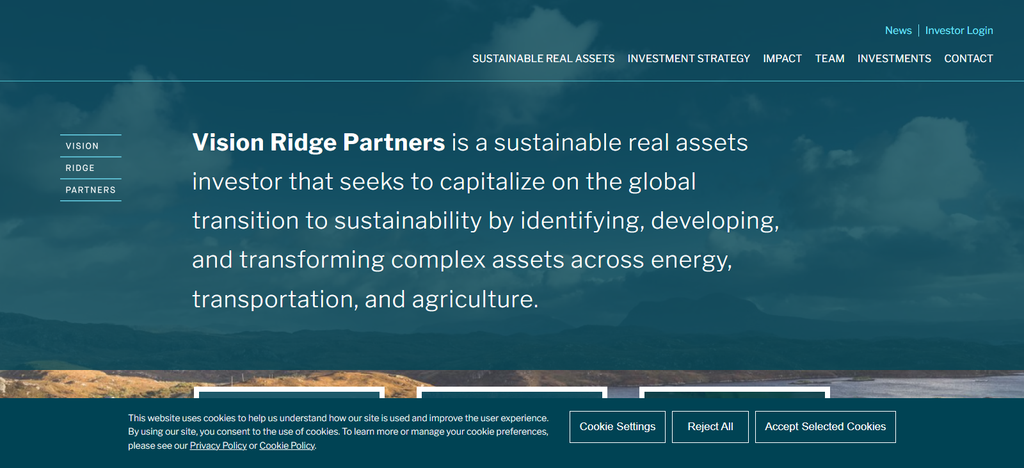
Vision Ridge Partners is a sustainability-oriented investment firm that deploys capital into real assets and businesses that support resource efficiency, clean energy, water, transportation and sustainable food systems.
Its agriculture portfolio consists of vertically integrated businesses with land, water, infrastructure and operating assets such as SunWorld in sustainable grapes, Vegpro International in leafy greens and vegetables and Yumi Dates which operates more than 4,000 acres of date ranches in the southwestern United States.
Vision Ridge’s strategy focuses on durable assets, operational improvement, water security and sustainability-linked value creation. So it’s agriculture exposure is asset-backed, operating-company oriented, not your typical open-ended farmland fund.
KEY FACTS
- Invests in sustainable real asset investments in agriculture, energy, and transportation.
- Concentrates on assets linked to the global transition to sustainability.
- Employs private market investment strategies to acquire and develop real assets.
- Recognizes opportunities to enhance asset performance through operational and strategic transformation.
- Merges environmental investment themes with long-term real asset value creation.
Principal Risks
- Climate policy and sustainability regulation changes can affect investment opportunities.
- Agricultural assets’ performance may be impacted by weather and commodity price volatility.
- Investments in infrastructure and real assets may need substantial upfront capital.
- Long investment horizons and prevailing market conditions may lead to exit and liquidity issues.
10. Tiverton
Tiverton is a private investment firm that makes direct investments in agricultural, food and natural-resource businesses, particularly in North America. Its strategy usually includes operational involvement and long-term ownership of productive assets to improve yields, processing capacity, supply-chain efficiency and market access.
Tiverton’s current assets under management, fund size and full portfolio are publicly available but not regularly updated, so investors should consult the firm’s most recent official materials for accurate numbers. What’s relevant to agricultural investment is its focus on food-system businesses and productive-asset exposure, which complements larger farmland and timberland managers.
Main Features
- Concentrates on investment opportunities in the food and agriculture value chain.
- Employs a farmer-driven investment strategy with agricultural industry experience.
- It is intended for business involved in agricultural production and food systems.
- Seeks opportunities for improvement in operational efficiency and agricultural business performance.
- Links agricultural investment strategies with long-term food production and industry development.
Significant Risks
- Weather disruptions and changing climate conditions can have an impact on agricultural operations.
- Profitability in agricultural businesses may be affected by commodity price fluctuations.
- Food production may take longer and cost more due to supply chain disruptions.
- Agricultural enterprises may encounter problems with funding, operations and market access.
Conclusion
Investors can invest in farmland, agribusiness, food production, forestry and sustainable agriculture through agricultural investment companies. Butterfly Equity, BTG Pactual, Manulife Investment Management, JPMorgan Natural Capital and Paine Schwartz Partners offer exposure to a range of agricultural investment strategies.
But investors need to look closely at each company’s investment portfolio, its assets under management, its past performance, its management fees, and its geographic exposure. Equally important is an understanding of risks like climate change, commodity price volatility, regulatory challenges and limited liquidity.
To select the right agricultural investment company, you will need to do your research, have realistic expectations and make sure that it fits your financial targets and your long term investment objectives.
FAQ
What are agricultural investment companies?
Agricultural investment companies are firms that invest in farmland, agribusiness, food production, forestry, and agricultural-related assets to generate potential returns for investors.
Which are the top agricultural investment companies to watch in 2026?
Some notable companies include Butterfly Equity, BTG Pactual, Manulife Investment Management, JPMorgan Natural Capital, Paine Schwartz Partners, New Forests, DCP Capital, Stafford Capital Partners, Vision Ridge Partners, and Tiverton.
How do agricultural investment companies make money?
They may generate returns through farmland appreciation, agricultural operations, timber production, business growth, property income, and investments in food and agribusiness companies.
Why should investors consider agricultural investments?
Agricultural investments offer exposure to food production, farmland, natural resources, agribusiness growth, portfolio diversification, and long-term demand for essential agricultural products.
What are the major risks of agricultural investments?
Major risks include climate change, droughts, floods, commodity price volatility, regulatory changes, operational challenges, limited liquidity, and fluctuations in farmland valuations.