The data center industry is experiencing rapid growth and exciting opportunities driven by artificial intelligence, cloud computing and digital technology. More and more data are being produced and managed by companies, driving the need for dependable storage, computing power, and modern infrastructure. In this article, I will share the top data center investment opportunities for 2026 including the best REITs, AI infrastructure, power management, cooling technologies and networking solutions that investors should consider.
Why Invest in Data Center Opportunities?
Increasing Need for AI: Artificial intelligence demands robust computing infrastructure, boosting the need for data center capacity, cutting-edge servers and specialized setups that enable machine learning and big data crunching.
Growth of Cloud Computing: Companies will continue to use cloud platforms for storage, software and operations, which will drive long-term demand for data centers to provide dependable computing and hosting infrastructure.
Rising Data Consumption: The expanding use of digital services, streaming platforms, online transactions, and connected devices generates large volumes of data, fueling the global need for secure storage and processing infrastructure.
Recurring Revenue Opportunities: Data center operators frequently generate recurring income from long-term leases, colocation agreements, and infrastructure contracts, presenting potential revenue stability and predictable business growth.
Expansion of Hyperscale Infrastructure: Major tech firms are still expanding hyperscale facilities to accommodate AI and cloud workloads, offering investment opportunities in data center properties and supporting infrastructure.
Long Term Market Potential: The increasing digital transformation across industries is supporting continuous demand for data storage, connectivity and computing services. Hence, data center infrastructure is an attractive long term investment sector.
Power and Cooling Innovation: Growing computing needs create opportunities in advanced cooling, energy management, backup power and electrical infrastructure that enhance data center efficiency and operational reliability.
Portfolio Diversification: Data center investments offer exposure to digital infrastructure, technology growth, and real estate markets, allowing investors to diversify their portfolios beyond conventional stocks and traditional property investments.
Risks of Investing in Data Center Infrastructure
High Capital Expenditure: Data centers need significant initial investment in land, buildings, servers, cooling systems and electrical infrastructure, placing a strain on financial resources and potentially affecting investment returns.
Increased Energy Costs: Data centers use a lot of energy to run servers and cooling systems. Higher prices for power can increase operating costs, reduce profitability and impact long-term financial performance.
Interest Rate Risks: Data center companies often rely on debt financing to fund construction and expansion. Higher interest rates increase the cost of financing, making new projects costly and reducing potential returns.
Regulatory and Environmental Issues: Environmental regulations, energy consumption limits, water usage requirements, and permitting issues can delay construction and increase compliance costs for data center operators.
Technological Obsolescence: The rapid pace of technological progress can quickly render existing servers, cooling systems, and networking equipment obsolete, necessitating continuous upgrades and further capital investment to remain competitive.
Development and construction delays: delays in land acquisition, shortage of equipment, labor constraints and delays in the connection of power supply may interfere with the development schedules, increase the project costs and delay the expected revenue generation.
Market Competition: Higher investment levels by established operators and technology companies may create pricing pressure, lower occupancy rates and challenges for smaller data center providers to compete.
Risks Related to Customer Concentration: Heavy reliance on a few large cloud providers or enterprise customers creates financial exposure. If you lose big contracts, or your customers purchase less from you, your revenues can take a big hit.
Key Points
| Investment Opportunity | Key Investment Points |
|---|---|
| Equinix (EQIX) | Offers exposure to global colocation facilities, cloud connectivity, interconnection services, and enterprise demand through its publicly traded REIT structure. |
| Digital Realty Trust (DLR) | Provides investment exposure to hyperscale data centers, colocation facilities, cloud infrastructure, and large-scale digital storage requirements. |
| Iron Mountain (IRM) | Combines information management services with expanding data center operations, offering exposure to digital infrastructure and enterprise storage demand. |
| Data Center Infrastructure ETFs | ETFs such as Global X Data Center & Digital Infrastructure ETF (DTCR) provide diversified exposure to data center operators and related infrastructure companies. |
| AI and Hyperscale Data Centers | Investing in companies developing large-scale facilities for artificial intelligence, machine learning, cloud computing, and high-performance computing infrastructure. |
| Power Management Infrastructure | Companies such as Eaton supply electrical distribution, backup power, and power management technologies required for reliable data center operations. |
| Cooling and Thermal Management Systems | Vertiv offers exposure to cooling, thermal management, and critical power technologies supporting high-density computing facilities. |
| Electrical and Energy Infrastructure | Schneider Electric provides electrical distribution, energy management, and automation solutions used in modern data centers. |
| Data Center Construction and Development | Companies such as Anant Raj offer exposure to data center development, property infrastructure, and expanding digital capacity in India. |
| Fiber Optic and Network Infrastructure | Companies such as Corning support data center connectivity through optical fiber, networking infrastructure, and high-speed communication technologies. |
1. Equinix (EQIX)
Equinix is a global interconnection and colocation REIT that runs carrier-neutral data centers that connect enterprises, cloud providers and networks. Rather than simply leasing space, its platform focuses on dense connectivity, hybrid-cloud access and edge deployments.
Equinix reported $9.2 billion in revenue in 2025, with 12% year-over-year AFFO growth from 2024. It’s aggressively expanding, with some 3 gigawatts of developable capacity and a stated plan to double capacity by 2029, supported by land purchases across major world metros.
Core Functions
- Retail colocation services for businesses that need secure data center space.
2.Interconnection services for companies, networks and cloud providers. - Direct connection to major cloud services.
- International Business Exchange (IBX) data center real estate.
- xScale data centers built for hyperscale cloud needs.
Competitive Edge
- Huge global data center footprint in key business markets.
- Strong ecosystem of interconnects between enterprises, networks, and cloud providers.
- Network neutral facilities with multiple service providers.
- Existing customer relationships and repeat demand for colocation and connectivity.
2. Digital Realty Trust Inc (DLR)
One of the world’s largest data-center REITs, Digital Realty provides services to enterprises, cloud providers and hyperscale customers on interconnected campuses. It offers colocation, interconnection and large-scale build-to-suit development.
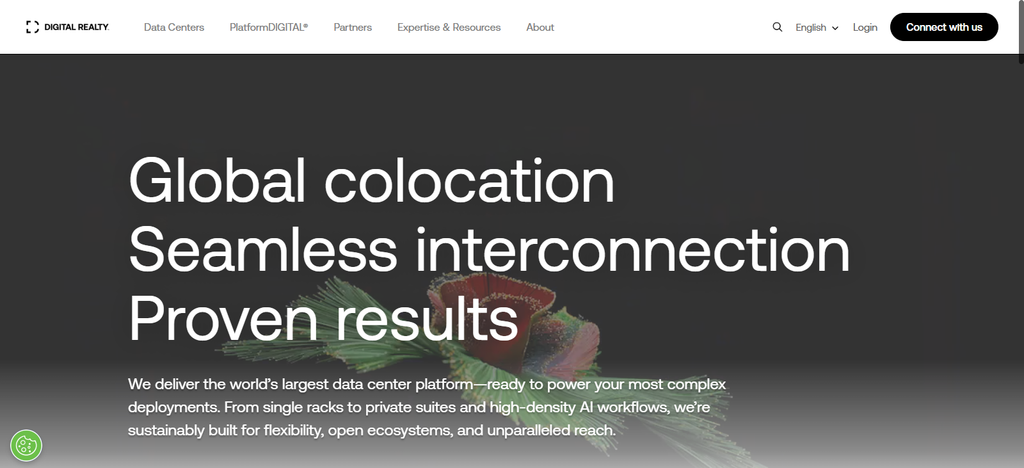
The company reported revenue of about $6.1 billion in 2025 and guided for revenue of $6.6 billion-$6.7 billion in 2026. It had a global capacity of about 769 MW, with more than 5 GW of future development capacity and over $15 billion available for hyperscale development, putting the company in a strong position for AI-driven demand.
core services
- Secure IT infrastructure with enterprise colocation services.
- Space for large scale deployments in data centers, wholesale.
- Hyperscale data centers for cloud and technology companies capacity
- Cloud connectivity and network interconnection solutions.
- Records storage and information management services
Competitive Advantage
- Proven experience in information management and secure storage.
- Growing data center portfolio serving enterprise and hyperscale customers.
- Experience with sensitive business information and infrastructure requirements.
- Information management and data center operations create a range of income streams.
3. Iron Mountain (IRM)
Iron Mountain’s Global Data Center division, a records storage and information management giant, is becoming a key growth engine for the diversified REIT. It owns and operates 31 data centers in 21 markets directly or through joint ventures.

Total revenue was $6.9 billion in 2025, up 12.2%, and data-center revenue was $416.3 million. Fourth-quarter data-center revenue rose to $236.7 million from $170 million a year earlier. The company sees revenue between $7.625 billion and $7.775 billion in 2026.
Main Services
- Investment exposure to publicly traded data center REITs.
- Access to digital infrastructure and technology firms.
- Exposure of portfolio to data center REITs and infrastructure businesses.
- Investment access to data center equipment and technology suppliers.
- Exchange-traded investment opportunities that have market-based liquidity.
Competitive Edge
- Exposure to a portfolio of data center related companies.
- Easy access to the stock market without having direct ownership in data center facilities.
- Interaction with different elements of digital infrastructure.
- Periodic Rebalancing & Professional Selection of Index-based Portfolios (depending on the ETF).
4. Data Center Infrastructure ETFs
Data-center ETFs offer diversified exposure without the need to pick individual operators. Examples include the Global X Data Center & Digital Infrastructure ETF (DTCR) with major names like Digital Realty and Equinix, and thematic funds covering servers, networking, power and cooling suppliers.

Although ETFs can reduce single company risk, they still face sector concentration, valuation, interest rate and technology cycle risk. Investors need to look at their holdings, expense ratios, liquidity, and if a fund focuses on REITs, semiconductor companies, electrical equipment or the broader AI infrastructure.
Main Services
- AI workloads high-density compute infrastructure.
- Huge cloud computing and storage facilities.
- Machine learning in GPU-accelerated computing environments
- High speed network for large data processing.
- Power and cooling infrastructure that can scale to support heavy compute operations.
Competitive Edge
- Ability to meet the growing demand for artificial intelligence computing.
- Large scale infrastructure for enterprise and hyperscale customers.
- Advanced computing environments to support demanding workloads.
- Potential to benefit from growing demand for cloud and AI infrastructure.
5. AI and Hyperscale Data Centers
Training and inference for AI require dense clusters of GPUs, rapid networking, a lot of electricity and sophisticated cooling. The cloud giants – Amazon, Microsoft, Google, Meta and others – build or rent massive facilities known as hyperscale data centers.

This trend is good for landlords with big development pipelines like Digital Realty and Equinix, and for suppliers of servers, chips, power equipment and cooling systems. The key investment consideration is that AI demand can drive rapid growth, but with capex, power availability and customer-concentration risks.
CORE SERVICES
- Power distribution systems in data centers.
- UPS (uninterrupted power supply) solutions.
- Interfacing with generators and backup power.
- Power monitoring and management technology .
- Electrical switchgear and power protection apparatus.
Competitive Edge
- Essential to ensuring smooth data center operations.
- Dedicated solutions for high-density computing power demands.
- The increasing need for reliable electricity infrastructure.
- Opportunities to serve data center expansion and modernization projects
6. Infrastructure for Managing Power
Power is becoming the main constraint on expanding data centers as AI facilities consume much more electricity than traditional sites. Utilities, developers, and hyperscalers are investing in capacity, which benefits companies that supply transformers, switchgear, generators, grid equipment, backup power, and electrical distribution.
Power management also involves grid upgrades, on-site generation, energy storage and efficient power delivery. Investors should also watch equipment backlogs, utility interconnection timelines, electricity costs and regulatory approvals. Even robust demand for data-center projects can be slowed by power access.
Essential Services
- High accuracy cooling systems for server environments.
- High density compute liquid cooling solutions.
- Air conditioners in computer rooms (CRACs).
- Thermal condition monitoring and environment control.
- Assistance in cooling infrastructure design and maintenance.
Competitive Advantage
- Technologies intended to deal with ever increasing heat load of servers;
- Increasing importance as AI workloads fuel demand for cooling.
- Energy efficiency improvements possible with advanced cooling solutions.
- Critical infrastructure that ensures the reliability of equipment and continuity of operations.
7. Thermal Control and Cooling Systems
Cooling systems draw heat away from servers and are increasingly important as AI racks get denser and more power-hungry. Liquid cooling, direct-to-chip cooling, immersion systems and advanced heat-rejection technologies are replacing traditional air cooling.

Suppliers of chillers, pumps, heat exchangers, fans, thermal interface materials and building-management software can benefit from the demand for retrofits and new builds.
The cooling efficiency also influences operating costs and sustainability; energy-efficient thermal management is a competitive advantage for data-center operators confronted with rising power prices and emissions targets.
MAIN SERVICES
- Power management and electrical distribution systems.
- Electrical equipment of medium and low voltage.
- Solutions for energy monitoring and management.
- Data center automation and controls.
- Integration of power infrastructure for large facilities.
Competitive Edge
- Proven experience in electrical infrastructure and energy management.
- Reliable data center power distribution solutions.
- Opportunities from growing electricity needs of AI infrastructure.
- Integrated technologies that incorporate power management, automation and monitoring.
8. Energy and Power Infrastructure
High-voltage transmission, substations, switchgear, transformers, cables, backup generators, batteries and renewable-power arrangements are part of the electrical infrastructure. Data centers require reliable, redundant power; AI campuses may require dedicated generation or major grid upgrades. Utilities, independent power producers, electrical equipment manufacturers and engineering firms all stand to benefit.

The investment case is underpinned by electrification and AI-driven load growth, but risks include project delays, supply-chain constraints, commodity costs, permitting challenges and the possibility that power shortages constrain data-center development in key markets.
Core Services
- Site selection and land development for data centers
- Construction of facilities and development of infrastructures.
- Installation of electrical and mechanical infrastructure.
- Data center building design and engineering.
- Expansion of facilities and modernization of infrastructure.
Competitive edge
- Capability to construct facilities in high-demand digital infrastructure markets.
- Experience in managing large construction and engineering projects.
- Meeting growing hyperscale and enterprise demands.
- Long term revenue potential through lease of developed data center facilities.
9. Data Center Building & Development
Data-center construction firms design and build the shells, electrical systems, mechanical systems and network infrastructure that support digital infrastructure. Operators are increasing capacity to meet demand from cloud and AI workloads. Equinix is aiming to double capacity by 2029 and Digital Realty has over 5 GW of future development capacity.

Construction firms are beneficiaries of large multiyear project backlogs, but they are subject to labor shortages, material-cost inflation, permitting delays and execution risk. “Investors need to look at the quality of the backlog, the margins, how concentrated the customer base is and the exposure to hyperscale development cycles.
Core Services
- Site selection and land development for data centers
- Construction of facilities and development of infrastructures.
- Installation of electrical and mechanical infrastructure.
- Data center building design and engineering.
- Expansion of facilities and modernization of infrastructure.
Competitive edge
- Capability to construct facilities in high-demand digital infrastructure markets.
- Experience in managing large construction and engineering projects.
- Meeting growing hyperscale and enterprise demands.
- Long term revenue potential through lease of developed data center facilities.
10. c
Fiber and networking are the connective tissue of cloud and AI infrastructure, carrying traffic between data centers, enterprises, cell sites and end users. The growth is driven by data-center interconnection, 5G, edge computing, private networks and AI clusters that require high-bandwidth, low-latency links.
There are opportunities in fiber owners, optical components, telecom equipment, subsea cables and network-software providers. Network companies have recurring revenue, but they face competition, pricing pressure, capital intensity, and dependence on telecom-operator spending. Data-center landlords do not.
Key Services
- manufacturing and supply of fiber optic cable.
- High speed optical interconnect solutions.
- Interconnections infrastructure for data centers.
- Communication technologies and optical networking equipment.
- Cabling and connectivity infrastructure for data transmission in networks.
Advantages
- Vital to high-speed data center communication.
- Growing need for higher bandwidth and lower latency connectivity.
- Specialized optical technologies for large-scale data transmission.
- Opportunities in cloud computing, AI networking and expansion of digital infrastructure.
Conclusion
Data center investments are drawing attention as the demand for computing and storage infrastructure grows globally with the rise of artificial intelligence, cloud computing and digital transformation. Opportunities for investors include data center REITs, infrastructure ETFs, hyperscale facilities, power management, cooling technology and fiber optic networks. These investments offer long-term growth, recurring revenues and exposure to the growth of digital infrastructure.
But capital requirements still are large, energy prices are rising, regulatory issues, technological changes and market competition remain important risks. Before you invest, evaluate financial performance, market demand, infrastructure capacity, and business stability to identify suitable opportunities and make informed investment decisions.
FAQ
What are the best data center investment opportunities in 2026?
Some major opportunities include data center REITs, infrastructure ETFs, AI and hyperscale data centers, power management systems, cooling technologies, electrical infrastructure, and fiber optic networks.
Why are data centers becoming attractive investments?
Data centers are attracting investors because of increasing demand for artificial intelligence, cloud computing, digital storage, enterprise technology, and high-performance computing infrastructure.
Are data center REITs good long-term investments?
Data center REITs can offer long-term growth potential through property ownership, colocation services, and recurring rental income. However, returns depend on valuations, occupancy, financing costs, and market conditions.
How can beginners invest in data centers?
Beginners can explore publicly traded data center REITs, infrastructure ETFs, and companies providing power, cooling, networking, and construction solutions for digital infrastructure.
Which technologies are driving data center investment growth?
Artificial intelligence, machine learning, cloud computing, liquid cooling, high-density computing, edge computing, and advanced power management are major technologies supporting industry expansion.