
The investment in carbon credits is increasingly becoming a key opportunity for investors who want to combine financial growth with environmental sustainability. Specialist firms are finding new ways to finance green projects and access carbon markets as businesses and governments try to cut carbon emissions.
However, choosing the right investment partner requires knowing its investment model, project quality, transparency and possible risks. In this article, I will go over the Top Carbon Credit Investment Companies, their key features, investment strategies, and what makes each company unique.
Benefits of Investing Through Carbon Credit Investment Companies
Carbon Market Access: These companies offer investors access to carbon markets, assisting them in identifying carbon credit opportunities without the need to source and assess individual environmental projects independently.
Expertise in Project Management: Investment companies have specialized expertise in sourcing, evaluating and managing carbon projects. This expertise alleviates the research burden and helps investors understand project performance and risks.
Diversifying your portfolio: There are different types of carbon projects to invest in — forestry, renewable energy, agriculture, carbon removal, etc. — so it’s an opportunity to diversify your portfolio with a focus on climate solutions.
Supporting climate action: When you invest through these companies, your money supports projects that reduce greenhouse gas emissions, restore ecosystems, and help create real environmental impacts in different places.
Access to Specialized Expertise: Carbon investment firms have expertise in market dynamics, project development, verification standards, and credit quality, assisting investors in making more informed decisions about potential opportunities.
Institutional Investment Opportunities: Some firms offer vinvestment opportunities for institutional investors, including carbon funds, project financing arrangements, and long-term carbon credit purchase agreements.
Environmental and Social Impact: Carbon projects selected can provide co-benefits like biodiversity conservation, sustainable farming, local job creation and improved community well-being, in addition to emission reduction results.
Possible Financial Gains: Some carbon investment strategies aim for returns from carbon credit sales, project revenues or asset appreciation, but performance is dependent on market conditions and project risks.
How to Choose the Best Carbon Credit Investment Company?
Assess Company Experience: Look for a company that has experience in carbon markets, project finance, and environmental investments. Check its past projects, investment strategy, industry experience and operating performance.
Examine Carbon Credit Quality: Verify if the company invests in projects that are certified by standards like Verra VCS, Gold Standard or other credible carbon certification systems.
Understand investment models: Before you commit to an investment, compare the structures available such as carbon credit funds, project financing, equity investments, streaming agreements and forward purchase agreements.
Review Project Diversification: Investigate companies investing in forestry, renewable energy, regenerative agriculture, biochar, and carbon removal to understand portfolio exposure and reduce dependence on specific project categories.
Compare Fees and Costs: To understand the total cost of participating in carbon investments, consider management fees, transaction fees, minimum investment thresholds, performance fees, and any other costs.
Evaluate Project Transparency: Choose companies that offer clear details about project location, carbon credit creation, verification methods, monitoring mechanisms, ownership, and environmental outcomes.
Assessing Financial Risks: Before committing to any carbon opportunity, consider the volatility of carbon prices, the risks associated with project execution, the liquidity of the investment, changes in regulations, and the possibility of credit reversals.
Think Environmental Impact: Give preference to companies that deliver measurable reductions in emissions, additionality, long-term carbon storage, biodiversity protection and positive community outcomes, through credible independent monitoring and reporting.
Key Points
| Company Name | Key Point |
|---|---|
| Carbon Growth Partners | Specializes in investing in verified carbon market assets, financing emission reduction projects, and generating financial returns alongside environmental impact. |
| Climate Asset Management | Provides institutional investment opportunities in forestry, regenerative agriculture, ecosystem restoration, and nature-based carbon credit projects. |
| Carbon Streaming Corporation | Provides upfront financing to carbon project developers in exchange for future carbon credits or royalty-based revenue. |
| Respira International | Focuses on carbon market investments, project due diligence, portfolio diversification, and long-term carbon credit supply. |
| Rubicon Carbon | Connects organizations with carbon credit projects through portfolio management, project sourcing, and carbon market solutions. |
| Just Climate | Invests in businesses and solutions targeting major climate challenges, including natural climate solutions and industrial decarbonization. |
| Cultivo | Develops and finances nature-based carbon projects, connecting institutional capital with land restoration and carbon credit opportunities. |
| Key Carbon | Supports carbon project developers through upfront capital arrangements in exchange for a share of future carbon credit production. |
| Silva Capital | Focuses on financing carbon project development through natural capital investment strategies and project-level equity. |
| Finance Earth | Structures investment opportunities for conservation, climate projects, ecosystem restoration, and nature-based solutions. |
1. Carbon Growth Partners
Carbon Growth Partners is an Australia-based investment manager focused on global carbon markets, investing in “blue-chip” carbon assets seeking to deliver financial returns as well as climate and development impact. Its investment focus includes emissions-reduction and removal projects with an emphasis on developing economies, nature restoration and energy transition.

It uses a fund and direct-project investment model to finance projects and manage diversified carbon-credit portfolios. Credits are available as avoidance and removal types, usually verified to established standards. It has worked on projects in 27 countries across five continents, with a strong focus on the developing world. Access is largely institutional, through fund-of-funds or bespoke mandates; fees are not generally published and depend on the vehicle.
Key Features
- Invests in carbon assets in global voluntary carbon markets.
- It is focused on verified carbon reduction and removal projects.
- Backs clean energy, renewable biogas and clean cooking initiatives.
- Supports projects to conserve and restore natural habitats.
- Integrates climate finance and investment strategies with carbon asset management.
Key Characteristics
- A focus on voluntary carbon markets as an investment management business.
- Combines financial returns with environmental and community impact goals.
- Invests in nature-based and tech-supported climate solutions.
- Provides climate finance to projects, especially in developing economies.
2. Climate Asset Management
Climate Asset Management is a natural capital and climate investment manager which deploys institutional capital into nature-based solutions. Its Nature Based Carbon Strategy gives companies and investors access to projects that generate high-impact carbon credits while supporting landscape restoration, conservation, biodiversity and community benefits.
The firm’s investment model focuses on large-scale nature-based carbon projects, especially in developing economies, where carbon revenue helps to fund long-term restoration and protection. Its Nature Based Carbon Fund is focused on high quality credits from restoration and conservation landscapes.
Project verification is based on recognized carbon standards and independent validation. But each standard varies by project. It is mainly institutional access through its funds. Management and performance fees are not standardized publicly.
Main Features
- Provides natural capital and nature-based carbon investment strategies.
- Invests in regenerative agriculture, sustainable forestry.
- Undertakes projects to conserve mangrove, wetland and peatland.
- Collaborates with project developers and local operating partners.
- Seeks financial returns, as well as biodiversity and climate benefits.
Unique Selling Points
- Formed as a joint venture between HSBC Asset Management and Pollination.
- Combines institutional investment management and natural capital expertise.
- Offers dedicated investment vehicles for nature-based carbon projects.
- Considers carbon, biodiversity, water, and land use outcomes.
3. Carbon Streaming Corp.
Carbon Streaming Corporation is a publicly listed carbon credit streaming and royalty company that provides upfront capital to carbon projects in return for the right to future credits. Its investment model is similar to mining streaming where it provides developers capital or shares and then buys a share of the future verified credits at terms they have agreed upon and sells them for cash flow.

It targets high-quality voluntary and compliance market projects with co-benefits to the environment, communities and biodiversity. Its portfolio has included forestry, agriculture, methane avoidance and other project types across multiple countries and crediting regimes. Credits are independently verified prior to issuance.
Retail investors get access through its listed shares while corporate buyers can purchase credits directly. Reported credit economics are around $5-$10 per credit for projects in agriculture, forestry and land-use. It has also disclosed retaining about 15% – 25% of credit revenue.
Main Features
- Provides up-front financing to developers of carbon credit projects.
- Utilizes carbon credit streaming and royalty agreements.
- Gains contractual rights to subsequent carbon credit deliveries.
- Funds projects for carbon reduction and removal.
- Purchases carbon credits and then sells them for a profit.
Major Differentiators
- It uses a streaming-based financing model instead of traditional project investment only.
- Provides upfront capital for future carbon credits from projects.
- Coordinates financing arrangements between project partners.
- Combines carbon credit purchase with ongoing delivery payments
4. Respira International
Respira International is an impact-driven carbon-finance company providing long-term, non-dilutive capital to carbon-project developers, unlike a conventional broker. It provides developers with revenue certainty through guarantyd floor prices and long-term offtake agreements before supplying buyers with high-integrity credits.

Its investment focus is primarily on nature-based solutions such as forest conservation and mangrove restoration, while also tracking and investing in technological carbon removal. Types of credits include avoided emissions and removals, with a focus on projects that deliver biodiversity and community benefits.
Projects are validated and verified to high standards, but the registry used depends on the project. Respira caters to corporate buyers and institutional investors worldwide, with a strong developing market and Global South focus. Fees and prices for credits are bespoke, based on project, vintage, volume and contract length.
Key Features
- It provides private capital to quality carbon credit projects.
- Uses long term offtake agreements for carbon credits.
- Primarily invests in nature-based climate solutions.
- Supports forest conservation, reforestation and agroforestry and blue carbon project.
- Works with project developers to obtain long-term project finance.
Key Differentiators
- Works as a carbon finance company, not a traditional carbon broker.
- Offers project developers guarantyd floor price arrangements.
- Long term financial commitments for forward purchase of carbon credits.
- Prefers projects that deliver biodiversity and community benefits in addition to carbon reduction.
5. Rubicon Carbon
Rubicon Carbon is a carbon credit management company for large enterprises looking for credible pathways to net zero. Rather than selling individual credits, it builds diversified, actively-managed portfolios of credits called Rubicon Carbon Tons (RCTs) using verified avoidance and removal credits to mitigate concentration and quality risk.
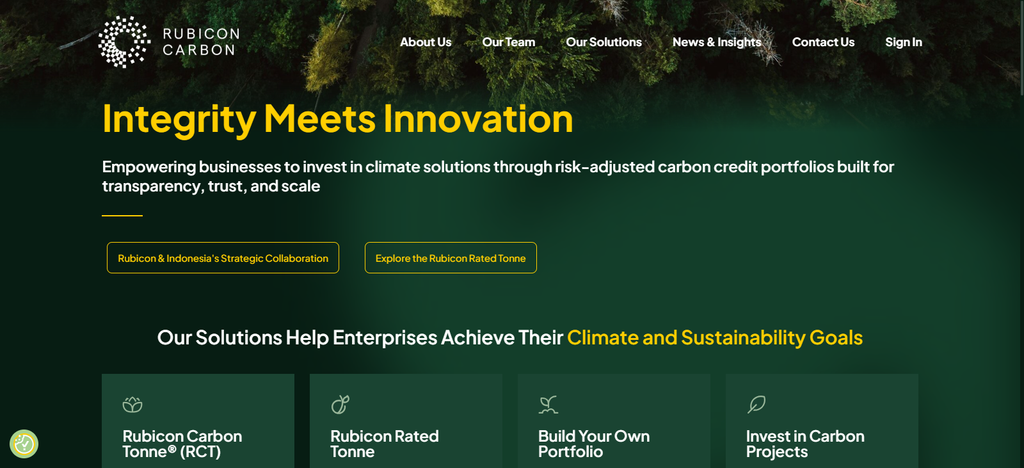
It has a vertically integrated model: it invests in projects, buys credits issued, curates portfolios, manages them over time and sells to corporate customers. Its investment focus is both on avoidance and carbon removal, with an emphasis on projects that reinforce carbon sinks.
The credits are derived from third party verified projects and the portfolio construction is built to enhance durability and optionality. Access is primarily through corporate portfolio buys Price and management fees are negotiated and not widely posted
Main Features
- Comprehensive carbon credit portfolio solutions.
- Provides curated and customized carbon credit portfolios.
- Supports carbon removal and avoidance projects
- Offers technology for carbon portfolio tracking and management.
- Performs scientific due diligence and ongoing monitoring of the project.
What makes us different
- Marries financial portfolio management with carbon science.
- Provides its Rubicon Carbon Ton portfolio solution.
- Offers risk-adjusted portfolios of carbon credits to business buyers.
- Combines project evaluation and credit retirement management with portfolio tracking.
6. Climate Just
Just Climate is a mission-driven investment business, affiliated with Generation Investment Management, that invests institutional capital in climate solutions with the potential for deep emissions reductions or removals. Its “climate-led” approach first identifies high-impact decarbonization opportunities, then invests in those solutions where they can also generate attractive risk-adjusted returns. Its strategies include Industrial Climate Solutions and Natural Climate Solutions, targeting agriculture, forestry, land use, soil, wetlands, water and waste.

Rather than just purchase carbon offsets, it invests in companies and platforms that drive systemic emissions reductions. The geographical coverage is global with early industrial investments in North America and Europe and growing activity in Latin America, including Brazil. It is available to institutional investors, mostly through closed-end funds, with private and fund-specific fees.
Main Features
- Invests in companies building high impact climate solutions.
- Delivers industrial and natural climate solutions.
- Supports low carbon technologies for hard to abate industries.
- Invests in sustainable agriculture and land use change.
- Research, due diligence and active management of portfolios.
Why We Are Different
- Created by Generation Investment Management.
- Deals with transformational emission reductions, not incremental improvements.
- Connects climate research with flexible investment structures.
- Attempts to build scalable climate solutions that could provide financial and environmental benefits.
7. Cultivo
Cultivo is a nature finance platform that invests in and develops natural assets to restore ecosystems while generating carbon and nature credits. Its investment model aggregates capital into “nature generators”—bundles of projects such as regenerative grazing, reforestation, grassland restoration, wetlands, and biochar—that create carbon credits and other ecosystem-service revenues.
Investors provide growth and project capital and corporate offtakers buy credits or long-term offtake agreements. It has a carbon focus including avoidance and removal, especially nature-based carbon dioxide removal, with projects screened against strict quality and co-benefit criteria.
Cultivo has also been involved in the tokenization of verified credits via the Carbon Opportunities Fund. It works in forests, grasslands, wetlands and other landscapes around the world. Buyers can access credits via spot purchases or multi-year contracts. Investor access and fees are usually structured via bespoke investment products.
Highlights
- Links investors to nature-based investment opportunities.
- Recognizes and evaluates promising natural resources.
- Supports projects for forest restoration and landscape regeneration.
- Offers access to nature-based carbon removal projects
- tracks project results through geospatial technology and on-the-ground verification.
Key Attributes
- Connects financial investment with natural capital restoration.
- Arranges investments through project-specific investment vehicles.
- Combines tech-driven tracking with expert project evaluation.
- It links landowners, investors and project developers through a coordinated investment model.
8. Carbon Key
Key Carbon is an investment and advisory firm focused on carbon markets, financing and developing high integrity carbon projects. Its model usually includes a combination of project development assistance, carbon-credit origination and long-term offtake agreements, giving developers a way to raise upfront capital, and buyers access to a future supply of credits.

It invests in nature-based and technology-enabled climate solutions, focusing on projects that can demonstrate measurable emissions reductions or removals and credible social or biodiversity co-benefits. The types of credits will depend on the underlying project and could include avoided deforestation, improved forest management, restoration and engineered removals.
Projects are expected to adhere to established independent verification standards with due diligence on additionality, permanence, leakage, and community impact. Geographic coverage is international, with access typically through direct institutional investment or negotiated credit offtakes; public fee disclosures are limited
Key Features
- Funds high quality carbon credit projects.
- Advances clean cooking and improved household energy programs.
- Supports projects that advance regenerative agriculture and soil enhancements.
- Supports blue carbon and carbon capture projects.
- Re-invests cash flows into further climate-positive projects.
How we’re different
- Integrates direct project development capabilities with carbon finance.
- Works through a portfolio of specialized carbon project companies.
- Links climate finance with biodiversity and community development.
- Supports range of climate solutions across project types
9. Silva Capital
Silva Capital is a natural capital investment manager with expertise in forestry, land restoration and nature-based carbon solutions. Its model usually includes acquiring, managing or financing forests and land-based assets that can generate revenues from timber, conservation, biodiversity and carbon credits over time.
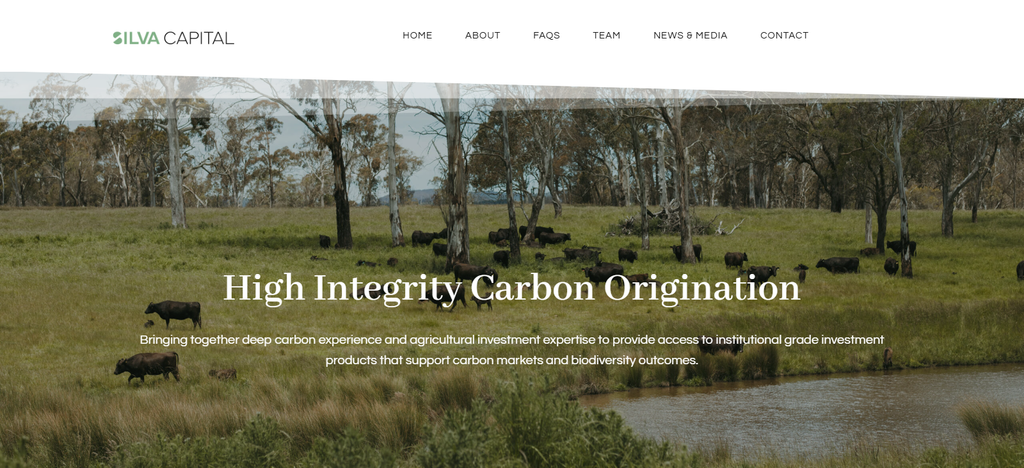
It invests in long-duration or durable natural assets like afforestation, reforestation, improved forest management and conservation projects. Carbon credits can be avoidance credits from the protection of existing forests or removal credits from tree planting and ecosystem restoration.
Typically, projects are verified to recognized carbon standards and monitor biomass, land tenure, permanence and community safeguards. “Silva’s geographic focus is global with emphasis on jurisdictions where forestry and land use opportunities are scalable. Most access is institutional, via funds or direct investments in assets. Fees are non-standardized and vary by mandate.
Highlights
- Focuses on Australian Carbon Credit Unit (ACCU) projects.\
- Integrated focus on land reforestation and agriculture.
- Offers carbon investment opportunities to corporate and institutional investors.
- Supports large-scale origination and management of carbon credit projects.
- Aligns carbon reductions with biodiversity benefits.
Key Differentiators
- Addresses only the Australian carbon credit market.
- Incorporates carbon asset management into land-based investment strategies.
- A partnership between Roc Partners and C6 Investment Management.
- Achieved project registration under Australia’s Nature Repair Market Act, linking carbon investment with biodiversity outcomes.
10. Earthly finance
Finance Earth is a specialist environmental investment and advisory firm structuring finance for nature recovery and natural capital and climate solutions. It often combines public, private and philanthropy capital to create investable vehicles for restoration, sustainable land use and environmental outcomes.
The focus is on nature-based carbon, biodiversity, water, regenerative agriculture, forestry and landscape scale restoration. It does more than trade carbon credits, it builds funds and financial structures that connect landowners and project developers with long-term capital.
Carbon credits can be generated from woodland creation, peatland restoration, habitat regeneration and other nature-based interventions, subject to verification depending on the scheme and project design.
Its coverage is especially strong in the United Kingdom and Europe, but its advisory work can be international in scope. It is primarily institutional access or through bespoke fund structures, with fees varying according to the particular vehicle and mandate.
Important Features
- Develops investment structures for environmental and conservation projects.
- Services of investment advice and financial structuring;
3.Encourages the development of carbon and biodiversity markets. - Develops blended finance and impact investment vehicles.
- Working with governments, NGOs, businesses and institutional investors.
Unique Selling Points
- Runs a mission-driven employee-owned social enterprise.
- Combines investment product management with environmental finance expertise.
- Develops customized finance solutions for nature restoration projects.
- Connects private, public and charitable capital to environmental initiatives.
Conclusion
Carbon credit investment companies are key in connecting investors with climate-focused projects and carbon market opportunities. They include Carbon Growth Partners, Climate Asset Management, Carbon Streaming Corporation, Respira International and Rubicon Carbon, which have different investment models including project finance, carbon credit portfolios and nature-based solutions.
Before choosing a company, investors should consider the quality of the carbon credits, investment structures, project transparency, fees and potential financial risks. While these investments can lead to environmental progress and financial opportunities, they do not assure returns. You should select a transparent and experienced company to make informed investment decisions.
FAQ
What are carbon credit investment companies?
Carbon credit investment companies provide financing, investment management, and carbon market opportunities through projects designed to reduce greenhouse gas emissions or remove carbon dioxide from the atmosphere.
Which are the top carbon credit investment companies in 2026?
Some notable companies include Carbon Growth Partners, Climate Asset Management, Carbon Streaming Corporation, Respira International, Rubicon Carbon, Just Climate, Cultivo, Key Carbon, Silva Capital, and Finance Earth.
How do carbon credit investment companies make money?
They may generate revenue through carbon credit sales, investment management fees, project financing arrangements, royalty agreements, and returns from climate-focused assets, depending on their business models.
Can individuals invest in carbon credit investment companies?
Some companies provide investment opportunities to eligible individual investors, while others primarily serve institutional investors, corporations, and qualified investors. Eligibility depends on the investment structure.
Are carbon credit investments profitable?
Carbon credit investments may offer financial returns through credit sales and project revenue. However, profitability is not guaranteed and depends on market prices, project performance, and investment costs.