Best Equipment Financing Investment Platforms offer investors exposure to asset-backed lending, equipment leasing and private-credit investments across a range of industries. Companies like Onward Equipment Finance, Hum Capital, Akrapoint Commercial Capital, HPS Investment Partners and Clarus Capital have different financing structures and market exposure. But each platform has different investor eligibility requirements, investment terms, liquidity conditions and potential risks. Prior to investing, look into expected returns, collateral on the equipment, quality of the borrower’s credit, fees and repayment structures. Choosing the right platform ultimately calls for thorough research, risk assessment, and alignment with your financial objectives.
Why Should Investors Consider Equipment Financing Investments?
Possible Regular Income: Investing in equipment financing can provide income from scheduled loan repayments, interest charges, and lease payments, allowing investors to receive regular cash flow over the life of the financing agreements.
Asset-Backed Financing: Many equipment financing deals are backed by physical assets, which offer potential recovery options in the event of a borrower default. But actual recovery is dependent on the value of the asset and the enforceability of the agreement.
Diversification of Portfolios. Investors can gain exposure to equipment-backed private credit, diversifying portfolios beyond traditional stocks, bonds and conventional lending products while accessing different commercial financing markets.

Business Demand Growing Companies in construction, manufacturing, health care, agriculture, and transportation all require specialized equipment, which leads to a consistent demand for financing options and possible opportunities for capital providers.
Flexible Investment Structures: Equipment financing includes loans, leases, sale-leasebacks and asset-backed credit arrangements — so eligible investors can evaluate different financing structures depending on their investment goals.
Commercial Market Exposure: Investors can get indirect exposure to commercial equipment financing markets. This provides them with the opportunity to participate in business expansion, industrial operations, infrastructure development, and equipment replacement needs.
Defined Repayment Structures: A lot of equipment finance contracts will have predetermined payment schedules, interest terms and contract lengths, so investors know what to expect in terms of payment structures and can assess the likely cash-flow profile.
Specialised Investment Opportunities Equipment financing provides access to niche private-credit opportunities in machinery, vehicles, medical devices and industrial assets. These investments may complement broader investment portfolios, if risks are carefully managed.
How to Choose the Best Equipment Financing Investment Platform?
Investment Models: Verify if the platform offers equipment loans, leasing models, sale-leasebacks, or asset-backed private credit to confirm the investment structure aligns with your financial objectives and risk tolerance.
Check Investor Eligibility: Before you invest your money, check whether the platform accepts retail investors, accredited investors or institutional investors, including minimum qualification requirements and investment limits that apply.
Compare Minimum Investments Check the minimum investments, funding requirements, transaction sizes and any additional capital commitments to assess whether the platform matches your budget and financial capacity.
Assess Expected Returns: Look at interest rates, lease income, target yields, payment schedules, and past performance that are disclosed, but remember that expected returns are not a guaranty of what you will actually earn on your investment.
Review Equipment Collateral: Before investing, review the type of equipment being financed, its valuation, ownership, collateral security, and the process for recovering the asset in the event of a borrower default to understand how your investment is protected.
Know Your Investment Risks: Before selecting an equipment financing investment platform, understand the risks involved, including the borrower’s credit quality, depreciation of the equipment, industry concentration, default risk, changes in interest rates, and recovery costs.
Check Fees & Liquidity: Analyze management fees, origination charges, servicing costs, investment holding periods, withdrawal limitations, and secondary market availability to grasp the true costs and accessibility of your investment capital.
Evaluate Platform Transparency: Assess the company’s financing background, underwriting process, portfolio reporting, legal documentation, regulatory compliance, and investor disclosures to determine its credibility and overall transparency to investors.
Key Points
| Platform / Company | Core Investment Focus | Key Investment Features |
|---|---|---|
| Onward Equipment Finance | Equipment lease portfolios | Asset-backed private credit, equipment collateral, lease income |
| Hum Capital | Private business credit | Connects capital providers with businesses seeking equipment financing and other funding |
| Akrapoint Commercial Capital | Commercial equipment financing | Vocational assets, specialty trailers, industrial equipment financing |
| HPS Investment Partners | Asset-based private credit | Equipment-backed loans, lease portfolios, diversified asset-based investments |
| Clarus Capital | Equipment finance private credit | Equipment loans, sale-leasebacks, middle-market financing |
| Wingspire Equipment Finance | Equipment finance capital markets | Equipment loan acquisitions, portfolio purchases, transaction financing |
| Ansley Park Capital | Large-ticket equipment financing | Equipment-backed loans, commercial leases, middle-market financing |
| PrivateCap | Equipment finance investment funding | Connects institutional investors with equipment finance originators |
| Stonebriar Commercial Finance | Commercial equipment finance | Asset-backed lending, equipment leases, large-ticket financing |
| Blue Owl Leasing | Equipment leasing investments | Investments in equipment leases and loans through a joint venture |
1. Onward Equipment Finance
Onward Equipment Finance is a specialty commercial equipment lender that structures financing for businesses that rely on productive equipment, including transactions that traditional banks may turn down. Its investment model is direct origination and underwriting of secured equipment loans and leases with credit decisions advertized in 24-48 hours.
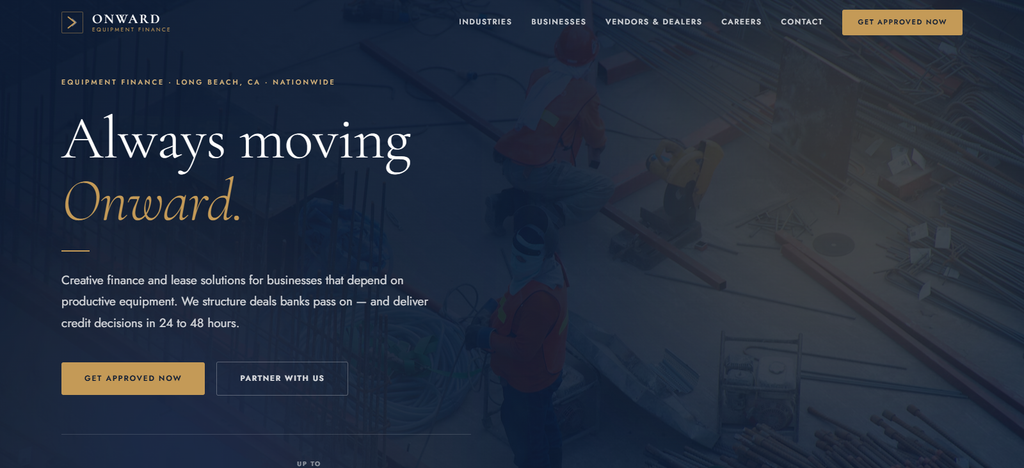
There is no published exhaustive list of equipment categories but the platform targets business critical, income producing assets in commercial sectors. Public materials do not disclose a retail minimum investment, or an expected investor return or an open investor-eligibility program.
It appears to fund borrowers directly rather than offer a public investment marketplace. Appropriate counterparties would be corporates financing equipment. Capital providers would require a direct institutional set up.
Main Features
- Provides private-credit investment opportunities backed by equipment through a range of equipment lease portfolios.
- Offers asset-based financing secured by physical equipment.
- Includes construction, manufacturing, medical, technology and food service equipment.
- Employs equipment valuations and secondary resale markets in its investment strategy.
- Private placements give accredited investors access to investment opportunities.
Principal Risks
- The investment is limited to qualified accredited investors.
- Equipment depreciation could decrease collateral recovery values.
- A default by the borrower may affect lease payments and investment income.
- Investments through private placements may be illiquid and have limited exit opportunities.
2. Human capital
Hum Capital is a financing marketplace and direct lender connecting established U.S. companies with institutional capital for growth, acquisitions, working capital, refinancing and equipment needs. Its model combines a two-sided marketplace and direct lending – companies submit financing needs and institutional investors can fund whole transactions or join alongside Hum.

Financing typically ranges from $1 million to $50 million for U.S. companies earning at least $2 million annually. One option is equipment financing, but there are also venture debt, revenue-based financing, asset-based lending and structured credit. Hum does not publicly disclose a standard investor minimum, return target or retail eligibility threshold. Performance reporting is provided to institutional capital partners on funded facilities.
Main Features
- Marketplace for funding, linking businesses with lenders and institutional capital.
- Offers direct business financing via Hum Financial.
- Supports term loans, asset based facilities, sale-leasebacks and equipment finance.
- It uses financial data analytics and AI-enabled underwriting to evaluate financing opportunities.
- Provides institutional capital providers access to business financing opportunities and loan participation.
Main Risks
- Financing availability is contingent upon borrower eligibility and underwriting approval.
- The financial situation of the borrower can impact the loan repayment performance.
- Marketplace funding is subject to lender availability.
- Terms, fees and capital availability will vary from transaction to transaction.
3. Akrapoint Business Capital
Akrapoint Commercial Capital is a newly launched mid-ticket equipment finance company backed by KKR with an initial $350 million commitment from KKR-managed Asset Based Finance funds. It offers equipment financing agreements, secured loans, TRAC leases, capital/finance leases, dollar-out leases and certain operating leases.
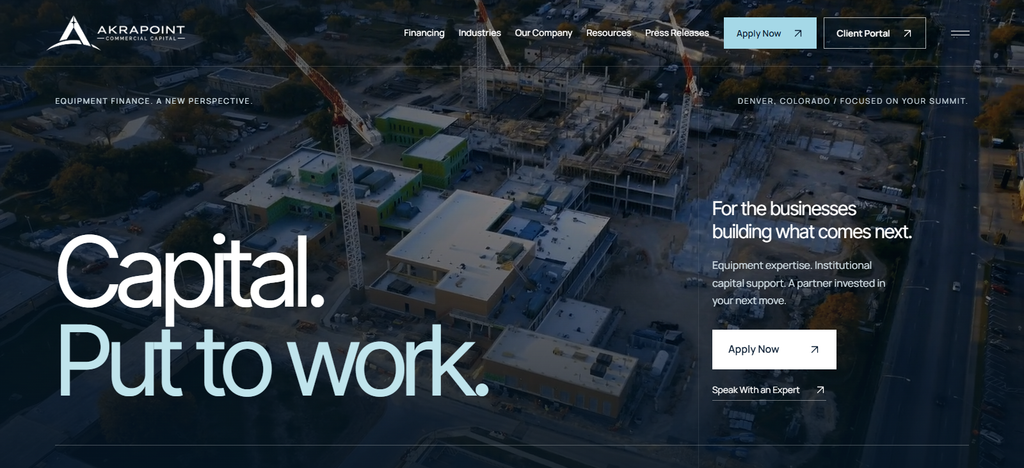
Specialty trailers, vocational assets and industrial equipment for small to mid-sized businesses in the manufacturing, energy, sanitation, construction and transportation industries are the focus.
Typical deals are $500,000–$600,000, with financing from $50,000 to large ticket deals; the stated mid-ticket range is $250,000–$5 million. It’s a lender, not a public investment platform, so retail minimums and investor returns are not disclosed.
Main Features**
- Specializes in mid-ticket commercial equipment financing for the small to middle market.
- Specialty Trailers, Vocational Assets, and Industrial Equipment.
- Serves businesses in manufacturing, construction, transportation, energy and waste services.
- Combines equipment financing expertise with the strength of KKR’s institutional capital.
- Has $350 million in capital commitment from investment funds managed by KKR to support its launch.
Main Risks
- Financing activity is concentrated on commercial equipment and associated asset classes.
- Borrower defaults can affect loan repayments and portfolio performance.
- Equipment resale values can be reduced by depreciation or changes in market demand.
- It is relatively new in terms of its launch, which means a shorter history of operating as a stand-alone company.
4. HPS Investment Partners
HPS Investment Partners is an alternative credit manager with a global presence, utilizing its Asset-Based Finance platform to invest in credit instruments collateralized by equipment, technology, transportation and fleet assets. Its investment strategy is institutional private credit: It deploys capital via funds and managed accounts to make asset-backed loans, leases and other receivables that finance small- and medium-sized businesses and investment-grade corporate borrowers.
Equipment categories include transportation, fleet, technology, and other business assets required for essential use. HPS does not offer a retail investment product to the public, does not have a fixed minimum investment or standardized expected return and is generally only available to qualified institutional buyers, pensions, insurers, endowments and other sophisticated investors, as applicable, through fund vehicles. Returns will vary depending on fund, vintage year, amount of leverage and credit portfolio.
Main Features
- Provides asset-backed private credit investment strategies connected to physical and financial assets.
- Financing of hard assets such as equipment, transportation, infrastructure and the like.
- Invests in asset-backed financing transactions that are privately negotiated.
- Leverages a broad range of sourcing channels to uncover lending and investment opportunities.
- Provides exposure to equipment leasing and real asset-backed loans through its asset-value strategy.
Risks Material
- Private credit investments may have limited liquidity in the secondary market.
- Loans that are secured with collateral can still generate losses when borrowers default.
- Equipment depreciation and valuation changes can affect collateral recovery.
- A portfolio’s performance can be impacted by interest rate changes and economic crises.
5. Clarus Capital
Clarus Capital is a specialty finance firm that provides capital to businesses with durable cash flows, recurring revenue, flexible balance sheets, liquidity and access to capital markets. It says it focuses its investment approach on financing established operating platforms rather than early-stage or speculative ventures.
Public information emphasizes its focus on cash-generative businesses, but does not clearly identify a dedicated retail equipment-finance investment product, equipment categories, minimum investment or target investor return. So its “investment model” is best understood as institutional or private credit/specialty finance, with eligibility determined through direct fund or transaction conversations.
Clarus should be treated as an equipment-finance allocation, but prospective investors should ask for updated offering documents, fund terms, asset mix, leverage and fees and net-return targets.
Main Features
- Expertise in equipment financing for middle market and large corporate borrowers.
- Offers term loans for equipment and capital and fair market value leases.
- Assists in new equipment acquisitions, business growth and sale-leaseback transactions.
- Includes sectors such as manufacturing, construction, healthcare, transportation, technology and others.
- Has the ability to undertake direct financing transactions of up to $100 million on its own balance sheet.
Principal Risks
- Financing is primarily for established businesses with good operating cash flow.
- Borrowers with non
- Investment grade ratings may carry higher credit-default risks.
- Demand for used specialized equipment may be limited.
- Large ticket finance can result in significant exposure to individual borrowers and transactions.
6. Wingspire Equipment Leasing
Wingspire Equipment Finance, backed by Blue Owl Capital, offers large-ticket equipment financing to private-equity-owned and middle-market companies in the U.S. and Canada. Its investment approach includes directly originating secured leases and loans, such as capital leases, operating leases, FMV leases, equipment finance facilities, TRAC leases, sale-leasebacks, equipment credit lines and synthetic leases.
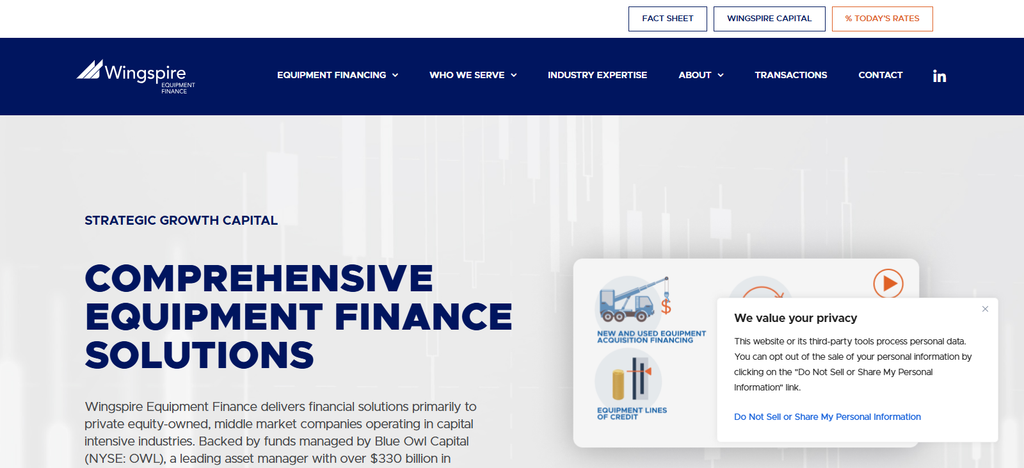
It finances new and used essential-use assets across the construction, mining, manufacturing, aerospace, transportation, technology and medical industries. Typical transaction sizes range from $5 million up to over $100 million. Borrowers generally need to have $100 million plus in revenue and $10 million EBITDA with credit profiles between CCC+ and BB-. This isn’t a public investing marketplace, so there are no minimums or disclosed returns for investors.
Main Features
- Commercial equipment financing, primarily to middle-market businesses.
- Provides equipment loans, capital leases, operating leases and equipment finance agreements.- Provides financing for new and used equipment purchases and sale-leaseback transactions.
- Finances construction, manufacturing, transportation, health care and technology assets.- Offers large financing transactions in the range of about $5 million and over $100 million.
Principal Risks
- Large-ticket financing can increase the risk of exposure to individual borrowers.
- More risk of default for businesses with bad credit.
- Depreciation of used equipment can occur and its resale value can vary.
- Complex lease and financing structures can also create additional contractual obligations.
7. Ansley Park Capital
Ansley Park Capital is an equipment finance platform backed by funds managed by Ares Management that focuses on essential use, large ticket equipment and machinery in the US and Canada. It provides tailored sponsor-financed and equipment-based solutions, typically for transactions of $10 million to $200 million or more, with long-term fixed-rate financing that matches asset useful lives.
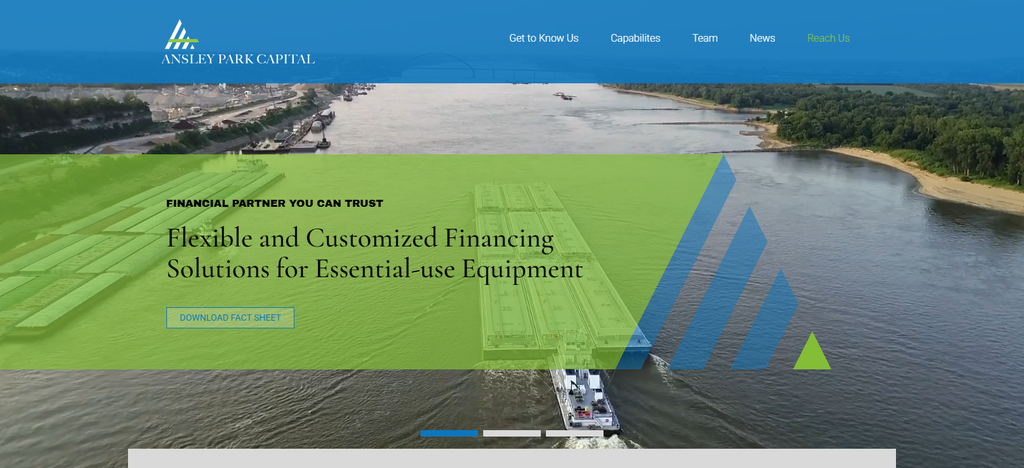
Its borrower base includes public companies, sponsor-owned businesses, founders and family-owned companies across industries. The platform originates and manages equipment credit and does not have a public retail investment portal so there is no standard minimum investment or published investor return. Depending on the fund eligibility rules, institutional investors may also have indirect exposure through funds managed by Ares or through structured credit investments.
Main Features
- Specializes in financing large equipment purchases for business and corporate borrowers.
- Provides equipment loans, sale-leaseback transactions and finance leases.
- Manufacturing, construction, marine vessels, transportation, mining and industrial equipments.
- Structures custom financing solutions for new and existing equipment.
- Backed by capital managed by Ares Management. Transaction sizes supported from $10 million to $200 million.
Main risks
- Financing of large-ticket items can result in high borrower concentration.
- Equipment collateral may be subject to depreciation and market fluctuations.
- Scheduled repayments may be influenced by borrower financial distress.
- Specialized assets like vessels and industrial equipment may take longer to resell.
8. Private Capita.
PrivateCap is a funding platform that connects equipment-finance originators with institutional investors, with a focus on small and mid-market leases and loans. It buys pools or portfolios of business-critical equipment with individual exposures of $1 million or less in a fund structure that provides originators with access to private capital without the protracted process that typically accompanies asset-backed securities.
It has a flexible investment policy that can consider different essential-use assets and risk/return structures within sectors. It is aimed at institutional investors – for example pension funds and insurers – and equipment-finance originators, rather than individual retail investors. Publicly available materials do not disclose a standard investor minimum or target return; terms are unique to each transaction and fund.
Main Feature
- Targeting portfolios of business critical equipment finance assets.
- Applies to individual equipment financing exposures of $1 million or less.
- Works with equipment finance originators looking for capital and portfolio liquidity.
- Assists originators in controlling credit exposure on portfolio purchase transactions.
- Has merged industry experience in equipment finance credit assessment and operations.
Main Risks
- Performance of the portfolio depends on the repayment quality of the underlying borrowers.
- Smaller equipment loans may have more servicing and administrative requirements.
- Resale values for equipment can decline in times of economic recessions
- In the case of portfolio acquisitions, credit concentration and asset valuation risks may arise.
9. Stonebriar Commercial Finance
Stonebriar Commercial Finance is a diversified commercial lender and lessor that provides financing secured by essential, income-producing assets. Its investment strategy focuses on making secured loans and leases, which it also finances through multiple equipment asset-backed securitizations, with its 2026 deal being its 15th equipment ABS sponsorship.

Equipment and asset classes include: marine, mining, real estate, energy, manufacturing, rail, aviation and titled motor vehicles. Stonebriar does not have a universal minimum investment or expected investor return.
They provide commercial loans and do not have a retail investment product available to the general public. The one disclosed portfolio metric was a weighted average internal rate of return of 9.65% for the referenced ABS collateral pool, although that is not a guarantyd investor return.
Key Features
- Deals with commercial finance for companies that need heavy machinery.
- Provides structured financing solutions to large corporate and middle-market borrowers.
- Supports equipment backed lending and commercial asset based financing.
- Could be a useful source of funding to businesses that require bespoke financing options beyond the traditional bank lending model.
- offers exposure to commercial finance opportunities via its institutional financing structure.
Major Risks
- Commercial borrowers can have cash-flow issues that impact their ability to repay.
- Collateral for equipment could depreciate faster than anticipated.
- Default recovery can be difficult to sell specialized assets.
- Large commercial financing transactions can create borrower and industry concentration risk.
10. Blue Owl Leasing
Blue Owl Leasing is the equipment-leasing and asset-finance platform of Blue Owl Capital, delivering institutional capital for mission-critical equipment across a variety of industries. The model is to originate, hold and manage leases and equipment-backed credit, often for middle-market and private-equity-backed companies; Blue Owl is publicly identified as backing Wingspire Equipment Finance.
Types of equipment include manufacturing machinery, aerospace assets, transportation fleets, medical equipment, technology and heavy equipment. Blue Owl’s investment products are typically institutional private-credit, private-equity or real-assets vehicles and not a public equipment-finance marketplace so there is no standard retail minimum or published return target. Investor eligibility is typically determined by the offering documents of the specific Blue Owl fund and the relevant accredited/institutional investor requirements.
Main Features
- Focused primarily on secured, fixed rate equipment leasing and lending.
- Is structured as a joint venture between Blue Owl-affiliated investment vehicles and institutional investors.
- Offers exposure to equipment-backed credit investments.
- Has a formal investment structure with participating institutional members.
- Unanimous consent of its joint-venture members is needed for investment decisions.
Key Risks
- Investment exposure is primarily equipment leases and related loans.
- Defaults by borrowers may affect interest income and recovery of principal.
- Depreciation of equipment may reduce the value of the underlying collateral.
- Private investment structures may have limited liquidity and complex governance arrangements.
Conclusion
Equipment financing investment platforms offer investors exposure to asset-backed lending, equipment leasing and private-credit investments across a range of industries. Companies like Onward Equipment Finance, Hum Capital, Akrapoint Commercial Capital, HPS Investment Partners and Clarus Capital have different financing structures and market exposure.
But each platform has different investor eligibility requirements, investment terms, liquidity conditions and potential risks. Prior to investing, look into expected returns, collateral on the equipment, quality of the borrower’s credit, fees and repayment structures. Choosing the right platform ultimately calls for thorough research, risk assessment, and alignment with your financial objectives.
FAQ
What Are Equipment Financing Investment Platforms?
Equipment financing investment platforms connect businesses seeking equipment funding with lenders, private-credit providers, or investors. They support financing through equipment loans, leasing arrangements, and asset-backed credit structures.
How Do Equipment Financing Investments Work?
These investments generally involve providing capital for businesses to purchase or lease equipment. Investors or financing providers may earn income through scheduled interest payments, lease payments, or financing returns.
Can Individual Investors Invest in Equipment Financing Platforms?
Some platforms offer opportunities to accredited individual investors, while others primarily serve institutional investors, lenders, and commercial borrowers. Eligibility depends on the platform’s investment structure.
What Types of Equipment Can Be Financed?
Common equipment categories include construction machinery, agricultural equipment, manufacturing systems, medical devices, commercial vehicles, transportation assets, and industrial machinery.
How Do Investors Earn Money From Equipment Financing?
Investors may earn money through interest payments on equipment loans, lease income, or returns from asset-backed private-credit investments, depending on the specific financing arrangement.