Patents, copyrights, trademarks and music royalties are creating new avenues for potential income and intellectual property is becoming an interesting alternative investment. In this article, I am going to discuss the Top Intellectual Property Investment Platforms that help investors explore royalty-based opportunities, acquire valuable IP assets and participate in the technology commercialization.
I will also cover their key attributes, investment structures, risks and key selection considerations to help readers identify the platforms that suit their investment objectives.
Why Should Investors Consider Intellectual Property Investments?
Potential Royalty Income Investments in intellectual property can produce recurring income streams from music streaming, copyright licensing, patent agreements, and other commercial arrangements, depending on asset performance and contractual provisions.
Portfolio Diversification: IP investments offer investors exposure to alternative assets outside of traditional stocks, bonds, and real estate, potentially allowing investors to diversify their portfolios across different industries and sources of income.

Fractional Investment Opportunities: Platforms could provide investors with the ability to buy fractional interests in music catalogs and royalty rights, enabling them to access selected opportunities without needing to buy entire intellectual property assets.
Potential to Earn Money over Time: Existing patents, copyrights and music catalogs have the potential to continue generating revenue over long periods of time, provided the intellectual property rights are valid and there is still demand for the product.
Exposure to Innovation Investing in patent-related opportunities can offer exposure to new technologies, innovative products and commercially valuable inventions across a range of sectors, including healthcare, software and manufacturing.
Different Classes of Investment Investors can invest in different types of intellectual property, including music royalties, patents, trademarks, copyrights and technology licensing, with intellectual property. This gives more flexibility in terms of evaluating other investment options.
Commercialization Opportunities: Intellectual property assets can be a source of value through licensing, strategic alliances, acquisitions and commercial agreements, providing investors with exposure to businesses looking to monetize protected innovations.
Intellectual Property Ownership: Some investment structures offer investors access to royalty interests or intellectual property rights, providing access to asset-backed investment opportunities outside conventional financial markets.
How to Choose the Best Intellectual Property Investment Platform?
IP Types: Choose platforms that offer the types of IP that you are interested in such as patents, copyrights, trademarks, music royalties, or technology rights that match your investment goals and capital.
Assess Investment Needs: Check the minimum investment, eligibility, funding expectations and investment arrangements to confirm that the platform aligns with your financial capacity and level of involvement.
Review Fees and Pricing: Compare transaction fees, management fees, administrative costs and other expenses that can eat into potential returns or increase the overall cost of the investment.
Confirm Legal Ownership: Check intellectual property ownership records, licensing agreements, copyright documentation, patent registrations and contractual rights before investing in any investment opportunity.
Research Revenue Potential: Investigate past royalty distributions, licensing income, commercial demand, asset performance, etc. to assess potential sources of revenue without assuming guarantyd future returns.
Assess Platform Transparency: Select platforms offering clear asset descriptions, financial disclosures, valuation data, transaction details, and readily available documentation to enable informed investment decisions.
Examine Liquidity and Exit Opportunities: Assess the feasibility of selling, transferring or redeeming investments and consider the availability, restrictions and possible obstacles of exiting positions in secondary markets.
Know the Dangers of Investing: Before you choose a platform for long-term investment, consider market volatility, intellectual property disputes, changing consumer demand, technology obsolescence and regulatory requirements.
Key Points
| Platform | Main IP Asset Category | Key Investment or Transaction Focus | Best Suited For |
|---|---|---|---|
| Royalty Exchange | Music copyrights, trademarks, royalties | Buying and selling royalty-producing intellectual property assets | Royalty investors and rights buyers |
| ANote Music | Music copyrights and royalty rights | Buying fractional shares in music catalogues and receiving royalty distributions | Individual music royalty investors |
| SongVest | Music publishing and recording royalties | Acquiring fractional royalty interests and entire music catalogues | Music rights investors |
| Musicow | Music copyrights and royalty rights | Fractional music royalty investment through an auction-based marketplace | Music royalty investors |
| Jukebox | Music intellectual property | Music rights investment and royalty-based opportunities | Music IP investors |
| IAM Market | Patents and technology IP | Discovering, acquiring, and licensing intellectual property assets | Patent buyers and technology businesses |
| Ocean Tomo | Patents and technology portfolios | Intellectual property auctions, brokerage, and asset transactions | Institutional IP investors and businesses |
| Tynax | Patents and technology innovations | Patent brokerage, acquisition, sales, and licensing transactions | Patent owners and corporate buyers |
| Yet2 | Patents and technological innovations | Connecting technology owners with potential buyers and licensing partners | Technology investors and companies |
| PatentAuction.com | Patented inventions and technologies | Online marketplace for buying and selling patent-protected innovations | Inventors and patent purchasers |
1. Swap of Royalty
Royalty Exchange is a U.S.-based online marketplace that allows investors to bid on future royalty revenue from music catalogs, songwriter shares, producer royalties and related entertainment assets. At its heart, it acquires existing royalty streams at auction, not fractional shares of individual songs. Buyers must undergo platform verification.
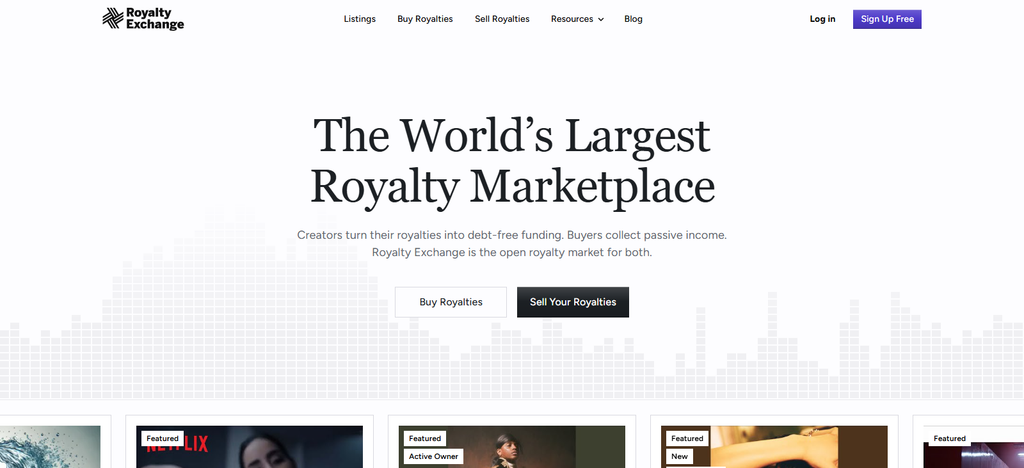
The company says it verifies ownership of the asset with the seller and the relevant royalty-paying organization before listing. Pricing is typically quoted as a multiple of trailing annual royalty income; reported market activity has varied roughly from 2.9x to 8.7x with a median around 6.7x. Minimum is not formally stated but practical purchases require substantial capital, roughly $25,000 or more.
Royalty Exchange charges buyers a 1% fee, with a $500 minimum, and buyers can pay for premium services. Expected returns are purely a function of catalog performance. The platform’s marketplace is best suited for accredited or high net worth investors looking for bigger, less liquid royalty positions.
Main Features
- Offers an auction-based marketplace for buying and selling existing royalty streams.
- Supports music royalty interests including publishing, master recording and other royalty interests.
- Allows buyers to bid on individual royalty-producing assets and catalogs.
- Furnishes historical earnings data for buyers to assess the performance of royalties.
- Allows for transactions with full or partial royalty interests, depending on the listing.
Principal risks
- If streaming, licensing, or audience demand drops, so can royalty income.
- Buyers may be focused on a single artist or catalog.
- Winning an auction does not guaranty any future royalty payments or returns on investment.
- It can take time to resell royalty interests and is subject to the availability of buyers.
2. ANote Music
ANote Music is a European music royalty investment platform where investors can purchase shares in music catalogs and receive a proportional share of the royalties generated from these catalogs. The asset types included are catalog-level royalty interests on recording, publishing and related music-rights income.

Historical royalty data are provided for each catalog, and return calculations are based on IRR. The minimum investment is the lowest price of one share in an auction or the platform’s secondary market, which makes it relatively easy for investors to begin the process. ANote charges a 4% royalty on shares bought at auction and 8% on shares bought on the secondary market. Rightsholders may also incur listing-related expenses.
The company is reporting a 10.62% annualized royalty return for its Royalty Index from August 2020 through October 2026. Past performance is not indicative of future results. Protection is provided by contract royalty-share arrangements, not by direct ownership of the copyrights. Investors should carefully review the offering documents, liquidity restrictions and eligibility rules, which vary by jurisdiction.
Features
- It offers fractional investment opportunities in music catalogs and royalty interests.
- Enables investors to buy and sell cataloged shares on its marketplace.
- Provides historical royalty information and catalog performance analytics.
- Allows use of different music rights and royalty generating catalogs.
- Provides a market function for investors who wish to purchase or resell the shares.
Key Risks
- Royalty payments vary depending on music consumption and catalog performance.
- Demand for selling catalog shares in the marketplace may be limited.
- Investors using different currencies may be impacted by currency fluctuations on their returns.
- Past performance of royalty companies does not guaranty future income or investment growth.
3. SongVest
SongVest is a US based music royalty investment platform that offers fractional ownership interests in music royalty income through its product SongShares. Investors can gain access to publishing, master recording, producer and other royalty streams ranging from single royalty interests to full catalog acquisitions.
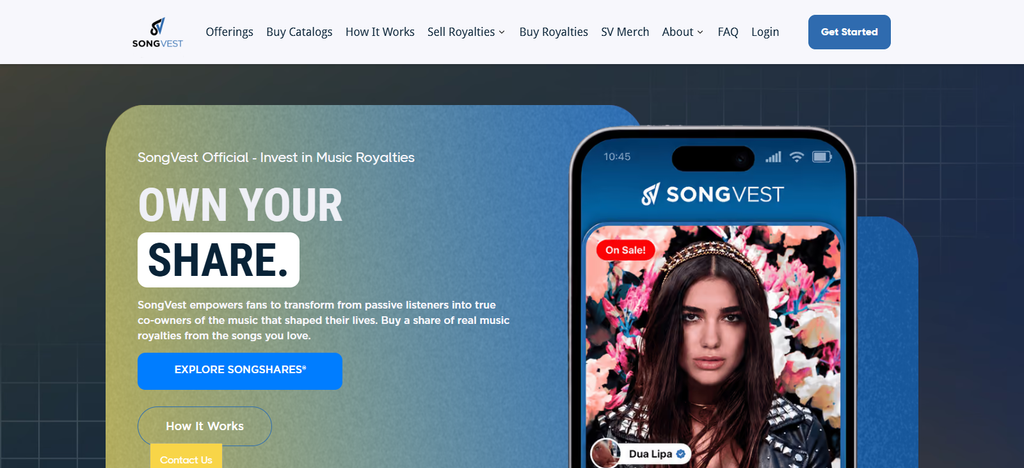
Each SongShare is a contractual right to a proportional share of cash flow generated from a defined Royalty Share Agreement, net of applicable administrative fees. Investors do not necessarily own the underlying songs outright. The minimum investments are kept quite low, with fractional shares usually available for a few hundred dollars. SongVest can be expensive, as fees are embedded in the offerings, and estimates of the costs range from 17% to 49%.
Returns are based on streaming, sync, performance and mechanical royalty performance. The platform offers historical royalty information for each offering. SongVest has utilized Reg A+ offerings, which can increase the number of eligible retail investors. However, investors should review offering circulars, risks, valuation methods, and the absence of an established secondary market before investing.
Main Features
- Sells SongShares as fractional ownership interests in future music royalty income
- Allows investment opportunities for individual songs and music catalogs.
- Provides historical royalty data for investors to gage what’s on offer.
- Provides royalty opportunities through structured investment offerings.
- Gives investors access to music royalty investments without the need to buy entire catalogs.
Major Risks
- Royalty income can fluctuate depending on streaming and licensing success.
- Fractional investment interests do not imply ownership of underlying copyrights.
- It is difficult to exit an investment due to limited opportunities for resale.
- Issuance expenses, administrative fees and acquisition costs can erode returns to investors.
4. Musicow
South Korean online marketplace Musicow focuses mainly on K-pop and domestic music assets and allows investors to buy shares linked to future music royalties. The company was founded in 2017 and allows investors to share in the income generated by streaming, broadcasting and performance revenues, with payouts distributed in proportion to an investor’s holdings.

Its asset type is mostly royalty-linked economic interests in songs, as opposed to outright ownership of full copyrights. Investors receive royalty-related payments associated with structured music assets. Minimum investment amounts are relatively low as investors can buy fractional shares in individual songs, though minimums vary by listing. Pricing is typically market based and influenced by a song’s historical royalty income, popularity and expected future cash flows.
Musicow’s U.S. offering documents say investors can be accredited investors or non-accredited investors whose purchase doesn’t exceed 10% of the greater of annual income or net worth. Legal protection is contractual and the company discloses that Royalty Shares are not protected as interests in a registered investment company. Returns are uncertain and depend largely on continued royalty generation.
Highlights
- Provides fractional investment opportunities tied to music royalty rights.
- Allows investors to take part in the royalty income from selected songs.
- Supplies music asset information to assist users in evaluating investment opportunities.
- Links music rights owners with investors seeking royalty-generating assets.
- It is focused on fractional investment structures to monetize music intellectual property.
Risk Factors
- Income in music royalties may change with the streaming and popularity of audience.
- Investment products may be affected in terms of structure and availability by regulatory requirements.
- Trading may not be available, making it difficult to sell investment interests.
- Music consumption trends can negatively impact catalog valuations.
5. Jukebox
Jukebox, formerly JKBX, is a U.S. platform that turns music royalty income into investable securities. It provides fractional “Royalty Shares” that are tied to royalties on songs, recordings and related music-rights income streams, giving investors exposure to income from streaming, licensing, performance and other royalty sources.
It’s also a more affordable alternative to auction-style royalty marketplaces, with the platform’s stated entry point being $500. Jukebox says investors don’t pay a dealer-manager or similar service fee when they buy but may pay payment-processing costs, which are disclosed before payment, and its offering documents also refer to a 1% royalty fee on certain gross income interests.
There are no guaranties of expected returns, which are subject to royalty collections, catalog longevity and changes in the streaming economics. Asset valuations are based on historical royalty income, remaining term and projected cash flows but investors are expressly told not to rely solely on estimates from the platform.
Eligibility is determined by a “qualified purchaser” standard: accredited investors can invest; non-accredited investors are generally restricted to investments of no more than 10% of the greater of income or net worth. The investments may have to be held forever . Legal protection is provided by formal securities offering documents .
Key Features
- Investment opportunities tied to music royalty interests.
- It offers exposure to royalty-generating songs and music catalogs.
- Utilizes fractional investment structures for certain music royalty offerings.
- Enables investors to look for offerings connected to established musical works.
- Links the monetization of music rights to investment opportunities for qualified participants.
Key Risks
1.Royalty distributions are dependent on the commercial success of the underlying music assets.
2. Changes in the way that streaming services and licensing agreements work can impact royalty income.
3. Fractional interests may not give direct ownership of a music copyright.
4. Limited secondary market activity can restrict investors’ ability to exit positions.
6. IAM Marketplace
IAM Market, the intellectual property and technology listing service within the IAM media ecosystem. It connects IP owners with potential buyers, licensees and technology transfer partners, enabling owners to promote patents, technologies, brands and licensing or sale opportunities. Its asset types include patents, technology rights, licensing opportunities and IP portfolios across industries, and users can search listings by industry, technology and transaction type.
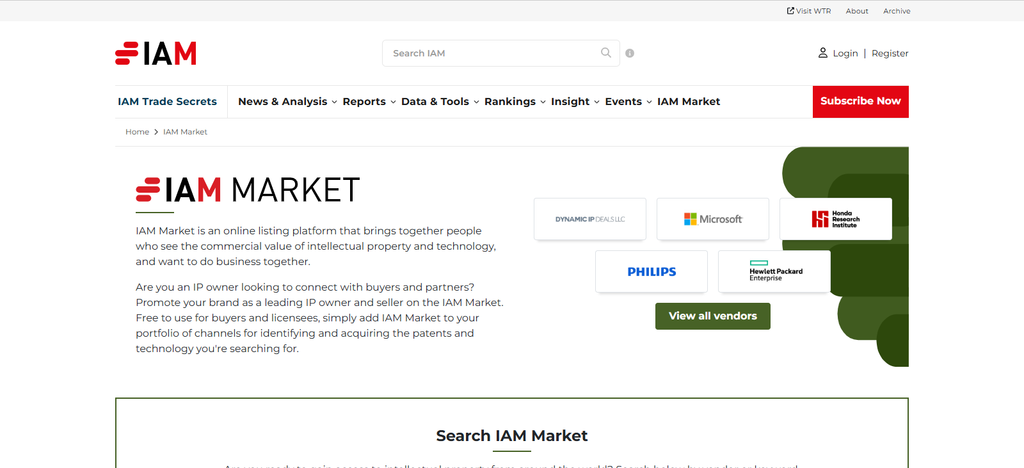
Unlike music-royalty platforms, IAM Market is a business-to-business IP transaction venue, rather than a retail investment marketplace. There is no minimum investment standard, as transactions are negotiated between buyers and sellers individually, and buyers and licensees can use the search and listing functions at no cost. License, Sale or Transfer Agreement Pricing and fees will vary depending on the license. 3.
IP owners may pay for enhanced promotion or listing services. We expect to receive returns from licensing, asset sales or strategic technology partnerships rather than royalty distributions on a standard basis. Legal protection is no stronger than the underlying patent, trademark, copyright or contractual rights, and buyers are expected to do their own IP due diligence.
Main Features
- Offers a marketplace for identifying and assessing intellectual property assets.
- It specializes in patents and intellectual property relating to technology.
- Links patent holders with potential buyers, licensees and business partners.
- Supports IP commercialization via licensing and acquisition opportunities.
- It helps companies identify technology assets for strategic alliances and transactions.
Significant Risks
- Valuing patents can be a challenge due to varying commercial potential.
- Ownership of patents and their legal enforceability must be independently and carefully verified.
- Licensing opportunities may not provide expected commercial revenue.
- The costs of acquisition and ownership can be increased by patent disputes and infringement claims.
7. Ocean Tomo
Ocean Tomo is an intellectual property advisory and auction firm that helps organizations monetize, value and transact IP assets. Its auctions include patents, patent portfolios, trademarks, copyrights and other intangible assets, and it aims to connect sellers with corporate buyers, investors and licensing partners.

Investment opportunities usually include direct acquisition of IP assets or participation in IP-related transactions rather than fractional retail investments in royalty income. There is no fixed minimum – the reserve price or bid that wins the auction lot determines the investment needed. Ocean Tomo’s published auction economics include a $2,500 listing fee per lot, a 15% seller commission at closing and a 10% buyer’s premium added to the winning bid.
Expected returns depend on whether the acquired IP can be licensed, enforced, commercialized or resold. Outcomes can be highly variable. Asset valuation is normally based on market comparables, income potential, legal strength and technological relevance. Legal protection is afforded through the underlying IP rights and transaction documentation but buyers should independently verify ownership, encumbrances, validity and jurisdictional enforceability.
Features
- Provides IP valuation, advisory and transaction services.
- Focuses on patents and technology assets and intangible business assets.
- To conduct IP auctions and brokerage type transactions.
- Assists organizations in evaluating the financial and commercial value of intellectual property.
- Connects IP owners with potential buyers & strategic business partners.
Main Risks
- Patent valuations do not always reflect real market demand and possible selling prices.
- Complex legal due diligence can take time and cost money in a transaction.
- Patent litigation or disputes over ownership can affect asset value.
- Finding a suitable buyer for specialized technology assets is challenging.
8. Tynax
Tynax is a global intellectual property marketplace and brokerage service that helps patent holders, technology companies and inventors sell, license or commercialize IP assets. Its listings can include patents, patent portfolios, technologies and related invention rights, and buyers can register, browse and contact sellers. Investment opportunities typically are direct purchases of patents, licensing arrangements, or technology commercialization deals, rather than fractionalized securities.

The minimum investment will depend on the asset and the negotiation. There is no retail minimum because each patent or technology is priced individually. Buyers typically sign up and browse listings for free, and sellers list for free and pay a commission on a successful transaction. Tynax also offers optional brokerage services for an additional fee.
The expected returns depend on licensing revenue, patent enforcement, product commercialization or resale value, all of which are highly uncertain. Asset valuation includes patent quality, claim scope, market demand, remaining patent term and potential exposure to infringement. Legal protection is based on patent and transaction agreements, so buyers must perform due diligence on title, validity and freedom to operate.
Highlights
- Specializes in intellectual property transactions and patent brokerage.
- Connects patent owners with companies looking to obtain rights to technology.
- Supports patent sales, licensing and portfolio commercialization.
- Examines technology patents across industries and types of innovation.
- Assists businesses in identifying potential buyers and licensing opportunities for patent portfolios.
Main Risks
- Patent sales are contingent on buyer demand and commercial relevance.
- Patent negotiations are complex and can lengthen transaction timelines.
- Disputes of legal ownership may arise in the transfer of patent rights.
- Obsolescence of technologies may lead to the loss of commercial value of patent portfolios.
9. Yet2
Yet2 is an innovation and technology commercialization company, helping businesses to identify, market, license, buy and sell intellectual property. It’s not just a simple public listing site, it is also a provider of strategic licensing, patent-transaction support, technology scouting and business-development services. Its asset types include patents, patent portfolios, proprietary technologies, trade secrets and other innovation-related IP that companies may want to out-license or monetize.
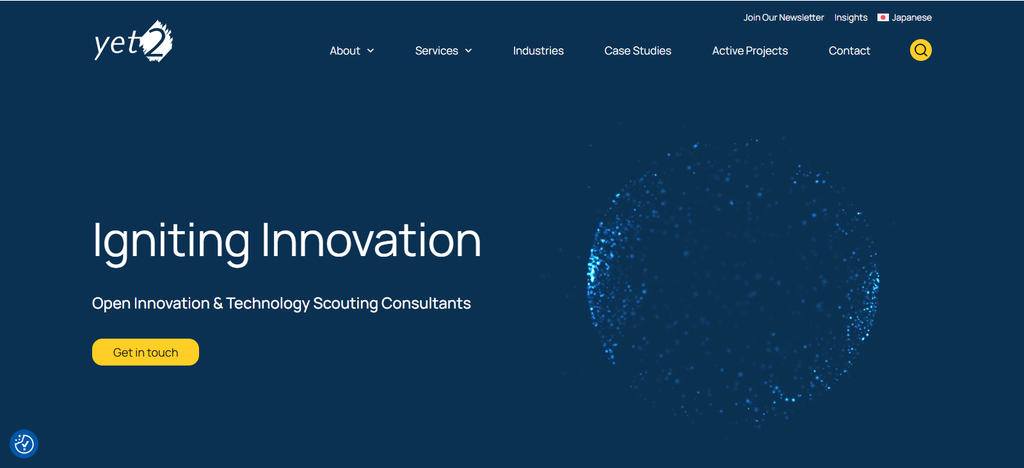
The investment opportunities are usually large corporate acquisitions, licensing agreements, joint development arrangements or portfolio transactions, not small retail investments. There is no minimum investment, as deal terms are customized to the technology, patent portfolio and counterparty. Fees and pricing are usually negotiated or engagement-based, reflecting Yet2’s advisory and deal-management role, rather than a standard marketplace commission.
Anticipated return sources include up-front licensing fees, running royalties, milestone payments, equity deals and proceeds from the sale of assets. The valuation of an asset is based on technical differentiation, market application, strength of patents and commercialization potential. The legal protection will rely on the underlying IP rights and the licensing or assignment agreements that have been carefully negotiated.
Characteristics
- Provides an open innovation marketplace for technology and IP opportunities.
- Links organizations looking for technologies with external innovators and IP owners.
- Supports technology licensing, acquisition and commercialization activities.
- Helps businesses to find patents, technical solutions and innovation opportunities.
- Promotes cooperation among businesses, inventors and technology providers.
Major risks
- Technology discovery is not equal to successful licensing or commercialization.
- Patent protection and ownership are to be assessed separately.
- Technology owners and businesses can spend a lot of time negotiating.
- Commercial viability depends on market demand, implementation costs and technology uptake.
10. Patent Auction.com
PatentAuction.com is a free online marketplace for listing patented inventions for sale or license. It is designed to help inventors find potential purchasers, licensees or investors and features hundreds of patent-backed inventions in a wide range of technology areas. The types of assets offered are mainly issued patents and patent pending inventions offered directly by their owners.
This site is specifically for selling or licensing patented inventions. Investment opportunities are to purchase a patent, license a patent or negotiate a commercialization arrangement. It is not a fractional royalty-investment platform. There is no stated minimum investment as prices, licensing terms and deal structures are negotiated directly between buyers and sellers.

Pricing and fees are refreshingly simple, PatentAuction.com says its service is entirely free and does not charge buyers or sellers for listings or transactions. Expected returns depend on whether a buyer can exploit, license, enforce or sell the patent.
Asset valuation is buyer driven, driven by the utility of the invention, patent claims, market demand and competitive positioning. The legal protection is based on the underlying patent and the agreement negotiated between the parties. The platform presents itself as a venue and not a traditional auctioneer, so the users keep responsibility for negotiations and agreements.
Main Features
- Relates to the purchase and sale of intellectual property rights concerning patents.
- It aims to connect patent owners with potential buyers.
- Offers a transactional approach to patent asset discovery.
- Facilitates opportunities to explore patented inventions and technology assets
- Assist patent holders in identifying potential commercialization and acquisition interest.
Critical Risks
- Selling a patent can be difficult when there are few buyers.
- The validity and enforceability of the patent is a matter of independent legal opinion.
- Disputes over patent ownership can stall or block deals.
- Commercial value of acquired patents can be impaired by technology obsolescence.
Conclusion
Intellectual property investment platforms give investors alternative opportunities to explore music royalties, patents, copyrights, trademarks and other technology-related assets. Royalty Exchange, ANote Music, SongVest, Musicow and Ocean Tomo offer different avenues for royalty investments, IP transactions and commercialization.
But investors should check out platform fees, asset valuations, legal ownership, revenue potential and liquidity before they invest. The knowledge of investment structures and risks is also important. Ultimately, it will be down to your financial objectives, how much you can invest, your risk appetite and the categories of intellectual property you are looking to invest in.
FAQ
What Are Intellectual Property Investment Platforms?
Intellectual property investment platforms connect investors with opportunities involving patents, copyrights, trademarks, music royalties, and technology assets through investment, licensing, acquisition, or royalty-based models.
Which Are the Best Intellectual Property Investment Platforms?
Some platforms to explore include Royalty Exchange, ANote Music, SongVest, Musicow, Jukebox, IAM Market, Ocean Tomo, Tynax, Yet2, and PatentAuction.com.
How Do Intellectual Property Investment Platforms Generate Income?
These platforms facilitate opportunities to earn through music royalties, copyright licensing, patent agreements, trademark licensing, and intellectual property sales, depending on the investment structure.
Can Beginners Invest in Intellectual Property?
Yes, some platforms offer accessible investment structures, including fractional music royalty interests. However, beginners should understand investment requirements, legal rights, fees, and potential losses.
What Types of Intellectual Property Can Investors Explore?
Investors can explore music royalties, patents, copyrights, trademarks, technology innovations, publishing rights, and other commercially valuable intellectual property assets.