


This article will describe the Best Financial Risk Analytics Software that assists in recognizing, analyzing, and controlling financial risks. Modern systems give insights in real-time, predict risk, and evaluate compliance.
Through the examination of risk analytics software, the advantages and disadvantages of such software, and the decisions each software supports, organizations can better manage risk, make financial decisions with less uncertainty, and better formulate risk strategies.
What is Financial Risk Analytics Software?
Financial Risk Analytics Software employs cutting-edge technology to assist firms in understanding and managing financial risks through sophisticated data analytics, predictive modeling, and timely reporting.
Traditional risk assessments focus on credit and market risks. This type of data analysis identifies concerns related to operational and liquidity risks as well. Software of this type focuses on the detection of market, credit, liquidity, and operational risks.

Forecasting and scenario analytic tools featured on dashboards of these data analytics platforms help firms and financial institutions make calculated decisions, improve regulation and standards compliance, and reduce operational risk and losses. This in turn strengthens the liquidity and financial stability of the enterprise.
How To Select Financial Risk Analytics Software
Evaluate Risk Management Features: Select software with risk assessment, predictive analytics, stress testing, scenario analysis, and real-time risk monitoring.
Check Data Analytics Capabilities: Software must have the capability to analyze large financial datasets and yield risk insights.
Consider Integration Options: Software must integrate with existing ERP, banking and accounting and financial management software.
Review Compliance Support: Software must help meet regulatory reporting and auditing requirements as well as compliance in the industry.
Analyze Scalability: The software must be able to handle your organizational growth as well as an increase in data and users.
Prioritize Security Features: Select Software that provides data security and privacy protection such as data encryption and access security.
Compare User Experience: User-friendly software, with customizable dashboards and simplified reporting is preferred.
Assess AI and Automation Features: Software with AI and automated features that improve detection and forecasting of risk is preferred.
Check Vendor Support: Adequate customer service and support, with training and assistance during and after implementation is preferred.
Review Pricing and ROI: Software must be cost-effective and have flexible licensing models with potential value-added benefits for the organization.
Best Financial Risk Analytics Software List
- Oracle Risk Management Cloud
- SAP Risk Management
- IBM OpenPages Risk Analytics
- Moody’s Analytics RiskFoundation
- FIS Risk Analytics
- Murex Risk Analytics
- Calypso Risk Management
- Numerix Risk Analytics
- RiskWatch
- MetricStream Risk Analytics
10 Best Financial Risk Analytics Software
1. Oracle Risk Management Cloud
Oracle Risk Management Cloud uses analytics, automation, and continuous observation to help businesses recognize, quantify, and mitigate financial risks. It includes features like risk modeling, compliance management, and fraud detection.
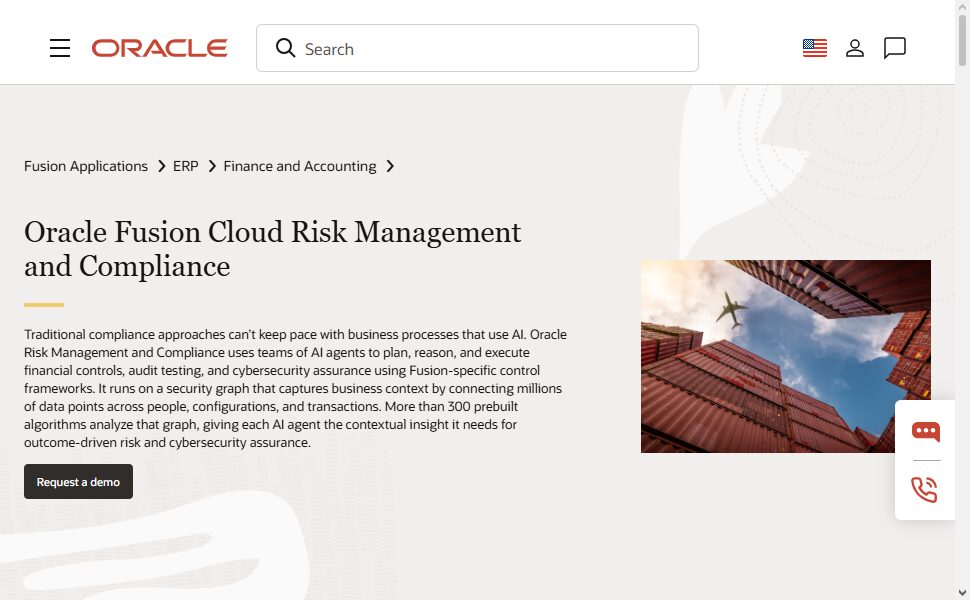
The Best Financial Risk Analytics Software – Oracle Risk Management Cloud helps companies with their finance departments and offers suggestions on risk patterns.
The software is built to interface with Oracle ERP, and allows companies to manage their operational, financial, and compliance risks from a single location. The software is highly popular with companies that want greater governance and risk management.
Oracle Risk Management Cloud – Key Features
- Sophisticated Risk Evaluation: Assists businesses with the identification and management of financial, operational, and compliance risks.
- AI Risk Detection: Intelligent analytics to identify fraud, atypical behavior, and threats.
- Continuous Risk Evaluation: Dashboards and reports provide ongoing evaluation of exposure to risks.
- Compliance Control Automation: Testing and monitoring of controls makes compliance with regulations easier.
- ERP Risk Consolidation: Financial risk management is centralized as a result of integration with Oracle applications.
| Benefits | Drawbacks |
|---|---|
| Cloud-native integration with Oracle ERP | Best suited for Oracle ecosystem only |
| Automated compliance and audit workflows | High licensing costs |
| AI-driven risk detection | Complex customization |
| Real-time monitoring | Requires Oracle expertise |
| Scalable for enterprises | Steep learning curve |
2. SAP Risk Management
SAP Risk Management gives companies the ability to assess their financial exposures and better understand the risks that SAP Risk Management – Best Financial Risk Analytics Software builds visibility around the enterprise risks.
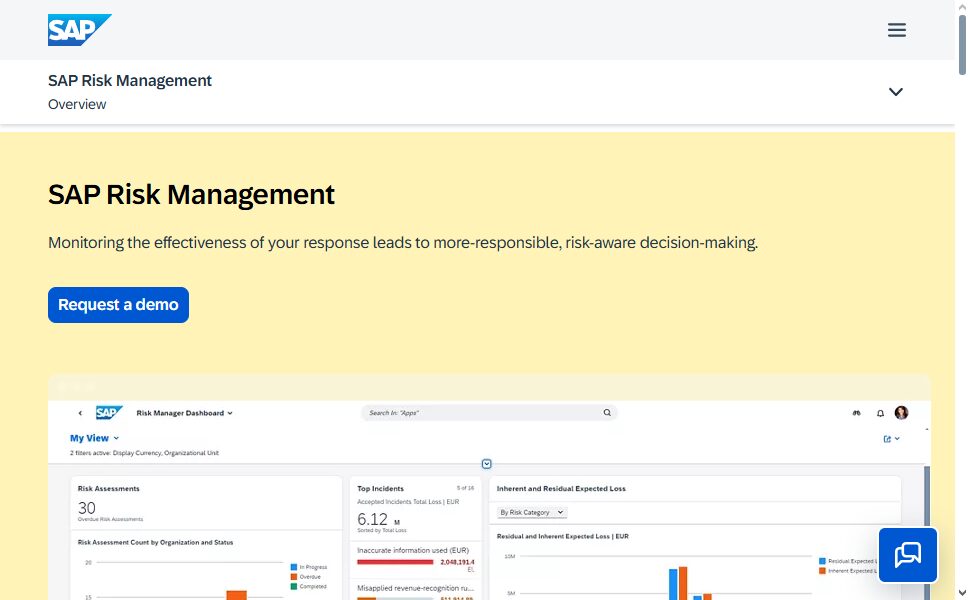
The product offers risk identification and assessment as well as the ability to conduct scenario analysis and the use of risk in the formulation of company strategies. SAP offers a suite of enterprise systems that deliver instant insight into market, credit, and operational risk.
This software is appropriate for large companies that need integrated risk management, financial compliance, and ongoing financial risk assessment.
SAP Risk Management – Key Features
- Risk Discovery: Allows the identification and assessment of risks by enterprise business units.
- Impact Analysis: Assess potential financial impacts of identified risks.
- Risk Analytics: Dashboards and analytics promote timely and accurate risk related decisions.
- Control Compliance: Assists businesses with compliance to controls and regulatory requirements.
- SAP Integration: Unified management of risks is made possible by SAP ERP.
| Benefits | Drawbacks |
|---|---|
| Deep ERP integration | Heavy implementation effort |
| Strong governance features | Expensive for mid-sized firms |
| Flexible dashboards | Requires SAP specialists |
| Comprehensive compliance support | Long deployment cycles |
| Scalable for global enterprises | Complexity in upgrades |
3. IBM OpenPages Risk Analytics
IBM OpenPages Risk Analytics is an AI risk management software platform that assists organizations in the analysis, prediction, and management of financial risk. Leveraging analysis, automation, and governance, it generates an all-in view of enterprise risk.
Best Financial Risk Analytics Software – IBM OpenPages Risk Analytics allows organizations to identify growing risks, refine compliance, and improve financial controls. Risk evaluations, regulatory reporting, and the analysis of operational risk, along with the monitoring of risks through dashboards, are all supported.
Due to its AI-driven insights and numerous configuration options, risk management intelligence, and flexible design, IBM OpenPages is a software of choice for many financial and other enterprises.
IBM OpenPages Risk Analytics – Key Features
- AI Risk Analysis: Pattern detection and prediction of risks is possible with AI.
- Risk Management Customer Centralization: Customers can manage all enterprise risks with the provision of a singular platform.
- Risk Evaluation Automation: Risk Assessments are easily completed via user defined automation.
- Compliance Automation: Customers are aided in fulfilling compliance requirements and regulations to their industry.
- Personalized Dashboards: Analytics and visual data representation are offered in real-time.
| Benefits | Drawbacks |
|---|---|
| AI-powered analytics with Watson | Complex deployment |
| Strong regulatory compliance | High total cost of ownership |
| Scalable for large enterprises | Steep learning curve |
| Flexible reporting | Requires IBM ecosystem |
| Advanced risk modeling | Resource-intensive setup |
4. Moody’s Analytics RiskFoundation
RiskFoundation from Moody’s Corporation provides organizations with the ability to perform advanced credit risk analysis and financial risk measurement and assessment through the analysis of portfolios and the fulfillment of regulatory requirements.
Financial institutions utilize the platform to analyze credit risk, perform stress testing, and improve the assessment of financial risk through the use of sophisticated techniques. Best Financial Risk Analytics Software – Moody’s Analytics RiskFoundation was developed for banks, insurance organizations, and financial institutions in need of precise capital and risk assessment calculations, as well as the analysis of a spectrum of financial scenarios.
The solution seamlessly blends financial industry knowledge and innovative modeling in order to assist organizations to sustain financial health and manage risk.
Moody’s Analytics RiskFoundation – Key Features
- Risk Assessment Modeling: Specialized analytics to assess credit risk of borrowers and portfolios.
- Stress Testing: Enables organizations to assess their financial performance in a variety of situations.
- Portfolio Risk Assessment: Provides an understanding of the risk related to investments and lending.
- Regulatory Reporting: Offers assistance with compliance-centric reporting for financial institutions.
- Sophisticated Data Analytics: Employs quality financial data to predict risk with greater accuracy.
| Benefits | Drawbacks |
|---|---|
| Trusted financial risk modeling | Primarily finance-focused |
| Strong credit risk tools | Limited non-financial coverage |
| Stress testing capabilities | Costly licensing |
| Regulatory compliance expertise | Complex implementation |
| Widely recognized in finance | Narrow industry scope |
5. FIS Risk Analytics
FIS Risk Analytics provides tools to help financial organizations manage risks across market, credit, and liquidity, in addition to regulatory challenges.
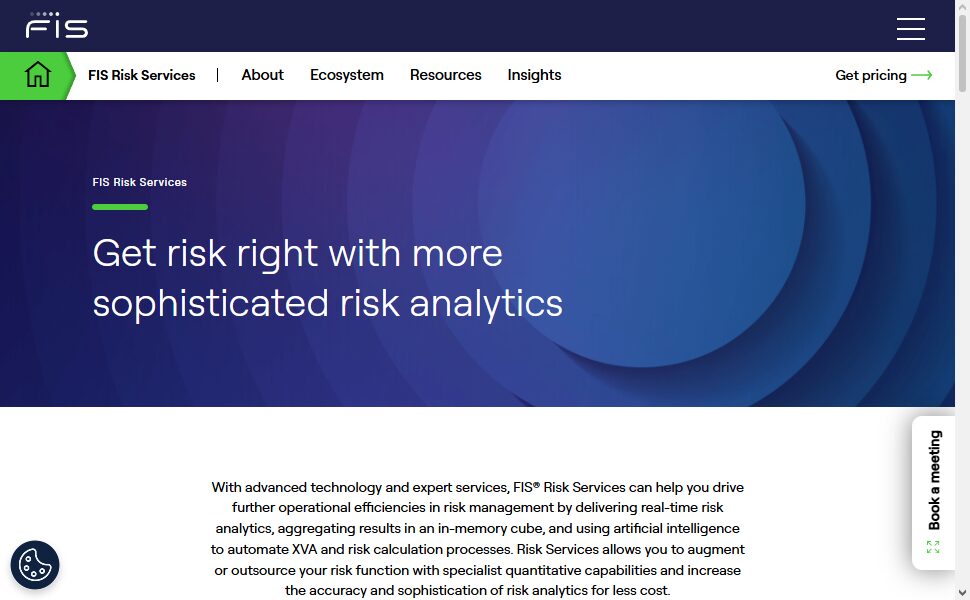
This platform integrates analytics, automation, and the processing of data as it arrives to enhance the precision of risk assessments. Best Financial Risk Analytics Software – FIS Risk Analytics allows organizations the ability to view their financial exposure, interpret shifts in the market, and fine-tune risk methodologies. Stress testing, reporting and compliance tools are provided to banks and investment businesses.
FIS employs a flexible design with a concentration on a specialized industry to aid organizations in the improvement of their risk comprehension and the facilitation of rapid response in financially intricate frameworks.
FIS Risk Analytics-Specialties
- Market Risk Management: Provides assistance in the observation of fluctuations in the market and financial exposure.
- Credit Risk Assessment: Delivers solutions to the analysis of credit and the risk of loss.
- Liquidity Risk Assessment: Concerned with financial equilibrium and the risk of loss or reduction in cash flow.
- Risk Reporting Automation: Produces automated, comprehensive risk reports for compliance.
- Analytics in Real Time: Processes financial data to derive results with unprecedented speed.
| Benefits | Drawbacks |
|---|---|
| Strong in financial services | Narrow industry focus |
| Real-time risk monitoring | Complex integration |
| Advanced analytics | High cost for smaller firms |
| Scalable for banks | Requires FIS ecosystem |
| Flexible reporting | Steep learning curve |
6. Murex Risk Analytics
Murex Risk Analytics is an all-inclusive risk solution for financial institutions to analyze and control market, valuation, liquidity risk, in addition to regulatory risk. This platform’s sophisticated functionality assesses a variety of scenarios in greater detail through the analysis of portfolios.

Best Financial Risk Analytics Software – Murex Risk Analytics provides a deeper understanding of financial exposures to help organizations refine their approach to managing risk. It offers real-time analysis with control of risk in a consolidated manner for trading firms, banks, and other financial institutions.
Murex’s risk solutions empower users to interpret market conditions and perform stress tests, while also enabling financial firms to comply with the ever-evolving requirements of regulatory frameworks.
Murex Risk Analytics-Specialties
- Market Risk Assessment: Supports measurement of risk for trading and investment.
- Outcome Prediction: Organizations can forecast financial results for varying scenarios.
- Portfolio Risk Assessment: Analysis of the exposure of all assets and related transactions.
- Compliance with Financial Regulations: Aids organizations in fulfilling worldwide risk compliance mandates.
- Risk Systems Integration: Consolidation of trading, risk, and valuation systems.
| Benefits | Drawbacks |
|---|---|
| Excellent for trading/derivatives | Very specialized use case |
| Strong risk modeling | High implementation complexity |
| Widely used in capital markets | Expensive |
| Real-time analytics | Resource-heavy |
| Flexible scenario analysis | Limited outside finance |
7. Calypso Risk Management
Adenza Calypso Risk Management combines sophisticated analytics for financial institutions to assess market, credit, collateral, and liquidity risks. Financial modeling and risk measurement tools, along with collateral and portfolio analysis, and regulatory assessments, are all part of the platform.

Best Financial Risk Analytics Software – Calypso Risk Management gives firms the ability to enhance control and visibility over complex financial processes.
With scenario analysis and the ability to make informed decisions, Calypso helps financial institutions better understand their risk. Their flexible framework and built-in analytics help Calypso’s users deal with financial risks, operate more effectively, and keep up with the standards and requirements of regulators.
Calypso Risk Management – Key Features
- Multi Risk Consolidation: Covers market, credit, liquidity, and collateral risk.
- Stress Testing Kits: Analyzes the effect of market fluctuations on the portfolio.
- Regulatory Reporting: Aids in compliance with the reporting requirements of regulatory bodies.
- Central Risk Dashboard: Comprehensive overview of all financial exposures.
| Benefits | Drawbacks |
|---|---|
| Strong derivatives coverage | Limited outside financial markets |
| Real-time analytics | Complex customization |
| Integrated trading + risk | High cost of ownership |
| Flexible reporting | Steep learning curve |
| Scalable for large banks | Narrow industry scope |
8. Numerix Risk Analytics
Numerix Risk Analytics focuses on advanced financial modeling and valuation and risk assessment frameworks for capital markets. Complex mathematical frameworks help financial market participants analyze risks of portfolios and the impacts of market and derivative instruments.
Best Financial Risk Analytics Software – Numerix Risk Analytics focuses on the integrity of the calculations performed for framework and model stress tests, as well as risk and value assessments.
This solution is built for the demand of investment banks, asset managers, and financial institutions needing high-end quant solutions. Numerix Risk Analytics empowers users to analyze unharnessed financial instruments and framework and model risks with confidence.
Numerix Risk Analytics – Key Features
- Quantitative Risk Modeling: Employs sophisticated models for quantitative financial analysis.
- Derivative Analytics: Aids the assessment of pricing risks for financial derivatives.
- Real-Time Calculations: Provides rapid measurements of risk and insights into value.
- Scenario Analysis: Aids projection and stress-testing of financial scenarios.
- Cloud-Based Risk Solutions: Designed for financial institutions, provides scalable analytics.
| Benefits | Drawbacks |
|---|---|
| Advanced quantitative modeling | Niche financial focus |
| Flexible scenario analysis | Requires specialized expertise |
| Strong derivatives pricing | Costly for smaller firms |
| Widely recognized in finance | Limited non-financial coverage |
| Customizable risk tools | Complex deployment |
9. RiskWatch
RiskWatch is a financial and operational risk management tool. It has several risk assessment tools and compliance and risk monitoring tools. Reviewing and measuring possible consequences helps organizations develop a formal risk management framework. RiskWatch lets companies improve their risk controls and compliance.
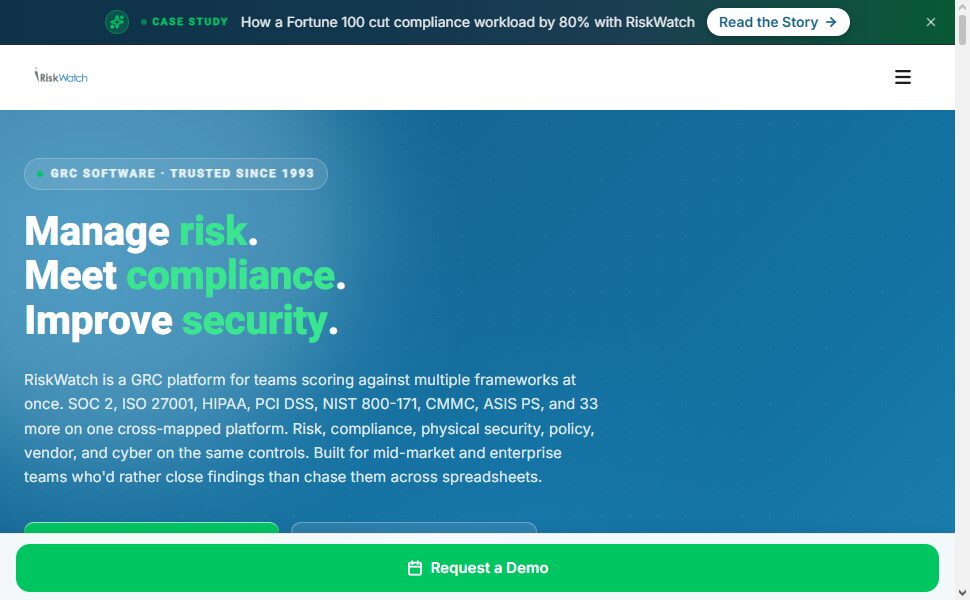
It also increases the visibility of financial risk. Along with governance, risk management, and compliance (GRC) tools, RiskWatch has several analytical tools and custom dashboards that let companies focus on specific risks and create the best financial risk management strategies.
RiskWatch – Key Features
- Risk Assessment Management: Designed to help organizations identify and assess risks.
- Compliance Tracking: Assists in the tracking of both regulatory and in-house compliance.
- Risk Reporting Tools: Provides tools to report risks in a clear and comprehensive manner.
- Customizable Workflows: Enables the personalization of risk management workflows.
- Risk Mitigation Planning: Aids in the prioritization of risks and planning of responses.
| Benefits | Drawbacks |
|---|---|
| Easy-to-use compliance tool | Less advanced analytics |
| Affordable for SMBs | Limited scalability |
| Good for operational risk | Narrow industry coverage |
| Quick deployment | Limited customization |
| User-friendly interface | Not enterprise-grade |
10. MetricStream Risk Analytics
MetricStream Risk Analytics is used to manage the financial, operational, and compliance risks of most enterprises. It has risk assessment and reporting dashboards that include some predictive analytics, and a lot of workflow automation.
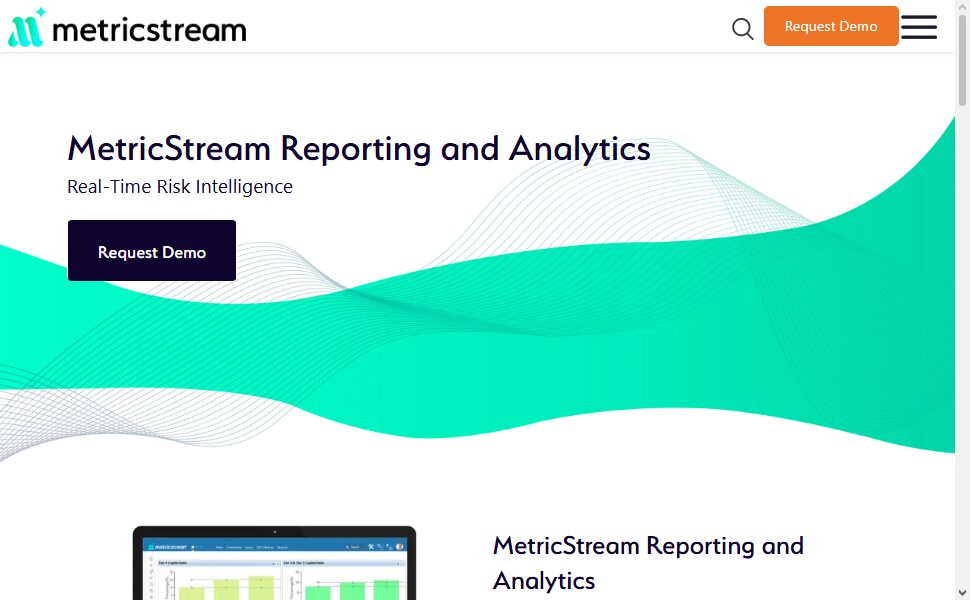
The best financial risk analytics software — MetricStream Risk Analytics — helps companies detect risks and improve their compliance and business decisions. It provides a consolidated picture of risk exposure by integrating data from various sources. It is also made for big companies.
MetricStream Risk Analytics – Key Features
- Enterprise Risk Management: Provides management of financial, operational, and compliance risks.
- Predictive Risk Analytics: Provides insight and the identification of risks.
- Automated Risk Monitoring: Provides the automated monitoring of risks and controls.
- Interactive Dashboards: Provides analytics in a visualization that aids management decisions.
- Governance and Compliance Management: Enhances compliance and control within the organization.
| Benefits | Drawbacks |
|---|---|
| Strong GRC platform | Complex implementation |
| Customizable workflows | High cost for full suite |
| Scalable for enterprises | Requires dedicated support |
| Comprehensive compliance | Steep learning curve |
| Flexible reporting | Resource-intensive |
Comparison Table: Best Financial Risk Analytics Software
| Software | Best For | Key Features | Risk Coverage | Integration | Pricing Level |
|---|---|---|---|---|---|
| Oracle Risk Management Cloud | Large enterprises using Oracle systems | AI risk detection, compliance automation, fraud monitoring, real-time dashboards | Financial, Compliance, Operational Risk | Oracle ERP & Cloud Applications | High |
| SAP Risk Management | SAP-based organizations | Risk assessment, scenario analysis, reporting, enterprise risk controls | Financial, Operational, Strategic Risk | SAP ERP & Business Systems | High |
| IBM OpenPages Risk Analytics | Enterprises requiring AI-powered risk management | AI analytics, automated workflows, dashboards, compliance management | Enterprise, Financial, Regulatory Risk | IBM Cloud & Enterprise Systems | High |
| Moody’s Analytics RiskFoundation | Banks and financial institutions | Credit modeling, stress testing, portfolio analysis, forecasting | Credit, Market, Investment Risk | Financial Data Platforms | High |
| FIS Risk Analytics | Banking and financial services firms | Market risk analysis, liquidity monitoring, regulatory reporting | Market, Credit, Liquidity Risk | Banking & Financial Systems | High |
| Murex Risk Analytics | Capital markets and trading firms | Market risk calculations, valuation analytics, scenario testing | Market, Trading, Liquidity Risk | Trading & Treasury Platforms | High |
| Calypso Risk Management | Global financial institutions | Risk measurement, portfolio analysis, collateral management | Market, Credit, Liquidity Risk | Treasury & Capital Market Systems | High |
| Numerix Risk Analytics | Quantitative finance teams | Financial modeling, derivatives analytics, valuation tools | Market, Investment, Model Risk | Financial Technology Platforms | Medium-High |
| RiskWatch | Organizations needing risk assessments | Risk tracking, compliance monitoring, reporting tools | Operational, Compliance, Security Risk | Business Management Systems | Medium |
| MetricStream Risk Analytics | Enterprises focused on GRC management | Predictive analytics, risk monitoring, governance dashboards | Enterprise, Financial, Compliance Risk | Enterprise Applications & Cloud Systems | High |
Quick Selection Guide
| Business Need | Recommended Software |
|---|---|
| Best for Oracle ERP users | Oracle Risk Management Cloud |
| Best for SAP environments | SAP Risk Management |
| Best AI-driven risk analytics | IBM OpenPages Risk Analytics |
| Best for credit risk analysis | Moody’s Analytics RiskFoundation |
| Best for banking risk management | FIS Risk Analytics |
| Best for capital markets | Murex Risk Analytics |
| Best for complex financial instruments | Calypso Risk Management |
| Best for quantitative modeling | Numerix Risk Analytics |
| Best for risk assessment workflows | RiskWatch |
| Best for enterprise GRC management | MetricStream Risk Analytics |
Conclusion
The Best Financial Risk Analytics Software offers organizations the tools they need identify, assess, and address the challenges of financial uncertainty.
Following the trend of advanced analytics, some of the software provides real-time monitoring, or predictive analytics.
Oracle Risk Management Cloud, SAP Risk Management, IBM OpenPages, and MetricStream provide useful business tools to optimize business decision outcomes, improve risk-based compliance initiatives, and ultimately reduce the organization’s exposure to risk.
Proper software enhances organizational risk visibility, improves financial flexibility, and strengthens long-term financial planning.
FAQ
What is Financial Risk Analytics Software?
Financial Risk Analytics Software helps businesses identify, analyze, monitor, and manage financial risks using data analytics, forecasting models, and automated reporting tools.
Why should businesses use Financial Risk Analytics Software?
Businesses use these platforms to improve risk visibility, reduce financial losses, support better decision-making, and maintain compliance with industry regulations.
What are the key features of Financial Risk Analytics Software?
Key features include risk assessment, predictive analytics, stress testing, scenario analysis, compliance monitoring, dashboards, and real-time risk reporting.
Which is the Best Financial Risk Analytics Software for enterprises?
Popular enterprise solutions include Oracle Risk Management Cloud, SAP Risk Management, IBM OpenPages Risk Analytics, Moody’s Analytics RiskFoundation, and MetricStream Risk Analytics.
How does Financial Risk Analytics Software improve decision-making?
It provides accurate risk insights, identifies potential threats early, and helps organizations create data-driven strategies to reduce financial uncertainty.