


Building Web3 applications is getting easier, but the challenge of picking the right development framework still remains. Thirdweb is a favorite for its blend of SDKs, smart-contract tools, wallets, APIs, and blockchain infrastructure.
But different projects require different capabilities, pricing models and levels of customization. In this guide, I’ll walk you through the Top Thirdweb Competitors for Web3 Dev Frameworks, compare their core technology, supported chains, developer experience, pricing and use cases to help you pick the best platform for your project.
What Makes a Good Thirdweb Alternative?
Developer Experience – A great alternative should have easy-to-use SDKs, documentation, templates, APIs and workflows to make it easier to build and deploy Web3 applications.
Blockchain Support – Developers building multichain applications want broad network support. Provides greater flexibility by supporting Ethereum, Layer-2 networks, and other major ecosystems.

Smart-Contract Tools: Seek out platforms that provide contract deployment, testing, debugging, reusable libraries, and upgrade mechanisms to support the entire smart-contract development lifecycle.
Wallet Infrastructure – Embedded wallets, smart accounts, account abstraction, authentication and transaction-management features can significantly improve onboarding and offer more seamless experiences for Web3 users.
APIs & Infrastructure – Reliable RPC endpoints, blockchain APIs, indexing, webhooks and real-time data services enable applications to interact with blockchain networks efficiently without having to manage the infrastructure themselves.
Pricing & Scalability – Look at free tiers, pay-as-you-go costs, API limits, and enterprise pricing. As application traffic, users and blockchain activity grow, the right platform needs to stay cost-effective.
Security & Reliability – Audited tools, secure infrastructure, monitoring, testing capabilities, uptime and established security practices are a must when dealing with intelligent contracts, wallets, transactions and valuable onchain assets.
Use-Case Fit – The best alternative depends on the project. Some platforms are good at RPC infrastructure, some at blockchain data, some at smart-contract security, testing, gaming, wallets, or consumer-facing apps.
Top 10 Thirdweb Competitors for Web3 Development Frameworks
1. Alchemy
Alchemy is a Web3 infrastructure platform that gives the world’s leading companies with blockchain infrastructure, APIs, wallet tooling, and developer services to build scalable dApps. Free plan provides 30M compute units per month. Pay-as-You-Go costs start at $0.525 per million compute units.

Enterprise pricing is custom. Node API, NFT, Token, Transfers, WebSocket, Wallet, Bundler, Gas Manager, and other APIs. Supported Chains: Ethereum, Base, Arbitrum, Polygon, Solana, Starknet, Sui, Avalanche and many more are covered. Excellent SDKs, documentation, APIs, webhooks, and development tools, suitable for startups and production teams.
Best Applications For
- Create scalable dApps on top of managed blockchain infrastructure.
- Connecting to trusted RPC endpoints on multiple chains.
- Build NFT, token, and wallet applications.
- Building applications of blockchain data and analytics.
- Support Web3 applications with high traffic without running nodes.
Key Distinctions
- Full-stack focus: More holistic developer infrastructure than just bare RPC providers.
- API ecosystem: Provides dedicated APIs for NFTs, tokens, transfers, wallets and blockchains.
- Developer tooling: SDKs, webhooks, account abstraction and embedded wallet features
- Scalability Designed for production-level applications with heavy, high-volume infrastructure needs.
2. QuikNode
QuickNode is a blockchain infrastructure provider dedicated to providing high-performance RPC access, APIs, data services, and developer tooling for production Web3 applications. It uses usage-based API credits and plan-based infrastructure options, with pricing varying by chain, throughput and add-ons. The platform is made up of RPC endpoints, Streams, plug-ins, archive nodes and APIs for blockchain data.

QuickNode supports a broad spectrum including Ethereum, Arbitrum, Base, Avalanche, BNB Chain, Solana, Bitcoin, Celestia, and more. Fast endpoint creation, documentation, SDK integrations, debugging capabilities and add-ons make it attractive for developers who need flexible multichain infrastructure.
Application Scenarios Top
- High-performance RPC infrastructure for dApps.
- Developing multichain applications with extensive network coverage
- Real-time infrastructure for streaming blockchain data.
- Developing applications using specialized blockchain APIs and plug-ins.
- Scaling production Web3 apps via managed nodes.
Key Differences
- Infrastructure breadth: Big focus on RPC and blockchain infra.
- Multi-chain coverage: Offers a very broad coverage of blockchain networks.
- Add-ons: Developers are able to add custom APIs and data services to endpoints.
- Performance oriented: Ideal for use cases that require scalable, low latency blockchain connectivity.
3 Moralis
Moralis is a Web3 data and API platform that is all about simplifying blockchain development with wallet, token, NFT, DeFi, price, and blockchain APIs. $149/month for the Starter plan (billed annually), $249 for Pro, $749 for Business, custom for Enterprise and free for developers.

Moralis provides REST APIs, RPC nodes, Streams, and crypto-data-specific endpoints. Ethereum, Base, Solana, BNB Chain, Polygon, Avalanche, Arbitrum, Optimism, Linea, zkSync, etc.
With prebuilt APIs, teams can build wallets, analytics platforms, dashboards and Web3 applications faster by simplifying blockchain data complexity.
Best Applications
- Developing crypto wallet & portfolio apps.
- Development of NFT marketplaces and NFT analytics platforms.
- Creating token and DeFi dashboards
- Building wallet intelligence and applying blockchain data.
- Building multichain applications using prebuilt APIs.
Major Differences
- Data-first: It puts a huge emphasis on the ready-to-use blockchain data APIs.
- Prebuilt APIs: Reduces the effort of parsing raw blockchain data by hand.
- Wallet Intelligence: In-depth insights for wallets, tokens, NFTs, and portfolios.
- Simplicity for developers – especially if teams want application-ready data, not low-level infrastructure.
4. Infura
Infura is a long-standing blockchain infrastructure platform that provides managed RPC access and APIs for developers building decentralized applications. Core is free, Developer is $50/month, Team is $225/month, and Enterprise pricing is customized. Infura provides JSON-RPC access, archive data, debugging & tracing, Web3 APIs, and infrastructure services.

Supported chains: Its network coverage goes beyond Ethereum to multiple blockchain ecosystems and networks it supports. Infura offers simple API access, documentation, SDK compatibility, community forums, and developer support. It is especially helpful for teams wanting reliable managed blockchain connectivity without needing to run their own nodes.
Most Popular Use Cases:
- dApps integration with Ethereum and other supported blockchain networks.
- Managed RPC for building wallets and blockchain apps.
- Accessing blockchain data without running your own nodes.
- Support for production applications requiring reliable network connectivity.
- Creating applications that require scalable Web3 APIs.
Differences
- Ethereum pedigree: Has a strong footing in Ethereum infrastructure.
- Managed infrastructure: Offload the operational overhead of maintaining blockchain nodes.
- RPC/API-focused: Highlights reliable blockchain connectivity and developer APIs.
- Enterprise ready: For teams that require proven infrastructure and support.
5. Chainstack
Chainstack is a managed blockchain infrastructure platform for developers needing RPC nodes, dedicated nodes, archive access and multichain deployment. Pricing: The Developer plan is free and offers 3M request units. The Growth plan starts at $49 per month, Pro at $199, Business at $499, and the Enterprise plan starts at $990 per month.
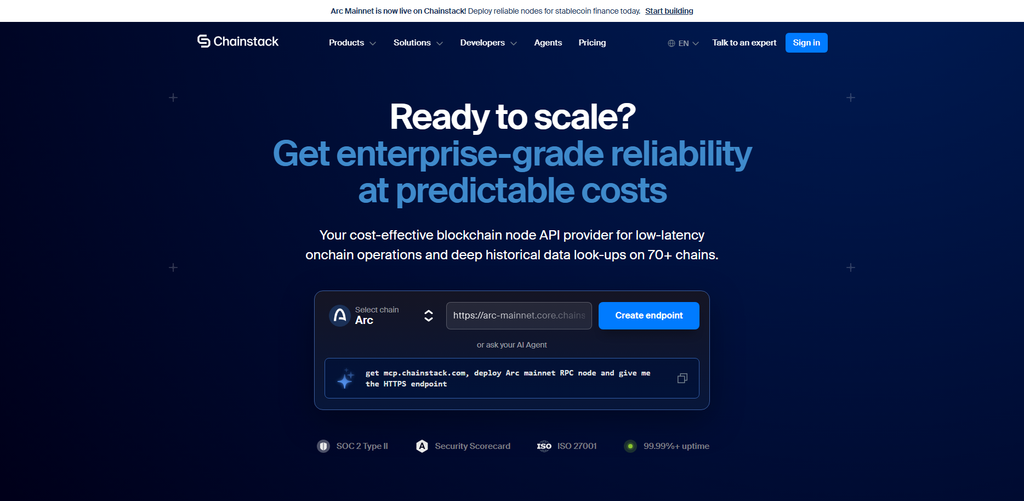
Chainstack delivers Global Nodes, archive nodes, dedicated infrastructure, WebSockets, APIs, node monitoring and specialized services like Solana Geyser. It supports 70+ networks including Ethereum, Solana, Base, Polygon, BNB Chain, Arbitrum, Hyperliquid and others. Infrastructure setup is comparatively easy due to the presence of its dashboard and one-click node deployment.
Best Applications
1.Deploying managed blockchain nodes across multiple networks.
2. Multichain dApps building with dedicated infrastructure.
3. Access to archive nodes and historical blockchain data.
4. Running applications that require custom node configuration.
5. Scaling of blockchains infrastructure without the need to maintain hardware by yourself.
Big Differences
- Node control: Provides developers with a high level of control over the blockchain infrastructure.
- Multi-chain deployment: Support for multiple networks from one platform.
- Dedicated infrastructure: Provides dedicated nodes for workloads that require more control.
- Infrastructure flexibility: Better suited to teams that require configurable node environments and not just APIs at the application level.
6. Tenderly
Tenderly is a Web3 development and simulation platform that enables smart-contract debugging, transaction simulation, monitoring, and production-like testing environments. Pricing: Tenderly offers consumption-based pricing with self-serve options, and larger needs can look into tailored enterprise plans.

Transaction Simulator, Debugger, Gas Profiler, Virtual TestNets, Simulation API, blockchain infrastructure. Supported Chains: Tenderly currently supports over 100 networks.
Developers are able to recreate transactions on live blockchain state, view detailed traces, test complete workflows, and develop production-synced environments. That makes Tenderly especially useful for DeFi teams and developers who are focused on testing, debugging, and minimizing the risk of deployment.
Best Use Cases
- Debugging of failing smart-contract transactions.
- Simulate transactions before mainnet execution.
- Testing of complex DeFi protocols and contracts.
- Keep an eye on the transaction activity and deployed contracts.
- Creating production-like blockchain test environments
Key Differences
- Focus on debugging: We have a stronger focus on smart-contract debugging than general RPC providers.
- Transaction simulation: Developers are able to simulate transactions against the state of the blockchain before executing them.
- Virtual TestNets: Provides advanced environments to test intelligent contracts in a realistic manner.
- Developer security: helps find execution & gas issues before going live.
7. OpenZeppelin
OpenZeppelin is the #1 smart-contract security & development ecosystem, known for reusable Solidity libraries, upgradeable contracts, and security-first development tooling. Pricing: ** Its open-source contract libraries and development tools are free and do not include the standard SaaS subscription costs, although professional security services and some enterprise products are paid subscriptions.

It has an ecosystem that includes OpenZeppelin Contracts, Contracts Wizard, Upgrades tooling and security-focused developer infrastructure. Supported Chains: Its EVM-oriented tooling can be used on any compatible network.
Easy to build secure intelligent contracts, thanks to well-documented audited libraries, Hardhat & Foundry integrations, and reusable contract components. Important: OpenZeppelin Defender’s hosted service was officially retired on July 1, 2026, with key components replaced by open source alternatives.
Best Uses
- Build Solidity intelligent contracts that are secure.
- Writing ERC-20, ERC-721 and other token contracts.
- Construction of upgradable smart-contract systems.
- Enforce standardized access-control and security patterns.
- Writing production-quality contracts with popular libraries.
Important distinctions
- Security-first approach: The primary difference is smart-contract security.
- Reusable libraries: Includes common implementations of standard blockchain protocols.
- Open source tooling: Developers are able to audit and modify core contract implementations.
- Contract development: Focused more on the smart-contract code than the RPC or blockchain data infrastructure.
8. Hardhat
Hardhat is an Ethereum development environment, not a hosted RPC provider. It’s focused on writing, testing, debugging, and deploying smart contract software. Pricing: Hardhat is open source and free to use, with developers only paying for any external infrastructure or services they connect to.

Hardhat 3 introduces the Rust-powered Ethereum Development Runtime, Solidity and TypeScript testing, debugging, fuzzing, gas statistics and Hardhat Ignition for deployments. It can connect to JSON-RPC networks and supports Ethereum-like environments, including OP Stack simulations.
With its plugin ecosystem, TypeScript support, network configuration, testing tools, and deployment workflows, it’s highly customizable for professional smart-contract development.
Top Use Cases
- Writing and testing smart contract protocols in Ethereum.
- Running automated tests for solidity and typescript.
- Debugging execution of intelligent contracts.
- Contract deployment management workflows
- Building Custom Ethereum Development Environments.
Major Differences
- Development environment Hardhat is a development framework, not a hosted blockchain API provider.
- Focus on testing: Includes powerful tools for automated contract testing.
- Customization: Developers are able to configure networks, plugins, tasks and workflows pretty much any way they like.
- Open-source model: Provides a flexible environment, no proprietary infrastructure platform required.
9. Coinbase Developer Platform (CDP)
The Coinbase Developer Platform provides APIs and SDKs for wallets, blockchain access, payments, and developing onchain applications. Pricing: CDP Node has a pay-as-you-go pricing model with 10 million Billing Units free per month, and $0.50 per million Billing Units thereafter.

Among its features are managed Node RPC, Server Wallets, Smart Accounts, embedded wallet features, Paymaster, and developer SDKs. Chains Supported: CDP supports Base natively, with wallet support for EVM networks and Solana.
Smart Accounts are supported on Base, Ethereum, Arbitrum, Optimism, Polygon, BNB, Avalanche, and Zora. Developer Experience: TypeScript and Python SDKs, APIs, CLI tooling, and wallet automation make implementation easy.
Best Use Cases
- Embedded and smart-wallet application development.
- Building on-chain payment experiences.
- Building applications on Base and other supported networks.
- Account Abstraction and Gas Sponsorship Implementation.
- Developing consumer-friendly Web3 apps.
Major Differences
- Coinbase ecosystem: Benefits from the integration with the broader onchain infrastructure of Coinbase.
- Wallet infrastructure: Heavy emphasis on managed and programmable wallets.
- Payments: Especially helpful for applications with crypto payments.
- Base integration: Provides strong tooling for developers building in the Base ecosystem.
10. Sequence
Sequence is a smart wallet, account abstraction, payments, indexing and user-friendly onchain experiences development platform for Web3. Pricing: Sequence does not publish a universal public SaaS rate but instead uses tailored pricing for integrations and larger developer requirements.

Its stack covers embedded wallets, smart sessions, checkout, cross-chain payments, real-time indexing, wallet APIs and developer SDKs. Chains Supported: It is mostly targeted at the Ethereum and EVM-compatible ecosystems, with multichain support across all supported networks.
Sequence has SDKs for Web, React Native, Unity, Unreal, TypeScript and Go, wallet widgets and marketplace components. It is especially strong for gaming, DeFi, payments, NFTs and consumer-facing applications.
Key Use Cases**
- Build Web3 gaming applications.
- Building embedded wallets for consumer applications
- Build NFT marketplaces and digital asset experiences.
- Deploying blockchain payments and checkout flows.
- Building user-friendly, multichain applications.
Key Differences
- Gaming focus: Especially strong in blockchain games and interactive applications.
- Embedded wallets: Aims to simplify wallet complexity for the mainstream user.
- Consumer UX: Built to make interacting with blockchain more user-friendly and approachable.
- Development SDKs: Offers tools for Web, mobile and game-engine development.
Thirdweb vs. Its Top Competitors — Comparison Table
| Platform | Primary Focus | Pricing Model | Chain Support | Key Developer Tools | Wallet Support | Best For |
|---|---|---|---|---|---|---|
| Thirdweb | Full-stack Web3 development | Paid plans + usage-based pricing | 2,500+ chains listed | SDKs, contracts, APIs, RPC, wallets, account abstraction | Strong | All-in-one Web3 app development |
| Alchemy | Blockchain infrastructure & APIs | Usage-based + paid plans | Multichain | RPC, APIs, SDKs, webhooks, wallet tools | Strong | Scalable dApps and infrastructure |
| QuickNode | RPC & blockchain infrastructure | Usage-based | Broad multichain coverage | RPC, Streams, APIs, add-ons | Moderate | High-performance blockchain connectivity |
| Moralis | Blockchain data & APIs | Free + subscription plans | Multichain | Data APIs, Streams, RPC, wallet/token APIs | Strong | Data-rich Web3 applications |
| Infura | RPC & Web3 infrastructure | Free + usage/paid plans | Multichain | RPC, APIs, archive access, developer tools | Limited | Reliable blockchain connectivity |
| Chainstack | Managed blockchain nodes | Free + usage-based/paid plans | 70+ networks | RPC, dedicated nodes, archive nodes, WebSockets | Limited | Customizable blockchain infrastructure |
| Tenderly | Smart-contract testing & debugging | Usage-based/paid plans | 100+ networks | Simulator, Debugger, Virtual TestNets, monitoring | Limited | Smart-contract testing and debugging |
| OpenZeppelin | Smart-contract security | Open-source + paid services | EVM-focused | Contracts, libraries, security tooling | Limited | Secure smart-contract development |
| Hardhat | Ethereum development framework | Free & open source | EVM-compatible | Testing, debugging, deployment, plugins | Via integrations | Professional smart-contract development |
| Coinbase CDP | Wallets, payments & onchain infrastructure | Usage-based | EVM + selected ecosystems | Wallets, APIs, SDKs, account abstraction | Strong | Wallets, payments and Base applications |
| Sequence | Web3 gaming & consumer apps | Custom/usage-based | EVM-focused | Wallets, SDKs, checkout, indexing | Strong | Gaming and consumer-facing Web3 apps |
Conclusion
Thirdweb is still a great one-stop-shop for Web3 devs, offering up SDKs, smart-contract deployment, wallets, APIs, RPC infrastructure, and account-abstraction tools all in one place. However, the best option is determined by the particular requirements of a project. Alchemy and QuickNode are great choices if you need scalable blockchain infrastructure. Moralis is best if you need blockchain data and APIs.
Chainstack also has flexible managed nodes, and Tenderly is good at smart contract testing and debugging. OpenZeppelin and Hardhat are very useful for developing secure contracts, whereas Coinbase CDP and Sequence are more focused on wallets, payments, gaming and consumer apps. Comparing pricing, chain support, tooling, scalability, developer experience helps teams make the right choice.
FAQ
What is the best Thirdweb alternative?
There is no single best option for every project. Alchemy is strong for full-stack infrastructure, QuickNode for RPC services, Moralis for blockchain data, Tenderly for smart-contract testing, and OpenZeppelin for secure contract development.
Is Alchemy better than Thirdweb?
Alchemy can be a better choice when reliable RPC infrastructure, blockchain APIs, data services, and scalability are the main priorities. Thirdweb is more focused on providing an integrated toolkit for building complete Web3 applications.
Which Thirdweb competitor is best for blockchain data?
Moralis is a strong option for blockchain data because it provides APIs for wallets, tokens, NFTs, DeFi, prices, and other onchain information, reducing the need to process raw blockchain data manually.
Which Thirdweb alternative is best for RPC infrastructure?
QuickNode, Alchemy, Infura, and Chainstack are strong RPC-focused alternatives. QuickNode and Alchemy are particularly suitable for developers looking for scalable, multichain infrastructure and production-ready blockchain connectivity.
Which Thirdweb competitor is best for smart-contract development?
Hardhat is well suited for development, testing, debugging, and deployment workflows, while OpenZeppelin is particularly valuable for reusable and security-focused smart-contract libraries.


