
In this article I will be talking about the Best Particle Network Rivals for Wallet Abstraction. Platforms that make Web3 wallet experiences simple via account abstraction, embedded wallets, smart accounts, gas abstraction and multichain support.
We will look at their main features, architecture, chain compatibility, pricing, gas management, developer tools, and potential restrictions to understand how each platform differs.
What Is Particle Network?
Particle Network is a web3 infrastructure platform that provides the ability to simplify multichain application experiences through chain abstraction, wallet abstraction and account abstraction.
Universal Accounts enable users to interact with multiple supported blockchain networks using a single unified account, eliminating the need to manage separate wallets for each chain. The platform’s Universal Liquidity and Universal Gas also make it easy to move assets and pay for transactions.

The architecture uses Particle Chain as the execution and coordination layer of cross-chain interactions. For developers, Particle Network offers SDKs and infrastructure built to simplify wallet and blockchain complexity when building consumer apps, DeFi products and multichain Web3 experiences.
Key Points
| Platform | Primary Focus | Why It Competes with Particle Network |
|---|---|---|
| Web3Auth | Embedded wallets & social login | Enables wallet creation through Google, Apple, email, and social accounts, targeting seamless Web2-to-Web3 onboarding. |
| Privy | Consumer app onboarding | Provides embedded wallets, authentication, and user onboarding for crypto applications. |
| Dynamic | Wallet authentication & user management | Offers flexible wallet connection flows, auth infrastructure, and user account management tools. |
| ZeroDev | ERC-4337 Account Abstraction | Focuses on smart accounts and modular account abstraction infrastructure. |
| Alchemy Account Kit | Smart account infrastructure | Provides account abstraction tooling and smart-account development within the Alchemy ecosystem. |
| Turnkey | Key management infrastructure | Delivers secure wallet infrastructure and signing services for developers building wallet products. |
| Thirdweb | Full Web3 developer stack | Combines wallet infrastructure with smart contracts, payments, and backend tools. |
| Magic | Passwordless wallet onboarding | Specializes in email-based authentication and embedded wallet experiences. |
| WalletConnect | Wallet connectivity protocol | Enables connections to external wallets such as MetaMask and Trust Wallet across applications. |
| Sequence | Smart wallets & gaming UX | Provides smart-contract wallets, account abstraction features, and gaming-focused wallet experiences. |
1. Web3Auth
Web3Auth (est. 2019) offers embedded, non-custodial wallet and authentication infrastructure through social login, email, passkeys, MPC/TSS and account-abstraction tooling. Pricing starts with a Free Base plan for 1,000 monthly active wallets, then Growth at $69/month and Scale at $399/month.
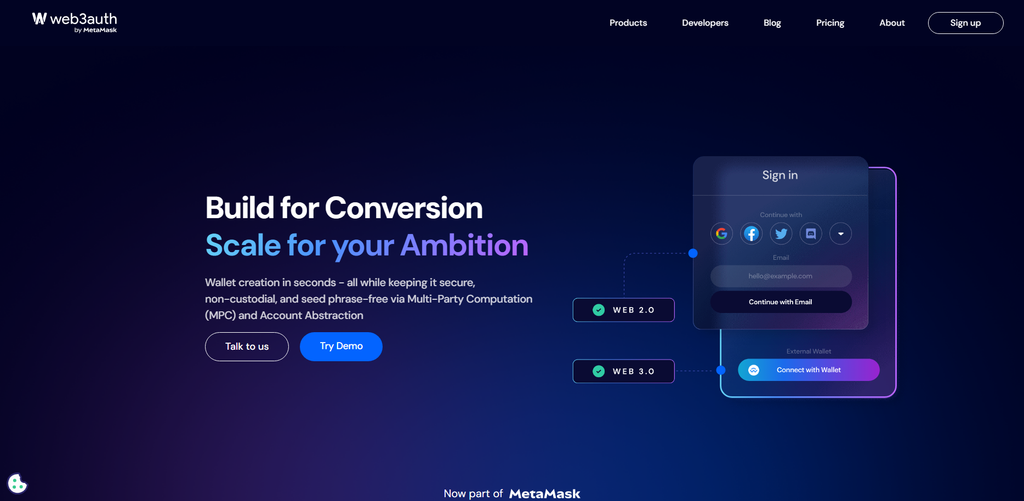
According to the company, Web3Auth’s infrastructure is chain-agnostic for chain support. Its native Account Abstraction SDK supports smart-wallet integrations. Its architecture combines authentication, key management, embedded wallets and AA while gas abstraction can be implemented using compatible account-abstraction infrastructure.
Possible Downsides of Web3Auth
- Pricing scalability: As usage increases, projects may move from free allowances to paid tiers.
- Integration complexity: Advanced account abstraction implementations may require more effort to develop.
- Feature dependencies: Some of the advanced wallet features may rely on SDKs or integrations.
Chain Variations: Not all chain features are available on all chains. - Customization: Some wallet architectures that are highly specialized may require additional engineering work beyond standard implementation.
| Feature | Details |
|---|---|
| Core Focus | Embedded wallets, authentication, key management and account abstraction |
| Wallet Type | Non-custodial embedded wallets |
| Authentication | Email, SMS, social login, passkeys and wallet-based authentication |
| Architecture | Embedded wallet infrastructure with authentication, key management, MPC/TSS options and AA integrations |
| Account Abstraction | Native Account Abstraction SDK plus compatibility with external AA SDKs |
| Chain Support | Chain-agnostic wallet infrastructure supporting multiple blockchain ecosystems |
| Gas Abstraction | Account-abstraction integrations can enable sponsored/gasless transactions |
| Security | Non-custodial architecture, MFA and MPC/TSS options |
| Developer Tools | SDKs, APIs, customizable authentication UI and wallet services |
| Best Fit | Consumer applications requiring simple Web2-style wallet onboarding |
| Pricing | Base is free for 1,000 MAWs; Growth $69/month; Scale $399/month; Enterprise custom pricing |
2. Privy
Privy (est. 2021) — embedded wallets, authentication, wallet management, and developer APIs for consumer and Web3 apps. There is a free Developer plan for up to 500 MAUs. Core is $299/month and Scale is $499/month. Privy supports EVM and Solana wallets for chain support, and embedded wallets are built for multichain applications.
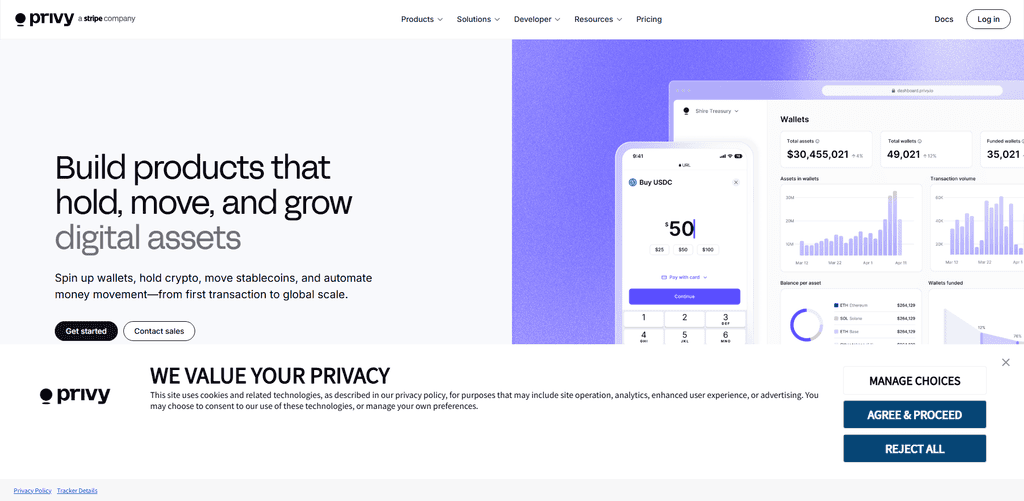
Its architecture combines authentication, embedded wallets, delegated access, policy controls and APIs. Native gas sponsorship allows applications to sponsor transaction fees for users on selected EVM and SVM chains to make gas abstraction directly configurable.
Possible Drawbacks of Privy
- Platform dependence: Applications could depend on Privy’s wallet and authentication infrastructure.
Chain-specific features: The capabilities and features of transactions vary across supported blockchains. - Advanced customization: Complex wallet architecture may require deeper API and SDK integration.
Costs based on usage: Larger applications need to consider MAU and infrastructure-based pricing. - Migration considerations: It can take some development effort to migrate an existing embedded-wallet implementation to another provider.
| Feature | Details |
|---|---|
| Core Focus | Embedded wallets, authentication, smart accounts and wallet infrastructure |
| Wallet Type | Self-custodial embedded wallets |
| Authentication | Email, SMS, social login, biometrics, passkeys and external wallets |
| Architecture | Key-splitting and secure-enclave-based wallet infrastructure with APIs and smart-wallet integrations |
| Account Abstraction | AA-optimized smart accounts and integrations with major smart-wallet providers |
| Chain Support | EVM-compatible chains, Solana and Bitcoin |
| Gas Abstraction | Native gas sponsorship across selected EVM and SVM chains |
| Cross-Chain | Automated bridging and cross-chain wallet functionality |
| Developer Tools | SDKs, APIs, headless transactions, webhooks and server-side wallet access |
| Security | Self-custodial architecture and granular authorization/policy controls |
| Best Fit | Consumer apps, DeFi, trading, payments and applications needing embedded wallets |
3. Dynamic
Dynamic was established in 2022, and offers wallet and authentication infrastructure with embedded wallets, smart wallets, wallet connectors, and developer SDKs. Its architecture can incorporate account-abstraction providers such as ZeroDev, Alchemy, Pimlico, Biconomy, Safe, Circle, ZKsync, and Crossmint.
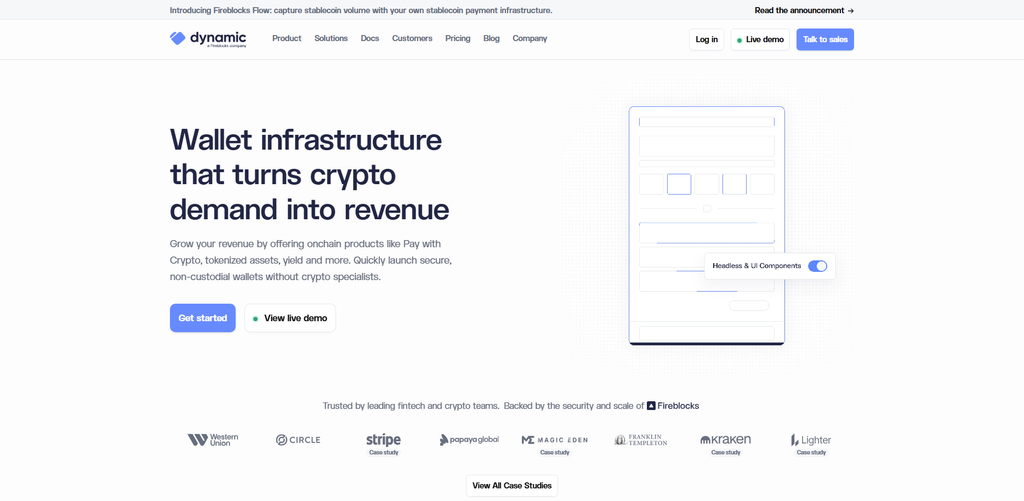
Dynamic for chain support EVM, Solana, Bitcoin, Flow, StarkNet, Sui, Cosmos and Algorand, and custom networks. Its smart-wallet architecture enables the use of ERC-4337, batching of transactions, session keys, recovery, and gas sponsorship, which allows developers to create gasless experiences but retain flexible wallet and authentication infrastructure.
Possible Drawbacks of Dynamic
- Implementation complexity: Supporting multiple wallet and smart-wallet configurations can contribute to implementation complexity.
- Provider dependencies: Some of the account-abstraction functionality is dependent on integrations with external infrastructure providers.
- Differences in chain coverage: The wallet may not have identical functionality on all supported networks.
- Pricing considerations: Larger user bases can come with higher infrastructure costs.
- Advanced customization: Heavily customized wallet flows may require additional SDK and backend development.
| Feature | Details |
|---|---|
| Core Focus | Wallet authentication, embedded wallets and smart-wallet infrastructure |
| Wallet Type | Embedded wallets plus external wallet connections |
| Authentication | Email, social authentication, passkeys and other wallet-login options |
| Architecture | Embedded wallet can act as the owner of a smart-contract wallet |
| Account Abstraction | Supports smart wallets with ERC-1271/ERC-6492 and multiple AA providers |
| Chain Support | EVM and Solana-focused multichain wallet infrastructure |
| Gas Abstraction | Smart-wallet integrations can support gas sponsorship |
| Transaction Features | Batched transactions and session-key capabilities |
| AA Integrations | ZeroDev, Alchemy, Pimlico, Biconomy, Safe, Circle, ZKsync and Crossmint |
| Developer Tools | SDKs, wallet connectors and authentication infrastructure |
| Best Fit | Apps requiring flexible wallet onboarding plus configurable smart-wallet infrastructure |
4. ZeroDev
ZeroDev is a provider of infrastructure for account abstraction with a focus on smart accounts, transaction abstraction, gas abstraction, and chain abstraction. Its architecture supports ERC-4337 smart accounts and EIP-7702 smart EOAs with features such as passkeys, session keys, transaction batching, and sponsored transactions.
ZeroDev supports a large number of EVM networks and Solana for chain support, such as Ethereum, Arbitrum, Base, Optimism, Polygon, Avalanche, BNB Chain, and many more. Its Chain Abstraction system provides unified balances and cross-chain spending without users manually bridging assets. Gas can be sponsored or paid in ERC-20 tokens.
Possible Drawbacks of ZeroDev
- Technical learning curve: Smart accounts, ERC-4337, EIP-7702, chain abstraction are more advanced Web3 concepts.
- EVM focus: Developers building for non-EVM ecosystems may run into compatibility limitations depending on the functionality they need.
- Infrastructure complexity: Some advanced policies, plugins and cross-chain execution may need more configuration.
- Gas economics: Sponsored transactions still have underlying network and infrastructure costs.
Implementation effort: Complex account-abstraction apps may require considerable testing and transaction-flow design.
| Feature | Details |
|---|---|
| Core Focus | Smart accounts, account abstraction and chain abstraction |
| Wallet Type | Programmable smart accounts and smart EOAs |
| AA Standards | ERC-4337 and EIP-7702 |
| Architecture | Modular smart-account infrastructure with policies, plugins, session keys and programmable permissions |
| Chain Support | 50+ networks according to current ZeroDev documentation |
| Gas Abstraction | Gas sponsorship and ERC-20 gas payments |
| Chain Abstraction | Cross-chain transactions without requiring users to manually bridge |
| Transaction Abstraction | Batching, automation and session-key-based execution |
| Security/Controls | Policies, permissions and restricted transaction capabilities |
| Developer Tools | Smart Account SDKs, APIs and AgentKit capabilities |
| Best Fit | DeFi, multichain applications and AI-agent transaction infrastructure |
5. Alchemy Account Kit
Alchemy Account Kit, now with support for Alchemy’s Wallet APIs, offers smart-wallet infrastructure for account creation, transactions, authentication and gas sponsorship. It’s architecture is based on programmable smart wallets, audited smart-account implementations like Modular Account v2, Bundler infrastructure, and Gas Manager policies.
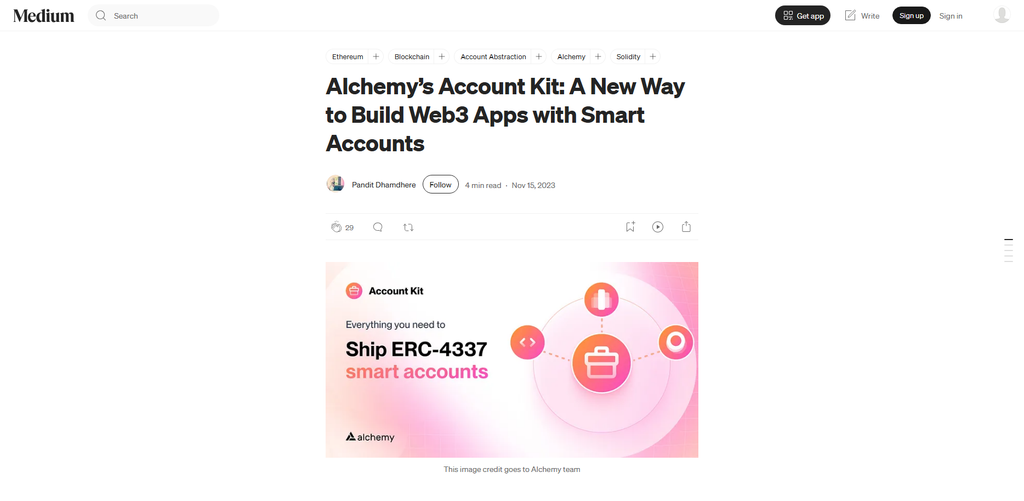
Alchemy supports major EVM networks for chain support with multiple chains within the same application. Gas sponsorship available on supported networks. Transaction fees can be sponsored by developers through Gas Manager policies, while smart wallets offer batching and other programmable transaction functionalities.
Alchemy Account Kit Limitation
- EVM orientation: Developers targeting non-EVM chains might need to build separate infrastructure.
- Alchemy dependency: Applications that use multiple Alchemy services can become tightly coupled to the Alchemy ecosystem.
- Configuration requirements: Gas policies, smart accounts and bundler infrastructure need to be set up carefully.
- Pricing at scale: The more transactions you have or the more infrastructure you use, the more you’ll pay.
Customization trade-offs: Highly specialized account architectures might require additional development work outside of the standard Account Kit functionality.
| Feature | Details |
|---|---|
| Core Focus | Smart wallets, account abstraction and wallet APIs |
| Wallet Type | Programmable smart wallets |
| Architecture | Modular Account v2, Wallet APIs, Bundler infrastructure and Gas Manager |
| Account Abstraction | ERC-4337-based smart-account infrastructure |
| Authentication | Email, social login and passkey-compatible authentication through supported owner/key-management providers |
| Chain Support | Major EVM networks with multichain application support |
| Gas Abstraction | Gas Manager and Bundler Sponsored Operations |
| Transaction Features | Batching, smart-wallet transactions and programmable controls |
| Gas Payments | Sponsored gas and ERC-20 gas payments on supported networks |
| Developer Tools | Wallet APIs, Bundler APIs, Gas Manager and SDKs |
| Best Fit | Developers building production-grade smart-wallet and AA applications |
6. turnkey
Turnkey Founded in 2022, Turnkey offers non-custodial wallet infrastructure, secure key management, transaction management, and programmable policies. It’s architecture utilizes secure signing infrastructure, policy controls, APIs, transaction lifecycle management and multichain wallet support.
Turnkey supports both EVM and SVM transactions for chain support, and has expanded transaction-management capabilities across networks such as Monad and Optimism. Its gas-sponsorship system also supports EVM, Solana, Tron and Tempo. Pricing starts at Pay-as-You-Go at $0.10/signature after 25 free signatures and Pro at $99/month at $0.05/signature.
Limitations of Turnkey Potential
- Infrastructure responsibility: Developers need to configure policies, permissions and signing workflows correctly.
- Technical integration: A secure key-management infrastructure can be more backend engineering intensive than simple wallet SDKs.
- Chain-specific implementation: Different blockchain ecosystems might have variations in transaction behavior and features.
- Cost at scale: Signature-heavy applications should consider the per-signature and infrastructure costs.
- Migration complexity: Current wallet infrastructure may need substantial modification to transition to Turnkey’s architecture.
| Feature | Details |
|---|---|
| Core Focus | Secure wallet infrastructure, key management and transaction execution |
| Wallet Type | Embedded and programmable wallets |
| Architecture | Secure signing infrastructure based around cryptographic curves, policies and programmable controls |
| Chain Support | EVM and SVM transactions with broader multichain capabilities |
| Authentication | Email, phone, biometrics, social login and external wallets |
| Gas Abstraction | Managed gas sponsorship and transaction fee handling |
| Transaction Management | Construction, nonce management, fee estimation, signing, broadcast and status tracking |
| Security | Granular policies, MFA and delegated access controls |
| Developer Tools | APIs, SDKs, wallet connectors and transaction-management infrastructure |
| Best Fit | Fintech, payments, wallets, treasury and enterprise applications |
7. Thirdweb
thirdweb (est. 2021) offers a complete Web3 development stack, featuring wallets, SDKs, intelligent contracts, APIs, account abstraction and infrastructure. Its architecture includes in-app wallets, server wallets, Wallet APIs, audited contracts and managed infrastructure. Chain Support: Thirdweb supports 2500+ supported chains, making it a good fit for multichain application development.
It has a Growth plan at $99/month, Scale at $499/month, and Pro starting at $1,499+. Transactions Cloud and server-wallet infrastructure support sponsored or managed transaction execution with applicable gas-related fees, and account abstraction provides simplified transaction flows.
Possible Downsides of thirdweb
- Platform complexity: Its extensive toolset can make it more confusing to select the required components.
- Infrastructure dependency: Applications with a high dependency on thirdweb services can have higher migration costs down the road.
- Chain differences: The features might differ based on the network and the infrastructure it supports.
- Pricing at scale: Larger apps have to think about usage and plan limits.
- Customization needs: Highly specialized blockchain infrastructure might necessitate custom development outside of standard thirdweb components.
| Feature | Details |
|---|---|
| Core Focus | Full-stack Web3 development, wallets, smart contracts and infrastructure |
| Wallet Type | Embedded/in-app wallets, external wallets and server wallets |
| Authentication | Email, phone, Google, Discord, Steam, passkeys and other options |
| Architecture | Wallet-as-a-Service combined with SDKs, smart contracts, APIs and account abstraction |
| Account Abstraction | In-app wallets can work with smart-contract accounts |
| Chain Support | Broad multichain support across supported EVM networks |
| Gas Abstraction | Sponsored/gasless transactions through account abstraction |
| Security | Self-custodial wallets with secure enclave-based recovery |
| Developer Tools | SDKs, APIs, Connect, smart contracts and wallet infrastructure |
| Best Fit | Games, consumer apps, NFT platforms and general Web3 applications |
8. Magic
Magic (est. 2018) offers non-custodial embedded-wallet infrastructure for apps with email, social, passkey or custom authentication. It is designed to include embedded wallet creation, secure key management, transaction signing, APIs and trusted execution environments, with configurable sharding models.

Magic provides wallet infrastructure for chain support across supported blockchain ecosystems through its Wallet API and its infrastructure is built for high volume wallet creation and signing. Developer is priced at $0/month with 1,000 MAWs, Startup at $99/month for 2,500 MAWs, and enterprise pricing is customized.
Potential Downsides of Magic
- Infrastructure dependency: Applications might become dependent on Magic’s authentication and wallet infrastructure.
- Embedded-wallet focus: Some projects requiring sophisticated native smart-account infrastructure might require more services.
- Feature differences: The features of a wallet will differ based on the blockchain and integration method.
- Customization: For complex transaction architectures, more development than standard SDK features may be needed.
Scaling costs: Larger applications need to think about costs based on wallet and user counts
| Feature | Details |
|---|---|
| Core Focus | Embedded wallets and Web3 authentication |
| Wallet Type | Non-custodial embedded wallets |
| Authentication | Email, social login, SMS and passwordless authentication options |
| Architecture | Embedded wallet APIs with secure key-management infrastructure |
| Wallet Experience | Users can access wallets without traditional seed phrases or browser-extension dependency |
| Chain Support | Supports multiple blockchain ecosystems through its wallet infrastructure |
| Gas Abstraction | Can support simplified/gasless experiences through compatible wallet and transaction infrastructure |
| Developer Tools | SDKs, APIs and customizable authentication experiences |
| Security | Non-custodial wallet architecture and secure key-management mechanisms |
| Best Fit | Consumer applications prioritizing simple onboarding |
| Main Strength | Web2-style authentication combined with embedded Web3 wallets |
9. WalletConnect
Launched in 2018, WalletConnect is more about wallet-to-application connectivity than a direct embedded-wallet or smart-account stack. Its architecture includes an open connectivity protocol, SDKs, session infrastructure, verification and network-wide services.
WalletConnect supports the largest chain support, connecting 700+ wallets and 80,000+ applications to the biggest blockchains with WalletConnect Pay, a new payment infrastructure for stablecoins across the biggest chains.
Its core traditional wallet feature is not gas abstraction, but its ecosystem is becoming more focused on payment and transaction flows, with chain-abstraction capabilities available via newer products.
Potential Limitations of WalletConnect
- Not a complete wallet stack: WalletConnect primarily provides connectivity rather than a full embedded smart-wallet infrastructure.
- External wallet dependency: Users generally need a compatible wallet for the connection experience.
- Limited gas abstraction: Gas sponsorship is not its primary infrastructure function.
- Integration differences: Wallet behavior can vary depending on the connected wallet and blockchain.
- Less suitable for embedded wallets: Applications seeking complete in-app wallet creation may need additional infrastructure.
| Feature | Details |
|---|---|
| Core Focus | Wallet-to-dApp connectivity and blockchain communication |
| Architecture | Open wallet connectivity protocol with SDKs and network infrastructure |
| Wallet Model | Primarily connects existing wallets with decentralized applications |
| Chain Support | Broad multichain connectivity across supported blockchain ecosystems |
| Wallet Compatibility | Connects a large ecosystem of wallets and applications |
| Authentication | Wallet-based connection and authorization flows |
| Gas Abstraction | Not primarily an embedded-wallet gas-abstraction platform |
| Payment Infrastructure | WalletConnect Pay extends the ecosystem toward stablecoin payment flows |
| Developer Tools | WalletConnect SDKs, protocol infrastructure and app integrations |
| Best Fit | Connecting wallets to dApps rather than building complete embedded-wallet infrastructure |
| Key Difference | More focused on interoperability and connectivity than full smart-wallet infrastructure |
10. Sequence
Sequence (founded 2017) provides wallet and blockchain infrastructure for apps, games, and consumer-facing Web3 experiences. Its architecture includes embedded wallets, smart contract wallets, developer SDKs, account infrastructure and transaction tooling. Sequence is a multi-chain Web3 app platform that supports EVM-based networks for chain support, enabling developers to build wallet experiences across supported chains.
Its wallet infrastructure can protect users from having to deal with blockchain complexity, and gas-management capabilities can help applications build better transaction flows. Pricing and enterprise arrangements are determined based on the specific Sequence products, deployment model and usage needs.
Potential Limitations of Sequence
- Gaming orientation: Some capabilities are particularly designed around gaming and consumer Web3 use cases.
- EVM considerations: Developers targeting non-EVM ecosystems may need additional solutions.
- Platform dependency: Deep integration with Sequence infrastructure can increase switching or migration work.
- Customization requirements: Complex enterprise wallet architectures may require additional engineering.
- Cost considerations: Larger applications should evaluate infrastructure pricing and usage requirements before deployment.
| Feature | Details |
|---|---|
| Core Focus | Embedded wallets, Web3 gaming and consumer application infrastructure |
| Wallet Type | Embedded smart wallets and application-controlled wallet experiences |
| Architecture | Wallet infrastructure combined with SDKs, APIs and blockchain development tools |
| Multichain Support | Designed for applications operating across multiple supported EVM networks |
| Account Abstraction | Smart-wallet architecture can abstract blockchain complexity from users |
| Gas Abstraction | Supports simplified transaction experiences where applications can manage or abstract gas |
| Gaming Features | Designed for game wallets, asset management and frictionless player onboarding |
| Developer Tools | SDKs, APIs, wallet infrastructure and application-development tools |
| User Experience | Embedded wallet experience designed to reduce seed phrases and extension dependency |
| Best Fit | Web3 games, consumer applications and digital-asset platforms |
| Key Difference | Strong focus on gaming and consumer-oriented Web3 wallet experiences |
Quick Feature Comparison
| Platform | Embedded Wallets | Account Abstraction | Gas Abstraction | Chain Abstraction | Multichain | Main Focus |
|---|---|---|---|---|---|---|
| Web3Auth | ✓ | ✓ | Via AA | — | ✓ | Authentication + wallets |
| Privy | ✓ | ✓ | ✓ | ✓ | ✓ | Embedded wallets |
| Dynamic | ✓ | ✓ | Via integrations | Limited | ✓ | Wallet UX + authentication |
| ZeroDev | ✓ | ✓ | ✓ | ✓ | ✓ | Smart accounts |
| Alchemy Account Kit | ✓ | ✓ | ✓ | — | ✓ | Smart-wallet infrastructure |
| Turnkey | ✓ | Via integrations | ✓ | — | ✓ | Key management |
| thirdweb | ✓ | ✓ | ✓ | — | ✓ | Full Web3 stack |
| Magic | ✓ | Integration-based | Integration-based | — | ✓ | Embedded wallets |
| WalletConnect | — | — | Limited | — | ✓ | Wallet connectivity |
| Sequence | ✓ | ✓ | Supported flows | — | ✓ | Gaming + consumer Web3 |
Conclusion
Particle Network’s competitors have different approaches to wallet abstraction, account abstraction, embedded wallets, and multichain Web3 infrastructure. Web3Auth and Privy focus on authentication and embedded wallets, while ZeroDev and Alchemy Account Kit focus on smart accounts, account abstraction and gas sponsorship.
Turnkey is about secure wallet infrastructure and programmable signing, thirdweb is about a broader development ecosystem. Magic focuses on embedded wallet experiences, while dynamic includes authentication, wallets and smart-wallet integrations.
WalletConnect is mainly for wallet to app connections while Sequence is targeting consumer and gaming applications. Developers should consider chain support, architecture, pricing, security, SDKs and gas abstraction capabilities when comparing these platforms.
FAQ
What are Particle Network rivals?
Particle Network rivals are Web3 infrastructure platforms that provide similar capabilities such as wallet abstraction, embedded wallets, account abstraction, smart accounts, gas sponsorship, multichain transactions, and developer APIs. Examples include Web3Auth, Privy, Dynamic, ZeroDev, Alchemy Account Kit, Turnkey, thirdweb, Magic, WalletConnect, and Sequence.
What is wallet abstraction?
Wallet abstraction simplifies blockchain interactions by hiding technical wallet operations from users. Depending on the infrastructure, users may be able to sign in with familiar methods, use smart accounts, batch transactions, receive sponsored gas, and interact with multiple networks without manually managing every blockchain detail.
Which Particle Network rivals support account abstraction?
ZeroDev and Alchemy Account Kit are strongly focused on account-abstraction infrastructure. Privy, Dynamic, thirdweb, Web3Auth, and Sequence also provide wallet or smart-account capabilities that can support simplified blockchain experiences.
Which Particle Network alternatives support gas abstraction?
Several alternatives provide gas sponsorship or related gas-abstraction functionality. ZeroDev supports sponsored transactions, while Alchemy provides Gas Manager policies. Privy also provides gas sponsorship capabilities, and other providers can offer gasless experiences depending on their supported networks and implementation.