


I will cover the Best Polyhedra Rivals for ZK Cross-Chain Bridges in this article. In addition, I will cover the projects bringing excellent cross-chain interoperability solutions. Cross-border transactions have been rapidly gaining popularity.
This means that the demand for secure cross-border data and asset transmission solutions is increasing. While comparing different solutions, I will evaluate the factors including the underlying technology, the scope of inter-protocol communication, the range of supported blockchain networks, and the general applicability of the solution.
What Is Polyhedra zkBridge?
Launched by the Polyhedra Network in 2023, Polyhedra zkBridge provides transfer and messaging services across various L1 and L2 networks. It employs zero knowledge proofs (ZKPs) to validate transaction documents and bridge assets across different blockchains. As a result, it achieves trustless bridging, and therefore, provides a highly secure service.
Among other blockchain networks, zkBridge provides bridging and messaging services for Ethereum, BNB Chain, and Arbitrum networks. and bridges other blockchain networks including Bitcoin. zkBridge employs its own deVirgo proofs for bridging.

The deVirgo proofs utilizes parallel computing to help generate block header proofs. This greatly improves proof generation time and helps align proof generation time with time taken to produce a block. As a result, zkBridge provides very secure bridging service at a relatively lower cost and with very high finality.
| Protocol | Key Point |
|---|---|
| Scroll | ZK-rollup scaling solution with native interoperability, competing via deep Ethereum alignment and developer tooling. |
| Polygon zkEVM | Offers ZK-based Ethereum-compatible bridging, strong ecosystem adoption, and institutional-grade scaling. |
| Axelar | GMP (General Message Passing) with validator-driven security, enabling Cosmos ↔ EVM interoperability. |
| Wormhole | Guardian-based cross-chain messaging, widely adopted for Solana ↔ Ethereum NFT and DeFi transfers. |
| Celestia | Modular data availability layer, rivaling Polyhedra by enabling trust-minimized rollup interoperability. |
| Chainflip | Uses validator vaults for native asset swaps, focusing on Bitcoin ↔ Ethereum bridging with ZK enhancements. |
| Symbiosis | MPC-based pooled liquidity bridging, offering synthetic BTC (syBTC) and multi-chain swaps. |
| Across | Intent-based fast transfers across Ethereum L2s, secured by UMA’s optimistic oracle. |
| Relay | Non-custodial contract bridging with single relayer design, optimized for speed and simplicity. |
| Garden | HTLC atomic swap model, fully non-custodial, ensuring cryptographic guarantees without intermediaries. |
1. Scroll
Scroll is a ZK-rollup modeled after Ethereum’s EVM, launched in 2022. Its model allows Ethereum developers to easily migrate to the network. Scroll uses zk-SNARKs to provide users with the ability to verify transactions on their own.

Smart contracts and assets transferred on Scroll’s network are also natively supported on Ethereum, thereby also inheriting the security of Ethereum.
While gas fees are significantly lesser than on the main network, proving times and costs continue to pose a problem on the network. Nonetheless, Scroll is considered one of the better ZK bridges.
Key Features
- First ZK-rollup on Ethereum
- Security via zk-SNARKs
- Compatibility with Ethereum Virtual Machine (EVM)
- Reduced transaction costs
- Improved developer tooling
Limitations
- Increased cost and time to generate proofs
- Longer finality compared to Optimal Roll-ups
- Limited reach beyond Ethereum
- Complex design of ZK circuits
2. Polygon zkEVM
Another ZK-rollup, Polygon zkEVM, was released in 2023, and similarly provides users with the ability to create smart contracts natively supported on Ethereum. Like other ZK-rollups, Polygon zkEVM allows existing Ethereum developers to port their applications to the network.

As Polygon zkEVM inherently ties with Ethereum, Polygon zkEVM benefits from the security of Ethereum. Like all ZK-rollups, proving times can increase the latency of a transaction compared to an optimistic roll-up. Polygon zkEVM is also positioned as a ZK-based bridge and scaling solution for Ethereum.
Key Features
- Compatibility with Ethereum bytecode
- Security via zk-SNARKs
- EVM-compatible bridges
Limitations
- Increased latency to generate proofs
- Support for only EVM-compatible chains
- ZK circuits are more complex
- Slower roll-ups compared to Optimal
3. Axelar
Axelar, launched in 2020, is a ZK rollup based on the Cosmos ecosystem. Though it does not directly use ZK proofs to verify its integrity, Axelar employs ZK rolls to increase trust in its system.

Axelar connects blockchain networks by enabling transfers of any type of data and token. It aims for an optimal balance between fees, decentralization, and speed.
As with all bridges, the costs charged by Axelar are higher than native bridge transitions but lower than centralized transfers. The main use case of Axelar is providing connectivity between EVM-compatible chains in the Cosmos ecosystem.
Key Features
- General Message Passing (GMP) in Cosmos
- Large chain support (Avalanche, Ethereum)
- Cross-chain messaging
- Developer tooling
Limitations
- Not ZK-proof
- Validator centralization
- Increased costs
- Slower to adapt outside Cosmos
4. Wormhole
Wormhole is a more recent entrant in the cross chain bridge space. It enables transfers of wrapped assets across multiple blockchain networks. The core component of Wormhole is a relay chain that uses a guardian set of 19 validators.

Signature based verification makes Wormhole an extremely simple and fast bridge but increases the attack surface. Wormhole offers bridging services for multiple chains and has centralized security.
Performance is good but costs are high due to congestion of other chains. It is the most used bridge for interoperability between Solana and Ethereum.
Key Features
- Guarded messaging
- Large ecosystem (Aptos, Solana, Ethereum)
- DeFi and NFT bridges
Limitations
- Guarded centralization
- Hacks
- Wrapped assets
- Messaging scale
5. Celestia
Celestia is a blockchain focused on data availability. It uses a modular design to provide rollup interoperability. Like Wormhole, Celestia uses a design to separate consensus and execution. This allows Celestia to further reduce costs and boost performance.

Similarly to Wormhole, security is provided by DA proofs. This makes Celestia and Wormhole direct competitors. Celestia has bridges for rollups in Ethereum and Cosmos. It also provides messaging and bridging services for other ZK Rollups.
Key Features
- ZK-proofs for data
- Blockchain modularity
- Support for Rollup interoperability
- Allows for consensus and execution to occur separately
- Can work with ZK Rollups
Limitations
- First generation solution
- Currently has no on-chain means to directly transfer assets
- Integrating Rollups increases complexity and depends on the security of the DA layer
6. Chainflip
Chainflip, launched in 2021, is a protocol that enables native asset swaps. It emplokeys Validator Vaults to facilitate cross-chain liquidity. It uses ZK technology to validate transfers.

It currently supports swaps for BTC and ETH, as well as other Layer-1 chains. It’s messaging focus is transferring assets.
It uses validator vaults to ensure swaps, and slashes validators who don’t behave properly. Swaps for BTC and ETH are currently cheaper and faster than wrapped asset swaps.
Key Features 2
- Direct BTC and ETH swaps
- Liquidity management via validator vaults
- Swaps are guaranteed by cryptography
- Entire process is
Limits
- Less messaging capability
- More expensive than a wrapped token bridge
- Validator misbehavior
- Less ecosystem integration
7. Symbiosis
Symbiosis, launched in 2021, uses MPC technology to enable swaps across multiple chains. Its architecture relies on pooled liquidity. MPC technology allows it to validate transfers for swaps, but it’s not ZK technology.

It currently supports swaps for ETH and other chains. It focuses on swapping and creating synthetic assets. Because of the pooled nature of MPC technology, there is a risk of one or more of the MPC validators colluding to steal funds. Swaps are relatively cheap and fast, depending on the liquidity. It is used to create syBTC and other swaps across multiple chains.
Key Features
- Liquidity pools across multiple chains for swaps
- On-chain BTC (syBTC)
- Cross chain swaps
- Works with EVM
Limits
- Depends on MPC for liquidity pools
- Only supports EVM
- Transactions still depend on the liquidity pool
8. Across
Across, launched in 2021, is a bridge that focuses on transferring assets between chains as quickly as possible. It uses liquidity providers and an optimistic UMA oracle.

It supports ETH and other Layer-2 Chains. It has a messaging focus on asset transfers. Assets are protected by UMA’s fraud proofs.
Because it uses an optimistic oracle, transfers are quickly and cheaply, but finality may not be reached for some time. It is used to quickly transfer assets between ETH and other Layer-2 chains.
Key Features
- Secures swaps with optimistic oracles (UMA)
- Quick swaps between Eth 1 and some L2s
- Swaps occur over a bridge (similar to RAINBOW)
Limitations
- First party risk (oracles)
- Liquidity Provider-based Model
- Popular in L2
- No arbitrary messaging
- Just a few Chain networks
9. Relay
Relay, launched in 2020, is a non-custodial asset transfer bridge. It uses a single relay methodology. Transfers are validated by contracts.

It has support for Ethereum and EVM based chains. Its focus is on moving assets. There are risks of centralization.
It is faster and cheaper than other bridges, but has less use cases. It is made for moving assets when cheaper options are desired.
Key Features
- Low Latency
- EVM Chain Bridge
- Non-Custodial Swaps
- Light Client
Limitaions
- Centralized Relying Party
- No Message Passing
- Not as efficient as ZK Bridges
- Adoption in few Blockchain Ecosystems
10. Garden
Garden was released in 2022 and is a non-custodial swap protocol. It uses HTLC contracts for swaps. Cryptographic mechanisms are used for verification, allowing for trustless swaps.
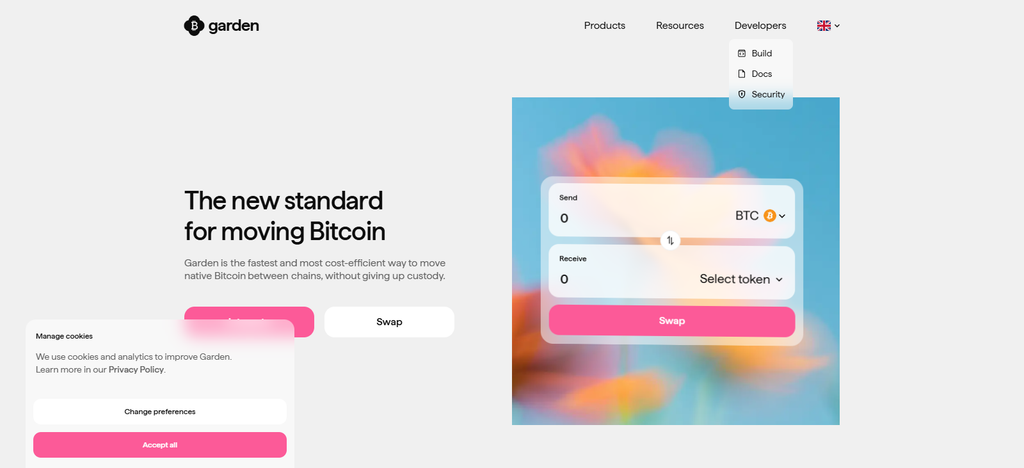
It supports a variety of chains, including Bitcoin and Etheruem. Like other bridges, it focuses on moving assets. HTLCs increase the security of swaps, but increase the complexity for end users.
Similar to ZK bridges, Garden bridges is limited. Garden is a better option for users concerned with the security of their swaps.
Key Features
- Zero knowledge proofs
- Swaps Without Custody
- Bitcoin and Ethereum Swaps
- Atomic Swaps
Limitations
- No message passing
- Complex Swap U.I.
- Slightly slower Swap times
Key Factors to Consider Before Choosing a Polyhedra Alternative
Security Model: Cross-chain platforms use various mechanisms to secure inter-chain interactions. It is essential to understand the models to assess the level of trust assumed by the protocol.
Verification Model: The trust model and the type of verification (ZK-SNARKs, light-clients) affect the level of centralization of the bridge. It is important to evaluate the trade-offs.
Ecosystem Coverage: A bridge connecting only Ethereum to another chain limits the use cases of the bridge. Other bridges connecting diverse ecosystems are more suitable.
Inter-chain Messaging: Not all bridges support generalized inter-chain communication. Evaluating bridges based on this feature is important to achieve true inter-operability.
Performance and Cost: Cheap and fast bridges encourage use. Long term, both performance and price should be taken into account.
Liquidity: Bridges are only as good as their liquidity. Deep liquidity ensures the Swap feature of the bridge works as intended.
Decentralization: Bridges should not rely on centralized or collaborating validators. True inter-chain communication should ideally achieved using MPC.
Ecosystem: An inter-chain communications protocol should have integrations with various protocols to encourage interoperability.
Conclusion
Polyhedra zkBridge introduces next-generation cross-chain bridging. With zero-knowledge proofs, bridging between blockchains becomes trustless, safe, and optimized. zkBridge does not rely on custodial, or centralized, bridging mechanisms. Instead, it validates bridging state transitions on the destination blockchains.
Therefore, it protects state transition privacy. Additionally, zkBridge makes use of deVirgo proofs. Compared to other proofs, deVirgo proves are faster in verifying block headers and are timed with block generation.
As such, zkBridge provides faster finality. Beyond blockchains, like Ethereum, Bitcoin, and BNB Chain, zkBridge supports blockchains’ lower layer two (L2) networks. Overall, zkBridge provides better cross-chain bridging, and messaging, between blockchains.
FAQ
What is Polyhedra zkBridge?
Polyhedra zkBridge is a zero-knowledge proof–based cross-chain protocol enabling secure, trustless communication and asset transfers between multiple blockchains without relying on centralized intermediaries.
How does zkBridge ensure security?
It uses zk-SNARKs and Polyhedra’s deVirgo proof system to verify state transitions directly on destination chains, ensuring correctness, privacy, and resistance to exploits.
Which chains does zkBridge support?
zkBridge supports Ethereum, Arbitrum, BNB Chain, Bitcoin, and other ecosystems, enabling both token transfers and arbitrary cross-chain messaging.


