
You can still have the convenience of US banking services when you live abroad. But if you’re spending money internationally, it can get complicated with international transfers, foreign transaction fees, ATM charges and account restrictions. The right bank can make these financial tasks much easier. In this article, I’ll go over the best US banks for expats living abroad, comparing key features, benefits, international banking services, fees and account accessibility.
Why Do Expats Need a US Bank Account?
Deal with US Dollar Earnings: Expats earning a salary, pension, rental income or payments for a business in the United States can easily deal with their dollar earnings using a US bank account.
US Bill Payments: With a US bank account, you can conveniently pay your mortgage, credit card bills, insurance premiums, subscriptions, and other recurring financial commitments without relying on international payment services.
Receive International Payments: Expats can receive eligible payments from US employers, clients, financial institutions and government programs directly into their domestic US bank accounts.
Avoid Currency Conversion Costs: Having a US dollar account allows expats to avoid unnecessary currency conversions when receiving, holding or spending money meant for US-based expenses.
Keep Financial Ties: An active US bank account allows expats to maintain their banking relationships and handle their established financial commitments while residing abroad.
Use US Investment Accounts It makes it easier for expats to transfer money between their eligible brokerage, retirement, savings and investment accounts when managing their American financial portfolios.
Manage Emergency Expenses: Expats can have a US bank account to keep funds available for any urgent medical bills, family emergencies, property expenses or any other financial needs in America.
Facilitate Money Transfers: Expats can easily send and receive domestic transfers with US bank accounts and use international wire transfer services for eligible cross-border money transactions.
How to Choose the Best US Bank for Expats Living Abroad
Verify Eligibility for Overseas Account: Select a bank that permits its clients to maintain accounts while living abroad. Review policies for foreign residential addresses, country restrictions and new account application eligibility.
Research International ATM Fees** Locate banks that have lower international ATM withdrawal fees, access to ATMs around the world, and reimbursement benefits to help you save money when you withdraw cash while traveling or living abroad.
Compare foreign transaction fees: Look at the debit-card foreign transaction fees and currency conversion fees.
International Money Transfers: Research your international wire transfer options, including which currencies you can transfer, the transfer limits, how long it takes and the fees associated with it. This will allow you to easily transfer money between US and foreign accounts.
Review Minimum Balance Requirements: Compare minimum opening deposit, monthly maintenance fee and balance requirements.
Affordable Account Conditions: Look for banks that offer reasonable account conditions while you’re living outside the United States.
Digital Banking Features: Choose a bank that offers reliable mobile banking, online account access, transaction monitoring, digital payments and secure authentication that works well from international locations.
Documentation Requirements: See if the bank requires a Social Security Number, ITIN, US residential address, proof of identity or other documents before opening or maintaining an account.
Review International Customer Support: Pick a bank that provides easily accessible customer support, international calling options, secure messaging, and help with verifying your account, debit-card issues, and overseas banking transactions.
Key Points
| US Bank / Financial Institution | Key Features |
|---|---|
| Charles Schwab Bank | Unlimited worldwide ATM fee rebates, no foreign transaction fees, linked checking and brokerage accounts. |
| Citibank | International wire transfers, global banking relationships, Citigold services and access to international banking facilities. |
| HSBC Bank USA | HSBC Premier relationship banking, international account services and global banking connectivity. |
| State Department Federal Credit Union (SDFCU) | Foreign-address support, online banking, international debit-card access and membership options for eligible Americans abroad. |
| Fidelity | Cash Management Account, ATM fee reimbursements, brokerage integration and U.S. financial account access. |
| Capital One | 360 Checking, no foreign transaction fees on eligible debit-card purchases and digital account management. |
| Bank of America | International wire transfers, online banking, debit cards and access to global financial services. |
| JPMorgan Chase Bank (Chase) | Online account management, international wire transfers, debit-card access and broad U.S. banking services. |
| Wells Fargo | Checking and savings accounts, international wire transfers, online banking and debit-card services. |
| Navy Federal Credit Union | Worldwide account access, mobile banking, checking accounts and international ATM services. |
1. Charles Schwab Bank
Charles Schwab Bank is a brokerage-affiliated bank in the U.S. best known for its Investor Checking account. It provides checking with an associated Schwab brokerage account, no monthly maintenance fee, no minimum balance and no overdraft fee. Its debit card has no foreign transaction fees and Schwab reimburses ATM fees anywhere in the world for cash withdrawals, making it very strong for travelers and expats.
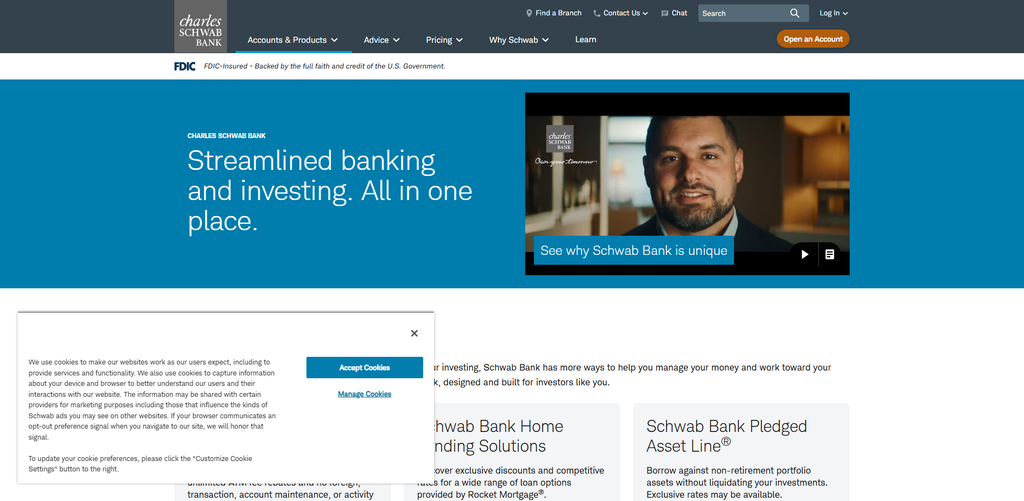
Digital banking features include mobile check deposit, transfers, bill pay and integration with investing accounts. It doesn’t emphasize opening accounts with foreign addresses, so applicants usually need a U.S. address and ID. International wires are offered, but recipient and intermediary banks may charge separate fees.
Advantages
- Unlimited ATM fee reimbursements on eligible cash withdrawals globally.
- No foreign transaction fees on eligible debit card purchases.
- There is no monthly service charge on Investor Checking.
- No minimum balance required on linked checking and brokerage accounts.
- Easy money movement between checking and brokerage accounts.
Best For
- Expats who regularly withdraw cash abroad.
- US citizens abroad who require everyday checking services.
- International travelers looking to save on ATM fees.
- Investors seeking banking and brokerage services under one roof.
2. Citi bank
Citibank is a large global bank with a large network of branches in the U.S. and internationally that can be useful if you move between countries. It offers checking, savings, credit cards, CDs and wealth-management services, with premium tiers like Citigold. Digital banking features a strong mobile app, international transfers and foreign currency services. Support for foreign addresses depends on product and residency status.
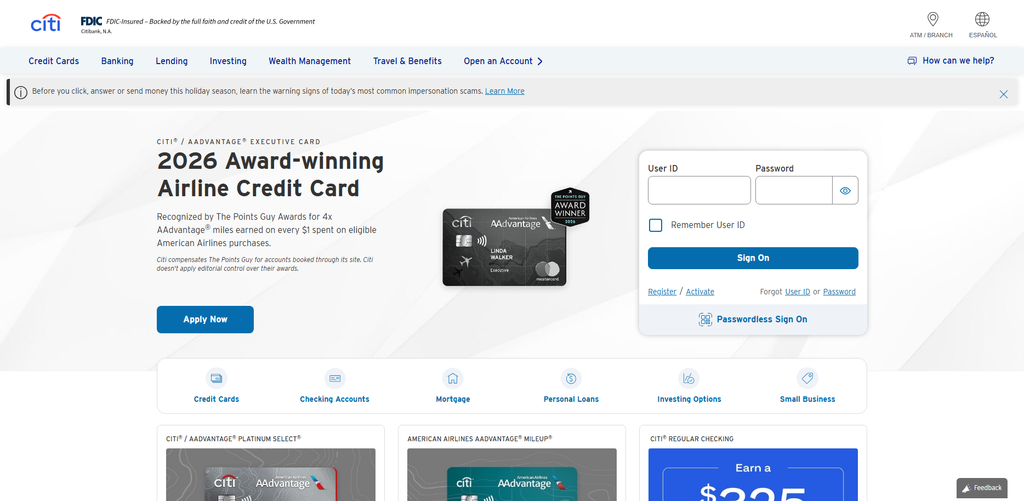
Non-U.S. residents may be required to provide additional documentation and meet eligibility requirements. Access to international ATMs will depend on the account and the network of the card, and fees for foreign currency transactions and wires will vary by account type. Minimum-balance requirements are usually attached to premium relationship levels, not basic checking. Please check with Citibank on current terms before applying.
Advantages
- A variety of checking and savings account options.
- Offers international wire transfer services.
- Offers premium relationship banking with qualifying account levels.
- Offers online and mobile banking facilities.
- Provides international banking support with its global network.
Ideal For
- Expatriates with financial interests in the United States.
- Customers who need to transfer money abroad.
- Customers with high balances looking for premium banking services.
- Existing Citi customers requiring cross-border banking support.
3. HSBC Bank USA
HSBC Bank USA is a cross-border bank. We offer U.S. accounts to customers moving to the United States, or moving from the United States. Its Premier Checking helps customers set up banking before they arrive and offers international account opening in eligible locations. Account types include checking, savings, credit cards, and Premier relationship banking.
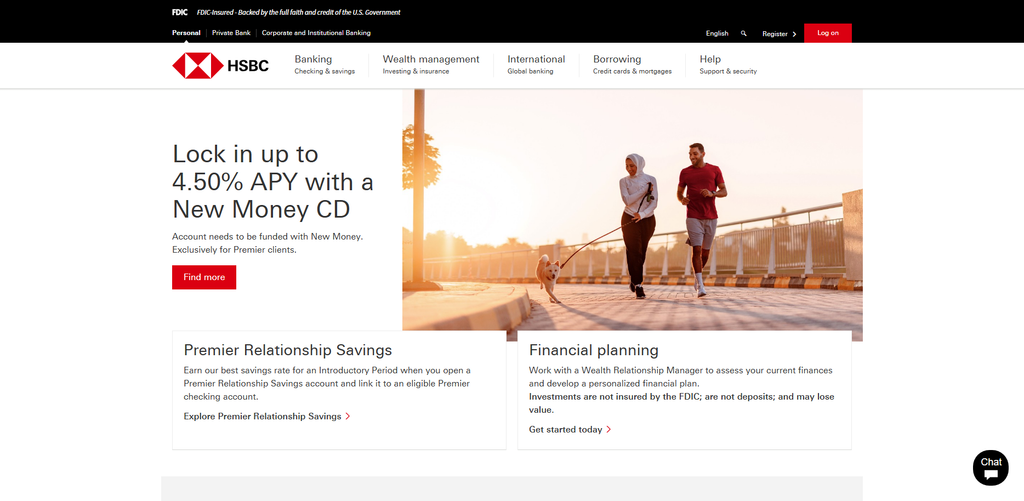
To avoid a $50 monthly fee, Premier requires a $100,000 relationship balance or $5,000 in monthly direct deposits. HSBC’s Premier credit card has no foreign transaction fee, but debit-card foreign transactions may incur an exchange-related charge.
It excels at sending money internationally, supporting a range of countries and opening accounts overseas, although your eligibility and the countries available will depend on your location.
Advantages
- Provides HSBC Premier relationship banking.
- Offers international banking services to qualified clients.
- Accepts international wire transfers.
- Provides online account management and mobile access.
- Access to HSBC’s global banking relationships.
Ideal For
- Expatriates with significant international banking needs.
- Customers with accounts in different countries.
- Meeting for High Income Professionals Premier Eligibility Criteria
- International relationship banking for families.
4. State Department Federal Credit Union
State Department Federal Credit Union (SDFCU) is a member-owned credit union of special interest to U.S. government employees, contractors and eligible family members, many of whom live overseas. It provides checking, savings, credit cards, loans and digital banking. SDFCU supports members living abroad and provides international outgoing wire services for a $35 fee.
Its credit cards do not charge foreign transaction fees, and eligible Privilege or Advantage checking members can be reimbursed for ATM and international service assessments, subject to balance, direct deposit, debit transaction and eStatement requirements. The minimum balances for those benefits are $25,000 for Privilege and $2,000 for Advantage. It’s expat friendly, with its overseas focus, fee reimbursements and remote service.
Advantages
- Offers checking and savings account options.
- Provides online and mobile banking facilities.
- Assists eligible overseas members.
- debit-card access is provided for day-to-day transactions.
- Provide financial services to qualified international and government-connected members.
Best Suited For:
- U.S. citizens working abroad who are eligible.
- Banking services for expats at credit unions.
- U.S. Government employees residing abroad.
- Members who want easy online banking when they’re overseas.
5. Fidelity
Fidelity’s Cash Management Account is a brokerage-linked cash account, not a traditional bank checking account, although it has many banking-like features. There are no minimum balances, no monthly fee, no foreign debit transaction fee and unlimited reimbursement of ATM fees charged by other institutions for its Visa, Plus or Star network debit card.
Customers can make transfers to Fidelity brokerage accounts, write checks, use mobile banking and bill pay, and set up direct deposit. Fidelity does not charge foreign transaction fees, but if you opt to pay for your transactions in U.S. dollars while traveling abroad, you may receive an unfavorable conversion rate. Before you use it as your primary overseas banking account check if it is eligible for international wires and foreign addresses.
Perks
- Provides a Cash Management Account for daily money management.
- Worldwide ATM fee reimbursements (eligible accounts only).
- No foreign debit transaction fees.
- Offers check writing & online bill pay.
- Cash management integrated with investment accounts.
Best For
- Investment focused expats.
- Customers managing investments and cash from one place.
- International travelers who need ATM access.
- US investors wanting integrated financial management.
6. Capital One
U.S. digital-first bank Capital One offers checking, savings, credit cards and auto loans. Capital One does not charge an extra fee for foreign-currency or cross-border debit transactions for its 360 Checking and MONEY Checking accounts, and Capital One says its U.S.-issued credit cards do not charge foreign transaction fees. For non-360 accounts, there will be a $2 plus 3% fee for international ATM withdrawals.
The operator of an out-of-network ATM may also charge its own fee. Digital banking is strong with mobile deposits, Zelle, transfers and card controls. Capital One generally requires a U.S. address and does not present itself as a full cross-border banking provider. International wires are available, but may include fees and exchange rate costs.
Advantages
- Provides 360° Options for checking and savings accounts.
- No foreign transaction fees on eligible debit card purchases.
- Provides online and mobile banking.
- Allows for payment via digital wallet.
- Gives access to alerts on account and transaction tracking.
Best For
- Expats who already have a Capital One account.
- International card purchases from customers in the US.
- Digital bank users.
- Customers who want everyday checking accounts with no monthly maintenance fees.
7. Bank of America
Bank of America is one of the largest banks in the U.S. It offers checking, savings, credit cards, mortgages, investment services and a large branch and ATM network. Its checking accounts include SafeBalance, Advantage Banking and relationship-based tiers.
When you use your debit card to make a purchase abroad, you’ll typically pay a 3% international transaction fee. And if you use a non-Bank of America international ATM (unless it’s in an eligible partner network), you’ll typically pay a $5 fee.
International wires cost $45 if sent in U.S. dollars, but foreign-currency wires have no outbound wire fee but do incur exchange-rate markups. SafeBalance has different minimum-balance rules for each account. The daily balance must be $500 or you must qualify for the waiver of the monthly fee.
Advantages
- Multiple checking and savings account options are offered.
- Supports international wire transfers to send money.
- Mobile check deposits and online banking.
- Debit card can be used for international purchases.
- Offers relationship banking benefits with eligible account programs.
Ideal For
- Expats who retain their US bank relationships.
- Customers making international wire transfers.
- People who run savings in the US.
- Customers who prefer the traditional and established banking services.
8. JPMorgan Chase Bank
Chase is a national bank that offers a wide variety of financial services to nearly half of U.S. households, including personal banking, credit cards, mortgages, investing with J.P. Morgan and business banking. Its consumer checking products are Chase Total Checking, Premier Plus Checking and Sapphire Banking. Chase charges $5 for each withdrawal made at non-Chase ATMs outside the U.S.
A foreign exchange rate adjustment may be applied on foreign-currency ATM withdrawals. Foreign transaction fees vary by card and account type, so travelers should check the specific disclosure. Chase digital banking does have international wire transfers but fees and exchange margins vary. Minimum balance requirements may vary by account and can be waived with direct deposits, linked investments or relationship balances. Chase is convenient for domestic use but less optimized for low-cost international ATM withdrawals.
Advantages
- Provides a variety of checking and savings accounts.
- Offers international wire transfer services.
- Mobile banking and digital account management are supported.
- Offers debit-card access for overseas transactions.
- Access to a broad US banking network.
Best For<br
- Chase accounts for existing expats.
- Customers who budget their income and expenses in the US.
- People who want to send money abroad.
- Customers who like traditional US banking services.
9. Wells Fargo
Wells Fargo is a large, full-service U.S. bank offering checking, savings, credit cards, mortgages, investment services and business banking. Its Everyday Checking, Prime Checking and Premier Checking accounts serve a range of customer needs and typically come with monthly fees that can be waived with direct deposits, minimum balances or linked products.
Wells Fargo provides support for international wire transfers through online and mobile banking, but wire fees, correspondent bank fees and exchange rate markups may apply. Some of its debit and credit cards may charge foreign transaction fees depending on the product.
Card networks provide broad international access to ATMs, but out-of-network and foreign ATM fees may apply. For customers seeking a traditional U.S. bank, rather than a dedicated expat banking solution, Wells Fargo is best.
Benefits
- Provides checking and savings accounts.
- Supports domestic and international wiring.
- Mobile banking and online account management.
- Offers debit-card services for qualifying international transactions.
- Provides different account types to suit different banking needs.
Great For
- Wells Fargo accounts currently owned by expats.
- US customers with financial obligations.
- Individuals needing facilities for international wire transfers.
- Customers who want traditional checking and savings services
10. Navy Federal Credit Union
Navy Federal Credit Union is the largest U.S. credit union, serving military members, veterans, Department of Defense employees and eligible family members. Checking, savings, certificates, credit cards, auto loans, mortgages, and digital banking are available. Its checking accounts are generally low-cost, and its debit and credit cards charge a 1% foreign transaction fee on foreign transactions including foreign ATM withdrawals.
International wires sent abroad are $25. Navy Federal has a large ATM network and mobile banking, but membership is limited to military and their communities. Minimum-balance requirements vary by product, although many checking accounts have no ongoing minimum. It is a practical option for eligible service members living or stationed overseas.
Advantages**
- Provides checking and savings accounts to qualified members.
- Digital banking: Access your account from anywhere in the world.
- Support of international debit-card transactions.
- Mobile check deposits and online banking.
- Serves military-connected communities with financial services.
Best for
- U.S. military personnel stationed overseas.
- Veterans living outside of the United States.
- Eligible Department of Defense employees stationed abroad.
- U.S. banking access for military families residing overseas.
Conclusion
Choosing the best US bank for expats living abroad depends on international accessibility, banking fees, ATM benefits, money transfer options, and account eligibility. Charles Schwab is a strong option for worldwide ATM access, while Citibank and HSBC provide international banking services for eligible customers. SDFCU and Navy Federal offer alternatives for qualifying members, whereas Fidelity supports investment-focused cash management.
Before selecting a bank, expats should compare foreign transaction fees, minimum balance requirements, documentation, and overseas address policies. Ultimately, the right account should provide convenient access to US dollars and reliable banking services while living overseas.
FAQ
What is the best US bank for expats living abroad?
Charles Schwab Bank is a strong option for expats because it offers worldwide ATM fee reimbursements and no foreign transaction fees on eligible debit-card purchases.
Can US citizens maintain a bank account while living abroad?
Yes, many US citizens can maintain existing US bank accounts while living overseas. However, account access depends on the bank’s residency policies and country restrictions.
Which US bank offers free international ATM withdrawals?
Charles Schwab Bank offers unlimited ATM fee reimbursements worldwide on eligible Investor Checking accounts, making it attractive for international travelers and expats.
Can expats open a US bank account without a US address?
Some financial institutions may accept foreign residential addresses, but many traditional US banks require a US residential address for new account applications.
Do US banks charge foreign transaction fees?
Some banks charge foreign transaction fees on international debit-card purchases, while others, including Charles Schwab and eligible Capital One accounts, offer no foreign transaction fees.