
Investing in fine art is emerging as an interesting option for individuals seeking to diversify their portfolios beyond traditional stocks, bonds and real estate. With the growth of digital investment platforms, fractional ownership and specialized investment opportunities are opening up access to valuable paintings and established artists.
In this article, I will discuss the Best Fine Art Investment Platforms and their key features, investment models, minimum requirements, and limitations to help you understand which options may fit your investment goals.
How to Choose the Best Fine Art Investment Platform?
Investment Model: Select a platform that clearly outlines its investment model, whether it be fractional ownership, art funds, tokenized assets, or direct artwork purchases.
Minimum Investment: Compare the minimum investment requirements to ensure the platform fits within your budget without requiring too much capital or compromising your financial flexibility.
Artwork Selection: Check the categories of artwork available, the reputation of the artist, the historical performance in the market and the selection process before you commit your investment.
Ownership Rights: Check the legal documents on ownership, the shareholder agreements, the token rights and the investor entitlements, so you know exactly what you own.
Fees and Charges: Check management fees, transaction costs, performance fees, storage costs and any other charges that may eat into your overall investment returns.
Authentication and Security: Choose platforms that can authenticate artwork, verify provenance, professionally value pieces, securely store them, and provide adequate insurance.
Liquidity and Exit Options: Research secondary markets, resale options, redemption terms, lock-in periods, and withdrawal restrictions before investing in art.
Regulation and Investor Eligibility: Check the platform’s regulatory status, where it operates, who can invest and what legal protections exist to make sure the investment structure suits your situation.
Are Fine Art Investment Sites Worth It?
Fine art investment platforms can be a good option for investors looking for alternative investment opportunities and portfolio diversification beyond traditional assets like stocks and bonds. Through fractional ownership they provide investors access to valuable works of art without the need to purchase entire paintings or sculptures. They also provide professional services, such as artwork selection, authentication, storage and management, on many platforms.
Investing in fine art involves risks, such as uncertain valuations, limited liquidity, management fees, and unpredictable resale prices. Other platforms have minimum investment requirements and geographical restrictions. As such, investors must compare ownership structures, fees, platform credibility and exit options before investing. Fine art platforms can be a good option for investors who have a long-term investment horizon, who understand the risks and who don’t need immediate access to their capital.
Key Points
| Platform | Key Points |
|---|---|
| Masterworks | Provides shares in high-value artworks by established artists, with SEC-qualified investment offerings and a secondary trading market. |
| Mintus | Offers shared ownership opportunities in investment-grade artworks, particularly contemporary and blue-chip art. |
| Artemundi | Focuses on acquiring, managing, and investing in valuable artworks through specialist investment structures and art funds. |
| Splint Invest | Provides fractional investment opportunities in selected tangible assets, including art and other collectibles. |
| ARTEX Global Markets | Develops regulated financial-market infrastructure for trading securities linked to individual artworks. |
| Artory | Combines art-market information, provenance records, and technology supporting transparency in art transactions and investment structures. |
| ArtSplit | Uses technology to provide access to fractional ownership opportunities, with a focus on African artworks. |
| LondonTradeArt (LTArt) | Focuses on investment opportunities involving valuable artworks and fractional ownership structures. |
| ArtSharing | Offers blockchain-based fractions of physical artworks, with tokenized ownership and USDC settlement. |
| Matis | Uses digital investment infrastructure to support fractional ownership and investment opportunities in artworks. |
1. Great Works
Masterworks is a U.S. fractional-art platform that allows investors to purchase shares in individual blue-chip paintings, often from established artists such as Basquiat, Picasso and Warhol. It models its investment on SEC-qualified offerings, with each artwork held in its own entity, with shares starting at $20. Minimum investment may be higher or lower depending on the offering and investor status.
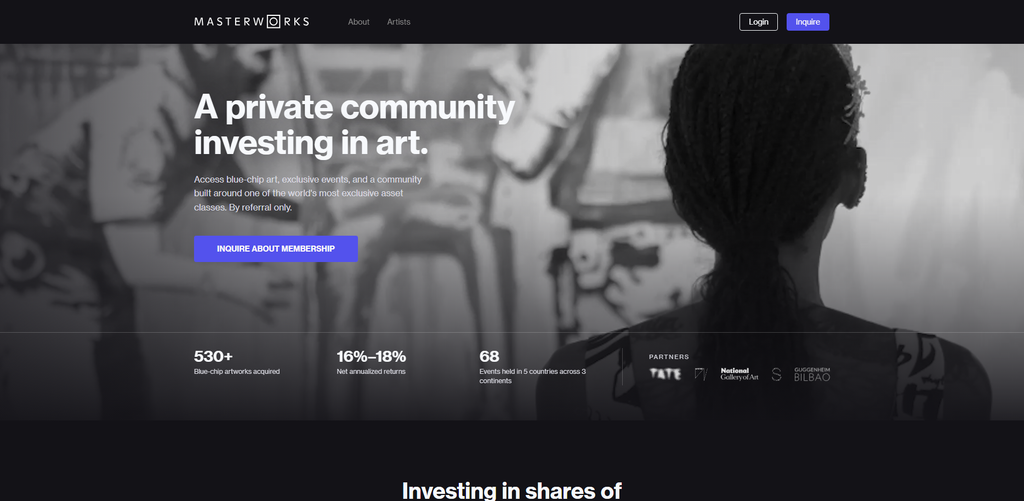
Masterworks chooses works from its proprietary market data and seeks museum-quality works that could appreciate in value. Fees generally include an initial allocation of costs, an annual management fee of 1.5% paid in shares and 20% of the profit on sale. Liquidity is limited: investors typically wait for a sale, although a secondary market has been provided.
Main Features
- Provides fractional investments in high-value contemporary and blue-chip art.
- Packages discrete art investments into individual Series LLCs.
- Offers shares in art works via securities offerings including Regulation A+ offerings.
- Offers professional artwork sourcing, insurance, storage and portfolio administration.
- Access to artwork research, artist market analysis and potential secondary share trading.
Limitations
- Investment opportunities may require an application and a membership sponsorship.
- Investors’ returns can be eroded by annual management fees and profit-sharing charges.
- The holding period for artwork investments is long and uncertain.
- There is no guaranty of secondary-market liquidity and investors may find it difficult to sell shares.
2. Mintus
Mintus is a fractional art-investment platform based in the UK that allows investors to co-own high-value artworks through special-purpose investment structures. It focuses on established, investment-grade works, generally by recognized modern and contemporary artists, selected through specialist art-market analysis. The minimum investment is listed as $3,000 but individual investments tend to range from $15,000 to $100,000.
The fees are set out in the relevant memorandum and are dependent on the artwork and the investment structure. Reported structures can include management charges, exit charges and performance related charges. Artworks are held for a specific investment period, with returns realized on the sale of the work, so liquidity is usually restricted. Mintus does not widely promote a constant secondary market.
Main Features
- “Previously provided fractional investment opportunities in high-value contemporary art.
- Investment vehicles that gave investors access to individual artworks.
- Concentrated on blue chip artists and investment grade contemporary art.
- Furnished artwork details and investment documents for individual offerings.
- Provided secondary market trading opportunities during designated trading windows.
Restrictions
- Its investment platform is reportedly inactive so do not assume new investment is available.
- It was previously FCA authorized but this was canceled.
- Secondary market liquidity and investor exits are unknown.
- Existing investors can contact the company or its appointed representatives in relation to their holdings.
3. Artemundi
Artemundi is a global art investment manager, providing art funds, fractional ownership and art-backed lending. Their traditional fund model is built around museum-quality works by established artists and utilizes a diversified portfolio approach to preserve and grow wealth. The Guernica V Fund was initially asking for about $200,000, but later resources listed $250,000 for individuals and $1 million for institutions.
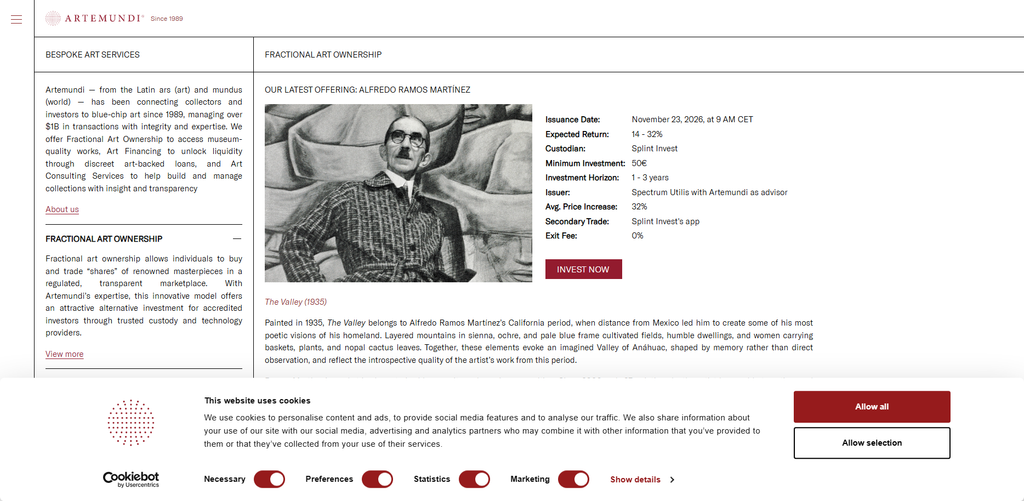
The fund structure has included a 2% annual management fee and a 20% performance fee above a 6% preferred return, while co-investment materials also describe profit-linked consulting and transactional fees of 2%-10%. Closed-end funds have limited liquidity, but Artemundi enables eligible offerings with tokenized fractional shares and secondary-market trading.
Main Features
- Specializes in Impressionist, Modern, Post-War and late 20th century art.
- Provides fractional ownership of art through investment partners.
- Provides art-backed financing solutions for collectors looking to unlock liquidity.
- Provides services for art consulting, collection management and professional appraisals.
- Concentrates on well-known artists with proven market histories and collector interest.
Limitations
- Certain fractional investment opportunities are available to accredited investors only.
- Investment availability depends on partner platforms and offerings.
- Art-backed financing has collateral valuations and repayment obligations,
- It can take a long time to sell artwork investments at a profit.
4. Splint Invest
Splint Invest is a Swiss-based alternative-asset platform offering fractional investments in art, wine, luxury handbags and classic cars. Investors purchase “Splints” – fractional units supported by selected physical assets – giving more people access to high-value art. It’s one of the lowest entry art platforms, with a minimum investment of €50. Artwork selection is based on curated assets with established investment strategies.
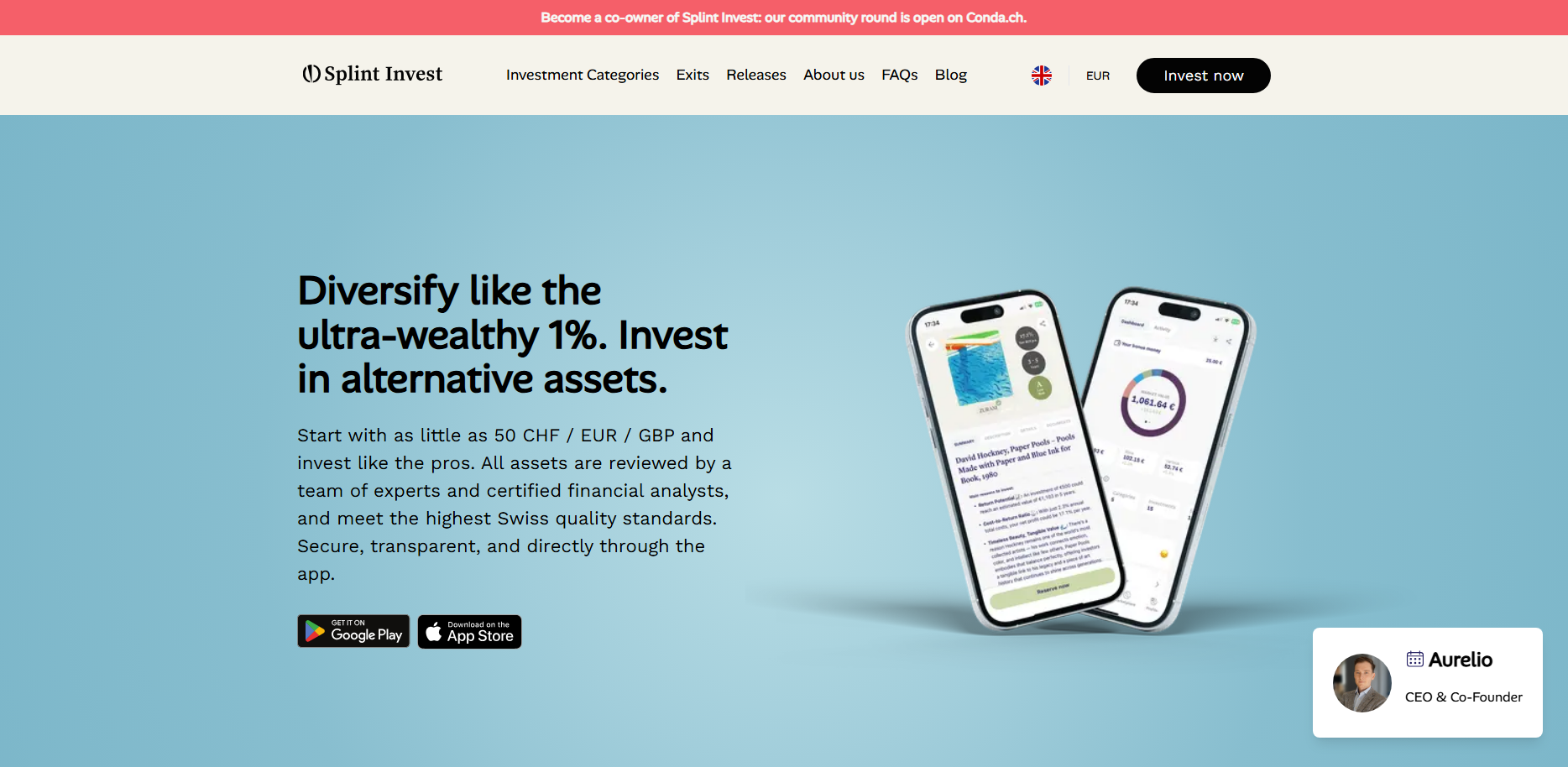
But investors need to consider the underlying artist, condition, valuation and storage arrangements. Splint charges a platform fee which is typically between 4% and 10% of the amount invested. The company recognizes that alternative assets are inherently illiquid, exits are driven by scheduled sale events or secondary market availability, and early selling may include a liquidity premium.
Key Features
- Provides fractional ownership of physical art and other alternative assets.
- Investors can start investing from €50, CHF 50 or GBP 50.
- Offers asset information and valuations for expert-chosen investment opportunities.-
- Responsible for the safe custody, insurance and storage of physical assets.
- Provides an investment marketplace and portfolio tracking on its mobile platform.
Limitations
- You can invest only in the assets that are listed on the platform.
- Transaction fees are usually in the range of 4-10% of the amount invested.
- Physical alternative assets may involve long holding periods and limited liquidity.
- The investment return is driven by the final sale price and the costs involved
5. ARTEX Global Markets
ARTEX Global Markets is a regulated marketplace in Liechtenstein for trading shares in individual high value artworks. Instead of running a traditional fund, it allows investors to buy and sell fractional shares in individual works of art on its multilateral trading facility. Minimum investments depend on the category: its site lists $1,000 for contemporary art, $500 for photography and $100 for digital art.
ARTEX focuses on large, high-value pieces, with its first listed work being a Francis Bacon painting broken up into 550,000 shares at $100 each to start with. Listing fees are reportedly 3%, with a trading fee of 0.25%. Shareholders don’t pay custody, administration or insurance fees. Its exchange structure has more liquidity potential than private fractional platforms.
Highlights
- Operates a regulated multilateral trading facility for art securities.
- Grants access to trading shares in companies that own selected artworks.
- Under the supervision of the Liechtenstein Financial Market Supervisory Authority.
- Utilizes existing financial market infrastructure built for trading regulated securities.
- Designed to enhance accessibility and possible liquidity of the fine art investment market.
Limitations
- Access is mainly structured for eligible market participants and qualified financial institutions.
- The trading facility may be used only for trading in securities admitted to the trading facility.
- Trading liquidity depends on market participation and on the existence of buyers and sellers.
- Investors are still exposed to the risks of valuation, market and investment in artwork.Just to say I’m forwarding the info you asked for.
6. Artory
Artory is mainly a provenance, authentication and registry platform using blockchain-based records to track the history and ownership of art and collectibles. Among its investment-related activities is the Artory/Winston Art Fund, a joint venture with art advisory firm Winston Art Group, for accredited and institutional investors. The fund model is not about fractional ownership of individual works, but rather a diversified portfolio of emerging, mid-career and established contemporary artists.
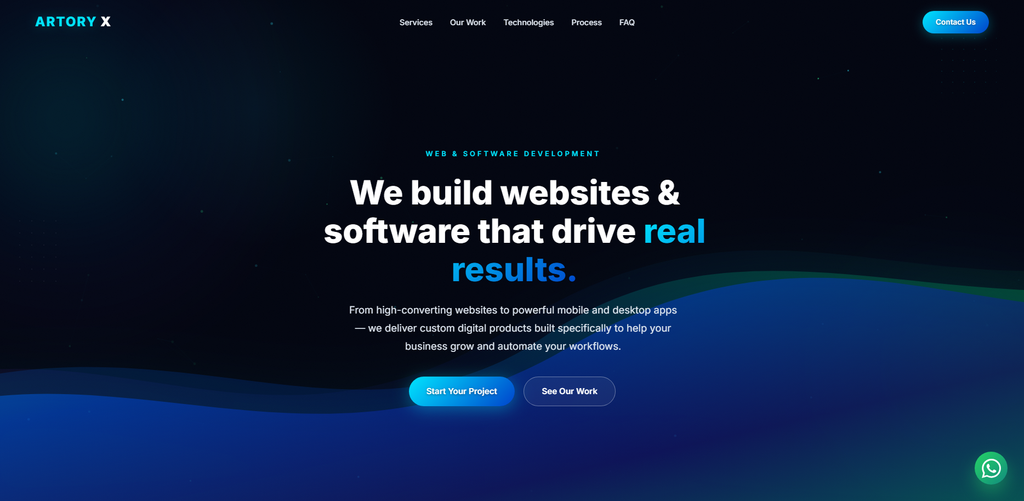
Minimum investment and fees vary by fund or offering and are not widely advertised. The vehicle is a private art fund and liquidity is expected to be limited. Typically exits are via sales of artwork or winding down of the fund, not through daily trading. The core value of Artory is verified provenance and transparent ownership records.
Features
- Provides provenance and ownership records of the artwork on blockchain.
- Keeps a full record of art market transactions and history.
- Provides digital certification and art due diligence technology.
- Facilitates verification of artwork information using expert and institutional data sources.
- Assists in the creation of physical artworks and collectibles for tokenization and financial use.
Limitations
- It is more of an art-market technology infrastructure than a typical retail investment platform.
- Does not automatically offer fractional investment opportunities on all recorded artworks.
- The blockchain entries alone do not guaranty the authenticity of the physical artworks.
- Its access to investment opportunities depends on its financial and institutional partners.
7. ArtSplit
ArtSplit is an art fractional ownership platform, allowing multiple investors to co-own selected art pieces. Its model typically divides a work into units of digital or contractual ownership, enabling participants to gain exposure without buying an entire painting. Artwork selection tends to favor contemporary and emerging artists, with curation aiming for a mix of accessibility and potential appreciation.
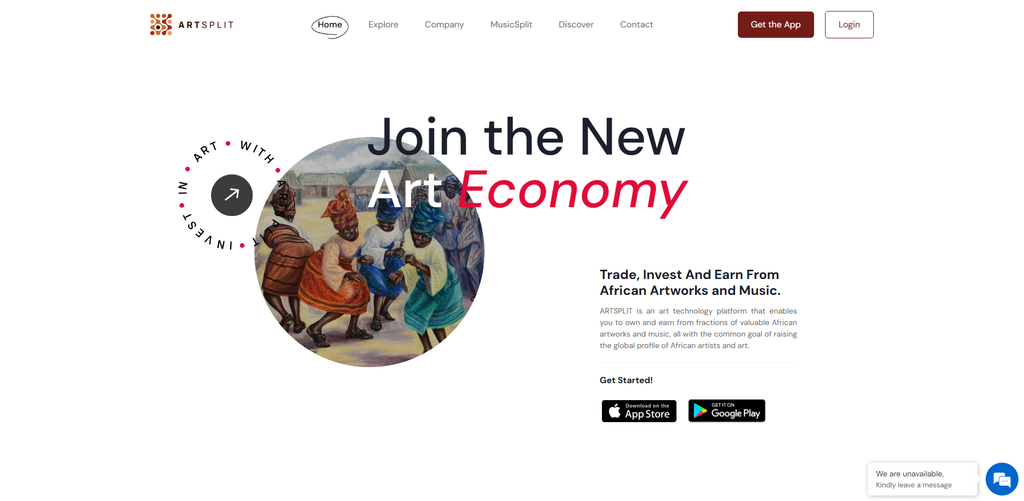
There is no public information on minimum investment, exact fee schedules, or current liquidity mechanisms, so investors should check the platform’s live terms before committing. Fees can include platform, transaction, custody, insurance and resale fees.
Exit options may include resale managed by the platform, peer-to-peer transfers or sale of the underlying artwork, but liquidity is likely to be thinner than on a regulated exchange.
Key Features
- Focuses on fractional ownership opportunities in African art.
- Creates 100,000 investment units, called Splits, of chosen artworks.
- Provides primary auction and secondary market trading capabilities.
- Provides artwork leasing options and temporary physical custody opportunities.-
- Introduces an art-backed lending model where eligible artworks can be used as collateral.
Limitations
- African art and related creative assets are the primary investment opportunities.-
- Secondary-market trading depends on the availability of buyers and sellers.
- Artwork pricing and resale values can be difficult to predict.
- Custody and leasing of physical artwork is defined by the terms of the contract
8. LondonTradeArt (LTArt)
LTArt, London TradeArt is a UK art market platform combining art investment, advisory and marketplace services. Its goal is to connect collectors and investors with artworks, providing research, valuation and transaction assistance. Its investment model can feature direct purchases, fractional or co-ownership opportunities, and curated art portfolios, depending on the offering.
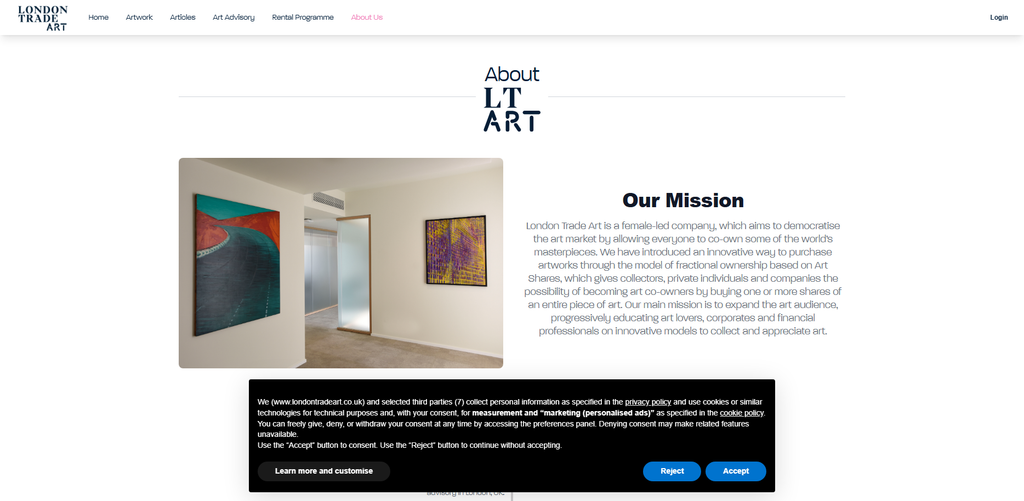
Fees and minimum investment amounts are not always published across offerings, so prospective investors should request to see the current term sheet. In most cases the selection of artwork is contemporary and investment-oriented, often assisted by analysis from experts and provenance checks.
Structure drives liquidity: direct ownership can be sold through galleries, auctions or private sales, whereas fractional holdings may have more limited exit routes. Valuations and fees should be independently verified.
Main Features
- Provides fractional ownership in expensive art pieces.
- Splits selected artworks into smaller Art Shares for shared ownership.
- Records ownership arrangements with intelligent contracts linked to blockchain.
- Issues digital ownership certificates, co-ownership agreements.- Oversees storage,
- insurance, maintenance and temporary custody of artwork opportunities.
Restrictions
- You’re not guarantyd an immediate resale when you have fractional ownership.
- The investment opportunities are determined by the artwork available in its marketplace.
- Investors have the same rights and liabilities as other co-owners.
- The art exchange and secondary trading functions of the platform are not to be assumed to be fully operational.
9. ArtShare
ArtSharing is a platform that promotes art ownership, promotion and investment through community-based art sharing services. Its model could enable investors or collectors to take part in some artworks, exhibitions or artist-led projects, with the aim of making art more accessible. It is not quite as clearly positioned as a regulated fractional investment exchange like Masterworks, Mintus or ARTEX, so its offerings can vary widely by project.
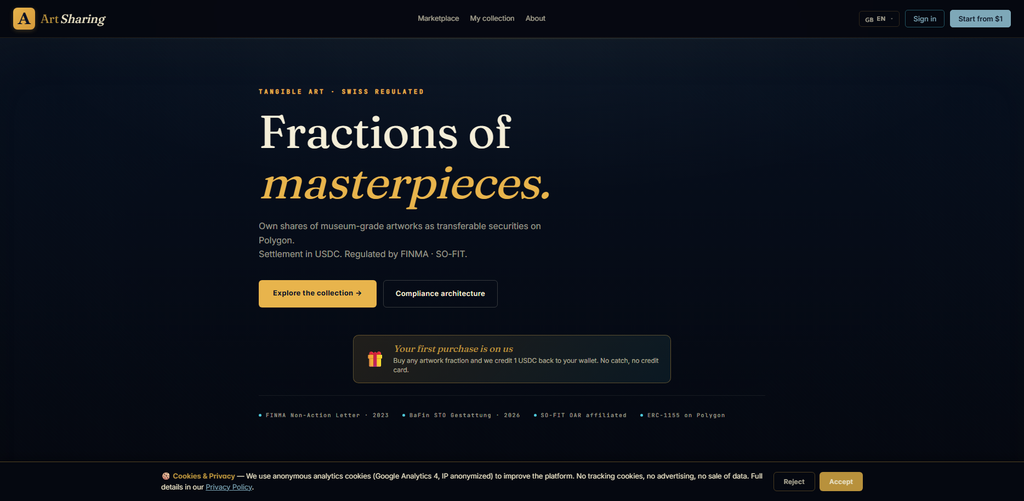
Minimum investment, fee structure, artwork selection criteria and exit terms are not widely standardized in public materials. Investors should therefore check whether they are buying direct ownership, revenue share, tokenized interest or other contractual right. Liquidity can be limited with exits typically reliant on resale demand, platform facilitation or eventual sale of the artwork.
Highlights
- Provides fractional economic ownership of physical fine art.
- Fractionalizes art via ERC-1155 tokens on the Polygon blockchain.
- Enables USDC-based transaction finality.
- Provides custody documentation and physical protection of artwork arrangements.
- Provides for transferability of art securities and secondary market functionality, subject to applicable jurisdictional restrictions.
Limitations
- Eligibility for investment access is subject to jurisdictional and regulatory requirements.
- Transactions need to know about digital wallets and the infrastructure of blockchain.
- USDC settlement raises additional digital asset and operational issues.
- There are no assurances of buyers, liquidity or profitable exits in secondary market transfers.
10. Matis
Matis is a French art co-investment platform providing access to major 20th century and contemporary artworks via convertible bonds issued by companies that own individual works. Its investment model therefore offers contractual claims attached to a piece of art, rather than simple fractional title. Investment opportunities start at €20,000, although some marketing materials speak of initial participation of a few thousand euros depending on the offer.
Matis curates works from the prestige world and presents each opportunity with auction or purchase price information. Included in the offer amount is a 5% commission on receiving and transmitting orders and a 5% commission on investment services listed in its public fee schedule. Returns are dependent upon the eventual sale of the artwork or repayment of the bond; liquidity is limited and investors should carefully review maturity, redemption and resale provisions.
Major features
- Focuses on investment opportunities in 19th and 20th century artists with established reputations.
- Provides access to works by artists such as Andy Warhol, Yves Klein and Yayoi Kusama.
- Structures individual art work investments through project companies and convertible bonds
- Offers investment opportunities from €20,000.
- Works with specialist international galleries to assist with artwork resale and investor exits.
Constraints
- It has a rather high minimum investment for individual investors.
- Investment opportunities are dependent on availability of selected artwork offerings.
- Target investment periods can extend beyond the expected 24 months, up to 5 years.
- Service charges and performance fees ate into any possible returns for investors.But the other side of the house was the other side of the house.
Conclusion
Fine art investment platforms allow investors to access valuable art works via fractional ownership, investment funds, tokenization, and professional art management. Masterworks, Artemundi, Splint Invest, ARTEX Global Markets, ArtSplit, and Matis platforms have different investment structures and artwork opportunities.
However, investors need to weigh up minimum investment requirements, ownership rights, management fees, authentication, storage and liquidity options. Market uncertainty is inherent in art investments and they may need long holding periods, with no guaranty of returns. Ultimately, the “best” fine art investment platform will depend on your budget, investment goals, risk appetite, and preferred ownership model.
FAQ
What are the best fine art investment platforms in 2026?
Some notable fine art investment platforms include Masterworks, Artemundi, Splint Invest, ARTEX Global Markets, ArtSplit, LondonTradeArt, ArtSharing, and Matis. Each offers different investment structures and artwork opportunities.
Can beginners invest in fine art?
Yes, beginners can access fine art investments through platforms offering fractional ownership. However, they should understand investment risks, fees, ownership rights, and holding periods before investing.
What is fractional art ownership?
Fractional art ownership allows multiple investors to purchase shares or units representing an interest in a valuable artwork instead of buying the entire piece individually.
What is the minimum investment required for fine art platforms?
Minimum investments vary by platform and offering. Some fractional investment opportunities start with relatively small amounts, while others, such as Matis, have offered investments starting at €20,000.
Are fine art investment platforms safe?
Safety depends on platform credibility, legal ownership structures, artwork authentication, insurance, custody arrangements, and regulatory compliance. Art investments still carry financial risks and do not guarantee returns.