In this article I will discuss the Top Gnosis Pay Rivals for Self-Custody Visa Cards and some of the top crypto card alternatives like MetaMask Card, ether.fi Cash, Bleap, Tria, 1inch Card, Coinbase Card and more. We will be looking at their custody models, card networks, accepted cryptos, payment methods, fees, availability, KYC requirements, and key features, to see how each option compares.
What Is Gnosis Pay Rivals?
Gnosis Pay competitors Crypto payment cards and platforms offer an alternative for users who want to spend digital currency via traditional card networks like Visa or Mastercard. These alternatives can vary greatly in custody, wallet integration, cryptocurrency support, payment conversion, fees, rewards and geographic availability.
Certain products offer self-custodial options where users can hold their assets until they pay, while others run on custodial or hybrid models. Some of the popular examples are MetaMask Card, ether.fi Cash, Bleap, Tria, 1inch Card, Coinbase Card, and Plutus. It helps users to compare their architectures and payment features and understand their differences.
Key Points
| Gnosis Pay Rival | Category |
|---|---|
| MetaMask Card | Self-Custody Crypto Card |
| ether.fi Cash | Self-Custody Visa Card |
| Bleap Card | Self-Custody Mastercard |
| Tria Card | Self-Custody Visa Card |
| Kolo Card | Wallet-Connected Crypto Card |
| Monolith Card | Non-Custodial Crypto Card |
| 1inch Card | Web3 Payment Card |
| Crypto.com Visa Card | Crypto Debit Card |
| Coinbase Card | Crypto Debit Card |
| Plutus Card | Crypto Rewards Card |
1. MetaMask Card
MetaMask Card – A product of MetaMask, founded in 2016, launched in 2025 after its pilot. It is a self-custodial model that is directly connected to the MetaMask wallet. Built on Mastercard and supporting assets such as mUSD, wETH, EURe, GBPe, USDC and USDT across Linea, Base, Monad and Solana.


Payment is in local currency after conversion from crypto. The Virtual Card is fee-free, while Metal costs $199 per year. Available in selected countries, subject to KYC and regional eligibility requirements.
MetaMask Card Features Features
- Self-Custody: Your funds sit in your MetaMask wallet until payment.
- Mastercard Network: Where Mastercard is accepted.
- Direct Crypto Spending: Turns supported crypto into local currency at the point of sale.
- Supported assets: mUSD, wETH, EURe, GBPe, USDC and USDT.
- Mobile Payments: Apple Pay and Google Pay are supported.
| Pros | Cons |
|---|---|
| Directly connected to a self-custodial MetaMask wallet | New card sign-ups are restricted in some regions |
| Supports spending through Mastercard | Virtual card has a transaction fee |
| Supports Apple Pay and Google Pay | Metal version costs $199 annually |
| Crypto converts at the point of payment | Supported tokens and networks are limited |
| Offers 1%–3% mUSD cashback | Features vary by country |
2. ether.fi Cash
ether.fi Cash ether.fi was launched in 2023 and is a crypto-native non-custodial Visa credit card. You can fund a Safe for Direct Pay using supported stablecoins, or use eligible crypto as collateral to borrow USDC via Credit Mode. The card supports physical and virtual cards and requires identity verification.

Unlike traditional custodial cards, ether.fi says users are still responsible for the assets in their wallets and collateral. The fees may include applicable borrowing interest, protocol related costs and disclosed transaction markups. Availability is dependent on jurisdiction and supported areas.
ether.fi Cash Features
- Visa Credit Card: We take Visa wherever it is accepted.
- Crypto-Native Spending: Spend using Direct Pay or Credit Mode.
- Safe Wallet: Deposit tokens into a Safe to spend or use as collateral.
- Flexible Limits: Users can create limits for daily and monthly spending.
- Cards (Virtual & Physical): Virtual and Physical cards will be issued post KYC.
| Pros | Cons |
|---|---|
| Supports self-custodial Safe-based spending | KYC is required |
| Available as virtual and physical Visa cards | Physical Core card has a $50 fee |
| Offers Direct Pay and Credit/Borrow modes | Borrowing introduces collateral and liquidation considerations |
| Users can set daily and monthly limits | Product availability varies by jurisdiction |
| Cashback and Visa benefits are available | Membership tiers affect benefits |
3. Bleap Card
Bleap Card is a non-custodial Mastercard for spending from a Bleap wallet, the product launched through Bleap’s Mastercard partnership in 2025. Its custody model means wallet assets remain with users, while card payments are processed using supported USD/EUR balances and stable assets such as USDC and EURC.
You won’t pay a Bleap transaction fee on card spending and it claims 0% FX fees. Compatible with Apple Pay and Google Pay, onboarding and availability vary by region; identity requirements may vary by product or jurisdiction.
Bleap Card Features
- Non-Custodial Wallet: You control your connected assets.
Mastercard Acceptance: Mastercard merchants can use it in all markets where the service is enabled.
Point-of-Sale Conversion Crypto is converted at the time of purchase. - No FX fees: Bleap promises 0% foreign exchange fees.
- Apple Pay & Google Pay: Add your digital card to supported mobile wallets.
| Pros | Cons |
|---|---|
| Designed around non-custodial crypto spending | Availability is geographically limited |
| Mastercard payment infrastructure | Product eligibility can depend on jurisdiction |
| Integrates card spending with a crypto wallet | Requires identity verification |
| Designed for everyday crypto payments | Supported assets may differ from broader wallet assets |
| Suitable for users wanting wallet-based spending | Less established than major exchange-issued cards |
4. Tria Card
Tria Card is a self-custodial Visa card that enables users to spend from a wallet they control, rather than having to transfer assets to a card provider. Tria says the card supports 1,000+ funding tokens and works in 150+ countries, with crypto converted at the point of purchase. Its model is built on non-custodial wallet infrastructure.

Applicable blockchain and transaction fees may apply. Tria said today that it charges no platform subscription fee. KYC and card eligibility are subject to regional requirements and the relevant card program.
Card tria Features
- Self-Custodial Visa: Crypto stays in the user’s wallet until used.
- 1,000+ Funding Tokens: Tria says its card supports over 1,000 tokens to fund.
- Point-of-Payment Conversion – The amount required to make a purchase is drafted and converted.
- 150+ countries: Built for international Visa spending in supported regions.
- Integrated Finance App: Card spending is linked to Tria’s swaps and other wallet features.
| Pros | Cons |
|---|---|
| Self-custodial Visa card architecture | Availability depends on supported jurisdictions |
| Supports more than 1,000 funding tokens | Large token support can make the product more complex |
| Designed for point-of-payment conversion | Conversion and network costs should be checked |
| Available across 150+ countries according to Tria | Cashback terms can vary by transaction and asset |
| Combines card, trading and DeFi-style functions | Broader features may be unnecessary for simple card users |
5. Kolo Card
Kolo Card is a crypto payment card that supports assets like BTC, ETH, USDC, USDT and other tokens. When you spend, crypto is converted to local currency. Kolo calls its wallet hybrid, but current third-party reporting tags the card as custodial so users should differentiate it from fully self-custodial options.

The card is compatible with Apple Pay and Google Pay and requires about 1 minute KYC. Kolo highlights rates at the exchange level and zero mark-up on certain stablecoins, although availability is mostly restricted to supported European markets and is subject to change depending on the jurisdiction.
Card Kolo Features
- Multi-Asset: Supports major crypto and stablecoin assets.
- Crypto Spending: Allows users to spend crypto on a payment card.
- Mobile Wallets: Built to work with digital-payment systems where available.
- Crypto-to-Fiat Conversion: Use crypto on cards can be converted to fiat.
- KYC Onboarding: Account verification is required as per applicable eligibility rules.
| Pros | Cons |
|---|---|
| Supports crypto-based everyday spending | Custody structure differs from fully self-custodial cards |
| Supports major crypto and stablecoin assets | Geographic availability is more limited |
| Designed for card-based crypto-to-fiat spending | KYC is required |
| Mobile-payment functionality is available | Smaller ecosystem than major crypto-card providers |
| Focuses on simplified crypto payments | Current fees and limits should be checked before use |
6. Monolith Card
Monolith Card is a crypto spending product for European users, and is known for integrating a wallet with real-world card payments. Its model was based on user-controlled crypto and card spending, with the card historically powered by Visa infrastructure.
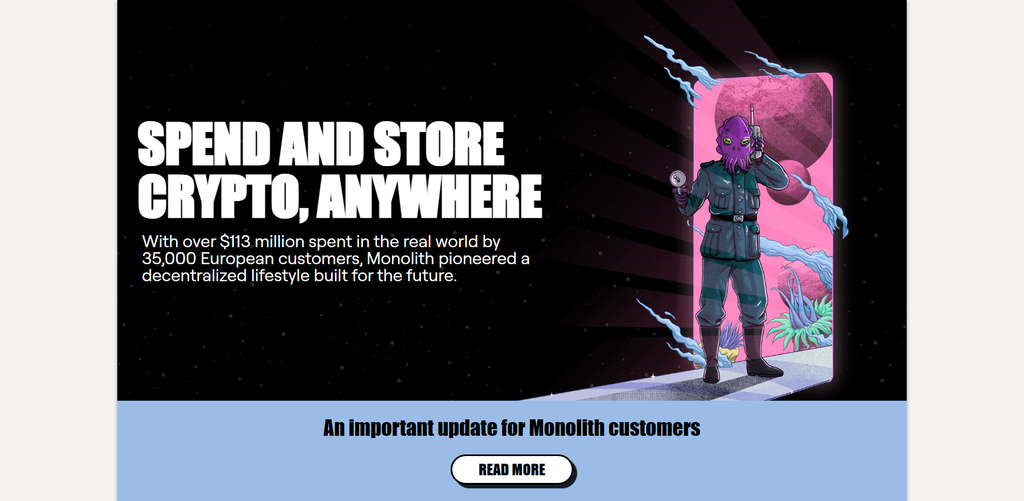
The supported assets and payment ability was built for converting crypto into everyday purchases. Its current card availability, fees, supported assets and onboarding status should be checked before treating it as an active alternative however Monolith’s current website now shows an important customer update.
Monolith Card Features
- Crypto Spending: Intended to spend cryptocurrency on everyday expenses.
** Wallet Integration:** Built to link your crypto assets to card transactions.
Card-Based Payments: Built to connect cryptocurrency with traditional merchant payments. - Crypto to Fiat Usage: Crypto assets can be used to make everyday purchases.
Check Current Availability: Users should confirm the status of the card before assuming it is an active option.
| Pros | Cons |
|---|---|
| Built around crypto-to-fiat card spending | Current card availability requires verification |
| Designed to connect crypto with everyday payments | Product information is less current than leading competitors |
| Historically focused on user-controlled crypto | Current features and supported assets may have changed |
| Card-based merchant spending was supported | Limited current documentation |
| Relevant as a historical Gnosis Pay alternative | May not be suitable as an active card option |
7. 1inch Card
The 1inch Card is a crypto payment card that was launched in 2024 in partnership with Crypto Life and Mastercard and is issued by Monavate. It enables users to spend supported crypto by automatically converting it to fiat at the point of purchase, such as online payments, in-store purchases and ATM withdrawals.
Supported assets are **1INCH, USDT, BTC, LTC, XRP and BXX. The card is issued in both physical and virtual forms and works with Apple Pay and Google Pay. Currently available mostly in eligible European countries with regional eligibility and applicable onboarding requirements.
1inch Card Features
- Mastercard Network: Works with merchants who accept Mastercard.
- Instant Conversion: Crypto is automatically converted to fiat at the point of purchase.
Online & In-Store: Make payments to merchants online or in a store.
ATM Withdrawals: You can make cash withdrawals at compatible Mastercard ATMs.
Physical and Virtual You can get it as a physical card or virtual card.
| Pros | Cons |
|---|---|
| Mastercard-based crypto spending | Availability is limited to supported regions |
| Supports physical and virtual cards | Requires identity verification |
| Automatic crypto-to-fiat conversion | Supported assets are more limited than some wallet platforms |
| Supports online and in-store purchases | Fees can apply depending on transaction type |
| ATM functionality is available | Card availability can change by jurisdiction |
8. Crypto.com Visa Card Card
The Crypto.com Visa Card is a prepaid, custodial crypto card, not a self-custodial card where you hold your crypto. Users fund the card from their Crypto.com account and can spend anywhere Visa is accepted, with rewards paid out in CRO.

The card can be used at Visa ATM locations to withdraw cash, with availability varying in the US, Europe, UK, Canada, Australia and other markets. The prepaid card itself may have no monthly, annual or setup fee but applicable limits, overseas charges and Level Up subscription requirements differ by region and tier.
Crypto.com Visa Card Features
- Visa Acceptance: Designed for spending at Visa merchants.
- Crypto-Funded Spending: Users can fund their card through their Crypto.com account.
- CRO Rewards: Eligible card tiers can provide CRO-based rewards.
- ATM Access: Supports ATM withdrawals where the card and location are eligible.
- Tier-Based Benefits: Higher card tiers can provide additional rewards and benefits.
| Pros | Cons |
|---|---|
| Established Visa payment infrastructure | Uses a custodial account model |
| Broad merchant acceptance | Not a direct self-custody alternative to Gnosis Pay |
| Multiple card tiers and benefits | Higher tiers can involve additional requirements |
| CRO-based rewards available | Rewards depend on applicable card tier and terms |
| ATM withdrawals are supported | Crypto must generally be managed through the Crypto.com ecosystem |
9. Coinbase Card
Coinbase Card is a Visa debit card that lets eligible users spend their crypto, USDC and local currency directly from their Coinbase account. The Coinbase account is the platform-based custody model, not a self-custodial wallet card. As of now, Coinbase does not charge any transaction fee for card spending.

Cryptocurrency buy, sell or conversion spreads may apply and ATM operators may charge their own fees. You can’t use it in Hawaii if you’re in US. For the UK and EU version you need to live in a country they support and verify who you are.
Coinbase Card
- Visa Debit Card: Uses the Visa payment network.
- Crypto Spending: Allows eligible users to spend supported crypto and USDC.
- Coinbase Integration: Connected directly with the user’s Coinbase account.
- Crypto Conversion: Crypto can be converted as part of the card-payment process.
- Rewards: Eligible Coinbase Card transactions can provide applicable crypto rewards.
Plutus Card Features
| Pros | Cons |
|---|---|
| Visa debit-card infrastructure | Coinbase account-based rather than self-custodial |
| Direct integration with Coinbase | Availability depends on country |
| Supports crypto and USDC spending | Does not provide the same wallet architecture as Gnosis Pay |
| Convenient for existing Coinbase users | Conversion spreads or applicable fees can affect costs |
| Simple exchange-to-card ecosystem | KYC and account verification are required |
10. Plutus-Card
Plutus Card was launched by Plutus in 2015. It’s a Visa debit card built for fiat spending & crypto rewards, not for direct self-custody spending.

Users can top up their linked Plutus account and earn PLUS rewards currently advertized at 3% on eligible everyday spend, with additional Perks depending on plan. KYC is required to open an account.
The card is accepted at over 60 million Visa merchants. Monthly subscription options are available in the current plans, and card fees and limits vary by plan and region selected.
Plutus Card Features
- Visa Debit card: Works via the Visa merchant network.
- Crypto Rewards – Rewards via the Plutus ecosystem.
- PLUS Rewards: PLUS rewards are earned on eligible spend.
- Perks: Some plans have additional merchant-related perks.
KYC Requirement: Applicable identity verification is required before using the card.
| Pros | Cons |
|---|---|
| Visa debit-card acceptance | Not a direct self-custodial wallet card |
| Rewards-focused card ecosystem | Benefits depend on plan and eligibility |
| PLUS rewards can increase spending incentives | Subscription costs may apply |
| Additional Perks available | Geographic availability is restricted |
| Suitable for users prioritizing rewards | Less focused on direct self-custody architecture |
Conclusion
Here are the best Gnosis Pay alternatives, featuring a range of choices for crypto card spending and self-custody. MetaMask Card, ether.fi Cash, Bleap, Tria, Kolo, Monolith, 1inch Card, Crypto.com Visa Card, Coinbase Card, and Plutus vary in custodial models, card networks, supported assets, payment mechanisms, fees, rewards, and geographic availability.
Some are trying to connect user-controlled wallets directly to card payments, others are using custodial accounts or hybrid structures. Users should compare the self-custody architecture, supported cryptocurrencies, conversion methods, transaction fees, KYC requirements, spending limits, mobile-wallet compatibility and regional availability to see which features satisfy their crypto-spending needs.
FAQ
What are Gnosis Pay rivals?
Gnosis Pay rivals are crypto payment cards and platforms that provide alternatives for spending digital assets through Visa or Mastercard networks. They differ in custody, supported cryptocurrencies, fees, wallet integration, and availability.
Which Gnosis Pay rivals support self-custody?
Products such as MetaMask Card, ether.fi Cash, Bleap, and Tria use self-custodial or non-custodial approaches. However, users should check the exact custody structure and regional product terms.
Are all crypto cards self-custodial?
No. Some cards use custodial accounts, while others use self-custody or hybrid models. This distinction is important when comparing a card with Gnosis Pay.
Do Gnosis Pay alternatives use Visa?
Yes. Several alternatives use Visa, while others use Mastercard. The payment network can affect merchant acceptance, ATM access, mobile-wallet compatibility, and geographic availability.
What cryptocurrencies can be used with crypto cards?
Supported assets vary by provider. Common examples include BTC, ETH, USDC, USDT, stablecoins, and selected network tokens. Some cards support a much wider range of funding assets.