

In cryptocurrency’s ever-changing environment, institutional investors focus on accuracy and data corroborated methods. AI Tools That Give Institutional-Level Crypto Insights offers on-chain analytical data, predictive model analytics, and alert systems so these users may provide tracking of smart money movements, portfolio optimizations, and trending analytics.
These tools provide institutions the ability to make informed decisions in a data-augmented way to manage risk in an optimized manner, providing institutions a competitive advantage in the ever-changing cryptocurrency market.
Key Point
| AI Tool | Key Point (Institutional-Level Insight) |
|---|---|
| IntoTheBlock | Uses on-chain data and AI models to deliver hedge fund–level signals like whale activity, smart money flow, and advanced risk metrics. |
| Glassnode | Provides deep on-chain analytics, including supply distribution, liquidity cycles, and macro indicators used by institutional investors. |
| CryptoQuant | Tracks exchange flows, miner activity, and whale behavior, offering real-time insights used by professional traders and funds. |
| Santiment | Combines AI with social sentiment, on-chain, and developer data to identify early market trends and institutional positioning. |
| Nansen | Labels wallet addresses and tracks smart money movements, helping users follow institutional-grade capital flows. |
| Messari | Offers AI-powered research reports, asset screeners, and governance data similar to institutional research desks. |
| Token Metrics | Uses machine learning to generate price predictions, ratings, and portfolio strategies used by professional investors. |
| Arkham Intelligence | Provides entity-based wallet tracking and AI-driven intelligence to uncover hidden market participants and fund flows. |
| Chainalysis | Delivers institutional-grade blockchain monitoring, compliance insights, and transaction tracking used by governments and funds. |
| Kaiko | Supplies high-quality market data, liquidity metrics, and AI-driven analytics used by institutional trading firms. |
1. IntoTheBlock
IntoTheBlock is an advanced analytics tool that uses AI and ML for large-scale analytics of blockchain data. It offers analytics around large transaction tracking, holder concentration, and profitability metrics, as well as other metrics usually only available to institutional investors.

While evaluating AI Tools That Give Institutional-Level Crypto Insights, found IntoTheBlock unique for its analytics around identifying whale movements and sentiment changes.

Its predictive analytics are of value to professional and high-end traders to forecast price move and sentiment, risk management, and to detect changes to the market conditions.
Price: Free plan; Payment Options: Roughly $10 to $300 per month
Key Features:
- On-Chain Analytics Powered By AI
- Tracking Whale Transactions
- DeFi Signals and Insights
- Holder and Profitability Metrics
Pros:
- Provides insights on-chain data
- Easy-to-use interface
- Offers strong predictive metrics
- Valuable for DeFi analytics
Cons:
- Advanced data behind a paywall
- Limited flexibility to customize analytics
- Not ideal for high frequency traders
2. Glassnode
Providing high value on-chain data and analytical services to investors, Glassnode helps understand the transactional health of markets. Different metrics showing realized capitalization, supply in profit/loss and the behavior of long-term holders.
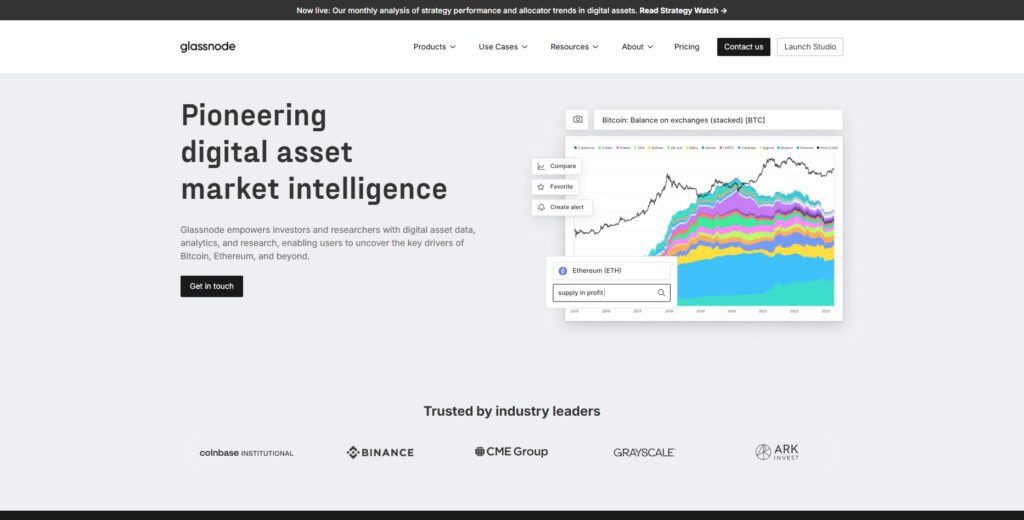
Regarding AI Tools That Give Institutional-Level Crypto Insights, Glassnode is very important because of the long-term macro indicators, employed by institutions to balance their strategies.
Their dashboards and notifications offer a liquidity cycle and trend forecasting on the market. Glassnode further analytics and data visualization aids in the decision making of the investor in relation to real speculation based transactional activity of the blockchain.
Glassnode
Price: Free; Advanced: $29/month; Pro: $799/month
Key Features:
- Tools to analyze advanced on-chain data
- Tools to analyze market cycle
- Tools to analyze and visualize supply distribution
- Dashboards for institutions
Pros:
- Analytics are industry-leading
- Quarterly and yearly reporting reliable
- Data visualization industry-leading
- Analytics industry-leading for institutions
Cons:
- Premium options are pricey
- Too advanced for beginner traders
- Too few alerts
3. CryptoQuant
Providing real-time on-chain data, CryptoQuant deals largely with data on exchange flows, miners and whale transactions which is key to supply-demand understanding of crypto markets.
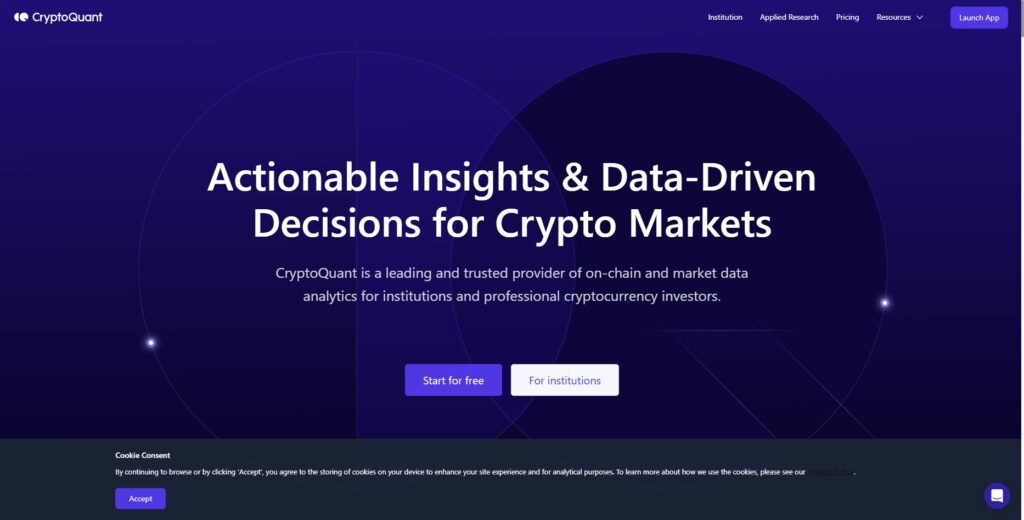
As AI Tools That Give Institutional-Level Crypto Insights, CryptoQuant is useful for the advanced identification of the reversal of the market by focusing exchange flows.
Because of the nature of their alerts system, traders can respond to changes very fast leading to the prevalence of the system among institutional traders, the actionable blockchain data driving the identification of accumulation, distribution and price changes.
CryptoQuant
Price: Free plan; Payment Options: Roughly $29 – $799/month
Key Features:
- Track inflows and outflows on exchanges
- Track and analyze whales activity
- Track and analyze miners behavior
- Alerts
Pros:
- Outstanding alerts
- Data on real-time activity
- Analytics are great for short-term trading
- Easy to interpret signals
Cons:
- The user has to adapt to a technical interface
- Premium analytics are high-priced
- Too few fundamentals
4. Santiment
Santiment uses on-chain information, developer activity, and social sentiment to create a full picture of the crypto market. Its unique analytics AI analyzes the crowd that often moves for significant price changes.

Among AI Tools That Give Institutional-Level Crypto Insights, Santiment stands out with market psychology and early signal trend identification.
It analyzes social media and GitHub metrics, and thus can help traders refrain from hype. Santiment is the only information in the market combining the above, enables traders to thoroughly understand the technical and the fundamental aspects of crypto.
Santiment
Price: Free; Paid ~$49–$249/month
Key Features:
- Social sentiment analysis
- On-chain + dev activity tracking
- Market trend signals
- AI-driven insights
Pros:
- Unique sentiment data
- Early trend detection
- Multi-source analytics
- Strong research tools
Cons:
- Learning curve
- Data noise in volatile markets
- Limited trading execution tools
5. Nansen
Nansen is praised for the identification of labeled blockchain wallets and the tracking and movement of smart money across the blockchain. Nansen also shows where institutional money is going and which projects are successful.

For AI Tools That Give Institutional-Level Crypto Insights, Nansen provides transparency in wallet movements of significant investors and hedge funds.
Nansen’s analytics shows trending tokens, NFTs, and DeFi. By following and mimicking experienced investors, traders can make better decisions and move their trades in sync with the crypto cycle.
Nansen
Price: Starts ~$100/month; Pro $1000+/month
Key Features:
- Wallet labeling system
- Smart money tracking
- NFT and DeFi analytics
- Portfolio dashboards
Pros:
- Best smart money insights
- High-quality dashboards
- Strong DeFi/NFT coverage
- Institutional-grade data
Cons:
- Very expensive
- Not beginner-friendly
- Limited free access
6. Messari
Messari provides institutional-grade reports, market intelligence, asset analysis, and research in crypto. Messari has a variety of unique tools, such as screeners, governance trackers, and detailed project profiles.
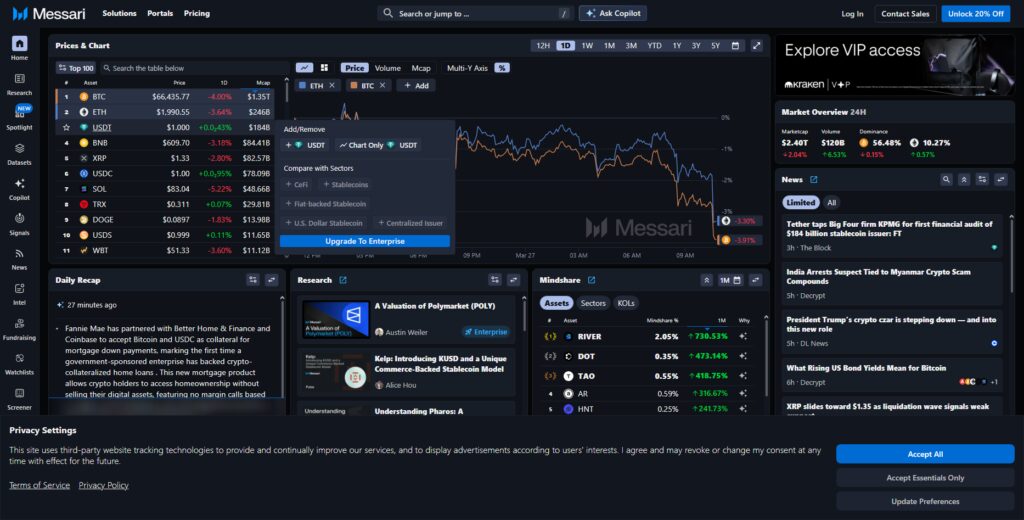
For example, Messari has a deep fundamental analysis of the market that resembles the analysis of traditional research firms, so it can be classified under the AI Tools That Give Institutional-Level Crypto Insights.
Messari offers investors AI Analysis that helps them identify and assess the value of assets and track the potential value of upcoming assets. Messari has very useful information for making long-term value investments in crypto.
Messari
Price: Free; Pro ~$29/month
Key Features:
- Institutional research reports
- Asset screening tools
- Governance tracking
- Market intelligence dashboards
Pros:
- High-quality research
- Strong fundamental data
- Easy-to-use interface
- Trusted industry insights
Cons:
- Less focus on trading signals
- Limited real-time analytics
- Advanced features behind paywall
7. Token Metrics
Token Metrics uses AI and machine learning to provide crypto ratings, predictive analysis, and portfolio strategies. Token Metrics Analysts break down each token using technical, fundamental, and sentiment analysis.

Token Metrics helps investors identify assets before they ‘pop’ and outperform based on predictive analysis. Token Metrics provides portfolio strategies, risk analysis, and automated portfolio management, making it beneficial for individual and institutional investors.
Token Metrics
Price: ~$10-300/month
Key Features:
- AI driven crypto ratings
- Price predictions
- Portfolio tools
- Insights automation
Pros:
- Simple for beginners
- Good AI based recommendations
- Great portfolio tracking
- Reasonable entry level pricing
Cons:
- Prediction accuracy is inconsistent
- Limited on-chain deep data
- Less depth of institutional grade
8. Arkham Intelligence
Arkham Intelligence deanonymizes blockchain data to give details on who is behind major transactions. Arkham Intelligence is the only institutional-level crypto insight AI tool that offers entity-based tracking.
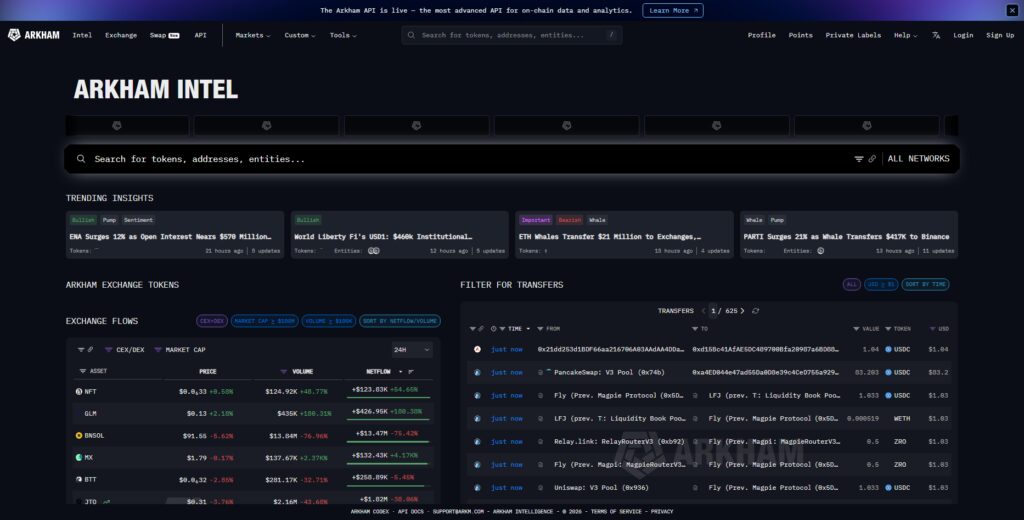
It gives customers the ability to track large market players, identify previously undetected connections, and track the flow of money. With AI-driven analytics, tracking abnormal transactions and market manipulation is made simple.
For institutions that want to fully understand the market and eliminate ambiguity surrounding the trades they make, Arkham provides a high level of market manipulation transparency.
Arkham Intelligence
Cost: Mainly free; evolving premium
Main Features:
- Wallet identity tracking
- Analytics by entity
- Intelligence dashboards
- Tracking fund flow
Pros:
- Newer transparency tools
- Good investigative insights
- Simple interface
- Access free of use
Cons:
- Limited historical deployed depth
- Less sophisticated analytical indicators
- Platform is still being developed
9. Chainalysis
Chainalysis is a major blockchain analytics company that governments and banks use worldwide. It provides services related to compliance, risk, and transaction monitoring.
Among other AI Tools That Give Institutional-Level Crypto Insights, Chainalysis is best known for tracking crime for services offered at the borderline of the law.
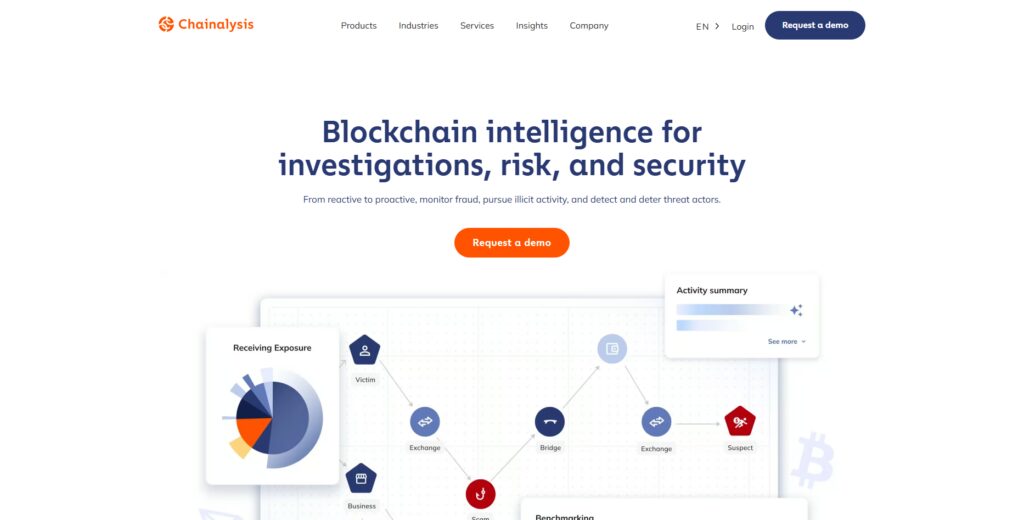
It provides sophisticated transaction risk assessments and analyses. It offers institutions the ability to operate transparently and securely through its services.
By pairing artificial intelligence with blockchain analytics, Chainalysis simplifies managing the financial risks related to criminal activity by analyzing complex transaction patterns.
Chainalysis
Cost: Enterprise pricing by quote
Main Features:
- Monitoring of transactions
- Risk scoring
- Analytics of compliance
- Tools for fraud detection
Pros:
- Governments’ trust
- Leading compliance
- Great safety
- Technology for advanced tracking
Cons:
- Super expensive
- Not for retail traders
- No trading capabilitiest
10. Kaiko
Kaiko fetches institutional-level market data such as pricing, orderbook depth, and liquidity statistics across various market exchanges. Trading firms, hedge funds, and other financial institutions use their data.
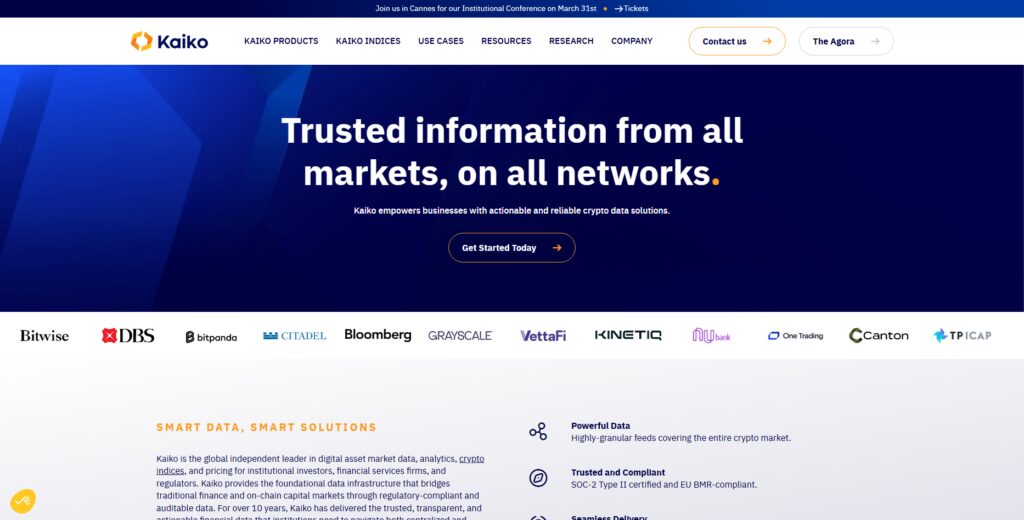
In the category of AI Tools That Provide Institutional-Level Insights into the Crypto Market, Kaiko stands out for providing trustworthy and precise data, which is crucial for executing any type of quantitative analysis.
Kaiko helps in evaluating market efficiency, slippage, and trading conditions. Its strong APIs and analytic tools enable algorithmic trading and research, making the platform indispensable for institutions that require top-tier data to implement their complex trading models.
Kaiko
Cost: Institutional pricing by quote
Main Features:
- APIs of Market data
- analytics on liquidity
- data of the order book
- insights on exchange level
Pros:
- Data feeds of the highest quality
- Best for quantitative trading
- Reliable and accurate
- APIs of institutional grade
Cons:
- Technical knowledge is required
- Not friendly for beginners
- Pricing is high
Why AI Tools Are Crucial for Institutional Crypto Analysis
Data Analysis – Unlike humans, AI tools analyze and process blockchain and market data in real-time, allowing institutional investors to act on trading opportunities and shifts in the market.
Investments Analysis – AI tools analyze wallet data and large movement flows. Knowing the investments of institutional players allows other market players to adjust their investments accordingly.
Market Predictions – AI analyzes data from the past. It creates metrics and plausible market moving conditions to predict volatility. Investors use AI data to enable strategic investments.
Compliance – In regards to market volatility and the digital economic space, AI tools analyze trends and market volatility to decrease the concerns of investors and keep the firm in compliance.
Investments – AI tools allow institutional investors to both forecast and monitor their volatile asset mixtures to optimize their returns. AI tools allow institutions to effectively forecast and evaluate their mixture of assets.
Market Advantages – AI constructs and monitors market metrics that allow institutions to examine trends and adjust accordingly in the digital economic space before the trends become mainstream to gain market advantages.
Data-Driven Decision Making – AI technology organizes many different data sets and uses them to derive insights. This allows businesses to replace wishful thinking with informed data-driven decisions for better confidence when it comes to determining where to direct resources and how to operate a business.
Market Movement Transparency – AI understands and analyzes the various flows through blocks and provides transparency into where funds are, where liquidity shifts, and the activity of larger investors. This way, institutional investors have a clear understanding of the market.
Criteria for Selecting Institutional AI Tools
Improved Flexible Decision Making – AI can analyze a significant amount of data from blockchains and various markets and provide actionable insights to institutions allowing them to make data-backed investment and trade decisions more quickly.
First Movers Advantage – By evaluating data from on-chain analysis, flows of intelligent capital, and prevailing social currency, AI detects shifting market influences before a critical mass of participants enter a market. This provides institutions market edges.
Safeguards to Risk – AI is capable of monitoring anomalous transactions, market liquidity, and unusual changes to protect institutions from potential financial loss and provide assurance of observance to financial regulations.
Better Cost-to-Benefit Ratio – AI can be used to optimize and improve allocation of financial resources, maintain other potentials and interoperability, and monitor use, to assist institutions to achieve their goals of increasing their revenues and preserving their financial investment in crypto assets.
Real-Time Alerts to Market Conditions – Institutions will be automatically notified of ‘whale’ transactions (big buys/sells), market exchanges, and liquidity pools, to allow them to rapidly respond to emerging market conditions.
Understand Changes to Upstream and Downstream Cash Flow – Using AI, analysis of blockchains reveals large investor flows and how ‘smart money’ operates in the market.
Data Automation and Integrated Reporting Saves Time – Collecting data, analyzing it, and reporting is automated thereby minimizing the manual effort in addition to revealing strategic elements to decision makers, rather than monitoring several decision points.
Machines that Learn Predict Changes to Pricing, Cycles in Markets and Declining/Increasing Opportunities in Market Sectors – AI provides transparency to institutions. These data-driven market insights assist institutions in their strategic decisions.
Key Benefits of Using These AI Tools
Improvement of Decisions – Tools using Artificial Intelligence streamline important datasets to help fiduciary institutions in their role as barrier to entry by refining their investment and trade decisions with the help of predictive analytics.
Identification of New Trends – Artificial Intelligence identifies and predicts emerging trends in the market by utilizing on-chain and social metrics as well as smart money flows allowing institutions to stay ahead of the curve.
Risk Management – Artificial Intelligence helps institutions manage and quantify their exposure by seamlessly identifying compliance with regulatory standards as related to unusual behavior in transactions.
Reallocation of Portfolios – Tools using Artificial Intelligence help institutions to reallocate and diversify their portfolios as well as evaluate their performance with the aim of maximizing the institutions goals and minimizing the exposure to cryptocurrencies.
Continuous Notifications – Institutions utilizing tools employing Artificial Intelligence will receive seamless, real-time notifications regarding whale movements and behavioral changes across exchanges.
Analysis of Blockchain Activity – Artificial Intelligence will analyze Blockchain Activity and provide institutions with insight into the movements of smart money across the market which can also be used for exploitation and grifts.
Reduced Time – Tools using Artificial Intelligence help analysts understand the impact of their decisions.
Forecasting – Machine learning models provide insight into possible future price fluctuations, market cycles, and opportunities at the sector level. This provides institutions the foresight necessary to strategize trades or investments.
Conclusion
The nature of today’s rapidly changing cryptocurrency market means institutions need precision, speed, and most importantly, transparency. AI tools derive transparency through analyzing on-chain metrics, market movement, social sentiment, and smart money.
With respect to real-time data, predictive models, and whale tracking, Glassnode, IntoTheBlock, and CryptoQuant provide these services. Portfolio optimization and fundamental analysis are offered by Nansen, Messari, and Token Metrics.
Regarding market data and improved transparency and compliance, Arkham Intelligence, Chainalysis, and Kaiko provide services. The ability of institutions to inform decisions, identify and act on trends, optimize portfolios, and manage risks is powerful.
The aforementioned tools provide institutions with measurable advantages over their competitors through crypto trading and investments.
FAQ
What are institutional-level crypto insights?
Institutional-level crypto insights are deep, data-driven analytics used by professional investors, hedge funds, and trading desks to monitor blockchain activity, track smart money flows, detect trends, and manage risk effectively.
Why do institutions use AI tools for crypto analysis?
AI tools process large volumes of on-chain and market data, provide predictive models, track whale activity, and automate alerts, allowing institutions to make faster, informed, and precise trading decisions.
What criteria should I consider when selecting an AI crypto tool?
Key factors include data accuracy, depth of analytics (wallet tracking, DeFi/NFT insights), real-time alerts, predictive capabilities, ease of integration, security, cost-effectiveness, and access to historical data.
Are these AI tools suitable for beginners?
Some tools like IntoTheBlock and Token Metrics are beginner-friendly, but most platforms such as Nansen, Chainalysis, or Kaiko are designed for professional or institutional use due to complex dashboards and high subscription costs.
How do AI tools improve portfolio management?
AI tools provide insights into asset allocation, risk assessment, performance tracking, and predictive analytics, helping institutions optimize portfolios, maximize returns, and minimize exposure to volatile crypto markets.