
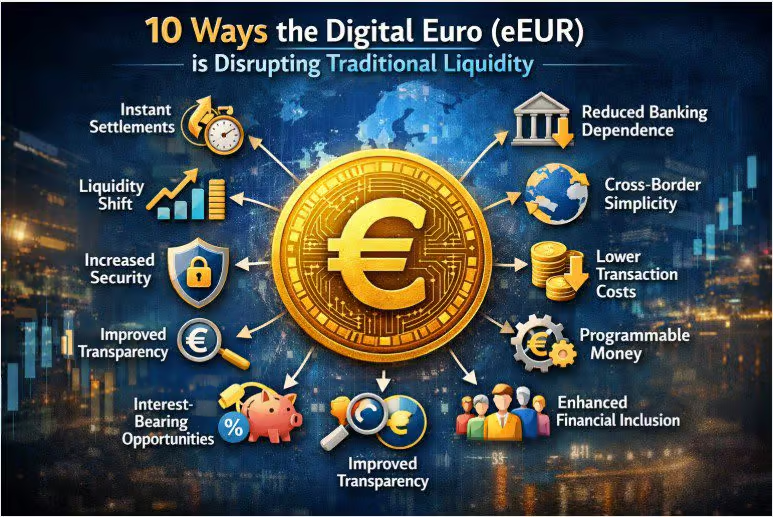
This post review Ways the Digital Euro (eEUR) is Disrupting Traditional LiquidityThe Digital Euro (eEUR) allows central bank digital money (CBDC) to change liquidity with real-time settlement and fewer intermediaries.
eEUR allows money to be programmable and paid cross borders for financial inclusion. eEUR also supports faster movement of money at a less expensive rate and with greater transparency allowing banks to be less relevant for liquidity management.
What is the Digital Euro (eEUR)?
The Digital Euro (eEUR) is a form of central bank digital currency (CBDC) that European Central Bank (ECB) plans to implement to modernize the payment system across the Eurozone and create a digital form of currency to sit alongside cash.
The Digital Euro will bring the Eurozone payment system into the 21st century to help promote safe and efficient Electronic Transactions and Payments and help meet the digital economy’s evolving payment needs while strengthening the European economy’s monetary policy and inclusive the Digital Euro will help Eurozone’s e…

Key point & Ways the Digital Euro (eEUR)
| Disruption Area | Key Point |
|---|---|
| Central Bank Control | eEUR enables direct central bank issuance, reducing reliance on commercial banks for liquidity distribution. |
| Real-Time Settlement | Instant settlement eliminates delays in interbank clearing, improving liquidity efficiency across markets. |
| Reduced Intermediaries | Peer-to-peer transactions bypass traditional intermediaries, lowering liquidity fragmentation. |
| Programmable Money | Smart contract functionality allows conditional liquidity flows, automating payments and reducing idle capital. |
| Cross-Border Efficiency | eEUR simplifies cross-border transfers, reducing dependence on correspondent banking liquidity pools. |
| Liquidity Transparency | Real-time transaction visibility enhances monitoring of money flows and systemic liquidity conditions. |
| Bank Deposit Shift | Movement of funds from bank deposits to eEUR wallets may reduce traditional bank lending liquidity. |
| Lower Transaction Costs | Reduced fees improve capital efficiency, allowing faster recirculation of liquidity in the economy. |
| Financial Inclusion | Broader access to digital currency increases participation, expanding overall liquidity in the system. |
| Crisis Response Tool | Central banks can inject or withdraw liquidity instantly via eEUR, improving monetary policy transmission. |
1. Central Bank Control
The direct issuance of the Digital Euro (eEUR) to the public will fully embrace Central Bank Control and allow for direct enforcement of direct control over the Control of Central Banks.
In previous systems, Central Banks lost control of their Direct Control of Central Bank Control as the Commercial Banks acted as mediators and in Doing so, the Banks used Mediation to Control Centralization within the Banks.

As control over the Centralized Control of Monetary Systems is lost, more direct control of the bank’s control is used within counter-cyclic Bank’s Lending Systems.
Central Bank Control Methodology’s built-in design also gives Central Control over the system’s control of the direct control of Central Bank Control over the systems to the Central Banks of the World with more direct Control of the Central Systems of the World than is delegated to the Central Banks of the World.
Central Bank Control Features, Pros & Cons
Features:
- Issuance of eEUR to the public and firms.
- Flow of money in real-time.
- Adjust the flow at any time.
- Control over monetary policy on eEUR.
Pros:
- Greater control over monetary policy.
- Less dependence on commercial banks.
- Greater stability in the financial sector.
- Control on financial crisis with speed.
Cons:
- Greater centralization.
- User’s privacy may be compromised.
- Control over policies may be excessive.
- Commercial banks may resist.
2. Real Time Settlement
The Digital Euro allows for the instantaneous completion of transactions, which greatly improves the Real Time Settlement process. In the older systems, Real Time did not exist as there were hours to days of delays within the older systems of interbank clearing, batch processing, and multiple settlement windows.

Within the Real Time Settle of the Digital Euro system, there will be a massive reduction in the settlement of the Risks associated with Real Time Settlings. There will be a massive reduction in all of the older systems of interbank processing Real Time Settlement.
There will also be a massive improvement in all of the older systems. There will also be a massive improvement in the instantaneous completion of high frequency, and highly responsive payments to immediate settlement.
There will also be Real Time Settlements in Demand of the older systems of interbank processing Real Time Settlement Systems. Real Time Settlement will also allows for all of the older systems of interbank processing Digital Euro Settlings to be processed within the older systems.
Real-Time Settlement Features, Pros & Cons
Features:
- Instant confirmation of a transaction.
- Settlement occurs without ‘batch’ processing.
- 24/7 Real-time processing.
- Integration of transactions with eWallets and banks.
Pros:
- Settlement risk is minimized.
- Economic liquidity levels are maximized.
- Cash flow of businesses improves.
- Cross-border payments are simplified.
Cons:
- A sophisticated technology infrastructure is needed.
- Instant (real-time) fraud may occur.
- Small financial institutions may become strained.
- Use of the system may be limited in offline situations.
3. Less Intermediaries
The Digital Euro lessens the role of traditional intermediaries, such as commercial banks and clearinghouses, in the payment and liquidity flow process. With Less Intermediaries in a transaction, costs are reduced and the circulation of money speeds up.

Users can transfer money from one wallet to another without the involvement of banks, as there are no layered approvals, and no corresponded banking networks. Less Intermediaries in a transaction improves capital efficiency by freeing up liquidity that was previously locked in transactional processing.
This approach also democratizes liquidity access to small businesses and individuals, who are often limited by their banks. This approach also increases the eEUR financial flow and reduces banks’ mediated liquidity, offering a more direct and clear money flow ecosystem.
Reduced Intermediaries Features, Pros & Cons
Features:
- Transfers from one eWallet to another.
- Less dependence on clearing houses.
- Fewer approvals required for transactions.
- Shorter payment chain.
Pros:
- Quicker transactions.
- Costs of transactions are lower.
- Greater access for small businesses.
- Less reliance on banks for systemically important functions.
Cons:
- Banks will lose revenue from transactions.
- Fewer human interventions in transactions.
- Less regulatory oversight.
- Greater reliance on digital infrastructure.
4. Money with Conditions
The Digital Euro is designed with Money with Conditions functionality, which allows the implementation of smart contracts, that set predetermined conditions for the payment to be made.
Money with Conditions makes it possible to create a flow of liquidity that is conditioned, such as automated payrolls, loans payments, and settlements of supply chains.

This automation also reduces the idleness of funds and increases the speed of liquidity, as Money with Conditions only allows the movement of capital when there is a condition defined by a contract.
Money with Conditions improves control of funds circulation, as the rules of the contracts are incorporated and kept up to date by the governing authority of the transaction. By improving control of the circulation of funds, Money with Conditions has transformed the management and control over digital liquidity.
Programmable Money Features, Pros & Cons
Features:
- Integration of smart contracts.
- Automation of payments based on conditions.
- Transaction compliance at point-of-sale.
- Automated allocation of funds.
Pros:
- Less wasted cash.
- Improved operational workflow.
- Better compliance and auditing.
- Automation of payments in supply chain.
Cons:
- Funds may be frozen due to programming mistakes.
- Less flexibility to make ad hoc changes.
- Technical knowledge is necessary.
- Smart contracts may be opened to exploitation.
5. Cross-Border Efficiency
The Digital Euro assists with cross-border payment transactions by notably increasing Cross-Border Efficiency. Historically, cross-border payments required several correspondent banks to process payments, creating delays and high fees.
Payments also suffered from poorly processed and managed flows of liquidity. These problems of liquidity are improved with the advanced method of processing payments with the eEUR, which bypasses the need for third and fourth party banks to settle border payments.

Payment settlers are able to access their money quicker; quicker payment access increases the speed of total trade and investment globally. Cross-Border Efficiency eliminates the necessity for multiple
foreign currency accounts and the need to maintain balances in foreign currencies. In addition, the Digital Euro increases payments and reduces liquidity to create a more seamless and less restrictive flow of liquidity in the Eurozone and the Digital Euro’s new system of payments eliminates outdated systems of cross-border payments that utilized correspondent banks.
Cross-Border Efficiency Features, Pros & Cons
Features:
- Eurozone instant payments and beyond.
- Less dependence on correspondent banking.
- Settlements standardized.
- Fewer intermediaries for foreign currency.
Pros:
- Transaction costs are reduced.
- International trade is faster.
- Overall global liquidity is better.
- Financial operations for small and medium enterprises (SMEs) are better.
Cons:
- Laws regarding cross border activities should be the same.
- Cybersecurity is at risk during cross-border transactions.
- Global transactions may be subject to geopolitical constraints.
- Monitoring by central banks may be required for a cross-border efficient system.
6. Liquidity Transparency
The Digital Euro is the first payment method to offer extensive Liquidity Transparency by providing regulators and market functionaries with improved access to the flow of money; they are able to see where and how eEUR flows.
eEUR loses its unique currency identifier in a transaction, meaning eEUR’s flow is opaque and cannot be monitored. This lack of flow is evident with central banks, who use the eEUR to monitor the economy’s liquidity to detect and manage shortages; they also use the eEUR to monitor systemic risks and exercise their right to manage balances.

Liquidity Transparency helps to illustrate a situation in which the banking system is burdened with excess reserves that, instead of creating a liquidity crisis, transfers and payments are more effective.
New systems of payment built around the Digital Euro as a payment method replace outdated systems, improving systems to maintain the Digital Euro’s transparency and integrity, and improving the overall confidence of all economic agents in the system.
Liquidity Transparency Features, Pros & Cons
Features:
- Monitoring of systemic liquidity.
- Real-time tracking of liquidity.
- Dashboards for public and private reporting.
- Monitoring liquidity shortage in advance.
Pros:
- Better risk management.
- Financial crises are less likely to occur.
- Better decisions can be made at the central bank.
- At a financial system, the liquidity risk is less in the private sector, which increases confidence of the private sector.
Cons:
- Users privacy.
- High storage costs to store data;
- Sensitive information can be exploited.
- More central banks in the world will have to monitor liquidity.
7. Bank Deposit Shift
The Digital Euro promotes moving funds from standard bank deposits to digital wallets, impacting the Bank Deposit Shift. As citizens and businesses start using eEUR to make daily purchases, it is likely that banks will experience a drop in deposits, which may restrict banks’ abilities to lend and create liquidity.

This may also lead to banks having to provide innovative solutions to avoid clients leaving, such as offering more enticing deposits or new services. Bank Deposit Shift also alters the circuit of the economy’s liquidity because eEUR is a central bank liability and will likely be a more used means of payment.
With altering the structure of deposits, the Digital Euro will change the commercial banks’ roles in the economy regarding the creation and distribution of liquidity.
Bank Deposit Shift Features, Pros & Cons
Features:
- Increased use of eEUR by the public means less bank deposits.
- eEUR is a substitute for bank deposits.
- Bank deposits makes funds not available to the public, which means less dependence on banks.
- Access to central bank cash.
Pros:
- Bank dependence for funds is less.
- Individual access to liquidity is broadened.
- Innovation is encouraged in banking.
- Adoption of digital finance is accelerated.
Cons:
- Lending by banks may be affected.
- Profitability in the financial sector may be affected.
- Rapid adoption may destabilize banks.
- Trust in the public is needed regarding eEUR wallets.
8. Lower Transaction Costs
The Digital Euro lowers the costs of payment and transfer services, which in turn increases the efficiency of capital and decreases the barriers to liquidity. Lower Transaction Costs provide the economy with more speed, lower costs, and more accessible financial operations.
Conventional systems have a greater liquidity obstructions due to the presence of a financial intermediary, multiple currencies, and the delayed settlement of payment. eEUR minimizes the payment costs.

This ensures greater circulation of financial resources with more payments. Lower Transaction Costs also reduce the costs of micro and small enterprises, easing the access to working capital.
As a trail, eEUR disrupts the conventional liquidity channels of the economy by facilitating the movement of money, enhancing economic activities and increasing the adoption of digital currency.
Transaction Costs are Lowered Features, Pros & Cons
Features:
- Fees are lower for payment and transfer activities.
- Intermediaries are involved minimally.
- Costs are transparent.
- Structure is applied for both micro and macro transactions.
Pros:
- More transactions are likely to happen.
- Business liquidity is freed up.
- Cross-border trade becomes efficient.
- Barriers are reduced for SMEs and individuals.
Cons:
- Banks are likely to lose their revenue streams.
- eEUR infrastructure may accumulate small fees.
- The system may be misused for cost arbitrage.
- Network maintenance will require investments.
9. Financial Inclusion
The Digital Euro exemplifies Financial Inclusion. It offers digital currency to people and businesses who currently do not have access to banking services. Financial Inclusion ensures access to all demographics.
eEUR promotes digital participation in the economy by providing a means for safe, secure payment and value storage. The overall liquidity of the economy improves when eEUR enables people to transact, store value, and make payments, activities they could not do before.

Increased participation in the economy not only improves overall liquidity but strengthens social equity and economic resilience.
Also, Financial Inclusion allows central banks and policymakers to provide liquidity support in a targeted manner. The Digital Euro Enders the access to liquidity for the first time.
Financial Inclusion Features, Pros & Cons
Features:
- The underbanked and unbanked populations can access this.
- Simple devices and mobile wallets are compatible.
- Payment networks are inclusive.
- Digital liquidity is accessible directly.
Pros:
- The liquidity pool is expanded.
- The participation of the economy is encouraged.
- Reliance on physical cash is reduced.
- Initiatives directed socially equity are supported.
Cons:
- A digital literacy adoption will be required.
- Areas underserved with technology are at risk of exclusion.
- Users with less sophisticated devices are at security risk.
- There is Dependence on digital infrastructure and connectivity.
10. Crisis Response Tool
The Digital Euro enables central banks to control liquidity without losing responsiveness in times of economic crisis. During recessions and financial shocks, the ECB can quickly add or remove eEUR from the economy and, for the first time, economically and financially support banks, businesses, and people without the use of traditional banking systems and processes.

The Crisis Response Tool’s flexibility allows for precise control of liquidity in prioritized control zones to stabilize the economy and maintain trust in the market.
The traditional economic control systems are fragmented and slow, but eEUR makes control fast and responsive. The Digital Euro allows central banks to easily and effectively stabilize the economy and control liquidity during times of crisis, reducing systemic risk.
Tool for Crisis Response Features, Pros & Cons
Features:
- Ability to quickly inject or withdraw liquidity.
- Provides support for banks and businesses.
- Makes automated monetary policy adjustments during crises.
- Distributes digital emergency currency.
Pros:
- Decreases systemic risk.
- Less reliance on slow conventional measures.
- Boosts public confidence in the economy.
Cons:
- Threat of misuse or over-injection.
- Possible moral hazard for banks.
- To avoid inflation, precise monitoring is needed.
- Increased reliance on central bank technology infrastructure.
Criteria for choosing or evaluating the impact of the Digital
Central Bank Integration eEUR’s capabilities of allowing Central Banks issuance control, money flow control, and execution of monetary control over integrated systems.
Settlement Speed eEUR’s capabilities of allowing real-time settlement and overall reduction of settlements and liquidity risks.
Intermediary Reduction eEUR’s capabilities to reduce reliance on banks, clearinghouses, and correspondents to improve flow of direct liquidity to users.
Programmability & Automation eEUR’s support of smart contracts and automated conditional payment reduces stagnant liquidity and operational efficiency in systems.
Cross-Border Capability eEUR’s support of easy, fast, and low-priced global eEUR transactions and improved liquidity of eEUR to boost global trade.
Transparency & Reporting eEUR’s monitoring, tracking, and liquidity risk control to improve trust in financial systems.
Impact on Traditional Banking eEUR impact of liquidity on banks and lending to banks to innovate to protect financial systems.
Cost Efficiency Indicates the lessening of transaction and operational costs, as well as the costs of intermediaries, allowing for better capital circulation, quicker circulation of funds and liquidity accessibility to businesses and individuals.
Financial Inclusion Assesses if the eEUR facilitates the use of digital payments for the underbanked and unbanked, thereby expanding the total liquidity to encourage more people to participate in the financial ecosystem.
Crisis Response Capability Evaluates how eEUR allows central banks to rapidly add or remove liquidity in times of economic shocks to stabilize markets, boost confidence and respond to financial crises effectively
Risk and considerations
Risk of Centralization. Greater central bank control on eEUR will limit market flexibility, create hazards, and store central financial power, which will result in less innovation and responsiveness in managing the economy’s liquidity.
Bank Disintermediation. If eEUR takes off, it will lead to the loss of deposits for commercial banks, limit their lending, reduce traditional liquidity creation, and lead banks to make changes for financial stability.
Risk of Cybersecurity. The Digital Euro will be exposed to theft, fraud, and other operational failures, which will result in lost and inaccessible liquidity, in addition to the created trust deficit in the digital economy.
Risk of Privacy and Data. While the transparency of the eEUR system allows for real-time transaction monitoring, user privacy will be put at risk. The loss of trust will slow real-time transaction adoption and liquidity
.Operational and Technical Risks. The eEUR system will depend on a digital economy. Until it is complete, liquidity in financial systems will be disrupted by operational failures that stop transactions.
Risk of Financial Stability. The rapid adoption of the eEUR will create uncertainty for banks and payment systems, requiring central banks to manage liquidity to avoid shocks and uncertainty.
Risk of Legal and Regulatory Issues. The adoption of the eEUR will face issues such as the harmonization of divergent laws and the adoption of international regulatory compliances, which will result in a range of cross-border liquidity challenges.
Concerns Regarding Digital Divide and Inclusion Lack of access to devices, internet, or knowledge of digital systems may exclude certain groups, aggravating the inequitable distribution of liquidity and creating barriers to the financial inclusion of eEUR.
Implications for Monetary Policy eEUR’s direct issuance may hinder the functioning of interest rate transmission and the control of inflation. Improper calibration may lead to either excessive or inadequate liquidity, which may destabilize the economy.
Crisis Management Dependencies Although eEUR enables quick changes to liquidity, the dependence on technology and infrastructure can be detrimental. If systems are disrupted, effective agile crisis management and market stabilization may be severely limited.
Conclusion
eEUR is disrupting traditional liquidity through the Digital Euro’s (eEUR) Disrupting Traditional Liquidity involves the Digital Euro (eEUR) as the Digital Euro (eEUR) incorporates Central Bank Digital Currency (CBDC) control, real-time (instant) settlement, programmable money, less disintermediation, and effective and transparent liquidity.
Automated liquidity. eEUR adds privacy issues. Payment disintermediation. Cybersecurity. Operational/eEUR digital euro. eEUR is a digital euro. Disrupting liquidity equals responsive Capital rapid cash. Bank Cybersecurity.
Digital Disrupting is digital liquidity. Controlling the digital euro is identified as a major shift is less disintermediation. Control and access to fluidity flexible. responsive control to the digital euro holds a position within Europe’s economy.
FAQ
How does eEUR impact traditional liquidity?
It disrupts conventional banking by enabling direct central bank issuance, real-time settlement, reduced intermediaries, programmable payments, cross-border efficiency, and financial inclusion, altering how money flows in the financial system.
Who can use the Digital Euro?
Individuals, businesses, and financial institutions within the Eurozone can use eEUR through digital wallets, while adoption depends on regulatory frameworks and central bank access policies.
What are the benefits of using eEUR?
Benefits include faster settlements, lower transaction costs, increased transparency, automated payments, broader financial inclusion, and enhanced crisis response capabilities for central banks.
What are the risks associated with eEUR?
Risks include bank disintermediation, cybersecurity threats, operational failures, privacy concerns, regulatory challenges, and potential over-reliance on technology for liquidity management.
How does eEUR help during economic crises?
It provides central banks with rapid tools to inject or withdraw liquidity, stabilize markets, and maintain confidence, enabling faster and more precise crisis response than traditional systems.