

Tokenized real-world assets (RWAs) enable the integration of real estate, bonds, private credit, and commodities into blockchains.
In this article, I will highlight the Top Platforms to Invest in Tokenized RWAs. I will cover their platforms, the benefits these platforms offer, and the opportunities they present to you as an investor.
If you are just starting to invest, or have been an investor for a while, these platforms will offer different ways to bring real world assets into your portfolio that will be more transparent, liquid, and easier to implement.
What is RWAs Tokenized Platforms?
RWA (Real-World Asset) tokenization platforms operate on the blockchain to create an ecosystem of digital tokens for trading and managing previously physical assets.

Asset examples range from real estate and bonds to private credit, commodities and investment funds. Liquidity, speed of transaction, and a global market for tokenized assets contribute to the accessibility of real-world assets on a blockchain system.
Combining traditional finance with DeFi, RWA tokenization platforms create opportunities for investors to access real assets on the blockchain with a high degree of transparency and security.
Key Point & Best Platforms to Invest in Tokenized RWAs
| Platform | Key Point |
|---|---|
| Ondo Finance | Tokenized U.S. Treasury and fixed-income investments |
| Maple Finance | Institutional crypto lending and private credit markets |
| Centrifuge | Asset-backed financing using invoices and receivables |
| Goldfinch | Unsecured lending to real-world businesses globally |
| RealT | Fractional ownership of tokenized real estate properties |
| Matrixdock | Tokenized gold and U.S. Treasury-backed assets |
| Clearpool | Decentralized institutional borrowing and lending pools |
| Credix | Private credit financing for emerging-market fintechs |
| Securitize | Regulated tokenization of securities and investment funds |
| Tokeny | Enterprise platform for compliant digital asset tokenization |
1. Ondo Finance
As the primary leader in the tokenization of traditional assets in the decentralized world, Ondo Finance seeks to bring U.S. Treasuries and other Treasury securities onto the blockchain. Ondo Finance offers institutional-grade tokenized products that provide low-risk exposure to real-world assets (RWAs).
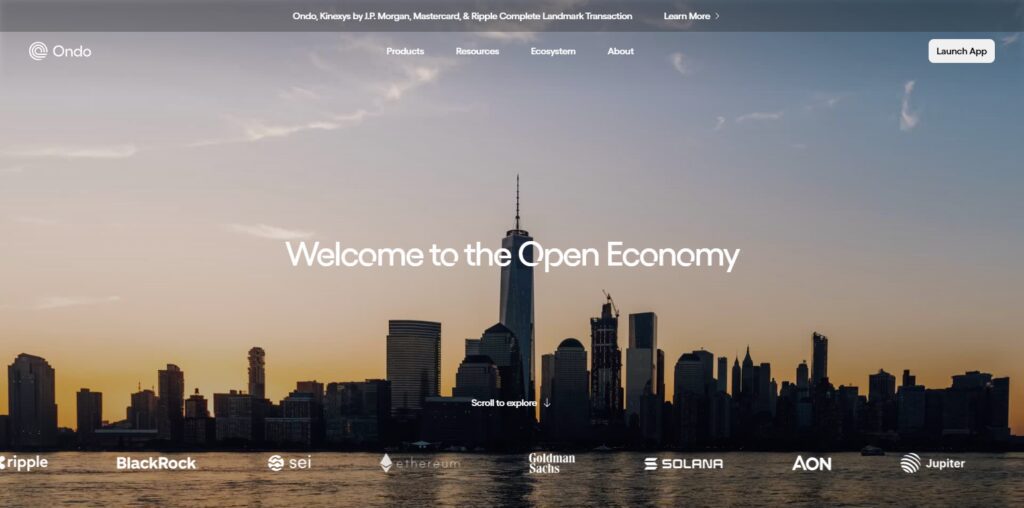
Ondo also brings a bridge between traditional finance and DeFi by providing on-chain access to high-quality, fixed-income securities. With the blockchain settlement system, Ondo offers strong compliance, transparency, and liquidity. Ondo Finance earns the spot of one of the Best Platforms to Invest in Tokenized RWAs due to its solid backing of trusted finance.
Ondo Finance Features, Advantages & Disadvantages
Features
- Offers Tokenized U.S. Treasury and fixed-income products
- Provides Institutional-grade asset management
- Offers on-chain access to traditional financial instruments
- Features Regulatory-focused investment structure
- Supports Multi-chain ecosystem
Advantages
- Provides stable and predictable yield opportunities
- Investments are backed by real-world government securities
- Lower volatility than most crypto assets
- Higher transparency thanks to blockchain
- Strong institutional partnerships
Disadvantages
- Limited exposure to high-growth assets
- Possible changes to regulations can affect availability
- Returns may be lower than DeFi lending
- Geographic restrictions in some jurisdictions
- Limited to fixed income
2. Maple Finance
Maple Finance is a decentralized platform that brings crypto lenders and institutional borrowers into the same virtual space. It operates a tokenized real-world lending system that makes capital accessible to businesses without a traditional banking system.
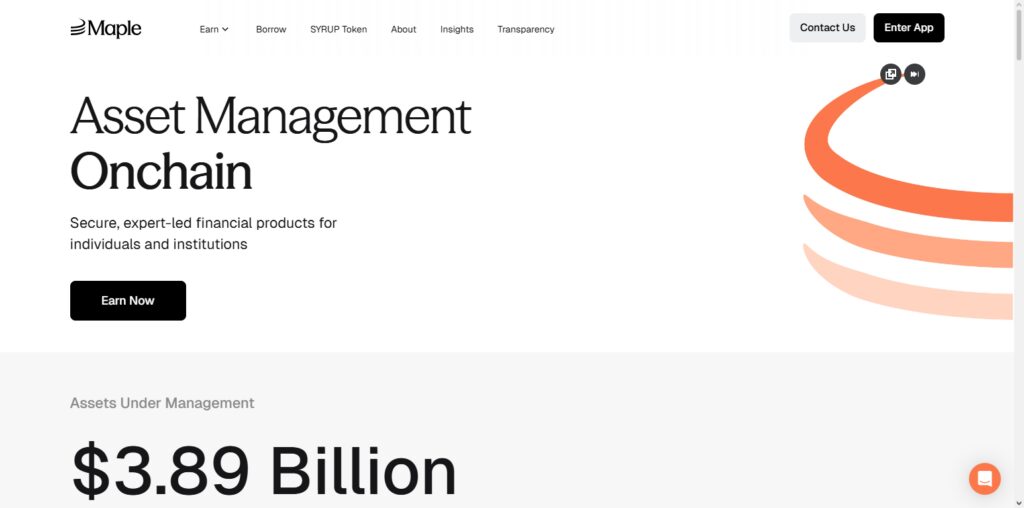
Maple also manages the lending pools through professional delegates, and investors earn a yield by providing liquidity to the pools. Maple achieves risk management through over-collateralization, credit assessment, and on-chain transparency.
Because of the higher return potential to corporate borrowers, Maple stands out among the Best Platforms to Invest in Tokenized RWAs. Maple Finance successfully builds a more efficient blockchain for credit markets.
Maple Finance Features, Advantages & Disadvantages
Features
- Institutional crypto lending marketplace
- Professional Credit Underwriting
- Permissioned lending Pools
- Loans tracked on-chain with full transparency
- Yield generation from private credit
Advantages
- Great yield opportunities
- Access to institutional borrowers
- Excellent risk assessment framework
- Effective capital allocation
- Flexible lending
Disadvantages
- Risk of borrower default
- Limited credit market yields
- Liquidity can be limited in stressed markets
- Can be complex for new investors
- Lending market regulations are in flux
3. Centrifuge
Centrifuge allows businesses to finance their decentralized business assets by tokenizing RWAs like invoices and real estate. Centrifuge connects these assets to DeFi liquidity pools. It allows investors to earn a yield of on-chain assets with collateral in off-chain assets.
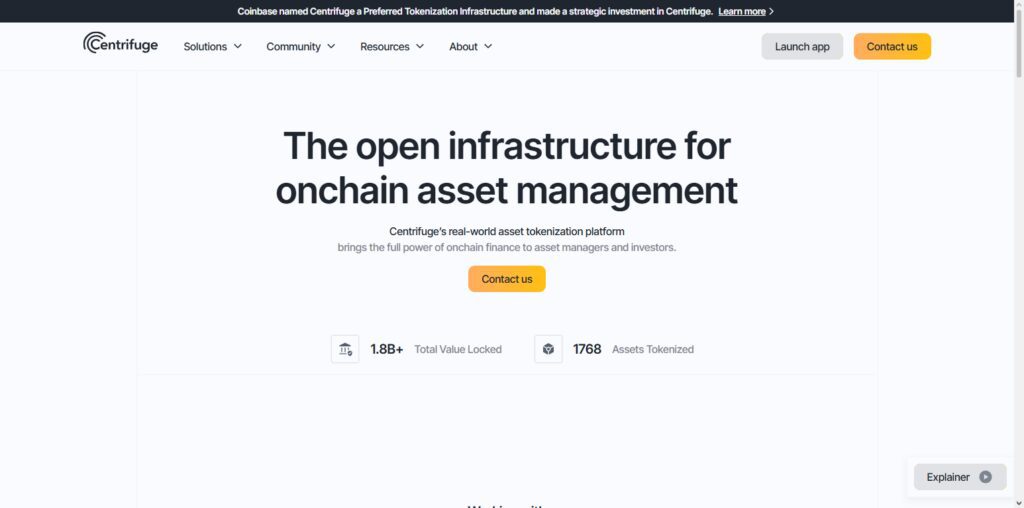
Centrifuge provides a blockchain-based financing solution, increasing financing transparency, and decreasing reliance on banks. Centrifuge uses Tinlake pools to segregate risks and provides protection to the investors.
Centrifuge is bringing on-chain supply chain finance and on-chain SME finance. Centrifuge, with the accessibility of its infrastructure, financing solutions, and tokenization of real world assets, is among the Best Platforms to Invest in Tokenized RWAs.
Centrifuge Features, Advantages & Disadvantages
Features
- Invoice and receivables tokenization
- Asset-backed lending pools (Tinlake)
- Financing real-world assets
- Integrated with DeFi
- Transparency from the blockchain
Advantages
- Exposure to real-world assets
- Income-generating and diversified opportunities
- Less reliance on traditional banks
- Better data for asset performance
- Stronger transparency and enterprise adoption
Disadvantages
- Quality of assets may be poor for certain pools
- Attracts credit risk
- Complex investment structure
- Limited liquidity for some investments
- Needs an understanding of RWA markets
4. Goldfinch
Goldfinch is an uncollateralized decentralized credit protocol that provides access to real world decentralized lending finance. Goldfinch provides opportunities to lend to businesses of the emerging markets and real world decentralized lending finance to the Unsecured lending platforms.
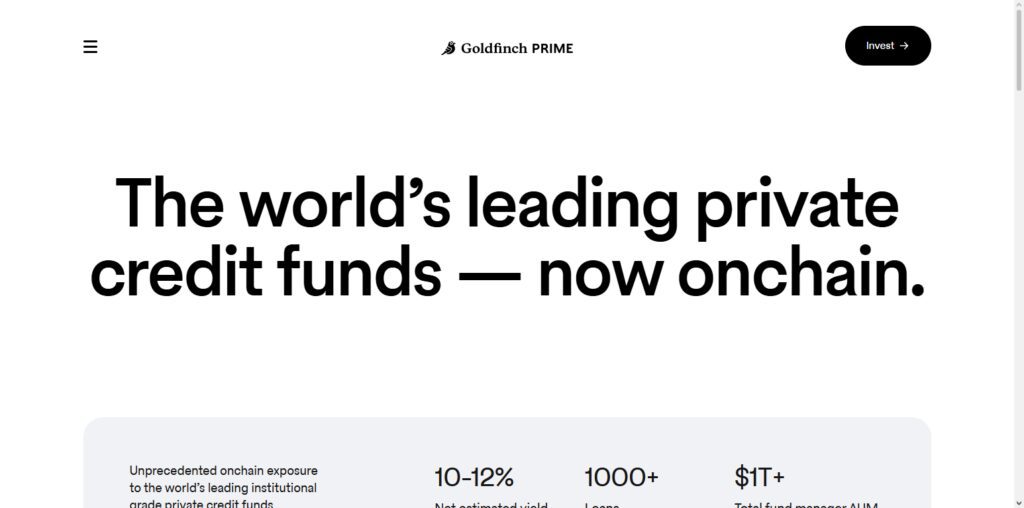
Investors earn yields by funding auditor vetted and community-backed credit pools. Goldfinch employs a novel model of “trust through consensus” which combines capital from institutions with DeFi credit.
Goldfinch aims to increase financial inclusion by offering credit to the unserved markets. With an innovative system of unsecured lending finance, Goldfinch qualifies among the Best Platforms to Invest in Tokenized RWAs by giving the users high yields and lending to real world businesses.
Goldfinch Features, Advantages & Disadvantages
Features
- Protocol for unsecured crypto lending
- Targets businesses in developing markets
- Credit risk assessed by the community
- Network of real-world borrowers
- Decentralized lending
Advantages
- Supports financial inclusion
- More diversified borrowers
- Socially responsible lending
- Greater potential for yield
- No crypto collateral
Disadvantages
- More risk of borrower default
- Has emerging market risk
- Less liquidity
- Greater risk of economic downturns
- Harder to assess risk
5. RealT
RealT offers a way for people to invest in U.S. rental properties in a fractional ownership model, where each owner of a token earns rental income in stablecoin. RealT users earn daily rental payouts and can view property management operations on the site.
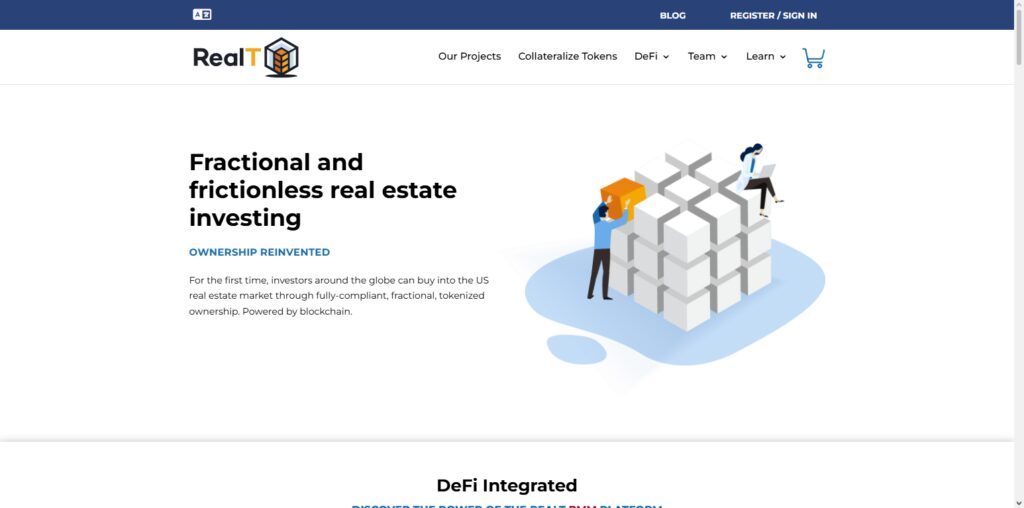
Users outside the U.S. are able to easily access the U.S. rental market, and the platform secures the property on the blockchain. RealT Users are able to invest in a property of their choice, allowing them to diversify their investments.
RealT eliminates the traditional methods of investing in real estate like heavy paperwork and a large capital investment. RealT is one of the Best Platforms to Invest in Tokenized RWAs because it allows blockchain users ownership of a physical property, and a token that generates income.
RealT Features, Advantages & Disadvantages
Features
- Fractional Ownership of Real Property
- Tokenized Residential Real Estate
- Daily Distribution Of Rental Income
- Real Estate Maintained By A Blockchain
- Low Minimum Investment
Advantages
- Ability to invest in the U.S. real estate market
- Passive income through rent
- High Transparency
- Easy to diversify a portfolio
- Less capital needed
Disadvantages
- Value of investments still tied to the property
- Real estate market risk
- Lack liquidity
- Limited in some areas due to blockchain regulations
- Rent risk
6. Matrixdock
Matrixdock offers tokenized U.S. real-world assets, including short-term U.S. Treasury products and the gold token (XAUm). These digital tokens are gold and U.S. Treasuries in a fraction of their form, and are liquid and backed by custodians of institutional grade. When investing in a Matrixdock token, you are ensured both gold and Treasuries are in an audited and regulated vault.
This makes Matrixdock a great way to access safe-haven investments. With a focus on high-quality, real, and rare collateral that is backed by assets and offers transparency, Matrixdock is one of the Best Platforms to Invest in Tokenized RWAs.
Matrixdock Features, Advantages & Disadvantages
Features
- Gold and Treasuries Tokenization
- Asset-backed Tokens
- Digital Tokens
- Excellent Custody
- Management of Reserved Audits
Advantages
- Participant in safe-haven assets
- Excellent reserves
- Low Operational Costs
- More investment opportunities
Disadvantages
- Limited Variety of Assets
- Potential for lower returns relative to riskier RWAs
- Compliance with regulations is necessary
- Changes in commodity pricing
- Difficulties in onboarding institutions
7. Clearpool
Clearpool is a protocol for DeFi to facilitate unsecured institutional lending. It uses permissioned pools for lenders and users earn yield based on risk. Clearpool also has tokenized credit pools (cpTokens) for lending in real world credit. For credit lending, it uses credit scoring and risk models. It focuses on lending transparency.
Clearpool connects decentralized credit lending to traditional lending solution. Clearpool is among the Best Platforms to Invest in Tokenized RWAs for its credit market innovation and its ability to scale on-chain for institutional lending.
Clearpool Features, Advantages & Disadvantages
Features
- Institutional Decentralized Lending
- Unsecured Lending Pools
- Dynamic Interest Rate
- On-Chain Credit
- Permissioned Liquidity
Advantages
- Higher lending yields
- Access to Institutional Borrowers
- Greater transparency in lending
- Optimized lending capital
- Easy to scale
Disadvantages
- Credit default risk
- Market liquidity risk
- Greater risk than Treasury Backed RWAs
- Regulatory concerns
- Yields are less certain
8. Credix
Credix is a credit platform in DeFi, seeking to fund lending businesses in fintech from developing economies. It tokenizes credit portfolios and links them to the DeFi ecosystem. The platform uses structured credit pools and risk segmentation to bolster liquidity.
This allows access to private credit markets at a higher yield. Credix also focuses on lending businesses in fintech, providing investors with a diverse range of yield. Among the Best Platforms to Invest in Tokenized RWAs, it is the first to link credit systems to blockchain from credit lending.
Credix Features, Advantages & Disadvantages
Features
- Private credit for emerging markets
- Custom lending pools
- Institutional credit assessment
- Blockchain credit
- Lending via Fintech
Advantages
- Access to credit
- Potential for greater returns
- Greater borrower diversity
- Increased access to finance
- Focus on underserved markets
Disadvantages
- High credit risk
- Emerging market instability
- Limited liquidity
- High risk assessment difficulty
- Reliant on borrower credit
9. Securitize
Securitize is a regulated digital asset platform that tokenizes private equities and other private securities like funds and bonds. It offers institutions an entire infrastructure compliant with regulations to issue and trade security tokens.
Many institutions use Securitize for compliant Real World Asset (RWA) tokenization. Securitize provides automated compliance and identifies investors for safer secondary markets.
Securitize integrates traditional finance with blockchain by providing regulated real world investment products. Strong regulatory compliance and institutional tokenization solutions position Securitize as a top choice among the Best Platforms to Invest in Tokenized RWAs.
Securitize Features, Advantages & Disadvantages
Features
- Platform for Tokenized Securities
- Compliant with Regulations
- Investor onboarding and KYC
- Support for Secondary Trading
- Tokenization for Institutional Assets
Advantages
- Good Compliance
- Institutional Confidence
- Widespread Tokenization
- Secure Investor Management
- Crossing Traditional Finance and Blockchain
Disadvantages
- Lengthy Compliance
- Limited Jurisdiction Availability
- High Onboarding Difficulty
- Regulatory costs can accumulate quickly. Less decentralized than DeFi platforms.
10. Tokeny
Tokeny is one of the top enterprise tokenization platforms for financial institutions. Since tokenization of real world assets like equities and bonds needs to be compliant, Tokeny focuses on that. Tokeny has a bunch of tools for automating compliance checks, onboarding investors, and connecting secondary markets.
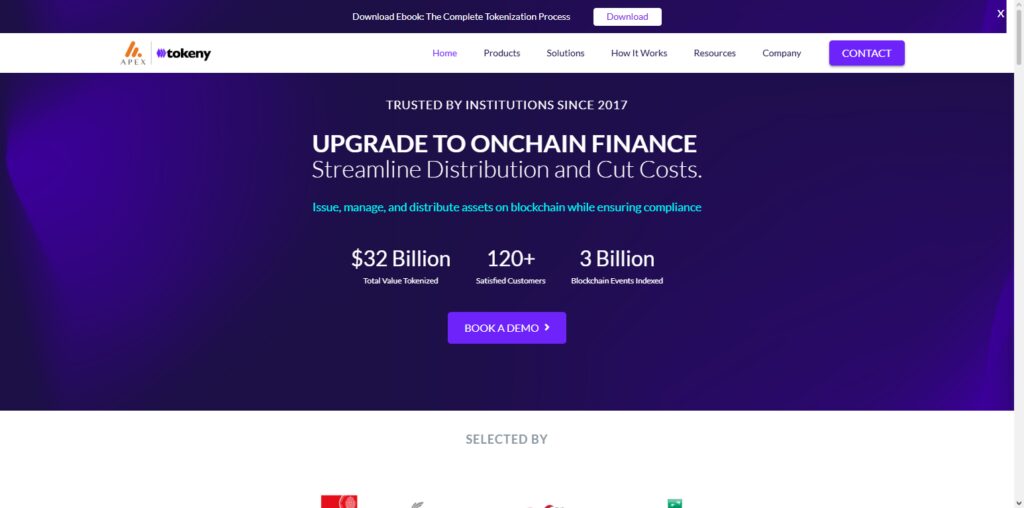
A bank or an asset manager looking to issue blockchain secured assets wishes for their compliance to be assured. Since Tokeny is flexible to issues of multiple jurisdictions, it is used by many institutions. With its strong compliance, flexible use, and easy connection to legacy financial systems, it is one of the best platforms for tokenizing real world assets.
Tokeny Features, Advantages & Disadvantages
Features
- Enterprise tokenization solutions
- Built-in compliance safeguards
- Issuance of digital securities
- Supports multiple jurisdictions
- Integration of secondary markets
Advantages
- Solid compliance infrastructure
- Open to institutional clients
- Advanced tokenization capabilities
- Multiple asset class tokenization
- Streamlined management of investors
Disadvantages
- Focused on enterprise needs
- Few options for retail investors
- Compliance steps can be cumbersome
- More expensive to use
- Need tech integration skills
Comparison Table
| Platform | Asset Focus | Key Investment Type | Yield Potential | Best For | Key Strength |
|---|---|---|---|---|---|
| Ondo Finance | U.S. Treasuries & Bonds | Tokenized Fixed Income | Moderate | Conservative Investors | Stable, low-risk yield products |
| Maple Finance | Institutional Credit | Private Lending | High | Yield Seekers | Institutional borrower access |
| Centrifuge | Invoices & Receivables | Asset-Backed Lending | Moderate to High | RWA Investors | Real-world business financing |
| Goldfinch | Emerging Market Loans | Unsecured Credit | High | Growth Investors | Global credit opportunities |
| RealT | Real Estate | Fractional Property Ownership | Moderate | Real Estate Investors | Rental income from tokenized properties |
| Matrixdock | Gold & Treasuries | Asset-Backed Tokens | Moderate | Risk-Averse Investors | Backed by physical assets |
| Clearpool | Corporate Debt | Institutional Lending | High | DeFi Lenders | Dynamic yield generation |
| Credix | Private Credit | Fintech Lending | High | Alternative Credit Investors | Emerging market exposure |
| Securitize | Securities & Funds | Tokenized Securities | Moderate | Institutional Investors | Strong regulatory compliance |
| Tokeny | Digital Securities | Asset Tokenization Infrastructure | Varies | Asset Issuers & Enterprises | Enterprise-grade compliance tools |
Quick Comparison
| Platform | Minimum Investment | Regulatory Focus | Liquidity | Risk Level |
|---|---|---|---|---|
| Ondo Finance | Low | High | Medium | Low |
| Maple Finance | Medium | Medium | Medium | Medium-High |
| Centrifuge | Medium | Medium | Medium | Medium |
| Goldfinch | Medium | Medium | Medium | High |
| RealT | Low | High | Low-Medium | Medium |
| Matrixdock | Low | High | Medium | Low |
| Clearpool | Medium | Medium | High | Medium-High |
| Credix | Medium | Medium | Medium | High |
| Securitize | Medium-High | Very High | Medium | Low-Medium |
| Tokeny | Enterprise-Level | Very High | Medium | Low-Medium |
Key Takeaway
| Investor Type | Recommended Platform |
|---|---|
| Conservative Income Investors | Ondo Finance, Matrixdock |
| Real Estate Investors | RealT |
| High-Yield Credit Investors | Maple Finance, Clearpool, Credix |
| Emerging Market Exposure | Goldfinch, Credix |
| Institutional & Regulated Investments | Securitize, Tokeny |
| Diversified RWA Exposure | Centrifuge, Ondo Finance |
Conclusion
Tokenized RWAs are changing how we invest by providing real assets on the blockchain, like real estate, private credit, bonds, and commodities. Ondo Finance, Maple Finance, Centrifuge, and RealT create more ways to invest.
If you want stable yield by buying tokenized Treasuries, private credit, or even fractional ownership of real estate, there are RWA platforms that will help you reach your investment goals. The tokenized RWA platforms are expected to become a popular place for investment,
especially for retail investors, as the platforms will bring traditional finance and digital assets together, especially with the growing adoption of blockchain technology.
The platforms will become popular with institutional investors as well. The platforms will fill the gap between the two worlds and will create new opportunities for investors.
FAQ
Which RWA platform is best for real estate investing?
RealT is one of the most popular platforms for tokenized real estate investments, allowing investors to own fractions of rental properties and earn rental income through blockchain-based ownership.
Which platforms offer tokenized Treasury products?
Ondo Finance and Matrixdock are well known for offering tokenized U.S. Treasury and fixed-income investment products that provide relatively stable yields.
How do investors earn returns from tokenized RWAs?
Returns can come from rental income, interest payments, bond yields, private credit lending, revenue-sharing agreements, or appreciation in the value of the underlying asset, depending on the specific RWA investment.
Are tokenized RWAs regulated?
Many RWA platforms operate under regulatory frameworks, particularly those offering tokenized securities. Platforms such as Securitize and Tokeny focus heavily on compliance, investor verification, and securities regulations.
What should I consider before choosing an RWA platform?
Important factors include asset quality, regulatory compliance, security measures, liquidity options, platform reputation, yield potential, fees, transparency, and the type of real-world assets available for investment.