Finding the Best Stripe Alternatives for Small Businesses as they work to manage the cost-efficient way to gain customer trust. While Stripe is one of the most popular options, Square, Pay Pal, Shopify Payments, Helcim, Adyen, Authorize.net, PaymentCloud, FastSpring, CardX, and Airwallex all have unique pros.
There are solutions for a variety of industries with lower transaction fees and faster access to funds, a global reach, approval of high-risk merchants, and specialized SaaS compliance. Assessing what each of these solutions offers will help small businesses minimize the risk of cash flow while also offering an easy internationalavailability, all while maintaining a quality customer experience.
Why Should Small Businesses Consider Stripe Alternatives?
- Cost Efficiency: Most alternatives provide lower effective processing costs, interchange-plus pricing, or zero-fee surcharging models. Small businesses would save more on transaction costs compared to Stripe’s flat rates.
- Global Reach: Airwallex and Adyen cover 160+ payment methods and 130+ currencies. This makes it easier for small businesses to do international transactions, without the pain of a high FX markup and/or limited coverage.
- High-Risk Approval: PaymentCloud provides payment processing services for merchant categories which include CBD, adult, gaming, etc. in which Stripe declines to process payments.
- Faster Payouts: Most of Stripe’s competitors offer instant or next-day settlements. This has a positive impact on cash flow for most small businesses as compared to Stripe’s payout of 2-3 business days
- Specialized Features: Shopify Payments, FastSpring, and CardX provide services tailored to their industry, e.g., e-commerce, software, etc. that Stripe’s processing does not cover.
- Fraud Protection: Most of Stripe’s competitors offer AI-based fraud prevention systems that either replace Stripe or have significantly better customer protection systems.
- Flexibility & Choice: Besides offering pricing that small businesses can align with, most of Stripe’s competitors provide coverage for a variety of payments, and greater integration flexibility.
What to Consider Before Moving Away From Stripe?
Transaction Fees: Assess Stripe against other processors on effective fees and mark ups. Consider options, but watch out for hidden costs or steep monthly fees. Stripe’s straight-forward pricing may provide better value than other processor’s savings.
Integration Complexity: Stripe offers a lot of pre-built integration and easy to use plugins. Leaving Stripe may need re-work of your ERP or use of third-party integrations which will increase cost and complexity for small businesses.

Global Acceptance: Stripe includes over 135 currencies and local payment rails. While many alternatives may have some coverage, Stripe offers the best global reach for payments.
Payout Times: At 2-3 days, Stripe has predictable payouts. Other options may offer settlement at a faster time, but that may come at the cost of cash flow stability due to rolling reserves or delays to the final settlement.
Fraud Tools: Stripe Radar uses AI to detect fraudulent transactions. Other processors may offer trade-offs between chargeback coverage, dispute resolution, and fraud liability which will increase risk to the merchant.
Brand Recognition: Stripe is a commonly recognized brand. This will provide checkout confidence for your users. Many alternatives may not have this recognition which could impact conversion and trust in purchases.
Growing Businesses: Stripe supports businesses at all stages of their growth. Other processors may not be able to support you at the same level, especially as you reach larger growth goals.
Key Points
| Platform | Best For | Pricing Model | Key Features |
|---|---|---|---|
| Square | All-in-one payments | $0 monthly | POS hardware, online + offline sales, invoicing |
| PayPal | Payment flexibility | $0 monthly | Widely accepted, easy setup, global reach |
| Shopify Payments | Ecommerce stores | $5 monthly | Seamless Shopify integration, fraud protection |
| Helcim | Transparent pricing | $0 monthly | Interchange-plus pricing, invoicing, recurring billing |
| Adyen | Global enterprises | Custom pricing | Multi-currency support, advanced fraud tools |
| Authorize.net | Fraud protection | $25 monthly | Strong integrations, recurring billing |
| PaymentCloud | High-risk merchants | $10 monthly | Approval for high-risk industries, fraud prevention |
| FastSpring | SaaS & MoR | Revenue-share | Handles tax, compliance, global SaaS billing |
| CardX | Zero processing fees | $29 monthly | Pass fees to customers, surcharging compliance |
| Airwallex | Cross-border businesses | Custom pricing | Global accounts, FX management, multi-country payments |
1. Square
Founded in 2009, Square is a US-based payment processor that offers flat-rate simplicity. Cash flow costs average around 2.6% + $0.10 in-person and 2.9% + $0.30 online, with no monthly fee on the free plan. Small businesses typically process $5K–$50K monthly volume with an AOV of $20–$60.
Domestic transactions account for most transactions, but international cards incur a +1.5% surcharge. Daily settlements are provided. Payouts with instant settlements cost 1.95% with flexible payout options.
Transactions support Visa, Mastercard, Amex, Discover, Apple Pay, Google Pay, and Afterpay. Chargeback administration costs are zero, but most funds are held. Square dominates the omnichannel POS integration market, but flat rates become costly as volume and transaction count increase.
Key Features
- POS Hardware Integration
- Flat Rate Pricing
- Sales Support On and Off the Internet
- Invoicing and Recurring Billing
- Fraud Detection tools
Pros:
- Easy for small businesses to get started
- Pricing is clear, no hidden fees
- Strong omnichannel ecosystem
- Fast payments with an instant transfer option
Cons:
- Limited international reach
- Costly flat rates for high volumes
- Basic customization compared to enterprise gateways
Best for: Small businesses that need POS and online payments.
2. PayPal
PayPal processes the most transactions of any payment processor with its 439M active accounts and $486B of TPV in Q2 2026. Within the US, PayPal’s effective domestic cost is 2.59% + $0.49 per transaction, while international transactions add a +1.5% cross-border fee and approximately 3-4% FX markup.

There is a great deal of range in the small business transactional volumes from freelance level transactions of $2K to enterprise level transactions in excess of $100K. The AOV is typically $50–$150, especially with the sale of digital goods. Working capital loans are available to facilitate PayPal payouts that settle in 1-2 business days.
Transactions cover PayPal wallet, cards, Venmo, Zettle POS, and BNPL. The cost of chargebacks is not a concern for customers, but most chargeback disputes are decided in favor of the purchaser. Despite high costs, the buyer trust and global reach of PayPal makes it an undisputed leader for most small businesses.
Key Features
- Acceptance in Global Wallets
- Easy Integration of Built-In Checkouts
- Venmo, Buy Now Pay Later (BNPL), Support
- Seller Protection
- Support for Multiple Currencies
Pros:
- Trusted globally, quick setup at no cost
- Strong protection for buyers leads to higher conversions
- Support for digital goods and subscriptions
Cons:
- Higher cross-border fees
- Chargebacks favor buyers
- FX markup increases costs
Best For: Freelancers and small businesses
3. Shopify Payments
Payment costs will vary based on your plan. Basic is 2.9% + $0.30, Shopify is 2.6% + $0.30, and Advanced is 2.4% + $0.30. Transaction volumes generally range from $10K–$100K with an AOV of $40–$120.
Most of Shopify’s business comes from domestic transactions, but it supports over 100 currencies and offers local payment methods such as iDEAL, Bancontact, and BLIK.
Also, payouts happen in 2 to 3 days, and the service is even faster if you use Shopify Balance. The service also covers cash out via cards and Apple Pay, Google Pay, Shop Pay, and even cash back in the form of USDC.
Chargebacks follow the industry standard, and Shopify Protect covers chargeback costs for eligible orders made using Shop Pay. For ecommerce-first businesses, Shopify Payments provides seamless fraud protection and boosts conversions.
Key Features
- Fraud protection via Shop Pay
- Multi currency
- BNPL with Shop Pay Installments
- Automated tax
- Support for 100+ currencies
Pros:
- Seamless ecommerce integration
- Boosts conversions with Shop Pay
- Pricing is transparent and clear
Cons:
- Available only to Shopify merchants
- Limited support for offline transactions
- Slower than Square payments
Best For: Ecommerce stores built on Shopify.
4. Helcim
Helcim has transparent interchange-plus pricing and charges no monthly fees. Effective pricing starts at 0.50% + $0.25, and at higher volumes, it can go as low as 0.15% + $0.06. Most merchants fall in the range of $5K to $100K in monthly processing volume, with an average order value of $30 to $80.
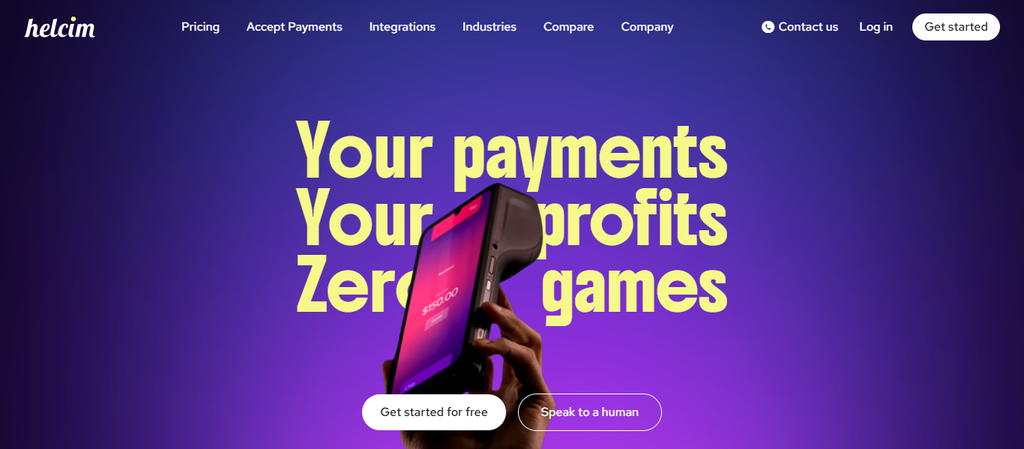
Commonly, domestic transactions account for the bulk of processing volume, but Helcim supports multi-currency payments. Settlement takes 2 business days, slower than most competitors who offer the same-day settlement.
The solution supports payments via cards, ACH, invoicing, recurring payment, and QR codes. Chargebacks follow the rules of Visa and Mastercard, and in such cases, the Merchant bears the cost of the dispute. Helcim’s volumes-based discounts and cost transparency are ideal for growing SMBs.
Features:
- Pricing model: Interchange plus
- Automatic volume discounts
- Recurring Billing and Invoicing
- Multi-currency
- Reporting
Pros:
- Does not charge a monthly fee
- Has a predictable cost structure
- Good SMB support
- Good customer service
Cons:
- Slow payouts (2 business days)
- Limited international coverage
- Less brand name recognition than PayPal
Best For: SMBs looking for a processor with a transparent pricing model with the ability to support business growth.
5. Adyen
Adyen, with its Amsterdam headquarters, is one of the world’s largest processors with an enterprise class offering. Adyen’s pricing is done on a case to case basis and is usually somewhere around interchange plus with volume discounts.
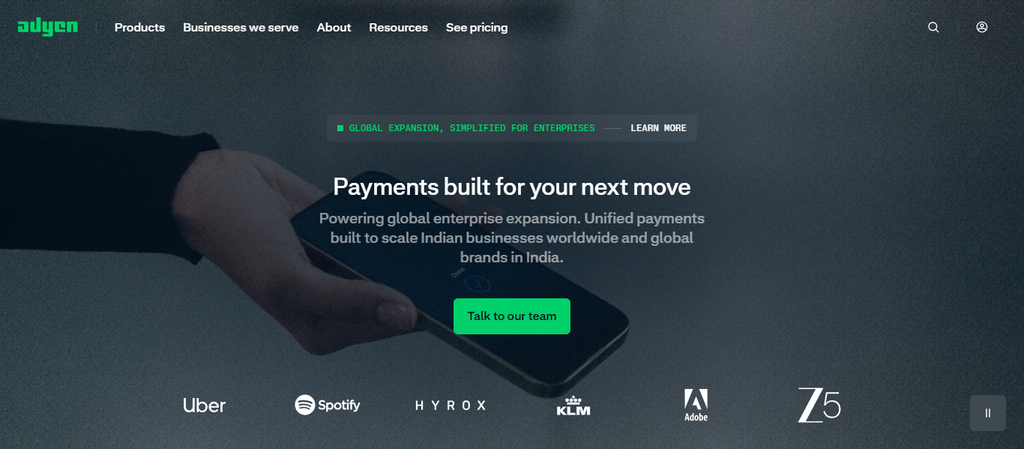
For the first half of 2026, Adyen processed €803.8 billion in payment volume, with merchants processing $100K to $1M per month on average. The average order value is $50 to $200, and Adyen supports international transactions strongly with 250+ payment methods and 175 currencies.
With unified acquiring, settlement happens fast, and there is significant latency reduction. Adyen supports payments via cards and wallets and local payment rails such as UPI and Pix. Chargebacks are managed via RevenueProtect AI, which reduces fraud by up to 35%. Though Adyen is robust for the enterprise class, it can be overkill for micro-merchants.
Features:
- Enterprise-grade acquiring
- 250+ payment methods
- Fraud AI: RevenueProtect
- Unified Commerce
- Multi-currency settlement
Pros:
- Strong global coverage
- Enterprise-level fraud protection
- Fast settlement
- Supports local rails
Cons:
- Complex onboarding
- Custom pricing may be incfsensitive for SMBs
- Overkill for micro-merchants
Best For: Large global enterprises looking for enterprise-level payments.
6. Authorize.net
Authorize.net, of which Visa acquired a majority stake, is a legacy gateway that serves over 430,000 merchants. The $25 monthly gateway cost plus 2.9% + $.30 per transaction. Small-to-medium businesses (SMB’s), on average, process volumes of $10k – $50k a month and have an average order value (AOV) of $40 – $100.
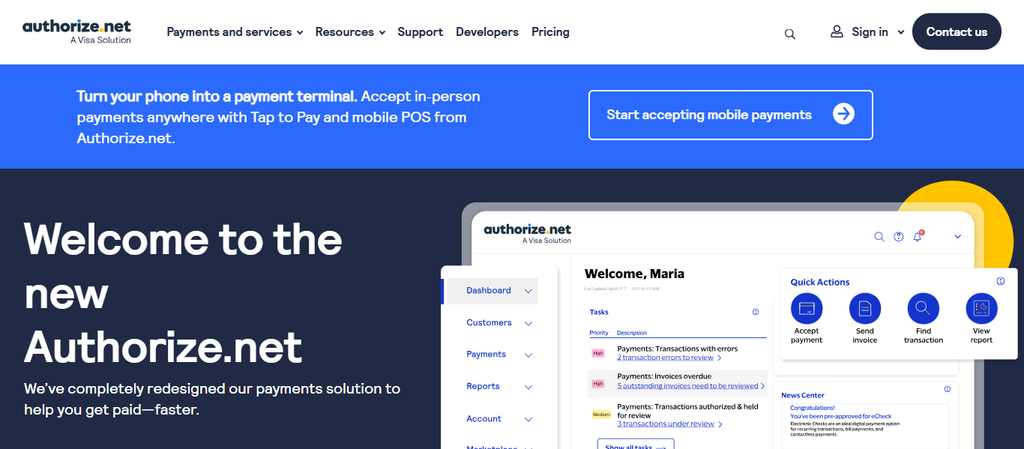
Domestic transactions dominate with only a minimal amount of international (US, CA, UK, AU) transactions. Typical settlements take 2 – 3 days. The gateway processes payment via cards, ACH, eChecks, and digital wallets.
Merchants are responsible for managing the chargeback process and there are customizable fraud filters. Authorize.net is well suited for businesses moving from legacy ERP and accounting systems as it is compatible with older systems.
Features:
- Gateway legacy offering from Visa
- Recurring billing
- eCheck, ACH, and other payment formats supported
- Fraud filters
- Customizations for integrations with ERP’s
Pros:
- Reliable brand
- Strong customer service and fraud tools
- Works with legacy systems
- Supports multiple payment methods
Cons:
- $25 monthly gateway fees
- Limited coverage internationally
- Old, outdated interface compared to the competition
Best For: Companies with legacy ERP/Accounting systems.
7. PaymentCloud
PaymentCloud focuses on premium CBD, vape, adult, and firearm related high risk merchant accounts. Average effective pricing is around 2.4 – 3.5%, and is structured with the interchange plus pricing model.
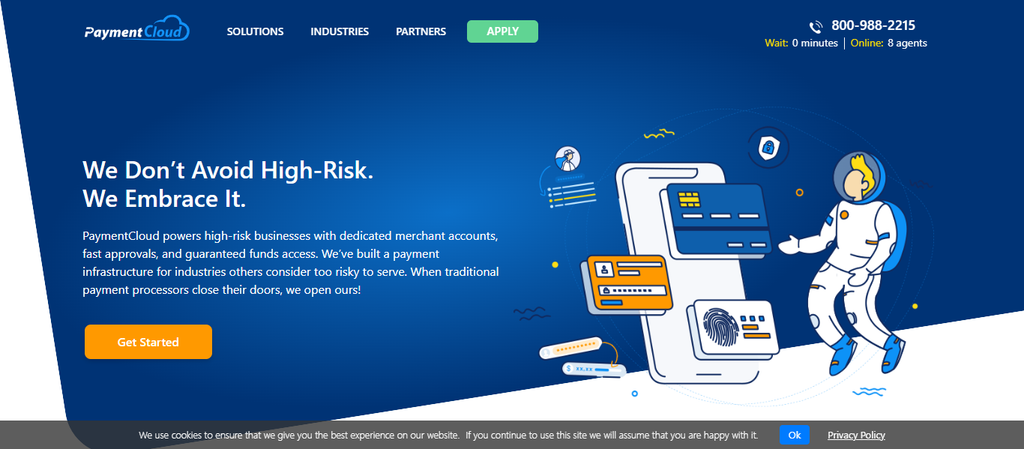
Processing volumes of $10k – $250k are typical with average order values of $50 – $150. There is support for international processing with multiple acquiring banks. A typical settlement is 2 – 3 days, as are rolling reserves.
The processor support cards, ACH, crypto, and gateways such as NMI and Authorize.net. Chargeback thresholds are set between 1 – 2% of total monthly volumes, and PaymentCloud’s strength is approval of businesses that have been declined by Stripe or Square. However, the costs and long 5 – 10 day approvals are not ideal for most businesses.
Features:
- High-risk merchant approval
- Interchange-plus pricing
- ACH & crypto support
- Gateway integrations (NMI, Authorize.net)
- Fraud prevention tools
Pros:
- Accepts high-risk industries
- Multiple acquiring bank partners
- Strong fraud monitoring
- Customizable solutions
Cons:
- Effective rates ranging between 2.4% and 3.5%
- Onboarding takes 5 to 10 days
- Usually uses rolling reserves
Best For: Merchants operating high-risk industries.
8. FastSpring
FastSpring operates as a Merchant of Record (MoR) for SaaS and/or digital goods. Their pricing exchanges a revenue share commission of 5 – 8% for each transaction. Processing volumes of $20k – $500k average with an AOV of $50 – $200.
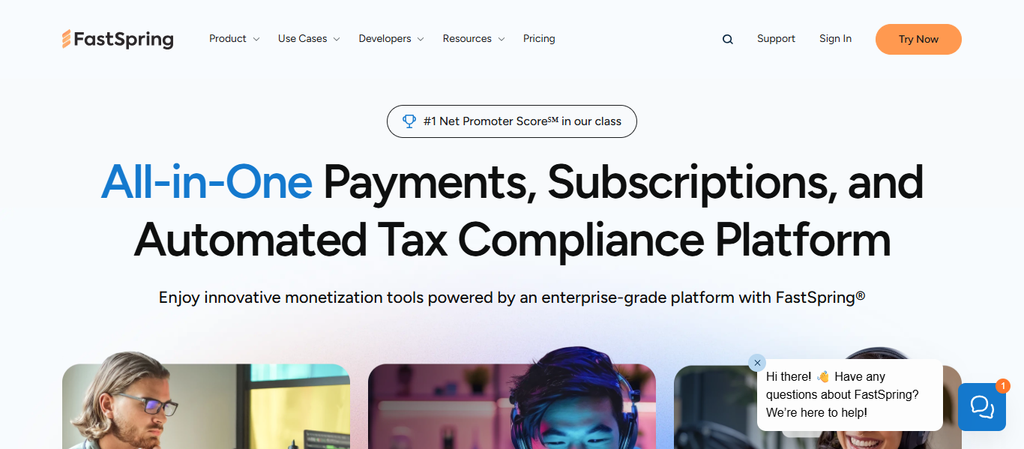
With a significant 240+ countries and 35+ currencies supported, international transactions are the majority. There is a 2-3 day settlement, and FastSpring has a VAT/GST deal in which the company processes the remittance for the merchant, who pays $54+ million annually.
Additional payment methods include local payments, wallets, and ACH. As a legal seller, FastSpring absorbs chargebacks, so merchants’ liability is minimal. For SaaS companies needing global tax compliance and subscription management, FastSpring is a strong option.
Features:
- Merchant of Record model
- Global tax compliance for VAT/GST
- SaaS subscription billing
- Support in 35+ currencies
- Charges absorbed for you
Pros:
- Tax and compliance are taken care of
- Decreased liability for merchants
- Advanced SaaS billing tools
- Global digital goods supported
Cons:
- Higher fee range of 5-8%
- Limited for physical goods
- Complicated revenue-share model
Best fits: Global digital goods and SaaS businesses that need tax compliance.
9. CardX
As a subsidiary of Stax, CardX provides a solution to accept transactions at no credit card processing fees with a compliant surcharging solution. Merchants pay $99 monthly, and customers pay a 3% fee.
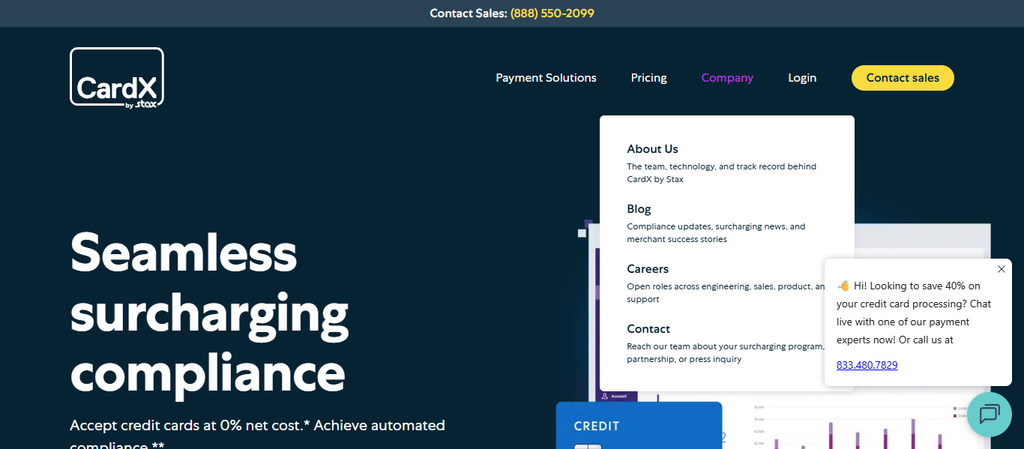
Transaction pricing depends on the type of debit card and is in the range of 1.25%–2.91%, with a 25-cent minimum. Monthly volume is between $10K and $200K with an AOV of $50 to $150. Domestic transactions are the majority of volume, while international is limited.
Standard is a settlement of 1–2 days. The service includes card processing, ensuring compliance with surcharging, and a virtual terminal. Surcharging liability is on the merchant in the case of a chargeback. Most suitable for service businesses and B2B companies looking to eliminate processing fees, though there is some compliance risk..
Features:
- Zero cost credit processing
- Compliance to surcharging system
- Virtual terminals
- Additional debit card support
- Clear, Predictable pricing every month
Pros:
- Eliminating credit card processing fees
- Easy franchise management
- Strong B2B frictionless adoption
- Predictable monthly costs
Cons:
- $99 monthly charge
- Restricted use in international markets
- Compliance risks from improper use
Best fits: Zero processing fees required in B2B/Service markets.
10. Airwallex
Founded in Melbourne, Airwallex has licenses in SG, AU, UK, and EU. Having started as a multi-currency wallet, they have pivoted to providing banking-as-code infrastructure to SaaS and ERP vendors.
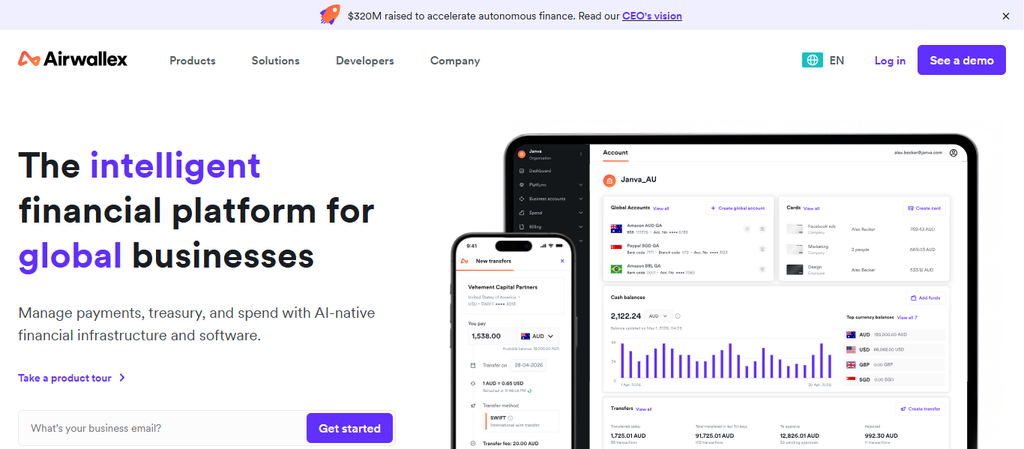
Airwallex in 2026 has a strong position as one of the alternatives to Stripe for SMBs in its focus on providing multi-currency accounts, embedded finance APIs, and low FX margins vs PayPal and traditional banks. It supports 130+ currencies and 160+ payment methods, acting as a gateway and a processor to improve settlement times and lower settlement costs.
Typical SMBs process $50K to $1M monthly, while midmarket SMBs process more than $1M monthly with embedded APIs. Enterprise contracts typically have local payout rails like UPI (India) and Pix (Brazil) included.
Features:
- Global accounts in 130+ currencies
- FX services provided at low margin
- Cross border payments
- Virtual cards for spending
- API integration first
Pros:
- Greater cross border services
- FX rates are better than PayPal
- Supports 160 payment methods
- Ideal for global SMBs
Cons:
- Custom pricing may be convoluted
- Offline POS is limited
- Requires integration that’s not straight forward
Best fits: SMB with international Customers/Suppliers
Conclusion
Small businesses will need to consider trade-offs involving cost-effectiveness, international operations, anti-fraud measures, and fast payouts in order to look beyond Stripe in 2026. In this context, PayPal and Square have advantages in ease of use and trust, whereas Helcim has interchange-plus pricing.
Adyen and Airwallex have a strong foothold in international commerce and multiple currencies. PaymentCloud serves Stripe’s riskier transactions, and Shopify Payments is the most integrated ecommerce solution.
FastSpring manages tax compliance for SaaS, CardX eliminates credit card fees, and Authorize.net works with legacy systems. Optimal payments solutions will depend on industry risk, transactions, and international needs, so that businesses are able to optimize their cash flow and customer trust.
FAQ
Why consider Stripe alternatives?
Small businesses explore alternatives to reduce transaction costs, gain faster payouts, expand global reach, or access specialized features like high‑risk merchant approval and SaaS tax compliance.
Which alternative has lowest fees?
Helcim offers transparent interchange‑plus pricing with automatic volume discounts, making it one of the most cost‑effective options compared to Stripe’s flat‑rate model.
Which is best for global payments?
Airwallex and Adyen dominate cross‑border commerce, supporting 130+ currencies and 160+ payment methods, with lower FX margins than PayPal or Stripe.
Which option supports high‑risk industries?
PaymentCloud specializes in approving merchants in industries Stripe rejects, such as CBD, adult, vape, and gambling, though costs are higher.
Which is best for ecommerce stores?
Shopify Payments integrates seamlessly with Shopify, offering fraud protection, BNPL via Shop Pay, and conversion boosts for online stores.
Which platform eliminates card fees?
CardX enables compliant surcharging, passing credit card fees to customers, effectively reducing merchant processing costs to zero.