This article will address the Best Stablecoin Fraud Prevention Tools that shape compliance and security for 2026. Stablecoins such as USDT, USDC, and DAI are proliferating digital payments. Fraud prevention becomes necessary for exchanges, merchants, and regulatory agencies. These newer tools offer real-time monitoring, risk assessment, sanctions screening, and forensic tracking to keep transactions safe.
Leading tools offer businesses a way to build trust,, transparency, and compliance with regulatory frameworks in the rapidly changing crypto world. We will analyze the leading tools to see what options are available for businesses.
Why Choose Stablecoin Fraud Prevention Tools
Real-Time Monitoring – These tools allow us to see suspicious wallet transactions in real time and prevent funds from being transferred.
Risk Scoring – Merchants are assisted with prioritizing their investigations by assigning risks to addresses and transactions.

Sanctions Screening – Compliance with global regulations is ensured by automated checks against OFAC, EU, and UN lists.
Multi-Chain Coverage – Give protection across USDT, USDC, DAI, and other stablecoins.
Merchant Trust – Fraud prevention builds a merchant’s reputation with regulators and customers.
Regulatory Alignment – Effectively addressing AML/KYC requirements.
Cost Efficiency – prevents fraud losses, chargebacks, and damage to reputation
Key Points
| Tool | Strengths | Best Fit For |
|---|---|---|
| Chainalysis KYT | Real‑time monitoring, OFAC compliance, deep clustering | Banks, exchanges, regulators |
| TRM Labs | Entity attribution, sanctions screening, fraud case management | Financial institutions & payment firms |
| Elliptic | Risk scoring, mixer detection, regulator‑trusted | Exchanges & custodians |
| Merkle Science | Predictive analytics, multi‑chain stablecoin coverage | DeFi platforms & fintechs |
| Scorechain | EU compliance, AML reporting, stablecoin analytics | European crypto businesses |
| CipherTrace (Mastercard) | Global AML, Mastercard backing, strong fraud detection | Payment processors & banks |
| Crystal Blockchain | Investigative suite, fraud alerts, forensic analysis | Enterprises & regulators |
| Coinfirm | AML automation, sanctions integration, fraud detection | Exchanges & custodians |
| Blockpass | Address + identity screening, modular compliance | DeFi protocols & token issuers |
| Didit | Transparent $0.15/check pricing, unified API (KYC/KYT/AML) | Startups & mid‑tier firms |
1. Chainalysis KYT
Chainalysis KYT (Know Your Transaction) is our first offering for real-time compliance with 200+ supported blockchains. Its pricing model is mostly enterprise-based (although custom models exist) for regulators, exchanges, and custody providers.
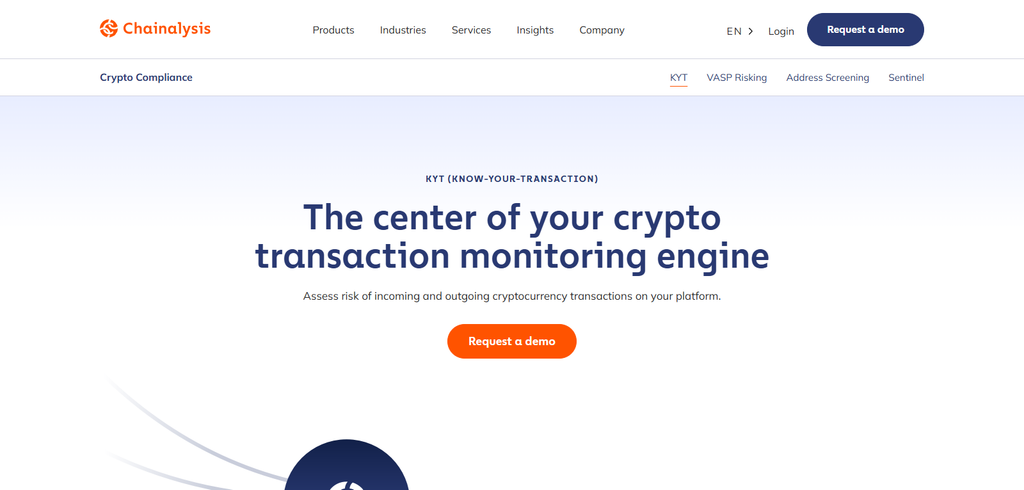
The platform has continuous wallet screening, sanctions checks, and risk scoring based on transaction behavior. Chainalysis KYT nicely complements compliance stacks with alert functionality for suspicious activity and forensic transaction tracing.
Chainalysis KYT is trusted by governments and top-tier institutions for their investigative power. It strikes the right balance between compliance and forensic power and is the most adopted blockchain monitoring solution globally.
What It Does: Provides real-time monitoring of transactions and screening against sanctions lists and forensic analysis across 200+ blockchains.
Merchant Use Case: Detection of suspicious transactions is offered by the service to crypto exchanges and payment processors.
Best For: This service offers maximum forensic depth for regulators as well as Tier-1 exchanges and custodians.
Chainalysis KYT Pros & Cons
| Pros | Cons |
|---|---|
| Supports 200+ chains | Premium pricing, costly for startups |
| Real-time monitoring | Complex integration for small firms |
| Strong forensic tracing | Heavy enterprise focus |
| Trusted by regulators | Requires advanced compliance teams |
| Seamless API integration | Less flexible for lightweight use cases |
| Detailed risk scoring | May overwhelm smaller merchants |
| Global adoption | Limited affordability for SMEs |
2. TRM Labs
TRM Labs offers a pricing model that is transparent and flexible for fintech and exchange clients. It supports transaction monitoring for more than 190 blockchains with an additional 65 blockchains for deep tracing. Its real-time monitoring API provides wallet screening, sanctions checking, and tracing for transactions across bridges.
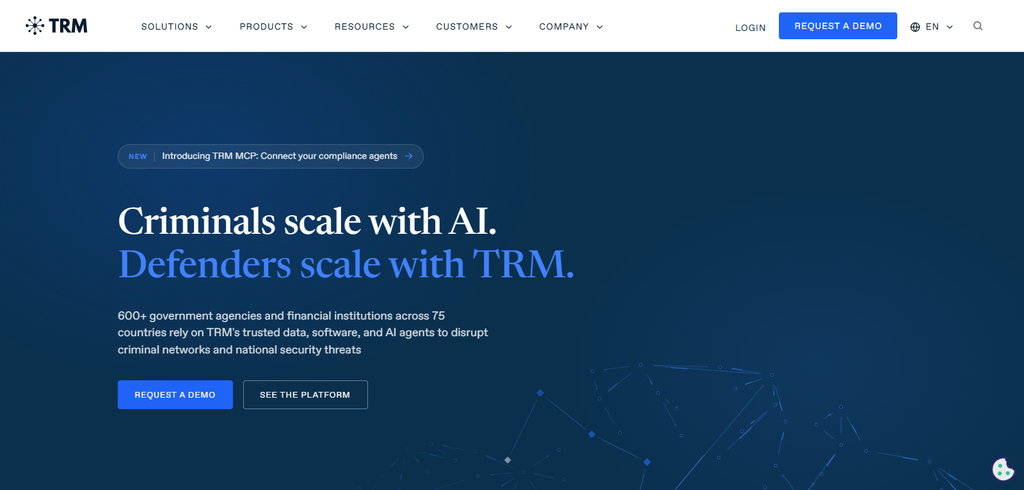
In addition, the framework provides scoring for each risk assessment. TRM Labs is favored for the clarity and attribution of its scoring, and as a result, provides strong reporting and Travel Rule support. TRM Labs pricing is mid-to-high range, however, it is designed to be flexible for its institutional clients. Overall, TRM Labs is a leading choice for exchanges and regulators for its strong, transparent cross-chain monitoring with risk scoring.
What It Does: Provides cross-chain transaction monitoring, risk scoring, and transparent attribution of risk scores to wallets.
Merchant Use Case: Used by Fintechs and exchanges for Travel Rule compliance and reporting.
Best For: Institutions that want clear and auditable compliance with strong chain coverage.
TRM Labs Pros & Cons
| Pros | Cons |
|---|---|
| Transparent risk scoring | Pricing mid-to-high tier |
| Strong Travel Rule support | Slightly less forensic depth |
| Flexible packages | Requires institutional resources |
| Supports 190+ chains | Not as widely adopted as Chainalysis |
| Clear reporting tools | Integration may need customization |
| Good attribution clarity | Focused more on compliance than forensics |
| Adaptable pricing | Less suited for very small startups |
3. Elliptic
Elliptic provides real-time monitoring and risk scoring for more than 100 blockchains and 1100 crypto networks, utilizing AI. Its pricing model is geared toward the enterprise.
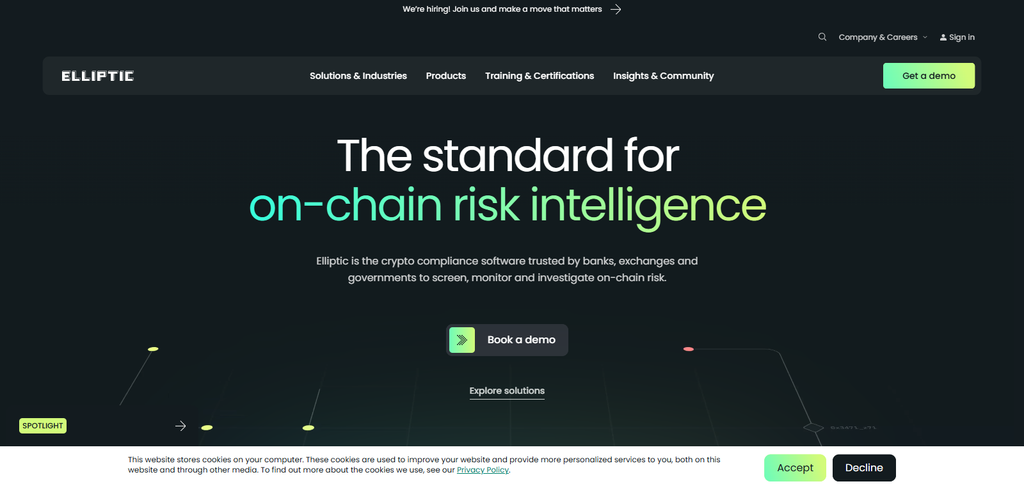
Real-time screening combines sanctions screening, darknet attribution, and ongoing transaction scoring. Mid-paragraph highlight: Elliptic builds compliance workflows trusted by major banks. When integrated with financial systems, Elliptic is designed to meet the needs of regulated businesses. Enterprise pricing makes Elliptic a good choice for institutions seeking significant coverage and advanced monitoring.
What It Does: Offers risk scoring, darknet attribution, and institution-grade monitoring with AI.
Merchant Use Case: Used by banks to screen crypto transactions that are tied to the fiat rail.
Best For: Financial institutions that want trusted compliance workflows.
Elliptic Pros & Cons
| Pros | Cons |
|---|---|
| AI-driven risk scoring | Enterprise pricing |
| Trusted by banks | Startup adoption limited |
| Wide coverage (100+ chains) | Less modular for DeFi |
| Strong darknet attribution | Focused on fiat-crypto rails |
| Institutional-grade workflows | Integration complexity |
| Seamless compliance integration | Less affordable for SMEs |
| High credibility | Narrower appeal outside banking |
4. Merkle Science
Merkle Science has predictive blockchain monitoring designed with a mid-market pricing structure. It offers APIs for behavioral risk scoring across multiple chains and supports real-time screening of wallets and DeFi exposure analysis.
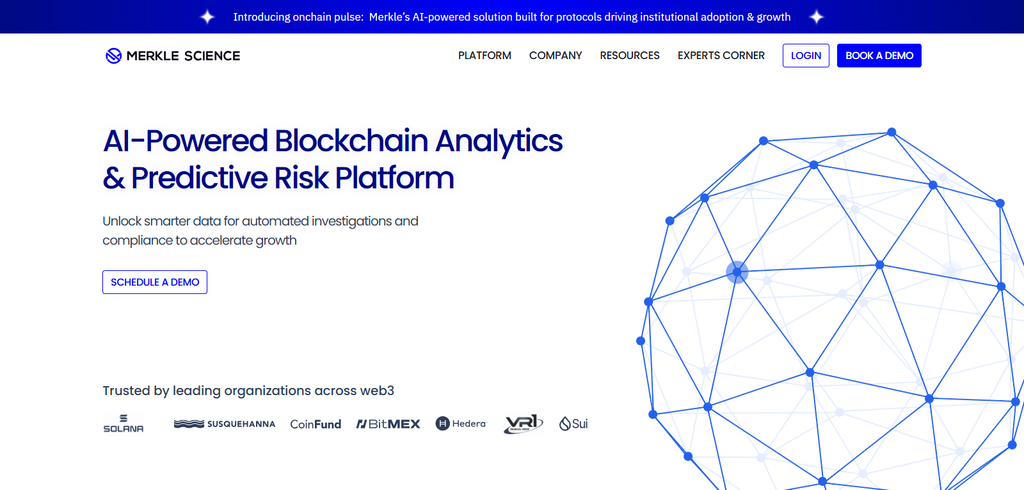
Mid-paragraph highlight: Merkle Science’s predictive analytics lets businesses anticipate future threats. Compared to Chainalysis, it has more affordable pricing. It also features a flexible, modular approach to compliance integration. Overall, Merkle Science meets the compliance needs of firms wanting forward-looking solutions.
What It Does: Predicts behavioral risk scores and offers blockchain analytics.
Merchant Use Case: Used by DeFi (decentralized finance) to detect risky wallets.
Best For: Used by companies that are looking to incorporate forward-looking compliance tools that provide predictive insights.
Merkle Science Pros & Cons
| Pros | Cons |
|---|---|
| Predictive analytics | Smaller chain coverage |
| Behavioral risk scoring | Less adoption among regulators |
| Affordable pricing | Still growing footprint |
| Modular integration | Limited enterprise penetration |
| Forward-looking compliance | Less forensic depth |
| Good for DeFi | Not as global as peers |
| Flexible deployment | Requires adaptation for larger firms |
5. Scorechain
Scorechain, based in Luxembourg, offers pricing models that cater to smaller clients, with a particular focus on EU regulatory compliance. It supports 21+ chains and offers a free real-time sanctions API (for startups). They also provide risk scoring tools for wallet and sanctions screening and transaction monitoring.
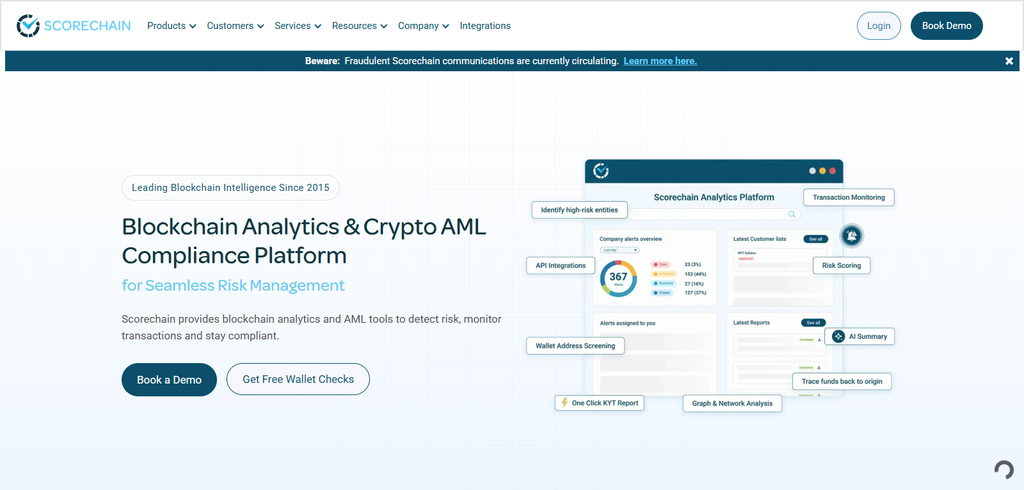
Mid-paragraph highlight: Scorechain is EU-focused making it ideal for firms regulated in the EU. For cryptocurrency businesses, it offers a user-friendly platform. Its pricing makes it a good option for compliance efforts that are particularly cost-sensitive. Overall, Scorechain offers cost-effective EU compliance.
What It Does: Offers affordable KYT monitoring and EU compliance modules, and a sanctions API.
Merchant Use Case: European crypto exchanges and startups use the service to fulfill their AML compliance obligations.
Best For: Companies that would like to comply with regulations at a lower cost.
Scorechain Pros & Cons
| Pros | Cons |
|---|---|
| Affordable pricing | Limited chain coverage (21+) |
| Free sanctions API | Less forensic depth |
| EU compliance focus | Primarily EU-centric |
| Easy integration | Smaller global reach |
| Modular packages | Not ideal for Tier‑1 exchanges |
| Startup-friendly | Limited advanced analytics |
| Strong AML support | Narrower adoption outside Europe |
6. CipherTrace (Mastercard)
CipherTrace, acquired by Mastercard, Offers enterprise-level pricing to banks and payment service providers. It has APIs integrated with Mastercard’s stack to cover multiple chains, and provides real-time screening along with monitoring of wallets and checks for sanctions listings as well as darknet attribution.
CipherTrace provides institutional-grade trust scoring that is used by global payment networks. CipherTrace (Mastercard) is the best option for banks and payment companies that need global integration for compliance. Pricing is high, but justified by Mastercard’s market dominance. CipherTrace is a good option for global financial institutions needing seamless compliance integration.
What it Does: Offers enterprise-level monitoring, darknet tracing, and compliance for Mastercard.
Merchant Use Case: Banks and payment providers use it for global crypto-to-fiat compliance.
Best For: Financial services firms wanting to connect instantly to Payments network ramps.
CipherTrace (Mastercard) Pros & Cons
| Pros | Cons |
|---|---|
| Backed by Mastercard | Premium pricing |
| Strong darknet tracing | Enterprise-only focus |
| Seamless payment integration | Less accessible for startups |
| Institutional-grade compliance | Focused mainly on banks |
| Global reach | Limited flexibility |
| Trusted by payment providers | Not tailored for DeFi |
| High credibility | Cost barrier for SMEs |
7. Crystal Blockchain
Crystal Blockchain has the best coverage at 330+ chains compared with the competition. Its pricing model is mid-tier and designed for compliance departments. Real-time screening incorporates wallet monitoring, KYT transaction tracing, and forensic analysis.
Risk scoring is comprehensive and examines stablecoins, DeFi, and other cryptocurrency exposures. Crystal Blockchain is ideal for firms looking for maximum chain transparency. Integration with exchanges and mid-tier firms is also strong. Pricing is balanced, allowing for broad product take-up. Crystal Blockchain excels in covering chains and forensic depth.
What It Does: Blockchain coverage (330+), case forensics, and KYT
Merchant Use Case: Digital currency exchanges set-up to track multiple assests including stablecoins and DeFi.
Best For: Products needing advanced chain visibility and forensic analysis.
Crystal Blockchain Pros & Cons
| Pros | Cons |
|---|---|
| Broadest chain coverage (330+) | Mid-tier pricing |
| Strong forensic tracing | Complex for small firms |
| Balanced pricing | More suited for compliance teams |
| Stablecoin & DeFi coverage | Less startup-friendly |
| Detailed risk scoring | Requires technical expertise |
| Good for exchanges | Not as widely adopted by banks |
| Strong forensic depth | Integration complexity |
8. Coinfirm
Coinfirm has flexible pricing which is aimed at exchanges and fintechs, and incorporates AML/ KYT APIs for multi-chain coverage. Real-time screening provides wallet monitoring and risk scoring, as well sanctions checking.
Mid-paragraph highlight: Coinfirm enjoys an excellent reputation for accessibility and modularity in compliance. Integration is easy with strong EU compliance. Pricing is flexible and therefore appropriate for startups and mid-market businesses. Overall, Coinfirm is the ideal modularity compliance solution for a low cost.
What It Does: Flexible AML/KYT APIs with multiple add-on modules for compliance.
Merchant Use Case: Start ups integrate it for wallet screening and sanctions checks.
Best For: Mid-tier firms looking for low cost, modular compliance services.
Coinfirm Pros & Cons
| Pros | Cons |
|---|---|
| Flexible modular APIs | Less chain coverage |
| Affordable pricing | Risk scoring less advanced |
| Strong EU compliance | Smaller institutional adoption |
| Easy integration | Limited forensic tools |
| Startup-friendly | Less global reach |
| Adaptable packages | Not ideal for Tier‑1 exchanges |
| AML/KYT support | Narrower appeal outside fintechs |
9. Blockpass
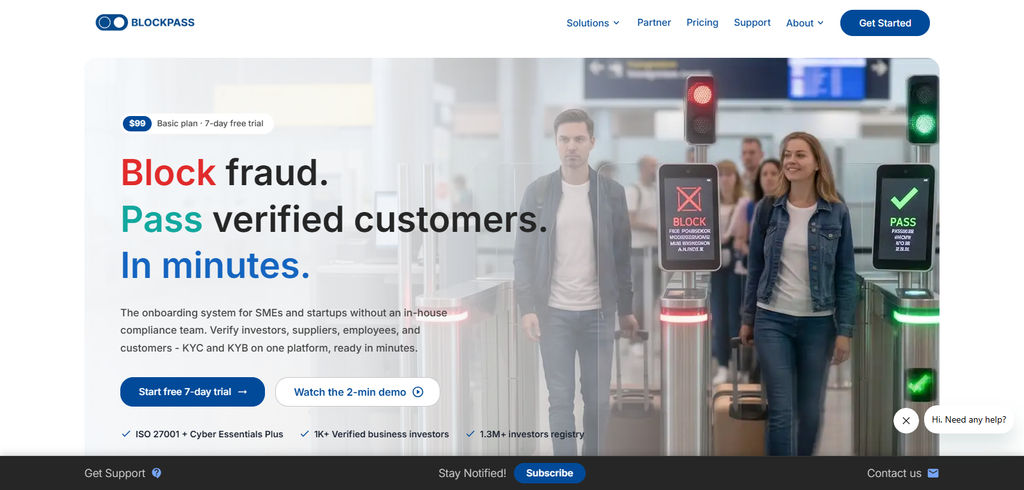
Blockpass focuses on identity verification and KYC integration rather than deep chain forensics. Its pricing model is designed to target start-ups and DeFi projects.
Didit was founded later, and therefore has less features and less chain support than the competitors, but offers custom APIs. Real-time screening supports wallet monitoring, sanctions checking, and basic reporting.
Didit uses a risk scoring solution that effectively addresses light compliance requirements. Didit is designed for firms that need use affordable, customizable compliance solutions. Pricing models are designed to attract start-ups and mid-size firms. Overall, Didit offers flexible solutions for light compliance monitoring.
What It Does: ID verify and KYC, sanctions checks.
Merchant Use Case: DeFi projects use it to onboard users with verified ID.
Best For: Firms looking to prioritize ID compliance over transaction forensics.
Blockpass Pros & Cons
| Pros | Cons |
|---|---|
| Affordable identity verification | Limited chain coverage |
| Easy KYC onboarding | Focused only on identity |
| DeFi project integration | Not suitable for regulators |
| Sanctions screening | No deep forensic tracing |
| Startup-friendly | Narrower compliance scope |
| Seamless onboarding APIs | Limited institutional adoption |
| Specialized in identity | Less versatile than peers |
10. Didit
Didit offers competitive pricing models for startups and mid-tier firms. Chain support is limited compared to competitors, but APIs are more flexible. Real-time screening includes wallet monitoring, sanctions checks, and basic tracing. Risk scoring is lightweight but sufficient for basic compliance needs.
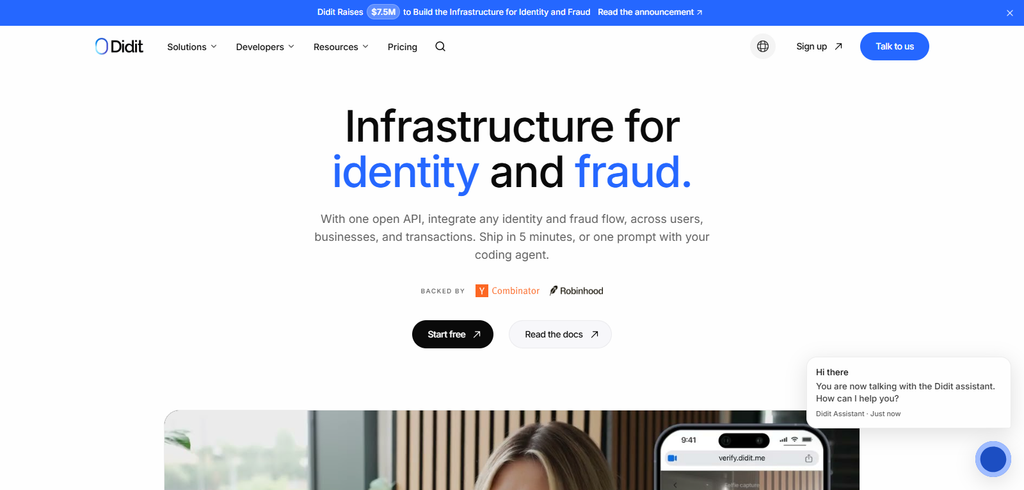
Mid-paragraph highlight: Didit is a good choice for firms needing compliance tools that are both affordable and flexible. Pricing is attractive to firms that are price sensitive. Overall, Didit is a good choice for light compliance monitoring.
What It Does: Compliance APIs for wallet monitoring and basic tracing.
Merchant Use Case: Start ups use it for basic compliance at a low cost without heavy infrastructure.
Best For: Smaller firms needing cost effective compliance tools.
Didit Pros & Cons
| Pros | Cons |
|---|---|
| Competitive pricing | Limited chain support |
| Lightweight APIs | Risk scoring less sophisticated |
| Customizable compliance | Still new in market |
| Startup-friendly | Less proven adoption |
| Flexible deployment | Lower forensic depth |
| Cost-effective | Limited global reach |
| Good for SMEs | Not enterprise-ready |
How To Choose Stablecoin Fraud Prevention Tools
Chain Coverage: Check that the tool supports the main stablecoins (USDT, USDC, DAI) across different chains and new assets.
Real-Time Monitoring: Select tools that provide you with real-time alerts for all suspicious transactions and wallet activity.
Risk Scoring: Look for tools with fraud risk models based on risk scoring.
Sanctions & AML Screening: Ensure the tools include built-in integration with sanctioned and high-risk screening lists, such as OFAC, EU, and UN.
Pricing Model: Assess transparent pricing models compared to enterprise pricing to choose what best fits your needs.
Integration Flexibility: Choose APIs/tools that fit your existing compliance stack.
Merchant Use Case Fit: Adjust the tool to your business (exchange, DeFi, payment processor, or startup).
Conclusion
In summary, the blockchain compliance ecosystem offers many options, and each provider has its own distinct specialization. For most regulators and top tier crypto exchanges, Chainalysis KYT and TRM Labs have the broadest chain coverage and the most trusted institutional relationships. For banking integrations,
Elliptic and Merkle Science are among the best, but Elliptic has the advantage with its AI based risk scoring. Scorechain has the best algorithms to target EU compliance, while CipherTrace (Mastercard) has top enterprise solutions for bank and payment system compliance. Crystal Blockchain has the best cover across the most chains.
Coinfirm has the best combination of price and flexibility, while Blockpass is the best for identity onboarding. If you’re a small start up, Didit has what you need to comply. When it comes to compliance, merchants have many choices depending on the size and reach of their firm. With these options, merchants can select the compliance solution that best aligns with their needs.
FAQ
What is the main purpose of blockchain compliance tools?
A: They provide real-time monitoring, risk scoring, and sanctions screening to help exchanges, banks, and fintechs stay compliant with AML/KYC regulations.
Which provider offers the widest chain coverage?
A: Crystal Blockchain leads with support for 330+ chains, making it ideal for exchanges handling diverse assets.
Which tool is best for regulators and Tier‑1 institutions?
A: Chainalysis KYT is widely trusted by regulators and major exchanges for forensic depth and global adoption.
Which provider is most affordable for startups?
A: Scorechain and Coinfirm offer cost-effective packages, while Didit provides lightweight compliance APIs.
Which solution focuses on identity verification rather than transaction forensics?
A: Blockpass specializes in KYC onboarding and identity compliance, making it unique among peers.