

Building wallets, DeFi platforms, analytics dashboards, or multi-chain apps? The right Web3 data API can make a big difference. Covalent has one API for developers to access blockchain data, but there are a number of alternative options that vary in terms of network support, API functionality, pricing, and indexing and analytics. In this article,
I’ll take a look at the Best Covalent Rivals for Unified Web3 Data APIs and compare their key features, supported blockchains, data capabilities, pricing, and ideal use cases.
Why Look for Covalent Rivals?
Broader Blockchain Coverage: Some of Covalent’s rivals offer support for more blockchain networks, enabling developers to access data from newer, niche, or less frequently supported ecosystems through a single API infrastructure.
Access to Real-Time Data: Some platforms offer WebSockets, webhooks, streams, and event-driven APIs, which are useful for applications that need faster blockchain updates and real-time monitoring of on-chain activity.

Advanced Analytics: A few competitors highlight richer wallet intelligence, on-chain analytics, behavioral data, and historical metrics, providing deeper insights for research, trading, dashboards, and analytics applications.
Flexible Pricing: Cloud providers provide various pricing models like free tiers, monthly subscription, API credits, or usage-based pricing to give developers more flexibility in managing infrastructure costs as per their actual needs.
Custom Data Querying: Blockchain indexing and analytics providers such as The Graph enable developers to build custom queries, datasets, or subgraphs for applications that require specific on-chain data, providing greater flexibility.
Developer Tools: Covalent alternatives could have SDKs, dashboards, documentation, webhooks, monitoring tools, and development environments to facilitate API integration and lower the barrier to entry to build blockchain applications.
Different Use Cases: Some Web3 projects may require infrastructure built specifically for wallets, exchanges, DeFi, NFTs, payments, analytics, or institutional research, and specialized alternatives may be a better fit for them.
How to Choose a Covalent Alternative?
Blockchain Coverage: Ensure the platform supports all the major networks such as Ethereum, Layer-2s, Solana, and new chains to consistently get your application multi-chain data.
API Capabilities: Review APIs for wallets, tokens, NFTs, transactions, DeFi, balances, prices, and contracts to ensure the provider has the data your application needs.
Data Quality. Assess data accuracy, indexing consistency, historical depth, normalization, and update frequency, as reliable datasets are critical for analytics platforms, dashboards, wallets, and production applications.
Real-Time Performance: When your app needs fast access to new confirmed blockchain transactions and activities, use WebSockets, webhooks, streaming APIs, event notifications, latency and request limits.
Pricing Model: Look at free tiers, monthly subscriptions, API credits, usage-based pricing, request limits, and enterprise pricing to see if it matches your expected data consumption.
Developer Experience: Examine documentation, SDKs, API samples, authentication methods, dashboards, testing tools and integration support to assess ease of implementation and ongoing API maintenance by developers.
Scalability and Reliability: Look at rate limits, infrastructure capacity, uptime, response consistency, geographic availability, and enterprise support so that the provider can handle the growing application traffic and data needs.
Use-Case Compatibility: Pick a provider that fits the core needs of your project, whether that’s wallet data, DeFi analytics, NFT info, blockchain indexing, payments, trading intel, or dashboards.
Key Points
| Covalent Rival | Key Point |
|---|---|
| Alchemy | Provides blockchain infrastructure, enhanced APIs, node services, NFT APIs, and developer tooling for Web3 applications. |
| QuickNode | Offers high-performance RPC endpoints, blockchain APIs, and multi-chain infrastructure for decentralized applications. |
| Moralis | Delivers unified wallet, token, NFT, and transaction APIs across multiple blockchain networks. |
| The Graph | Decentralized indexing protocol that enables querying blockchain data through subgraphs and GraphQL APIs. |
| Tatum | Provides a unified API layer for interacting with numerous blockchain networks and digital assets. |
| CryptoAPIs | Offers unified REST APIs for blockchain data, wallet management, market data, and transaction monitoring. |
| Dune | Enables blockchain data analytics through SQL-based queries and customizable dashboards. |
| Flipside | Provides accessible on-chain datasets and analytics tools for blockchain developers and researchers. |
| Nansen | Combines blockchain data with wallet intelligence and analytics for on-chain insights. |
| Glassnode | Specializes in blockchain and digital asset market intelligence using on-chain metrics and APIs. |
1. Alchemical
Alchemy was founded in 2017 and offers a wide-ranging stack of Web3 infrastructure that includes Chain APIs, Data APIs, Wallet APIs, NFT APIs, Token APIs, Transfers APIs, Prices APIs and WebSockets. It is compatible with major chains including Ethereum, Solana, Polygon, Arbitrum, Optimism, Base, BNB Smart Chain, Avalanche, Starknet and zkSync.
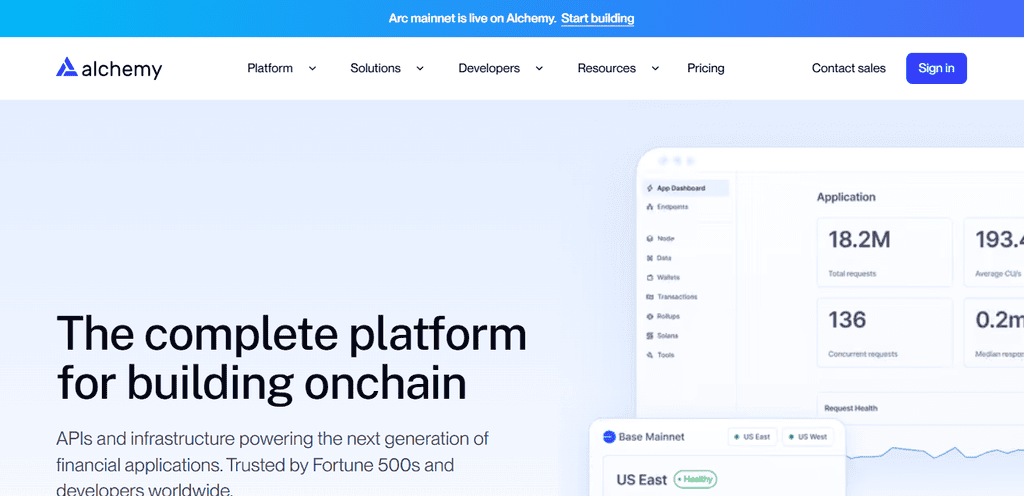
Its Data APIs offer token balances, transfers, NFT information, prices, portfolio data and historical blockchain data. Alchemy has a Free plan with 30 Million Compute Units monthly then Pay As You Go pricing. Developers use Alchemy for wallets, NFT platforms, analytics dashboards, DeFi applications and dApps.
Main Features
- Multi-Chain APIs – Access to blockchain infrastructure and data across 100+ supported chains.
- Data APIs – Provides access to indexed blockchain data including portfolio, token, NFT, transfers, pricing and more.
- WebSockets & Webhooks – Get real-time blockchain events without polling the network.
- Simulation APIs – Simulate the effects of transactions before submitting them on-chain.
- Wallet Infrastructure – Smart wallets, account abstraction, gas sponsorship, transaction management.
Best For
- Web3 wallet and portfolio apps
- NFT applications and marketplace
- DeFi apps and dashboards
- Multi-chain dApps developers
2. QuickNode
Founded in 2017, QuickNode provides blockchain infrastructure through JSON-RPC, REST, WebSocket, gRPC, Streams, Webhooks and other data APIs. Its network coverage includes 80+ chains such as Ethereum, Bitcoin, Solana, Polygon, Arbitrum, Base, BNB Smart Chain, Avalanche, Optimism, TRON, TON and many others.
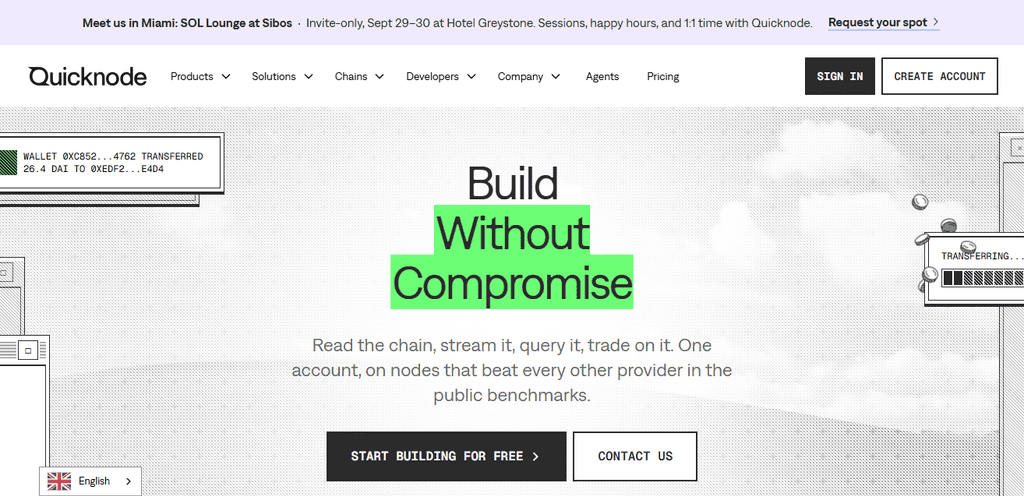
Developers are able to use streams to deliver custom data, get blockchain transactions, blocks, logs, token activity and real-time events. QuickNode offers a one-month free trial with 10 million API credits and 15 RPS. Paid Build plans start at $49 a month. It works for dApps, wallets, exchanges, analytics platforms, and blockchain infrastructure projects.
Main Features
- Multi-Chain RPC – Access to blockchains via standard JSON-RPC and other protocols.
- Streams API – Build real-time data pipelines for the blockchain with filters of your choice.
- Webhooks – Forward blockchain activity directly to application endpoints.
- SQL Explorer – A tool for developers to query indexed blockchain data using SQL.
- Developer SDK – SDK support for Python, Node.js, Rust, and Ruby workflows. [3])
Best For
- dApps with high performance.
- Blockchain applications in real time
- Blockchain data pipelines
- Developers who need RPC and indexed data
3. Morality
Moralis was launched in 2017 and focuses on providing high-level Web3 APIs for blockchain, wallet, token, NFT, price and DeFi data. Its API suite includes Wallet API, Token API, NFT API, Price API, Blockchain API, DeFi API and Streams API. Supported networks: Ethereum, Base, Solana, BNB Smart Chain, Polygon, Avalanche, Arbitrum, Optimism, Linea, zkSync, Blast, Mantle and other major chains.
Moralis has a free Starter option and paid plans currently available that include Starter, Pro, Business and Enterprise options. Its pricing page shows paid plans starting at $149/month billed annually. Moralis is popular with developers creating wallets, portfolio trackers, NFT apps, token analytics, DeFi dashboards, and cross-chain Web3 apps.
Characteristics
- Wallet API – Get Wallet balances, transactions, portfolio information and activity.
- Token API – Provides token balances, metadata, prices, transfers, and other info.
- NFT API – Simplify NFT ownership, metadata, transfer and collection data.
- DeFi APIs – Data for DeFi protocols, positions, and financial applications.
- Cross-Chain Data – Allows developers to build apps that interact with data from multiple supported networks.
Best For
- Crypto wallets and portfolio trackers
- NFT applications and platforms
- Dashboards for DeFi
- multi-chain Web3 apps
4. The Graph
Founded in 2018, The Graph provides decentralized blockchain indexing via Subgraphs, Graph Node, Firehose and Substreams, rather than being mainly a traditional RPC provider. This makes smart contract events and on-chain activity easier to access and enables developers to create and query structured blockchain datasets.
It supports Ethereum, Arbitrum, Avalanche, Base, BNB Chain, Celo, Polygon-related ecosystems, Solana, Starknet, Stellar, Sui, zkSync, and many others. Features are available per network.
The platform can be used to extract indexed transaction, contract, protocol and application data. Developers use it for dApps, DeFi analytics, protocol dashboards, blockchain explorers and custom Web3 data applications.
Important Features
- Subgraphs – Index blockchain data into structured datasets applications can query.
- GraphQL Queries – Offers a versatile way of querying indexed blockchain data.
- Substreams – Allows for high-performance processing and streaming of blockchain data.
- Firehose – Infrastructure for blockchain data indexing and large data processing.
- Decentralized Indexing – Allows for an open ecosystem to index and query blockchain data.
Best For
- Indexing of dApp data
- DeFi apps
- Protocol analytics
- Developers that are building custom queries for blockchain data.
5. Tatum
Tatum was founded in 2018 and offers a unified blockchain development layer with support for RPC nodes, indexed blockchain data, notifications, wallets, transactions and digital currencies.
Supports 130+ blockchain networks at various levels of integrations (Ethereum, Bitcoin, Solana, Polygon, Base, Arbitrum, Avalanche, BNB Smart Chain, Optimism, Ripple, Tron, Stellar, and more).
Tatum offers a free plan with 100,000 lifetime credits, 3 requests per second on full nodes, and 100 notifications per month. Paid plans add more capacity and dedicated API keys. Developers rely on Tatum for wallets, payments, exchanges, portfolio applications, blockchain monitoring and multi-chain apps.
Main Features
- Blockchain APIs – Provides unified APIs to interact with multiple blockchain networks.
- Wallet APIs – Create wallets, check balances, send transactions, and interact with the blockchain.
- Transaction APIs – Enable applications to build, sign, submit and monitor blockchain transactions.
- Blockchain Data – Data on blocks, transactions, balances and other network information.
- Notifications – Allows applications to subscribe to notifications of blockchain events and transaction activity.
Best For
- Wallets (digital)
- Aplicativos de pagamento
- Exchange
- Fin-tech apps for multiple chains
6 CryptoAPIs
CryptoAPIs is a platform providing unified Blockchain Data APIs and Developer Tools to build your Blockchain Applications in Crypto and Blockchain industry. Its APIs support 35+ blockchain networks including Bitcoin, Ethereum, XRP Ledger, BNB Smart Chain, Polygon, TRON, Solana, Avalanche, Arbitrum, Optimism, Base, and more.
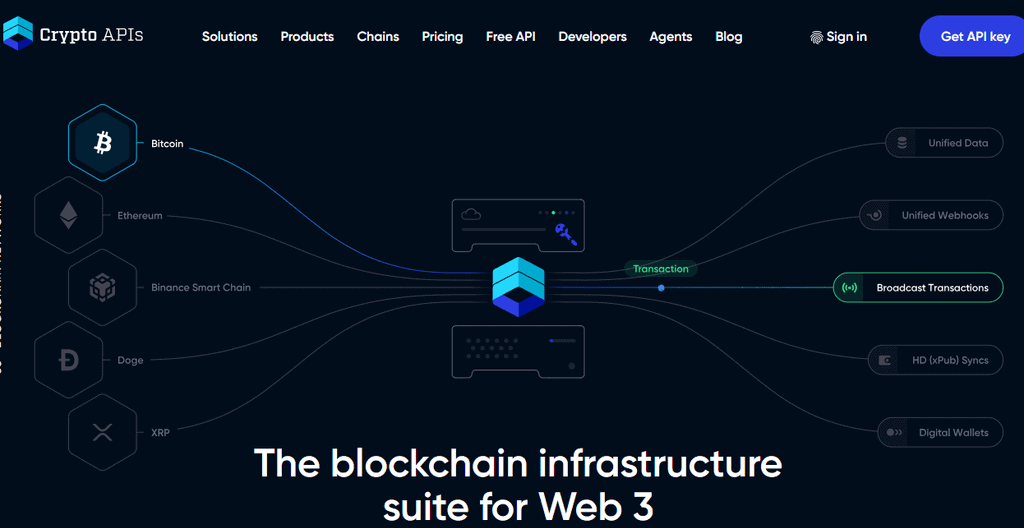
Addresses, transactions, blocks, token balances, blockchain events, market prices, wallet data, contract data. CryptoAPIs offers a free plan with 100,000 monthly credits and a Starter plan starting at $49/month.
Developers use it for wallets, exchanges, payment services, portfolio trackers, digital banking apps, accounting tools and blockchain explorers.
Key Characteristics
- Blockchain Unified APIs – Provides common API access to data from multiple blockchain networks.
- Transaction Data – Get transactions, addresses, blocks, and other data from the blockchain.
- Blockchain Events – Track on-chain activity and receive event-based data.
- Wallet APIs – Contains functions for wallet related blockchain operations and data.
- Market Data – Cryptocurrency prices and market data for apps.
Best For
- Exchanges de crypto
- Payment platforms
- Wallet apps
- Blockchain surveillance tool
7. Dune
Dune, established in 2018, specializes in queryable blockchain datasets, DuneSQL, dashboards, APIs, and data connectors. It now has 100+ blockchains on its platform, with datasets on token transfers, balances, DEX trading, stablecoins, NFTs, DeFi, bridges, lending, staking, gas fees, wallet labels, and decoded smart-contract events.
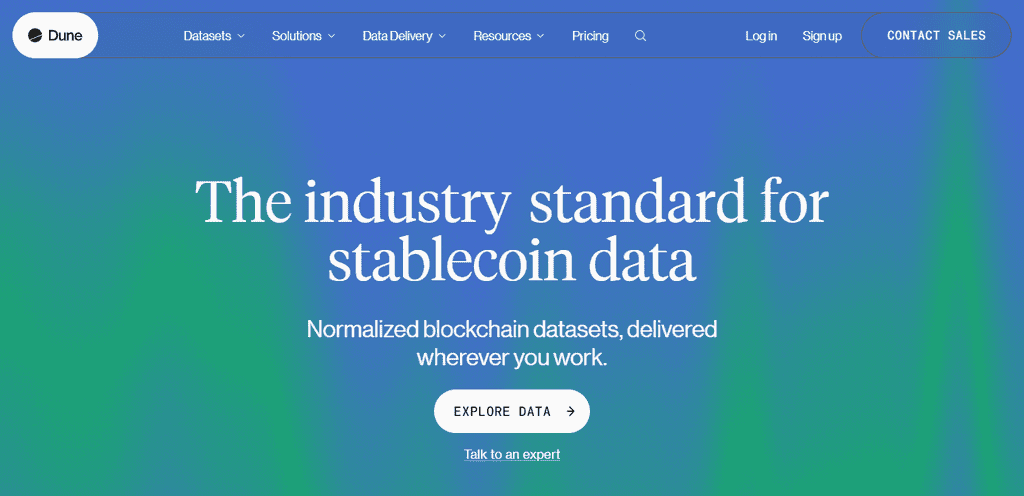
Dune offers APIs to access the data programmatically, and SQL allows developers and analysts to write custom queries and datasets. Dune 10 Use cases for developers include protocol analytics, trading intelligence, stablecoin observability, reporting, portfolio research, blockchain dashboards and applications that need normalized multi-chain on-chain data.
Main Features
- DuneSQL – Query large collections of indexed blockchain data with SQL.
- Multi-Chain Data – Curated datasets of on-chain data across a variety of blockchain ecosystems.
- API Access – Allows programmatic queries and blockchain analytics. ([Dune][5])
- Custom Dashboards – Transform blockchain queries into interactive analytics dashboards.
- Data Connectors – Export Dune data to outside BI and analytics programs like Metabase, Looker.
Best for
- Analytics on chain
- Protocol research and DeFi
- Dashboards for blockchain
- Web3 applications, data-centric
8. The Flipside
Founded in 2017, Flipside has been focused on blockchain analytics through curated datasets, SQL querying, APIs, dashboards, and automated data workflows. Its data infrastructure spans 30+ blockchain networks with datasets dedicated to core blockchain activity, DeFi, NFTs, prices, and statistics.

It has a Data API that lets you run SQL queries and get their results programmatically, and developers are able to access blockchain datasets through API-based workflows.
Previously, Flipside offered a free Community allocation, in addition to additional usage based Builder and Pro capacity. Its data can be used for wallet analysis, DeFi research, protocol analytics, cross chain activity, dashboards, airdrop analysis and blockchain intelligence apps.
Key Points
- Blockchain Datasets – Offers structured datasets for analyzing on-chain activity.
- SQL Analytics – Data from the blockchain is now accessible through SQL queries.
- Data APIs – Programmatically access query results and analytics.
- Custom Analytics – Research customized to your needs across wallets, protocols, tokens, and networks.
- Cross-Chain Analytics – Enables activity analysis across various blockchain ecosystems.
Best For
- Blockchain researchers
- Analytics for protocols
- Wallet and user behavior analysis
- Cross-chain data applications
9. Nansen
Nansen, founded in 2019, provides enriched on-chain intelligence through its API, wallet profiling, token analytics, Smart Money insights, labels and real-time blockchain data. Its API serves data for 25+ chains, contains over 500 million labeled addresses, and provides wallet analysis, token discovery, Smart Money tracking, and trading-related workflows.
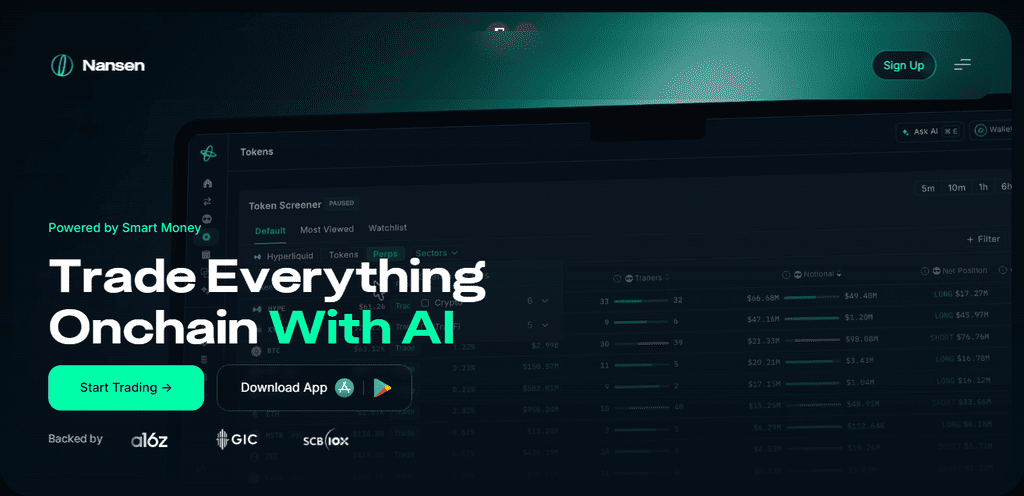
Nansen has a free API limit of 100 credits and a 10-credit daily refill. API credits cost $10 per 10,000 credits. The Pro plan includes additional credits. Developers use Nansen for wallet intelligence, token research, alerts, trading tools, portfolio analytics and on-chain behavior analysis.
Key Features
- Wallet Labels – Adds labels to blockchain addresses to identify wallet behavior and entities.
- Smart Money Tracking – Allows to track activity of specific high value or strategically relevant wallets.
- Token Analytics – On-chain activity and market intelligence on a token-by-token basis.
- Wallet Intelligence – Analyzes wallet balances, transactions, and behavioral trends.
- API Access – programmatic access to on-chain intelligence for applications and data workflows.
Best For
- Chain Research
- Trading smarts tools
- Wallet analysis
- Token & Smart Money Tracking
10. Glassnode
Established in 2018, Glassnode provides professional blockchain data via unified APIs, on-chain metrics, financial metrics, market data and analytical tools. Today, its platform supports data from 11 blockchains including Bitcoin, Ethereum, Solana, Tron, BNB Chain, Dogecoin, Arbitrum, TON, and XRP, covering more than **1,500 digital assets.
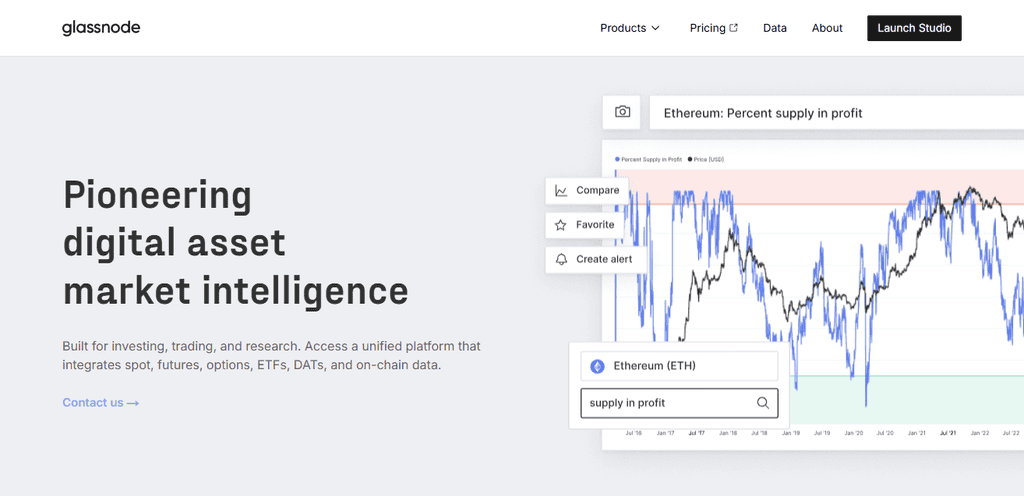
Glassnode’s Advanced plan is $49/month (annual billing), while the Professional plan includes more extensive API and historical-data capabilities. Glassnode provides developers, researchers, traders and institutions with on-chain metrics, market analytics, historical datasets, research, dashboards, and quantitative digital-asset analytics.
Main Features
- On-Chain Metrics – Delivers blockchain metrics to evaluate network and asset activity.
- Market Data – Combines market and financial datasets with blockchain data.
- Historical Data – Access to historical blockchain metrics for research and quantitative analysis.
- API Access – Enables developers and institutions to integrate Glassnode datasets into their own systems.
- Digital Asset Analytics – Offers deep analysis of network activities, market behavior and crypto assets.
Best For
- Crypto research at institutions
- Analysis quantitative
- Digital asset analytics instruments
- Historical analytics on-chain
Conclusion
Covalent is a handy option for accessing unified Web3 data, but its rivals offer different approaches to blockchain infrastructure, indexing, analytics and API access. Alchemy and QuickNode are focused on the blockchain infrastructure and data services for developers, while Moralis focuses on wallet, token, NFT and DeFi APIs.
The Graph is a decentralized indexing protocol and Tatum and CryptoAPIs provide a comprehensive suite of multi-chain development tools. Dune & Flipside are focused on blockchain analytics and queryable data sets, Nansen & Glassnode are focused on enriched onchain intelligence and research.
The right Covalent alternative will ultimately depend on your required blockchain coverage, data types, API performance, pricing, historical depth, and developer use cases.
FAQ
What is Covalent?
Covalent is a Web3 data infrastructure platform that provides unified APIs for accessing blockchain information such as wallet balances, transactions, tokens, NFTs, and DeFi activity.
What are Covalent rivals?
Covalent rivals are platforms that provide comparable blockchain data, indexing, analytics, RPC, or Web3 APIs. Examples include Alchemy, QuickNode, Moralis, The Graph, Tatum, CryptoAPIs, Dune, Flipside, Nansen, and Glassnode.
Which Covalent alternative is best for multi-chain APIs?
Alchemy, QuickNode, Moralis, Tatum, and CryptoAPIs provide broad multi-chain infrastructure and API capabilities. The appropriate choice depends on the required networks, data types, pricing, and application requirements.
Which Covalent rival is best for wallet data?
Moralis provides dedicated Wallet APIs for balances, transactions, portfolio information, and wallet activity. Nansen also focuses on wallet intelligence, labels, and behavioral on-chain analysis.
Which alternative is suitable for blockchain indexing?
The Graph is specifically designed for blockchain indexing through Subgraphs, GraphQL, Substreams, and Firehose, making it useful for applications that require structured and queryable on-chain datasets.