


Choosing the right Arbitrum RPC node provider can make a real difference in how smoothly a blockchain application can perform. If you are building a DeFi platform, working on smart contract, or deploying a decentralized application, you need reliable access to the Arbitrum network. With so many providers offering different features, pricing plans and levels of performance, it can be hard to find the right fit.
In this guide, I’ll take a look at the best Arbitrum RPC node providers and compare their key features, pros, and cons to help you make an informed decision.
Why Do Developers Need an Arbitrum RPC Provider?
Connect dApps: RPC providers allow dApps to connect to the blockchain. Developers are able to access network data and interact with intelligent contracts to provide a seamless experience for users.
Submit Blockchain Transactions Developers use RPC endpoints to submit transactions, execute smart contract functions, transfer tokens and interact with decentralized finance protocols running on the Arbitrum network.”

Access Blockchain Data: RPC providers enable apps to access block data, transaction receipts, wallet balances, token transfers, and smart contract events for accurate blockchain data access.
Improve Application Performance: A strong RPC infrastructure reduces response times, processes large volumes of requests, and sustains responsive user experiences in decentralized applications, even during peak network periods.
Scale Application Traffic: RPC providers enable applications to scale with their user base and increasing blockchain calls by providing scalable infrastructure, configurable limits and the right service plans for demanding workloads.
Support Wallet Integration Developers integrate Arbitrum RPC endpoints into cryptocurrency wallets to enable users to check balances, review transaction status, transfer digital currencies, and interact with decentralized applications.
Enable Smart Contract Development: RPC endpoints allow developers to deploy intelligent contracts, call functions, monitor events, and test applications, helping them build, debug, and maintain blockchain applications on Arbitrum.
Enhance Reliability & Availability: Managed infrastructure, monitoring, and service reliability features provided by professional RPC providers help to reduce connectivity issues and make blockchain applications available to users.
How to Choose the Right Arbitrum RPC Provider?
Performance and Latency: Pick a provider with fast response times and low latency to guaranty smooth blockchain interactions, efficient transaction processing, and responsive decentralized applications for users.
Network Support Check: Confirm that the provider supports Arbitrum One, Arbitrum Nova, and the required testnets for your project, development environment, and deployment needs across various blockchain networks.
Consider Pricing Levels: Look into the free levels, subscription options, pay-per-request billing, and other expenses to choose a cost-effective provider that fits your app’s usage habits and budget constraints.
Evaluate Reliability and Uptime: Opt for a vendor with reliable infrastructure, established uptime commitments, monitoring tools and recovery procedures to reduce connectivity problems and ensure consistent application availability.
Review Rate Limits: Check the limits of requests per second, monthly quotas and burst capacity to ensure that the provider can support the present traffic levels and the growth of the application in the future without any interruptions.
Use Developer Tools: Prefer providers that offer clear documentation, SDKs, debugging tools, analytics dashboards, and easy integrations to aid in the development, troubleshooting, and maintenance of applications over time.
Inspect Security Features: Seek out API key management, access restrictions, traffic controls, and abuse prevention features to protect RPC endpoints and minimize unauthorized use across your applications.
Test Scalability and Support. Before committing to a provider for long-term production deployment, test the endpoints under realistic workloads, and check for customer support availability, failover options, and scaling flexibility.
Key Points
1. The Alchemy
Alchemy is a blockchain infrastructure provider that offers RPC access to Arbitrum developers building decentralized applications, DeFi platforms, NFT projects, and other Web3 products. The platform offers APIs and developer tools to read blockchain data, submit transactions, and monitor app activity.
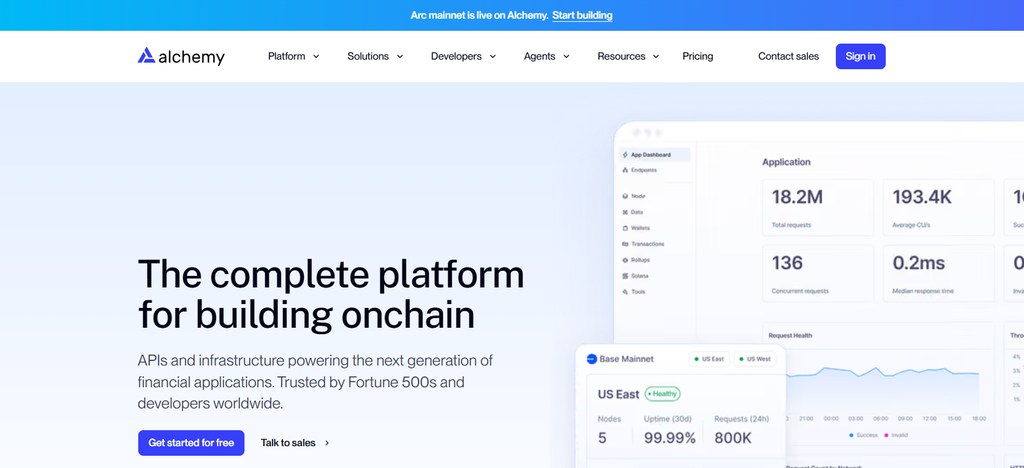
Developers should look at what Arbitrum networks Alchemy supports, how many requests Alchemy allows, how fast Alchemy returns responses, what features Alchemy’s dashboard has and what pricing plans Alchemy offers.
Its infrastructure and debugging tools can aid in simplifying development and debugging. Before you select a plan, look at the features offered and match them to your application’s expected traffic, scalability needs, and reliability requirements.
Benefits
- Powerful developer tools, APIs and SDKs to build blockchain applications.
- Robust infrastructure to support high traffic applications.
- Extensive debugging and monitoring tools for developers.
- Supports multiple blockchain networks and offers useful NFT and transaction data capabilities.
Cons
- More advanced features and more usage can be expensive.
- Free tier limits can constrain growing applications.
- Some advanced tools might create dependencies on Alchemy’s ecosystem.
- Pricing and features may vary depending on supported network
2. QuickNode
QuickNode provides the blockchain infrastructure and RPC endpoints that developers need to connect applications to supported networks like Arbitrum. It can be useful for teams building DeFi apps, blockchain games, trading tools, and other decentralized services.
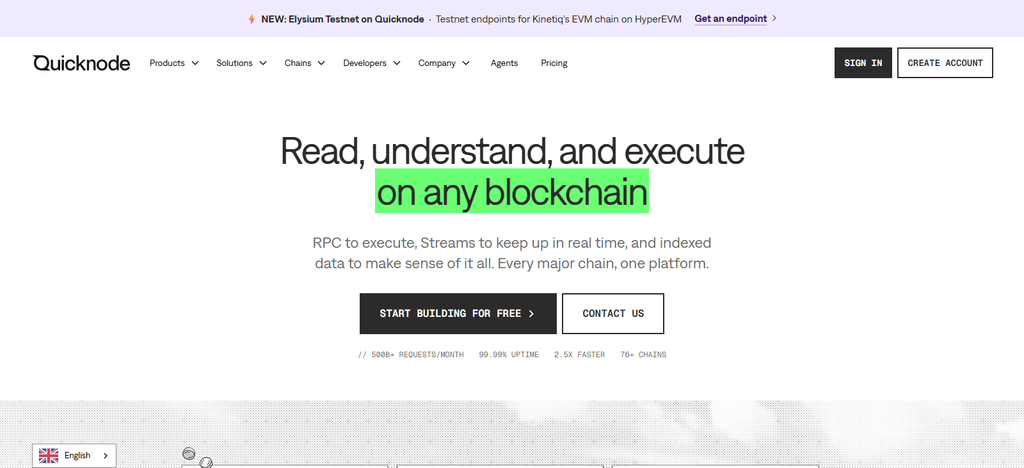
When developing their infrastructure, developers are able to look at its endpoint performance, APIs supported, analytics, add-ons, and integration options. Reliability, latency, request limits, pricing, those are all important things to consider especially if you have an app that’s constantly interacting with the blockchain.
Before choosing to use QuickNode, review the current support and plan limitations for the Arbitrum network to determine if its services are the right fit for your project’s technical needs and expected usage.
Pros
- Works on a variety of blockchain networks.
- Offers high-performance RPC endpoints with an emphasis on robustness and reliability.
- Offers customizable infrastructure options and add-on services.
- Developer-friendly dashboard and tools for tracking endpoint usage.
Cons
- More usage can result in significantly higher costs.
- A few advanced features require paid plans or add-ons.
Pricing structures and usage units are hard to compare. - Feature availability and performance may vary by plan and Blockchain network
3. Chainstack
Chainstack is a blockchain infrastructure platform that offers managed node services and RPC connectivity for supported blockchain networks, including Arbitrum. It enables developers to query blockchain data and send transactions without having to manage all the underlying node infrastructure.
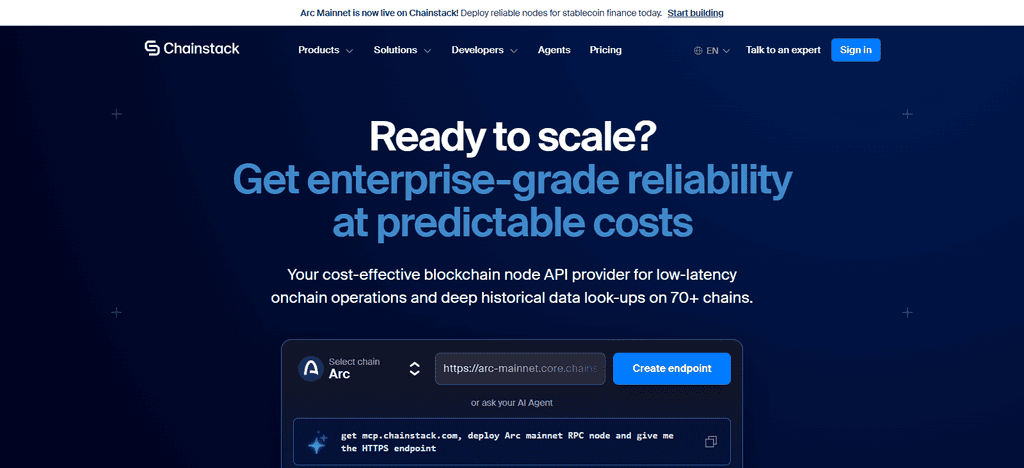
The platform could be a useful tool for development teams working on decentralized applications, enterprise blockchain solutions, and Web3 products that require reliable network access.
Chainstack If you are thinking about Chainstack, consider the availability of the Arbitrum endpoints, deployment options, request quotas, monitoring, and pricing. # Developers should also consider service-level commitments, scaling options and support availability to ensure the platform meets their application’s performance and operational needs.
The benefits
- Supports multiple blockchain networks with managed node infrastructure.
- Has dedicated node options for more control and predictable performance.
- Enterprise-class deployment, monitoring and support capabilities.
- Good for teams that want managed infrastructure, but don’t want to run each node themselves.
Cons
- Complex infrastructure setups can be technically demanding.
- Dedicated nodes may be more expensive than shared endpoints.
- Available features vary by network and deployment type.
- Smaller projects may not require enterprise-grade capabilities
4. Ankr
Ankr provides web3 infrastructure services, including RPC connectivity for supported blockchain networks, such as Arbitrum. Its services help developers connect decentralized applications, wallets and other blockchain-based products to network data and transaction functionality. Ankr could be an option for teams seeking managed RPC access without the pain of running their own full node infrastructure.
The most important selection factors are endpoint availability, supported network methods, request limits, response latency and access to sophisticated RPC features. Before committing, developers should compare available free and paid options including security controls and usage policies. The best choice depends on traffic to the application, level of reliability you need and your budget.
Advantages
- Offers RPC infrastructure with support for a variety of blockchain networks.
- Offers decentralized infrastructure options to avoid reliance on a single node operator
- Archive data retrieval support and multiple advanced RPC methods.
- Provides pay-as-you-go pricing for projects with varying traffic needs.
Disadvantages
- Certain premium features and modes of service may be available to paying customers only.
- Performance depends on the network and the node provider that handles requests.
- Decentralized routing may result in inconsistencies in response latency.
- Debugging can be more difficult in the case of distributed infrastructure requests
5. Infura
Infura is a blockchain infrastructure platform from Consensys, providing RPC access to developers building decentralized applications. It supports Arbitrum. It lets applications query blockchain data, interact with intelligent contracts, and submit transactions through standard APIs. Infura is a good fit for Web3 projects that are looking for managed infrastructure and established development tools.
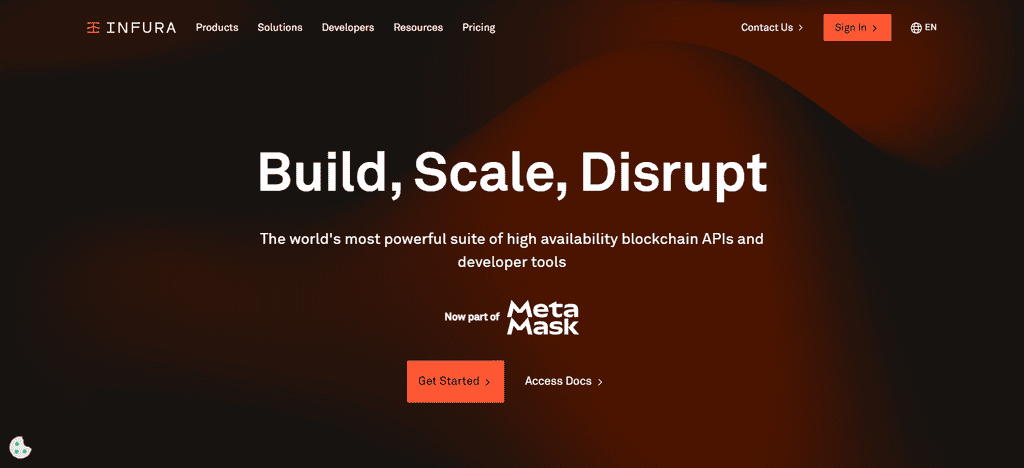
Developers should evaluate its services on request quotas, API availability, WebSocket support, response latency and pricing. It is also important to look at the authentication options, monitoring capabilities and service commitments. Testing real application workloads can help evaluate whether Infura meets specific performance and reliability requirements.
Advantages:
- Established provider with strong backing for Ethereum and EVM compatible chains.
- Works great with MetaMask and popular Web3 development tools.
- Offers managed RPC endpoints for simple blockchain connectivity.
- Provides you with documentation and a familiar development workflow to build blockchain applications.
Cons
- Coverage will be less than some of its multi-chain competitors.
- You can throttle applications that have high traffic using usage quotas and rate limits.
- More advanced debugging and trace requests can cost a lot more credits.
- Risk of a single provider of infrastructure due to dependence on a centralized provider.
6. dRPC
dRPC is an infrastructure provider of blockchain RPCs that connects applications to supported networks through its distributed infrastructure and routing capabilities. The wallet supports Arbitrum One, Arbitrum Nova and Arbitrum Sepolia, so it is relevant for projects operating across Arbitrum environments.
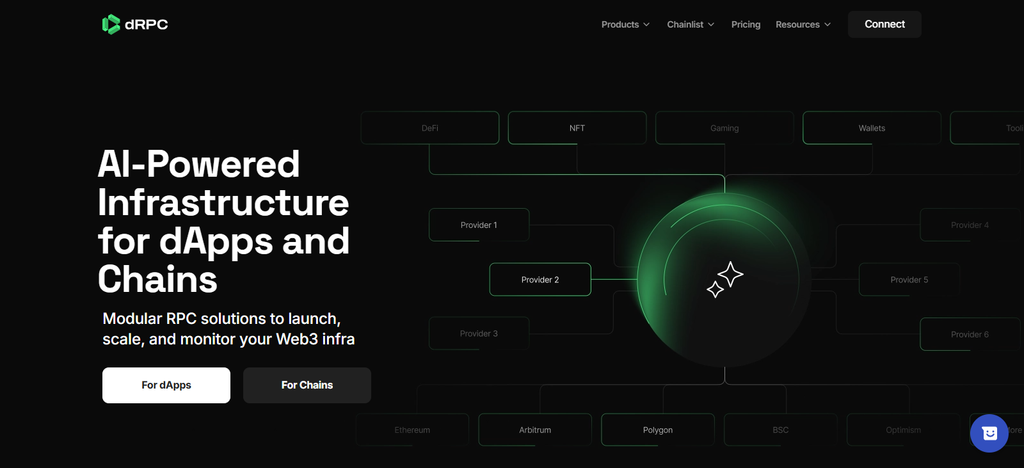
Developers are able to test dRPC for decentralized applications that require access to blockchain data and transaction submission. Some important things to consider are endpoint availability, request limits, routing behavior, latency, and pricing.
Before choosing a plan, check the supported RPC methods, WebSocket connectivity, security controls and monitoring features. Testing the response in a realistic traffic pattern is a way of verifying whether the service will meet production needs.
Benefits
- Decentralized RPC architecture with access to various node providers.
- Offers a single point of access to numerous blockchain networks.
- Can direct requests across the providers for increased robustness.
- Offers a methodology that reduces dependence on a single infrastructure vendor.
Disadvantages
- Variability in providers may impact consistency of response and methods available.
- Response times may depend on underlying node providers.
- If a request passes through multiple providers, it can be harder to diagnose failures.
- The quality of service depends in part on the availability and reliability of the nodes participating in it
7. Tatum
Tatum is a platform for blockchain development, offering APIs and infrastructure tools to make it easier to build Web3 applications. When considering it for an Arbitrum project, developers are able to explore its available blockchain integrations, transaction functionality, and API-based workflows.
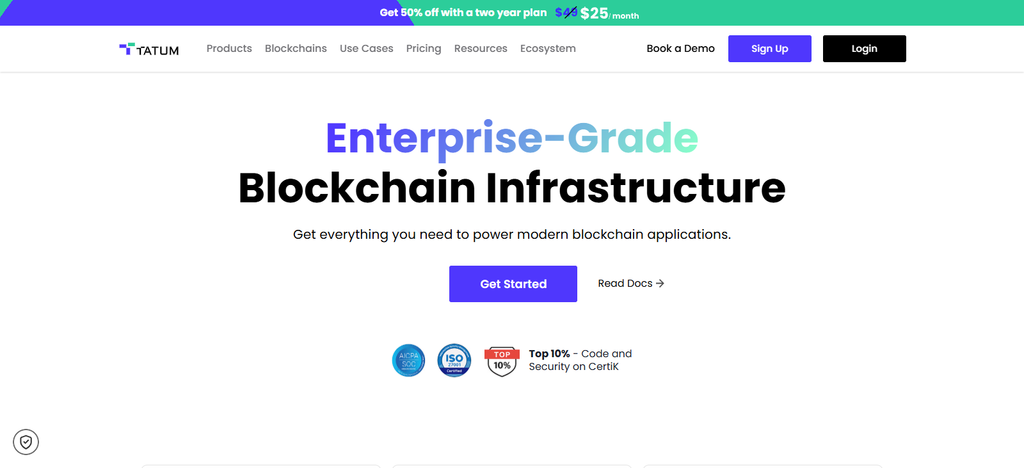
However, confirmation of Arbitrum-specific endpoint availability and supported methods directly should confirm inclusion of Tatum in a final provider shortlist. Factors for selection include integration complexity, API limits, pricing, documentation, security controls and scalability.
Teams should also look at historical data access and transaction-handling requirements. Running a functional test with the workload you expect your application to handle will show whether Tatum offers the right functionality and business value.
Advantages
- Offers a unified API approach to Blockchain development.
- Facilities for blockchain transactions, wallet operations and token related functionality.
- A single development interface for several blockchain networks.
- Helps developers reduce the amount of chain-specific integration work
Disadvantages
- Usage-based pricing can be expensive for apps with heavy API traffic.
- Advanced RPC methods could cost a lot more credits than standard requests.
- In some configurations, per-key security controls may be limited.
- Developers might need further infrastructure for some blockchain features.
8. GetBlock
GetBlock offers managed blockchain node infrastructure and RPC endpoints for supported networks, enabling developers to access blockchain data without the need to operate their own node servers. It supports Arbitrum One and can be used by applications that need to query intelligent contracts, retrieve blocks or submit transactions.
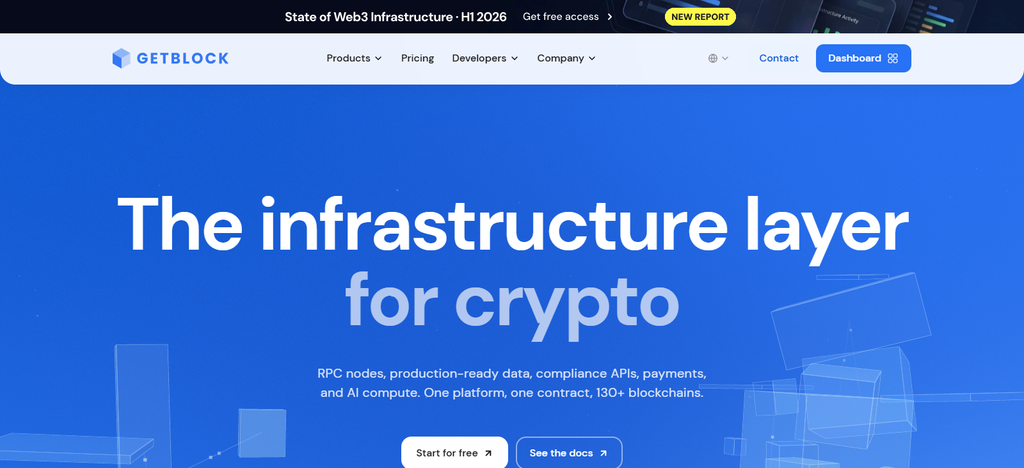
Developers should consider the choices of shared and dedicated nodes, depending on the anticipated traffic and infrastructure requirements. Key selection criteria are request limits, latency, uptime guaranties, pricing, and availability of historical data.
Checking WebSocket availability, authentication controls, and support arrangements can also help teams figure out if GetBlock is a good fit for their application’s production workload.I’ve seen too many of these.
Benefits
- Offers managed blockchain nodes and RPC endpoints on multiple networks.
- Provides dedicated node options for applications that require more predictable resources.
- Various API protocols and blockchain access methods, depending on the network.
- Makes it easier for dev teams to deploy and maintain nodes.
Cons
- Dedicated infrastructure is often more costly than shared access.
- The rate limits and quotas of usage depend on the chosen plan.
- The supported blockchains have different API capabilities and network coverage.
- For high volume applications, you may need to upgrade your plan to keep the performance.
9. Blockdaemon
Blockdaemon provides blockchain infrastructure services to organizations building and operating Web3 applications and digital asset systems. For projects needing managed blockchain connectivity and operational support, it’s worth a look due to its broader infrastructure offering.
Developers should verify current Arbitrum RPC availability, supported networks and API functionality before considering it as a direct replacement for established Arbitrum endpoint providers. Key things they look at to judge you include options for putting nodes, commitments on reliability, controls on access, monitoring, scalability, and enterprise support.
The project’s expected traffic should be considered when assessing pricing and integration requirements. A technical trial can help to establish whether its available services fit the intended Arbitrum use case.
Advantages
- Provides blockchain infrastructure for institutions and enterprises.
- Provides node infrastructure, staking and validator services
- Compatible with multiple blockchain networks and institutional blockchain operations.
- Offers options for production workload infrastructure management and support.
Cons
- Pricing may be less accessible or less clear for smaller customers.
- Small development projects might find enterprise-focused offerings to be overkill.
- Implementation and configuration may need expertise in blockchain technology.
- Use of managed infrastructure can limit operational independence
10. Lava Tube Network
Lava Network is a decentralized RPC infrastructure network connecting blockchain applications to independent service providers. The model is designed to give flexible access to blockchain data and at the same time reduce dependence on a single infrastructure operator. “Lava supports Arbitrum One and Arbitrum Nova which is relevant to developers building applications across these networks.

When testing Lava, teams should test provider routing, response consistency, supported RPC methods, latency, and service availability. Other important factors include cost, security, network coverage and integration complexity.
Testing endpoints in real-world scenarios allows developers to assess whether Lava’s decentralized architecture will meet their application’s reliability and performance expectations.
Advantages
- Serves blockchain requests through a decentralized network of RPC providers.
- Facilitates multi-chain approach through a shared connectivity layer.
- Helps applications move between providers instead of being locked into one vendor.
- Incentivizes participating providers to offer access to blockchain through its network model.
Cons,
- Provider availability and geographic distribution affect network performance.
- The quality and latency of the responses may vary by participating provider.
- Integration may need to know the routing and configuration mechanisms specific to Lava.
- The maturity of the decentralized infrastructure and the consistency of services may vary between different supported networks.
Conclusion
Selecting the appropriate Arbitrum RPC node provider is essential for creating dependable, scalable, and high-performing blockchain applications. Providers such as Alchemy, QuickNode, Chainstack, Ankr, Infura, dRPC, Tatum, GetBlock, Blockdaemon and Lava Network offer different capabilities, pricing models and infrastructure options.
Developers should consider latency, uptime, request limits, security features, supported networks and access to historical data before making a choice. Free plans are good for testing and early development; paid services are better for higher workloads. Ultimately, the best provider will depend on your application needs, budget, scalability goals, and long-term infrastructure strategy.
FAQ
What is an Arbitrum RPC node provider?
An Arbitrum RPC node provider offers endpoints that allow applications to communicate with the Arbitrum blockchain, retrieve transaction data, read smart contract information, and submit transactions.
Which are the best Arbitrum RPC node providers?
Popular options include Alchemy, QuickNode, Chainstack, Ankr, Infura, dRPC, Tatum, GetBlock, Blockdaemon, and Lava Network. The right choice depends on performance, network support, pricing, and application requirements
Why do developers need an Arbitrum RPC provider?
Developers use RPC providers to connect decentralized applications to Arbitrum, execute smart contract functions, retrieve blockchain data, submit transactions, and maintain reliable communication with the network.
Are free Arbitrum RPC endpoints suitable for production?
Free endpoints can be useful for testing and low-volume applications. However, public endpoints may have rate limits and lack uptime or latency guarantees, making managed services or self-hosted nodes worth considering for production.