

What Are Community Gaming Platforms with Crypto Rewards?
Gaming Communities: These platforms unite players via multiplayer games, esports tournaments, competitions, and social activities, fostering collaboration and community engagement.
Blockchain Technology: They use blockchain networks to record transactions, verify digital ownership, and support transparent distribution of gaming rewards.
Cryptocurrency Rewards: Players can earn digital tokens by participating in eligible tournaments, reaching gameplay milestones, completing quests, challenges, and other activities supported by the platform.
NFT Ownership: Some platforms permit gamers to acquire, purchase, sell, and trade gaming assets on blockchain technology such as characters, cards, virtual land and collectibles.

Play-to-Earn Opportunities: These platforms provide reward-based gaming models, where players earn eligible digital resources by completing activities and participating in competitions.
Tournament Competitions: Players can participate in organized esports tournaments, team battles and leaderboard challenges that offer cryptocurrency or digital asset prizes.
Crypto Wallet Integration: Most of the blockchain gaming platforms allow the integration of compatible crypto wallets to manage tokens, connect accounts and claim eligible digital currency.
Community Engagement: Players can participate in guilds, social events, governance activities and collaborative challenges that improve gaming communities and ecosystem engagement.
How to Choose the Best Community Gaming Platform?
Supported Games: Choose a platform that features popular games, esports titles, and gaming genres that interest you and offer engaging multiplayer experiences.
Crypto Rewards: Compare cryptocurrencies, native tokens, NFT rewards and prize distribution available to see how players can earn digital currency.
Compatibility with Blockchain: Consider supported blockchain networks, transaction speeds, network reliability, and compatibility with your favorite crypto ecosystem.
Wallet Integration: Opt for platforms that enable you to integrate with trusted crypto wallets to manage your digital possessions, connect your accounts, earn rewards, and transfer eligible tokens.
Earning Opportunities: Analyze tournaments, quests, missions, achievements, and play-to-earn activities to understand the reward opportunities and the requirements for participation.
Fees and Costs: Before you put down any money for gaming, make sure to check the entry fees for tournaments, transaction fees, costs of buying NFTs, withdrawal fees, and any other charges.
Security and Transparency: Look for wallet protection, smart contract security, reward distribution transparency, platform reputation and account security features.
Community and Accessibility: Take into account the active player communities, multiplayer options, regional availability, mobile compatibility, customer support and regular platform updates.
| Platform | Key Point |
|---|---|
| Community Gaming | Tournament-based platform that rewards players with cryptocurrency prizes through esports competitions, quests, and community events. |
| Gala Games | Community-driven Web3 gaming ecosystem where players earn crypto rewards and own blockchain-based in-game assets. |
| The Sandbox | Metaverse gaming platform allowing users to create, play, and earn crypto rewards through virtual experiences and NFTs. |
| Axie Infinity | Popular play-to-earn community game where players earn token rewards through battles, breeding, and ecosystem participation. |
| Gods Unchained | Blockchain trading card game that rewards skilled players with crypto tokens and tradable NFT cards. |
| Splinterlands | Competitive card-battle platform offering token rewards, tournaments, and player-owned digital assets. |
| Alien Worlds | Decentralized gaming metaverse where players mine, compete, and earn cryptocurrency through community participation. |
| Pixels | Social farming RPG with an active player community that rewards gameplay and in-game achievements with crypto tokens. |
| Illuvium | Open-world blockchain gaming platform featuring community competitions, staking rewards, and NFT-based gameplay. |
| Upland | Virtual property trading metaverse where users earn rewards through property ownership, events, and community activities. |
1. Community gaming
Community gaming refers to players coming together to form groups and collaborate, compete, share resources, and impact the direction of a game. In blockchain games, communities often form guilds or DAOs, where members pool NFTs, lend assets to newer players, organize tournaments, share strategies and split rewards according to agreed rules.
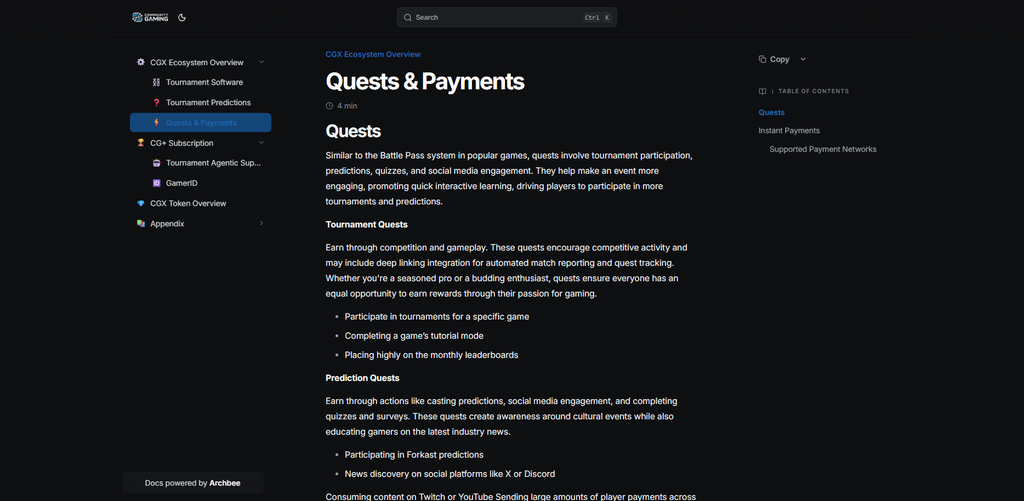
These groups help lower the barrier to entry by allowing players to borrow expensive characters, cards, land, or tools instead of purchasing them themselves. Many communities also use token-based voting to decide on treasury spending, game investments, events and development proposals.
Examples would include Axie guilds, Splinterlands guilds, Alien Worlds planetary DAOs, and Pixels farming communities. Simply put, community gaming turns players into active participants, co-creators, and stakeholders in the game economy, rather than passive consumers.
Main Features
- Esports Tournaments: Organize competitive gaming tournaments with prize pools and structured competition formats.
- Crypto Rewards: Supports crypto based rewards for tournaments and payouts to players.
- Automated Payments: Provides automated prize distribution to facilitate tournament payouts.
- Tournament Management: Provides tools to create, manage, and participate in esports tournaments.
- Community Engagement: Links players, teams, organizers, and gaming communities together through competitive events.
Key Risk Factors
- Reward Availability: Prize pools and earning opportunities are contingent upon tournament participation and event funding.
- Regional Restrictions: Not all competitions and payment features are available in all countries.
- Crypto Volatility: Cryptocurrency rewards are subject to market fluctuations.
- Competition Risk: Players might face stiff competition and not make any tournament money
2. Gala Games
Gala Games is a Web3 gaming ecosystem with an emphasis on player ownership of NFTs and in-game assets. Its catalog features titles such as Town Star, Spider Tanks and other games published by Gala. Basic play is typically free, but gas or transaction fees may be charged for NFT purchases, marketplace trades and blockchain actions; Gala has used a 2.5% NFT royalty model.
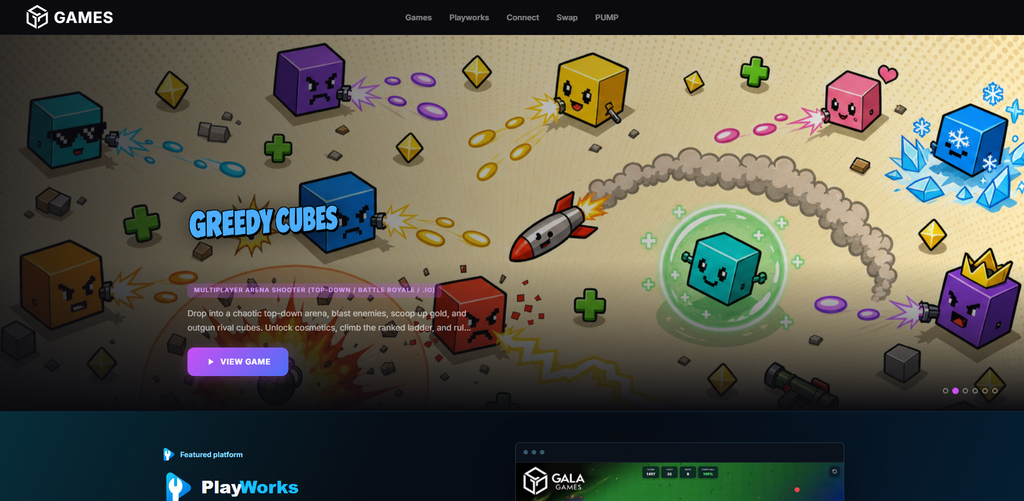
Players can earn GALA through gameplay, node participation and staking depending on the title. GALA is live on Ethereum and Gala’s own blockchain infrastructure, and is supported by wallets compatible with ERC-20 such as MetaMask, Trust Wallet and Ledger. Its community is involved through Discord, node ownership, governance, and creator-driven game development.
Main features
- Blockchain Gaming: Offers a variety of blockchain games in various gaming genres.
- GALA Token: Uses its native GALA token for its blockchain gaming ecosystem.
- NFT Ownership: Lets players own and trade eligible in-game digital items.
- Game Variety: Offers a wide range of gaming experiences, from strategy, RPG, and action-based genres.
- Player Ecosystem: Links players, developers and digital asset owners via its gaming ecosystem.
Major Risks
- GALA token prices can be highly volatile.
- NFT Liquidity – Some in-game assets may have limited buyers and resale opportunities.
- Game Dependence: The utility for rewards and assets is dependent on the development and adoption of each game.
- Ecosystem Complexity: Players might have to learn about wallets, tokens, and blockchain transactions.
3. The Box
The Sandbox is a user-generated metaverse where players can create, own, and monetize voxel-based experiences using LAND NFTs. Its experiences span games and social spaces, concerts and brand worlds.
Access is free, but users require SAND to make purchases on the marketplace, create assets, and access some experiences; The Sandbox has a 2.5% marketplace royalty charge and gas fees on the blockchain depend on the network.
Players can earn SAND through contests, Play & Earn events, raffles, sales from creators, and staking or liquidity programs. The platform is primarily built on Ethereum and uses Polygon to process rewards and claims. It can be linked to third-party Web3 wallets such as MetaMask and its community is made up of creators, LAND owners and game makers.
Main Features
- Virtual Land Ownership Users can buy and own virtual LAND represented in the form of NFTs.
- SAND Token: Used for transactions and activities within its virtual ecosystem.
- Game Development: Offers tools to build interactive gaming experiences without deep coding knowledge.
- NFT Marketplace: Facilitates the trading of physical assets, collectibles and virtual items.
- Community Experiences: Users can participate in virtual events, games and social experiences.
Main risks
- Virtual Land Volatility: The prices of LAND may be volatile depending on the market demand.
- Development Costs: Creating detailed virtual experiences can be time-consuming and expensive.
- Market Liquidity: No assurance of selling virtual land and NFTs at desired prices.
- Platform Adoption: The long-term utility of an asset is contingent on user activity and ecosystem development
4. Axie_Infinity
Axie Infinity is a creature-collecting and battling game where players own Axie NFTs, breed them and fight in tactical battles. Its original Smooth Love Potion economy brought play-to-earn gaming to the mainstream. To start playing, you need Axie NFTs, so the cost of entry will depend on the marketplace cost.
Sky Mavis gets a 4.25% fee from the marketplace and there could be other costs for breeding. Players can earn by battling, completing quests, breeding, trading Axies, and staking AXS. The game uses Ronin, a gaming sidechain that connects to Ethereum for cheap transactions.
The official Ronin Wallet is the main wallet and supports AXS, SLP, RON, and Axie NFTs. Axie has a huge global community and is especially strong in competitive play, guilds and creator content.
Main Features
- Creature Battles: Players can collect, breed, and battle digital creatures known as Axies.
- AXS Token: Utilizes Axie Infinity Shards (AXS) for governance and participation in the ecosystem.
- SLP Rewards: Uses Smooth Love Potion (SLP) as an in-game token tied to gameplay and breeding.
- NFT Ownership: Players own, trade and handle Axie NFTs.
- Competitive gameplay: Provides strategic battles, game modes and competitive player activities.
Main Risks
- Token Volatility: Prices of AXS and SLP can vary greatly.
- Upfront Investment: Some gameplay features and NFT assets may incur some upfront costs.
- Reward Changes: Reward token systems and earning opportunities are subject to change.
- NFT Depreciation: Axie asset values can decline due to reduced demand
5. Gods Unchained
Gods Unchained is a tactical free-to-play trading-card game where players build competitive decks and own their cards as NFTs. It has ranked matches, expansions, card crafting in the forge and trading in the marketplace.
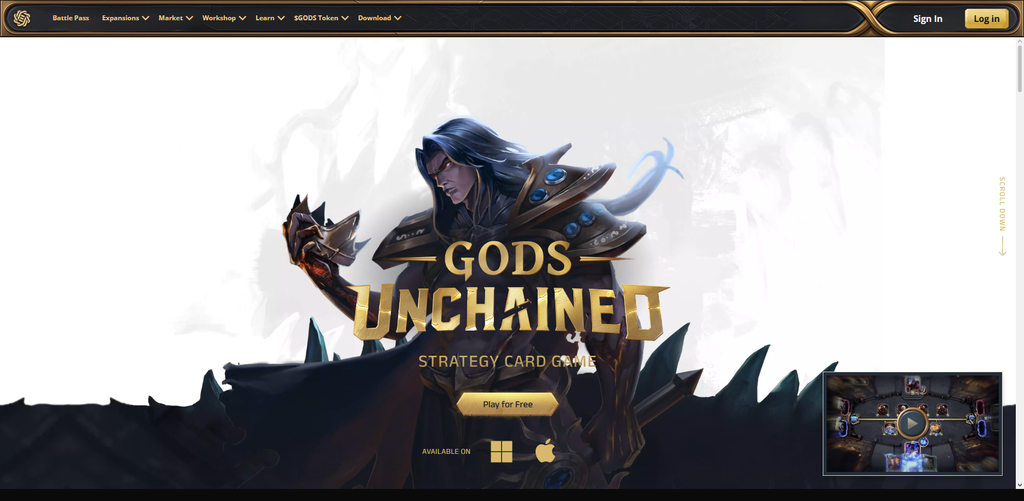
The core game is free, but you can pay to buy card packs and higher quality NFT cards. Secondary sales may be subject to Immutable marketplace fees and project royalties. Players earn GODS from Weekend Ranked, tournaments, quests, card sales and staking. GODS are used for crafting, governance, purchasing and staking rewards.
The game is powered by Immutable, an Ethereum Layer-2 network, allowing NFT trading at very low costs. Popular wallets include MetaMask and Immutable Passport. Its community revolves around ranked play, deck theory, tournaments, and trading cards. [assets
Main Features
- Free-to-Play Gameplay: Provides a competitive digital trading card game with strategic battles.
- NFT Card Ownership: Players can own, collect and trade blockchain-based cards on which are supported.
- GODS Token: The native GODS token is used for ecosystem activities and crafting NFTs.
- Competitive Matches: Includes ranked play, strategic deck creation and competitive events.
- Card Marketplace: Allows players to trade eligible digital cards on its marketplace.
Principal Risks
- Card Value Fluctuations: The price of NFT cards can vary based on demand and the game’s popularity.
- Competition Difficulty: New players can face off against seasoned players with better card collections.
- Token Volatility: The value of the GODS token is subject to the conditions of the crypto currency market.
- Changes to Game Balance: Modifications to card abilities and game rules may affect asset utility.
6. Splinterlands
Splinterlands is a fast-paced, strategic auto-battler card game where players collect monster and summoner NFTs, build teams and battle using mana, abilities, and elemental rules. They can start with a lite account for free, but a $10 Summoner’s Spellbook will unlock all features and eligibility for SPS rewards.
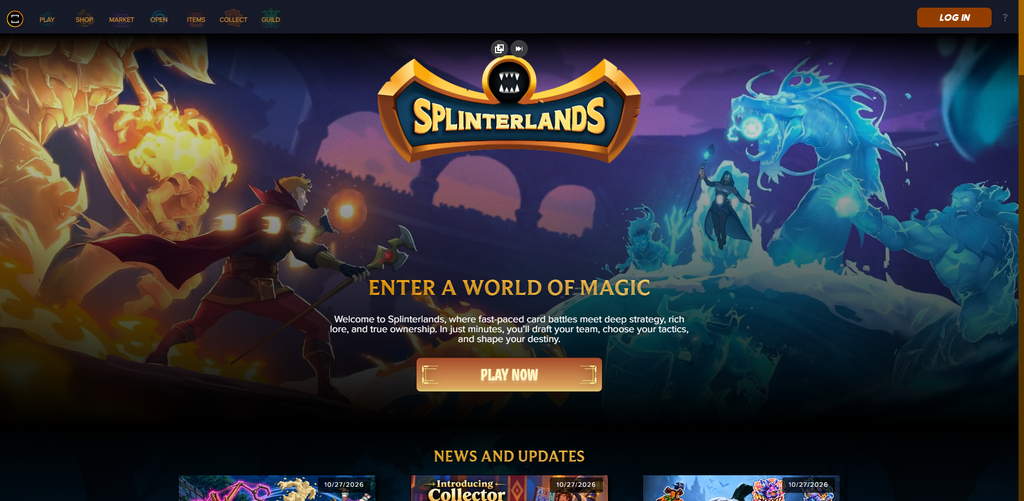
Ranked battles, quests, guilds and competitions offer players rewards in the form of Dark Energy Crystals (DEC), SPS, cards and tournament prizes. SPS is also a governance token that can be staked and voted with.
The game is built on the Hive blockchain, with bridges and linked wallets to support Hive, BNB Chain, WAX and other networks. The primary wallet is Hive Keychain and the community is active with guilds, tournaments, DAO proposals, and content creation.
Key Features
- Digital Card Battles: Take on other players in strategic collectible card battles.
- NFT Card Ownership: Players will be able to own, trade, rent and upgrade cards on blockchain.
- Crypto Rewards: Gives eligible players chances to win in-game crypto rewards.
- Tournament Participation: Encourages competitive play, tournaments, and ranked gameplay.
- Multiple Reward Assets. Incorporates reward systems with assets like DEC and GLINT.
Major Risks
- Entry Cost: You need to buy the Summoner’s Spellbook to get access to all earning features.
- NFT Card Price Fluctuation: The price of NFT cards may fluctuate based on the demand for the player.
3.Changes to Reward: Reward structures and opportunities to earn may change over time. - Competition. You may need better cards and more investment to compete at higher levels.
7. Alien Worlds
Alien Worlds is an NFT space exploration game where you mine Trilium (TLM), complete missions, stake in planetary DAOs and battle using NFT tools and avatars. It’s free to start playing, but players usually need mining tool NFTs to be able to play well. WAXP handles all the small transaction fees.
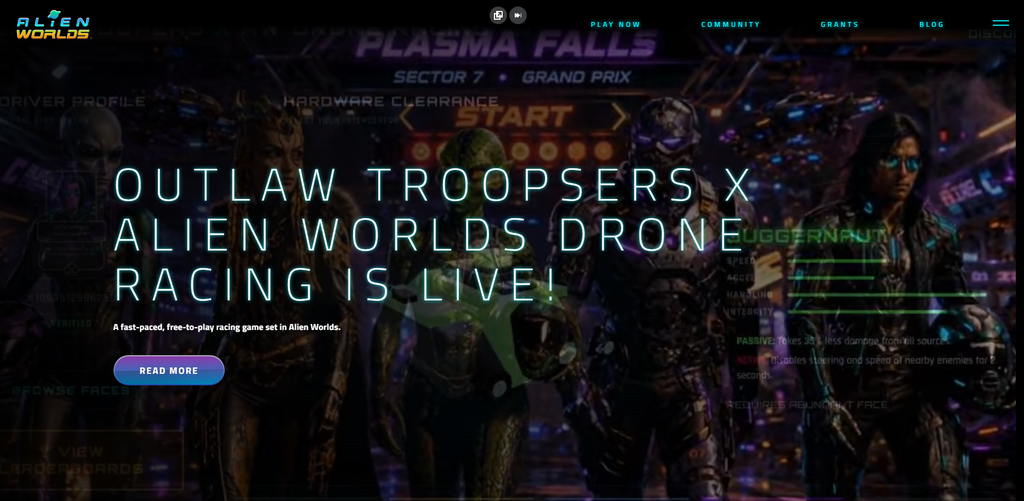
Players can get TLM by mining, missions, governing planets, battles and trading NFTs. TLM can be used to stake and perform in-game actions in planet DAOs. Alien Worlds runs mainly on WAX with cross-chain support for Ethereum and BNB Chain.
WAX Cloud Wallet and Anchor are common wallets with relatively easy onboarding. Its community is organized around planets, DAOs, guilds, explorers and player-run missions.
Main Features
- Mining Gameplay: players can mine digital resources on various virtual planets.
- TLM Token: The native ecosystem token is Trilium (TLM).
- NFT Tools: Support for collectible NFT tools, weapons, and other in-game assets.
- Planet Governance: Creates opportunities for planet governance and participation.
- Mission Activities: Offers missions and community activities associated with its blockchain gaming ecosystem.
Key Risk Factors
- Volatility of the Token: TLM price can swing wildly.
- Competition in mining: The amount of rewards you receive from mining is based on the level of competition and the resources available.
- NFT Liquidity: It could be challenging to sell certain electronic assets and collectibles.
- Reward Uncertainty Mining and mission rewards are not guarantyd income
8. Pixels
Pixelis a farming and social MMO set in a web browser where players grow crops, raise livestock, craft items, complete quests and interact in shared pixel-art worlds. It is free to play, but it has optional VIP membership and NFTs like Farm Land and Pixel Pets. VIP gives you other tasks, energy, storage and withdrawal perks.
Players can earn from farming, daily tasks, quests, guild participation, land ownership and staking PIXEL into ecosystem games. PIXEL withdrawals could include a “Farmer Fee” and vPIXEL offers a fee-free, spend-only alternative.
Pixels has moved from Polygon to Ronin. On-chain tokens and NFTs require the Ronin Wallet. Its community is deeply engaged through guilds, land ownership, creator tools and Ronin’s wider gaming ecosystem.
Main Features
- Social Farming Gameplay: Includes farming, resource gathering, crafting and exploration.
- PIXEL Token: used for supported in-game purchases and ecosystem activities.
- NFT Integration: Supports electronic assets on the blockchain and selected collectibles.
- Social Interactions: promotes social activities, cooperation, and player participation.
- Quest-Based Activities: Offers quests, achievements, and gameplay progression opportunities.
Key Risks
- Token Volatility: PIXEL prices may be volatile based on market conditions.
- Reward Limitations: Not all activities will reward cryptocurrency.
- Changes to the Gameplay Updates can change the progression, rewards and usefulness of assets.
- Market Dependency: NFT and token demand is dependent on continued player engagement
9. Illuvium
Illuvium is a blockchain-based open world gaming franchise that combines creature collecting, auto-battler combat, exploration, and city-building gameplay. Its games consist of Illuvium Arena, Overworld, and Zero. You can try a lot of experiences for free, but NFT creatures, land, cosmetics and marketplace items are purchased. Marketplace sales have fees that support the ecosystem.
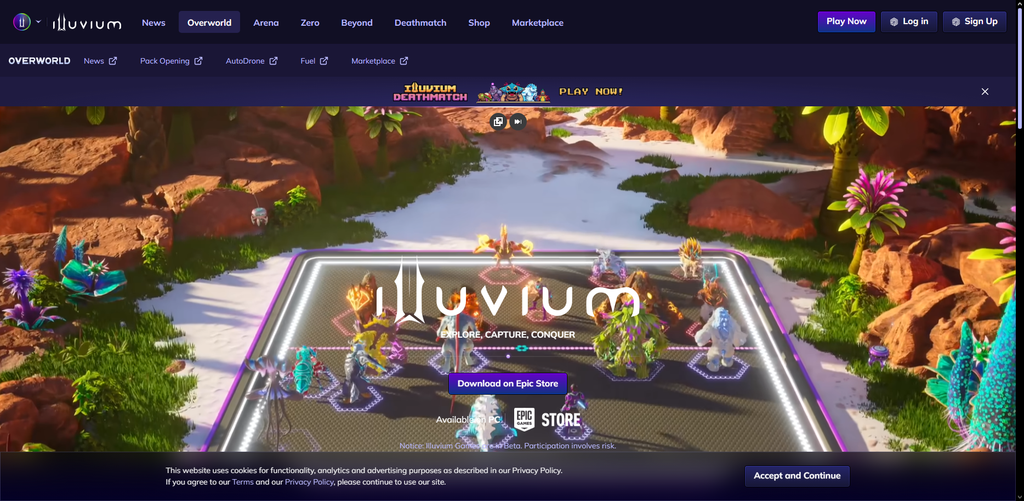
Competitive Arena performance, quests, seasonal rewards, staking, and liquidity participation are all ways players can earn ILV. ILV is used for governance, staking and Vault revenue sharing. Illuvium is secured by Ethereum and uses Immutable Layer-2 technology for low cost NFT minting and trading. MetaMask and Immutable Passport are two popular wallets. Its community is engaged through DAO governance, staking, tournaments and cross-game ecosystem development.
Main Characteristics
- Open-World Exploration: Provides a full gaming experience with players exploring different regions and encountering creatures.
- Illuvial NFTs: Enables players to collect and manage digital creatures called Illuvials
- ILV Token: Uses ILV for governance and participation in its gaming blockchain ecosystem.
- Auto-Battler gameplay: Experience strategic team building and automated creature battles.
- Digital Asset Ownership: enables blockchain-based ownership and trading of eligible in-game assets.
Critical Risk
- Hardware intensive. Some games might require a powerful computer.
- Token Volatility: ILV prices can fluctuate significantly in the market.
- Risks of NFT investment: The value of creatures and digital possessions is not guarantyd to increase.
- Development Dependency: Long-term success is dependent on game development, updates, and player adoption
10. UPLAND
Upland is a property-trading metaverse based on real world cities. Players can trade, develop and manage virtual properties associated with real world addresses. You can start the game free, but you need UPX to buy properties, develop, hunt for treasure, and pay transaction fees.
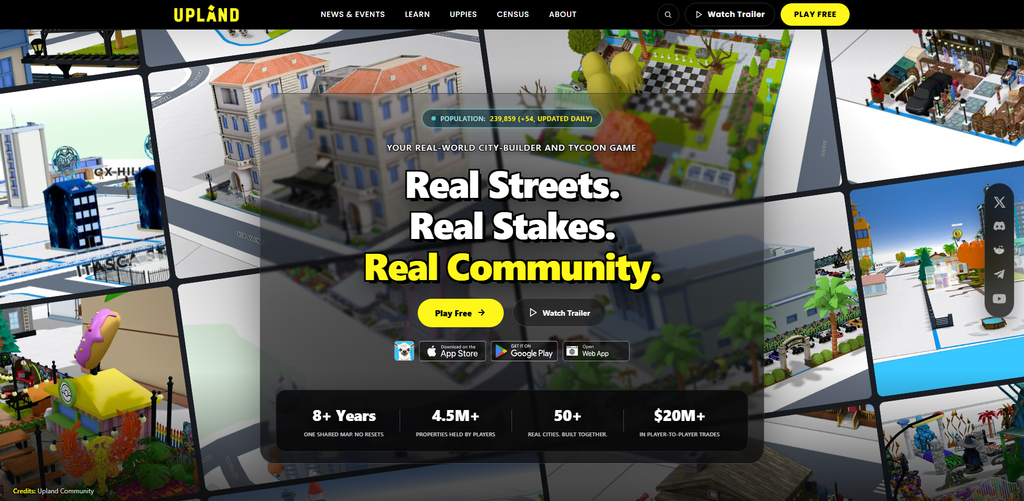
UPX is pegged for web purchases at 1,000 UPX per $1. Players make money by flipping properties, renting, treasure hunting, starting businesses, holding events and completing collections.
Upland takes a 10% community contribution on player to player market place transactions. Split between buyer and seller. It’s built on the EOS blockchain, but the everyday play is meant to feel like Web2. Upland accounts have integrated wallets. KYC required for transfers of UPX. The community is active in city groups, property trading, live events and entrepreneurship
Key Features
- Virtual Property ownership: enables players to buy and own virtual properties associated with real-world addresses.
- UPX Currency: UPX is the main in-game currency for property-related activities.
- Property Trading: Allows players to buy, sell and trade virtual property.
- City Exploration: Provides virtual maps of real world cities and locations.
- Property Development: Players can develop properties, join community activities and create virtual businesses.
Risks to highlight
- Property Value Changes: The value of virtual property may change depending on market demand.
- Limited Liquidity: Properties may not be sold quickly at the expected price.
- Availability in your region: Some features and cash-out options may not be available in all countries.
- Investment Risk: Buying property calls for careful consideration as returns are not guaranteed.
Conclusion
Crypto rewards and community gaming platforms are opening up new possibilities for players to engage in tournaments, earn digital tokens, collect NFTs, and connect with blockchain-powered gaming communities. There are platforms like Community Gaming, Gala Games, The Sandbox, Axie Infinity, and Splinterlands that offer different gaming experience and reward mechanisms.
However, to select the right platform, you will need to consider the games they offer, the cryptocurrency rewards, the wallet compatibility, the transaction fees, the security, and the community. Players should also be aware of token volatility, NFT risks and reward limitations prior to participating. At the end of the day, the ideal platform is one that offers a fun gaming experience, tangible rewards, reliable technology, and a thriving gaming community.
FAQ
What Are Community Gaming Platforms with Crypto Rewards?
Community gaming platforms with crypto rewards are online gaming ecosystems where players participate in games, tournaments, quests, and competitions to earn cryptocurrency tokens or digital assets.
Which Are the Best Community Gaming Platforms with Crypto Rewards?
Some popular platforms include Community Gaming, Gala Games, The Sandbox, Axie Infinity, Gods Unchained, Splinterlands, Alien Worlds, Pixels, Illuvium, and Upland.
Can Players Earn Real Cryptocurrency Through Gaming?
Yes, eligible players can earn cryptocurrency through tournaments, gameplay activities, quests, and competitions. However, rewards depend on platform rules and participation requirements.
Do Crypto Gaming Platforms Require a Wallet?
Most blockchain gaming platforms require compatible cryptocurrency wallets to connect accounts, manage digital assets, receive eligible rewards, and complete blockchain transactions.
What Types of Rewards Do These Platforms Offer?
Common rewards include native cryptocurrencies, governance tokens, NFTs, digital collectibles, virtual properties, and other blockchain-based gaming assets.