In this article I will talk about the Best Private Lending Investment Platforms that help investors discover opportunities outside of traditional investment markets. These platforms offer access to private credit, real estate loans, small business financing and other debt-based investments.
The platforms differ in the types of investments available, minimum investment levels, possible returns and the way loans are repaid. It can be useful to understand these differences when you compare providers, assess the risks and decide on a platform that suits your investment preferences and financial objectives.
Why Should Investors Use Private Lending Investment Platforms?
Alternative Investment Opportunities: Private lending platforms provide investors with an opportunity to access debt investments other than traditional stocks, bonds, and bank deposits, which allows them to diversify their capital allocation strategies.
Potential for recurring income: Depending on the loan agreements, the borrowers’ performance and the platform’s investment structure, investors may be able to earn interest income on a monthly, quarterly or scheduled basis.
Portfolio Diversification: Private lending investments can diversify portfolios across real estate, small business, consumer lending and private credit, reducing reliance on conventional financial markets.
Investment options you can afford: There are a number of platforms that have fairly low minimum investment requirements, so qualifying investors can give private lending a try without having to put in huge sums of money.
Flexible Investment Terms: Investors have the option to select from a variety of investment opportunities with varying loan terms, interest rates, repayment schedules, and borrower types, depending on their investment preferences.
Real Estate Exposure: Private lending platforms allow investors to invest in property-backed financing such as construction loans, bridge loans, renovation projects and commercial real estate financing.
Open Investment Data: Many platforms provide borrower information, loan conditions, security, financial statements, and repayment timelines, allowing investors to evaluate projects prior to investing.
Greater Return Potential: Private lending may provide a more profitable income stream relative to some traditional fixed-income vehicles, though actual returns depend on borrower performance, credit risk, fees, and market circumstances.
How to Choose the Best Private Lending Investment Platform?
Check the Platform’s Reputation: Before you invest a dime, look into the platform’s history, legitimacy, openness, how it vets borrowers, what investors are saying about it, and any regulatory disclosures.
Compare minimum investment: Check minimum investment requirements to ensure the platform fits your budget and allows you to diversify across multiple lending opportunities.
Look at Potential Earnings: Think about the interest rates, estimated annual earnings, payment schedule, and investment structure, remembering that advertized returns are not guaranteed.
Loan Security Assessment: Assess the security of the loans (secured or unsecured), the nature of the collateral, loan-to-value ratios, priority of repayment, and recovery procedures in case of borrower default.
Know Fees and Charges: Review origination fees, servicing fees, management fees, transaction fees and other expenses that may impact your total investment returns.
Liquidity Choices: Before investing, evaluate the investment’s maturity period, withdrawal restrictions, redemption rules, availability in secondary markets, and early exit options.
Investor Eligibility Requirements: Verify whether the platform is open to accredited or non-accredited investors, what documentation is required, any geographic limitations, and account verification processes.
Compare Investment Opportunities: Examine borrower profiles, loan purposes, property details, creditworthiness, diversification options, repayment terms, and platform reporting tools to identify suitable investments.
Key Points Comparison Table
| Platform | Main Investment Focus | Lending / Investment Model | Key Highlight |
|---|---|---|---|
| 1. Percent | Private credit | Asset-backed lending and specialty finance | Individual private credit deals and diversified credit investments |
| 2. Groundfloor | Real estate lending | Short-term real estate loans and notes | Access to individual real estate debt investments |
| 3. Fundrise | Real estate and private credit | Pooled investment funds | Diversified real estate and income-focused fund options |
| 4. Worthy Bonds | Business and property financing | Fixed-income bonds | Low entry investment amounts and bond-based investing |
| 5. Honeycomb Credit | Small business lending | Business debt securities | Direct access to individual small business funding campaigns |
| 6. SMBX | Small business financing | Small Business Bonds | Invest in bonds issued by growing small businesses |
| 7. Connect Invest | Real estate financing | Real estate-backed investment notes | Fixed-term real estate investment opportunities |
| 8. Sharestates | Real estate debt | Crowdfunded real estate loans | Access to real estate lending opportunities |
| 9. Willow Wealth | Private credit and alternative assets | Private credit offerings and investment funds | Multiple alternative investment strategies |
| 10. EquityMultiple | Commercial real estate financing | Debt, preferred equity, and equity investments | Real estate debt opportunities for accredited investors |
1. Percent
Percent is a private credit investment platform that provides investors access to alternative lending opportunities, such as asset-backed loans, consumer finance, and specialty credit. It provides individual deals and diversified investment options, allowing eligible investors to select opportunities that align with their financial objectives and risk appetite.
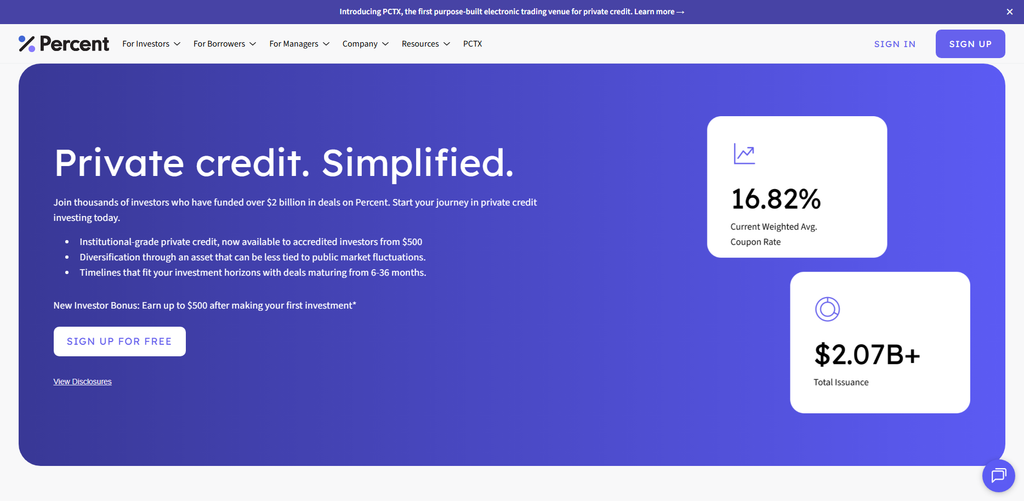
It gives deal specific information, investment terms, and borrower information to aid in making an informed decision. Its investment opportunities may provide attractive income potential, but returns are not guaranteed. Investors should carefully consider minimum investments, fees, restrictions on liquidity, protection of collateral and risks of borrower default before investing.
Main Features
- Access to asset-backed private credit investment opportunities.
- Provides investment opportunities in small business loans, consumer receivables and trade finance.
- Allows selection of individual deals and diversified Notes mixed.
- Offers terms of investment that vary by deal, usually between 6 and 36 months.
- Offers borrower information, deal documentation and investment performance monitoring.
The main risks
- Borrower default may cause principal losses.
- Private credit investments are typically illiquid.
- Collateral values can decline during recessions.
- Returns are dependent on borrower repayments and deal performance.
2. Groundfloor
Groundfloor is a real-estate private-lending marketplace that allows everyday investors to fund fractional shares of short-term, property-backed loans for residential renovation and development projects. It does not charge an investor fee on individual Loans and Notes, although its managed Flywheel portfolio may have a portfolio fee.

Types of investment: individual loans, fixed rate Notes, convertible Notes, managed portfolios. Minimums for individual loans are $10 and for Notes are $100. In some cases, Notes will require a $1,000.
Loans have expected returns of 8%–15%, while Notes are expected to return up to 9%. These are targets, not guaranties. Typical loan terms are 6-12 months. Notes can run 1, 3 or 12 months. The loans are secured by first or second lien mortgages on residential real estate and are secured by property collateral, not an unsecured business promise.
Main Features**
- Enables access to individual real estate loan investments.
- Allows investors to pick individual loan opportunities secured by property.
- Provides investment opportunities from relatively modest amounts.
- Offers loan information, property details and investment disclosures.
- Offers fixed-rate, fixed-term Notes secured by different loan pools.
Major Risks
- Defaults by borrowers can delay or reduce repayments.
- A fall in property values will impact the recovery of collateral.
- Delays in renovations can prolong investment horizons.
- Individual loan investments are subject to concentration and liquidity risk.
3. Fundrise
Fundrise is an online private-markets platform that provides exposure to real-estate equity, income-producing real estate, and private credit and venture-capital funds through managed portfolios. It’s best for passive investors who want broad exposure instead of picking individual loans. Fundrise also has an annual advisory fee of 0.15% and its real-estate funds charge an annual management fee of 0.85%.
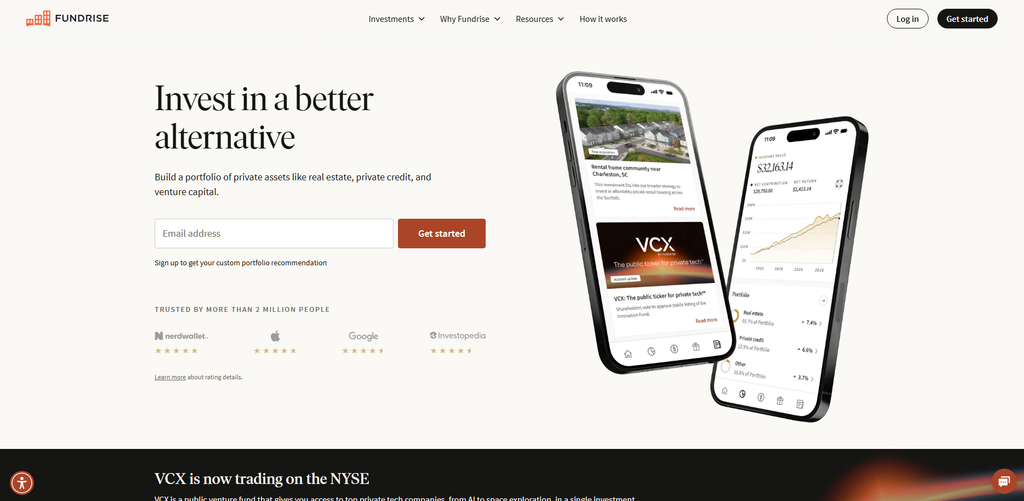
So those funds charge about 1.00% in annual costs. Taxable accounts can be opened with as little as $10, but IRAs require $1,000. It does not offer a guarantyd return. Past performance and projections may not predict future results.
Fundrise investments are typically longer term and less liquid than short-term notes, so investors should be prepared to stay the course through market cycles. Collateral differs from fund to fund, which can be property, mortgages, private loans or startup equity instead of a single standard security structure.
Main points
- Offers access to private credit and real estate investment strategies.
- Offers an Income Real Estate Fund that focuses on real estate-backed fixed-income investments.
- Invests in multifamily housing, homebuilder financing and real estate debt.
- Gives pooled funds to provide investment diversification.
- Provides income-oriented investment options and portfolio management services.
Key Risks
- A downturn in the real estate market can affect investment performance.
- Defaults by borrowers can cause loss of principal.
- Withdrawals of funds may be restricted or delayed.
- Changes in interest rates can affect debt valuations and distributions.
4. Worthy Bonds
Worthy Bonds is a simplified fixed-income platform that sells $10 SEC-qualified bonds that fund U.S. residential real-estate developers and associated lending activity. It’s aimed at investors looking for a simple, fixed-rate savings account alternative without investing in individual real-estate deals.
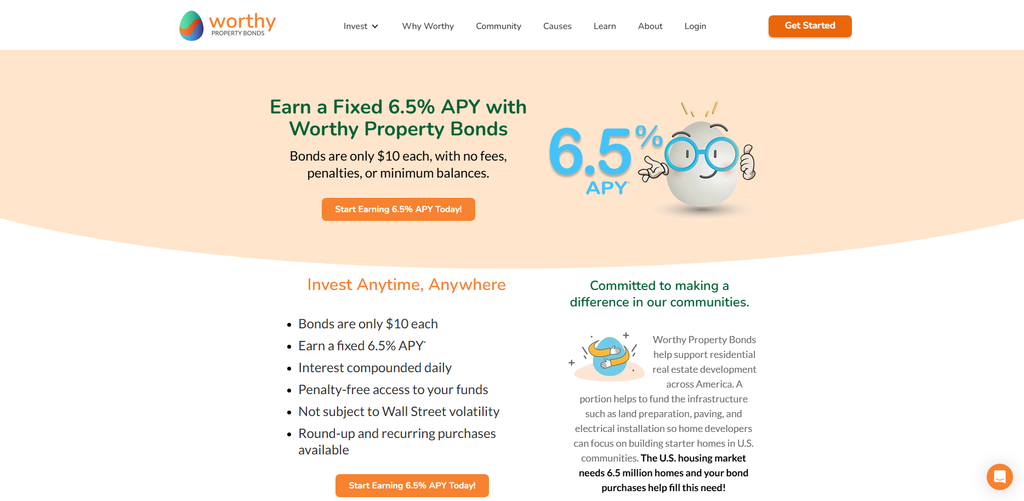
“Investors pay no purchase, withdrawal, transfer fees or penalties,” Worthy states. Its flagship investment is the Worthy Property Bond, with a minimum purchase of $10 and a stated investment cap of $50,000. The platform advertizes a fixed APY of 7.0% which is compounded daily, but the rate is subject to change based on the issuer’s credit and market conditions.
Worthy bonds have no set maturity date, and the company says investors have access to funds with no penalty or fees. The bonds are backed by Worthy’s real-estate lending business, but investors own Worthy obligations, not a direct first-lien mortgage on a specific property.
Main Features
- Möglichkeit, in Anleihen zu investieren.
- Access to fixed interest investment products.
- Traditionally had relatively low minimum investment amounts.
- Focuses on financing through business and property related lending structures.
- Offers information about bond investments and account management services.
Critical Risks
- A bond issuer may default on both principal and interest.
- Redemptions may be suspended or delayed.
- There may be no reliable secondary market for investments.
- The structure of unsecured bonds can result in significant losses for investors.
5. Honeycomb Credit
Honeycomb Credit is a community investment marketplace where people can lend directly to local small businesses through fixed income offerings. It’s aimed at investors who want to back local businesses and earn interest but carries more borrower-specific risk than diversified real-estate lending. Honeycomb charges businesses a $250 posting fee and a loan-origination fee of 6%–8% depending on the amount funded.
Fees on the investor side are not prominently disclosed in the available information about the platform. The primary type of investment is a direct small-business loan or bond for expansion, working capital, or other business needs. Minimum investment is $100. The returns reported can be high–15.25% according to one industry comparison–but small-business lending carries a significant risk of default.
Different businesses have different loan lengths and payment schedules . Investors get their principal back , with interest , over the length of the loan . Investors should carefully review each borrower’s financials and repayment protections. Collateral is specific to each offering and may be limited or unsecured.
Features at a Glance
- Traditionally matched investors with small business funding campaigns.
- Sale of investment securities – debt.
- Enabled investors to invest in specific local businesses.
- provided business information and funding details at the campaign level.
- Servicing for the repayment of existing business loans.
Principal Risks
- Small businesses may have financial problems.
- The borrower may default and miss repayments.
- The investments have limited liquidity.
- Investors may lose all or a portion of their principal.
6. SMBX
SMBX is the Small Business Bonds Marketplace. Investors buy bonds issued by small businesses, including local franchises and independent operators. It mixes small business lending with a crowdfunding-like marketplace and pays monthly principal and interest. SMBX says investors pay no platform fee for Reg Crowdfunding bond offerings, but a 4% processing fee applies to credit-card investments.

Businesses pay service and possibly bond-structure fees. Investment type: Small Business Bond. Minimum investment: $10. SMBX says it’s interested in up to 11.5%, but notes that estimated returns of principal and interest are not guaranteed.
Bond duration is how many months the business has to pay back principal plus interest . The terms are set by each offering . Some bonds are collateralized. Issuers may be required to sell collateral to cure defaults within 90 days where possible, but collateral is not universal across every offering.
Key Features**
- Offers a market for small business bonds.
- Allows investors to select individual business bonds.
- Historically had investments starting at $10.
- Features bond structures with fixed interest.
- Provides for scheduled monthly principal and interest payments under the terms of the applicable bonds.
Major Risks
- Investors could lose their principal if the issuer fails to meet its obligations.
- Small business issuers may be defaulting on their payments.
- Bonds may not be easily salable.
- Business performance affects repayment capacity.
7. Connect Invest
Connect Invest is a real estate lending platform that offers fixed-rate Short Notes funding for a portfolio of residential and commercial real estate loans. It’s a good option for investors who want predictable monthly income and defined maturity dates, instead of picking individual projects. Connect Invest says that it does not charge investor fees or account fees on its Short Notes.
Investment is primarily in a fixed-rate, asset-backed Short Note secured by real estate loans. The minimum investment in a Connect Note is $500. The platform offers a fixed annualized return of 7.5%-9.0% depending on the term chosen.
Investors can choose between 6-, 12-, or 24-month terms, which means they have a clear holding period and payment schedule. The underlying loans are secured real estate loans, typically in first position. Investors own a claim on the note portfolio, not a direct mortgage on an individual property.
Main Features
- Access to private real estate lending investments.
- Issues Fixed Income Notes and Direct Notes.
- Offers access to pooled real estate loan investment options.
- Offers fixed rate investment products with monthly interest payments.
- Different terms and eligibility requirements for investment.
Key Risks
- Fixed Income Notes are obligations of the issuer and are not secured by any collateral.
- The issuer’s financial problems may affect repayment.
- If borrowers default, investment performance could be affected.
- Investors could lose all of their money.
8. Sharestates
Sharestates is a real estate private lending marketplace focused on business-purpose mortgage loans including fix-and-flip, bridge and other short-term real estate financing. It’s better suited for investors comfortable underwriting individual loans or looking for exposure through a credit fund. Sharestates’ High Yield Credit Fund has no investor fee, and the platform has provided promotional servicing-fee waivers.

Fees vary by product. Investors can access individual first lien real estate loans and a High Yield Credit Fund of Sharestates originated mortgages. Minimum investments are $5,000 for U.S. investors and $10,000 for non-U.S. investors per loan. The platform advertizes net annualized returns of 7% to 11%, and promotional offers have advertized as much as 13%, but the returns are not guaranteed.
The underlying loans are typically 6 to 24 months in maturity, while the credit fund can hold mortgages with maturities from 6 to 360 months. The loans are collateralized by the real estate collateral and are recorded as liens against the property and the borrower.
Main Features
- Concentrates on real estate debt investment opportunities.
- Provides residential transition and rental property loan investments.
- Access to whole loans and fractional loan participations.
- Financing for fix-and-flip, bridge and ground-up development included.
- Provides loan-level information like loan terms and property details.
Main risks
- Construction and renovation delays may affect repayments
- -Collateral values can fall during a real estate market downturn.
- If the borrower defaults, foreclosure may be initiated.
- Loan investments can be illiquid and take a long time to be recovered.
9. Willow Wealth
Willow Wealth (formerly Yieldstreet) is a broader alternative-investment platform with managed portfolios and individual offerings in private credit, real estate, private equity and other alternative assets. It’s a good fit for higher-balance investors wanting diversified private market exposure, not a single-loan marketplace.
Fees: Fees vary depending on the offering. Willow may charge a one-time flat commitment fee that is deducted from the investment. Willow 360 charges a 1.25% annual advisory fee plus approximately 0.175% in expenses. Underlying funds may charge their own management fees. We invest in private credit, real estate and other alternative assets.
Willow 360 offers a managed portfolio of these assets. Typical first investments start at $5,000, Willow 360 is $25,000 and Short Term Notes start at $10,000 or $5,000 for a first investment. The returns projected are specific to the offering and are not guaranties. Can be multi-year, deal dependent. Collateral is dependent on underlying asset, may be real estate, receivables, equipment or other security.
Highlights
- Access to private credit and alternative investments.
- Individual investment opportunities, and diversified funds.
- Provides advice on real estate and private equity investment strategies.
- Offers curated opportunities through investment screening and due diligence.
- Provides managed portfolios and short-term investment notes.
Major Risks
- Private market investments are typically illiquid.
- Private credit returns can be affected by borrower defaults.
- Investment valuations can be hard to determine.
- Investors may lose some or all of their principal.
10. EquityMultiple
EquityMultiple is a commercial real-estate investment platform that provides vetted debt and equity opportunities, including short-term notes and longer-term property investments. Designed for investors seeking professionally underwritten private real estate exposure with the option of income-oriented notes or equity upside.

EquityMultiple’s Alpine Notes are said to have no investor fee, but other offerings may have sponsor, asset-management or performance-related fees, which would be disclosed in the offering documents. Investment types include short-term Alpine Notes, real estate debt investments and equity positions in commercial real estate. Alpine Notes, like the platform, has a $5,000 minimum investment.
Its investment page says it offers a 7.5% annualized yield for a nine-month investment, but your returns will vary depending on the investment and how the borrower performs. Alpine Notes are offered in 3-, 6- or 9-month terms, with longer-dated debt and equity investments available. Debt offerings are typically secured by real estate, but lien priority, loan-to-value ratio, sponsor guaranty and quality of collateral vary by deal
Features
- Offers access to commercial real estate investment opportunities.
- Invests in senior debt and preferred equity.
- Supports income-based real estate investment strategies.
- Investment-level property and sponsor information provided.
- Holds a diverse range of real estate funds and investment portfolios.
Principal Risks
- Investment values can be volatile due to fluctuations in the property market.
- Delay in repayment of principal due to borrower defaults.
- Real estate investments usually involve long holding periods.
- Different repayment and loss risk for preferred equity versus debt investments.
Conclusion
Private lending investment platforms provide investors with opportunities to earn potential interest income, diversify portfolios, and access real estate financing, business loans, and private credit investments.
Platforms like Percent, Groundfloor, Fundrise, Sharestates, and EquityMultiple offer different investment structures, eligibility requirements, and repayment terms. Choosing the right platform requires careful evaluation of minimum investments, potential returns, fees, collateral, borrower creditworthiness, and liquidity restrictions.
Although private lending can offer attractive income opportunities, it involves borrower defaults, market uncertainties, and potential principal losses. Investors should compare platforms, understand investment risks, and select opportunities that align with their financial goals and risk tolerance.
FAQ
What are private lending investment platforms?
Private lending investment platforms connect investors with lending opportunities, including real estate loans, small business financing, and private credit deals, allowing investors to earn potential interest income.
How do private lending investment platforms work?
Investors select lending opportunities, contribute capital toward loans, and receive interest and principal repayments according to the investment agreement and borrower repayment performance.
Are private lending investments safe?
Private lending investments carry risks, including borrower defaults, illiquidity, and potential principal losses. Collateral, diversification, and borrower screening can help manage risks but cannot eliminate them.
How much money is required to start investing?
Minimum investment requirements vary by platform and offering. Some platforms allow investments starting with relatively small amounts, while private credit funds may require substantially larger commitments.
How do investors earn money from private lending?
Investors generally earn through interest payments, scheduled repayments, or distributions from private credit funds. Actual earnings depend on borrower repayments, investment fees, and loan performance.