

Base rollups are gaining traction as a means of utilizing the validator infrastructure of Ethereum to improve sequencing and security as Ethereum scaling evolves. But Taiko is one of the major projects in this space, and not the only approach.
Several alternatives now look into faster pre-confirmations, high-performance execution, shared sequencing, and customizable rollup frameworks. In this guide, I’ll cover 10 great Taiko alternatives and compare the technologies, architectures and scaling methods that distinguish them.
What Is Taiko?
Taiko is a zero-knowledge proof technology based rollup, an Ethereum Layer 2 scaling network. Instead of a centralized sequencer, Taiko utilizes Ethereum’s block-proposing infrastructure to sequence transactions, which keeps the rollup in close alignment with Ethereum.
It provides Ethereum-equivalent execution, so developers are able to build with familiar Solidity contracts and Ethereum tooling. Taiko posts proofs and rollup data to Ethereum for settlement and verification. Its architecture focuses on decentralized sequencing, alignment with Ethereum security, low-cost transactions and scalable execution, while being compatible with the wider Ethereum ecosystem.

Why Look for Taiko Alternatives?
Alternative Sequencing Models: Developers may consider other models such as basis sequencing, shared sequencing, or custom transaction-ordering mechanisms to find a design that best fits their decentralization, latency, and application requirements.
Quicker Transaction Confirmation: Some of the alternatives are geared toward preconfirmations and low-latency execution, so applications can provide faster feedback about transactions without waiting for full Ethereum settlement before showing confirmation.
Improved execution performance: Alternative architectures employ parallel execution, optimized execution clients, or specialized virtual machines to increase computational capacity and alleviate execution bottlenecks for demanding applications.
Application-specific scaling: Developers building specific applications can select dedicated rollup or appchain architectures that offer custom execution environments, resource allocation, transaction policies, and infrastructure.
Flexible Proving Architecture: Different projects adopt different approaches for validity-proof and proving, so developers could compare the proof generation speed, verification complexity, computational costs, and scalability based on their needs.
Alternative data availability: Certain scaling architectures offer alternative data-availability configurations, providing developers with options around Ethereum blobs, external DA systems, availability costs and deployment flexibility.
More Composability: Alternatives can be tailored for synchronous L1-L2 or cross-rollup composability, allowing applications to coordinate transactions and liquidity more effectively across interconnected Ethereum scaling environments.
Key Points
| Alternative | Current Status |
|---|---|
| Puffer UniFi | Testnet / development; docs describe 50ms preconfirmations and same-slot L1-L2 composability |
| Spire / Pylon | Active development / deployments; Spire says its Pylon platform supports synchronously composable based appchains |
| RISE Chain | Mainnet live; RISE reports 1ms latency, 50K TPS peak capacity and 5 Ggas/s compute capacity |
| Surge | Alphanet / experimental deployments; Surge documentation describes a Taiko-based stack with real-time proving |
| Namechain / ENS via Surge | Development / staged rollout; ENS selected Surge for its planned based-rollup architecture |
| Espresso | Mainnet 1.0 live; it supports integrated rollups with shared sequencing, so it is an infrastructure alternative rather than a direct Taiko-style L2 |
| Fuel | Production network; relevant as a technical alternative, although its architecture is not a direct Taiko clone |
| Puffer Preconf | Live infrastructure; Puffer describes sub-second confirmations for based-rollup applications |
| Ethereum-based Surge deployments | Early deployments / testing; Surge states that deployments are already demonstrating synchronous composability |
| Taiko Stack-based deployments | Active ecosystem; Taiko’s open-source stack is being used for additional based-rollup deployments, including Surge-related infrastructure |
1. UniFi Puffer
Puffer UniFi is an Ethereum Layer 2 based rollup, released to the public in 2024 with its testnet. It based sequencing model uses Ethereum L1 validators to sequence transactions instead of a centralized L2 sequencer. UniFi is built on the OP Stack. Signal Service provides synchronous composability L1-L2.

Ethereum provides settlement and data availability while Puffer builds TEE-based real-time proving to verify state faster. Documentation states 50ms preconfirmations.
Earlier announcements mentioned different targets, so check the latest documentation for current figures. UniFi is mostly EVM-equivalent and focuses on Ethereum-aligned scaling, fast confirmations, composability and less L2 fragmentation.
Important Features
- Based Rollup Architecture – Instead of an L2 sequencer that’s fully centralized, it uses Ethereum aligned based sequencing.
- EVM Compatibility – Built with Ethereum-compatible execution in mind, this makes it easier to use existing Solidity and Ethereum tooling.
- Preconfirmation Infrastructure – Puffer’s architecture enables much faster confirmation of transactions than waiting for normal Ethereum block inclusion.
- Ethereum Settlement – Uses Ethereum as the underlying settlement environment, keeping rollup closely coupled to Ethereum.
- Synchronous Composability – Built to enable faster L1-L2 interaction and composability across Ethereum and the rollup.
Major Limitations
- Ecosystem Development – Application and developer ecosystem less mature than established Ethereum L2s.
- Architecture Complexity – The combination of based sequencing, preconfirmations and proving introduces additional infrastructure complexity.
- Ethereum Dependency – Performance depends on Ethereum block-production and settlement infrastructure.
- Changing Specifications – Some of the technical parameters and deployment specifics are still in flux.
2. Spire Labs’ Pylo
Spire Labs’ Pylon is a based appchain platform, not a typical, standalone L2. The Spire architecture today is built to launch customizable appchains that are still synchronously composable with an underlying Ethereum L2.
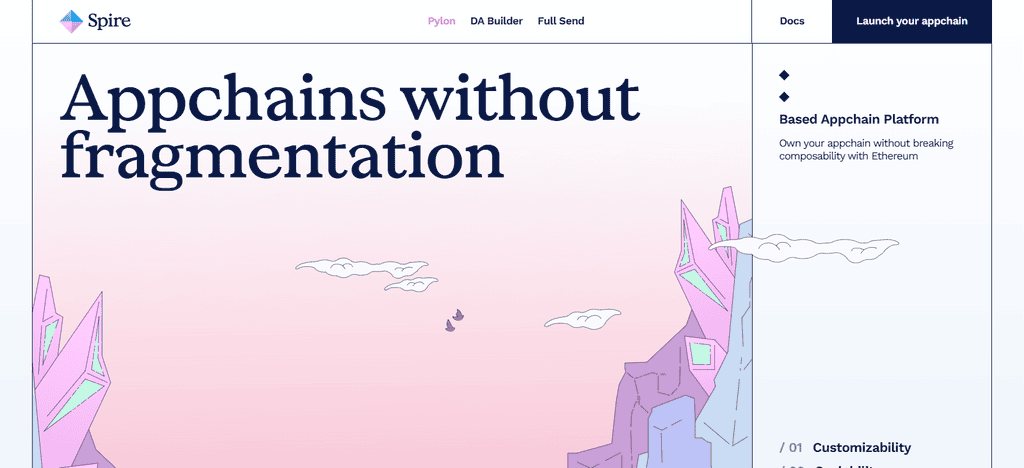
Spire’s new stack also outlines shared settlement and coordinated sequencing for L3-style deployments, with its sequencing model built on the underlying chain.
Developers are able to customize components such as data availability, permissioning, gas sponsorship, and execution configuration. Pylon is built for EVM-based application environments and lets developers use their existing Ethereum tooling.
Its main scaling priorities are app-specific execution, synchronous composability, low infrastructure overhead, and preventing liquidity fragmentation between independently operated appchains.
Core Functions
- Appchain Infrastructure – Pylon is building application chains around Ethereum-aligned sequencing.
- Customizable Architecture – Developers are able to customize execution, DA and, application-specific infrastructure.
- Synchronous Composability – To enable applications to interact with the underlying ecosystem without the need for complete asynchronous bridging.
- EVM Compatible Development – Enables Ethereum-like development and tooling for compatible deployments.
- Application-Specific Scaling – enables individual applications to get their own execution resources rather than fighting for capacity on a general-purpose rollup.
Limitations
- Less mature ecosystem – The platform is less mature than more established rollup ecosystems.
- Complexity of Deployment – Custom appchain infrastructure is more complex to deploy than a normal smart contract.
- Architecture Dependence – Performance depends on the underlying sequencing and settlement infrastructure.
- Short Production History – Decentralization characteristics and long-term performance are still being developed.
3. RISE Chain
RISE Chain is an Ethereum Layer 2 for high-performance EVM execution and on-chain financial applications. Its architecture is built around sequencing. Ethereum validators are used as gateways for L2 preconfirmations. RISE has detailed a move to more decentralized gateway participation.
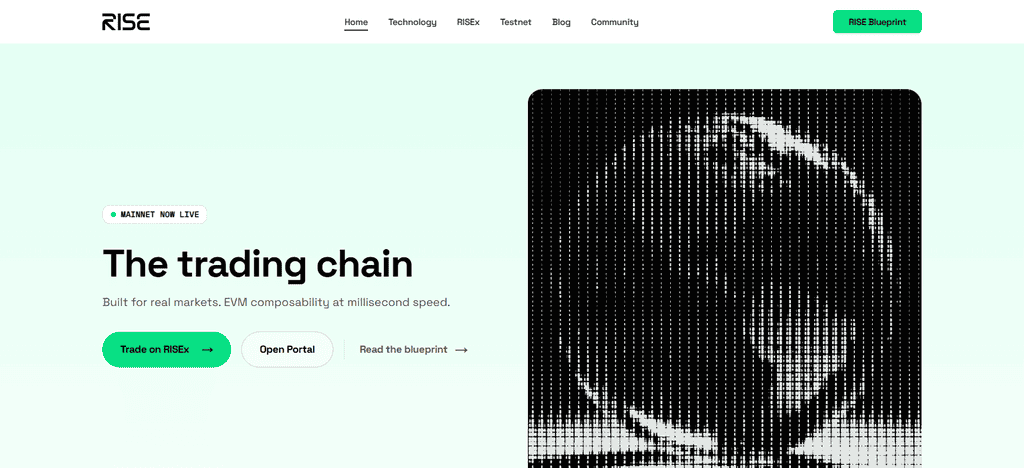
Continuous Block Pipeline, parallel execution, Shreds and Reth-based infrastructure are its execution technologies. RISE’s stack maintains sequencing and DA modular for different deployments, with Ethereum providing the underlying security and settlement environment. RISE is currently reporting 1ms latency and 50K+ TPS on its main site.
Its newer documentation mentions higher capacity targets so these numbers should be tagged with their source and measurement context. The focus is mainly on high-speed EVM trading and financial applications.
RISE Chain5 Key Features
- Based Sequencing – Relies on Ethereum-aligned sequencing to minimize reliance on a centralized sequencer.
- High-Performance EVM – Concentrates on ultra-fast Ethereum compatible execution.
- Parallel Execution – Its architecture supports execution of independent transactions in parallel, thus improving its execution capacity.
- ** Continuous Block Pipeline ** – Intended to guaranty continuous flow of transaction processing instead of relying only on traditional sequential execution stages.
- Low-Latency Transactions – RISE aims to reduce confirmation and execution latency for use cases such as trading and DeFi.
Major Limitations
- Infrastructure Complexity – The need for a more complex technical stack for high performance execution.
- Ethereum constraints – Sequencing is still working on Ethereum in the broader environment of Ethereum block production.
- Ecosystem Maturity – Smaller ecosystem than the more mature Ethereum L2s.
- Benchmark Interpretation – Throughput numbers reported may be for specific test or benchmark conditions and should not be assumed as sustained mainnet TPS by default.
4. Overload
Instead of a single public rollup, Surge is a based rollup template launched by Nethermind in 2025. It is built on the Taiko stack, and instead of a centralized sequencer it uses Ethereum’s validators, builders and searchers via the L1 block-building pipeline for transaction ordering.
Surge uses the Nethermind execution client for high-performance Ethereum-compatible execution, and is built around Ethereum settlement. Its architecture is intended to leverage Ethereum’s data availability, while enabling advanced proving and preconfirmation designs for deployments built with the framework.
Surge is EVM compatible and uses ETH for gas. Its primary scaling focus is on decentralized sequencing, Ethereum alignment, censorship resistance, efficient execution and building a reusable framework for future based rollups.
Main Features
- Based Rollup Framework – Surge is a generic framework to build Ethereum-based rollups that use based sequencing.
- Ethereum Validator Sequencing – Transactions are sequenced within the validator/block-building ecosystem of Ethereum, not by a centralized sequencer.
- Taiko Stack Foundation – Surge is powered by technology from the Taiko rollup stack.
- Real-Time Proofs – The architecture is designed to have a sophisticated proving infrastructure for faster proofs generation and confirmation.
- EVM Compatibility – Built for Ethereum compatible execution and existing Ethereum developer workflows.
Major Limitations
- Framework not single L2 – Surge is not a single, stand-alone, production blockchain.
- Deployment Dependency – Actual performance is dependent on the particular rollup deployment.
- Technology Development – Some components are still under active development.
- Complex Infrastructure – Real-time proving and based sequencing demand complex infrastructure.
5. Namechain / ENS on Surge
Namechain is the ZK rollup being built for the Ethereum Name Service (ENS) and is being deployed with Nethermind’s Surge based-rollup framework. In November 2025, ENS announced the switch to Surge, dropping its earlier plans to use the Linea stack.

The architecture is based on Ethereum-native based sequencing. Preconfirmations are offered by L1 validators. Namechain combines these preconfirmations with the TEE-generated pre-settled proofs to provide state information earlier with the fallback security path as the settled ZK proofs. Design is Ethereum/EVM-centric.
Ethereum is the settlement and DA base. It’s not really focused on L2 throughput in general, but rather ENS-specific execution, fast finality, censorship resistance, Ethereum-native settlement and CCIP-Read interactions.
Important Features
- ENS-Specific Rollup – Namechain is purpose-built for scaling Ethereum Name Service activity.
- Ethereum-aligned Sequencing – Uses the Surge architecture for Ethereum-aligned sequencing.
- Ethereum Settlement – Ethereum remains the base settlement environment.
- Fast preconfirmations – The architecture is designed to provide faster transaction assurances before the final confirmation.
- ** EVM-Based Environment ** – Compatible with Ethereum-based smart-contract infrastructure.
Major Limitations
- Application-specific Focus – Namechain is built around ENS primarily; not all types of applications are treated equally.
- Early Deployment Stage – Its ecosystem is not as mature as established general-purpose L2s.
- Surge Dependency – The architecture is heavily dependent on the Surge framework and infrastructure.
- Ethereum Dependency – Settlement and security are tightly coupled to Ethereum.
6. The Coffee
Espresso is different from Taiko in that it is mainly shared sequencing systems and not a direct competitor as a standalone based-rollup. The project, initiated in 2022, developed the HotShot consensus system and the Tiramisu data-availability architecture to provide a standard sequencing framework for integrated rollups.
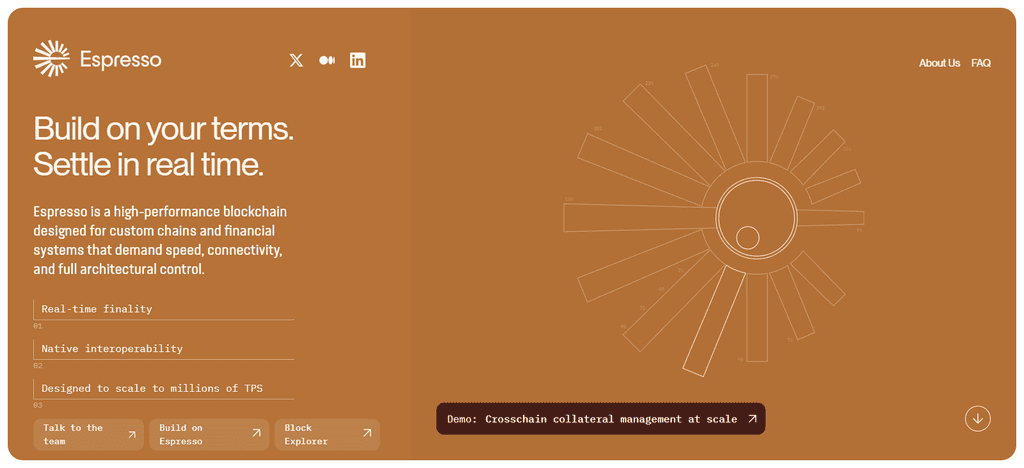
Espresso can coordinate the ordering of transactions across participating rollups, instead of requiring every rollup to have its own sequencer. So, settlement and execution are per the individual rollup using Espresso, not Espresso itself as a normal EVM L2.
EVM compatibility is therefore rollup-specific. Its main goal for scaling up is shared sequencing, faster coordination across rollups, composability, and reducing the fragmentation from isolated rollup sequencers.
Core Features
- Shared Sequencing – Enables multiple rollups to coordinate transaction ordering with shared sequencing systems.
- Cross-Rollup Coordination – Aims to improve interaction between participating rollups.
- HotShot Consensus – Leverages Espresso’s HotShot consensus architecture for decentralized sequencing.
- Rollup-agnostic infrastructure – It can support multiple rollup technologies instead of requiring a single execution environment.
- Faster Confirmations – Shared sequencing means faster transaction ordering and confirmation times for integrated rollups.
Major Limitations
- Not a direct L2 alternative – Espresso is mostly a sequencing system, not a Taiko-like rollup.
- Need Integration – Rollups need to be integrated into the infrastructure of Espresso to leverage its capabilities.
- Added Infrastructure Layer – Sharing sequencing adds another technical infrastructure layer to the rollup architecture.
7. Fuel
Fuel was founded in 2019 and is a rollup execution ecosystem for ethereum scaling, not a direct based-rollup equivalent to Taiko. The execution technology is the FuelVM, which enables parallel transaction execution using a UTXO-inspired state model and access lists.
Fuel Ignition is using Ethereum as its settlement and data-availability layer Fuel is building a modular stack that can support other DA and settlement environments. Its proving architecture is based on a hybrid proving approach that mixes optimistic assumptions with ZK proofs for disputed claims.
Fuel is not EVM-equivalent . It uses FuelVM rather than the EVM . Its main scaling target is parallel execution, reduced state access, high compute capacity, and efficient rollup infrastructure.
Main Features
- FuelVM – A custom virtual machine that is not tied to Ethereum’s EVM.
- Parallel Execution – Enables simultaneous execution of transactions that access independent states.
- UTXO-Inspired Architecture – Uses a transaction/state model to make resource access more explicit.
- Ethereum Settlement – Fuel’s rollup architecture ties its execution environment to Ethereum.
- High-Performance Execution – Highly focused on increasing computational power and reducing execution bottlenecks.
Major Limitations
- Not EVM-Equivalent – Don’t expect backward compatibility with existing Ethereum contracts from developers.
- Migration Needs – Ethereum apps may need to be changed to move to FuelVM.
- Different Developer Model – Fuel’s architecture and programming environment is different from the traditional Solidity/EVM development.
- Not Pure Based Rollup – Its architecture should not be marketed as a direct Taiko-style based-rollup implementation.
8. Puffer Preconf
Puffer Preconf is preconfirmation infrastructure, not an L2 by itself, so best framed as a supporting alternative in a Taiko-focused article. Puffer launched its based-rollup/preconfirmation architecture via the Puffer Preconf AVS built on EigenLayer infrastructure.
The model enables participating Ethereum validators to submit preconfirmations for rollup transactions before final L1 inclusion. Puffer’s technical materials describe near-instant confirmations, with documentation citing about 100ms versus Ethereum’s typical block interval for the preconfirmation experience.
Execution, DA and settlement depend on the rollup integrating the infrastructure. It’s EVM-oriented through its UniFi ecosystem. Its main scaling goal is to reduce confirmation latency while keeping Ethereum-like sequencing and economic security.
Must Have Features
- Preconfirmation Network – Offers early confirmations for transactions before they are definitively included in Ethereum.
- Ethereum Validator Participation – Utilizes the participation of validators to give credible pre-confirmation commitments.
- Low-Latency UX – Aims to cut down on the waiting times that users usually experience with Ethereum based settlement.
- Rollup Infrastructure – Can be infrastructure for basis rollups and other Ethereum scaling applications.
- Economic Security – Reinforces pre-confirmation guaranties with Ethereum-aligned validator economics and infrastructure.
Key Limitations
- Not a Standalone L2 – Puffer Preconf is infrastructure, not a separate rollup.
- Validator Participation Required – Its guaranties are based on infrastructure participation and validator commitments.
- Integration complexity – Rollups require proper integration to benefit from preconfirmations.
- Preconfirmation ≠ Finality – A confirmation early on is not the same as the final Ethereum settlement.
9. Surge Deployments on Ethereum
Ethereum based Surge deployments should be considered as a deployment category, not a separate blockchain. Surge is a reusable based-rollup template built by Nethermind on top of Taiko stack. This means that Deployments using Surge may utilize the Ethereum-validator-based sequencing architecture of the framework, rather than a traditional centralized sequencer.
The execution environment is Ethereum compatible through Nethermind execution infrastructure while Ethereum provides settlement and the underlying DA environment. Preconfirmation and proving configurations can be customized to particular deployments including the use of TEE-based mechanisms.
Each Surge deployment can have its own configuration and launch status and there is no one TPS or latency number for all. Scaling focus is customizable, Ethereum-aligned based-rollup infrastructure.
Main Features
- Ethereum-native sequencing – Deployments may opt to use Ethereum validators and block builders for transaction sequencing.
- Reusable Surge Architecture – Projects may utilize Surge as a framework rather than building a full based-rollup stack from scratch.
- EVM Compatibility – Allows existing development tooling to be more accessible through Ethereum-compatible execution.
- Ethereum Settlement – Deployments can settle on and use Ethereum for data availability.
- Customizable Scaling – Each deployment may optimize the execution, proving and application infrastructure to their specific needs.
Major Limitations
- Not One Blockchain – Different deployments of Surge will have different configurations and performance.
- Early Ecosystem – It’s still building out compared to mature rollups.
- Ethereum dependency – Deployment is still dependent on an Ethereum settlement and block-production environment.
- Configuration Variances – Metrics from one Surge deployment don’t necessarily fit another.
10. Stack-based Taiko Deployments
Taiko Stack-based deployments are a framework/deployment category and not a standalone network. Taiko provides an open rollup stack for building Ethereum-compatible rollups. Projects like Surge have built based-rollup frameworks on the Taiko stack.
The architecture can support Ethereum settlement and DA, with the specifics of sequencing, proving, execution, and preconfirmation determined by the deployment. EVM compatibility is a big part of the puzzle, as Taiko’s architecture is aiming for Ethereum-equivalent execution.
This category needs to be explained carefully because it is not a fully independent competitor but technology based on or built around Taiko’s stack. Work on scaling focuses on reusable rollup infrastructure, ZK-based verification, Ethereum compatibility, and customizable deployment architecture.
Important Features
- Open Rollup Stack – Taiko’s technology can be used as the basis for developers to deploy Ethereum compatible rollups.
- ZK-Proving Architecture – Taiko’s stack includes validity-proof technology for rollup state verification.
- Ethereum compatibility – Built on Ethereum-like execution and existing Ethereum tooling.
- Ethereum-Aligned Rollup Support – The stack supports deployments with Ethereum-aligned roll-up sequencing architectures.
- Modular Deployment – Developers are able to tailor different portions of the rollup infrastructure to suit particular application needs.
Key Limitations
- Performance depends on the deployment – throughput and latency may vary for different projects using the stack.
- Technical Complexity – Running a ZK rollup requires proving, sequencing, execution and settlement infrastructure.
- Proving Costs – ZK proving can contribute significant computational and infrastructure costs.
- Not All Deployments Are Direct Taiko Competitors – Some deployments are ecosystem extensions or custom implementations, not standalone alternatives.
Top Taiko Alternatives — Main Comparison Table
| Alternative | Network / Infrastructure Type | Based Sequencing Model | Execution Technology | Settlement Layer | Data Availability | Preconfirmation / Latency | EVM Compatibility | Primary Scaling Focus |
|---|---|---|---|---|---|---|---|---|
| Puffer UniFi | Ethereum L2 based rollup | Ethereum L1 validators | OP Stack-based, mostly EVM-equivalent | Ethereum | Ethereum | 50ms preconfirmations documented by UniFi | Mostly EVM-equivalent | L1-L2 composability, decentralized sequencing, fast transactions |
| Spire / Pylon | Based appchain / rollup framework | Ethereum-aligned based sequencing | Configurable application-specific execution | Ethereum ecosystem | Configurable | Designed for fast synchronous interactions | EVM-oriented | Application-specific scaling and composability |
| RISE Chain | Ethereum L2 | Based sequencing | High-performance EVM, parallel execution | Ethereum | Ethereum-oriented | Low-latency execution/preconfirmations | EVM | High-throughput DeFi and fast EVM execution |
| Surge | Based rollup framework | Ethereum validators / L1 block-building pipeline | Nethermind/Ethereum-oriented execution | Ethereum | Ethereum | Preconfirmation + real-time proving focus | EVM | Decentralized sequencing, fast proving, Ethereum-aligned scaling |
| Namechain / ENS via Surge | ENS-focused Ethereum rollup | Based sequencing through Surge | Ethereum-compatible execution | Ethereum | Ethereum | Preconfirmations + fast proof architecture | EVM-oriented | ENS-specific scaling and Ethereum-native composability |
| Espresso | Shared sequencing infrastructure | Shared validator-based sequencing | Rollup-dependent | Rollup-dependent | Tiramisu / deployment-dependent | ~1–2s consensus round reported for shared sequencing | Rollup-dependent | Cross-rollup coordination and atomic composability |
| Fuel | Ethereum rollup / execution layer | Not a direct Taiko-style based model | FuelVM + parallel execution | Ethereum | Ethereum-oriented | Architecture focuses on high-performance execution rather than Taiko-style preconfirmation | Not EVM-equivalent | Parallel execution and computational scalability |
| Puffer Preconf | Preconfirmation infrastructure | Ethereum validator-based preconfirmations | Rollup-dependent | Rollup-dependent / Ethereum ecosystem | Rollup-dependent | ~100ms preconfirmation target documented by Puffer | Rollup-dependent | Faster confirmations for Ethereum L2s |
| Ethereum-Based Surge Deployments | Rollup deployment framework | Ethereum validator sequencing | Deployment-dependent, Surge/Taiko-derived stack | Ethereum | Ethereum-oriented | Deployment-dependent | EVM-oriented | Custom Ethereum-aligned based rollups |
| Taiko Stack-Based Deployments | Rollup stack / deployment ecosystem | Deployment-dependent based sequencing | Taiko-derived ZK rollup architecture | Ethereum | Ethereum | Deployment-dependent | Ethereum-equivalent / EVM | Customizable ZK rollup and based-rollup deployment |
Conclusion
How is Taiko different? Other approaches to Ethereum scaling include base rollups, application-specific rollup frameworks, shared infrastructure for sequencing, and high-performance execution layers. Puffer UniFi and RISE are focused on Ethereum-aligned sequencing and faster execution, and Surge and Pylon are about customizable based-rollup infrastructure.
Espresso scales by sharing sequencing, whereas Fuel has a different execution model, one focused on parallelism. Puffer Preconf is more about faster confirmations.
These differences mean that sequencing, execution technology, settlement, data availability, proving, EVM compatibility, latency, and deployment status are important factors to consider when evaluating alternatives. Ultimately it will depend on the scaling architecture and the technical requirements of your application.
FAQ
What are Taiko alternatives?
Taiko alternatives are projects and infrastructure designed to address Ethereum scaling through based rollups, application-specific rollups, shared sequencing, preconfirmations, or high-performance execution. Examples include Puffer UniFi, RISE Chain, Surge, Spire/Pylon, and Espresso.
What is a based rollup?
A based rollup is an Ethereum scaling architecture where transaction sequencing is handled through Ethereum’s L1 block-production process, typically involving validators, builders, and proposers rather than relying exclusively on a centralized rollup sequencer.
Is Puffer UniFi a Taiko alternative?
Puffer UniFi can be considered a based-rollup alternative because it uses Ethereum-aligned sequencing and focuses on fast transactions, EVM compatibility, and L1-L2 composability. Its architecture differs from Taiko in its specific preconfirmation and stack design.
How is Surge different from Taiko?
Surge is a based-rollup framework built using technology from the Taiko stack, while Taiko is itself a deployed Ethereum Layer 2. Surge focuses on providing reusable infrastructure for Ethereum-aligned based-rollup deployments and real-time proving.
Is Espresso a direct Taiko competitor?
Not exactly. Espresso is primarily shared sequencing infrastructure rather than a standalone Taiko-style L2. It enables participating rollups to coordinate transaction sequencing and improve cross-rollup composability.