

Right here on this guide, I’ll introduce top Supra competitors for decentralized VRF oracles and compare their approaches for secure verifiable randomness. Solutions include Chainlink VRF, Switchboard, drand, Pyth Entropy, Witnet, Algorand, and Sui, each with its own architecture, blockchain coverage, and integration model.
To help developers find the right randomness solution for their applications, I’ll summarize the major differences, security models, supported ecosystems, use cases and limitations of each.
What Is a Decentralized VRF Oracle?
VRF oracle: It is a decentralized oracle that supplies intelligent contracts with random values that are unpredictable and cryptographically verifiable on-chain. Decentralized VRF systems produce and distribute randomness using distributed oracle nodes, validators or cryptographic networks, rather than a centralized source.
Each result is typically accompanied by a proof that verifies the result’s authenticity before the result is revealed. These systems are widely used for blockchain gaming, NFT traits, lotteries, raffles, validator selection and other applications where fair and tamper-resistant randomness is needed.

How to Choose the Right Supra Alternative
Blockchain Compatibility – Verify that the VRF oracle is compatible with your blockchain, EVM environment, or ecosystem. Broader compatibility can ease deployment when applications need randomness across multiple chains.
Randomness Architecture – See if the platform uses VRF, commit-reveal, randomness beacons or blockchain-native generation. Select the architecture that fits the security and verification needs of your application.
Security & Verification – Understand how randomness is generated, proven and verified. Favor solutions with good cryptographic guaranties and mechanisms that reduce chances of prediction, manipulation or biased results.
Latency & Availability – Test the time it takes for randomness to be provided after requesting it. Speed is particularly essential for gaming, lotteries, NFT launches, and applications that require responsive on-chain interactions.
Decentralization Model – See how oracle nodes, validators, providers, or network participants provide randomness. Know the participation requirements, and if the architecture creates centralized dependencies or trust assumptions.
Developer Integration – Review of SDKs, APIs, smart-contract libraries, documentation and tooling for developers. Simple integration can reduce implementation effort, and facilitate testing, deployment and ongoing maintenance.
Cost Structure – Review oracle request fees, blockchain gas fees, subscription necessity and other service costs. Check the total cost by request frequency and expected application usage.
Use-Case Support – Employ the platform as per your needs, be it gaming, NFTs, lotteries, DeFi, or anything else requiring randomization. Check if its features directly support your application’s workflow for randomness.
Key Points
1. Chainlink VRF
Chainlink was founded in 2017, and Chainlink VRF is a decentralized Verifiable Random Function for intelligent contracts. It combines oracle infrastructure with cryptographic proofs to provide unpredictable and verifiable random values. VRF produces random output for each request, and proof of how the output was generated.
Decentralization, Blockchain Support & Security Chainlink VRF runs on Chainlink oracle infrastructure and supports major networks such as Ethereum, Arbitrum, Avalanche, Base, BNB Chain, Optimism and Polygon. It’s cryptographic proof is verified on-chain before applications consume randomness, making it suitable for gaming, NFTs, lotteries and DeFi.
Main Differentiators
Extensive Multichain Ecosystem – Operates on a wide variety of blockchain networks, making it perfect for use cases that need randomness from different ecosystems.
2. Cryptographic Proofs – All randomness results come with a verifiable cryptographic proof that is verifiable by smart contract.
3. Robust Oracle Infrastructure – VRF is part of Chainlink’s larger decentralized oracle network and not a standalone randomness service.
4. Widespread Developer Adoption – Chainlink VRF is easily accessible to mainstream Web3 developers through extensive documentation, tooling, SDKs and integrations.
Limitations
- Cost Potential – Oracle calls may result in higher fees than using on-chain randomness.
- Integration Complexity – Developers could need to set up subscriptions, contracts, and network specific parameters.
- Availability per network – Supported blockchains might have different features and pricing.
- External Oracle Dependency – Apps rely on Chainlink infrastructure rather than generating randomness entirely on their own blockchain.
2. drand
drand started as a research project in EPFL’s DEDIS lab, with its first experimental network deployed in 2019 and production drand in 2020. drand is a distributed randomness beacon that produces publicly verifiable, unpredictable and bias-resistant randomness at fixed intervals, unlike a traditional blockchain VRF oracle.
Independently generate randomness via decentralized nodes using threshold BLS signatures and distributed key generation. This signature is verified against a distributed public key and hashed in the random value. drand is usable for lotteries, gaming, sharding and consensus related applications over HTTP and libp2p relays for blockchain applications.
Distinctive Features*
- Randomness Beacon Model – drand provides publicly verifiable randomness at regular intervals, not as a request-driven VRF oracle per se.
- Threshold cryptography – Distributed key generation and threshold signatures for joint randomness generation.
- Open infrastructure – The protocol is designed as a public randomness beacon, which can be utilized by different applications and systems.
- Blockchain-Agnostic Design – Applications are able to utilize drand through APIs and integrations, without being tied to a specific smart-contract platform.
Principal Limitations
- Beacon Timing – Applications may need to work with randomness rounds that are predetermined, rather than a value generated instantaneously.
- Integration Requirements – Blockchain developers might require extra infrastructure to link beacon outputs to smart contract protocols.
- Different Security Model – It is not a direct instantiation of a request-and-proof VRF architecture.
- External Dependency – Smart agreements that use drand depend on the beacon network being available and working correctly.
3. API3 QRNG
founded around 2020, is primarily an oracle infrastructure provider for first-party oracles. API3 QRNG offers a quantum-generated random number API instead of a traditional decentralized VRF network. Therefore, its model of randomness is different from the cryptographic VRF-based approach used by Supra, and the mechanism of source generation is the key point to explain.
API3’s more generic oracle architecture uses first-party data providers, cryptographic signatures and on-chain verification, and QRNG is designed to expose externally generated quantum randomness to applications. In your comparison, focus on randomness source, verification method, supported integrations and oracle architecture and avoid treating QRNG like a normal decentralized VRF.
Key Differentiators
- Quantum Randomness Source – API3 QRNG uses quantum-based physical processes to source randomness, rather than just traditional deterministic cryptographic generation.
- API3 Connection – QRNG is part of API3’s wider first-party oracle infrastructure.
- Good Randomness – The service is designed to provide unpredictable random values for blockchain applications.
- Not a Copy of VRF – The core difference is its randomness source, not a copy of a traditional decentralized VRF network.
Limitations
- Not a Conventional VRF – QRNG is not to be considered a direct technical equivalent to the Supra VRF-based randomness.
- External Randomness Source – Randomness is provided by an external quantum source and is not fully generated by the target blockchain.
- Infrastructure Dependency – The QRNG service and API3 delivery infrastructure are dependencies for applications.
- Scope of Blockchain Integration – Developers should confirm that their specific chain supports and is available for implementation prior to deployment.
4. Pyth VRF/Pyth Entropy
Pyth Network launched in 2021 and their randomness product is now branded Pyth Entropy. It is an on-chain source of random numbers for EVM intelligent contracts, providing cryptographically secure, unbiased and verifiable randomness. Entropy employs a commit-reveal design rather than a naive duplication of a standard VRF implementation.
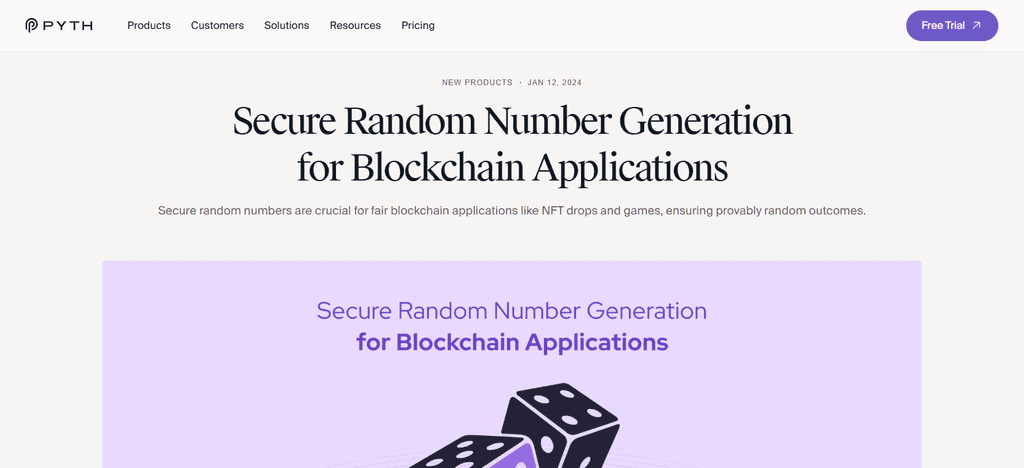
Decentralization, Blockchain Support & Security: Pyth Entropy is designed for low-latency randomness and documentation suggests that results are available within a few blocks. Supports 20+ EVM chains and requires on-chain verification of randomness generated by its protocol. Typical use cases include blockchain games, NFT mints, lotteries and other smart-contract systems that need unpredictable outcomes.
Differentiators**
- Commit-Reveal Architecture – Pyth Entropy uses a commit-and-reveal mechanism to generate randomness rather than a traditional VRF-only architecture.
- Low Latency – It is meant for use cases where randomness needs to be delivered relatively fast.
- Multichain Availability – Pyth Entropy is accessible on multiple EVM-compatible blockchain environments.
- Integration with Pyth Ecosystem – Entropy builds on the broader Pyth infrastructure, allowing developers to leverage an existing oracle ecosystem.
Main Limitations
- Provider Dependency – Applications depend on entropy providers that are part of the system.
- Provider Availability – The randomness delivery can be affected by the provider’s ability to respond to requests within the required time frame.
- Different Verification Model – Its commit-reveal mechanism differs from the direct VRF-proof model that some competing services use.
- Chain Coverage Differentiation – Availability and implementation details may vary across supported networks.
5. VRF Switchboard
Switchboard was founded in 2021 as a decentralized oracle infrastructure project. Its VRF service provides verifiable randomness for intelligent contracts and decentralized applications, especially in ecosystems where Switchboard oracle infrastructure is deployed. The main basis of comparison is a hybrid of decentralized oracle networks with cryptographic randomness verification.
Switchboard is a distributed oracle infrastructure for delivering data and randomness. Applications can cryptographically verify the results. Its ecosystem has been strongly tied to Solana but it has also been branching out into other blockchain environments. For the paragraph, please focus on VRF generation model, oracle operators, supported chains, verification process and gaming/NFT use cases instead of general oracle features.
Differentiating Features
- Robust Solana Ecosystem – Switchboard is well integrated into Solana and offers infrastructure designed for high-performance blockchain applications;
- Decentralized Oracle Network – VRF is part of Switchboard’s larger decentralized oracle network.
- Configurable Oracle Infrastructure – Switchboard’s infrastructure can be leveraged by developers for various types of decentralized data and randomness requirements.
- Web3 Application Focus – Its randomness infrastructure is especially relevant for gaming, NFTs and other applications that require unpredictable outcomes.
Major Limitations
- Ecosystem Concentration – Developers outside its most supported ecosystems should verify available functionality before choosing to use it.
- Dependency on Oracle – Applications depend on the oracle infrastructure of Switchboard to provide randomness.
- Integration Complexity – Implementation can require more configuration than blockchain-native randomness.
- Operational Costs – Network and service related costs can be generated by Oracle based randomness.
6. Witnet Randomness Oracle
Witnet was initially a decentralized oracle protocol, with research starting in 2017. Its Randomness Oracle provides unpredictable randomness to intelligent contracts with a crowd-witnessing commit-and-reveal mechanism. Witnet witnessing nodes randomly choose random byte sequences, commit to them and later reveal them to be deterministically aggregated.
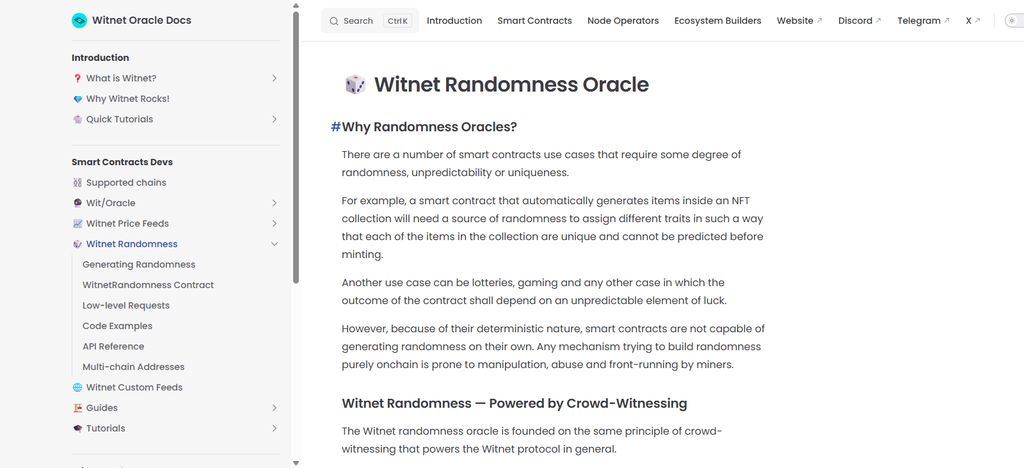
Witnet’s randomness is derived from multiple witnessing nodes, and aggregated into a tamper-resistant result. Its WitnetRandomness contracts are deployed on multiple EVM-compatible networks and L2s. The docs mention 256 bits of randomness and on-chain traceability and verification, with typical requests taking about 5–10 minutes to get into EVM storage.
Key Differentiators
- Decentralized Witnessing – Instead of using a single source, Witnet uses a large number of witnessing nodes to participate in the randomness generation process.
- Commit-and-Reveal Mechanism – Nodes commit to random values before revealing them, to prevent the participants from changing their contribution after seeing others’ contributions.
- EVM Compatibility – Witnet randomness contracts are deployed on most EVM compatible networks.
- On-Chain Verification – One can request randomness and then store it via smart-contract infrastructure.
Major Limitations
- Increased Latency – Creating randomness may take longer than systems designed for near instant delivery.
- Dependence on Network Participation – Security and availability depend on sufficient participation of witnessing nodes.
- Further Integration – Developers need to integrate Witnet’s contracts and request mechanism into their applications.
- Ecosystem Size – In general, its developer and ecosystem footprint is smaller than the major oracle providers like Chainlink.
7. VRF on Oraichain
Oraichain was founded in 2020 and created a decentralized AI focused oracle ecosystem. Its randomness infrastructure provides VRF-based randomization to blockchain applications. The relevant comparison should be the combination of decentralized oracle infrastructure and verifiable randomness rather than a simple general-purpose data-feed oracle.
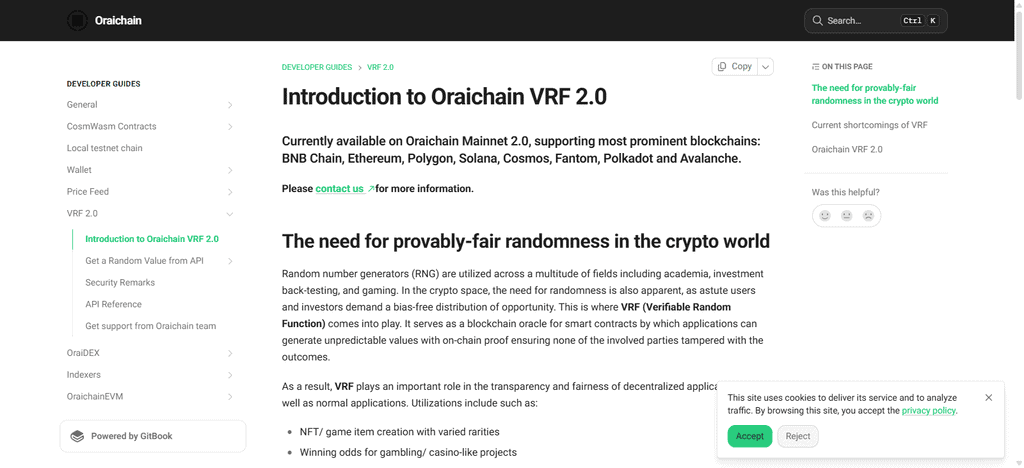
Oraichain relies on decentralized validators and the larger Cosmos-based ecosystem, with its oracle services linking intelligent contracts to external data and computation. In comparing the two, highlight VRF generation, validator participation, cryptographic verification, supported Cosmos/EVM environments and gaming or NFT applications. Do not add unrelated AI-oracle capabilities, except insofar as they relate to the delivery of randomness.
Unique Selling Propositions
- Cosmos-Driven Infrastructure – Oraichain is highly integrated with the Cosmos ecosystem and its interoperable blockchain infrastructure.
- VRF-Based Randomness – Delivers verifiable randomness for apps requiring unpredictable blockchain results.
- Oracle Ecosystem Integration – VRF is integrated with the broader decentralized oracle ecosystem of Oraichain.
- AI-Oriented Ecosystem – Oraichain’s wider ecosystem combines oracle services with AI-related blockchain infrastructure.
Principal Limitations
- Smaller Ecosystem – It has a smaller overall adoption than the leading multichain oracle networks.
- **Chain Coverage ** – Developers should verify the availability of VRF on their respective target blockchain.
- Infrastructural Reliance – Apps are reliant on the infrastructure provided by Oraichain’s oracle and validator.
- Less Mature VRF Adoption – Developer resources and integrations may be less robust compared to those around established VRF platforms.
8. Band Protocol
Band Protocol was founded in 2019 and is a cross-chain data platform, operating BandChain. Current documentation states that VRF is a product that provides provably fair, verifiable and tamper resistant randomness to intelligent contracts. This brings Band VRF into direct relevance when comparing decentralized randomness infrastructure to Supra.
BandChain is a validator-based architecture, where the validators are part of the data services of the network. Band’s VRF solution focuses on the cryptographic verification of the randomness that is generated, while BandChain provides cross chain connectivity. Your paragraph should cover the following points: VRF mechanism, validator model, supported blockchain integrations, verification guaranties and applications such as gaming, NFTs and lotteries.
Key Differentiators
- Validator-based Architecture – The BandChain provides oracle services via a decentralized validator network.
- Cross-Chain Orientation – Band aims to facilitate the connection of blockchain applications to outside data on different networks.
- VRF Capability – Its randomness feature provides verifiable random values to decentralized applications.
- Cosmos-Based BandChain – Instead of only working on smart contract based on a single host chain, BandChain provides a standalone blockchain layer for the oracle operation.
Key Limitations
- Extra Oracle Layer – Applications built on Band’s infrastructure are mandated to supply randomness to the target blockchain.
- Validator Dependency – Service reliability depends on the participation of the validator network.
- Integration Requirements – Developers need to configure Band specific oracle interactions.
- Smaller Developer Footprint – Band’s existing randomness ecosystem is smaller than some larger VRF competitors.
9. Algorand VRF
Algorand was founded in 2019 and incorporates VRF technology directly into its blockchain protocol. Its on-chain randomness beacon uses the same technology behind Algorand’s consensus mechanisms (VRF) to generate cryptographically secure random values. This is what sets Algorand apart from external oracle networks as randomness can be generated and utilized within the Algorand ecosystem.
Algorand’s randomness beacon is trustless, verifiable and unpredictable, and the VRF proofs are verified by the blockchain’s cryptographic infrastructure. The randomness generated can be used in gaming, NFT generation, lotteries and raffles through intelligent contracts on Algorand. Blockchain scope is somewhat narrower than multichain oracle networks like Chainlink or Supra in that it’s primarily an Algorand-native capability.
Main Distinguishers
- Native Randomness –Algorand built in VRF-based randomness into its protocol rather than relying on an external oracle.
- Consensus Integration – Randomness is deeply embedded in the Algorand consensus architecture.
- Low External Dependency – Applications may utilize randomness at the network level without relying on an external oracle operator.
- Cryptographic Verification – VRF proofs introduce verifiable randomness into the Algorand world.
Primary Limitations
- Algorand-Specific – Its biggest drawback is that the native randomness mechanism is designed for the Algorand blockchain.
- Limited Multichain Reach – It doesn’t have the same wide cross-chain oracle model as Supra or Chainlink.
- Migration Constraints – Other networks cannot directly use Algorand’s native randomness without extra infrastructure.
- Ecosystem Lock-in – Developers who pick the solution are stuck with the development environment and tooling of Algorand.
10. Sui Move VRF
Sui launched its own mainnet in 2023 and uses the Move programming language and an object-centric blockchain architecture. Its randomness ability can be better described as Sui On-Chain Randomness than a typical external VRF oracle. Sui provides native randomness support for Move apps, enabling developers to build apps with unpredictable outcomes directly on Sui.
Sui randomness is native to the Sui network, not a multichain oracle service. Its Move framework has specific protections in place to prevent contracts from manipulating or front-running randomness generation, including restrictions around entry functions. Major applications include gaming, randomized NFTs and other Sui-native applications that need unpredictable outcomes.
What sets us apart*
- Native Blockchain Randomness – Sui delivers randomness natively within the protocol, without the need for an external oracle.
- Move Integration – Move is Sui’s Move-based smart-contract environment with particular randomness requirements.
- Protocol Level Security Sui provides limitations to prevent applications from abusing or interfering with randomness.
- Sui-Native Performance Applications can get randomness without an additional oracle layer across chains.
Main Limitations
- Sui-Specific – The biggest limitation is its tie-in with the Sui blockchain and Move ecosystem.
- No cross-chain utility – It is not a generic multichain random oracle.
- Move Dependency – EVM or other ecosystem devs can’t use the same native implementation directly.
- Ecosystem Scope – Its randomness functionality is mostly useful for applications already building within the Sui ecosystem.
Comparison Table: 10 Top Supra Rivals for Decentralized VRF Oracles
| Platform | Randomness Model | Decentralization Model | Blockchain Support | Verification / Security | Main Use Cases |
|---|---|---|---|---|---|
| Chainlink VRF | Verifiable Random Function (VRF) | Decentralized oracle network | Multichain, including Ethereum, Arbitrum, Base, Avalanche, BNB Chain and others | Cryptographic VRF proof verified on-chain | Gaming, NFTs, lotteries, DeFi |
| drand | Distributed randomness beacon | Distributed threshold network | Blockchain-agnostic; API and relay integrations | Threshold BLS signatures and publicly verifiable proofs | Gaming, lotteries, selection, distributed systems |
| API3 QRNG | Quantum-generated randomness | API3 oracle infrastructure | Blockchain integrations through API3 | Quantum randomness with oracle delivery | Gaming, NFTs, lotteries, randomized applications |
| Pyth Entropy | Commit-reveal randomness | Entropy providers/network | 20+ EVM chains | Cryptographic verification and provider commitments | Gaming, NFTs, lotteries, DeFi |
| Switchboard VRF | Verifiable Random Function | Decentralized oracle network | Strong Solana support plus other supported ecosystems | Cryptographic randomness verification | Gaming, NFTs, DeFi |
| Witnet Randomness | Commit-reveal randomness | Decentralized witnessing nodes | Multiple EVM-compatible networks | On-chain randomness contracts and verification | Gaming, NFTs, lotteries |
| Oraichain VRF | VRF-based randomness | Validator/oracle network | Cosmos ecosystem and supported integrations | Cryptographic verification through oracle infrastructure | Gaming, NFTs, randomized applications |
| Band Protocol | VRF/randomness oracle | BandChain validator network | Cross-chain blockchain integrations | Validator-based oracle infrastructure and cryptographic verification | Gaming, NFTs, lotteries |
| Algorand VRF | Protocol-native VRF | Algorand consensus network | Algorand | VRF proofs integrated into protocol-level randomness | Consensus, gaming, NFTs, applications |
| Sui On-Chain Randomness | Blockchain-native randomness | Sui network validators | Sui | Protocol-level randomness protections | Gaming, NFTs, randomized Move applications |
Conclusion
The selection of the best Supra competitors to use as decentralized VRF oracles depends on the application’s blockchain, security requirements, randomness architecture, latency, and developer requirements. Chainlink VRF has broad multichain support, drand and API3 QRNG provide alternative randomness models.
Pyth Entropy, Switchboard, Witnet, Oraichain and Band Protocol each offer a unique approach to oracle-based randomness and cross-chain infrastructure. Algorand and Sui offer blockchain-native randomness adapted to their particular environment.
Each platform has its own advantages and disadvantages, so developers should weigh the verification process, decentralization, network support, integration ease, and use-case fit before choosing a Supra alternative for secure and verifiable on-chain randomness.
FAQ
What are the best alternatives to Supra for decentralized VRF oracles?
Chainlink VRF, drand, API3 QRNG, Pyth Entropy, Switchboard VRF, Witnet, Oraichain, Band Protocol, Algorand, and Sui On-Chain Randomness are notable alternatives, depending on blockchain and randomness requirements.
Is Chainlink VRF similar to Supra VRF?
Yes. Both provide verifiable randomness for blockchain applications, although their oracle architectures, supported networks, integrations, and implementation details differ.
Is drand a traditional VRF oracle?
No. drand is a decentralized randomness beacon rather than a conventional request-based VRF oracle. It uses distributed cryptographic infrastructure to produce publicly verifiable randomness.
What is Pyth Entropy used for?
Pyth Entropy provides verifiable randomness for decentralized applications and uses a commit-and-reveal approach, making it suitable for gaming, NFTs, and other applications requiring unpredictable outcomes.
Which Supra alternatives support blockchain-native randomness?
Algorand and Sui provide protocol-level randomness mechanisms within their respective blockchain ecosystems, reducing reliance on external oracle networks.