
I’ll go over the top cryptocurrency wallets with integrated staking in this post, which let users store their money safely and generate passive income.
These wallets, which range from mobile-friendly choices like Trust Wallet and Phantom to hardware wallets like Trezor Suite, combine security, convenience, and staking capabilities to make it simpler than ever to increase your cryptocurrency holdings effectively and safely.
What is Crypto Wallets?
A digital instrument that enables users to safely store, send, and receive bitcoins is called a crypto wallet. It ensures complete control over funds by holding the private and public keys required to access blockchain assets.
Crypto wallets can be hardware devices for offline security or software-based (desktop or mobile apps). Many current wallets also enable staking, DeFi access, and NFT administration, making them vital for anyone navigating the bitcoin ecosystem.
How To Choose Crypto Wallets with Built-in Staking
Security Features – Look for wallets with military-grade levels of encryption, two-factor authentication, and offline/private key storage. For example, the Trezor Suite is a hardware wallet that provides ultimate security for staked funds.
Supported Cryptocurrencies – Make sure that the wallet of your choosing accepts the coins and tokens that you are looking to stake. Some wallets are narrowly focused on certain ecosystems, such as Phantom and Keplr with Solana and Cosmos respectively.
Ease of Use – Since staking can involve some complex management, a wallet with a simple and intuitive design would be favorable. For instance, mobile wallets, such as the Trust Wallet or Exodus, are designed with beginners in mind and are quite simple to use.
Staking Rewards & Flexibility – It is worthwhile to assess the staking rewards offered by different wallets, as well as the minimum thresholds or maximum lock-up durations they impose. Additionally, some wallets allow for auto-compounding and/or offer the ability to unstake your tokens flexibly.
Compatibility & Integrations – Some wallets provide integrations with DeFi platforms, dApps, and exchanges. If a wallet provides such integrations, it may allow you to stake in a larger number of places and may make managing your staked assets more convenient.
Customer Support & Updates – Actively maintained wallets are often quite good with customer support and often provide step-by-step guides for common issues and for staking.
Reputation & Community Trust – In general, you want to use wallets that have a good reputation in the industry and have positive and trustworthy reviews, especially in the communities that are centered around the wallet.
Key Point & Best Crypto Wallets with Built-in Staking
| Wallet Name | Key Points |
|---|---|
| Trezor Suite (Trezor Wallets) | Hardware wallet offering top security, easy staking integration via third-party apps, supports multiple cryptocurrencies. |
| Trust Wallet | Mobile-friendly, supports a wide range of tokens, in-app staking with competitive rewards, intuitive interface. |
| Exodus Wallet | Desktop & mobile wallet, built-in staking for select coins, user-friendly interface, integrated exchange feature. |
| Atomic Wallet | Supports 500+ cryptocurrencies, decentralized staking, atomic swaps, and private keys stored locally. |
| Coinbase Wallet | Non-custodial wallet, integrates with Coinbase exchange, staking for supported assets, simple and secure interface. |
| Phantom Wallet | Optimized for Solana ecosystem, fast transactions, supports SOL and SPL token staking, browser extension available. |
| Keplr Wallet | Cosmos ecosystem wallet, supports multiple chains, built-in staking and governance voting, user-friendly interface. |
| Guarda Wallet | Multi-platform wallet, supports staking for many cryptocurrencies, private keys locally stored, no KYC required. |
| Binance Wallet (via Binance App) | Integrated with Binance ecosystem, easy staking of multiple assets, high liquidity, rewards auto-compounded. |
| MetaMask (with Staking Integrations) | Popular Ethereum wallet, staking through DeFi integrations, browser extension & mobile app, highly versatile. |
1. Trezor Suite (Trezor Wallets)
Trezor Suite is the flagship software of Trezor hardware wallets, and the Suite is praised for its security features. Being a hardware wallet means that it keeps private keys offline, while users are able to stake some cryptocurrencies using third-party services.
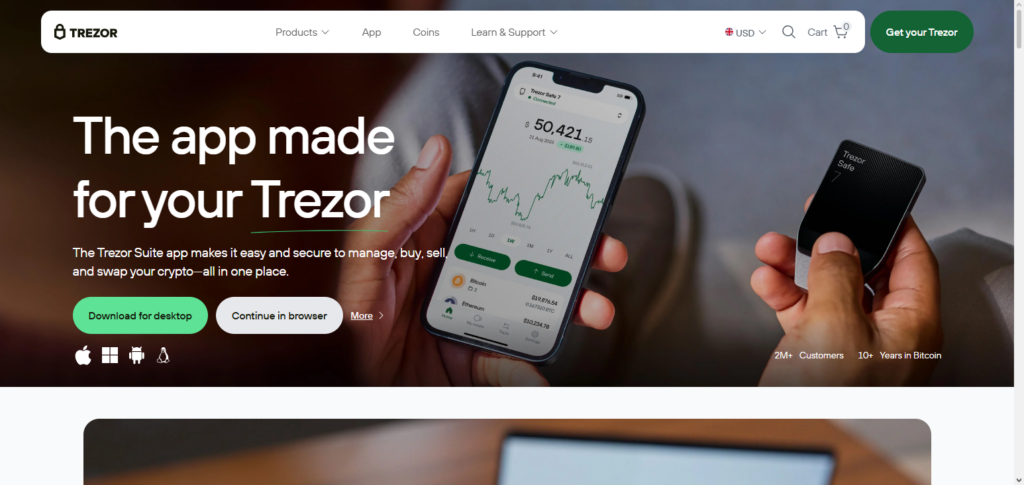
Trezor Suite supports Bitcoin, Ethereum, and other altcoins. It offers users a simple interface so that even beginners may feel comfortable using it. Users can view their portfolios and stake pods without compromising their security. Trezor Suite is one of the best crypto wallets with built-in staking due to its backup and recovery options, making it reliable for long-term investors.
Trezor Suite (Trezor Wallets) Features, Pros & Cons
Features:
- Trezor offers a hardware wallet with the option for offline key storage.
- Trezor supports a multitude of cryptocurrencies
- Trezor supports the user with features that help them with management of their portfolio and keeps record of their transactions.
- Integrated staking, courtesy of a trusted third party.
- Trezor offers options for backup and recovery that they claim are secure.
Pros:
- Trezor is very secure as they provide storage options that are completely offline.
- Trezor offers third party integrations for staking, which is a nice feature.
- Trezor has an interface that is very easy to use and is good for beginners.
- Trezor offers the user a multitude of currencies for them to work with.
- Trezor offers a useful recovery system.
Cons:
- Trezor is a service that is not completely free and requires the user to purchase a hardware device.
- Trezor has third party apps that they have to work with in order for them to provide their users with staking, so it is not native.
- The functionality available on mobile devices is limited.
- Trezor is higher in cost than the software wallets.
- The user has to work with the service and deal with their firmware updates.
2. Trust Wallet
Trust Wallet has gained huge popularity among crypto holders. The wallet supports thousands of crypto holders and has so many features being a mobile wallet like being user friendly. Trust Wallet has built in features like staking, which allows users to earn passive rewards by holding certain coins like BNB, TRX, and ADA. Coins can be staked directly in the wallet app.
Other than earning rewards, users can store private keys which means they fully own their assets and crypto. Trust Wallet allows access to crypto buyers all around the world and without a doubt is among the best staking wallets.
Trust Wallet Features, Pros & Cons
Features:
- Trust Wallet has a mobile-based wallet that is available for the use on both iOS and Android.
- Trust Wallet is able to support thousands of cryptocurrencies.
- Trust Wallet has built-in support for staking for the more popular coins.
- Trust Wallet has the option to integrate with dApp and DeFi.
- Trust Wallet has the option for in-app crypto exchange.
Pros:
- The interface Trust Wallet has for mobile use is nice as it is very user-friendly.
- Trust Wallet provides staking in a large range of options which is good.
- The private keys that the user has are stored on their device which is good as they are not in the hands of others.
- The application also provides support in many different languages.
- The user gains access to the DeFi services that are available.
Cons:
- Trust Wallet has the unfortunate disadvantage of not having a desktop version of the service, it is mobile-only.
- The user has to provide their own device security as this is a mobile-only software.
- The company that provides Trust Wallet has multiple coins available for staking, and they also have coins that are no available for staking, and that contributes to the risks.
- Trust Wallet does not provide support for the customers over the phone, which is a disadvantage.
3. Exodus Wallet
Exodus Wallet is ideal for novices because it combines desktop and mobile capabilities with an eye-catching UI. For some coins, such as ADA, DOT, and ATOM, the wallet has built-in staking, which enables users to generate passive revenue right within the app. Exodus places a strong emphasis on security by offering recovery alternatives and locally storing private keys.
Users can easily exchange bitcoins without ever leaving the wallet thanks to its integrated exchange feature. Exodus Wallet is among the top cryptocurrency wallets with integrated staking for practical, all-in-one cryptocurrency management because of its attractiveness, usability, and staking features.
Exodus Wallet Features, Pros & Cons
Features:
- Wallet for both desktop and mobile.
- Supports various digital currencies
- Automatic staking for some cryptocurrencies
- Built-in cryptocurrency trades
- Market analytics and portfolio management
Pros:
- Stunning and easy to use
- Swapping and staking are simple
- Syncs to all devices
- Private keys are stored locally
- Good for newcomers
Cons:
- Staking coins are limited
- No integrated hardware wallet
- High fees for exchanging coins
- Some parts are closed-source
- Few enhanced security options
4. Atomic Wallet
One of the most trustworthy wallets, Atomic Wallet, is one of the first wallets to implement state of the art technology, where everyone has access to everything, including the private keys to your wallet, meaning that you are the only one in control of your assets. You can stake more than 500 cryptocurrencies, including ATOM, Tezos, and ZIL.
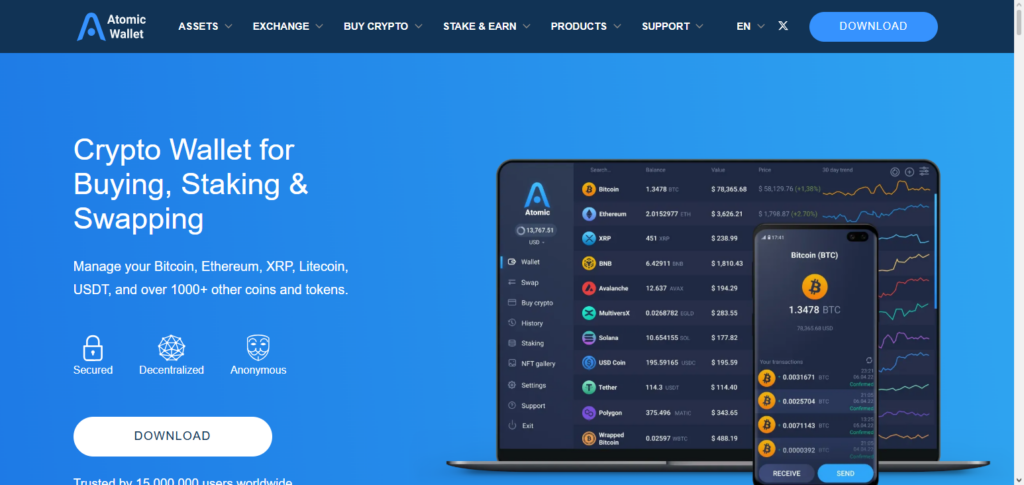
You are also able to perform atomic swaps, where you can trade assets to other wallets without the assistance of a third party. One of Atomic Wallet’s biggest advantages is that it is available on all devices. In addition to the wallet’s various other features, it also remains one of the best crypto wallets with built-in staking due to the fact that it has a very broad staking support.
Atomic Wallet Features, Pros & Cons
Features:
- Supports over 500 cryptocurrencies
- Built-in staking for select coins
- Atomic swaps for peer-to-peer exchanges
- Mobile and Desktop apps
- Private keys stored locally
Pros:
- Can be used anonymously
- Supports lots of crypto
- Staking for more than 1 coin
- High usability
- Customers can make exchanges among themselves
Cons:
- Competitors may pay more for staking
- No integrated hardware wallet
- Software may need to be updated
- Desktop apps are heavier and run slower
- Support staff can take a long time
5. Coinbase Wallet
Coinbase Wallet is a user-controlled non-custodial wallet that is connected to the well-known Coinbase exchange. Users may easily receive rewards because to its built-in staking capabilities for assets like Ethereum 2.0. The wallet gives users access to dApps and NFTs while safely storing private keys on the device.
It retains sophisticated capabilities for seasoned users while being user-friendly for beginners thanks to its straightforward interface and mobile-first design. Coinbase Wallet stands out as one of the greatest cryptocurrency wallets with integrated staking, ideal for both casual holders and active users, thanks to its unique blend of security, accessibility, and staking features.
Coinbase Wallet Features, Pros & Cons
Features:
- Wallet is non-custodial and linked to Coinbase.
- staking of Ethereum 2.0
- non-fungible tokens and decentralized apps access
- Mobile interface is focused
- Private keys stored securely
Pros:
- Ideal for novice cryptocurrency users
- Wallet and exchange are both reliable and secure
- simple to earn cryptocurrency by offering to stake coins.
- Integrates with Coinbase exchange
- Mobile-ready design
Cons:
- Fewer staking cryptocurrencies
- Needs Coinbase ecosystem for maximum profit
- No desktop version
- Less autonomy than fully self-custodial wallets
- Basic functions
6. Phantom Wallet
Phantom Wallet is a stellar example of a wallet that has been built natively for the Solana blockchain. Since the Solana blockchain provides users with fast blockchain speeds and low cost transactions, users of the Phantom Wallet will be able to enjoy the same experience. Users can stake SOL and SPL tokens and rack up rewards just by using the app, no need to leave it. Phantom Wallet also supports NFTs and a variety of DeFi services.
They have a browser extension that allows users to directly interact with Solana dApps. Users also control their private keys and Phantom Wallet does not have access to them. Phantom Wallet is a quality and straightforward wallet that has integrated staking features. Users of the Solana ecosystem will be able to enjoy it even more with the rewards.
Phantom Wallet Features, Pros & Cons
Features:
- Mobile wallet + browser extension
- Solana blockchain specific
- Offers staking for SOL + all SPL tokens
- Comes equipped for NFTs + DeFi
- Transactions with fast and low cost
Pros:
- Very good for Solana
- Staking + rewards built in
- Easy to use design
- dApp support + NFTs
- Transactions are fast
Cons:
- Just Solana ecosystem support
- Fewer desktop features than mobile
- Some features need browser
- Supports few chains
- Staking rewards are dependent on which validator you have
7. Keplr Wallet
Keplr Wallet supports several chains, including Cosmos, Osmosis, and Akash, and is built for the Cosmos ecosystem. It enables users can take part in governance voting by staking coins right within the wallet. Keplr Wallet connects to numerous dApps via its browser extension and safely keeps private keys on the device.
Users may track the performance of their portfolios, manage several accounts, and use staking to generate passive income. Keplr Wallet is regarded as one of the top cryptocurrency wallets with integrated staking for users involved in the Cosmos ecosystem because of its chain interoperability, governance features, and staking support.
Keplr Wallet Features, Pros & Cons
Features:
- Wallet for Cosmos ecosystem
- Supports multipi-chains
- Comes with built in staking + governance voting
- Offers mobile + browser extension
- Portfolio management options
Pros:
- Single wallet for all chains staking
- Governance voting is included
- Private key storage is secure
- Good for Cosmos ecosystem
- Availability on mobile and desktop
Cons:
- Cosmos ecosystem is primary focus
- More advanced features
- Limited options for NFTs
- Limited options on popular coins* Certain features require a browser extension
8. Guarda Wallet
Guarda Wallet is a multi-platform wallet with web, mobile, and desktop versions. It enables users to generate passive revenue without moving money elsewhere by supporting staking for a variety of cryptocurrencies, such as Tezos, Tron, and Cosmos. User control over assets is ensured via the local storage of private keys.
Additionally, the wallet has a user-friendly design, portfolio tracking, and an integrated exchange. Its combination of staking support, security, and accessibility across devices makes Guarda Wallet one of the finest crypto wallets with built-in staking, suitable for investors wanting both adaptability and reliable profits.
Guarda Wallet Features, Pros & Cons
Features:
- Available on multiple platforms: desktop, web, and mobile
- Supports a wide range of staking coins
- Has a built-in exchange
- You control your private keys
- Tracks your portfolio
Pros:
- Offers a wide range of staking support
- Accessible on numerous platforms
- You control your private keys
- Easy to use for beginners
- Basic use of the wallet does not require KYC
Cons:
- Varying rewards per coin
- Web version has restricted features
- Lacks a proprietary hardware wallet
- Staking can be a bit complicated
- Not completely open-source
9. Binance Wallet (via Binance App)
Users can stake several cryptocurrencies within the Binance ecosystem by using the Binance Wallet, which is available via the Binance App. The app offers high liquidity for simple entrance and exit from staking positions, and rewards are automatically compounded. Binance’s security measures, including as cold storage and two-factor authentication, are advantageous to users.
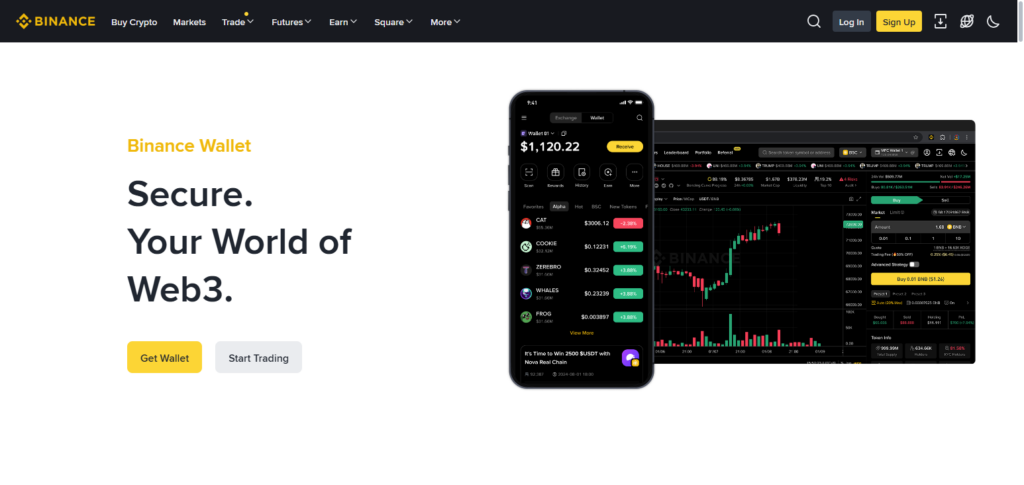
The wallet offers a comprehensive set of financial capabilities by integrating with Binance Earn, DeFi, and NFT features. The Binance Wallet is one of the top cryptocurrency wallets with integrated staking, making it ideal for frequent users due to its ease of use, wide range of staking choices, and strong security.
Binance Wallet (via Binance App) Features, Pros & Cons
Features:
- Used within the entire Binance ecosystem
- Staking available for many cryptocurrencies
- Rewards auto compound
- Offers access to DeFi, NFTs, and Binance Earn
- Web and mobile app available
Pros:
- Offers a large selection for staking
- High speed and instant transactions
- Rewards auto compound
- Complete ecosystem access (DeFi, NFTs, trading, etc.)
- Wallet is secured with 2FA and cold storage
Cons:
- You’ll lose control of your keys (custodial wallet)
- You have less control than you would with a non-custodial wallet
- Limited to the Binance platform
- Full usage may include KYC
- Limited privacy features
10. MetaMask (with Staking Integrations)
The most widely used Ethereum-based wallet is MetaMask, which is accessible as a mobile app and browser plugin. Although it doesn’t provide native staking, users can stake ETH and other tokens thanks to its smooth integration with DeFi systems.
Ethereum, Polygon, and Binance Smart Chain are just a few of the networks that MetaMask supports. Private keys are kept locally. It is a versatile tool for managing cryptocurrency because of its adaptability, widespread use, and interoperability with dApps. For DeFi aficionados looking for control and earning chances, MetaMask is regarded as one of the best cryptocurrency wallets with integrated staking and multi-chain functionality.
MetaMask (with Staking Integrations) Features, Pros & Cons
Features:
- Available on mobile and as a browser extension
- Supports multiple chains and Ethereum
- Integrations for staking in DeFi
- Capability for NFTs and dApps
- Key storage in private, local format
Pros:
- Great flexibility and high adoption
- Integrates with DeFi staking services
- Supports multiple chains / wallets
- Simple integration for NFTs and dApps
- Custody over private keys
Cons:
- No integrated staking, relies on DeFi services
- Complexity of DeFi may intimidate novice users
- Phishing risks for the browser extension
- Network dependent fees
- Mobile UI is feature sparse
Conclusion
In conclusion, choosing the appropriate wallet is vital for safely maintaining your crypto while optimizing benefits through staking. The wallets that are highlighted—Trezor Suite, Trust Wallet, Exodus, Atomic Wallet, Coinbase Wallet, Phantom, Keplr, Guarda, Binance Wallet, and MetaMask—offer a combination of built-in staking tools, security, and usability.
There is a solution for every kind of investor, whether you favor mobile-friendly solutions like Trust Wallet and Phantom, flexible DeFi-compatible wallets like MetaMask, or hardware wallets like Trezor for the highest level of security. Growing your cryptocurrency assets safely is now simpler than ever thanks to these wallets, which are the best since they have built-in staking.
FAQ
What is a crypto wallet with built-in staking?
A crypto wallet with built-in staking allows users to earn rewards by locking or delegating their cryptocurrencies directly within the wallet. These wallets handle staking without requiring external platforms, providing convenience and security while generating passive income.
Which wallets are considered the best for staking?
The top wallets include Trezor Suite, Trust Wallet, Exodus, Atomic Wallet, Coinbase Wallet, Phantom, Keplr, Guarda, Binance Wallet, and MetaMask (with staking integrations). They combine security, usability, and support for multiple cryptocurrencies.
Are hardware wallets safe for staking?
Yes. Hardware wallets like Trezor Suite keep private keys offline, making them highly secure. Staking via trusted integrations ensures rewards without compromising asset safety.
Can I stake multiple cryptocurrencies in one wallet?
Yes. Wallets like Atomic Wallet, Trust Wallet, and Guarda allow staking for several coins simultaneously, including ADA, DOT, ATOM, SOL, and TRX, offering diversified passive income options.
Do I need to lock my crypto for staking?
It depends on the wallet and blockchain. Some wallets (e.g., Coinbase Wallet, Binance Wallet) allow flexible staking with easy withdrawals, while others may require a minimum lock-up period.