

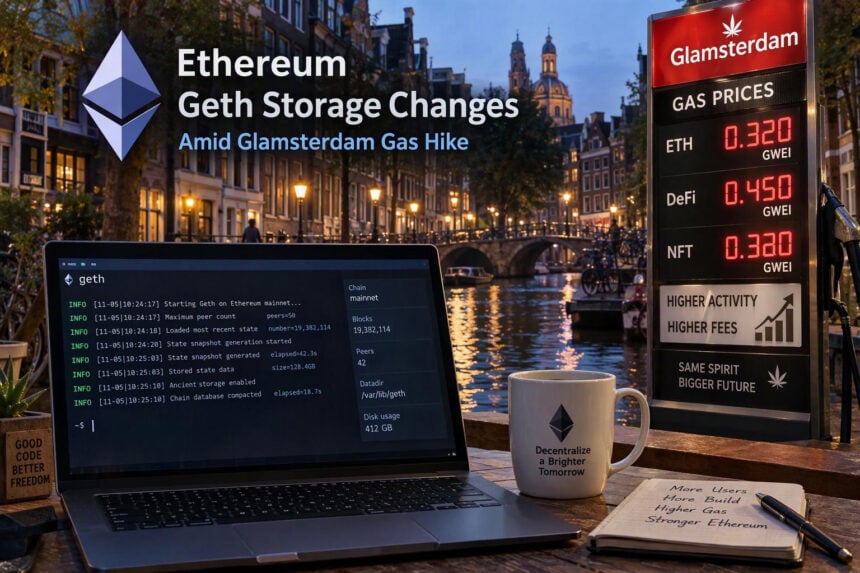
Glamsterdam Gas Costs Lead Ethereum Geth Developer to Propose Storage Changes
Developers of the Ethereum blockchain are looking to improve storage processing on the blockchain, as new tests of the Glamsterdam upgrade raise concerns about higher gas consumption. On November 24, a Geth developer proposed changes to speed up storage reconstruction via parallel processing.
In a separate report, one Optimism contributor said the dispute-game transactions consumed about 4.4 to 4.6 times more gas under Glamsterdam test rules than the previous Osaka rules. The findings have re-ignited debate around Ethereum’s storage efficiency, transaction fees and upgradeability.
Ethereum Geth dev proposes speeding up blockchain storage processing
Ethereum Geth developer rjl493456442 has proposed improvements to how the execution client deals with large storage structures on chain. The proposal filed in GitHub pull request #36213 on November 24 aims to reduce processing delays when creating large storage structures.
The proposed method partitions large storage structures into smaller parts based on a slot-hash prefix to be processed in parallel. This would enable multiple available workers to process different parts simultaneously and maybe speed up the rebuilding of the Ethereum blockchain state from stored snapshots.
The developer suggested a limit of 24 workers for account and storage processing. This can increase the utilization of resources and reduce the time taken for storage related operations.
But the proposal is still in the early stages of development. The developer wanted to see the benchmark results before taking the changes forward through the review process. An automated code review also flagged potential disk pressure issues and changes to cancellation-error handling.
The pull request is still waiting for review by code owner gballet and GitHub shows the proposed changes have not been deployed.
Ethereum Dispute-Game Gas Costs Rise, As Per Glamsterdam Upgrade Tests
In another post, Optimism contributor conr2d reported higher gas consumption during Glamsterdam testing. November 24 GitHub report compared four Sepolia transactions with local replays using the old Osaka rules.
There were two transactions with especially notable differences:
- Super Fault DisputeGame: Glamsterdam used 2,455,999 gas compared to 532,891 gas for Osaka.
Permissioned DisputeGame: used 2,103,594 gas vs. 456,482 gas on Osaka.
For the four sampled transactions, gas consumption increased by approximately 4.4 to 4.6 times. But the contributor cautioned that the comparison could be skewed by differences in blockchain state.
The report also found that state-related charges made up about 86% to 88% of the sample’s transaction gas consumption. The contributor tied these costs to EIP-8037, but could not isolate its impact.
The adoption of EIP-8037 will be an important topic in upcoming Ethereum upgrade discussions, as the proposal suggests increasing fees for some account storage and creation operations.
Optimism contributor questions Glamsterdam Dispute-Game Bonds
The Optimism contributor also investigated whether the transaction costs would need to be adjusted in line with Glamsterdam’s proposed gas rules for existing dispute-game bonds.
The sampled dispute-game moves consumed about 976,000 gas, as opposed to about 254,000 gas in Osaka replays. The report examined seven dispute-game factories, with root bonds of 0.08 ETH.
At a gas price of 200 gwei, these bonds represented about 41% of the transaction cost of a single Glamsterdam reply. However, the gas price on the Ethereum mainnet ranged between 0.08 gwei and 8.3 gwei and there was no bond shortfall for the contributor at those prices.
The report also pointed out a possible storage tweak that could cut gas costs for select game creation by around 4% to 4.7%. There were no patched-build measurements, and the issue was left unassigned with no pull request attached to it.
Ethereum’s Glamsterdam Upgrade Boosts Storage Efficiency, Sparks Questions on Gas Costs
Recent Geth and Optimism news brings two key technical considerations to Ethereum’s Glamsterdam upgrade: how to improve blockchain storage processing and the financial impact of increased state-related gas charges.
The proposed changes to Geth might improve the efficiency of snapshot-based state reconstruction, but the actual performance gains will still need to be benchmarked and reviewed by developers. But that dispute-game work from Optimism suggests current transaction costs and bond structures may warrant a second look.
Ethereum (ETH) was trading at $1,695, down 5.13% in the last 24 hours at press time. The proposals and testing reports are still preliminary, and further measurements will be important in deciding their wider impact on Ethereum’s network performance and upgrade readiness.