

Crypto business accounts are becoming instrumental for firms dealing with international finance. Crypto accounts make it easy for firms to handle treasuries in multiple currencies and types of crypto (BTC, ETH, Stablecoins ) as well as in traditional currencies. Business-focused accounts from Zengo Business, Coinbase Prime, and Binance Institutional provide precisely what startups, merchants, and businesses require. Expense accounts designed for corporate use and Web3 with easy to use APIs and crypto assets that can be shared among multiple users will change how businesses interact with the world of Web3 and beyond.
What Is a Crypto Business Account?
Crypto business accounts resemble a corporate bank account but for digital assets accounts. Digital asset business accounts let firms accept, make, and manage crypto payments and even make payroll. These accounts may facilitate faster and cheaper transactions than traditional accounts.
Many providers offer custodial accounts (where the provider retains the private keys) or non-custodial accounts (where the business retains the private keys) along with various corporate crypto cards, APIs, and other compliance-related tools. For merchants and firms in the Web3, global trade, and fintech ecosystems, crypto business accounts are a vital component of their crypto operations.
Why Companies Are Adopting Crypto Business Accounts in 2026
Global Payments
Companies can use direct country-to-country transfer methods to quickly, clearly, and cheaply pay any of their worldwide partners, employees, and suppliers and reduce their reliance on traditional banks.

Lower Fees
There are far fewer fees associated with converting and transacting with crypto accounts than with traditional accounts. Wire transfers and credit card transactions are some of the many expense examples eliminated.
Treasury Diversification
Crypto accounts help companies diversify their balances with crypto, such as Bitcoin and stable coins, in order to offset some of the negative impact of currency and geopolitical fluctuations.
Merchant Acceptance
Using crypto accounts allows companies to accept global customer payments, “instant cash” stablecoin or Bitcoin payments, to broaden their customer base beyond national borders.
Compliance Tools
Companies are able to safely handle their digital assets across many lands and jurisdictions with crypto accounts thanks to the automated compliance features built into digital asset accounts.
Corporate APIs
Seamless integration of crypto into enterprise workflows helps reduce manual errors and allows companies to use automated payroll, treasury management, and transaction tools.
Innovation & Branding
In the rapidly evolving world of DeFi and blockchain tech, innovative companies adopting crypto accounts for their business gain an immediate edge with new value to attract customers and investors.
Key Point
| Provider | Key Feature |
|---|---|
| Zengo Business | MPC wallet, seedless, multi-user governance |
| Coinbase Prime | NYDFS-regulated custody, deep liquidity |
| Binance Institutional | Largest liquidity pool, advanced infra |
| Kraken Business | SOC audits, strong track record |
| Gemini Business | SOC-certified, NYDFS trust charter |
| Mercury | FDIC-insured fiat + crypto-friendly |
| BitPay | Merchant processor, instant fiat conversion |
| Crypto.com Business | Debit card services, staking |
| OKX Institutional | Advanced trading tools, global reach |
| Bitstamp Corporate | Oldest exchange, user-friendly fees |
1. Zengo Business
Zengo Business is a novel, enterprise-focused, non-custodial, MPC wallet. Expect no monthly or annual fees, just predictable flat transaction costs with no Hidden costs! While crypto swaps incur ~0.5%, ramping USD and EUR fiat is offered seamlessly with IBAN integration. Withdrawal costs are reduced to the cost of network gas.
Zengo Business supports thousands of crypto assets, fiat (USD and EUR), and offers services internationally with a strong focus in Europe, the US, and Asia. Zengo Business is customizable, offers tiered approvals, and is ideal for DAOs and Start-ups needing non-custodial treasury services.
Pros
- Self-custody with MPC security. No seeds, no risk
- Governance options for teams and DAOs
- Globally available with wide crypto coverage
- No monthly or annual fees
Cons
- Limited fiats (mostly USD and EUR)
- No direct institutional-grade custody
- Network withdrawal fees can be inc
Best For: Self-custody Treasury management for the secure people for Startups, DAOs, and Enterprises.
Rating: ⭐⭐⭐⭐☆ (4.5/5) – Security is great, but limited fiat.
2. Coinbase Prime
Coinbase Prime is a regulated custodial platform for enterprise use. There is no monthly subscription, but fees are based on volume (Spot services incur costs of ~0.1–0.5%). Custodial fees are incurred for larger assets held. Withdrawal costs are low with fiat (ACH free, wires ~$25), and there is a cost for crypto.

Coinbase Prime offers over 250 Crypto assets and fiat USD, EUR, and GBP. Limited in the US, Europe (MiCA license), and Asia Pacific, it is designed for hedge funds and enterprise treasury services. Coinbase Prime offers a suite of corporate services with deep liquidity and offers qualified custody.
Pros
- Regulated custody under NYDFS
- Deep liquidity and OTC desk
- Great compliance and reporting
- 250 cryptocurrencies supported
Cons
- Custody fees for larger assets
- Higher trading fees when compared to Binance/OKX
- Limited support outside US/EU
- Withdrawal fees for wires (~$25)
Best For: Deep liquidity and custody for compliant businesses.
Rating: ⭐⭐⭐⭐☆ (4.6/5) – Compliance is good, and fees are higher.
3. Binance Institutional
The Binance platform offers tiered VIP accounts. Monthly fees are not required. At VIP level 9, trading fees are 0.0077% and even lower at the higher tiers. Withdrawal fees are determined by the particular blockchain. Binance offers 2000+ trading pairs. Binance offers trading pairs with BTC, ETH, BNB, stablecoins, and altcoins.
Fiat trading pairs are offered with over 100 currencies including USD, EUR and INR. Binance is available across the globe with the exception of some trading in the USA. As accounts are upgraded to higher levels, higher API thresholds and exposure limits are allowed.
Tiered accounts are catered to corporations and include OTC desks and account managers. Advanced traders who require liquidity will find API trading and other features offered by Binance useful.
Pros
- Largest liquidity pool
- Tiered VIP fee discounts for trading volume
- Great trading and API solutions
- Institutional staking and tools
Cons
- Many restrictions in the US and some other jurisdictions
- Fees can be complicated
- Counterparty risk for custody
Best For: Global liquidity for top-tier funds and high-volume trading.
Rating: ⭐⭐⭐⭐☆ (4.4/5) – Liquidity is best, and lower scores due to regulation.
4. Kraken Business
With Kraken Business, monthly fees do not exist. The trading fees are approximately 0.16% maker or 0.26% taker and decrease based on total trading volume. Withdrawal fees depend on the available fiat (i.e. USD Wire ~5). Kraken supports more than 200 cryptos like BTC, ETH, DOT, and includes stablecoins.
Available fiat currencies are USD, EUR, GBP, and AUD. Offered in the US, the EU, Asia, and Australia. Transaction limits are higher compared to personal accounts and are customizable; it provides an OTC desk for trades over $100k.
Business accounts include more features like multi-user permissions, advanced API, and support for margin and futures trading and staking rewards. Best for funds and corporates needing compliance along with OTC execution and treasury management.
Pros
- Great security
- Transparency with fees
- Great fiat support (USD, EUR, GBP, AUD)
- Large trade OTC desk
Cons
- Higher than Binance for trading
- Limited corporate card options
- Fiat wire withdrawal fees
- Smaller crypto selection than Binance
Best For: Offering OTC and fiat support for the compliance-driven corporate.
Rating: ⭐⭐⭐⭐☆ (4.3/5) – Secure and clear, but fewer pairs offered.
5. Gemini Business
Gemini Business provides enterprise custody along with trading. No monthly fees apply, but trading costs ~0.35% taker. Custody fees will also apply, and withdrawal costs vary by asset. Gemini supports over 100 cryptos, including BTC, ETH, GUSD, and stablecoins. Available fiat currencies are USD, EUR, GBP. Gemini operates in the US, EU, and Asia.

Gemini’s regulated under a NYDFS trust charter, and high transaction limits are offered. Includes multi-user governance and SOC-certified compliance. Features also include API integrations, customizable reports, and institutional custody. Best for businesses with high compliance and custody needs and who require trading with a regulated platform and audits.
Pros
- Compliant with trust charter from the NYDFS
- SOC custody certified
- Audits and reporting with no fee
- Multi-user governance
Cons
- Highest trading fees (~0.35%).
- Limited crypto support (~100+).
- Limited global availability when compared to Binance.
- Custody fees for institutional storage.
Best For: All institutions prioritizing regulated custody and audits.
Rating: ⭐⭐⭐⭐☆ (4.2/5) – Compliance is great, but limited reach.
6. Mercury
Mercury is a bank that offers financial technology solutions to startups. They charge no monthly fees and keep bank balances insured by the FDIC to $5 million with no additional fees. They do not offer direct crypto transactions, but do offer seamless wires to cryptocurrency banking solutions, such as Coinbase Prime or Anchorage. ACH and standard wires come with no withdrawal fees.

They only support USD with no international bank transfers, and crypto is only accessible through partnered networks. They only support banking within the US. Clients have access to generous transaction limits and treasury yields of 5% APY. While Mercury is a banking solution for startups, they do provide physical cards and API access, in addition to a banking solution for QuickBooks.
Pros
- FDIC-insured accounts.
- Easy to use Coinbase Prime.
- No monthly fees, free ACH/wires.
- API banking & debit cards.
Cons
- Only available in the US.
- No crypto trading.
- No support for fiat apart from USD.
- Dependent on partner exchanges for crypto.
Best For: U.S. Startups desiring a banking solution with crypto.
Rating: ⭐⭐⭐⭐ (4.0/5) – Great for U.S. founders, but no direct trading.
7. BitPay
BitPay is a tiered fee payment processor that assesses a fee of 2% + $0.25 per transaction. The transaction fee goes down to 1% for businesses that exceed $1 million in monthly transactions. There are no monthly fees, but withdrawal fees depend on the rails for fiatic settlement. There is a more favorable fee structure for larger businesses.
BitPay processes over 15 cryptocurrencies and offers the settlement of USD, MXN, AUD, EUR, and GBP, as well as DOGE, XRP, ETH, BTC, and stablecoins. Available in the US, EU, and the Rest of the World (ROW). Some features include crypto debit card payouts, staff permissions, and merchant invoicing. BitPay is great for merchants who value the processing of cryptocurrency with the instant settlement of fiat.
Pros
- Simple way to accept crypto payments.
- Merchants can receive instant fiat.
- Supports 15+ cryptocurrencies.
- Merchants can be located anywhere in the world.
Cons
- Crypto payments are limited when compared to exchanges.
- Merchant Fees (1–2%) can be significant.
- No sophisticated trading tools.
- Reliant on fiat settlement rails.
Best For: Merchants wanting crypto payments with fiat trades.
Rating: ⭐⭐⭐⭐ (4.1/5) – Great for payments, but trading is limited.
8. Crypto.com
Crypto.com Business provides a payment processor and an exchange all within the same ecosystem. The monthly fees are absent, but trading as well as withdrawal fees are subject to rates established by the blockchain.
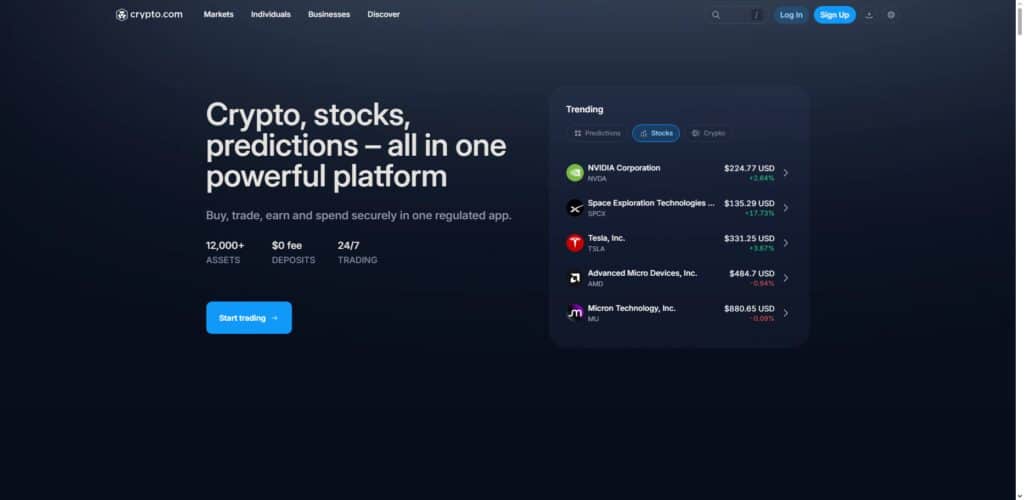
Crypto.com supports a large number of cryptocurrencies (400+) with a focus on stablecoins as well as BTC, ETH, CRO and offers fiat settlement in EUR, GBP, and USD.
The system is designed to support large transactions, offers API access, and corporate cards. Some features include staking and an integrated NFT marketplace. Crypto.com is great for businesses that need integrated trading and payment services.
Pros
- Supports 400+ cryptocurrencies.
- Visa corporate cards available.
- Merchant payment solutions.
- Staking and NFT marketplace.
Cons
- Staking CRO is required to get the best fees.
- Withdrawal fees vary by chain.
- Staking CRO is required to get the best fees.
- New businesses can find it hard to navigate the ecosystem.
Best For: Businesses wanting payments, cards, and trading.
Rating: ⭐⭐⭐⭐ (4.2/5) – Great for business, and CRO staking needed for best fees.
9. OKX Institutional
Providing deep institutional liquidity, OKX Institutional has no monthly fees and low trading fees (~0.02-0.05%). Withdrawal fees are blockchain-dependent. Offers 700+ trading pairs with BTC and ETH along with multiple options for stablecoin and fiat pairs. Supports fiat currencies of the USD, EUR, GBP, and HKD.
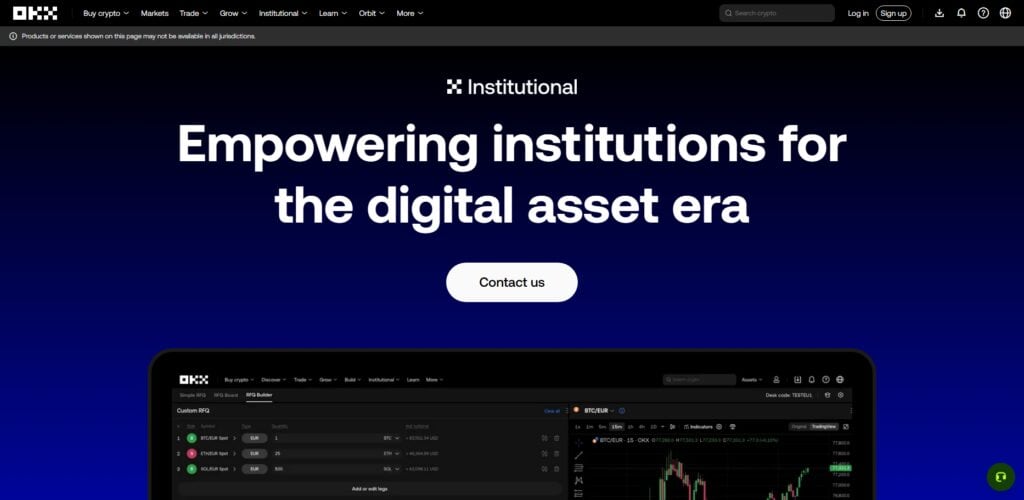
Has trading partners globally, focused on Asia and Europe. Transaction limits are high and designed for institutional trading desks. Offers portfolio margin, an OTC desk, Nitro spreads, API trading, and custody solutions with Standard Chartered. Offers liquidity and risk management solutions for trading desks of hedge funds.
Pros
- Low trading fees (~0.02–0.05%).
- 700+ trading pairs.
- Good liquidity & OTC desk.
- Custody partnerships with banks.
Cons
- Regulatory uncertainty in US/EU.
- Advanced tools for enterprises but simple trading for everyone.
- Withdrawal fees may apply (vary by chain).
- Limited support for fiat when compared to Binance.
Best For: Funds and corporates looking for sophisticated trading and custody solutions.
Rating: ⭐⭐⭐⭐☆ (4.4/5) – Good liquidity, bad regulation.
10. Bitstamp Corporate
Bitstamp Corporate is an exchange with a legacy system. Trading fees are 0.5% with no monthly fees and a volume-dependent withdrawal fee. Offers 80+ cryptocurrencies with fiat rails of USD, EUR, and GBP. Bitstamp Corporate is licensed under MiCA and offers services to the EU, US, and Singapore.
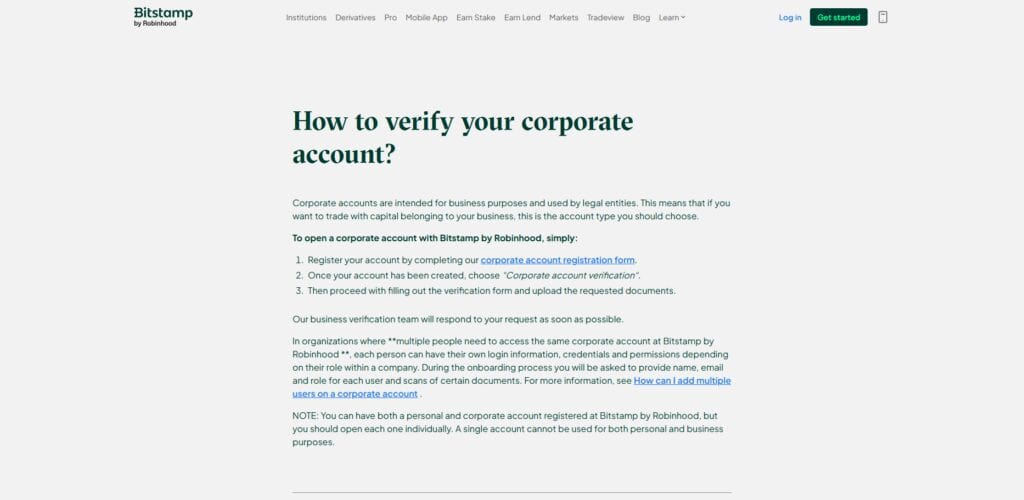
Transaction limits are high, and trade directly with OTC desks. Offers modular trading systems and APIs to integrate with the institutional infrastructure. Corporate features include Bitstamp-as-a-Service, compliance reporting, and a dedicated account manager. Offers a regulated system for trading fiat currencies with low latency.
Pros
- Oldest regulated exchange (legacy trust).
- Compliant with MiCA in the EU.
- Simple and clear fees.
- Dedicated account managers.
Cons
- Increased base trading fees (0.5%).
- Restricted crypto options (~80+).
- Restricted corporate card availability.
- Stagnant innovation in comparison to other exchanges.
Best For: Corporates looking for legacy trust and MiCA-compliant fiat solutions.
Rating: ⭐⭐⭐⭐ (4.0/5) – Good, but expensive with limited assets.
Security and Compliance Checklist Before Choosing a Crypto Business Account
Regulatory Licensing: Make sure the provider has the appropriate licenses (for example, NYDFS, MiCA, and FCA) and obeys the regulations in their country to avoid potential legal issues and account closures.
Custody Model: Assess if the account is custodial (provider controls keys) or non-custodial (you control keys). Self-custody is less risky, but it is important to have strong internal governance.
KYC/AML Standards: Having an appropriate Know Your Customer (KYC) and Anti-Money Laundering (AML) process helps to fulfill compliance obligations and reduces the risk of losses from fraud.
Insurance Coverage: Determine if assets are covered by insurance for loss due to theft, hacks, and loss of custody. Some providers offer FDIC-equivalent insurance for fiat and crypto.
Multi-Signature & Governance: Check if there is the capability of multiple user approvals, permission levels, and governance controls to avoid loss due to fraud.
Audit & Reporting: SOC certification and audits, easy-to-understand reporting and compliance dashboards are helpful to meet your reporting and regulatory requirements.
Jurisdiction & Availability: Make sure the account can be legally used in your country and supports the local fiat for easy on- and off-ramps.
Conclusion
By 2026, crypto business accounts will have been widely adopted by businesses and startups because of the secure, compliant, and efficient financial infrastructure. Crypto business accounts by Zengo Business, Coinbase Prime, and Binance Institutional have the most advanced custody, liquidity, and governance features. For global payments and merchant adoption, business accounts by BitPay and Crypto.com are optimal.
Businesses are adopting crypto business accounts for greater treasury diversification, decreased fees, an innovative brand, and compliance. These accounts position businesses on the cutting edge of Web3 technology and decentralized finance. With security checks and regulatory compliance, crypto business accounts are the first choice for modern corporate finance.
FAQ
What is a crypto business account?
A crypto business account is a financial account designed for companies to hold, trade, and manage cryptocurrencies alongside fiat currencies, enabling treasury management, payroll, and global payments
Why are companies adopting crypto business accounts in 2026?
Businesses adopt them for faster cross-border payments, lower fees, treasury diversification, compliance tools, merchant acceptance, and innovation branding in Web3 and decentralized finance ecosystems.
Which providers are best for institutions?
Coinbase Prime, Binance Institutional, and Gemini Business are best for regulated institutions due to custody, compliance, and deep liquidity.
Which providers are best for startups and merchants?
Zengo Business suits startups needing secure self-custody, while BitPay and Crypto.com Business are ideal for merchants accepting crypto payments with fiat conversion.
What fees should companies expect?
Fees vary: trading fees range from 0.02% (OKX) to 0.35% (Gemini), while withdrawal fees depend on fiat rails or blockchain gas costs. Monthly fees are usually zero.