

By 2026, businesses will struggle with incorporating AI that’s both private and compliant. That’s where synthetic data generation comes in. It is the answer for creating artificial datasets that show real-world data without having to reveal any sensitive information. This technology makes secure model training possible, and can minimize bias while also keeping something as important as data scalability in check.
Synthetic data sets will help companies meet requirements of GDPR and HIPAA in an innovative way. The long-standing problem of not having data to support AI development will begin to solve, and with the data and AI safely integrated within businesses, companies will become more agile and resilient.
What Is Synthetic Data Generation?
Synthetic data is a way to create real looking data using algorithms, simulations, and/or propriety Generative AI. This capability has a broad range of practical applications. It includes building, testing, and evaluating Machine Learning systems. This process legitimizes the use of datasets without personal data or other sensitive information.
This data do not violate privacy laws (for instance GDPR or HIPAA) and can be extensively used where no (or little) real data is/are available. To strike balance between security and risk, synthetic data are useful for generating machine learning models that are safe, fair, and robust.

Why Businesses Need Synthetic Data for Secure AI Models in 2026
Privacy Preservation Synthetic data enables businesses to train AI models without exposing sensitive records.
Bias Mitigation Synthetic data balances training datasets, and as a result, reduces bias in AI models and increases fairness and trust in machine learning systems.
Data Availability Synthetic data enables businesses to create datasets where real-world data is either not available, too expensive, too restricted or simply not scalable.
Regulatory Compliance Synthetic data enables businesses to train secure AI models while adhering to the stringent regulatory requirements of the finance and healthcare industries.
Enterprise Security Synthetic data removes the need to use real-world data-in-use, thereby reducing the exposure of data to be either processed, stored, or accessed during a potential data breach.
Cost Efficiency Synthetic data reduces the financial burden of data collection, data storage and data privacy.
Scalability AI model training from synthetic data is unencumbered by the availability of real-world data; therefore, training of models across multiple domains is fast and unencumbered.
AI Innovation The departure from real-world data as a boundary for innovation is Synthetic data’s greatest contribution.
Trust The use-case for synthetic data in 2026 will not be to replace real-world data. However, it will give businesses the trust to confidently utilize AI technologies.
Key Points
| Tool | Key Point (Security & AI Use) |
|---|---|
| GenRocket | Automates synthetic datasets at scale with controlled disclosure, ensuring secure test environments. |
| YData | Enhances data pipelines with bias-resistant synthetic data, improving fairness and compliance. |
| SAS Data Maker | Provides privacy-preserving synthetic datasets for banking and financial compliance workflows. |
| Mockaroo | Generates lightweight synthetic datasets for prototyping while masking sensitive attributes. |
| MDClone | Creates HIPAA-compliant synthetic medical records for research without exposing patient data. |
| K2View | Delivers synthetic datasets across large enterprises with strong governance and lineage tracking. |
| Tonic.ai | Converts production databases into safe synthetic versions, enabling secure sharing and testing. |
| MOSTLY AI | Generates statistically accurate synthetic datasets with GDPR-compliant privacy guarantees. |
| Syntho | Specializes in regulatory-compliant synthetic data pipelines for European enterprises. |
| Perforce Delphix | Combines synthetic generation with test data management for secure DevOps workflows. |
1. GenRocket
GenRocket is a tool to generate test data in a secure environment. The company uses its security and expertise to control the disclosure and mask sensitive data. GenRocket helps customers speed up Quality Assurance time and lower compliance risks. This solution shows very high data fidelity, with a rating of 9/10. It is also a powerful tool to generate datasets that resemble production with no leakage.
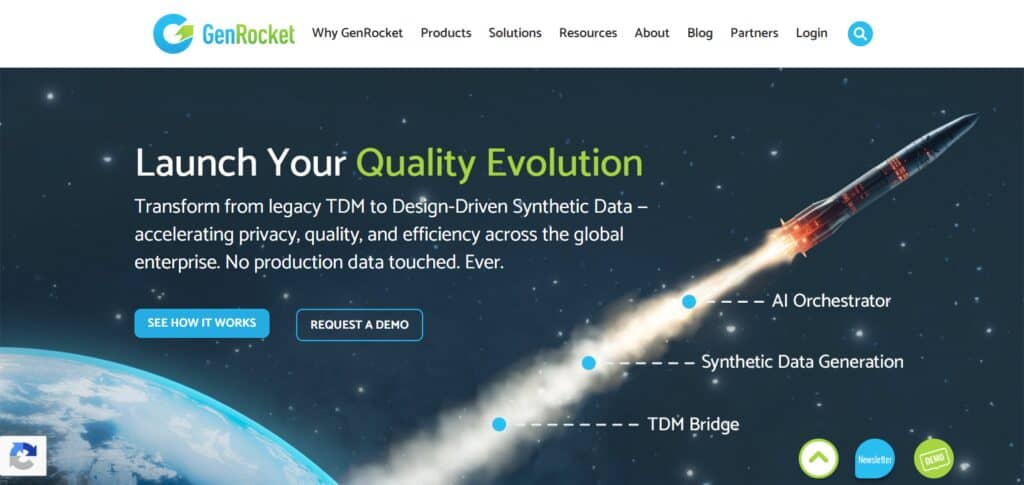
GenRocket offers a low privacy risk, scoring 2/10, with the strong anonymization it performs. GenRocket’s utility for machine learning is provided by its ability to perform its modeling to cover edge case situations.
GenRocket’s scalability allows for extensive deployment and is high across many categories of services. Overall, GenRocket combines a speed and compliance focused balance with fidelity, which makes it an excellent choice for many of its enterprise customers.
Key Features
- Synthetic datasets on-demand
- Controlled disclosure with data masking
- Edge-case simulation for Software Quality Assurance
- Compliance support
- Cloud infrastructure
Pros
- High quality data
- Compliance support
- Quick generation of test data
- Supports multiple sectors
Cons
- Difficult for beginners
- Expensive for enterprise
- Less open-source
- Hard to use without expertise
2. YData
Yata focuses on AI model training pipelines and helps provides a bias resistant synthetic dataset. For security and fairness, their compliance-focused model avoids bias and discriminatory outcomes. An improvement in the data quality and more accurate predictions lies in the value provided by Yata.
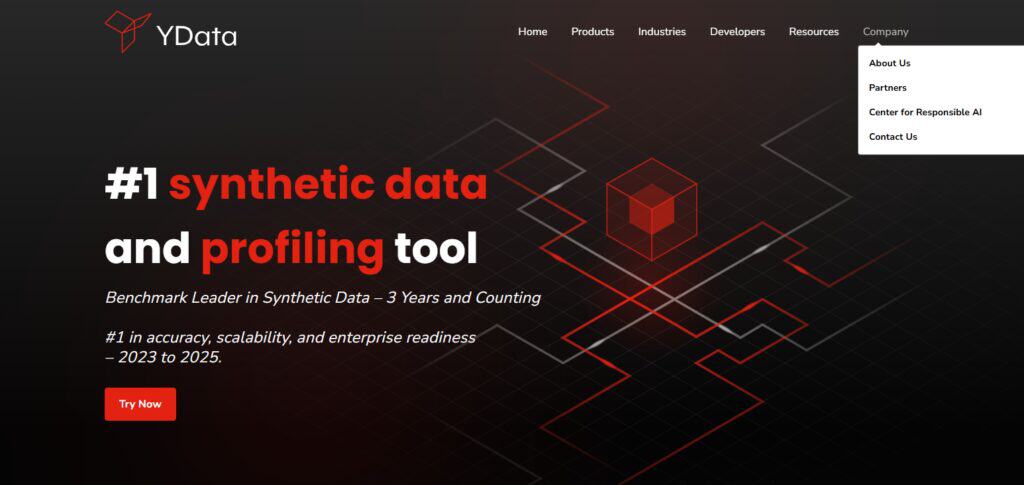
Yata, along with GenRocket, scores close to 9/10 on the data fidelity scale, and also has a low privacy risk score of 3/10 from GDPR compliant anonymization. Providing machine learning utility and balancing imbalanced datasets, Yata specializes in providing fairness for both datasets and metrics. In the sprints to market leaders in healthcare and finance, Yata has been able to provide a great amount of value in its secure generation of synthetic data for AI.
Key Features
- Synthetic data generation
- Anonymization
- Machine Learning
- Improvement of fairness metrics
Pros
- Focus on fairness
- Machine Learning
- Good data protection
Cons
- Limited scalability
- Need Machine Learning
- Harder to use
- Limited healthcare
3. SAS Data Maker
SAS Data Maker helps financial services companies develop and test new products and services rapidly using synthetic data, while maintaining compliance and protecting their sensitive financial records.
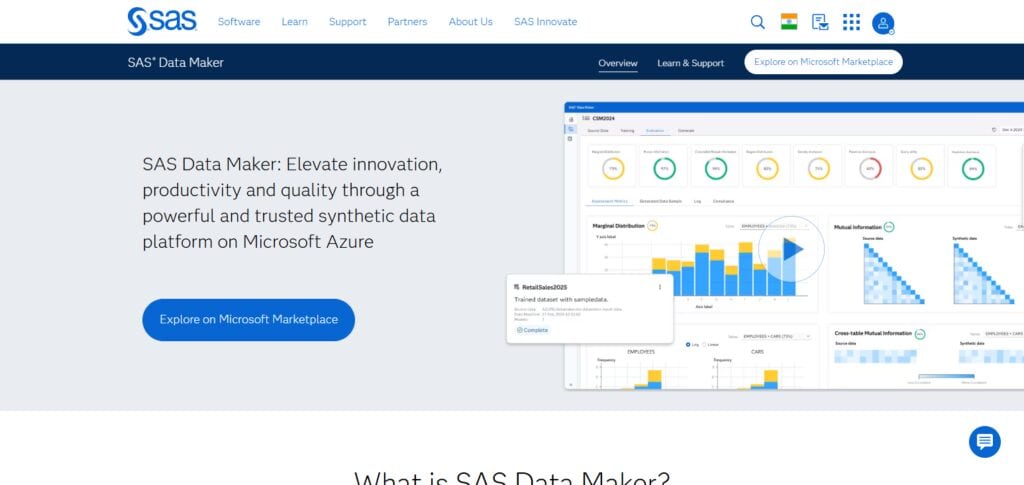
SAS Data Maker has a data fidelity score of 9/10 and helps customers design and review financial models and run business simulations.
SAS Data Maker is trusted by banks and insurance companies to generate secure, compliant, and scalable synthetic data. It helps balance fidelity, compliance, and scalability.
Key Features
- Synthetic data for finance
- Privacy-preserving data
- Fraud detection
- Compliance with regulations
Pros
- Compliance with finances
- Quality simulations
- Scalable
- Trusted brand
Cons
- High cost
- Hard to use outside of finances
- Complex integration
- Hard to use
4. Mockaroo
Mockaroo is a lightweight synthetic data generator built for speed and designed for prototyping. Sensitive attributes are masked when sample datasets are generated. With a data fidelity score of 7.5, Mockaroo provides realistic synthetic data. Privacy risk is moderate at 4/10, and Mockaroo is best used in non-production environments.
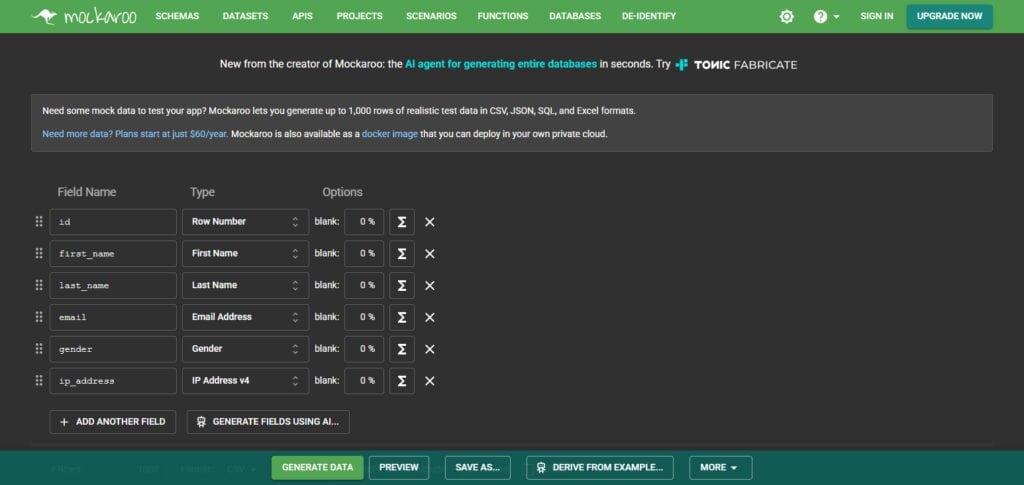
Mockaroo aids prototyping operations and model validations; scaled offerings are too enterprise-centric for most developers. Mockaroo’s ease of use, speed, privacy protections, and data generation formularity are the reasons Mockaroo is preferred by developers and by startups.
Key Features
- Easy to use data generation
- Attribute masking
- Easy to use
- Supports rapid prototyping
- Export data in various formats
Pros
- Easy to use
- Rapid data generation
- Cheap
- Good for startups
Cons
- Quality of data is low
- Hard to use for enterprises
- Privacy risks
- Not good for compliance
5. MDClone
MDClone uses synthetic data in medical research while preserving patient privacy. They are trusted globally for their balance of data privacy and compliance in healthcare. They have a data fidelity score of 9/10, showing that their synthetic medical data are realistic. Their privacy risk score, which reflects the strength of their anonymization, is 1/10, rivaling the best in the industry.

They use these anonymization techniques to support clinical AI models and other predictive analytics in healthcare and drug research. MDClone is appropriate for use by large hospital systems and research institutions due to their high scalability.
Key Features
- Data for healthcare
- Compliance with HIPAA
- Clinical AI bolstering
- Scalability for large hospitals
- Research-ready pipelines
Pros
- Excellent healthcare compliance
- High-fidelity medical data
- Low privacy concerns
- Trusted for research
Cons
- Limited outside healthcare
- More hospital costs
- Complicated deployment
- Requires domain expertise
6. K2View
K2View provides governance and lineage tracking for large scale synthetic data use. They have strong secure frameworks for data provisioning, and therefore good security practices. K2View has a high data fidelity score of 8.5/10, showing great accuracy for their synthetic data.
They have a privacy risk score of 3/10, which is still good, but is lower than MDClone. Because of their strong focus on data governance, K2View is appropriate for large enterprises, such as those in the Fortune 500. K2View is used for large scale synthetic data generation in a variety of industries, which allows enterprises to continue secure AI training.
Key Features
- Enterprise-grade synthetic pipelines
- Governance and lineage tracking
- Multi-department consolidation
- Secure provision
- Scalability to Fortune 500
Pros
- Good governance
- Highly scalable
- Enterprise grade
- Secure provision
Cons
- Costly enterprise tool
- Complicated integration
- Requires IT
- Unsuited for startups
7. Tonic.ai
Tonic.ai has a strong focus on developing advanced data masking. They are able to synthesize safer versions of production databases. This protective synthesis allows their clients to have the ability to share or test company data without releasing sensitive information. They score an 8.5/10 on data fidelity because they develop datasets that contain accurate statistics.
Their privacy risk score is a low 2/10, due to the strength of their masking protocols. Tonic.ai is able to support secure, production-like datasets for AI models, and are able to maintain a high level of privacy and focuses on the security of their data. Tonic.ai is an enterprise choice for their fidelity, privacy, and scalability of secure synthetic data.
Key Features
- Sophisticated data masking
- Transformative databases
- Secure sharing
- Statistically accurate datasets
- Scalable to enterprise
Pros
- Excellent privacy
- Realistic datasets
- Enterprise ready
- High ease of integration
Cons
- High cost
- Requires database expertise
- Little support for open-source
- Moderate learning
8. MOSTLY AI
MOSTLY AI focuses on developing privacy-safe synthetic data, with a primary emphasis on GDPR compliance. They synthesize accurate datasets with advanced anonymization techniques. Their technology permits innovation within companies with strict privacy laws. Like Tonic.ai, MOSTLY AI scores a 9/10 on data fidelity.
Their protocols position their privacy risk score at a very low 1/10. From an AI perspective, MOSTLY AI is able to develop datasets for AI simulations and for predictive analytics, and test datasets for fairness. They also maintain a high level of privacy and provide security for their datasets. MOSTLY AI is recognized for their privacy-focused solutions that balance what is needed for secure AI adoption.
Key Features
- Synthetic datasets that are GDPR compliant
- High anonymization
- Testing for fairness
- Predictive analytics
- Scalable to enterprise
Pros
- Excellent privacy compliance
- High fidelity datasets
- Enterprise ready
- Low risk to privacy
Cons
- Costly
- Complicated setup
- Requires machine learning expertise
- Few developer tools
9. Syntho
Syntho is a GDRP-compliant synthetic enterprise pipeline data platform. When it comes to security, Syntho focuses on certified AI data anonymization for European enterprises. The business value is building secure analytics and AI solutions without disclosing sensitive user information. Syntho has a data fidelity rating of 8.5/10. With Syntho’s protocols and practices which are designed to reduce the Privacy risk scores close to 2/10, also due to strict compliance, Syntho offers a low privacy risk
In terms of machine learning, Syntho offers the use of AI models in finance, healthcare, and retail. Syntho is extremely scalable across European enterprise pipeline coverage. Syntho is highly regarded by enterprise clients for balancing compliance, fidelity, and scalability, making it the most preferred synthetic data solution for secure AI model training in regulated industries.
Key Features
- GDPR compliant Pipelines
- Focus on European Enterprises
- Secure Analytics
- Finance and Healthcare
- Scalable Cloud
Pros
- Great Regulatory Compliance
- High Valued Data
- Enterprise Ready
- Low Risk of Data Privacy
Cons
- Low global adoption
- High rates
- Compliance expertise needed
- Moderate scalability
10. Perforce Delphix
Perforce Delphix offers integrated synthetic data and test data management solutions. When it comes to security, Delphix combines synthetic generation with secure data provisioning. The business value is allowing DevOps teams to speed up processes and meet compliance requirements. Delphix has a data fidelity rating of 8.5/10. For compliance, Delphix has a low privacy risk of around 3/10 due to strong masking and anonymization.
From a machine learning perspective, Delphix offers secure AI model testing and validation. From a scalability perspective, Delphix has been engineering solutions for enterprise-grade DevOps. Perforce Delphix has a great reputation with enterprise clients for balancing compliance, fidelity, and scalability, making it a trustworthy solution for synthetic data generation in AI and DevOps.
Main Features
- Synthetic and test data
- Secure provisioning
- Supports workflows in DevOps
- Data masking and anonymization
- Scalable within the enterprise
Pros
- Good integration with DevOps
- High level of dataset realism
- Scalable within the enterprise
- High level of security
Cons
- High level of enterprise cost
- High complexity of integration
- High level of enterprise DevOps
- Low adoption of enterprise startups
Challenges of Using Synthetic Data Generation Tools
Data Fidelity Limits: The inability of synthetic datasets to completely reflect real-world complexities leads retail AI models to be less accurate and restricted in their ability to comprehend and adapt to different situations.
Bias Replication: In the case of biased source data, synthetic datasets introduce bias to AI, causing unfair outcomes and diminishing trust in the trustworthiness of ML.
Integration Complexity: The introduction of synthetic data pipelines to company-wide workflows incurs a high integration cost as it requires advanced IT skills, especially for companies with little to no IT.
Regulatory Uncertainty: Mixed with the lack of clear regulations, the use of synthetic data over a variety of jurisdictions with diverse privacy and security frameworks increases the difficulty in compliance.
Scalability Constraints: Many synthetic data tools lack the capability to efficiently scale across larger enterprise clientele thus limiting them to service only AI deployments for small to medium enterprises.
High Costs: The high cost associated with setting up enterprise grade synthetic data infrastructure and tools further limits the use of these tools to greater fortune companies.
Model Utility Gaps: The utility of synthetic datasets is limited in situations that require specialized data which may lead to a loss in the utility of ML.
Conclusion
In 2026, AI model development cannot be done without having a solid foundation in synthetic data generation. Many industries have the luxury to leverage privacy, compliance, and scalability from the use of synthetic data. The advantage of privacy through synthetic data allows companies to innovate faster without as much of a worry about the possible bias issues, and more importantly, it helps companies concerned with regulations like GDPR and HIPAA.
While there are current challenges of synthetic data fidelity, integration, and cost, the consent of data privacy makes up for it when companies can build AI systems that are more fair and trustworthy. The use of synthetic data allows companies to access and innovate in the world of AI in an informed manner while also mitigating risks that could usually be impactful in the markets.
FAQ
What is synthetic data generation?
Synthetic data generation is the creation of artificial datasets that replicate real-world statistical patterns without containing sensitive information, ensuring privacy, compliance, and scalability for AI models.
Why do businesses need synthetic data?
Businesses use synthetic data to protect privacy, reduce bias, meet regulatory compliance, and scale AI model training securely, especially in industries like healthcare, finance, and enterprise AI.
How does synthetic data improve security?
It eliminates direct exposure of production data, reducing risks of leaks, breaches, or cyberattacks, while enabling safe experimentation and testing of AI models.
What industries benefit most?
Healthcare, finance, retail, and enterprise IT benefit significantly, as synthetic data allows secure AI adoption without violating HIPAA, GDPR, or other compliance standards.
What are the main challenges?
Challenges include data fidelity limits, bias replication, integration complexity, regulatory uncertainty, scalability constraints, high costs, and reduced utility in niche AI applications.