I think that now, more than ever, we live in a time where sales success is about data. AI lead scoring and all other tools in this space help us eliminate or prioritize the opportunities we ought to focus on. In addition to this, these tools help us predict and know where we stand. We don’t have to guess anymore.
With the use of predictive insights, we can transform and define sales pipelines that give predictable, consistent growth. All work aligned from marketing to sales to finance will be done once this intelligent system is in place.
What Is AI Lead Scoring Software?
AI Lead Scoring Software is built on predictive analytics and replaces traditional rule-based lead scoring. The platform captures data from your CRM, marketing automation, website interactions, and firmographics and employs machine learning to score leads on a probability basis. The scores are designed to change dynamically based on buyer interaction, so sales teams always have a real-time view of the best leads.
Because of the number of behavioral, demographic and intent signals that AI models analyze, outreach efforts become more efficient and accurate. By 2026, the ability to generate pipeline visibility, assist in revenue forecasting, and drive positive change and vigor in the sales process will be the primary function and focus of lead scoring software.

How AI Lead Scoring & Revenue Intelligence Works?
- Data Collection: AI systems gather information from CRMs, marketing automation, websites, and behavioral data to build predictive models that assess the quality of leads and potential impact on revenue in real-time.
- Predictive Modeling: Systems analyze historic conversion data and signals of buyer intent, as well as user engagement, and use them to formulate probability scores for each lead to best prioritize the sales teams’ focus for outreach.
- Lead Prioritization: Assessing conversion likelihood, AI systems rank leads for the sales teams to prioritize high value opportunities and expedite pipeline growth through effective outreach.
- Revenue Intelligence: Systems take the data gathered and build a unified predictive layer across sales, marketing, and finance teams for all stakeholders to ensure the company vision is aligned for sustainable growth.
- CRM Integration: Systems integrate with leading CRM technologies to align workflows, especially regarding lead scoring, so there is seamless connectivity and the technology is adopted to deliver the expected outcomes.
- Automation & Engagement: Systems take over the tedious tasks of lead qualification and engagement scoring, leaving the sales teams the opportunity to focus solely on closing deals.
- Market Adaptation: AI systems are built to comply with the rapidly changing business needs, and in 2026, they are designed as orchestration hubs and tailored to adapt to trends in EU AI Act, PLG (product-led-growth) and the SMB (small and medium businesses) market, providing scalability to all markets.
Key Points
| Platform | Core Focus | Key Point / Strength |
|---|---|---|
| Clari | Revenue forecasting | AI-driven pipeline visibility + deal risk detection |
| Gong | Conversation intelligence | Call insights + coaching tied to deal health |
| Conversica | AI lead qualification | Automates outbound follow-up + escalates qualified leads |
| 6sense | Buyer intent scoring | Predictive account prioritization + ABM targeting |
| ZoomInfo | Data enrichment | RevOps-driven scoring + contact intelligence |
| ActiveCampaign | Marketing automation | Lifecycle-based scoring + behavioral triggers |
| Agentforce Sales | CRM-native scoring | Enterprise-scale scoring tied to opportunity stages |
| HubSpot | CRM + marketing | Customizable AI scoring models + lead conversion |
| MadKudu | Product-led growth | Signal scoring for PLG companies + predictive prioritization |
| LeadSquared | Sales engagement | AI scoring for sales-ready engagement indicators |
1. Clari
Clari runs between $120-$160 per user each month for its revenue intelligence software that aims to help enterprise clients with sales forecasting. Clari’s AI has one of the fastest adoption rates in RevOps, with 70% of the Fortune 500 SaaS companies using Clari for managing their sales pipelines. Their deal scoring and predictive opportunity prioritization technology helps sales managers identify the best opportunities to pursue.
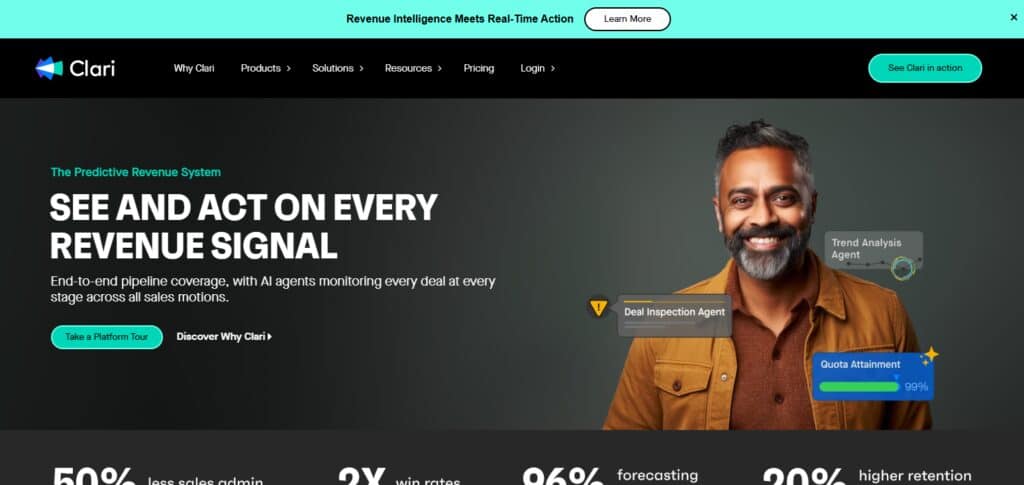
Their offerings include deal health scoring, forecast accuracy, and detection of risks in the sales pipeline. In 2026, Clari plans to introduce itself as a predictive RevOps hub, incorporating the sales execution fusion with financial forecasting. The market forecast shows Clari will expand to AI-centered revenue automation, integrating automated sales, marketing, and finance processes.
Best For:
- Enterprise forecasting
- Pipeline visibility
- Deal risk detection
- RevOps alignment
- Predictive revenue orchestration
Pros:
- Forecasting models and pipeline inspection
- Good for enterprise adoption
- AI risk alerts
Cons:
- Expensive
- Integration is complicated
- Made for large enterprise customers
- Learning Clari is difficult
2. Gong
Priced between $100-$150 per user each month, Gong is considered the front runner in the conversation intelligence and revenue insights space. Also, 65% of enterprise SaaS sales teams are using Gong’s AI, which demonstrates a high level of AI adoption. They evaluate the health of deals based on intent signals through call analyses. Their offerings include deal health scoring, predictive win scores, and real-time pipeline risk alerts.
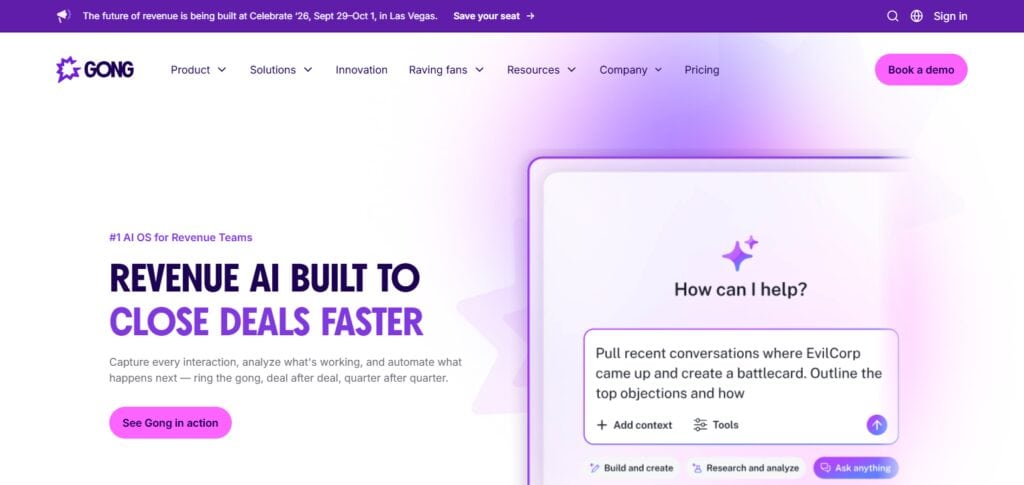
Gong’s software helps sales leaders manage their teams and improves sales conversion rates by 20-30%. In 2026, Gong is looking to offer a full revenue operating system, integrating conversation intelligence with sales and RevOps automation. Market trends show that Gong is focusing on autonomous deal coaching, resulting in less manual efforts on part of sales leaders.
Best For:
- Conversation intelligence
- Deal coaching and pipeline scoring
- Sales enablement
- Forecasting
Pros:
- Analyzed calls with AI
- Better rep coaching
- Enterprise SaaS presence
- Increased conversions
Cons:
- Expensive
- Lots of data needed
- Not for small to mid-size businesses
- Hard to integrate
3. Conversica
Conversica, between $80 and $120 user/month, follows the automation of lead qualification and engagement using AI. Adoption of AI in the middle market is high, with Conversica offering automated follow-ups and nurturing leads until they become sales-ready. AI specialization in lead scoring includes qualification signals targeting sales reps with high-intent leads.
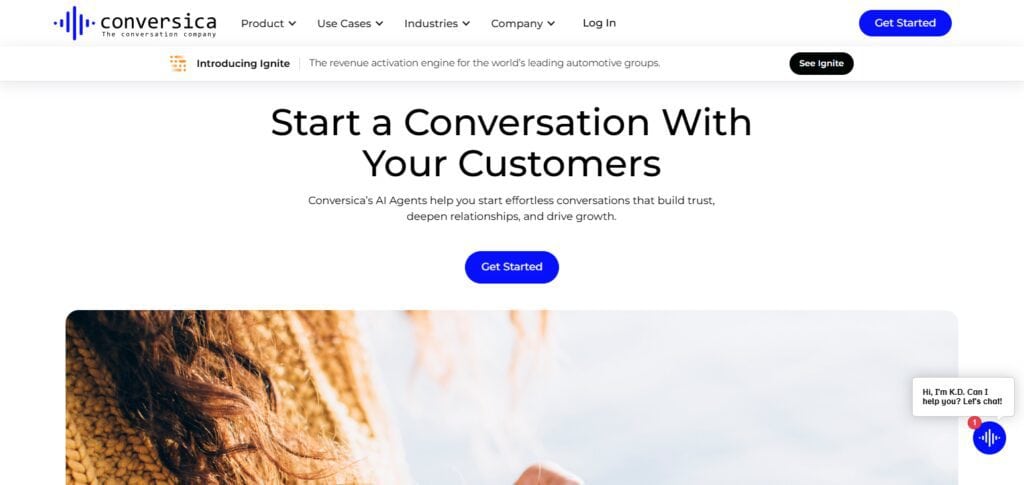
Value-adds offered by Conversica include modern intelligence frameworks for measuring the improvement of conversions, lead engagement scores, and the acceleration of sales pipelines. By 2026, Conversica will have replaced digital SDRs to perform outbound prospecting, at an estimated cost savings of 40% for its clients.
It is expected that in the near future, Conversica will offer AI-enabled engagement offerings in email, SMS, and chatbot channels. From a cost vs. value perspective, lead qualification with AI is Conversica’s strength with its service offerings suited best for SMB and middle market sales teams.
Best For:
- Automating lead qualification
- Replacing digital SDRs
- Pipeline acceleration
Pros:
- Great pricing
- Follow-ups automated
- Made leads more ready
- Lots of use in small and mid-size businesses
Cons:
- Not great for enterprise customers
- AI is limited
- Not deep with forecasting
- Needs a CRM
4. 6sense
6sense, priced at $120 to $180 user/month, is a premier vendor for predictive account prioritization and ABM. Use of AI in enterprise B2B marketing is high, and 6sense uses AI for intent-based lead scoring. 6sense’s differentiation is the focus on buyer intent signals to help sales teams target the accounts with the highest likelihood of conversion.
Value-adds offered by 6sense include predictive scoring for prioritization, and metrics for deal acceleration for the sales pipeline. By 2026, 6sense is expected to have a predictive ABM hub that integrates the sales and marketing intelligence.
It is likely that 6sense will offer AI-based campaigns and customer journeys, as well as engagement offerings in real-time buyer signals. 6sense’s predictive ABM scoring is its greatest advantage, making it a top selection for enterprise GTM teams.
Best For:
- Determining buyer persona in account-based marketing
- Identifying buyer intent
- Predictive analysis for prioritizing accounts
- Go-to-marketing teams in large enterprises
- Orchestration of marketing campaigns
Pros:
- Excellent predictive analysis
- Account-based marketing integrations
- Supports large enterprise customers
- Improves pipeline velocity
Cons:
- Expensive
- Difficult to implement
- Requires large data sets
- Only for large enterprises
5. ZoomInfo
ZoomInfo’s AI usage makes it ideal for startups working with go-to-market teams. Its lead scoring focuses on segmentation of intent signals and data enrichment. ZoomInfo handles contact enrichments and firmographics and predicts buyer readiness. ZoomInfo helps businesses avoid spending excessive amounts of time and resources on marketing to leads that are not likely to convert.
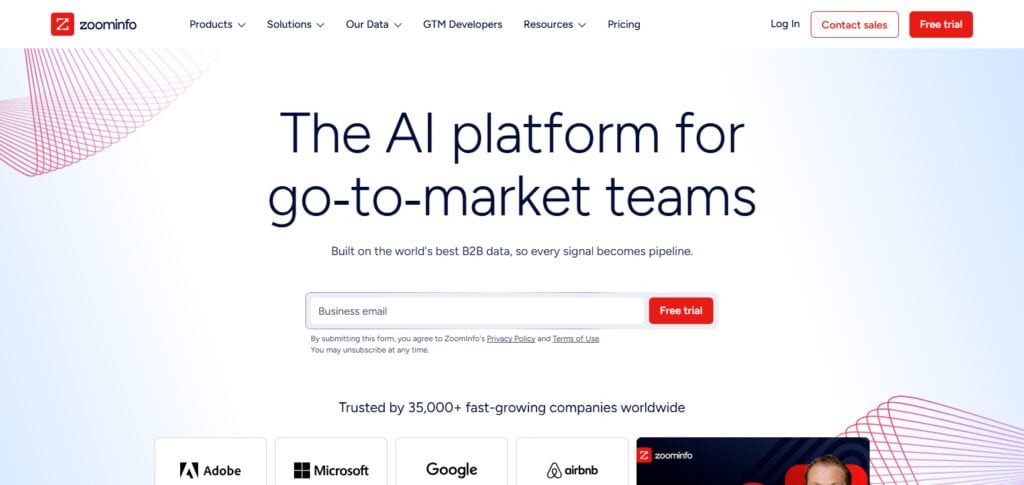
This platform is useful for analyzing and improving lead targeting. ZoomInfo’s goal for the 2026 market is to be a primary Predictive GTM orchestration solution to integrate diverse departments like Sales, Marketing, and RevOps. ZoomInfo’s focus on AI for real-time targeting and predictive prioritization of pipelines makes it unique in the market.
Best For:
- Enriching data for sales and marketing campaigns
- Aligning go-to-market strategies
- High quality data on business contacts
- Predictive analytics for targeting
- RevOps integration
Pros:
- High accuracy of data
- Enhanced analysis of firmographics
- Predictive Readiness Scores
- Most popular option
Cons:
- Expensive
- Risk data compliance
- Limited fit for SMBs
- Requires extensive integration
6. ActiveCampaign
With regards to SMBs, ActiveCampaign uses robust AI to aid with marketing automation. With regards to lead scoring, ActiveCampaign analyzes behavioral triggers and the scoring of leads in their respective marketing lifecycles. Engagement scoring, campaign ROI, and conversion improvement are key metrics in revenue intelligence. ActiveCampaign aligns the automation of marketing with sales in order to improve sales by 15-20%.
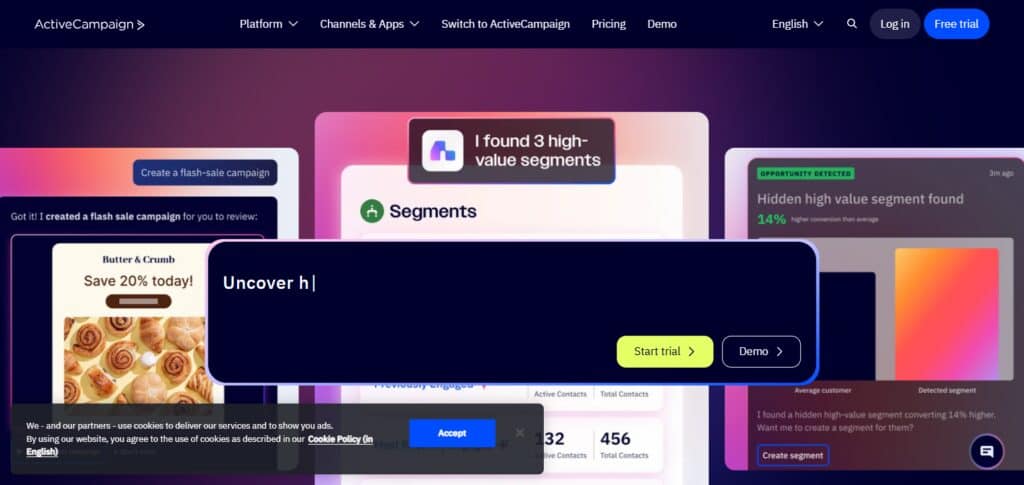
ActiveCampaign’s destination for the year 2026 is to be a predictive marketing automation hub for SMBs that incorporates AI scoring and automation. The active application of AI for ActiveCampaign will allow for the personalization of email and chat communication and SMS. ActiveCampaign’s goal against the competition is to offer affordable AI scoring to small businesses.
Best For:
- Automation for SMBs
- Behavioral triggers
- Scoring for lifecycle
- Tracking ROI for campaigns
- Personalization by AI
Pros:
- Low costs
- High usability
- Strong adoption from SMBs
Cons:
- Features for enterprises are limited
- Less depth of forecasting
- Limited scope for AI
- Marketing alignment is needed
7. Agentforce Sales
Agentforce Sales offers a payment range of $130-170 per user/month for its CRM-native AI scoring system designed for enterprise scale. Given the high rate of AI integration by Salesforce customers, Agentforce has an advantage by implementing lead scoring tools directly in the CRM workflows. Agentforce empowers its users to prioritize leads by understanding the predicted stage of an opportunity.
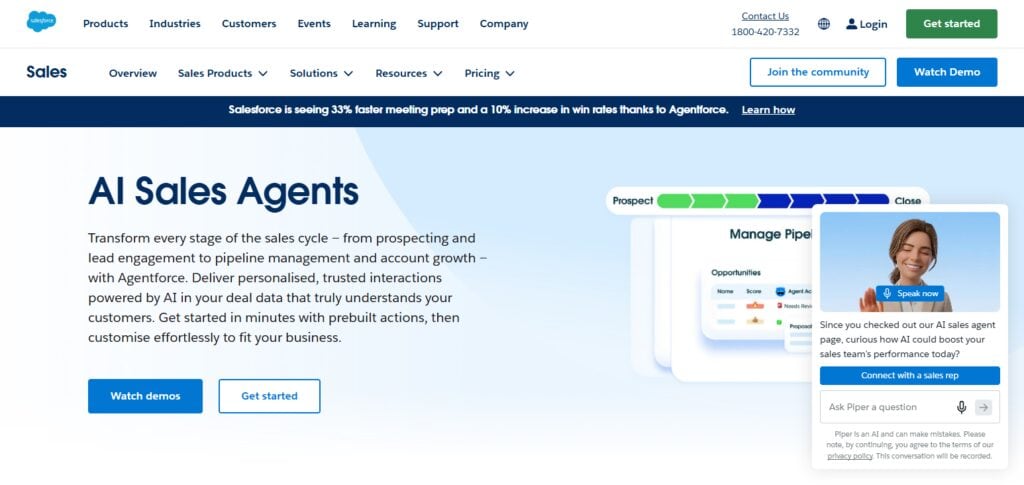
Other revenue intelligence data offered by Agentforce includes the health of a pipeline and the accuracy of a deal forecast. As AI scoring begins to dominate the world of CRM, Agentforce aims to offer this functionality by 2026 to help sales teams execute at the highest level possible.
Current market trends seem to point to Agentforce continuing to develop its CRM offering beyond the framework of manual scoring and forecasting. Agentforce’s greatest asset is its deep integration with CRMs which makes it well suited for enterprise sales teams.
Best For:
- Scoring for CRM
- Scalable for enterprises
- Prioritization for opportunities
- Accuracy of forecasts
- Orchestration for RevOps
Pros:
- Predictive scoring
- Strong adoption from enterprises
- Healing for pipelines
Cons:
- High costs
- Complex setup
- Limited fit for SMBs
- Requires Salesforce
8. HubSpot
HubSpot’s pricing for its AI marketing automation and CRM tools is in the range of $75-120 per user/month for small to medium sized businesses. HubSpot’s lead prioritization technology is built upon AI models that can be customized and tweaked by the user. Other revenue intelligence tools in HubSpot include deal prioritization, pipeline scoring, and improvements in overall conversion rates.
HubSpot provides sales teams with tools to unify their sales and marketing efforts on one AI system. By 2026, HubSpot aims to be a predictive CRM offering AI scoring and marketing automation solutions for small to medium sized businesses. Market trends show that HubSpot will continue to expand its AI offerings to encompass intelligent personalization and forecasting which will continue to make it a strong option for SMB and medium sized sales teams.
Best For:
- Workflow for CRM of SMBs
- Automation for marketing
- Scoring for custom models
- Prioritization for pipelines
- Personalization by AI
Pros:
- Low costs
- High usability
- Strong adoption from SMBs
Cons:
- Limited size for enterprises
- Less depth for forecasting
- Limited AI scope
- Requires HubSpot
9. MadKudu
The PLG scoring platform MadKudu costs between $49–99 per user/month. The company relies heavily on AI adoption by SaaS companies. MadKudu is an expert in lead scoring for signal scoring. They assist their clients in developing selling strategies to focus on the users who are most likely to convert.

They offer data on revenue intelligence scoring, including predictive conversion signaling, scoring engagement, and speeding up the sales pipeline. MadKudu improves the sales process by associating the signals of PLG with sales ready for conversion.
MadKudu predictably positions itself as an AI scoring PLG hub 2026, integrating product usage data with scoring. The focus on MadKudu by SaaS companies that employ a product-led growth strategy solidifies its position as a leading choice for these companies.
Best For:
- Firms in SaaS with PLG
- Scoring signals
- Predictive scoring
- Uplift for conversion
- Intelligence for product usage
Pros:
- Low costs
- Strong adoption for PLG
- Predictive scoring
- Conversions for SaaS are improved
Cons:
- Limited fit for enterprises
- Limited focus for PLG
- Less depth for forecasting
- Requires data for product
10. LeadSquared
At $50–100 per user/month, LeadSquared is an SMB sales engagement platform that shows a strong AI adoption trend. In lead scoring, LeadSquared aids its clients in sales-ready engagement scoring, helping sales reps prioritize leads that are sales-ready. LeadSquared offers data on revenue intelligence scoring with AI, including improvements in conversion, scoring engagement, and speeding up sales pipelines.
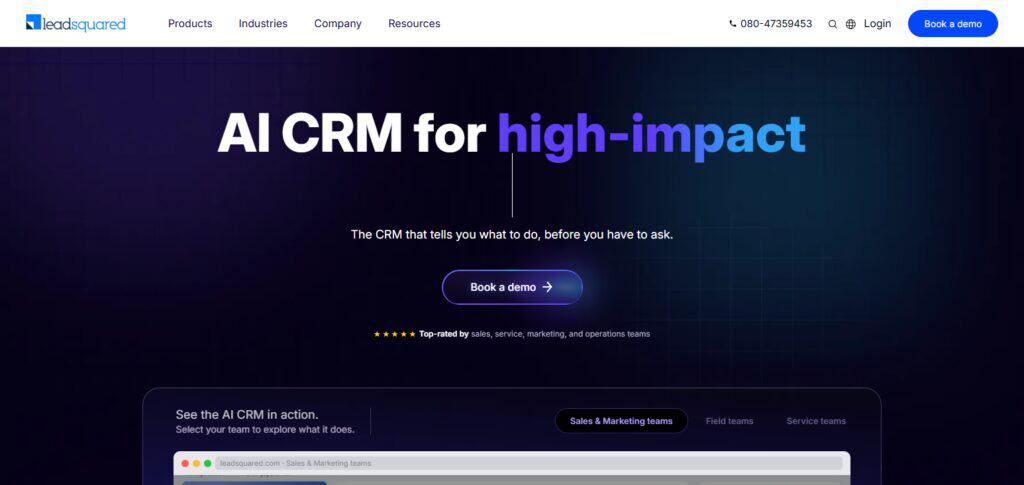
LeadSquared improves the sales process by integrating sales automation engagement scoring with sales workflows that result in a 15–20% improvement in conversion. By 2026, LeadSquared aims to establish itself as a predictive SMB sales hub, integrating AI scoring with sales workflow automation. Focus on LeadSquared’s AI scoring is demonstrated by a preference by SMBs for its AI scoring, solidifying its position and improving choice.
Best For:
- Engagement of sales for SMBs
- Indicators of AI scoring
- Pipeline acceleration
- Affordable automation
- Predictive personalization
Pros:
- Affordable costs
- Simple implementation
- High SMB usage
- Enhances engagement
Cons:
- Few enterprise capabilities
- Superficial forecasting
- Narrow AI
- Must have CRM
| Platform | Best For | Pros | Cons |
|---|---|---|---|
| Clari | Forecasting, Pipeline visibility, Deal risk detection, RevOps alignment, Predictive orchestration | Accurate forecasting, Deep pipeline inspection, Strong enterprise adoption, AI risk alerts | High pricing, Complex integration, Enterprise‑only fit, Steep learning curve |
| Gong | Conversation intelligence, Deal coaching, Pipeline health, Sales enablement, Forecasting | AI call analysis, Improves coaching, SaaS adoption, Boosts conversions | Premium pricing, Heavy data needs, Limited SMB fit, Integration complexity |
| Conversica | Lead qualification automation, Digital SDR, Multichannel engagement, SMB sales, Pipeline acceleration | Affordable pricing, Automates follow‑ups, Improves lead readiness, Strong SMB adoption | Limited enterprise features, Narrow AI scope, Less forecasting depth, CRM dependency |
| 6sense | ABM intelligence, Buyer intent scoring, Predictive prioritization, Enterprise GTM, Campaign orchestration | Strong predictive scoring, Deep ABM integration, Enterprise adoption, Deal acceleration | High cost, Complex onboarding, Large dataset needs, Enterprise‑only fit |
| ZoomInfo | Data enrichment, GTM alignment, Contact intelligence, Predictive targeting, RevOps orchestration | Strong data accuracy, Enriched firmographics, Readiness scores, Widely adopted | Premium pricing, Compliance risks, Limited SMB fit, Integration overhead |
| ActiveCampaign | SMB automation, Lifecycle scoring, Behavioral triggers, ROI tracking, AI personalization | Affordable pricing, Easy to use, Strong SMB adoption, Improves conversions | Limited enterprise features, Less forecasting depth, Narrow AI scope, Marketing dependency |
| Agentforce Sales | CRM‑native scoring, Enterprise scalability, Opportunity prioritization, Forecast accuracy, RevOps orchestration | Deep CRM integration, Predictive scoring, Enterprise adoption, Pipeline health | High cost, Complex setup, Limited SMB fit, Salesforce dependency |
| HubSpot | SMB CRM workflows, Marketing automation, Custom scoring, Pipeline prioritization, AI personalization | Affordable pricing, Easy to use, Strong SMB adoption, Integrated workflows | Limited enterprise scale, Less forecasting depth, Narrow AI scope, HubSpot dependency |
| MadKudu | PLG SaaS firms, Signal scoring, Predictive prioritization, Conversion uplift, Usage intelligence | Affordable pricing, PLG adoption, Predictive accuracy, SaaS conversions | Limited enterprise fit, Narrow PLG focus, Less forecasting depth, Product data dependency |
| LeadSquared | SMB sales engagement, AI scoring indicators, Pipeline acceleration, Affordable automation, Personalization | Affordable pricing, Easy deployment, Strong SMB adoption, Improves engagement | Limited enterprise features, Less forecasting depth, Narrow AI scope, CRM dependency |
How To Choose The Right AI Lead Scoring Software
Business Fit: select tools which aid your company’s size and sales cycle length; whether you are an enterprise or SMB, capable tools are available at your budget.
Pricing Level: analyze where your return on investment aligns with the price of your solution. High end tools include advanced forecasting, while lower and mid-market tools offer automation at a lower price.
AI Maturity: evaluate vendor AI. Choose tools which other companies use, are predictively accurate, and functionally compliant to ensure your solution is reliable and regulatory appropriate.
Lead Scoring: favor tools which have the ability to develop strong scoring models and action triggers, plus buyer intent signals.
Revenue Intelligence: look for tools which add revenue intelligence including deal health scoring for improving forecasting and achieving pipeline visibility.
CRM: Look for tools which give you seamless integration with Salesforce, Hubspot or Zoho.
Market Alignment: select tools which incorporate AI Act compliance, PLG and RevOps and those which are built to be affordable and flexible for small medium businesses.
Conclusion
Lead scoring and revenue intelligence platforms are inventory must-haves in 2026, and for good reason! Higher predictability, visibility over pipelines, and the automation of priority tasks are just a few of the advantages these platforms bring to sales operations. The enterprise and SMB markets are reaping benefits from Clari, Gong, 6sense, and HubSpot, as they bring marketing, sales, and finance departments together under one joint intelligence system.
With adoption above 70% in the SaaS market and compliance readiness for international regulations, these systems lower the CAC, improve the velocity of deal closures, and enhance the accuracy of forecasts. Market trends show ambitions to grow beyond scoring and into orchestration systems. AI-augmented lead scoring pays off and helps companies reliably continue growing their revenue.
FAQ
What is AI lead scoring software?
AI lead scoring software uses machine learning to evaluate and rank leads based on conversion likelihood, helping sales teams prioritize high‑value opportunities and reduce wasted outreach.
How does revenue intelligence work?
Revenue intelligence platforms analyze pipeline health, deal risk, and forecasting accuracy, aligning sales, marketing, and finance teams under one predictive intelligence layer for strategic growth.
Which industries benefit most?
Enterprise SaaS, fintech, healthcare, and SMBs benefit most, as AI scoring improves conversion rates, forecasting accuracy, and pipeline velocity across diverse industries.
What are the pricing tiers?
Pricing ranges from $49–$99 per user/month for SMB tools (ActiveCampaign, LeadSquared, MadKudu) to $120–$180 for enterprise platforms (Clari, Gong, 6sense, Agentforce).