
In this article, I will discuss the Best KYC/AML Verification Tools for Crypto Platforms and make a comparison of the identity verification, AML screening, fraud detection, compliance, and overall performance. From the services offered by Persona and Sumsub to Chainalysis and KYCAID, these tools can help crypto exchanges and wallets identify customers, mitigate risks, and prevent financial crimes.
What is KYC/AML Verification Tools?
KYC/AML verification tools are compliance technologies aimed at helping crypto exchanges and wallets perform identity checks of their customers and mitigate financial-crime risks.
Typically, KYC (Know Your Customer) procedures are related to customer identification and verification, while AML (Anti-Money Laundering) imply detecting illicit transactions or patterns. KYC/AML tools can be applied in crypto exchanges and wallets to onboard verified customers automatically, enhance transaction monitoring, screen high-risk clients, and ensure full compliance with regulatory requirements.
Why Choose KYC/AML Verification Tools for Crypto Platforms
Enhanced regulatory compliance: With KYC/AML tools, crypto platforms can meet KYC, AML, sanctions, and customer due diligence requirements in all jurisdictions where they operate.


Identity fraud prevention: By verifying documents, biometrics, and liveness, crypto platforms can expose imposters, fake identities, and stolen credentials.
High-risk customer identification: Through AML screening, crypto platforms can highlight sanctioned entities, PEPs, adverse media matches, and other high-risk customers.
Streamlined customer onboarding: The automated KYC/AML verification process reduces the amount of paperwork and speeds up customer registration.
Monitoring of ongoing risks: Some KYC/AML providers offer periodic re-screening/matching capabilities to help crypto platforms detect changes in customer risk profiles after they have been initially assessed.
Mitigation of money laundering risks: KYC/AML verification tools can help crypto compliance officers identify and flag suspicious customers and transactions before they cause significant harm to the business.
Support for international operations: Crypto platforms that want to operate globally can choose KYC/AML providers that offer the widest possible coverage in terms of documents, jurisdictions, languages, and databases.
Integration into crypto-specific compliance solutions: KYC/AML transaction monitoring tools can be used in conjunction with blockchain analytics to provide end-to-end compliance solutions for crypto platforms.
Automation of compliance processes: Where appropriate, KYC/AML providers can automate routine screening, risk-scoring, alerting, and case management to reduce the workload on compliance officers.
Improved customer trust: KYC/AML solutions demonstrate a commitment to responsible innovation, security, and financial crime prevention, which can be important credibilityenhancing signals to customers.
Beenfits Of KYC/AML Verification Tools for Crypto Platforms
Faster customer verification: Automates identity checks, document verification, biometrics, screening, improving verification speed.
Fraud prevention: Detects counterfeit documents, impersonation, stolen identities, and other potential fraud schemes during verification before a customer account is opened.
Compliance with AML regulations: Facilitates sanctions, PEP, watchlist, and other regulatory screening required to meet crypto platform compliance standards.
Risk-based customer due diligence: Enables assigning of risk categories and enhanced screening for higher-risk customers.
Reduced manual effort: Compliance officers can dedicate more time to complex and higher-value KYC/AML cases by automating rule-based checks.
International customer onboarding: Makes it possible to verify customers across different jurisdictions and with various identification documents.
Ongoing transaction monitoring: Some KYC/AML verification tools offer continuous monitoring capabilities that allow businesses to detect new threats right after a customer account has been opened.
Improved transaction security: When paired with blockchain analysis tools, KYC/AML tools can help assign risk levels to crypto transactions or wallet addresses involved in suspicious activity.
Better customer experience: Removing manual checks and paperwork, automated KYC/AML verification can make the customer onboarding process more efficient and less error prone.
Scales with business growth: Cloud-based KYC/AML verification tools enable crypto platforms to effortlessly onboard more customers without a proportional increase in manual compliance efforts.
Easier audits and reporting: Verification data, screening results, and procedures performed are often stored in one place, helping with regulatory documentation and audit controls.
Protects a company’s reputation: A strong KYC/AML compliance program reduces a crypto platform’s exposure to money laundering and other illicit activities and enhances its reputation with regulators and customers.
Key Points
| Tool | Strengths | Best For |
|---|---|---|
| Persona | Configurable workflows, detailed compliance records | Exchanges needing flexible onboarding |
| Sumsub | End-to-end KYC, AML, KYB, Travel Rule | High-volume crypto exchanges |
| Veriff | Document + biometric verification, fraud signals | Platforms needing frictionless onboarding |
| AU10TIX | Deepfake prevention, Travel Rule compliance | Enterprise-grade crypto compliance |
| Jumio | Global regulatory coverage, biometric checks | Multinational crypto firms |
| Trulioo | Broad data source coverage | Platforms needing global identity verification |
| iDenfy | Fast user checks, built-in AML screening | Startups needing cost-effective KYC |
| ComplyCube | Developer-friendly API, AML monitoring | Crypto apps needing easy integration |
| Chainalysis | On-chain analytics, wallet risk scoring | Exchanges needing blockchain forensics |
| KYCAID | Modular KYC + wallet screening | SMBs needing affordable compliance |
1. Persona
Persona is a flexible KYC and AML verification platform for crypto exchanges, wallets, payment processors, and other digital-asset platforms. It can verify government-issued IDs, selfies/living selfies, and databases, and check against sanctions, PEP, adverse media, and other lists.

For crypto businesses, Persona has a crypto-watchlist workflow that can screen wallet addresses for possible risks. Best KYC/AML Verification Tools for Crypto Platforms should offer an end-to-end solution, as businesses need to verify both customers’ identities and watch out for other transaction-related risks.
This is why Persona highlights the ability to build a customized verification workflow according to locations, transaction risk levels, and user segments. Additionally, its case-management tools enable compliance officers to automatically approve low-risk users while focusing on more complex cases.
Persona — Why It Matters
| Factor | Why It Matters for Crypto Platforms |
|---|---|
| Identity Verification | Helps confirm that customers are using legitimate identities during account registration. |
| Biometric Checks | Adds another layer of identity assurance and can help reduce impersonation attempts. |
| Risk-Based Workflows | Allows exchanges to apply different verification requirements based on customer risk. |
| Crypto Compliance | Useful for platforms that need identity verification combined with broader compliance workflows. |
| Automation | Reduces manual verification work and can speed up customer onboarding. |
| Customization | Businesses can design verification flows around their products, markets, and compliance policies. |
| Best For | Crypto exchanges, wallets, fintech platforms, and businesses needing flexible identity workflows. |
2. Sumsub
Sumsub is an end-to-end verification and compliance platform fit for crypto exchanges, wallets, and other financial platforms that operate in multiple regions, currencies, and asset classes. Its identity verification feature covers more than 220 jurisdictions and 14,000 document types, with optional biometric, liveness, NFC, database, and video checks.
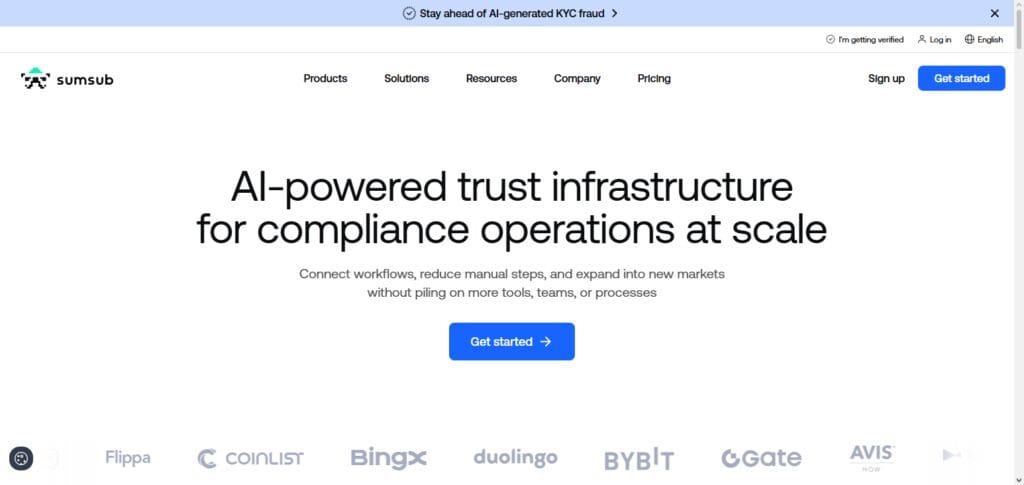
Best KYC/AML Verification Tools for Crypto Platforms should also offer blockchain-specific compliance checks, which is why Sumsub’s wallet and transaction screening solutions are crucial for ensuring effective risk managment.
They can be integrated with third-party blockchain analysis providers, including Chainalysis, TRM Labs, Elliptic, Crystal Intelligence, Merkle Science, and Cyvers. Thus, Sumsub is a great option for crypto businesses that want to incorporate identity verification, AML screening, and Travel Rule compliance into one seamless verification process.
Sumsub — Why It Matters
| Factor | Why It Matters for Crypto Platforms |
|---|---|
| Global KYC | Supports international customer verification, which is important for global crypto businesses. |
| Document Verification | Helps authenticate identity documents during onboarding. |
| AML Screening | Supports screening processes designed to identify potentially risky customers. |
| Crypto Compliance | Particularly relevant to exchanges and other digital-asset businesses. |
| Transaction Risk | Can work with crypto compliance providers for broader transaction-risk workflows. |
| Automation | Helps reduce manual checks and accelerate customer onboarding. |
| Best For | Global crypto exchanges, wallets, payment platforms, and regulated digital-asset businesses. |
3. Veriff
Veriff is a digital identity verification platform that enables businesses to issue verifiable credentials to customers and partners. In crypto, its e-KYC, biometric, and anti-fraud capabilities can help exchanges and wallets prevent impersonation, ID fraud, and account takeovers.

Best KYC/AML Verification Tools for Crypto Platforms should enable seamless onboarding while keeping the risk of fraudulent claims low, which is why Veriff can be a great choice for crypto businesses that want to implement secure digital verifications.
It can be embedded into the customer onboarding process to ensure that only legitimate users gain access to financial services. At the same time, crypto companies should consider whether Veriff’s fraud prevention, supported jurisdictions, customizable KYC checks, and technical integration can meet their business needs.
Veriff — Why It Matters
| Factor | Why It Matters for Crypto Platforms |
|---|---|
| Digital Identity | Helps crypto businesses verify customers remotely during onboarding. |
| Fraud Prevention | Identity and fraud signals can help identify suspicious onboarding attempts. |
| User Experience | Designed to make digital verification relatively straightforward for legitimate customers. |
| Document Checks | Helps validate government-issued identity documents. |
| Biometric Verification | Adds additional confidence that the person completing verification matches the submitted identity. |
| Scalable Onboarding | Useful when crypto platforms need to verify large numbers of customers. |
| Best For | Exchanges and wallets prioritizing user experience alongside identity and fraud controls. |
4. AU10TIX
AU10TIX is an automated verification platform that enables businesses to detect fake identities and ensure document authenticity. Hence, crypto exchanges and wallets can utilize its powerful fraud prevention solutions to add an additional layer of identity verification and improve their AML compliance programs.

Best KYC/AML Verification Tools for Crypto Platforms should highlight strong identity verification features, as businesses often encounter identity theft, synthetic identity fraud, and KYC-related challenges.
When considering AU10TIX, crypto companies should pay attention to its document verification capabilities, biometrics, global availability, fraud prevention tools, technical integration, manual review options, and KYC screening features.
AU10TIX — Why It Matters
| Factor | Why It Matters for Crypto Platforms |
|---|---|
| Document Authentication | Helps identify potentially fraudulent or manipulated identity documents. |
| Identity Assurance | Strengthens confidence in customer information collected during onboarding. |
| Fraud Detection | Can help businesses identify suspicious identity patterns and verification attempts. |
| Automated Processing | Reduces reliance on manual document reviews. |
| Global Verification | Useful for crypto platforms serving customers across multiple markets. |
| Compliance Layer | Can form part of a broader KYC/AML framework alongside sanctions and transaction monitoring. |
| Best For | Crypto businesses focused heavily on identity-document security and fraud prevention. |
5. Jumio
Jumio is an identity verification company that helps businesses ensure that their customers are who they claim to be. For crypto platforms, this means being able to detect fraudulent claims during account opening, high-value transactions, recovery processes, and other sensitive operations.

Best KYC/AML Verification Tools for Crypto Platforms should be able to balance business growth and regulatory compliance while offering seamless digital experiences. Thus, Jumio’s automated verification solutions can be a great option for crypto companies that want to prevent identity fraud without compromising the user experience.
Before finalizing a decision, crypto businesses should assess Jumio’s supported jurisdictions and documents, biometric and liveness detection features, fraud prevention tools, technical integration options, and compatibility with their overall compliance programs.
Jumio — Why It Matters
| Factor | Why It Matters for Crypto Platforms |
|---|---|
| ID Verification | Helps confirm the authenticity of customer identity documents. |
| Biometrics | Provides additional identity assurance during digital onboarding. |
| Fraud Prevention | Helps reduce risks from fake identities and identity-based attacks. |
| Customer Onboarding | Can streamline verification while maintaining stronger identity controls. |
| Global Operations | Useful for crypto businesses serving customers across different countries. |
| Compliance Support | Can contribute to a broader KYC and AML compliance process. |
| Best For | Crypto exchanges and financial platforms requiring strong digital identity verification. |
6. Trulioo
Trulioo offers global identity and business verification solutions that crypto platforms can utilize to collect and verify customer identities in local jurisdictions. Hence, it can be a great option for crypto exchanges and wallets that seek to adopt a centralized but regionally aware approach to KYC compliance.

Best KYC/AML Verification Tools for Crypto Platforms should enable businesses to collect and verify individual identities as well as conduct broader AML, KYB, and business-verification checks. Trulioo’s document verification, database checks, business verification, and fraud prevention offerings are worth considering for crypto platforms that want to reduce compliance costs and accelerate onboarding.
At the same time, businesses should request documentation and conduct due diligence to ensure that the Trulioo’s jurisdictional KYC checks, fraud prevention features, transaction monitoring capabilities, and API performance are up to their standards.
Trulioo — Why It Matters
| Factor | Why It Matters for Crypto Platforms |
|---|---|
| Global Coverage | Useful for platforms onboarding customers from multiple countries. |
| Identity Verification | Helps validate customer identity information before account access. |
| Business Verification | Can also be relevant when crypto platforms need to verify corporate customers. |
| Data Sources | Access to verification data can help strengthen customer due diligence. |
| AML Workflows | Can support broader compliance processes when combined with appropriate screening. |
| API Integration | Useful for integrating verification directly into existing onboarding systems. |
| Best For | International crypto exchanges, fintech businesses, and platforms serving both individuals and businesses. |
7. iDenfy
iDenfy is an identity verification and compliance platform that offers a wide range of KYC, AML, and fraud prevention solutions for businesses of various sizes and industries. For crypto exchanges and wallets, this includes automated verification of customer identities to ensure that only legitimate users can access financial or digital-asset services.
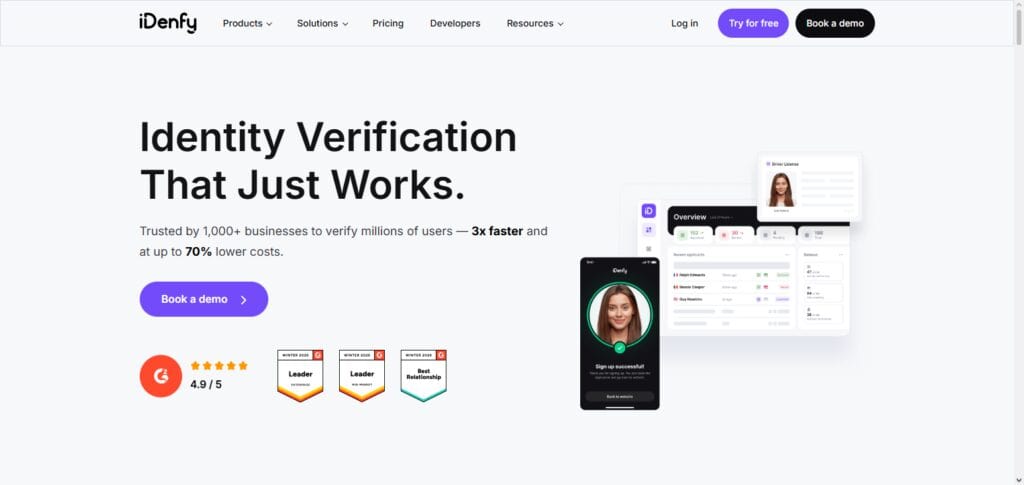
Best KYC/AML Verification Tools for Crypto Platforms should offer customizable verification solutions fit for different customer segments, as not all of them are equal in terms of risk. iDenfy can be considered as an option for fulfilling KYC requirements while also implementing AML, fraud prevention, and transaction-screening measures.
Crypto companies should take note of its wide range of document verification options, the jurisdictions it covers, biometric verification tools, sanctions and PEP screening, ongoing transaction monitoring, API and SDK options, manual review features, and security measures.
iDenfy — Why It Matters
| Factor | Why It Matters for Crypto Platforms |
|---|---|
| KYC Automation | Helps automate identity checks during customer onboarding. |
| AML Screening | Supports compliance teams in identifying potentially risky customers. |
| Fraud Prevention | Helps detect suspicious identity and onboarding activity. |
| Risk Management | Useful for applying additional checks to higher-risk customers. |
| API Support | Makes it easier to connect verification capabilities with crypto platforms. |
| Manual Review | Human review can help investigate verification cases that automation cannot confidently resolve. |
| Best For | Crypto startups and established platforms looking for combined KYC, AML, and fraud controls. |
8. ComplyCube
ComplyCube is a digital identity verification and AML compliance platform that helps businesses verify individuals and organizations and screen them for possible risks. It can be especially useful for crypto exchanges, wallets, fintech companies, and payment processors that need to identify their customers and ensure that they are not dealing with sanctionslisted entities.
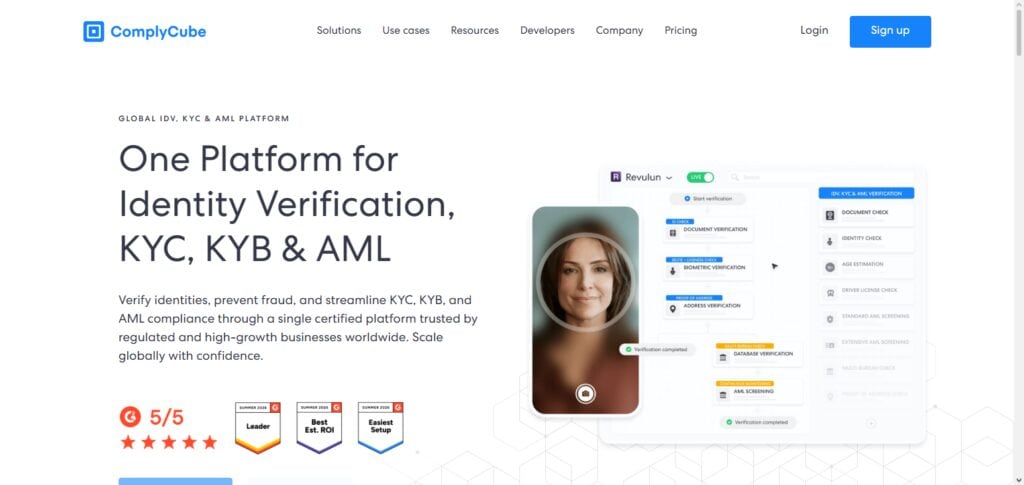
Best KYC/AML Verification Tools for Crypto Platforms should utilize a layered approach and combine identity verification with AML compliance screening. ComplyCube’s ID verification, biometric checks, AML screening, sanctions and PEP checks,
KYB, and developer-friendly interface are worth considering for crypto platforms that seek to build KYC screening directly into their workflows and offer flexible screening options for different customer segments.
ComplyCube — Why It Matters
| Factor | Why It Matters for Crypto Platforms |
|---|---|
| KYC Verification | Helps establish customer identity before providing access to crypto services. |
| AML Screening | Supports screening for potential compliance risks. |
| Biometric Checks | Adds another layer of assurance during identity verification. |
| KYB Support | Useful for crypto businesses onboarding companies as well as individual users. |
| Developer-Friendly | API-based integration can simplify incorporation into existing applications. |
| Flexible Compliance | Allows platforms to structure checks according to their risk-management requirements. |
| Best For | Crypto exchanges, wallets, fintech companies, and platforms needing configurable compliance infrastructure. |
9. Chainalysis
Unlike many other verification platforms, Chainalysis’ primary focus is on blockchain intelligence and crypto-related transaction screening. It can help crypto exchanges, wallets, and other blockchain platforms prevent money laundering, terrorism financing, and other illicit activities by investigating suspicious on-chain transactions and linking crypto addresses to traditional financial accounts.
Best KYC/AML Verification Tools for Crypto Platforms should be able to address both identity verification and blockchain transaction screening, as they contribute to building a comprehensive compliance strategy.
Chainalysis’ tools can be integrated into crypto exchanges’ and wallets’ KYC solutions to enable them to conduct enhanced wallet screening and transaction monitoring. It can also be used in combination with other compliance platforms, such as Sumsub, to facilitate crypto AML screening.
Chainalysis is crucial for crypto platforms that want to mitigate risks associated with sanctions, illicit financial services, scams, heists, and other potential issues.
Chainalysis — Why It Matters
| Factor | Why It Matters for Crypto Platforms |
|---|---|
| Blockchain Intelligence | Helps businesses understand activity occurring across public blockchain networks. |
| Wallet Screening | Can identify exposure to potentially high-risk or illicit wallet addresses. |
| Transaction Monitoring | Helps compliance teams investigate suspicious cryptocurrency flows. |
| Sanctions Risk | Can help identify blockchain exposure associated with sanctioned entities or addresses. |
| Investigations | Provides blockchain intelligence that can support compliance investigations. |
| Complements KYC | Works alongside traditional identity verification rather than replacing customer KYC. |
| Best For | Crypto exchanges, institutional platforms, financial institutions, and businesses requiring advanced on-chain AML monitoring. |
10. KYCAID
KYCAID is a KYC and AML verification platform that helps businesses perform automated customer due diligence and identity checks. It can be used by crypto exchanges and wallets to ensure that their users are not engaging in any illicit behaviors before giving them access to financial services.
Best KYC/AML Verification Tools for Crypto Platforms should enable businesses to conduct automated identity checks while also offering options for manual review, which is why KYCAID can be a great fit for crypto companies that want to implement automated verification as an additional compliance layer.
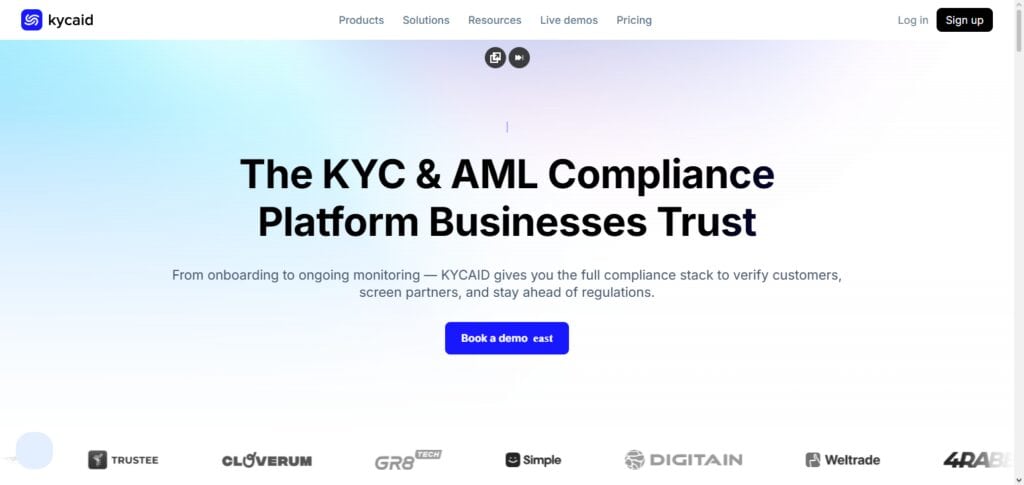
When considering KYCAID, businesses should pay attention to its document verification options, biometric checks, sanctions and PEP screening, KYC database checks, ongoing transaction monitoring, API/SDK, manual review features, and jurisdictional availability.
For crypto platforms, it is especially important to ensure that KYCAID’s KYC screening capabilities are compatible with their regional regulations and internal compliance initiatives.
KYCAID — Why It Matters
| Factor | Why It Matters for Crypto Platforms |
|---|---|
| Customer Verification | Helps crypto businesses establish customer identities during onboarding. |
| AML Checks | Supports screening processes for identifying potentially risky customers. |
| Automation | Reduces repetitive manual compliance tasks. |
| Fraud Controls | Helps strengthen defenses against suspicious or fraudulent onboarding attempts. |
| Digital Onboarding | Makes remote customer verification more practical for online crypto platforms. |
| Compliance Workflows | Can be incorporated into a broader risk-based KYC/AML program. |
| Best For | Crypto platforms seeking an automated identity and AML verification solution. |
Quick Comparison
| Tool | Main Reason It Matters | Strongest Use Case |
|---|---|---|
| Persona | Flexible verification workflows | Customized crypto KYC |
| Sumsub | Broad global compliance capabilities | Global crypto platforms |
| Veriff | Identity + fraud prevention | Smooth customer onboarding |
| AU10TIX | Document and identity security | Fraud-resistant verification |
| Jumio | Strong digital identity verification | Identity assurance |
| Trulioo | Global identity and business verification | International onboarding |
| iDenfy | KYC + AML + fraud controls | Automated compliance |
| ComplyCube | Flexible KYC/AML infrastructure | API-driven crypto platforms |
| Chainalysis | Blockchain intelligence | On-chain AML monitoring |
| KYCAID | Automated KYC/AML checks | Digital customer verification |
Conclusion
Choosing the best KYC/AML verification tools is critical for crypto-exchanges and platforms that aim to balance the needs of regulation compliance, transaction security, and convenient customer onboarding.
The Best KYC/AML Verification Tools for Crypto Platforms include Persona, Sumsub, Veriff, AU10TIX, Jumio, Trulioo, iDenfy, ComplyCube, Chainalysis, KYCAID and offer various approaches to identity verification, AML screening, fraud prevention, and blockchain transaction monitoring and analysis.
The choice of the most suitable crypto-specific KYC/AML verification tool depends on the list of supported countries, transaction volumes, customer risk assessment, level of automation, regulatory requirements, integration capabilities, and cost-effectiveness.
However, to benefit from cutting-edge fraud prevention mechanisms and built-in anti-money laundering controls, crypto-exchange platforms should consider applying both traditional KYC verification methods and ongoing AML transaction screening and on-chain monitoring services.
FAQ
What are KYC/AML verification tools for crypto platforms?
KYC/AML verification tools help crypto exchanges, wallets, and financial platforms verify customer identities and identify potential compliance risks. They can include ID verification, facial biometrics, sanctions and PEP screening, adverse-media checks, fraud detection, and transaction monitoring.
Which is the best KYC/AML verification tool for crypto platforms?
There is no single best option for every crypto business. Sumsub, Persona, Veriff, Jumio, and ComplyCube are strong options for identity verification, while Chainalysis is particularly useful for blockchain transaction and wallet-risk monitoring.
Why is KYC important for crypto exchanges?
KYC helps crypto exchanges establish who their customers are and reduce risks associated with identity fraud, money laundering, terrorist financing, and account abuse. It also helps platforms meet applicable regulatory and compliance requirements.
What does AML screening check?
AML screening can check customers against sanctions lists, politically exposed person (PEP) databases, watchlists, adverse-media sources, and other risk indicators. Some solutions also support ongoing monitoring after the initial customer verification.