

This article analyzes the Best Payment Processors for SaaS Companies and reviews the most preferred options for subscription-based businesses. We will analyze pricing, recurring billings, international payments, the number of supported countries, security, integrations, and scalability. By the end of this analysis, SaaS businesses will be able to choose the payment processor that suits their business model, the needs of their customer base, the requirements of their payments, and their growth aspirations.
Why Choose Payment Processors for SaaS Companies
Automated Recurring Billing: SaaS businesses need a payment processor that automates subscription charges, renewals, upgrades, downgrades, and cancellations.
International Currency Support: To serve international customers, payment processors must support local payment methods and multiple currencies.
Enhanced Cash Flow: SaaS businesses typically have better cash flow when payment collections are automated.

Prevention Of Unnecessary Churn: Billing system features that allow SaaS companies to retry payments and communicate with customers are essential to minimize unpaid churn.
Fraud Protection: Security systems that protect customer payment data and detect suspicious transactions are important features for payment processors.
Easy To Integrate: Payment processors offer integrations through APIs, SDKs, hosted checkout solutions, and plugins.
Growth-oriented Infrastructure: Payment processors can scale with a SaaS business.
Different Payment Models: Payment processors grant SaaS companies the flexibility to choose pricing models that include multiple payment tiers, usage, per-seat, flat-rate, or hybrid.
Tools To Support Tax And Compliance: Certain payment processors provide tax and compliance tools for international tax and VAT.
Advanced Analytics: Payment processors provide SaaS companies with reporting for payment and subscription analytics to help analyze revenue, churn, payment success rates, and customer behavior.
Benefits Of Payment Processors for SaaS Companies
Automated Subscription Payments: Allows your company to automatically bill customers for subscription services on a recurring basis. As a result, your company need not generate invoices and perform collections.
Improved Payment Success Rates: By utilizing smart retries, payment recovery, and account updater technology, processing companies can help protect against lost recurring revenue due to failed payments.
International Customer Base: Provides the ability to process international card transactions, support local payment methods, and process payments in multiple currencies. This allows your company to service international clients.
Reduced Customer Churn: Can help reduce the churn rate caused by failed payments or insufficient funds by offering payment retry technologies and flexible billing options.
SaaS Pricing Models: Companies can offer flexible pricing models and SaaS subscription packages such as monthly, annual, usage, and tiered pricing.
Payment Security: Secure card data and prevent payment fraud with PCI DSS (Payment Card Industry Data Security Standard) and SCA (Strong Customer Authentication) Protocol compliance with encryption, tokenization, and secure element technology.
Easy Integration: Payment processing technology enables trusted customer checkout with hosted checkout pages, API, SDK, and numerous integrations.
Better Revenue Management: Centralizes transactions and eliminates errors in reporting.
Less Administrative Work: Automates billing, reporting, and collecting payments. Reduces work load of finance and operations teams.
Scalable Payment Processing: Your chosen payment processor should support your growing customer base and international market volumes. This should be done without you having to build your own payment processing infrastructure.
Key Points
| Processor | Core Strength | Key Features | Best For |
|---|---|---|---|
| Stripe | Developer‑first | Advanced APIs, subscription billing, fraud tools | SaaS startups & scale‑ups |
| Braintree | PayPal‑owned | Vaulted cards, PayPal integration | SaaS with global customers |
| Chargebee | Subscription management | Dunning, invoicing, tax compliance | Mid‑market SaaS |
| Paddle | SaaS‑specific | All‑in‑one billing, tax handling | Global SaaS vendors |
| Recurly | Subscription optimization | Revenue recovery, analytics | SaaS with churn concerns |
| Adyen | Enterprise payments | 200+ local methods, unified commerce | Large SaaS enterprises |
| 2Checkout (Verifone) | Digital goods focus | Subscription billing, tax compliance | SaaS & digital product sellers |
| Worldpay | Global acquiring | Multi‑currency, enterprise scale | International SaaS |
| PayPal | Consumer trust | One‑click checkout, PayPal Credit | SaaS targeting SMBs |
| Square | Omnichannel | POS + online checkout | SaaS with hybrid retail models |
1. Stripe
One of the top payment processors for SaaS companies is Stripe. This payment processor combines all the tools you need to manage online payments, recurring billing, invoicing, and fraud protection with developer APIs. Stripe also excels in the areas of payment automation and developer tools. It was founded in 2010. U.S. standard online card transactions start at 2.9% per transaction plus 30 cents.
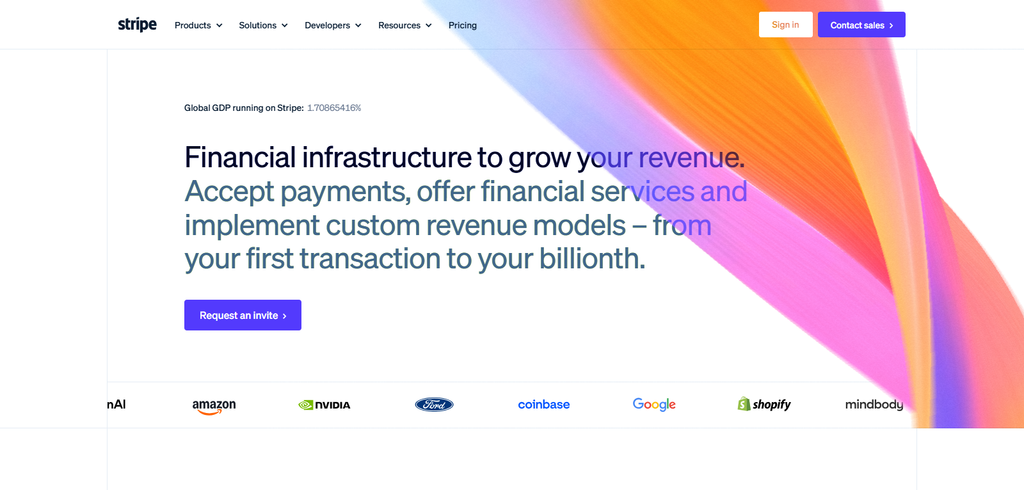
Additional costs occur for currency conversions and international card payments. Stripe provides many services around the globe, but payment capabilities and availability of accounts differ by region.
Stripe has over 135 payment options and supports over 135 currencies, and Stripe Billing aids in large scale subscription management. It is ideal for startups and growing SaaS companies due to its tools and APIs for Checkout, Billing, Tax, and Revenue Recognition.
Stripe Features
- Recurring Billing: Supports automated billing for subscriptions, trials, and invoicing for usage.
- International Payments: Supports numerous currencies and international payment options.
- Developer Tools: Features flexible APIs and SDKs as well as customizable checkout experiences.
- Fraud Detection: Features Stripe Radar to identify and block fraudulent payments.
- Integrations: Connects to accounting, CRM, tax, analytics and subscription management tools.
| Pros | Cons |
|---|---|
| Powerful APIs and developer tools | Can be complex for beginners |
| Strong subscription billing features | Fees can increase with add-ons |
| Broad international payment support | Account reviews can affect payouts |
| Excellent third-party integrations | Advanced features may require additional setup |
| Strong fraud-prevention tools | Pricing varies by payment method and region |
2. Braintree
Another popular payment processor for online businesses, marketplaces, mobile apps, and SaaS is Braintree. Like Stripe, Braintree’s focus is payment processing for digital goods and services, as well as recurring payments. It was founded in 2007.
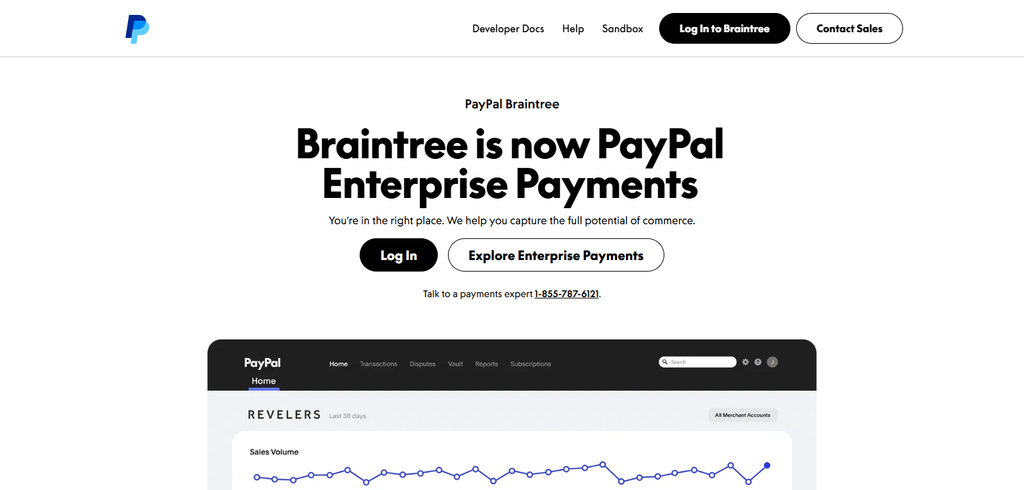
Pricing is based on the transaction and varies by location and payment method. For example, Braintree’s published European pricing packages standard cards and third-party digital wallets at 1.9% + 30 cents, while other payment methods may be priced differently.
Braintree Direct supports merchants in the U.S., Canada, Australia, parts of Europe, Singapore, Hong Kong, and Malaysia, with varying support for different products. SaaS companies are provided tools for recurring billing, fraud, vault/tokenization, PayPal integration, and developer APIs.
Braintree Features
- Payment Acceptance: Accepts a variety of payment options, including cards and PayPal.
- Payment Management: Provides tools for managing subscription and recurring transactions.
- Payment Vault: Securely stores customer payment information.
- Fraud Detection: Features tools to identify and manage suspicious transactions.
- Developer Tools: Provides APIs and SDKs to allow for the creation of custom web and mobile payment experiences.
| Pros | Cons |
|---|---|
| Supports PayPal and major card payments | International availability varies |
| Useful recurring billing capabilities | Pricing can vary by market |
| Secure payment vault for customer data | Some advanced features require technical work |
| Developer-friendly APIs and SDKs | Support experience may vary |
| Good option for mobile and online businesses | Less comprehensive than some enterprise platforms |
3. Chargebee
Chargebee focuses more on subscription billing and management of SaaS-based revenue, making it a good choice for SaaS companies with more complex recurring revenue models. It was started in 2009.
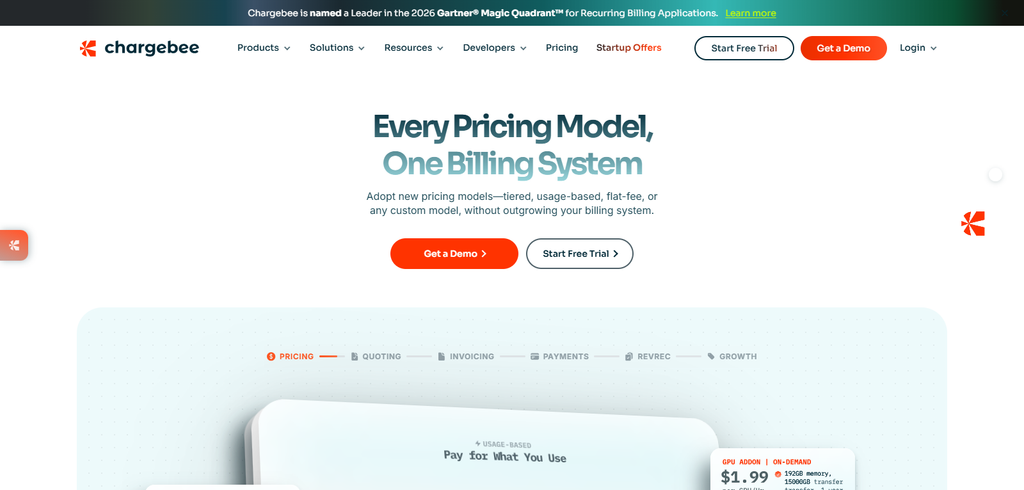
Pricing: its current plans include a Flow option with pricing around $0 and a percentage of billing volume, while other plans and enterprise offers use other pricing structures. Supported countries: Chargebee supports global billing through integrations with over 40 payment gateways and different payment methods like cards, PayPal, ACH, SEPA, BACS, UPI, etc.
SaaS businesses use Chargebee to do usage-based billing, set up pricing tiers, issues invoices, manage subscriptions, recognize revenue, and set up payment gateways to orchestrate multiple payment systems.
Chargebee Features
- Subscription Management: Manages subscriptions.
- Pricing: Uses multiple pricing models, such as tiered pricing or usage-based pricing.
- Revenue Management: Offers tools for managing subscription metrics and controlling recurring revenue.
- Payment Gateway Integration: Connects with payment gateways and payment methods.
- Dunning Management: Offers tool to recover payments and block involuntary churn.
| Pros | Cons |
|---|---|
| Excellent subscription management | Not primarily a standalone payment processor |
| Supports complex SaaS pricing models | Can be expensive as billing volume grows |
| Strong revenue-management capabilities | Initial configuration can take time |
| Multiple payment gateway integrations | Some features are plan-dependent |
| Useful analytics and reporting | May be more than small businesses need |
4. Paddle
If you’re a SaaS or digital product company and you’re looking for payments, subscription billing, tax compliance, and a service of record, Paddle is an all-in-one solution. Founded: 2012. Pricing: Paddle has public pay-as-you-go pricing that includes a total of 5 percent and $0.50 per Checkout transaction; custom pricing is available for larger businesses.
Supported countries: Paddle supports transactions and selling in over 200 countries and offers over 30 payment currencies. As a service of record, Paddle takes over the sales-tax and compliance burden, refund, fraud, chargeback and subscription management. This attracts SaaS companies that sell internationally and don’t want to worry about building a global tax and compliance infrastructure.
Paddle Features
- Merchant of Record: Deals with payment, tax, and compliance obligations for eligible companies.
- Payment Processing: Provides payment options for international customers and currencies, and localized payment experiences.
- Subscription Management: Controls subscription renewals and cancellations and offers subscription trials.
- Tax Management: Tax, VAT, and related obligations are managed for SaaS companies.
- Revenue Analytics: Provides subscription, transactional, and customer revenue reporting and analysis.
| Pros | Cons |
|---|---|
| Merchant-of-record model simplifies global selling | Transaction fees can be higher than basic processors |
| Strong SaaS subscription features | Less control over certain payment operations |
| Handles many tax and compliance responsibilities | Account approval requirements apply |
| Supports international customers | Product eligibility restrictions may apply |
| Simple solution for digital products | Custom enterprise requirements may need negotiation |
5. Recurly
Recurly focuses on subscription management and offers solutions to recurring revenue businesses like SaaS companies and streaming services. Founded: 2009. Pricing: In the current market, Recurly’s Starter plan is priced at $249 per month, with additional billing volume charged at 0.9 percent. Custom pricing is offered at higher volume tiers.
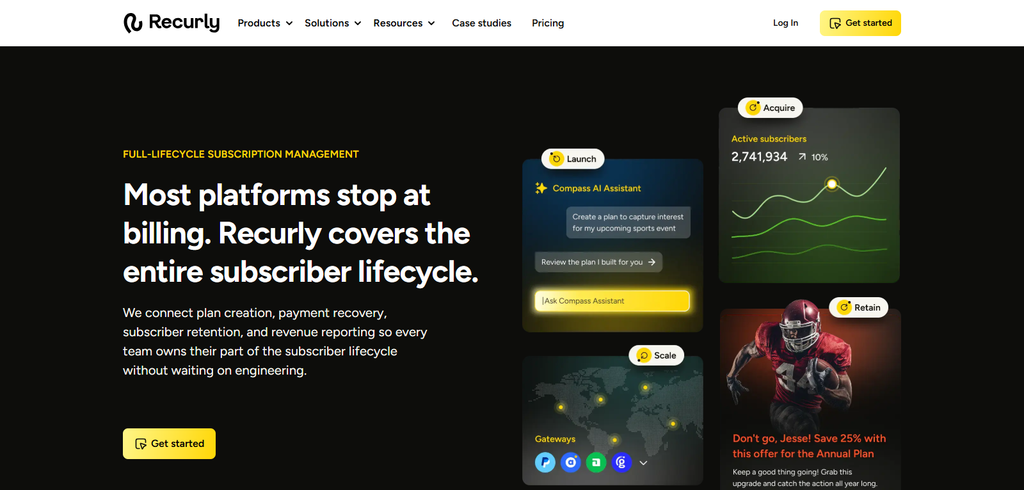
Supported countries: Recurly provides solutions for businesses around the world. Recurly’s customers can reach subscribers in 195 countries and uses 20+ gateways and 140 currencies. Recurly manages recurring transactions, Dunning, churn management and prevention, analytics, pricing, multiple gateway integrations, and revenue recovery.
Recurly Features
- Subscription Billing: Best suited for subscription and recurring revenue models.
- Flexible Billing: Offers multiple add-ons, various pricing plans, trials, and promotions.
- Payment Recovery: Keeps revenue flowing with dunning tools that automatically assist in payment recovery.
- Churn Management: Reduce churn with tools that help identify and manage the reasons behind subscriber cancellation.
- Analytics: Comprehensive subscription, revenue, customer, and payment performance reporting.
| Pros | Cons |
|---|---|
| Built specifically for subscription businesses | Monthly pricing can be costly for smaller companies |
| Strong recurring billing tools | Not a complete merchant-of-record solution |
| Effective payment-recovery features | Setup can require technical resources |
| Supports flexible subscription plans | Some advanced capabilities are plan-dependent |
| Useful churn and revenue analytics | May be unnecessary for simple one-time payments |
6. Adyen
In 2006, Adyen was founded in Amsterdam. Adyen’s focus is on payment integration, data, risk management, and finance offerings. Its pricing model is a fixed processing fee and a payment-method fee with no set up or monthly fees.
Adyen covers a lot of ground due to its payment and method focus, but the specific features available are dependent on the merchant and the product.
For SaaS businesses with a lot of international growth, Adyen offers payment method localization, recurring payments, risk management, improved authorization, and flexible settlement so it is likely to work better for large growing organizations.
Adyen Features
- Payment Acceptance: Accepts payments via multiple local payment transfer options and digital wallets.
- Payment Processing: Integrates global payment processing, risk management, and payment data in one unified platform.
- Payment Risk Management: Fraud detection is managed via routines and rules.
- Recurring Payments: Tokenization and subscription billing supported for payment processing.
- Enterprise Scalability: Designed for flexible, high volume payment processing for a larger international market.
| Pros | Cons |
|---|---|
| Excellent global payment capabilities | Better suited to established businesses |
| Large selection of local payment methods | Pricing can be less straightforward |
| Strong fraud and risk-management tools | Integration may require technical expertise |
| Scales well for high transaction volumes | Merchant onboarding can be more involved |
| Unified payments and financial data | May be excessive for small SaaS companies |
7. 2Checkout (Verifone)
2Checkout is part of Verifone and is a popular option for global payment solutions for software, SaaS, and digital-product companies. 2Checkout was founded in 2006. Costs vary with the product selected, the profile of the transactions, geography, and the payment method selected.
For SaaS companies, it is important to request or confirm a company-specific quote prior to disclosing any costs. 2Checkout meets the requirements of selling globally because it supports multiple currencies and markets, provided it meets the country and compliance requirements.
Its SaaS offerings include subscription billing, recurring payments, global checkout, local payment methods, tax, fraud management, and international payment processing. This service is suitable for software companies that sell their products to multiple regions.
2Checkout (Verifone) Features
- Global Payments: Transactions securely accepted for international customers.
- Subscription Billing: Recurring payments, subscription management and renewals, and trial subscription management.
- Variability in Payment Methods: Covers cards and digital wallets and supports regional payment methods.
- Tax Management: Digital tools to address the tax implications of doing business globally.
- Fraud Protection: Payment risk and fraud management for online transactions.
| Pros | Cons |
|---|---|
| Strong focus on international digital sales | Pricing can vary by product and market |
| Supports subscription billing | Fees may be higher for certain transactions |
| Useful for software and SaaS businesses | Merchant approval requirements apply |
| Multiple payment methods and currencies | Some features require additional configuration |
| Provides global payment and tax-related capabilities | Customer support experiences may vary |
8. Worldpay
Worldpay has a long history of operating an established payment processor for diverse businesses from small merchants to enterprise-level clients and offers support for online payments and recurring transactions, as well as payment and fraud management options across multiple channels. Founded: 1989 originally.
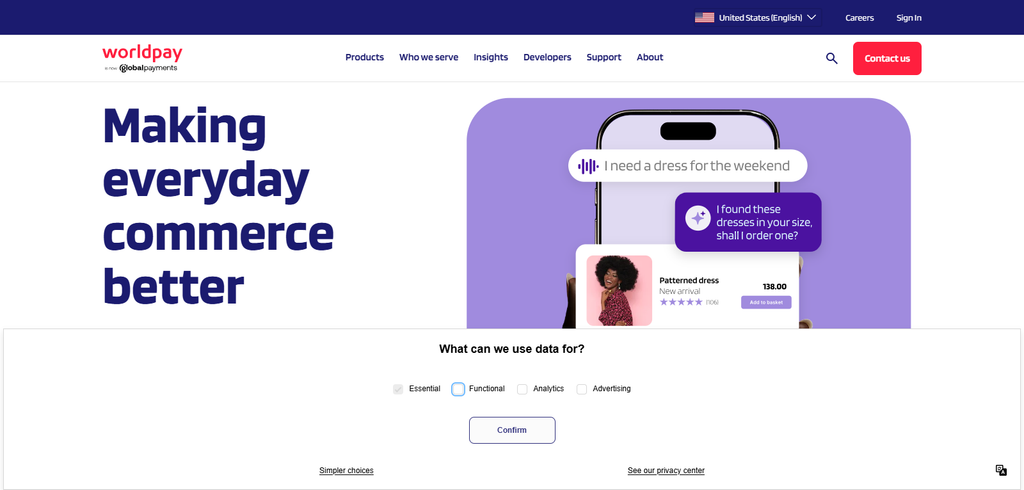
Pricing: Worldpay generally uses pricing tailored to the merchant based on factors such as payment methods, transaction volume, business type, and geography, so SaaS companies are advised to get a quote rather than assume a specific price.
Supported countries: Worldpay has strong international payment capabilities, although the availability of payment methods for international merchants may vary from market to market. Its developer platform includes payment pages, APIs, stored card payments, payment links, and fraud management functionalities among others. Worldpay is a good choice for SaaS with a high volume of payments.
Worldpay Features
- Online Payments: Supports online payment for a merchant’s card transactions and other digital payment types.
- Recurring Payments: Built for subscription and recurring revenue models.
- Global Acceptance: Transactions for payment accepted cross border.
- Fraud Management: Offers services to mitigate risks for your business.
- Developer Integration: Includes APIs with payment solutions for building payments into your SaaS products.
| Pros | Cons |
|---|---|
| Established global payment infrastructure | Pricing is often quote-based |
| Supports large transaction volumes | Setup can be complex |
| Offers online and recurring payment capabilities | May be less suitable for very small startups |
| Strong risk and security capabilities | Contract terms can vary |
| Broad payment-method coverage | Developer experience may vary by product |
9. PayPal
PayPal is a well-known global payment option that supports PayPal payments, cards, subscriptions, and invoicing within its payment services. Founded: 1998. Pricing: The merchant depending costs and fees vary for PayPal payments by country, payment method currency, and potentially by the transaction structure.

So commerce should find the local commercial rate and then assess payment costs. Supported countries: PayPal maintains a presence in many countries aross the globe and has differential features across different nations as well as varying withdrawal capacity. For SaaS, PayPal offers payment flexibility with strong brand recognition for wallet payments.
Braintree’s ecosystem is flexible enough to let businesses provide more tailor-made payment experiences using APIs and developed toolsu.
PayPal Features
- Digital Wallet: Allows your customers options to pay with their PayPal balance or other payment methods.
- Subscription Payments: Helps subscription based businesses provide payments that repeat based on a schedule.
- International Payments: Helps businesses receive payments from customers from multiple countries.
- Checkout Integration: Designed to be used in online checkout experiences and can be integrated into websites.
- Buyer Recognition: Includes a familiar customer checkout experience with PayPal’s brand.
| Pros | Cons |
|---|---|
| Highly recognizable payment brand | Fees can be relatively high for some transactions |
| Large international customer base | Account limitations can affect access to funds |
| Easy online checkout integration | Less customizable than some API-first platforms |
| Supports recurring payments | Features vary by country |
| Provides a familiar wallet option for customers | Currency-conversion costs can add to expenses |
10. Square
Square from Block is one of the best payment and commerce platforms for small and medium-sized businesses, but happens to offer online APIs that support SaaS and software apps too for embedded payment systems.

Founded: 2009. Pricing: Current card payments for the U.S. online APIs stands at 2.9% + $0.30 transaction fee, while ACH payments through the API stand at 1%, with a $1 minimum and $5 fee cap. Supported countries: Availability of Square is on a country-by-country basis, and vendors should confirm the service is available in their geographies.
Developers can leverage Square’s online payment APIs and SDKs for free without additional developer cost and let the platform take care of payment transactions. It is an attractive option for those seeking pricing simplicity.
Square Features
- Online Payments: Provides online payment for card payments (and other payment methods) for particular types of businesses.
- Payment APIs: Provides payment APIs for developers.
- Recurring Payments: Provides payment methods for recurring and subscription-based payments.
- Invoicing: Provides services to create and manage payment requests and invoices.
- Business Ecosystem: Provides services for payment, reporting, customer management, and invoicing.
| Pros | Cons |
|---|---|
| Simple and user-friendly platform | Country availability is limited |
| Transparent transaction-based pricing in supported markets | Less focused on complex SaaS billing |
| Developer APIs available | Advanced enterprise requirements may need alternatives |
| Includes invoicing and business tools | International capabilities are more limited than global specialists |
| Good ecosystem for smaller businesses | Not ideal for every high-volume SaaS model |
Conclusion
Payment processors matter to SaaS companies because billing goes beyond simple card payments. Stripe, Braintree, Chargebee, Paddle, Recurly, Adyen, 2Checkout, Worldpay, PayPal, Square, and others, offer various advantages with respect to subscription billing, international transactions, pricing, security, and integrations.
Stripe and Braintree have flexible integrations, Chargebee and Recurly are good at subscription management. Paddle provides global SaaS services by offering merchant of record services. Adyen and Worldpay are better suited for larger enterprise services.
SaaS companies should evaluate transaction fees, supported countries, recurring billing features, payment methods, scalability and compliance to choose a payment processor.
FAQ
What is a payment processor for SaaS companies?
A payment processor enables SaaS businesses to securely accept customer payments through cards, wallets, bank transfers, and other payment methods. Many SaaS-focused platforms also provide subscription billing, recurring payments, invoicing, fraud prevention, and payment recovery.
Which is the best payment processor for SaaS companies in 2026?
Stripe is one of the strongest overall choices because of its developer-friendly APIs, recurring billing, international payment support, and extensive integrations. However, Paddle, Chargebee, Recurly, Adyen, and Braintree may be better depending on a company’s billing model and international requirements.
Which payment processor is best for SaaS subscriptions?
Stripe, Chargebee, Recurly, and Paddle are particularly well suited to subscription-based SaaS businesses. They support features such as recurring billing, subscription plans, usage-based pricing, invoicing, failed-payment recovery, and customer management.
Which payment processor is best for international SaaS businesses?
Adyen, Stripe, Paddle, and 2Checkout (Verifone) are strong options for international SaaS companies. They provide access to multiple currencies and payment methods, although exact country availability varies by provider and merchant location.
Is Paddle a payment processor or merchant of record?
Paddle operates as a merchant of record for eligible digital products and SaaS businesses. This means it can take responsibility for certain payment, sales-tax, VAT, compliance, refund, and related obligations, potentially reducing the operational burden for SaaS companies selling globally.