


The best DEX liquidity routing API can make a world of difference in how efficiently a Web3 application handles token swaps and accesses liquidity. In this article, we will go over the Best 0x API Rivals for DEX Liquidity Routing such as 1inch, ParaSwap, Odos, OpenOcean, CoW Protocol, LI.FI, Jupiter, Bebop, and Hashflow.
I will explore their liquidity coverage, supported blockchains, routing technology, API capabilities, pricing, execution features, use cases and limitations to help developers understand how these platforms differ and what each can do.
How to Choose a 0x API Rival?
Liquidity coverage: Compare the number and variety of DEXs, AMMs, RFQ providers, and liquidity sources to ensure your application has access to competitive liquidity across required trading pairs.
Support for Blockchain: Make sure the platform supports the networks, tokens and ecosystems you need. Think about future growth needs so that your integration does not need to replace infrastructure when adding additional blockchains.

Routing Technology: Learn about smart routing, multi-hop paths, split orders, RFQ execution, solver-based mechanisms, and other routing technologies to find what fits your application’s trading needs.
API Performance: Evaluate quote latency, uptime, rate limits, reliability, transaction generation, and API consistency as these impact the responsiveness and operational stability of trading apps.
Execution Quality: Quantify price impact, slippage controls, transaction success rates, gas costs, and route optimization to understand how well the infrastructure can turn quoted prices into actual executions.
Developer Experience: Review API documentation, SDKs, integration examples, authentication, testing environments, supported programming languages, and technical support to assess the ease of implementation and maintenance for developers.
Pricing & Fees: Before committing to a routing provider, compare API costs, platform fees, transaction charges, volume-based pricing and any other integration costs to arrive at an estimate of your total operating costs.
Use-Case Fit: Align provider capabilities with your product needs, be it wallet, DEX, DeFi app, trading platform or cross-chain products requiring specialized liquidity and routing infrastructure.
Key Points
| Rival | Key Point |
|---|---|
| 1inch | Industry-leading Pathfinder algorithm that splits orders across hundreds of liquidity sources to optimize price and reduce slippage. |
| ParaSwap (Velora) API | MultiPath routing engine designed to deliver best execution across multiple DEXs and liquidity providers. |
| Odos API | Advanced Smart Order Routing (SOR) with support for complex multi-input and multi-output swaps. |
| OpenOcean API | Full-chain aggregator that sources liquidity from numerous DEXs across multiple blockchain networks. |
| CoW Protocol API | Uses batch auctions and solver competition to provide MEV protection and efficient trade execution. |
| LI.FI API | Combines cross-chain bridging and swap aggregation, enabling liquidity routing across multiple ecosystems. |
| Jupiter API | Dominant Solana liquidity aggregator, optimizing routes across Solana DEXs through its Metis routing engine. |
| Bebop API | RFQ-based trading infrastructure offering efficient execution and support for atomic multi-token swaps. |
| Hashflow API | RFQ-powered liquidity routing that delivers firm quotes directly from professional market makers, reducing slippage. |
1. 1inch
1inch is a multi-chain DeFi aggregator that offers APIs for token swapping, liquidity aggregation, pricing and transaction execution. Its routing infrastructure searches liquidity across supported DEXs to optimize swap execution while Fusion adds intent-based, gasless execution with resolvers competing to fill orders.
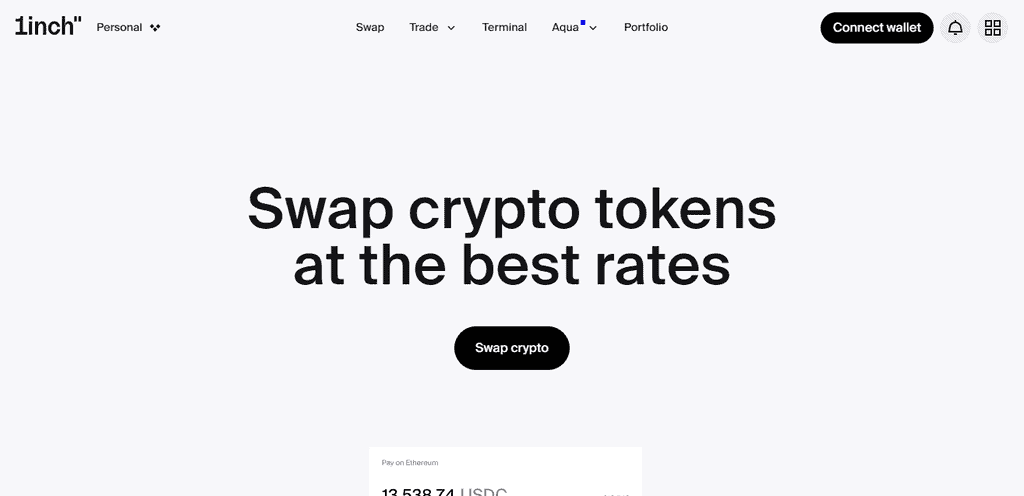
Today, 1inch is supporting the major networks such as Ethereum, BNB Chain, Base, Arbitrum, Polygon, Optimism, Avalanche, Solana, and many other new ones. Its Business platform offers REST APIs and developer infrastructure on a subscription basis, including free and paid plans and enterprise offerings.
This is what makes 1inch particularly relevant to wallets, trading applications, fintech platforms, and other products that require access to multi-chain DEX liquidity.
Best Use Cases
- Wallet Swap Integration – Access aggregated token swaps in your wallet from multiple DEX liquidity sources.
- DeFi Trading Apps – Offer users optimized routes instead of connecting to individual DEXs separately.
- Multi-Chain Applications – Token swapping between different EVM & non-EVM networks with one infrastructure.
- Fintech & Web3 Apps – Embed swap functionality into consumer-facing financial products.
- Advanced Trading – Routing, Fusion and API capabilities for applications requiring competitive execution and flexible transaction flow.
Limitations
- Complexity of Integration – Advanced routing and Fusion functionality may require more development effort than a simple DEX integration.
- Chain-Specific Variations – Features and liquidity can be vastly different across supported networks.
- API Plan Considerations – Applications with greater volume or commercial use may require payment for API access.
- Execution Dependency – Final execution is dependent upon the availability of underlying liquidity and market conditions.
2. ParaSwap
ParaSwap is a DEX aggregation protocol that aggregates liquidity from multiple DEXs and builds efficient swap routes. Its API has price discovery and transaction building capabilities. Its routing system can apply different pricing methods and liquidity sources in an effort to find competitive execution paths.
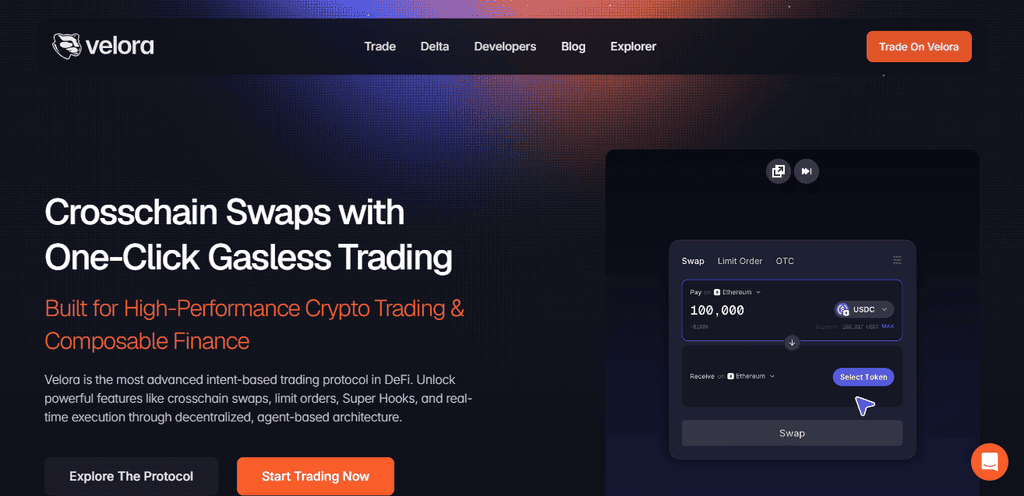
ParaSwap supports Ethereum, Optimism, BNB Chain, Polygon, Base, Arbitrum, Avalanche and other EVM ecosystems. Developers are able to integrate its APIs and SDK to request quotes, specify the DEXs it supports, manage swap parameters and generate transaction data.
The key difference from a basic DEX integration is that it aggregates from multiple liquidity sources, which is helpful for wallets, trading applications and DeFi interfaces that want automated route discovery.
Best Use Cases
- DEX Aggregation – Access liquidity from multiple DEXes in a single integrated platform.
- Wallet Apps – Add token swapping without the pain of integrating each DEX separately.
- DeFi Interfaces – Offer automated route discovery and transaction creation for users.
- Trading Platforms – Get swap quotes and transaction data by program.
- Developer Integrations – Use APIs and SDKs to create your own swapping experiences.
Limitations
- EVM-Centric Infrastructure – value proposition is dependent on the networks supported by the specific ParaSwap deployment.
- Liquidity Dependence – The quality of execution is contingent on the available liquidity from the integrated sources.
- API Changes – Developers are required to update integrations as API versions and supported features change.
- Complex Routes – More testing around slippage, gas and transaction execution might be needed for advanced aggregation.
3. Odos-API
Odos is a Smart Order Router API that finds the best routes to swap across fragmented on-chain liquidity. Its infrastructure aggregates liquidity from DEXs, AMMs, on-chain order books, lending protocols and private RFQ systems.
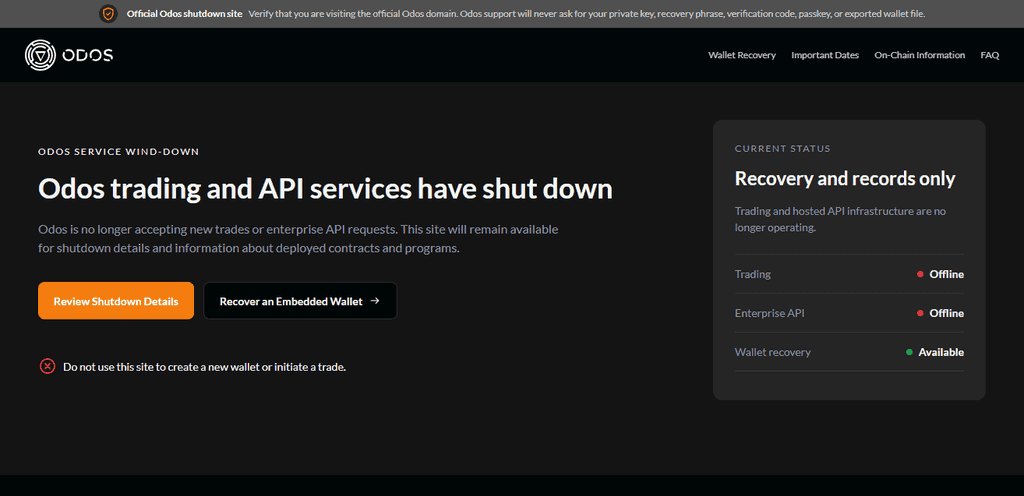
Odos breaks down transactions into multiple liquidity sources, and optimizes routes based on trade output and gas costs, which makes it particularly relevant for larger or more complex swaps.
Its API provides quote generation, transaction building, multi-token swaps, slippage control, pricing, and liquidity functions on many EVM networks. Developers are able to embed the REST API and router contracts into wallets, trading platforms and DeFi apps. The difference is not the single DEX , but multi-source routing .
Best Use Cases
- Large Token Swaps – Split orders across liquidity sources to potentially improve execution on larger trades.
- Multi-Token Swaps – Develop applications that support multi-hop token-to-token swaps.
- DeFi Use Cases – Embed smart order routing automation into trading interfaces.
4. Wallets – Enable wallet users to access aggregated liquidity via API-based swap functionality. - Institutional Trading Tools – Route optimization and multiple liquidity sources for more sophisticated trading workflows.
Limitations
- Complexity of routing – Sophisticated multi-source routing can increase the complexity of integration and transaction testing.
- Gas considerations – Transactions distributed across different sources may lead to increased complexity and gas costs.
- Network Availability – Functionality and liquidity are dependent on supported chains and integrated protocols.
- Execution Risk – Market movements can cause prices to move between quoting and executing a transaction.
4. API OpenOcean
OpenOcean is a routing and execution layer aggregating liquidity across 500+ DEXs, 40+ chains and 1,000+ liquidity sources. It employs smart routing to select routes based on price, gas efficiency, execution success, and transaction speed.
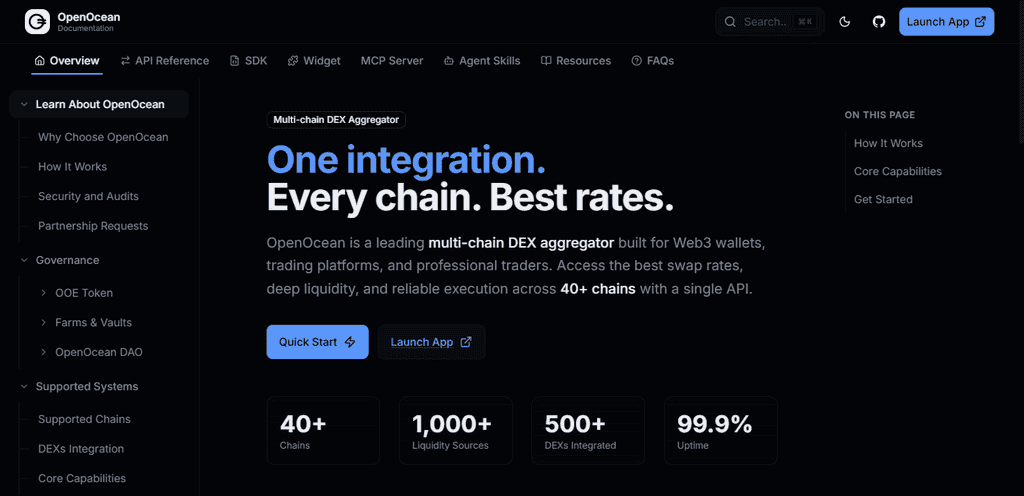
OpenOcean supports EVM and non-EVM ecosystems including Ethereum, BNB Chain, Base, Arbitrum, Polygon, Optimism, Avalanche, Solana and etc. In its developer stack it offers REST APIs, a TypeScript SDK and an embeddable Widget.
The infrastructure supports cross-chain swaps, limit orders, DCA and select gasless transactions in addition to same-chain swaps. The price depends on the integration and functionality you desire. Its wide chain and liquidity coverage makes it a practical alternative for multi-chain applications.
Best Use Cases
- Multi-Chain Swapping – Create apps that need to access liquidity on multiple blockchain networks.
- Wallet Integration – Include aggregated token swaps and routing to Web3 wallets.
- Trading Applications – Enable automated liquidity discovery and route optimization for users.
- Cross-Chain Products – Leverage its bigger infrastructure for use cases that require swap and cross-chain features.
- Embedded Web3 Trading – Embed swap widgets, APIs, or SDK functionality into consumer apps.##
Limitations
- General infrastructure complexity – The fact that there are many chains and liquidity sources to support can increase the integration and maintenance burden.
- Liquidity Variation – The quality of execution can vary widely between different networks and trading pairs.
- Feature Availability – Certain features may not be available across all supported blockchains uniformly.
- Third Party Dependency – Aggregated execution relies on underlying DEXs, bridges and liquidity providers.
5. CoW Protocol API
CoW Protocol performs DEX execution by batch auctions and a competition of solvers instead of simply traditional AMM routing. Its API allows quote generation, order submission, and order management. The solver competition determines the execution opportunities for submitted trades.
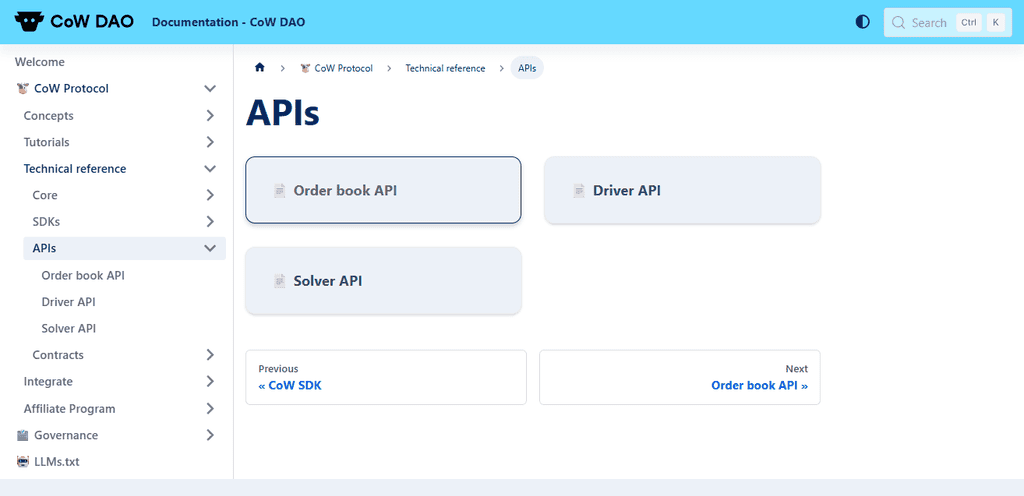
The API is available for networks such as Ethereum, Gnosis Chain, Arbitrum, Base, Polygon and more. Developers have the choice of using REST endpoints or TypeScript SDK, with integrations for Ethers and Viem. You don’t need an API key for basic API operations.
Its quote streaming endpoint can provide progressively better quotes as solvers respond. This model makes CoW Protocol particularly appealing when execution quality, solver competition, MEV protection, and custom order-management workflows are of importance.
Best Use Cases
- MEV-Aware Trading – Made for use cases that require protecting measures specific to solver-based execution.
- Batch-Auction Trading – Develop trading workflows based on batch auctions, not traditional single-venue swaps.
- Wallet integrations – Enable users to submit orders via the solver-based execution of CoW Protocol.
- Institutional DeFi – Ideal for applications that require formalized order submission and competitive solver execution.
- Custom Trading Interfaces – Leverage API and SDK features to build custom order-management experiences.
Limitations
- Solver Dependence – Execution is dependent on participating solvers, and the liquidity they can gain access to.
- Execution timing – batch-auction mechanics are different to instant AMM swaps, and might not fit every trading workflow.
- Supported Networks – Applications are limited to networks where the relevant CoW infrastructure exists.
- Integration Learning Curve – Solver based architecture might require more understanding than a simple swap API.
6. LI.FI API
LI.FI is a cross-chain aggregation API that aggregates DEX aggregators, exchanges, and bridges into one routing layer. LI.FI can compare different exchanges and bridges and build routes for same-chain or cross-chain token transfer instead of limiting developers to a single liquidity source.
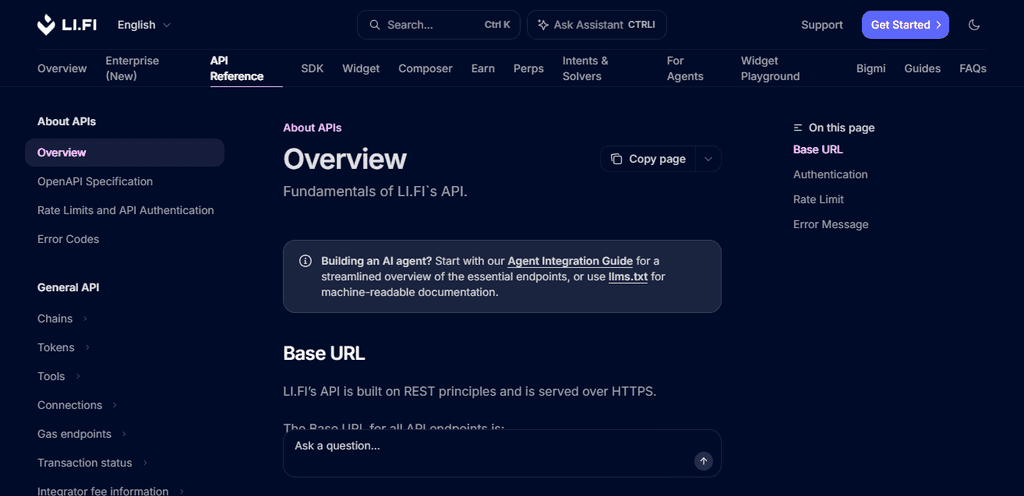
Quote API returns estimated output, minimum output, gas costs, fees, execution duration and transaction data. Developers are able to choose routing preferences for fastest or cheapest routing and permit, deny or prioritize specific exchanges and bridges.
Integrators can also set their own rates. This makes LI.FI especially useful for wallets, DeFi apps and trading interfaces that require DEX liquidity aggregation and cross-chain execution in a single API integration.
Best Use Cases
- Cross-Chain Swaps – Develop applications that enable users to exchange assets across different blockchain networks.
- Wallet Infrastructure – Provide access to bridge and DEX routing through a single integration.
- DeFi Applications – Integrate same-chain swaps and cross-chain transfers in a single interface.
- Trading Platforms – Compare different venues on cost, execution time and liquidity available.
- Web3 Aggregators – Build apps that want to access multiple bridges and DEX aggregators without having to integrate each one separately.
Limitations
- Cross-chain complexity – Cross-chain transactions have more moving parts and points of failure than simple swaps.
- Bridge Dependency – The availability of routes is dependent on the underlying bridges supported by the infrastructure.
- **Variable Execution Times ** – Cross-chain transactions can take longer to execute than same-chain swaps.
- Route Availability – Availability of routes will differ between token and blockchain pairs.
7. API Jupiter
Jupiter is a liquidity aggregation and routing infrastructure built on Solana that connects applications to liquidity across the Solana DeFi ecosystem. Its Swap API has quote and transaction-building endpoints, and newer routing infrastructure can aggregate multiple routing engines and sources of liquidity.
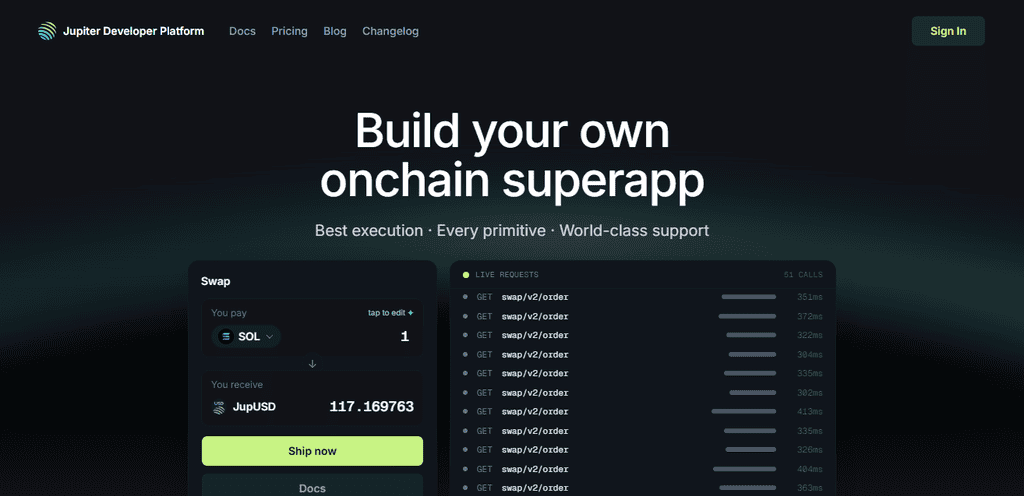
Developers are able to set parameters like slippage, swap mode, the inclusion/exclusion of DEX, intermediate tokens and platform fees. Jupiter APIs can return route information and generate swap data ready for transactions.
Its Ultra API also provides a managed order-and-execute workflow with managed transaction landing. Jupiter’s core strength in deep Solana liquidity routing, unlike multi-chain competitors, will make it particularly relevant for Solana wallets, trading platforms and DeFi applications.
Best Use Cases
- Solana Wallets – Integrate aggregated token swaps to Solana wallets.
- Solana DeFi Apps — Enable automated routing across liquidity venues on Solana.
- Trading Interfaces – Develop applications that need real time quotes and transaction generation.
- Token Swap Products – Have a configurable swap feature with controls for slippage and route.
- Solana Trading Infrastructure – Use Jupiter’s APIs as an execution layer for Solana market targeting apps.
Limitations
- Solana Focus – Jupiter is mainly built for the Solana ecosystem, and not for generic multi-chain routing.
- Solana Dependency – Targeting multiple disparate blockchain ecosystems introduces the need for additional infrastructure.
- Liquidity Conditions – Execution is dependent on the available Solana liquidity for the selected trading pair.
- API Integration Requirements – The developers should properly handle quotes, transactions, slippage and execution states.
8. Bebop API
Bebop is an RFQ and intent focused trading infrastructure that focuses on delivering competitive execution through professional liquidity providers over traditional AMM pools. The architecture features signed quotes and special routing mechanisms for token trading with controlled execution parameters.
Bebop’s developer infrastructure is designed for application integrations where quote retrieval, transaction construction and execution matter. Its RFQ contracts have built in fee and slippage protection mechanisms and its liquidity model allows market makers to participate in execution directly.
Bebop can be an additional source of liquidity and execution venue for wallets, aggregators and trading interfaces. The key differentiator is professional market-maker liquidity and RFQ-style execution, not traditional pool-only routing.
Best Use Cases
- RFQ Trading – Add professional market-maker quotes to trading apps.
- Wallet Swaps – Incorporate other liquidity sources and execution into wallet apps.
- Trading Aggregators – Integrate Bebop liquidity with AMMs and other venues.
- Large Order Execution – Leverage RFQ-style liquidity for trades where direct market maker pricing can be advantageous.
- Institutional DeFi – Design trading workflows for quote-based execution and professional liquidity providers.
Limitations
- RFQ Dependency – Quotes are dependent on the participating market makers and their liquidity.
- Pair Coverage – Not all token pairs are guarantyd to have the same depth and availability.
- Market Conditions – Quotes may be updated when market makers change prices.
- Integration Complexity – RFQ execution requires the handling of quotes, signatures, expiration and transactions to be done correctly by developers.
9. Hashflow API
Hashflow operates on a request-for-quote model, with market makers posting cryptographically signed prices for trades. Market makers can use off-chain pricing information and liquidity sources to generate quotes on Hashflow, instead of relying solely on AMM pricing curves.
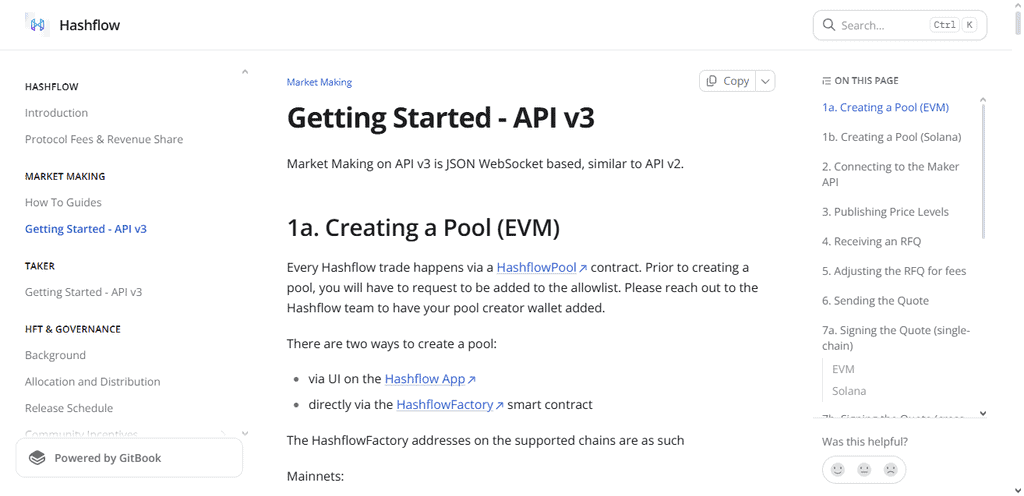
Signed quotes are still valid at the time of the trade, which protects the execution price and reduces the risk of front-running and sandwich attacks. Its API enables developers to discover available market makers, request RFQs and receive signed quotes ready for execution.
Hashflow charges trading fees in its RFQ pricing model, with dynamic fees for some blue-chip pairs and static fees for other pairs. This is particularly the case for applications that seek RFQ-based execution and professional market-maker liquidity.
Best Use Cases
- RFQ-Based Swapping – Build applications on top of professional market-maker quotes and not just AMM pools.
- MEV-Aware Trading – Use signed pricing to mitigate some front-running and sandwich attack concerns.
- Wallet Integration — Integrate Hashflow liquidity into wallets as an option for swaps.
- Trading Platforms – Offer market maker driven quotes and execution to users.
- Cross-Chain Trading – Allow apps that use Hashflow’s cross-chain trading infrastructure, where available.
Limitations
- Reliance on Market Makers – Execution relies on participating market makers giving usable quotes.
- Asset Availability – The market and network determine available assets and liquidity.
- RFQ Mechanics – Developers should properly handle the requests for quotes, signed pricing, expiration, and execution.
- Route Coverage – It may not have the same wide DEX-pool aggregation model as traditional DEX aggregators.
Key Features to Compare Before Integration
Real-Time Quotes: Before users commit to transactions, make sure the API returns accurate and frequently updated quotes that reflect current liquidity, prices in the market, gas fees, and expected swap execution.
Smart Order Routing: Verify that the API can locate and consolidate liquidity sources, utilize multi-hop routes, and optimize transactions based on output, price impact, and execution costs.
Multi-Chain Support: Look at supported blockchains and tokens to make sure the API supports the networks your application is already using and can support future expansion without major redevelopment.
Liquidity Coverage: Look at the number and quality of integrated DEXs, AMMs, RFQ providers, and other sources of liquidity to determine the breadth of available market liquidity that the API can access.
Slippage Controls: Check if developers are able to define slippage tolerance, minimum received amounts, and other transaction parameters to offer greater control over the result of an execution.
Gas Optimization: Evaluate how the API estimates gas prices and considers the transaction cost in routing decisions, especially in cases with multiple routes or liquidity sources for each swap.
API & SDK Support: To understand how easy it is for developers to build and maintain the integration, look at API endpoints, SDK availability, documentation, authentication, rate limits, programming language support, and integration examples.
Fees & Pricing: Review platform fees, transaction fees, API costs, volume costs, and potential partner fees to get a sense of the total cost of running the integration at scale.
Conclusion
The best 0x API alternatives to choose depend on your application’s liquidity, routing, blockchain, and integration needs. 1inch and ParaSwap are established DEX aggregators, while Odos focuses on smart order routing and complex trade paths. OpenOcean aggregates across many chains; CoW Protocol is based on solver-based execution.
LI.FI provides DEX and cross-chain routing, Jupiter concentrates on Solana liquidity. Bebop and Hashflow offer RFQ-based execution from professional liquidity providers. Developers need to compare the supported chains, liquidity coverage, quote quality, routing methods, API capabilities, fees, slippage controls, gas handling, documentation, and execution requirements before integrating to find the infrastructure that best fits their specific product.
FAQ
What is a 0x API rival?
A 0x API rival is a DEX aggregation or routing platform that provides similar infrastructure for accessing decentralized liquidity, generating swap quotes, optimizing routes, and executing token trades through APIs.
Which are the major 0x API rivals?
Major alternatives include 1inch, ParaSwap, Odos API, OpenOcean API, CoW Protocol API, LI.FI API, Jupiter API, Bebop API, and Hashflow API.
What should developers compare when choosing a 0x API alternative?
Developers should compare liquidity coverage, supported blockchains, routing technology, API performance, execution quality, developer tools, pricing, fees, documentation, and suitability for their specific application.
Which 0x API alternative focuses on Solana?
Jupiter is primarily focused on Solana liquidity and provides APIs for quotes, routing, and swap transaction generation. It is designed for Solana wallets, DeFi applications, and trading platforms.
Which alternatives support RFQ-based liquidity?
Bebop and Hashflow use RFQ-oriented execution models involving professional liquidity providers. CoW Protocol also uses a distinct solver-based model rather than relying exclusively on conventional AMM routing.