

As Web3 applications grow and diversify on various blockchain networks, the need for reliable multi-chain data is on the rise. While SimpleHash is known for providing structured NFT and blockchain data, developers may be seeking other options with varying chain coverage, API choices, wallet data, or pricing structures.
In this guide, I’ll be covering the Best SimpleHash Competitors for Multi-Chain Data and looking at what each of these platforms has to offer. I’ll walk you through data capabilities, supported networks, API access, pricing philosophy and practical use cases relevant when selecting a provider.
Why Look for SimpleHash Competitors?
Additional Chains Covered: Some alternatives support more blockchain networks, allowing developers to build applications that require data from a wider array of EVM and non-EVM ecosystems.
More Complete Data: Competitors may have wider data coverage, such as wallets, tokens, transactions, DeFi activity, and historical blockchain data beyond the NFT-centric data and standard collection metadata.

Sophisticated Wallet Analytics: They can be used for sophisticated wallet tracking applications . Some platforms provide detailed balances of wallets , holdings , transfers , transaction histories , portfolio values , address activity , etc .
Flexible API Options: Alternatives could offer various integration methods such as REST APIs, GraphQL, SDKs, RPC endpoints, WebSockets, and webhooks, enabling developers to choose the appropriate infrastructure.
NFT-specific Functionalities: Some NFT-specific competitors may provide enhanced marketplace data, floor prices, listings, bids, sales, ownership, collection analytics, and trading data for niche NFT use cases.
Needs for Real-Time Data: Apps that need live blockchain activity might prefer providers that offer real-time streams, event monitoring, webhooks, and continuously indexed data to update and analyze the app faster.
Pricing and Scalability: Pricing models differ between providers, which include free tiers, API credits, usage-based billing, and enterprise plans, allowing businesses to compare costs as application usage increases.
Specific Application Needs: Developers may require specific infrastructure for marketplaces, wallets, analytics, portfolio trackers, or Web3 applications, so alternative providers might be more appropriate for technical and data needs.
How to Choose the Right SimpleHash Competitor
Blockchain Coverage Check: Determine the specific blockchains your app will need, and verify that the provider has good data coverage on those chains, and whether they cover the datasets you need.
Assess Data Types: Identify if you want NFT metadata, ownership, token balances, wallet activity, transactions, prices, or marketplace data, then select the provider.
Match API Access: Determine if the platform offers REST APIs, GraphQL, SDKs, RPC endpoints, WebSockets, or webhooks that align with your application’s technical architecture and integration needs.
Check Data Freshness: Determine if your application needs real-time, near-real-time, or historical blockchain data, and check the provider’s indexing frequency, historical depth, and availability across supported networks.
Compare Pricing Models: Review free tiers, API credits, request limits, usage-based pricing, and enterprise plans to project costs based on your expected data volume and application expansion.
Evaluate Scalability: Select infrastructure that can support an increase in API requests, users, wallets, transactions, and data queries without creating major performance or reliability problems as your application grows.
Look at Developer Tools: Examine available SDKs, documentation, sample code, webhooks, testing environments, and technical support to see how easily developers are able to integrate and maintain the platform.
Match Your Use Case: Pick the competitor based on your core need such as NFT marketplaces, wallet analytics, portfolio tracking, blockchain research, token applications, or multi-chain data infrastructure.
Key Points
| Platform | Key Multi-Chain Data Capability |
|---|---|
| Alchemy | Multi-chain blockchain infrastructure and indexed data APIs |
| Moralis | Unified APIs for blockchain, wallet, token, and NFT data |
| Covalent | Unified blockchain data across multiple networks |
| QuickNode | Multi-chain RPC, indexed data, and blockchain APIs |
| Bitquery | Real-time and historical blockchain datasets through APIs |
| Chainbase | Multi-chain indexed blockchain and wallet data |
| GoldRush (Covalent) | Unified APIs for wallet, token, NFT, and transaction data |
| Reservoir | NFT and marketplace data across supported chains |
| Blockchair | Multi-chain explorer and blockchain data APIs |
| Ankr | Multi-chain RPC and blockchain infrastructure APIs |
1. Alchimy
Founded in 2017, Alchemy provides blockchain infrastructure and data APIs. It’s priced on usage-based plans, with free access for developers and paid tiers for higher usage. Alchemy works with leading networks, including Ethereum, Base, Polygon, Arbitrum, Optimism, and others. It covers core data including NFT’s, tokens, wallets, transfers and prices.
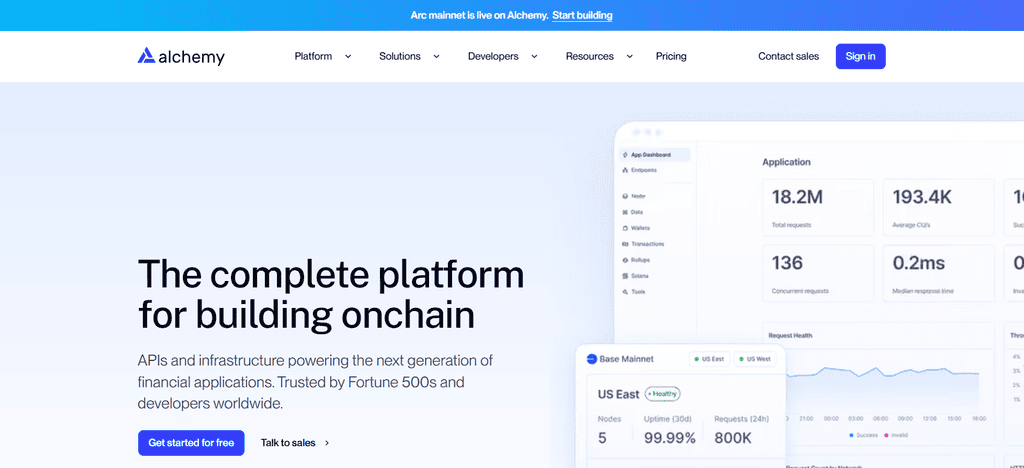
NFT APIs include information on metadata, ownership and marketplaces Token and Portfolio APIs include balances, wallet assets. Alchemy offers developers REST APIs, SDKs and webhooks to access data, making it suitable for multi-chain applications.
Top Use Cases
- Multi-chain dApps – Building apps that require connectivity to Ethereum and major Layer-2 blockchains.
- NFT Applications – NFT marketplaces, portfolio trackers, and applications requiring NFT metadata and ownership data.
- Wallet Analytics – Monitor wallet balance, token holdings, transfers and transaction activity.
- Blockchain Data APIs – Get structured on-chain information without needing to run your own indexing infrastructure.
- Web3 Developer Infrastructure – A collection of RPC, APIs, webhooks, and developer tools for building production blockchain applications.
Limitations
- Coverage varies by API – Not all data endpoints cover all blockchains.
- Usage costs – More usage of the API leads to more infrastructure costs.
- Advanced features may require paid plans – Bigger apps may need higher-tier access.
- Not NFT-specific – Applications oriented toward NFT may need extra specialized data services.
2. Moralis
Founded in 2018, Moralis provides structured blockchain data as consumption-based API plans. The current plans are Starter, Pro, Business and Enterprise, with pricing mostly based on Compute Units and throughput.
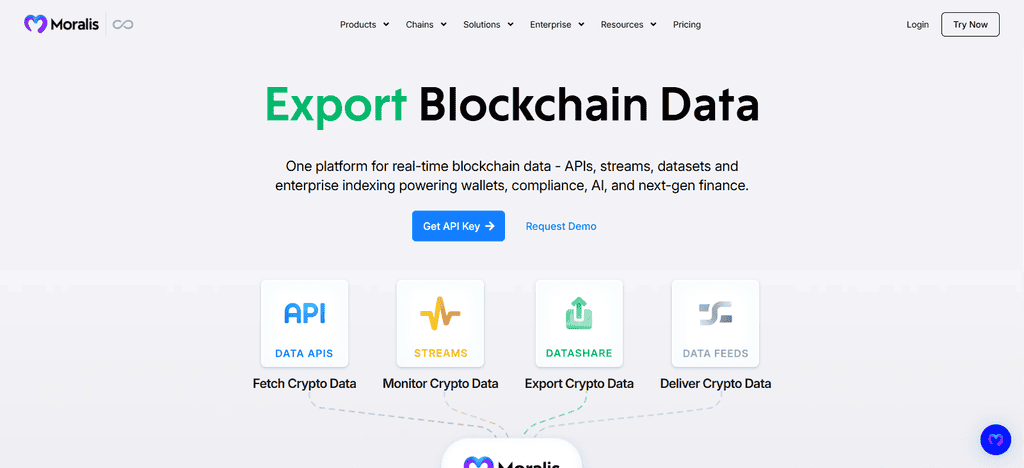
Moralis supports a number of EVM and non-EVM networks, including Ethereum, Solana and Bitcoin, although coverage varies by the API. Core data of wallets, tokens, NFTs, prices and DeFi. NFT APIs provide metadata, ownership, transfers and pricing.
Wallet APIs provide balances, holdings, transfers and net worth. Developers are able to connect using REST APIs, SDKs and Streams.
Best Use Cases**
- Wallet Analytics – Creating wallet dashboards to display balances, holdings, transactions and portfolio info.
- NFT Use Cases – Read NFT metadata, owners, transfers and collections info.
- Token Applications – Building token dashboards, portfolio trackers and token-analysis apps.
- DeFi Data Applications – Getting structured data on blockchain and DeFi.
- Multi-chain dApps – Applications that need harmonized data from multiple blockchains via standard APIs.
Constraints
- Usage-based on compute-unit – More activity of applications can lead to higher costs of API consumption.
- Not all networks are covered – Each API may be covered by different networks.
- Feature differences across chains – One data set can have a different depth on each network.
- API dependency – Applications that heavily depend on Moralis will continue to depend on its infrastructure and availability.
3. Covalent
Covalent was launched in 2018 and built unified blockchain data infrastructure, now primarily showcased through its GoldRush platform. It offers a mix of free, pay-per-use and professional pricing. The core focus of Covalent is normalized, multi-chain data for wallets, transactions, tokens, NFTs, and balances.
NFT capabilities include collection and ownership information, and token and wallet APIs provide balances, transfers and historical on-chain activity. Developers access the data via REST APIs, SDKs and other developer interfaces. The appropriate Covalent data platform for current product positioning is GoldRush.
Top Use Cases of
- Multi-Chain Analytics – Analyze standardized blockchain data from various blockchains.
- Wallet Portfolio Apps – To track balances, transactions, token holdings and history.
- NFT data applications – Collecting data on NFT ownership, metadata, and transaction-related information.
- Blockchain Research – Study of past on-chain transactions and token movements.
- Web3 Data Infrastructure – Leveraging indexed blockchain data rather than building an internal indexing system.
Constraints
- Product transition – Covalent’s data infrastructure is now primarily under the GoldRush brand.
- Endpoint-specific coverage – Supported chains and datasets may vary across APIs.
- Usage Limits – Applications with higher volume needs may require paid access.
- Not only NFT-specific – A more dedicated NFT API may be required for dedicated NFT apps.
4. QuickNode
Founded in 2017, QuickNode offers usage-based blockchain infrastructure and data services. It has free and paid plans with API-credit-based usage, and additional fixed-rate options for selected endpoints. QuickNode supports 80+ chains like Ethereum, Solana, Base and Bitcoin.
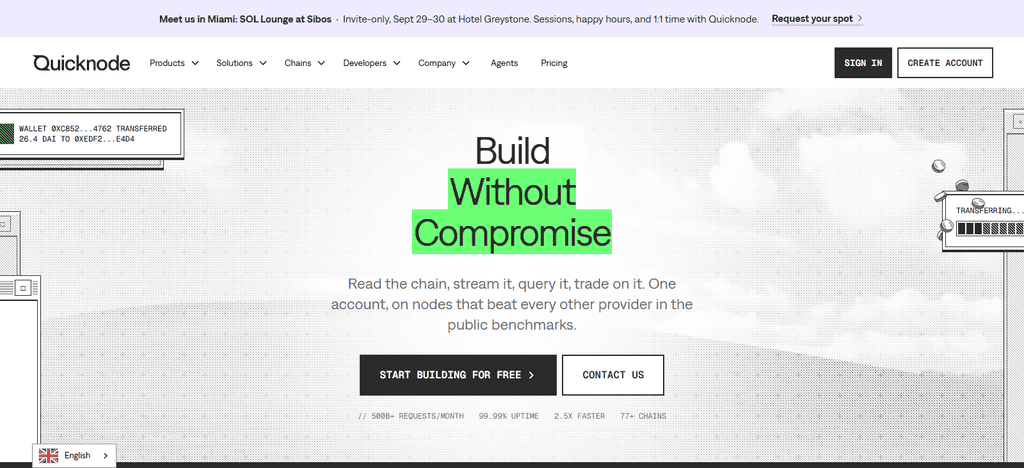
The main focus is on RPC infrastructure, real-time blockchain data & developer APIs. NFT capabilities are available through NFT-related APIs and add-ons and wallet and token information is available through supported data services. Developers are able to utilize RPC endpoints, APIs, SDKs, Streams, and webhooks to leverage multi-chain applications.
Most Common Applications**
- Blockchain RPC Infrastructure – Connect apps directly to supported blockchain networks.
- Multi-Chain dApps – Enabling applications to function on more than one blockchain ecosystem.
- Real-time Blockchain Data – Get blocks, transactions, logs and other on-chain data.
- NFT Applications – Use supported NFT APIs and data services to build NFT use cases.
- Developer Infrastructure – Production Web3 apps built on RPC, Streams, APIs and webhooks.
Study Limitations
- RPC-first platform – It’s infrastructure, not a dedicated NFT-data catalog, that’s its core strength.
- Features are chain-specific – Not all advanced APIs provide the same functionality on all networks.
- **Can be costly ** – Large requests can lead to higher consumption of API-credits.
- Multiple products may be required – Some applications require individual QuickNode services to receive full data coverage.
5. Bitquery (BQT)
Bitquery was founded in 2018 and provides usage-based access to blockchain datasets. Its current offering spans 40+ blockchains, including Ethereum, Bitcoin, Solana, BNB Chain, Arbitrum, Base, Polygon and Tron. At its heart, it focuses on data about transactions, transfers, token flows, DEX trades, prices, OHLC data and blockchain analytics.
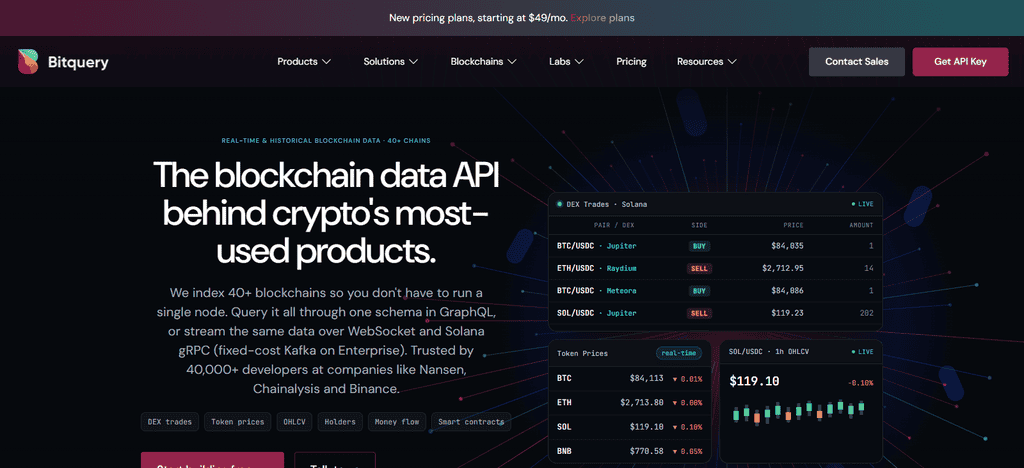
You can query NFT related and token activity, wallet addresses and transaction histories. For Bitquery, developers are able to use GraphQL APIs, real-time subscriptions, WebSocket, gRPC, Kafka and other data interfaces.
Top Use Cases**
- Blockchain Analytics – Transaction, transfer, token movement and blockchain activity queries
- DEX Analytics – Track swaps, liquidity activity, trading data and decentralized-exchange transactions.
- Wallet Intelligence – Wallet transaction analysis, token flows, address activity.
- Real-time Monitoring – Monitoring the blockchain events and transaction activity in real-time.
- Custom Data Analysis – Create custom queries of blockchain data via GraphQL and other interfaces.
Limitations
- Technical learning curve – More complex GraphQL queries demand more developer expertise.
- Pricing based on usage – High volume or complex data queries may consume additional resources.
- Dataset differences – What information is available depends on the blockchain and endpoint.
- Less consumer-oriented – More for developers and data analysts than simple plug-and-play NFT applications.
6. Chainbase
Chainbase launched in 2023 and delivers indexed blockchain data through API access on a usage basis. Its main focus is on multi-chain on-chain data for tokens, wallets, transactions and NFTs, with support mainly focused on EVM-compatible networks for specific data sets. Its NFT API provides collection information, metadata, ownership, transfers, floor prices and marketplace information.
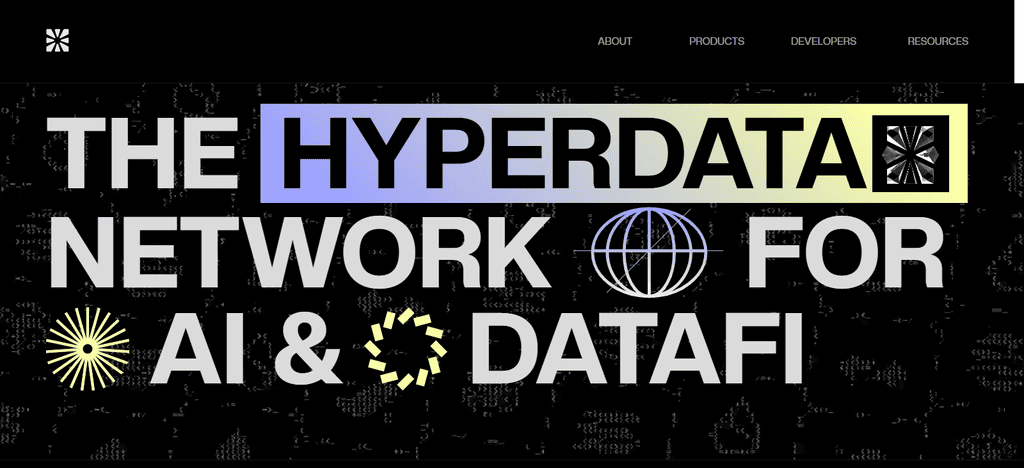
Balances, transfers and address-level blockchain analysis can be done using token and wallet data. Developers are able to incorporate Chainbase via APIs and data-query interfaces. Chain coverage is endpoint-dependent, so developers should check supported networks for each dataset they need.
Top use cases**
- Multi-chain Data Applications – Applications that build on top of indexed blockchain datasets.
- Wallet Analytics – Wallet balance, transactions, transfers and on-chain activity tracking.
- NFT Applications – Get NFT metadata, ownership, transfers and collection info.
- Token Analytics – Enables tracking of token balances, transfers and other blockchain data regarding the market.
- AI/Web3 Data Applications – Building data-driven applications and analytics using structured blockchain data.
Limitations
- Chain support for particular endpoints – Not all supported chains expose all datasets.
- API Usage Limits – Larger applications might need higher usage plans.
- Chain data depth varies – Historical and enriched data may vary across networks.
- Less rich ecosystem than established providers – Developers may find fewer mature integrations available than with larger infrastructure platforms.
7. GoldRush (Covalent)
Covalent’s existing multichain data platform is GoldRush, which offers access to **100+ EVM and non-EVM chains. It offers a free API-key option along with professional and enterprise access, and additional pay-per-request support via x402. GoldRush focuses on wallet, token, NFT, transaction and blockchain level data.
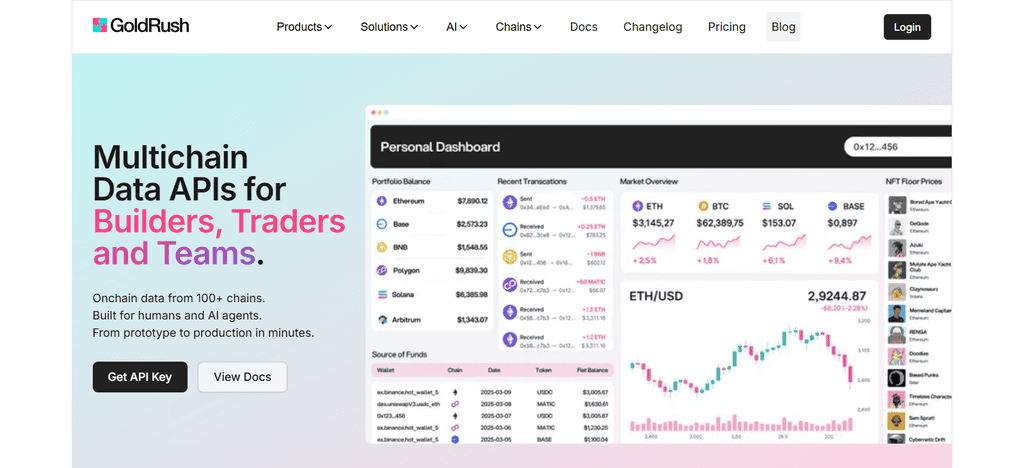
Its APIs can return wallet balances, historical transactions, NFT metadata, token prices and other on-chain data. GoldRush is a wide multi-chain data alternative that developers are able to access through direct APIs, SDKs, CLI tools, MCP and x402 pay-per-call.
Top Use Cases**
- Multi-chain Wallet APIs – Building portfolio and wallet apps on many supported networks.
- Token Data – Checking balances, transfers, token prices and wallet holdings.
- NFT Applications – NFT metadata, ownership and transaction information.
- Transaction History – Building explorers, wallet histories and Blockchain analytics
- Cross-chain Data Infrastructure – Access to normalized data without the need to maintain separate indexing systems.
Limitations
- Chain data availability – Not all networks have the same data available.
- Usage-based costs – API costs can be expensive for large-scale applications.
- Covalent-specific migration considerations – The transition to the platform and current product structure for existing Covalent users may need to be taken into account.
- Not all use cases are highly specialized – Specialized NFT or blockchain APIs can provide more depth for specific use cases.
8 Reservoir
Launched in 2022, Reservoir is mainly focused on NFT data and trading infrastructure. Its hosted API can be found on 30+ EVM chains including Ethereum, Polygon, Base, Arbitrum, Avalanche, BNB Chain and many more. Its data focuses on NFT metadata, ownership, prices, marketplace orders, and collection statistics.
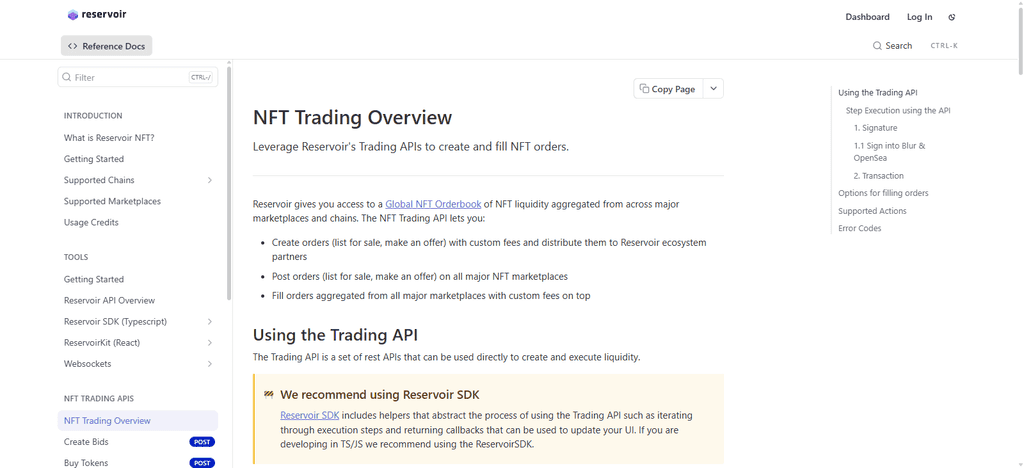
NFT APIs offer real time floor prices, top bids, token prices, historical royalty data and rich metadata. The token and wallet capabilities are more NFT-focused than general purpose blockchain data platforms. Developers are able to embed via REST APIs, SDKs and UI kits for NFT apps.
Top Use Cases
- NFT Marketplaces – Create marketplaces with listings of NFTs, orders, sales and trading capabilities.
- NFT Aggregation – Aggregation of NFT liquidity and marketplace data from the chains we support.
- NFT Portfolio Apps – Showing collections, ownership, floor prices and value of NFTs.
- NFT Trading Infrastructure – Building apps that interact with marketplace orders and NFT transactions.
- Collection Analytics – Monitoring NFT collection activity, pricing and marketplace info.
Restrictions
- NFT-centric platform – Not as well suited for general blockchain data needs.
- No full token analytics – It is not meant to be a full token and wallet data provider.
- Chain coverage is less than some general infrastructure providers – Developers should check the supported networks.
- Niche use case – Applications that need a lot of historical data from the blockchain may require a different data provider.
9. Blockchair
Blockchair was launched in 2017 and provides a blockchain explorer and API infrastructure with free and paid access models. Its API supports 19 blockchains and testnets from the Bitcoin-like, Ethereum-like, Ripple, Stellar, Monero, Cardano, Tezos and other ecosystems.
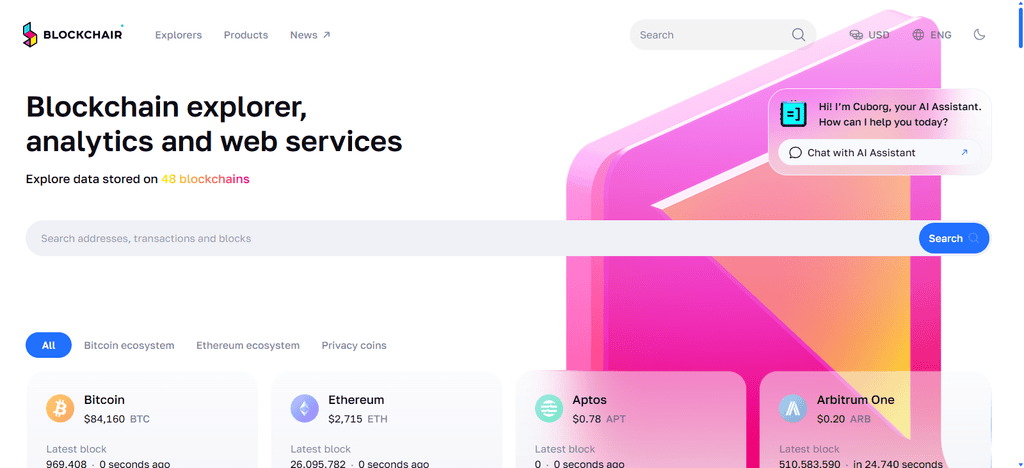
Its main focus is on blockchain search, transactions, addresses, balances, blocks and network statistics. NFT data isn’t its main specialty compared to SimpleHash, but token and wallet info is available for supported networks. Developers are able to access data via REST-style APIs, with the cost of requests varying by endpoint and data set complexity.
Best Features
- Blockchain Explorers – Create applications to search blocks, transactions and addresses.
- Wallet Monitoring – monitoring balances and activity at the address level on the blockchain.
- Transaction Analysis – Searching and analyzing historical transactions on the blockchain.
- Multi-chain Research – Comparison of the activity of blockchains supported by Blockchair.
- Blockchain APIs – Providing indexed blockchain data to analytics and monitoring applications.
Limitations
- Limited NFT focus – More advanced NFT features may be available through dedicated NFT APIs.
- Limited ecosystem coverage – Supports fewer blockchains than some multi-chain infrastructure providers.
- API limits – Access and usage is subject to the API plan and endpoint you select.
- Less specialized for modern Web3 applications – Developers creating advanced NFT or DeFi applications may require additional data services.
10. Ankr
Founded in 2017, Ankr provides public, freemium and premium blockchain infrastructure plans. The Premium service has API-credit based pricing with pay-as-you-go and monthly Deal options. Ankr supports 80+ networks such as Ethereum, Solana, BNB Chain, Arbitrum, Base, Bitcoin, TRON, TON and Sui.
Its main focus is RPC and enhanced blockchain data. Multi-chain NFT, token balance, price, transaction and log data. Advanced APIs. Developers are able to connect to Ankr using standard JSON-RPC, advanced APIs, HTTPS, WebSockets, gRPC, and SDK-based integrations.
Top Use Cases
- Multi-chain RPC – RPC endpoints that connect applications to multiple blockchain networks.
- Blockchain Data APIs – Use token, NFT, transaction and other rich blockchain data.
- Web3 dApps – Enabling blockchain connectivity for decentralized applications.
- Wallet and Token Applications – Check balances, token info and transactions on supported chains.
- ** Developer Infrastructure ** – RPC, APIs and WebSockets for blockchain apps at scale.
Limitations
- RPC remains a big focus – It is not just meant to be an NFT-data platform.
- Data support is network dependent – Advanced APIs may have different capabilities across different chains.
- Usage-based pricing – If you are running applications with high volume, these may consume a lot of API-credits.
- Additional services may be needed – Complex applications may require multiple Ankr APIs or external data providers for full coverage.
Key Factors to Compare SimpleHash Competitors
| Key Factor | What to Compare |
|---|---|
| Multi-Chain Coverage | Number and type of supported blockchains, including EVM and non-EVM networks. |
| NFT Data | NFT metadata, ownership, collections, transfers, sales, floor prices, and marketplace information. |
| Token Data | Token balances, transfers, prices, metadata, and historical token activity. |
| Wallet Data | Wallet balances, holdings, transactions, portfolio information, and address activity. |
| API & Data Access | REST, GraphQL, SDKs, RPC, WebSockets, webhooks, and other integration options. |
| Data Freshness | Availability of real-time, near-real-time, and historical blockchain data. |
| Pricing Model | Free tier, API credits, usage-based pricing, request limits, and enterprise plans. |
| Scalability | API capacity, rate limits, reliability, and ability to support growing application usage. |
| Core Data Focus | Whether the platform specializes in NFTs, wallets, tokens, transactions, DeFi, or broader blockchain data. |
| Best Use Case | Suitability for NFT marketplaces, wallets, portfolio trackers, analytics platforms, or multi-chain dApps. |
Conclusion
In terms of determining the best SimpleHash competitors, it all depends on the particular needs of your Web3 application. Alchemy, Moralis, Covalent, QuickNode, Bitquery, Chainbase, GoldRush, Reservoir, Blockchair, and Ankr provide different combinations of blockchain coverage, NFT data, token and wallet information, API access, and pricing models.
Projects focused on NFTs may prioritize data related to niche marketplaces and collections, while analytics platforms may require more detailed datasets on wallets, transactions, and history. Before selecting a provider, compare the supported networks, the freshness of the data, the APIs available, the scalability, and the costs you expect. The best option is the one that fits the data and technical infrastructure you need.
FAQ
What are SimpleHash competitors for multi-chain data?
Major alternatives include Alchemy, Moralis, Covalent, QuickNode, Bitquery, Chainbase, GoldRush, Reservoir, Blockchair, and Ankr. Each provides different combinations of multi-chain, NFT, token, wallet, and blockchain data.
Which SimpleHash alternatives provide NFT data?
Alchemy, Moralis, Covalent/GoldRush, QuickNode, Chainbase, Reservoir, and Ankr provide NFT-related data through their respective APIs. Coverage and available NFT fields vary by blockchain and endpoint.
Which competitors provide wallet and token data?
Alchemy, Moralis, Covalent/GoldRush, Bitquery, Chainbase, Blockchair, QuickNode, and Ankr provide wallet and token-related data. Specific balances, transfers, pricing, and historical information depend on supported networks.
What should developers compare when choosing a SimpleHash alternative?
Developers should compare multi-chain coverage, NFT capabilities, token and wallet data, API access, data freshness, pricing, scalability, and historical data availability before selecting a provider.
Are SimpleHash alternatives suitable for NFT marketplaces?
Yes. Platforms such as Reservoir, Alchemy, Moralis, and GoldRush can provide NFT-related data useful for marketplaces. Developers should verify marketplace, ownership, metadata, pricing, and transaction support for their target chains.