

Choosing the right blockchain indexer can have a huge impact in terms of performance, scalability and data accessibility of an application. While Envio is known for fast indexing and flexible blockchain data infrastructure, developers may find themselves needing alternatives with different levels of RPC control, network coverage, customization, or deployment flexibility.
In this guide, we will review the Best Envio Competitors for Custom RPC Indexing including The Graph, Goldsky, Subsquid, SubQuery, Ponder, Alchemy Subgraphs, Covalent (GoldRush), Ormi, Rindexer and custom-built indexers, helping you to determine the option that best suits your project needs.
What to Look for in Envio Alternatives
Support for custom RPC
Select an indexing platform that allows integration with custom RPC endpoints, such as private, dedicated or self-hosted nodes. This means more control over the data sources and infrastructure of the blockchain.
Support for Blockchain and Networks
Evaluate the number and types of networks supported, including Ethereum, Layer-2s, sidechains and other EVM-compatible chains. Multichain applications benefit from broader coverage.

Speed of Indexing and Latency
Think about how fast the platform is at processing new blocks and smart-contract events. Low latency indexing is a must for trading platforms, DeFi apps, dashboards and real-time blockchain monitoring.
Indexing of Historical Data
We look for reliable historical indexing that can efficiently deal with large ranges of blockchains. Strong historical data capabilities are important for analytics, backtesting, portfolio applications, explorers, and data-hungry Web3 platforms
API & Query Parameters
Ensure that the solution can support GraphQL, REST, SQL, SDKs, or any other query interfaces. Indexed blockchain data can be incorporated into applications and backend architectures more easily with flexible APIs.
Customization
Look for platforms that let you create your own schemas, event handlers, transformations, filtering and indexing logic. The improved customizability allows developers to create application-specific datasets, instead of working with standardized blockchain data.
Scalability and Reliability
Evaluate the scalability of the indexer as the blockchain data, users, queries, and networks grow. Find reliable synchronization, monitoring, automatic recovery, and infrastructure that can support production workloads.
Pricing and Deployment Options
Compare free tiers, pay-as-you-go pricing, infrastructure costs, enterprise plans. Also consider managed vs self-hosted deployment, as operational control and maintenance requirements can have a big impact on overall costs.
Key Points
| Competitor | Key Point |
|---|---|
| The Graph | Decentralized indexing protocol with GraphQL APIs and a large ecosystem of public subgraphs. |
| Goldsky | Fully managed indexing platform offering real-time data pipelines and Graph-compatible subgraph hosting. |
| Subsquid (SQD) | High-performance multichain indexing framework supporting EVM and non-EVM networks. |
| SubQuery | Multi-chain indexing solution with support for EVM and numerous non-EVM ecosystems. |
| Ponder | Developer-friendly TypeScript indexing framework designed for custom EVM applications. |
| Alchemy Subgraphs | Managed indexing service integrated into Alchemy’s blockchain developer platform. |
| Covalent (GoldRush) | Provides indexed blockchain data APIs for multichain analytics and application development. |
| Ormi | Managed Graph-compatible indexing platform focused on easy migration and hosting. |
| Rindexer | Open-source indexing framework optimized for custom event processing and RPC-based indexing. |
| Custom-Built Indexer | In-house indexing infrastructure offering complete architectural control and optimization flexibility. |
1. The Graph
The Graph is a decentralized indexing protocol for querying networks such as Ethereum and IPFS. Developers build serverless applications on blockchain and beyond with The Graph. It supports many leading networks such as Ethereum and several EVM-compatible chains, and its ecosystem also includes hosted and decentralized infrastructure.
Developers define data schemas and mappings for how on-chain events are mapped to structured data. The Graph is especially helpful for dApps that require GraphQL queries, historical blockchain data, and reusable indexing logic. Its decentralized architecture allows for great flexibility but deployment and optimization may require more technical expertise than fully managed indexing platforms.
Features
- Decentralized protocol to index blockchain data
- Defines which data from the blockchain should be indexed using subgraphs
- Provides GraphQL APIs to query the indexed data.
- Multi-blockchain network and EVM ecosystem support.
- Developers are able to build custom schemas, mappings, and data-processing logic.
Strong ecosystem for DeFi, NFTs, DAOs, wallets and Web3 apps. - Supports index for historical blockchain data.
- Has existing developer tooling and documentation.
Major Limitations
- Complex indexing needs make developing subgraphs challenging.
Schema and implementation play a crucial role in query and indexing performance. - Decentralized infrastructure may add extra operational complexity.
Customized data pipelines may require additional infrastructure. - Large scale usage can require careful optimization and cost management.
2. Goldsky
Goldsky offers managed blockchain indexing and real-time data infrastructure for applications that require fast access to on-chain data. Its products center on customizable data pipelines and indexing and streaming blockchain data into databases or application backends. Goldsky supports multiple EVM compatible networks, very useful for DeFi, NFT, analytics and trading applications.
Developers are able to build pipelines that convert blockchain events into application-ready datasets without having to maintain the entire indexing infrastructure themselves. The managed nature lessens the operational complexity but offers a great deal of control over the data processing, making it a good fit for production applications that require low-latency blockchain data.
Main Features**
- Enables live blockchain data streaming.
- Allows you to build custom data pipelines.
- Capable of moving blockchain data into databases and application backends.
- Great for DeFi, trading, analytics, NFT and gaming apps.
- Reduces the need to manage the infrastructure for indexing manually.
*Designed for applications needing relatively low-latency data. - Offers agility to convert blockchain events to application ready data.
Constraints
- Managed infrastructure offers less control than a fully self-hosted indexer.
- Costs may vary based on data volume and usage.
- Complex application-specific processing may require additional engineering effort.
- Developers are still dependent on infrastructure and networks provided by the provider.
- Migration away from the platform may require architectural changes
- Large production workloads still need monitoring and optimization.
3. Subsquid (SQD)
Subsquid is a blockchain data indexing platform designed for high-performance extraction, processing and querying of historical and real-time blockchain data. Its architecture enables developers to build custom data pipelines and index only the data their applications need.
Subsquid supports many blockchain ecosystems and is especially useful for apps that work with large historical data sets, analytics, DeFi protocols, and complex event processing.
Its SDK and APIs let developers define custom indexing logic and storage structures. Its decentralized data-access architecture provides scalability and flexibility, and its developer-centric tooling makes it appropriate for complex blockchain data workloads.
Key Features
- Especially good on large historical blockchain data sets.
- Support for customizable data processing pipelines.
SDKs are provided to developers to build indexers. - Support for multi-blockchain environments.
- Is able to handle blockchain events and transform them into structured datasets.
- For analytics, DeFi, explorers, research, and data-heavy applications.
- Greater control over the indexing logic than simple data APIs.
Major Limitations
- Steeper learning curve for developers who haven’t used it before.
- Complex projects require knowledge of indexing architecture and data pipelines.
Developers may have to deal with more infrastructure. - Large scale indexing calls for careful management of resources and performance.
- Custom pipelines can be a lot of development work.
- Not as simple as using a pre-built multichain API.
4. SubQuery
SubQuery provides blockchain indexing infrastructure to structure raw blockchain data into application-friendly datasets. Developers are able to build projects that specify data schemas and mappings, event-processing logic, and expose indexed data via APIs. SubQuery is compatible with multi-chain and multi-ecosystem – useful for multi-chain dApps, analytics platforms, wallets, explorers and web3 applications.
xIts framework reduces the need to build indexing infrastructure from scratch, while still allowing developers to customize how they process events on the blockchain. SubQuery also offers managed services, which help teams deploy and run indexers without needing to manage every piece of infrastructure themselves.
Main Features**
- Building application-specific datasets through blockchain indexing.
- Allows developers to specify schemas, mappings and indexing logic.
- APIs to query indexed blockchain info.
- Offers both managed and self-hosted deployment options.
- Useful for dApps, wallets, explorers, DeFi, NFT and analytics apps.
- Easy-to-use developer tools for indexing blockchain data
- Developer customization of how blockchain events are processed.
Major Limitations
- Large indexing projects can require a lot of infrastructure resources.
- Performance is dictated by indexer setup and database architecture.
- Specialized processing may require custom development.
- Network-specific features may vary.
- To run your own infrastructure, you need to do more operations wor
5. Ponder
Ponder is a developer-focused blockchain indexing framework, built primarily for EVM-compatible networks. It lets developers build custom indexers in TypeScript, using common web design tools, instead of having to rely solely on hosted query infrastructure. Ponder can consume smart-contract events, organize blockchain data and expose that data through user-friendly interfaces.
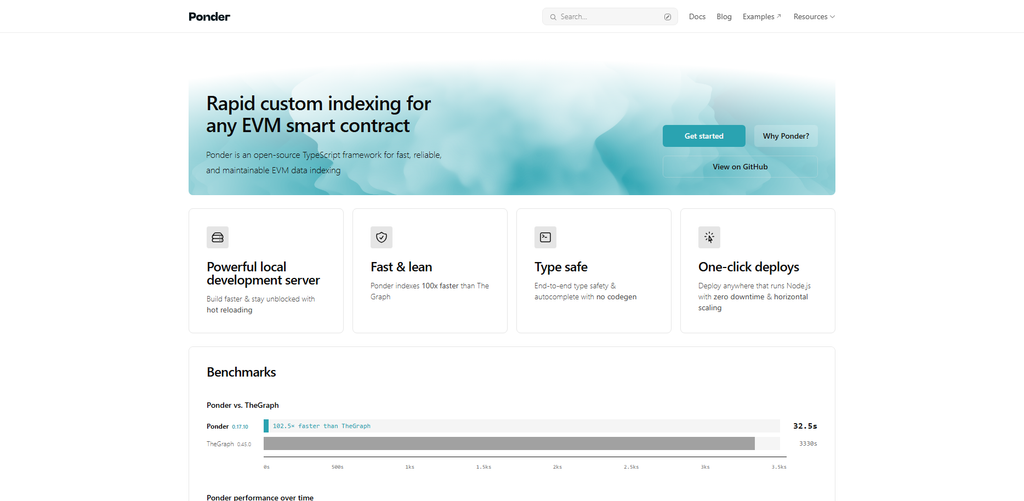
The biggest advantage is that it can be customized. Developers are able to choose how indexing is done, how the database is structured and how the application behaves. This makes Ponder especially attractive to teams building specialized dApps that need to have direct control over their indexing stack. However, compared to fully managed platforms, teams may have to take more responsibility for deployment and operations.
Main Features
- A developer-centric indexing framework designed primarily for EVM apps.
- Utilizes TypeScript, allowing for modern Web3 developers.
- Enables developers to plug in their own event-indexing logic.
- Supports event processing of intelligent contracts.
- Gives you control over database structures and application data
- Good for custom dApps and back-end applications.
- Developers are able to implement indexing infrastructure in their own application stack.
- Greater control than many fully managed indexing services out there.
Main Limitations
- Mostly targets EVM compatible blockchain environments.
- Not a good fit for applications needing extensive non-EVM support.
- Moves more of the application infrastructure to developers.
- Production deployments need to be managed and monitored operationally.
- Database and performance optimization might be needed for large scale workloads.
- Not as suitable for teams looking for a fully managed indexing service.
6. Alchemy Subgraphs
Subgraphs are a part of Alchemy’s blockchain dev infra that provides a managed solution for indexing smart-contract data and querying it using APIs. The service will be especially useful for developers already using Alchemy’s RPC and blockchain infrastructure, as indexing can be incorporated into the wider application stack.
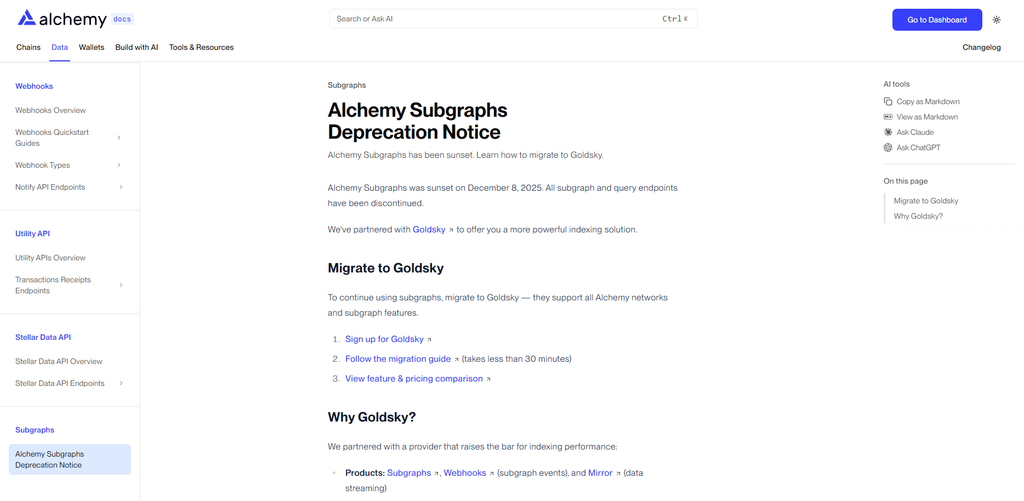
It reduces operational overhead of running independent indexers while providing structured access to contract events and blockchain data. Alchemy’s infrastructure is built to support multiple major blockchain networks, making it a good choice for dApps, analytics, wallets and Web3 applications that want managed infrastructure and smooth integration.
Main Features
- Provides managed blockchain indexing on Alchemy infrastructure.
- Enables developers to create structured blockchain datasets.
- Useful for indexing application specific data and smart contract events.
Integrates seamlessly with applications already using the Alchemy infrastructure. - Reduces operational burden of maintaining index infrastructure.
- Compatible with dApps, DeFi, NFT, analytics and web3 apps.
- Provides access via application-friendly APIs.
A part of Alchemy’s larger blockchain infrastructure ecosystem.
Limitations
- Increases your dependence on the Alchemy ecosystem.
- Less control at the infrastructure level than self-hosted indexing.
- Extensive data processing customization may require additional services.
- Large applications should consider usage limits and pricing
- Developers rely on the supported networks and available indexing functionality.
- Might require further development to move to a different indexing architecture
7. Covalent (GoldRush)
Covalent, which is now part of the GoldRush data platform, has unified blockchain data APIs that aim to make it easier to access historical and current on-chain data. Instead of requiring developers to build and maintain individual indexers for each network they support, GoldRush provides standardized APIs for balances, transactions, token activity, NFT data, and other blockchain information.
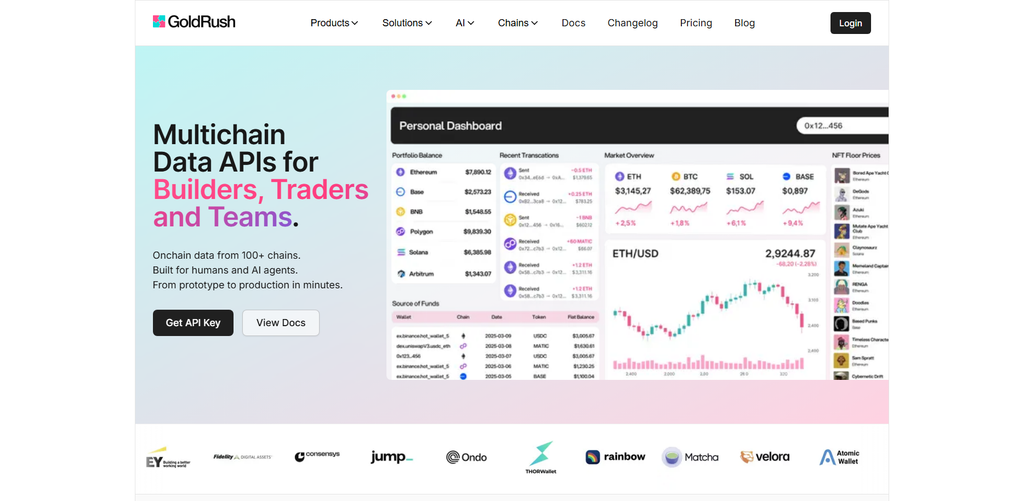
This is especially helpful for wallets, portfolio applications, analytics dashboards, and multichain applications. The main advantage is reducing development and infrastructure complexity. Developers are able to access normalized blockchain datasets via APIs, but the highly specialized indexing requirements may offer less customization compared to a custom indexer.
Highlights**
- Provides standard APIs to access blockchain data.
- Multichain data access is heavily emphasized.
- Normalizes blockchain data across supported networks.
- Offers transactional, balance, token, NFT and other on-chain datasets.
- Reduces the need to build individual indexers for each blockchain.
- Perfect for wallets, portfolio trackers, dashboards, analytics, and Web3 apps.
- Simplifies the development of multichain apps.
- Offers APIs of historical data on the blockchain.
Constraints
- Not as configurable as a fully custom indexer.
- It provides datasets and APIs that developers depend on.
- For very specialized smart-contract indexing, an alternative indexing solution may be needed.
Vendor lock-in problems can arise from the use of APIs. - You should also consider pricing and usage limits for high-volume applications.
Developers have less control over the underlying indexing infrastructure.
8. Ormi
Ormi is a blockchain indexing and data-access approach that aims to provide structured data infrastructure so that applications can more easily consume blockchain data. It is particularly relevant to developers who require configurable indexing, rather than simply relying on generalized blockchain APIs. The platform’s value is in simplifying the complexity of extracting smart-contract events and structuring blockchain information into usable datasets.
Developers are able to customize data processing to application requirements using indexing logic, depending on the supported ecosystem and deployment model. This enables Ormi to be taken into consideration when evaluating alternatives that promote developer control, specialized indexing workflows and application-specific blockchain data availability.
Main Features
- Aimed at making structured blockchain data easier to access.
- Suitable for application specific indexing requirements.
- Customizable data processing and indexing pipelines.
Developers don’t need to deal with raw blockchain data. - Useful for specialized blockchain-data applications.
- An alternative to larger general purpose indexing platforms.
- Can be evaluated when customized data-access requirements are important.
Principal Limitations
- Read the documentation and integrations carefully.
- Make sure the blockchain and network are supported for the project you want.
- Development effort may increase due to lack of widely adopted integrations.
- Adoption of production may require additional technical evaluation and testing.
9. Rindexer
Rindexer is an open source blockchain indexing framework written in Rust. It is designed for developers that want performance, flexibility, and control over their indexing infrastructure. It is particularly suitable for EVM-based applications where developers need to index smart-contract events into structured databases.
Since it’s self-hostable, teams can manage their own infrastructure, database configuration, indexing logic, and deployment environment instead of being fully dependent on a centralized indexing provider.
Its Rust foundation can deliver strong performance for demanding workloads. Rindexer will be particularly attractive to engineering teams that are comfortable managing their own infrastructure and are looking for an alternative to hosted indexing platforms that offers more control over the underlying system.
Main Features**
- Open source blockchain indexing framework.
- Written in Rust for performance critical applications
- Hosted yourself by development teams.
- Gives you control over the indexing infrastructure.
- EVM smart-contracts event indexing support.
- Developers are able to configure data processing and database as needed.
- Good for teams that don’t want to depend on a managed indexing provider.
- Can be tuned to the specific indexing needs of an application.
Major Limitations
- Knowledge of Rust can help with advanced customizations.
- A smaller ecosystem than some of the established indexing platforms.
- The infrastructure needs to be monitored and maintained by developers.
- Scaling requires optimization of the team’s own performance and the database.
- Internal handling of reliability, backups, upgrades and deployment
Envio vs. Its Top Competitors
| Platform | Indexing Approach | Custom RPC Support | Key Strength | Main Limitation | Best For |
|---|---|---|---|---|---|
| Envio | Managed or self-hosted indexer | Yes — EVM chains can be reached through RPC | Very fast historical indexing, TypeScript-based development, flexible deployment | HyperSync coverage is finite; unsupported chains may fall back to RPC | Fast EVM indexing and custom applications |
| The Graph | Decentralized subgraphs | Yes, including self-hosted infrastructure | Large ecosystem, GraphQL, decentralized indexing | More complex architecture; traditional subgraph development has a learning curve | DeFi, dApps, decentralized data access |
| Goldsky | Managed subgraphs + real-time data pipelines | Yes | Fully managed infrastructure and real-time streaming | No self-hosting; greater provider dependency | Production apps needing managed indexing |
| Subsquid (SQD) | High-performance data extraction/indexing | Yes | Strong historical data extraction and multichain capabilities | More technical setup for sophisticated indexing workloads | Large historical datasets and analytics |
| SubQuery | Indexing framework + decentralized infrastructure | Yes | Broad multichain ecosystem and customizable projects | Performance and setup vary by network/project | Multichain and non-EVM applications |
| Ponder | Open-source, self-hosted TypeScript indexer | Yes | Full TypeScript control and application-level customization | Self-hosting and scaling are the developer’s responsibility | EVM applications requiring maximum code-level control |
| Alchemy Subgraphs | Managed subgraph infrastructure | Yes, through supported infrastructure | Easy integration with Alchemy’s RPC ecosystem | More dependency on Alchemy’s platform | Teams already using Alchemy |
| Covalent (GoldRush) | Pre-indexed multichain data API | API/data access rather than custom indexer | Normalized multichain blockchain data | Less control over application-specific indexing logic | Wallets, portfolios, dashboards, analytics |
| Ormi | Managed, Graph-compatible indexing | Yes, subject to supported configuration | Real-time indexing and easier migration from subgraph-based systems | Smaller ecosystem than The Graph | Managed Graph-compatible indexing |
| Rindexer | Open-source, self-hosted Rust indexer | Yes | Performance, self-hosting, and infrastructure control | Requires infrastructure and technical expertise | Teams wanting open-source, high-control indexing |
| Custom-Built Indexer | Fully custom architecture | Yes — complete control | Maximum flexibility over RPC, indexing, storage, and APIs | Highest development, maintenance, and infrastructure burden | Enterprise or highly specialized indexing requirements |
Conclusion
The perfect Envio alternative for you will depend on your indexing speed, RPC flexibility, blockchain coverage, customization, and infrastructure needs. The Graph has the largest ecosystem and decentralized infrastructure while Envio is a good option for fast historical indexing and flexible deployment. Goldsky is probably best for managed low-maintenance indexing, Subsquid and SubQuery are great for multichain and historical-data capabilities.
Ponder and Rindexer are better for developers who want more control with self-hosted options. Alchemy Subgraphs, Covalent (GoldRush) and Ormi make it easy to get data managed or API based. Custom-built indexer that gives full control over RPC and architecture at the cost of maximum engineering effort.
FAQ
What is the best Envio alternative for custom RPC indexing?
Ponder, Rindexer, Subsquid, and a custom-built indexer are strong alternatives when custom RPC access and infrastructure control are priorities. Envio itself also supports EVM chains through standard RPC when HyperSync is unavailable.
Which Envio competitor is best for fast blockchain indexing?
Envio is particularly strong for historical backfilling because its HyperSync data layer is designed for high-speed data retrieval. However, actual performance depends on the blockchain, workload, and data source.
Is The Graph better than Envio?
It depends on the requirement. The Graph offers a mature ecosystem and decentralized indexing, while Envio focuses strongly on fast indexing, TypeScript-based development, and managed or self-hosted deployment
Which platform is best for multichain indexing?
SubQuery and Subsquid are strong choices for broad multichain requirements, particularly when non-EVM networks are important. Envio is more EVM-focused, although it supports additional chains through its available data sources and RPC connectivity