


Choosing the correct Sui RPC node provider is a key step in building fast, reliable, and scalable decentralized applications. With so many providers offering different features, pricing plans and performance capabilities, it can be challenging to find the right infrastructure provider.
In this guide, I will explore the best Sui RPC node providers with their key features, pros, cons, and who each is best suited for. This overview will help you make an informed infrastructure decision if you are a developer, startup, or established Web3 business.
Why developers need reliable Sui RPC access for decentralized applications?
Fast Transaction Processing: Reliable access to Sui RPC enables decentralized applications to submit transactions and get confirmations quickly, leading to a more responsive and seamless experience for users of blockchain-based services.
Real Time Blockchain Data Developers need trustable RPC access to retrieve balances, transaction data, smart contract results and on-chain events, enabling apps to display precise data and respond quickly.

Improved Application Reliability: Reliable RPC infrastructure ensures minimal connection failures and service outages, keeping decentralized applications online and operational as users engage in important blockchain activities during periods of increased network activity.
Improved User Experience: Low-latency RPC endpoints reduce lag when users connect wallets, check token balances, or interact with decentralized finance applications, improving overall usability and user satisfaction.
Scalability for Growing Traffic: Reliable RPC providers enable applications to accommodate more users and blockchain requests without developers needing to handle complex node infrastructure themselves as demand increases.
Reliable Transaction Monitoring: Stable RPC connections allow developers to monitor transaction execution, discover failures, follow on-chain events, and give users timely feedback on their blockchain activities.
Improved Developer Productivity: With Sui RPC services in place, developers are able to concentrate on application features, smart contract development, testing, and optimization, without worrying about infrastructure management.
Enhanced Operational Resilience: Reliable RPC infrastructure that includes redundant and backup endpoints allows applications to recover from connectivity issues, reduce downtime, and continue to access critical services on the Sui blockchain.
Key benefits of managed RPC infrastructure versus self-hosted nodes.
Lower Maintenance: Managed RPC providers take care of node installation, software updates, monitoring and troubleshooting so developers are able to focus on building decentralized applications rather than dealing with complex blockchain infrastructure.
Quick Deployment: Managed RPC services offer pre-built endpoints, enabling developers to quickly connect to blockchain networks without having to buy hardware, set up servers, or start node operations from scratch.
Better scalability: Managed infrastructure makes it easy to scale applications up to higher request rates with flexible service plans and infrastructure resources. Developers do not have to buy and configure extra servers by themselves.
Cost-effectiveness: Managed RPC services reduce the initial hardware investment and ongoing maintenance costs, which allows development teams to manage infrastructure budgets while gaining access to professional blockchain connectivity tailored to their application requirements.
Professional Monitoring. Providers monitor the performance of infrastructure and endpoint availability to help you identify connectivity problems, reduce service interruptions, and maintain consistent access to the blockchain without requiring continuous internal supervision.
Improved Reliability: Managed RPC platforms might provide redundant infrastructure, load balancing, and backup endpoints to assist applications in staying connected amid any single server failures or sudden surges in blockchain traffic.
Access to Enhanced Features: Developers are able to access specialized APIs, historical blockchain data, analytics, and developer tools without needing to build out and maintain the additional systems necessary to deliver these capabilities.
Simplified Security Management : Managed providers are able to deliver authentication , traffic controls and infrastructure protections , which reduces operational complexity and allows development teams to focus on application-level security and appropriate access management .
Key Points
| Sui RPC Node Provider | Key Point |
|---|---|
| QuickNode | Offers Sui gRPC, GraphQL, JSON-RPC, archive data access, global infrastructure, and a 99.99% uptime SLA. |
| BlockPI | Supports Sui Mainnet/Testnet with gRPC, GraphQL RPC, and archival services for production applications. |
| Ankr | Provides Sui Mainnet/Testnet RPC infrastructure with gRPC, GraphQL, and archive support through its Web3 developer platform. |
| Alchemy | Delivers enterprise-grade Sui RPC infrastructure and developer tooling with Mainnet support. |
| Dwellir | Known for transparent pricing, enterprise-grade infrastructure, and Sui gRPC support. |
| GetBlock | Provides dedicated and shared Sui RPC endpoints for blockchain application development. |
| NodeInfra | Supports Sui Mainnet/Testnet through gRPC and GraphQL services for data access and node infrastructure. |
| ZAN | Offers Sui gRPC, GraphQL RPC, and archival services, along with broader Web3 infrastructure solutions. |
| Triton One | Enterprise-focused infrastructure provider supporting Sui Mainnet/Testnet with archival capabilities. |
| BlockVision | Sui-focused data platform providing RPC nodes, APIs, indexing services, and blockchain explorer tools. |
1. QuickNode
QuickNode is a more established provider of blockchain infrastructure that supports the Sui network. It serves DeFi, gaming, NFTs, and enterprise applications and gives access to Sui Mainnet and Testnet through JSON-RPC, gRPC, GraphQL, and archive data services. In terms of performance, its low-latency endpoints and globally distributed infrastructure are a huge plus.
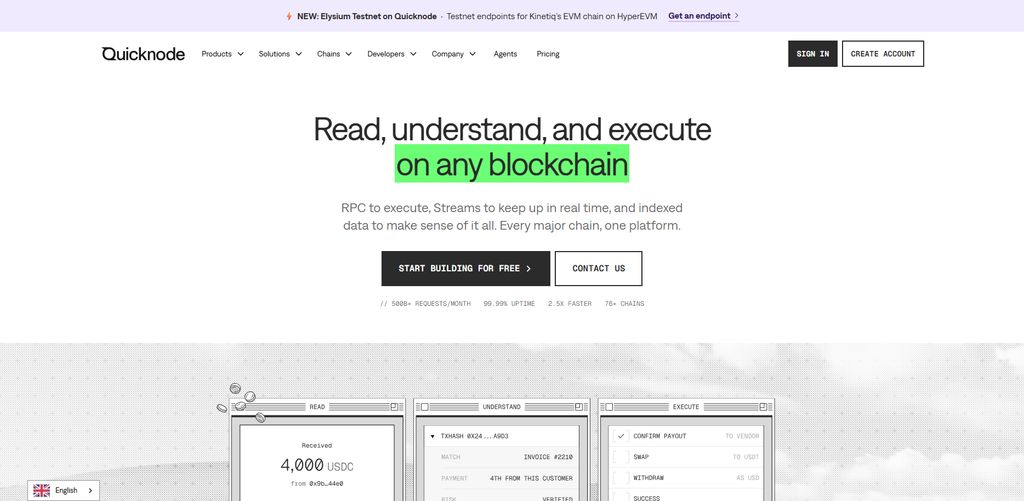
The platform comes with 99.99% uptime SLA, which helps to ensure reliability for production workloads. Scalability is supported by enterprise-grade plans and dedicated resources. Prices vary from free developer tiers to custom enterprise packages. QuickNode is future-proof for Sui developers with support for modern APIs like gRPC and GraphQL.
Key Features
- Multi-Blockchain Support: Offers RPC infrastructure for multiple blockchain networks, allowing developers to build decentralized applications across various ecosystems.
- Fast APIs: Provides access to the blockchain via APIs optimized for fast data retrieval and reliable app communication.
- Scalable Infrastructure: Can scale from early-stage projects to high-traffic Web3 applications.
- Developer-Friendly Tools : Offers APIs, SDKs, and development resources to ease blockchain integration.
- Monitoring and Analytics: Provides tools to assist developers in monitoring endpoint performance and managing blockchain infrastructure
Advantages
- Extensive Blockchain Coverage: QuickNode offers access to numerous blockchain networks, allowing developers to create decentralized applications without having to maintain separate node infrastructure.
- Developer-Friendly Tools: Its APIs, documentation and development tools make it easy for technical teams to integrate, test and deploy blockchain apps.
- Scalable Infrastructure: Developers are able to scale infrastructure resources up and down as application traffic grows, supporting projects with changing performance and capacity needs.
- Dependable Connectivity: Managed node infrastructure removes the operational burden of managing blockchain nodes and watching network connections.
- Advanced Data Services: Developer tools and blockchain data capabilities make transactions, NFTs, analytics and decentralized applications easier to work with.
Cons:
- Costly: Extra services, high performance and increasing number of requests can increase the cost for applications that require a lot of infrastructure.
- Usage Restrictions: Applications generating a high volume of blockchain requests may be subject to API quotas, rate limits and plan restrictions.
- Vendor Lock-in: Moving to a new infrastructure provider can be challenging if you rely heavily on proprietary services.
- TECHNICAL COMPLEXITY: Advanced configuration, performance optimization and usage management for demanding production workloads may require experienced developers
2. BlockPI
BlockPI is a Web3 infrastructure platform that provides RPC services to a variety of blockchain ecosystems, including Sui. It offers developers access to real-time and historical blockchain data through gRPC, GraphQL RPC and archival services, supporting both Sui Mainnet and Testnet. This platform is built for high-performance applications that require fast processing of requests and stable connections.

Distributed node architecture and enterprise-centric infrastructure improve reliability. BlockPI can scale to power everything from start-ups to high volume decentralized applications. Pricing includes developer-friendly plans and premium enterprise offerings. Modern API support like gRPC and GraphQL enables developers to build advanced Sui applications efficiently.
Key Features
- Decentralized RPC Network: It employs distributed infrastructure to support access to blockchain data and enhance the durability of services.
- Multi-Chain Connectivity: Supports many blockchains for various decentralized applications.
- Load Balancing: Distributes incoming requests across available infrastructure to help efficiently manage traffic.
- Reliable API Access: It provides RPC services for Web3 applications, ensuring connectivity at all times.
- Developer Integration: Enables blockchain apps to connect through familiar RPC endpoints and API-based workflows
Benefits
- Distributed Infrastructure: BlockPI uses a distributed blockchain infrastructure to provide access to network data and improve request processing on supported chains.
- Multi-Chain Access: Enables developers to link applications to multiple blockchain ecosystems through a single infrastructure provider.
- Performance-oriented design: Infrastructure optimization can reduce request delays and support applications requiring frequent blockchain interactions.
- Developer Integration: API-based connectivity simplifies integration with wallets, decentralized applications, trading systems and other blockchain products.
- Flexible Infrastructure Options: It’s service model can be ideal for projects that want managed blockchain connectivity without having to run every single node on their own
Cons
- Network Coverage Disparities Availability and service quality may differ among supported blockchain networks and you will need to check compatibility for your particular project.
- Usage-Based Costs: As applications grow, the need for higher request volume and complex infrastructure could drive up operating costs.
- Third-Party Dependence: Apps utilizing BlockPI must consider provider downtime, network problems, and possible service constraints.
- Feature Variations: APIs, performance characteristics, and service options can vary across networks, which makes consistent multi-chain development difficult.
3. Ankr
Ankr is a premier Web3 infrastructure provider that provides RPC, validator, staking, and developer services across a number of chains. Sui provides you with access to Mainnet and Testnet using gRPC, GraphQL RPC and archival services. The platform is renowned for delivering low latency blockchain access via its globally distributed node infrastructure.

Redundant systems are used to increase reliability by minimizing outages and increasing service availability. Ankr’s infrastructure is built to scale with the increasing transaction volumes and application demand. Pricing typically includes free access for testing and paid plans for higher throughput needs. Its wide compatibility with modern blockchain APIs makes it easy for developers to integrate Sui into production applications.
Key Features
- Wide Blockchain Support: It supports a wide range of blockchain networks, making it a useful tool for multi-chain development projects.
- Public and Premium RPCs: Provides several access options to developers with varying performance and usage needs.
- Staking Infrastructure: Apart from its blockchain infrastructure offerings, it also provides services related to staking.
- Web3 APIs: Assists developers in accessing blockchain data and integrating network capabilities into applications.
- Scalable Node Services: Offers infrastructure for decentralized applications, wallets, and Web3 platforms.
Benefits
- Decentralized Infrastructure: Its distributed infrastructure model can decrease dependence on a single node operator for blockchain connectivity.
-Flexible Pricing: Workloads and budgets can dictate infrastructure choices with usage-based options. - Developer APIs: RPC endpoints and blockchain data services that facilitate application development, integration and network access.
- Scalable Connectivity: Ankr helps growing application traffic with managed infrastructure and multiple options of accessing the network.
Downsides
- Variability in Performance: Response times can vary by blockchain network, region and endpoint configuration.
- Usage Limitations: Demanding applications may be limited by rate limits on public endpoints and entry-level plans.
- Cost Impact: Increased request volume & some premium features might incur more operational cost.
- External Dependencies: Developers rely on providers and supported network configurations to ensure applications run without interruption.
4.Alchemy
Alchemy is a popular enterprise blockchain development platform that combines RPC infrastructure with developer tools and analytics. For Sui, it delivers enterprise-level Mainnet RPC access geared toward professional development teams. Performance is tuned for reliable network connectivity and consistent treatment of requests.

Alchemy is known for its reliability across major blockchain ecosystems and powers mission-critical applications. The platform is very scalable and can be used by startups and big companies.
Pricing is generally usage based plans with customization for enterprise available. Although the scope of Alchemy’s broader ecosystem of developer tools is focused on RPC services for Sui, it improves developer productivity and application monitoring.
Key Features
- Developer APIs : Provides blockchain APIs to ease the development of decentralized applications.
- Enhanced Data Access: Provides tools to query blockchain data and interact with on-chain activity.
- Monitoring and Debugging: Offers developer tools for tracking errors and monitoring app performance.
- NFT Infrastructure: Dedicated APIs and data capabilities are provided to support NFT development.
- Scalable RPC Endpoints: Allows applications to scale their blockchain requests with their usage and traffic
Pros
- Extensive Developer Tools: Alchemy provides APIs, debugging tools, dashboards, and development utilities to support building blockchain applications.
- Multi-Chain Support: Developers are able to connect applications to a variety of supported networks without having to manage each blockchain node themselves.
- Improved Data APIs: Dedicated services are available for NFT applications, token information, transaction analysis and other blockchain data needs.
- Monitoring Capabilities: Analytics and application monitoring tools help developers to investigate errors, view usage, and identify performance issues.
- Enterprise Infrastructure: Dedicated Infrastructure options offer more isolation and customization for demanding production workloads
Cons
- Usage-based Costs: Applications that have a large number of requests or complex data requirements can drive up infrastructure costs.
- Learning curve: The platform’s multitude of tools and features may require developers more time to learn and set up.
- Service Tier: The service tier you select governs request throughput, available features and support options.
- Provider Lock-In: Applications built around provider-specific APIs may require code changes when moving to another infrastructure provider
5. Dwellir
Dwellir is a blockchain infrastructure provider that places transparency, performance and enterprise-grade reliability at the forefront. They offer Sui RPC infrastructure with full gRPC support and simple pricing models. We use a globally distributed infrastructure, advanced routing, and load balancing technologies to reduce latency and improve performance.

“Reliability is a big focus, infrastructure that’s built for production level blockchain applications. The Dwellir scales up for small and large deployments with predictable performance. It is famous for transparent pricing, which makes it easier to estimate the cost for business. Dwellir is a compelling option for next generation Sui applications with modern API support including gRPC services.
Key Features
- Multi-Chain Infrastructure: Access to blockchain across multiple networks and ecosystems.
- RPC Endpoint Services: Connects applications to supported blockchains through standard RPC interfaces.
- Enterprise Solutions: Designed for projects requiring strong blockchain connectivity and infrastructure support.
- Developer Integrations: Supports integration with blockchain applications and backend services.
- Infrastructure Scalability: Access to nodes should be able to support a variety of application workloads and traffic requirements.
Pros:
- Broad Network Support: Dwellir supports a wide variety of blockchain ecosystems, enabling developers to build apps on different network architectures.
- Bare-Metal Infrastructure: Bare-metal infrastructure strategy can deliver consistent performance for workloads that require dedicated hardware resources.
Transparent Request Metering: Response-based billing options can simplify the process of estimating costs for supported API workloads. - Dedicated Node Services: Use dedicated nodes and archive infrastructure for applications needing historical blockchain data or more control over resources.
- Performance Options: Infrastructure can be selected based on expected traffic and operational requirements due to different tiers of throughput.
Cons
- Plan-Specific Limits: Request rates, query capabilities and available features depend on the selected subscription.
- Premium infrastructure costs: dedicated nodes and specialized archive configurations can be expensive for smaller dev teams.
- Differences in Networks: Blockchain integrations can have different API methods and availability of historical data.
- Technical Evaluation: Developers need to research the supported queries, throughput requirements, and regional availability before selecting a configuration
6. GetBlock.io
GetBlock offers blockchain node infrastructure with shared and dedicated RPC endpoints, including support for the Sui network. It is designed to allow developers to query blockchain data without running their own full nodes. The platform is designed to deliver reliable connectivity and fast API access for decentralized applications. Managed infrastructure and ongoing surveillance networks increase reliability.

GetBlock is flexible enough to power early-stage applications and large-scale production deployments. pricing is pretty flexible , with a few tiers of service to accommodate varying levels of usage. GetBlock is best known for standard RPC access but it is a simple way for developers to hook their apps into the Sui blockchain services.
Key Features
- Wide Network Coverage: Access to many blockchain protocols through managed node infrastructure.
- Shared and Dedicated Nodes – Provides developers with infrastructure choices for different performance and resource needs.
- Multiple API Protocols: The blockchain can be contacted via standard interfaces, depending on the network selected.
- Scalable Node Access: Aids applications in handling the rising load of blockchain queries as traffic and data requirements increase.
- Managed Infrastructure: Takes the burden of running and maintaining blockchain nodes off your shoulders.
Benefits
- Multi-Network Access: GetBlock gives access to multiple blockchain networks with managed node infrastructure.
- Easy API Integration: Uniform connection methods make it easier for developers to integrate blockchain data into their existing applications.
- Dedicated Node Options: Dedicated infrastructure provides more control over resources and how requests are handled for specialized workloads.
- Flexible Deployment Choices: Development, testing, and production environments can be supported by various node and subscription choices.
- Less Maintenance: Managed services take away some of the operational work of running and updating blockchain nodes yourself.
Downsides
- Tier-Based Limitations: Your chosen plan and blockchain network determine the number of requests and features you can access.
Costs to operate: Higher traffic levels or the need for dedicated infrastructure may result in higher monthly costs. - Feature Availability: Advanced methods and access to historical data may not be available to the same extent on all supported networks.
- Third Party Dependency: Your application depends on GetBlock’s uptime, maintenance and infrastructure.
7. NodeInfra
NodeInfra is a Web3 infrastructure provider, providing services that allow developers and enterprises to access the blockchain. gRPC and GraphQL services make the platform available to Sui Mainnet and Testnet. Performance is about getting data fast and interacting with the blockchain in a timely manner. Reliability is ensured by well-managed infrastructure and coverage of the network.

NodeInfra is designed to scale with the needs of your applications, making it a good fit for scalable deployments. The price is based on your usage and infrastructure needs. Its support for modern technologies such as gRPC and GraphQL allows developers to take advantage of advanced blockchain data access methods while developing sophisticated Sui applications.
Key Features
- Blockchain Node Access: Infrastructure for applications requiring connectivity to supported blockchain networks.
- Developer Integration – node connectivity and APIs to support blockchain development workflows.
- Sui Ecosystem Support: Positioned as an infrastructure provider to access the Sui blockchain.
- Application Connectivity: Enables developers to integrate blockchain-based applications with network data and operations.
- Infrastructure Flexibility: Can be evaluated for projects that are looking for managed node services instead of running all infrastructure independently.
Pros
- Node Connectivity Management: NodeInfra allows to access blockchain infrastructure without the need to run each node independently.
- Ease of Development: Managed endpoints reduce the initial setup required to connect applications with supported blockchain networks.
- Simplified Operations: Development teams can be relieved of the heavy lifting of infrastructure management with node maintenance delegated.
- Potential Scalability: Managed infrastructure could allow applications to scale to meet growing demand without needing full in-house node deployments.
- Integration Flexibility: Existing blockchain development tools can make infrastructure adoption easier if the required interfaces are supported.
Cons
- Limited Public Information: It may have less publicly available information on its overall capabilities than larger providers.
- Coverage Verification: Developers should confirm supported blockchain networks and API methods before signing up for the service.
- Performance Uncertainty: Independent performance benchmarks may not be enough to prove the service can handle demanding workloads.
- Service evaluation: Pricing, support commitments, uptime guaranties and migration options should be verified directly before going to production
8. ZAN
ZAN is a product by Ant Digital Technologies that offers a complete suite of blockchain infrastructure services, including access to Sui RPC. gRPC, GraphQL RPC and archival support. Mainnet and Testnet environments are supported by the platform. Optimized network access and efficient infrastructure ensure performance to meet enterprise requirements.

Reliability is ensured by managed node services and enterprise-grade operational standards. ZAN scales to support businesses from emerging projects to large organizations. Pricing models are developed for both developers and enterprise customers. Its wide-ranging support for modern APIs and the Web3 services associated with them makes it a versatile provider to teams building on the Sui ecosystem.
Key Features
- Web3 Infrastructure: Offers blockchain infrastructure services to developers and businesses building decentralized applications.
- Multi-Chain Support: Access to supported blockchain networks for various Web3 use cases.
- RPC Node Services : Connect with the blockchain data and interact with the network via RPC infrastructure.
- Security Services: It provides infrastructure solutions with smart-contract security capabilities.
- Compliance Solutions Offers KYC and KYT-related tools designed to meet compliance requirements in blockchain applications
Benefits
- Blockchain Infrastructure Focus: ZAN offers blockchain infrastructure services for developers and Web3 applications.
- Ecosystem Compatibility: Its infrastructure offerings can be leveraged by projects operating in compatible blockchain ecosystems.
- Developer Connectivity: API access can simplify blockchain communication without teams having to maintain their own nodes.
- Specialized Services: Some projects may require specific network or application requirements that are compatible with existing infrastructure and development services.
-Operational Efficiency: Managed infrastructure can reduce the effort of deploying, maintaining and routinely monitoring nodes.
Disadvantages
- Ecosystem Suitability: Developers should check that the supported networks of ZAN are suitable for their application’s needs.
- Feature Variations: API and infrastructure capabilities may differ across networks and service offerings.
- Documentation Review: Teams should assess the quality and adequacy of the existing technical documentation prior to integration.
- Dependency Risks: Applications that rely on one provider may require backup endpoints to cover outages or service interruptions
9. Triton One (A)
Triton One is an infrastructure provider, providing high performance blockchain RPC services for professional and institutional users. It is also available with archival service capabilities and supports Mainnet and Testnet environments at Sui. The platform is designed for applications that need fast transaction processing and reliable uptime.

“Reliability is a big part of what Triton One offers, with infrastructure built for mission-critical workloads. Scalability helps organizations manage the growing traffic and data needs as applications expand. The pricing is generally aimed at professional development teams and enterprise users. Triton One is also well suited for sophisticated Sui deployments, thanks to its support for archival data access and modern infrastructure standards.
Key Features
- Solana Infrastructure Skills: Focuses on infrastructure and technical services within the Solana ecosystem.
- High Performance Nodes: Enables blockchain workloads that require fast transaction processing and data access.
- Validator Infrastructure: Offers technical infrastructure capabilities relevant for blockchain validators and network operations.
- Developer Connectivity: Enables applications and services to access data from the blockchain network.
- Institutional Infrastructure: Addresses the specialized blockchain infrastructure needs of professional operators and businesses
Benefits
- Solana Expertise: Triton One is deeply integrated with Solana infrastructure, suitable for apps that require specific Solana connectivity.
- Performance-Driven Services: Its infrastructure-centric approach can be suited for use cases requiring real-time access to blockchain data and transactions.
- Advanced Infrastructure: Specialized node services for high-demand blockchain applications and professional development teams.
- Validator Ecosystem Experience: Its experience with Solana infrastructure could be useful for projects that require deeper network-level capabilities.
- Infrastructure for Specialized Workloads applies to trading apps, data services and other performance-sensitive Solana projects.
Cons
- Ecosystem Fit: If teams are building across several unrelated blockchain networks, there may be a greater need for infrastructure providers.
- Technical Requirements: Advanced configuration and operational knowledge may be necessary for specialized infrastructure.
- Budget: High-performance or dedicated services might not be affordable for early-stage projects with limited budgets.
-Performance Benefits Are Workload Dependent:Performance benefits depend on application architecture, geographic location, network conditions and services selected.
10. BlockVision
BlockVision is a Sui-centric infrastructure + data platform that combines RPC, API, indexing tools and a blockchain explorer. It gives developers the complete environment to fetch and analyze Sui blockchain data. Performance is optimized for both RPC requests and data intensive workloads to keep applications responsive for users.

Reliability is derived from dedicated infrastructure designed to run blockchain data services. The platform will grow with your application and data as they scale. Pricing is based on service usage and enterprise needs. In addition to standard RPC access, the integrated tooling and analytics capabilities of BlockVision make it especially useful for developers building advanced Sui-based applications.
Key Features
- Blockchain Data Infrastructure: Data services and infrastructure for decentralized applications
- Sui Ecosystem Support: Provides developer infrastructure for the Sui blockchain ecosystem.
- RPC Connectivity: Enables interaction with the blockchain via appropriate node-access services.
- Data Access Features: Allows developers to retrieve and utilize data from the blockchain to enable app features.
- Web3 Development Support: Offers infrastructure capabilities that can support blockchain applications and ecosystem projects.
Benefits
- Blockchain Data Services: BlockVision is working on building blockchain data infrastructure that can assist applications to fetch and organize relevant network data.
- Developer Integration: Services based on API may reduce the complexity of integrating applications with supported blockchain data sources.
- Data Accessibility: Its services help developers access blockchain data without having to build each data processing component from scratch.
- Application Support: Blockchain data infrastructure supports analytics platforms, wallets, explorers and other Web3 applications.
Less infrastructure chores: Managed data services can imply you don’t have to maintain your own indexing and data retrieval systems.
Cons
- Network Compatibility: Developers should check that the provider supports the blockchains, datasets and API methods they want.
- Data Availability: Historical Coverage and Indexing Capabilities may vary by network and specific service.
Service Dependency: Applications that depend on externally managed data may be disrupted when endpoints become unavailable. - Scaling Limits: For large data retrieval and specialized indexing workloads, additional resources or paid service options may be required.
Conclusion
Reliable Sui RPC infrastructure is a key to building scalable, responsive and dependable decentralized applications. Managed RPC services allow teams to deploy faster, maintain more easily, get expert monitoring, scale flexibly and access developer tools – all without having to run their own nodes. The benefits allow developers to focus on building the application and reduce the complexity of the infrastructure.
However, one should take into account pricing, limitations on requests, dependence on providers and availability of services. Self-hosted nodes offer higher control and customization for specialized workloads. Ultimately the right infrastructure depends on the application requirements, budget, expected traffic and technical expertise. A hybrid approach can offer a compromise of convenience, reliability and control.
FAQ
What is a Sui RPC node provider?
A Sui RPC node provider offers infrastructure that allows decentralized applications to communicate with the Sui blockchain, retrieve on-chain data, submit transactions, and monitor blockchain activity
Why do developers need reliable Sui RPC access?
Reliable RPC access helps applications retrieve blockchain data efficiently, process transactions, reduce connectivity interruptions, and deliver a smoother user experience as application traffic increases.
What are the main benefits of managed Sui RPC infrastructure?
Managed RPC infrastructure reduces node maintenance, simplifies deployment, supports scaling, and provides access to monitoring tools and blockchain data services without requiring developers to operate their own nodes.
Which protocols should developers look for in a Sui RPC provider?
Developers should prioritize gRPC and GraphQL RPC. gRPC suits low-latency requests and streaming, while GraphQL supports flexible queries involving transactions, objects, events, and historical data.


