

Selecting the right Aptos node provider is crucial for developers looking to build fast, reliable, and scalable blockchain applications. Getting data on the Aptos network, submitting transactions, interacting with Move smart agreements, and supporting increased application traffic is simple with a trusted provider which takes all the hassle out of managing complex infrastructure.
In this guide I will introduce the Best Aptos Node Providers for Blockchain Developers, and compare their network support, performance, pricing, scalability, security features and developer tools to help you find the right fit for your project.
Why Do Blockchain Developers Need an Aptos Node Provider?
Reliable Blockchain Access: Aptos node providers offer developers the capability to access blockchain data, query account balances, retrieve transaction details, and interact with the network without the need to manage their own infrastructure.
Faster Application Development: Managed RPC endpoints make it easier to integrate with the blockchain so developers are able to spend more time building decentralized applications and less time managing, maintaining, and troubleshooting standalone node infrastructure.

Transaction Submission: Aptos node providers help applications submit transactions, check execution results, and retrieve transaction statuses, thereby enabling smooth interactions between users, smart contract platforms, and blockchain networks.
Smart Contract Interaction: Developers are able to use Aptos APIs to interact with Move smart contract platforms, read on-chain resources, execute contract functions, and retrieve information needed for the operation of decentralized applications.
Scalability & Performance: A good provider’s infrastructure is built to scale with growing API requests, so your growing dApp can maintain responsive blockchain connectivity as user activity and transaction volumes increase.
Reduced Maintenance Costs Managed node services relieve a lot of the operational burden of hardware, software updates, node monitoring and infrastructure maintenance, reducing the complexity of development.
Real-time Blockchain Data Aptos RPC services enable developers to access the latest ledger information, account resources, events, and transaction data needed for wallets, analytics dashboards, and blockchain explorers.
Improved Reliability & Security: Established providers provide infrastructure monitoring, API authentication, and control of access that assist developers in managing connectivity, securing endpoints, and reducing downtime for blockchain-powered applications.
How to Choose the Best Aptos Node Provider?
Ensure Aptos Network Support: Select a provider that supports Aptos Mainnet and Testnet, so developers are able to test smart contract functionality, access blockchain data, and deploy applications in the desired environments.
Track Performance and Latency: Examine response times, request processing times, and endpoint locations to guaranty rapid blockchain interactions, smooth application performance, and reliable access during network usage peaks.
Look at Pricing and Free Tiers: Review the free request limits, monthly fees, rate limits, and pay-per-use costs to identify a provider that fits your development budget and anticipated API consumption.
Assess Reliability and Uptime: Review published uptime guaranties, service-level agreements, infrastructure monitoring, and incident response procedures to minimize connectivity outages and ensure continuous access to Aptos blockchain data.
Evaluate Scalability Capabilities: Choose a provider that can accommodate increasing request volumes, concurrent users, and expanding application workloads without a significant decline in performance or unexpected infrastructure limits.
Check Out API Capabilities: For the supported Aptos API methods, transaction submission, account queries, event retrieval, SDK support, and documentation to be sure the provider fits your application’s technical needs.
Security and Monitoring Review: Look for providers that offer API-key authentication, access management, usage analytics, rate limiting, and monitoring tools to help you control access to your endpoints and catch unusual request activity.
Test Developer Support: Consider the quality of documentation, setup guides, troubleshooting resources and the availability of technical support for quickly resolving integration problems and simplifying long-term Aptos application maintenance.
Key Points
| Aptos Node Provider | Key Point |
|---|---|
| QuickNode | Provides high-performance Aptos RPC endpoints, archive data access, global infrastructure, and developer-friendly dashboards for scalable dApp development |
| Alchemy | Offers enterprise-grade Aptos RPC infrastructure with developer tools, analytics, monitoring, and scalable API access. |
| Chainstack | Delivers low-latency Aptos nodes, archive node support, global deployment options, and dedicated infrastructure for production workloads. |
| Ankr | Provides distributed Aptos RPC services with high scalability, multi-chain support, and infrastructure suitable for Web3 applications. |
| NOWNodes | Offers managed Aptos node access through a blockchain-as-a-service platform with support for numerous networks and APIs |
| GetBlock | Features shared and dedicated Aptos nodes, flexible API plans, and infrastructure designed for developers needing reliable blockchain connectivity. |
| OnFinality | Supplies Aptos RPC and API infrastructure with analytics, monitoring tools, archive access, and managed node services. |
| BlockPI Network | Focuses on high-performance, low-latency Aptos RPC services optimized for demanding decentralized applications. |
| Shinami | Specializes in infrastructure for Move-based ecosystems, providing Aptos RPC, indexing, wallet, and developer services. |
| Validation Cloud | Delivers enterprise-grade Aptos RPC, staking, and blockchain data infrastructure tailored for institutional and large-scale users. |
1. QuickNode API’s
QuickNode is a leading blockchain infrastructure provider delivering dedicated Aptos RPC endpoints for developers building wallets, DeFi platforms, NFT applications, and enterprise blockchain solutions. Support for Aptos Mainnet & Testnet, Access to archive data, Transaction simulation, Move smart contract interactions.
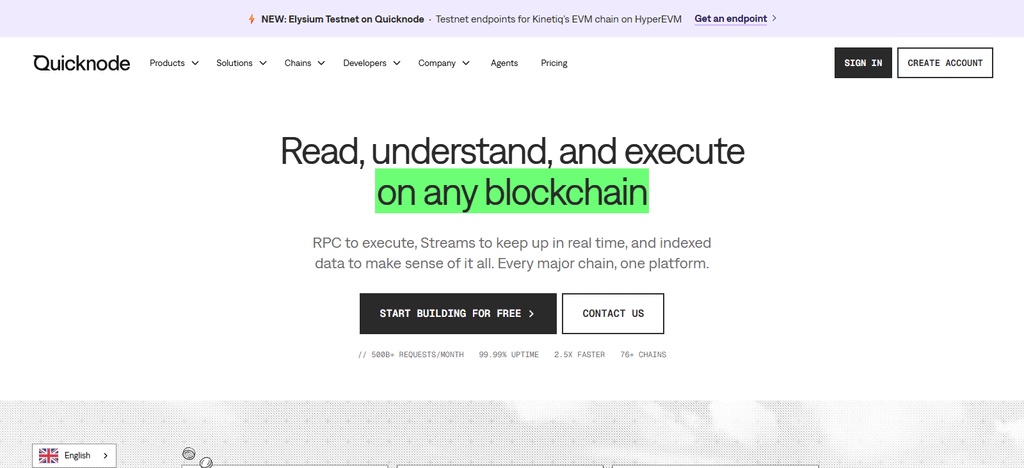
QuickNode has a free trial; paid plans are built for more requests and more advanced features. Infrastructure is distributed around the world to reduce latency and provide high availability. Security features include endpoint authentication, rate limiting, control of access, and monitoring dashboards to help developers efficiently track performance and resource usage.
Advantages
- It gives you managed Aptos RPC infrastructure so you can easily connect to the blockchain.
- Offers developer-friendly documentation and integration tools.
- Supports scalable infrastructure choices for applications that grow.
- Additional tools for real-time blockchain data workflows.
Disadvantages
- Using it in a sophisticated way can increase the cost of infrastructure.
- Usage may need to be closely monitored for credit-based pricing.
Higher throughput might be subject to premium plans. - Developers access the nodes via a third-party provider
2. Alchymie
Alchemy offers enterprise-grade Aptos node infrastructure and its popular Web3 development platform. The dashboard provides developers with Aptos RPC endpoints, analytics instruments, monitoring and APIs. Alchemy makes it easy for developers to start working with a free tier and no upfront costs.
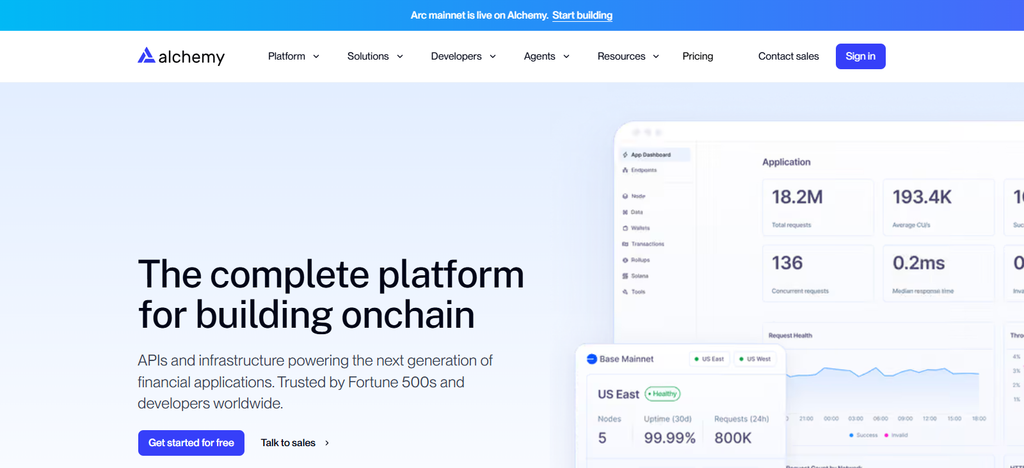
We have paid plans that scale with your application demand. Its infrastructure is designed for reliable network access and low-latency request routing. Aptos developers have access to developer-centric tooling, usage analytics and scalable API performance.
The platform also stresses security, system observability and operational monitoring for production-grade decentralized applications.
Benefits
- Offers APIs and infrastructure tools to developers.
- Provides a dashboard to monitor app usage.
- Managed endpoints that simplify blockchain integration.
- Provides plan options for dev and production workloads.
Cons
- Unit prices can make estimating costs more difficult.
- Restrictions on use of high traffic applications may apply.
- Some features may require paid plans.
- less control over the infrastructure compared to self-hosted nodes
3. Chainstack
Chainstack is a reputable node infrastructure provider that offers reliable Aptos RPC services and multiple deployment options. It supports Aptos Mainnet, Testnet, archive nodes, dedicated nodes and globally distributed RPC endpoints. Developers may start with a free tier and paid plans offer higher request limits and advanced features of the infrastructure.
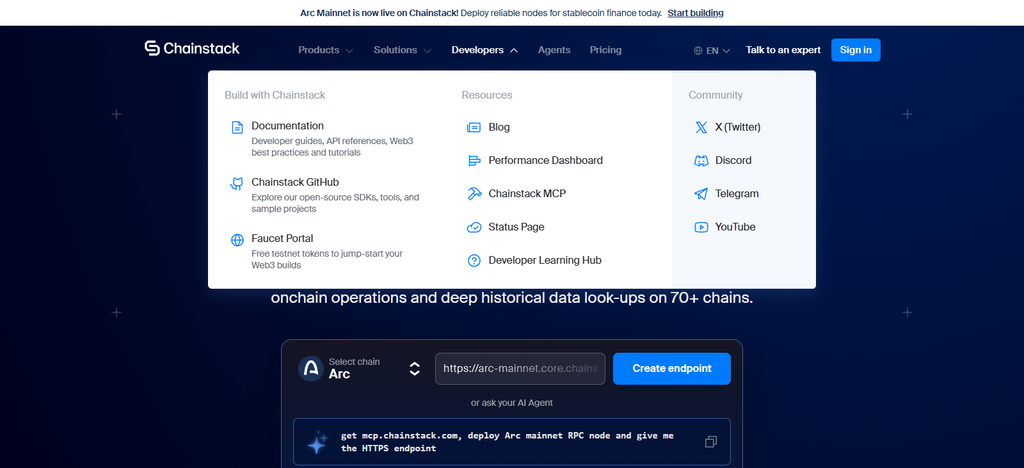
Chainstack’s focus on low-latency performance and scaling tools for applications as traffic increases. Its platform offers monitoring and infrastructure management tools, as well as enterprise-grade uptime commitments. Security features include private networking options, control of access, and infrastructure for production blockchain workloads.
Advantages
- Handled access to Aptos Mainnet and Testnet.
- Adaptable plans for various project scales.
- Tools for monitoring and management of infrastructure.
- Scaling is supported through higher capacity and enterprise options.
Cons
- Improved infrastructure decisions may incur additional costs.
- Access to historic archive may require upgraded plan.
Request limits are plan dependent. - Self-hosting provides more direct control than hosted infrastructure.
4. Ankr
Ankr is a multi-chain Web3 infrastructure platform providing node services for Aptos. It provides RPC endpoints for developers who wish to access the blockchain reliably without running their own nodes. Ankr offers a free tier of usage and scalable pay-as-you-go options for both startups and enterprise users.
The company uses a geographically distributed network to optimize response times and minimize latency. Developers on Aptos can enjoy high throughput capabilities, multi-chain integrations, and flexible API access. The platform gives priority to security, uptime reliability and monitoring support and provides infrastructure that can scale as decentralized apps grow.
Pros
- Provides managed RPC endpoints to connect to Aptos.
- Enables developers to work across multiple blockchain networks.
- Provides flexible infrastructure spend with usage-based options.
- Gives scalable access through distributed infrastructure.
Cons
- The advanced monitoring tools are not as extensive as some competitors.
-Usage-based billing means monitoring of consumption. - Performance depends on endpoint conditions and network traffic.
- Some premium features may need to be purchased
5. NOWNodes
NOWNodes is a Blockchain-as-a-Service provider which enables easy access to Aptos nodes via managed API endpoints. The platform is a great option for multi-chain projects, with support for Aptos and many other blockchain networks. Developers are able to get shared or dedicated node infrastructure without worrying about maintenance or synchronization.
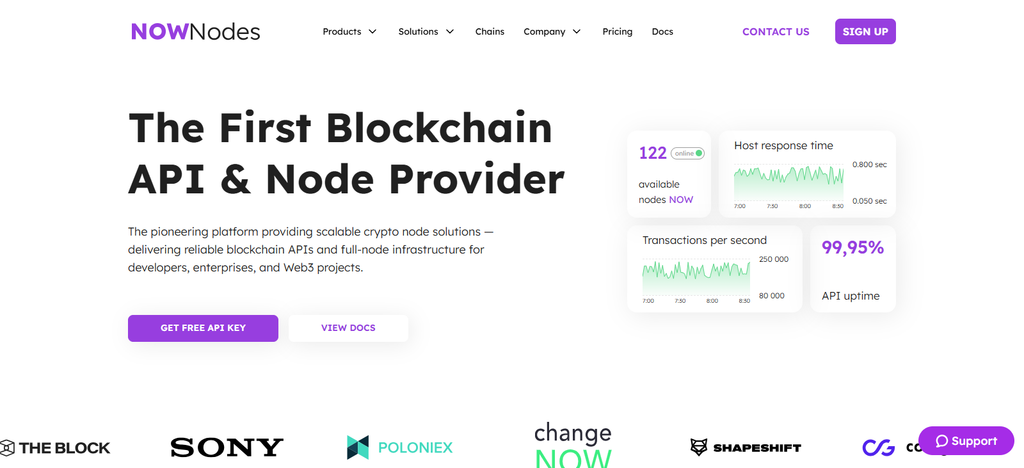
NOWNodes provides trial access and different subscription plans depending on the usage requirements. Its infrastructure is designed for reliable connectivity, consistent performance and broad blockchain coverage. Additional features include support for APIs, monitoring tools, and customer support designed to help developers keep their apps up and running smoothly and scaling effectively.
Advantages
- Provides access to managed blockchain nodes through APIs.
- Makes integration easier with API-key auth.
- Provides infrastructure services for a variety of blockchain networks.
- Provides plan choices for varying usage needs.
Cons:
- Higher usage may need more expensive plans.
- Monthly request limits may constrain growing projects.
- Verify that the available Aptos methods meet the project requirements.
- Reliance on an external provider introduces third-party service ris
6. GetBlock API
GetBlock offers a simple API platform to connect to shared and dedicated Aptos node infrastructure. Supports Aptos Mainnet and makes it easy for developers to connect their apps without a full node. There is a limited free tier for the service, and paid plans provide more request capacity and dedicated resources.
GetBlock aims to provide reliable RPC access, flexible deployment models, and predictable infrastructure performance. Developers are able to scale from test environments to production deployments on the same platform. Security features and dashboard administration tools and uptime guaranties make it a good choice for teams needing reliable blockchain access.
Advantages
- Makes it easier to access supported blockchain networks.
- Provides managed endpoints, no need for self-hosted nodes.
- Provides an API to retrieve blockchain data.
- Offers plan options for various application workloads.
Cons
- Limit high traffic applications using request quotas.
- Dedicated infrastructure may be less cost-effective than shared access.
- Actual latency will depend on endpoint location and traffic.
- Advanced features vary by network and subscription
7. OnFinality
OnFinality provides managed Aptos infrastructure with a focus on performance monitoring and developer analytics. The platform offers Aptos node access, API access, and archive data support for blockchain applications. Free plan for initial development, premium plans for higher throughput and additional management capabilities.
OnFinality provides developers with analytics dashboards and infrastructure metrics to monitor usage of the application. Its services are aimed at reducing the operational overhead while providing reliable access to the Aptos network resources. Its platform offering features include scalability, uptime reliability, and infrastructure observability.
Advantages
- Provides managed infrastructure for Aptos API.
- Offers free entry option for initial development.
- Facilitates access to historical data for relevant workloads.
- Paid plans and dedicated infrastructure are available.
Disadvantages
- Rate limits on public endpoints can be limiting.
- Aptos API access is via a REST-based interface, rather than the standard JSON-RPC.
- You may need a paid plan for higher throughput.
- Higher priced advanced infrastructure and support options
8. BlockPI Network
BlockPI Network is a blockchain infrastructure provider, committed to providing high-performance RPC services. It offers low-latency network access and infrastructure designed to support demanding decentralized applications for Aptos developers.
The platform is built to provide a balance of performance, reliability and cost efficiency for startups and enterprise projects alike. Instead of running their own blockchain infrastructure, developers may opt to use managed node services.
BlockPI focuses on scalable architecture that can handle increasing transaction volumes and application traffic. It also offers monitoring, infrastructure management and reliability-focused network operations to help maintain stable connectivity as part of its service model.
Benefits
- Distributed RPC infrastructure for blockchain applications.
- Supports Aptos API operations to get blockchain data.
- Provides multi-chain connectivity for Web3 development.
- Provides managed access, not running independent nodes.
Drawbacks
- Check Aptos specific plan limits
- Performance may vary based on traffic and endpoint conditions.
- Advanced analytics may not have all the features developers need.
- Service dependency could add one more infrastructure risk
9. Shinami
Shinami is building infrastructure for Move-based ecosystems, and will be especially relevant for developers building on Aptos. Shinami offers RPC endpoints as well as complementary services such as indexing, wallet infrastructure and developer tools to make it easier to develop applications.
The platform offers integrations with the Aptos network and seeks to simplify operational complexity for teams building decentralized applications. Developers love managed infrastructure, simplified API access, and tools built for Move-powered blockchains.
Shinami is concerned with scalability, reliable network performance and efficiency in the development, as well as monitoring and operation support of production environments.
Pros:
- Developer infrastructure for Move-based blockchain ecosystems.
- Provides managed APIs to access Aptos nodes.
- Provides developer tools to support application workflows.
- Brings API key management and usage visibility features.
Weaknesses
- May require capacity planning to address usage limits.
- Higher traffic may require an upgrade or custom plan.
- Developers should verify support for their required API methods
- Managed infrastructure limits the ability to directly manage the node
10. Cloud Validation
Validation Cloud provides enterprise-grade blockchain infrastructure such as Aptos RPC services, staking infrastructure and blockchain data solutions. Its platform is built for institutions, enterprises, and high-volume applications that need a dependable blockchain connection.
Validation Cloud offers scalable infrastructure that can handle production level workloads with high standards of reliability. We provide managed services, performance-centric infrastructure and operational support to Aptos developers and organizations.
The platform also emphasizes on security, monitoring and system visibility, helping businesses to maintain consistent blockchain access while also reducing complexity associated with node management and infrastructure maintenance.
Advantages
- concentrate on Web3 infrastructure and blockchain data services.
- Provides infrastructure aligned to institutional and protocol needs.
- Provides services related to blockchain data and staking.
- May be appropriate for enterprise workloads where its supported network coverage is adequate.
Disadvantages
- Check availability of aptos specific rpc before adoption.
- Some services may require you to call us for pricing.
- Developers should review supported API methods and network environments.
The service needs to be appropriate in terms of uptime, control of access and monitoring capabilities and this must be documented.
Conclusion
The right Aptos node provider for you will depend on your project’s performance needs, budget, scalability, and development needs. Developers building Aptos-based applications can use infrastructure providers like QuickNode, Alchemy, Chainstack, Ankr, and Shinami. Compare features, support for Aptos Mainnet & Testnet, pricing plans, request limits, and documented uptime commitments before you choose.
Look at security controls, monitoring tools technical support to ensure reliable blockchain connectivity. Free tiers may help startups reduce initial costs, while higher capacity plans may help existing projects. When choosing a provider, always check Aptos’s current support and service terms.
FAQ
What is an Aptos node provider?
An Aptos node provider offers API endpoints that allow developers to access blockchain data, query account balances, retrieve transactions, and connect decentralized applications without operating their own nodes.
Which are the best Aptos node providers for blockchain developers?
Popular options include QuickNode, Alchemy, Chainstack, Ankr, NOWNodes, GetBlock, OnFinality, BlockPI Network, and Shinami. The right choice depends on Aptos support, pricing, performance, and project requirements.
Are there free Aptos RPC providers?
Yes. Some providers offer free tiers or limited-access plans for development and testing. Check request quotas, rate limits, and available Aptos API features before choosing a free plan.
What is the difference between an Aptos RPC and a full node?
An Aptos full node maintains and serves blockchain data, while an RPC endpoint provides an interface for applications to query that data and submit transactions. Managed RPC services simplify access without requiring developers to operate the infrastructure themselves.