
Music royalties are an interesting alternative investment for those who want to earn an income stream from the music industry. Now, instead of traditional investments, people can look at platforms that give access to royalty earnings from hit songs, albums and music catalogs. In this article, I will discuss the Best Music Royalty Investment Platforms.
I will cover their investment opportunities, royalty structure, minimum investment requirements, fees and possible earning models to allow investors to compare their options.
What Are Music Royalty Investment Platforms?
Music royalty investment platforms are online marketplaces where individuals can invest in income generated from songs, music recordings, publishing rights and music catalogs. These platforms connect investors with artists, songwriters, publishers and music rights holders seeking funding or selling royalty interests.
Depending on the platform’s investment model, investors can buy full or fractional royalty interests. In return for their participation , they might get a cut of the money made from streaming , radio play , downloads , public performances , and licensing . These investments are a way to get involved in the music industry, but there is no guaranty of a return, and it is contingent upon the actual royalties received.
How to Choose the Right Music Royalty Investment Platform?
Investment Model: Select a platform with an investment model that matches your investment goals, such as fractional royalty stakes, entire music catalogs, or contractual royalty sharing.
Minimum Investment: Compare the minimum investment requirements of different platforms to find opportunities that work with your available capital without requiring you to invest more than you’re comfortable with.
Royalty Sources: Understand the origin of the income, whether from streaming, downloads, radio airplay, publishing, or synch licensing, to evaluate how various sources of revenue could affect potential investment income.
Historical Performance: Examine past royalty earnings, streaming trends, catalog performance, and payment history to evaluate revenue consistency, but do not assume that past returns will repeat in the future.
Platform Fees: Check transaction fees, management fees, marketplace fees and withdrawal fees as other fees can impact the total income received from music royalty investments.
Payment Frequency: Understand how frequently the platform pays out royalty income, whether it’s monthly, quarterly or periodically, and understand the platform’s payment calculation and reporting processes before you invest.
Secondary Market: If liquidity is a concern, select platforms that offer explicit resale or secondary market capabilities. Review trading restrictions, potential buyers, transaction costs, and transfer terms.
Transparency & Security: Examine ownership documents, royalty contracts, regulatory compliance, financial reporting, and platform credibility to know your legal rights and avoid unnecessary investment risks.
Key Points
| Platform Name | Key Investment Features |
|---|---|
| Royalty Exchange | Bidding on existing music catalogs, historical royalty data, multiple royalty asset types |
| SongVest | SEC-qualified Regulation A offerings, fractional song royalty interests, investor dashboard |
| ANote Music | Music catalog auctions, secondary-market trading, royalty distributions |
| Musicow | Song-based royalty investments, fractional participation, music catalog opportunities |
| Jukebox | Royalty participation opportunities connected to individual songs and music catalogs |
| Sonomo | Royalty shares, streaming performance data, monthly distributions, secondary trading |
| Bolero | Song Shares, Catalog Shares, fractional participation and secondary trading |
| MasterExchange | Initial Music Offerings, fractional royalty participation and digital asset structures |
| Anotherblock | Tokenized music assets, fractional royalty exposure and blockchain-based transactions |
| Global Rockstar | Crowdfunded music projects, royalty participation and music catalog investments |
1. Royalties Exchange
Royalty Exchange is a marketplace where investors can bid on music royalty assets such as publishing, master, producer and other royalty streams. Its investment model is mostly auction-based: buyers buy a full royalty interest or a particular royalty stream, not a tiny fractional share. Royalty streams can include streaming, downloads, sync, public performance and mechanical royalties.
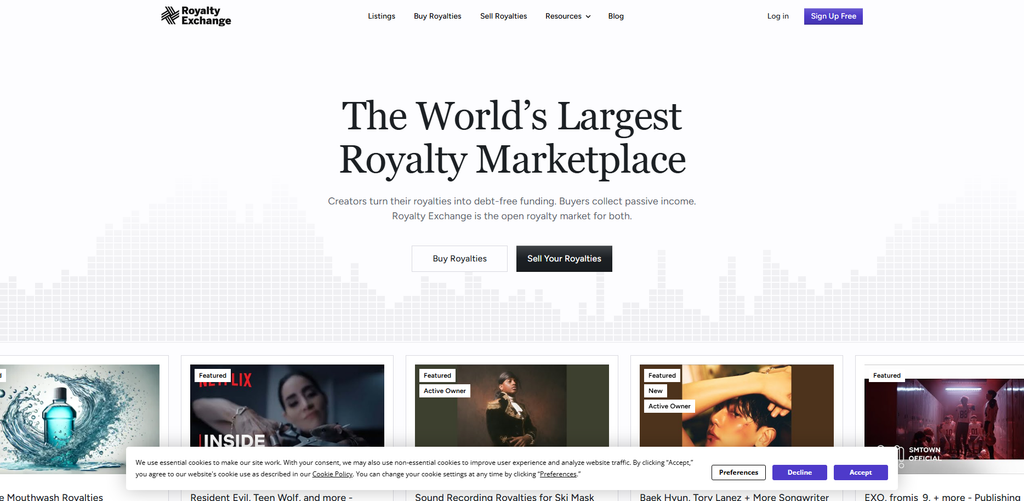
There is not a formal minimum, but practical listings tend to be around $25,000 or higher. Catalogs can be a single song or a portfolio of songs. The royalties are distributed according to the underlying agreement. Reported historical performance includes a claimed average return of 12.6%, although results vary materially by asset. There is a 1% buyer fee, with a minimum charge of $500, and sellers can relist assets on its secondary market.
Key Features**
- Auction-based marketplace for investing in music royalties.
- Provides both full and partial music royalty interests.
- Offers historical royalty earnings for listed catalogs.
- Includes songwriter and publisher and other royalty interests.
- Supports both direct and secondary-market catalog listings.
What makes us different
- Lets investors bid on pre-existing music royalty catalogs.
- Includes detailed earnings history and royalty source information.
- Provides auction and fixed-price marketplace opportunities.
- Makes possible investment in music rights beyond fractional song ownership.
2. Songvest
SongVest gives fans and investors the chance to buy fractional music-royalty securities called SongShares, which entitle them to a contractual right to a proportionate share of royalty cash flow after administrative fees. Its model includes fractional offerings and full catalog sales, with artists able to sell selected percentages of royalty streams via VIP auctions. Royalty sources vary based on the rights sold and can include income from streaming, performance, mechanical and licensing.
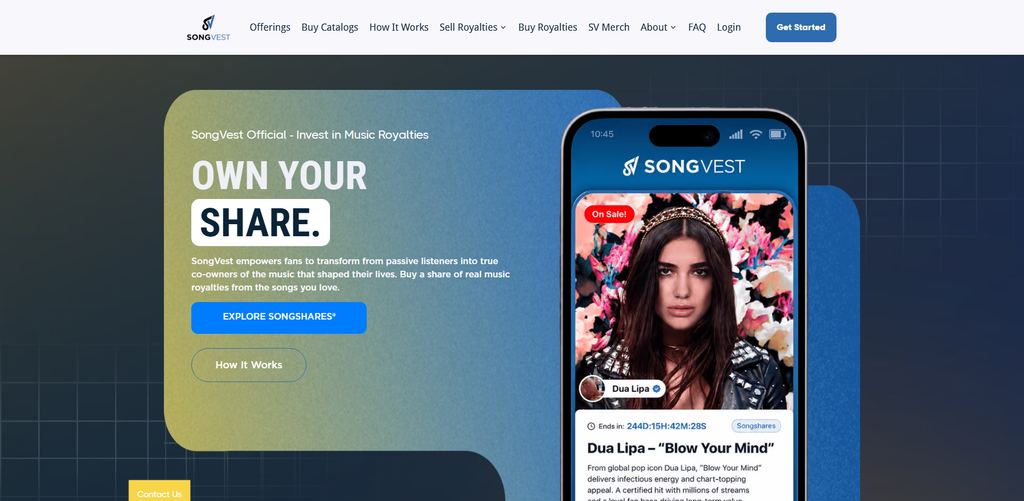
Minimums can be as low as a few hundred bucks so its relatively accessible. Its catalog has included recordings by Beyoncé, Queen, TLC, Cardi B, Bad Bunny, Eminem and Mariah Carey. Distributions are paid out quarterly or semi-annually, based on percentage of ownership. SongVest has total sales of over $75 million, but investors should consider the sourcing fees at the offering level and the lack of an existing secondary market.
Main Features**
- Provides fractional music royalty investments via SongShares.
- Grants access to individual song royalty offers.
- Utilizes Regulation A qualified investment offerings.
- Investors can look through the available music investment opportunities.
- Investor dashboard for tracking participation in royalties.
How we’re different?
- Provides select music royalty investments to individual investors.
- Links music lovers with opportunities to invest in famous songs.
- Provides structured investment options through SongShare.
- Combines a share of the ownership of the music with the potential to earn royalties.
3. ANote Music
ANote Music is a European music royalty marketplace, which tokenizes or fractionalizes royalty interests so investors can buy shares in catalogs. Investors buy shares in primary auctions or trade on ANote’s secondary market. Usually the sources of royalty include streaming, downloads, public performance, synchronization and other catalog revenue. The cheapest share price available is the practical entry point but institutional certificates require €125,000.
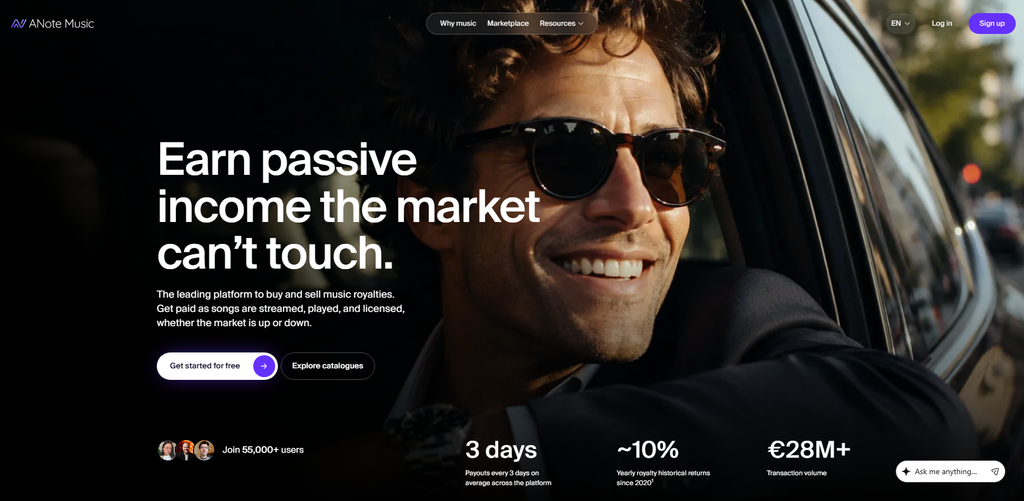
Its catalogs have concentrated on European repertoire and established catalogs with histories of royalty. ANote takes a percentage of royalty payments for administration: 4% on primary-market shares and 8% on secondary-market shares, capped at 0.5% of a catalog’s market cap per distribution. It said that more than €1m in royalties were distributed by October 2024, with secondary trading accounting for the bulk of recorded volume.
Main Features
- Creates a marketplace for the purchase and sale of music royalties.
- Offers fractional shares in legacy music catalogs.
- Includes transactions based on auction and secondary market.
- Shows historical royalties earned and catalog information.
- Royalty income is distributed according to the ownership interests of the investors.
Main Differentiator
- Focuses on investments in music royalties.
- access to European and international music catalogs.
- Secondary trading of acquired royalty interests.
- Supplies historical performance data and financial data at catalog level.
4. Musicow
Musicow’s securities are based on music-royalty interests, not ownership of the underlying songs or copyrights. Investors purchase Royalty Shares tied to specific music assets, with returns dependent on the royalty income generated by those assets. Income from streaming services, radio play and licensing are among royalty sources.
Its SEC registration materials describe a 10% Musicow IP fee deducted from royalty income before distributions to investors and potentially an additional premium of up to 30% over fair-market value at issuance.
There will be a minimum investment based on the offer and share price. Catalogs have included songwriter and publisher royalty interests like the $42,000 catalog acquisition of Brian Kennedy Seals. Distributions are normally made 45 days following the end of each full calendar month, although the first distribution may take about six months. Historical performance is specific to the asset and not broadly transferable.
Key Features
- Allows for fractional ownership of music royalties.
- Allows users to purchase shares associated with specific songs.
- Provides royalty participation from qualifying music assets.
- Employs an auction-based investment model.
- has a strong focus on the South Korean music market.
What makes us different
- Access to Korean music royalty assets
- Provides fractional investment opportunities based on songs.- Connects individual investors with music rights owners
- Offers a different investment model, based on music intellectual property.
5. JukeBox
Jukebox, formerly known as JKBX, is a U.S. platform that turns music royalty streams into investable shares. Its model allows investors to buy fractional interests in royalty-generating songs with entry from $500. Sources of royalty can be streaming, performance, mechanical and other payouts received through rights owners, licensees and servicers. Jukebox says it gives access to royalty shares for over 60,000 songs, letting investors spread their money across artists and time periods.

Distributions are paid from cash actually received and generally take up to 45 days to process after the end of a quarter, although payment timing may vary by one to four quarters. The materials available do not mention its fee schedule. A secondary market was announced for 2024 but the liquidity observable is still limited. Investors should understand that the rights purchased are only for the defined royalty term.
Main Features
- Provides Royalty Shares of music earnings.
- Allows access to certain music royalty streams.
- Pinpoints investment opportunities related to individual songs.
- Employs structured participation arrangements of royalties.
- Access to music investment opportunities.
Key Differentiators
- Related to royalties participation and not to ownership of song copyrights.
- Provides investors with opportunities to invest in royalties from existing music.
- Uses a share based structure for royalty participation.
- Offers an alternative to buying whole music catalogs.
6. Sonomo
Sonomo is a global music exchange that enables investors to buy shares in music catalogs and receive royalties based on their share. You can invest directly or through a Robo-Advisor. The latter has strategies with minimum commitment of one month and charges management and performance fees. Royalty sources are mainly streaming royalties, depending on the platform, region and type of subscription, typically €0.002 to €0.005 per qualified stream.
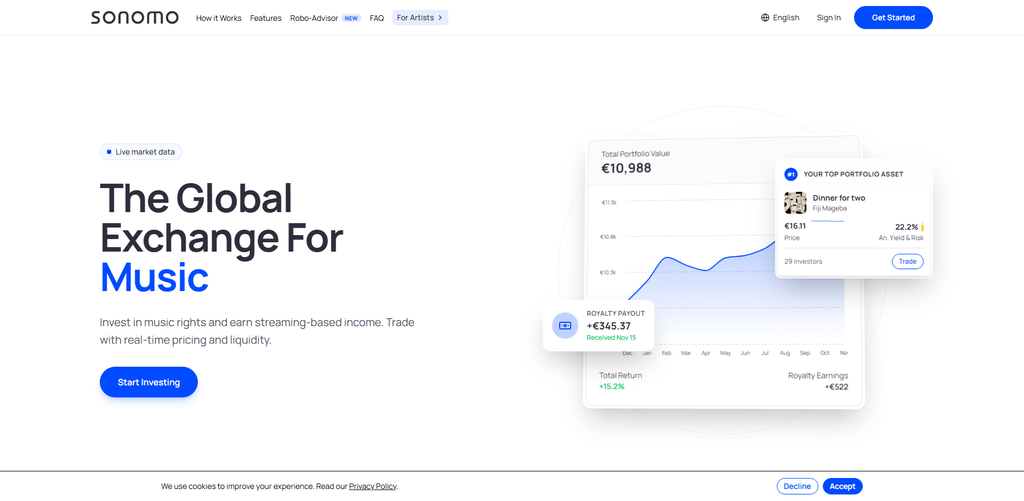
Shares held at month-end are entitled to that month’s royalties, which are credited to the Sonomo wallet around the 15th of the following month (roughly 2.5 months after streaming). Sonomo charges a 1% fee on all trades, whether you are buying or selling, including Robo-Advisor trades. The company’s catalog strategy involves buying master rights from artists. It says it is flexible on artists with around 15,000 monthly listeners. Historical performance is based on actual streaming activity.
Key Features
- Fractional ownership of music royalty assets.
- Delivers streaming performance and past earnings data.
- Allows trading against a live orderbook.
- Pays out monthly royalties to qualified investors.
- Portfolio tracking and investment performance reporting were included.
What makes us unique
- Brings streaming data into investment analysis.
- Provides live price and trading information.
- We offer monthly royalty distribution arrangements.
- Offers automated portfolio management through its Robo-Advisor offering.
7. Bolero
Bolero is a French/European platform that allows individuals and institutions to invest in bonds secured on existing music catalogs through Song Shares and Catalog Shares. New issues can be subscribed for from €100 while existing holdings can be traded on its Bulletin Board from €1. Royalty sources are exploitation revenues from publishing and master rights collected by Bolero or its agent and redistributed from time to time.
Catalog Shares are a diversified investment vehicle in groups of songs, like an ETF-style music portfolio. Bolero charges management fees of between 3% and 10% on exploitation royalties before coupon distribution, a seller register-keeping commission of 2.5% on secondary trades and a performance commission of 15% but only if it makes a margin on a catalog sale. No entry, custody or exit fees are charged. Historical performance is shown catalog by catalog and is not indicative of future income.
Highlights
- Provides fractional music royalty investment opportunities.
- Provides SongShares for chosen music assets.
- Provides investors an opportunity to earn royalties income.
- Utilizes digital investment vehicles for music assets.
- Allows trading of eligible music investment interests.
Key differentiators
- Enables participation in select music royalty opportunities fractionalized.
- Uses SongShares as its investment product structure;]
- Connects music rights owners to potential investors.
- Incorporates digital asset infrastructure and music royalty participation.
8. Master Exchange
MasterExchange is a music-royalty investment platform that fractionalizes royalty streams into tradeable shares called Royalty Shares. Investors can buy into selected songs or catalogs and receive a percentage of future royalty payments, through its model. Royalty streams can include streaming income, performance income, mechanical income, synchronization income, and catalog income depending on the asset.
There is no obvious minimum investment mentioned in the materials available, so the practical minimum will be based on the share price and listing. MasterExchange charges a 2% transaction fee from each buyer and seller and an administration fee of 1% on all royalty payments; the minimum quarterly distribution is €0.10 per Royalty Share.
It lists assets like Opus in its catalogs, and shows the yield on an annual basis based on historical performance, with a clear warning that past performance is no guide to future performance.
Main Features
- Provides initial music offerings (IMOs).
- Allows for fractional share of music royalty streams.
- Participates in investments through digital asset structures.
- Identifies selected music rights and royalty opportunities.
- Connects investors to music creators and rights holders.
Differentiators
- Utilizes IMOs to structure investment offerings in music.
- Fractional royalty participation emphasis.
- Utilizes blockchain-based infrastructure for music investment products.
- Offers an alternative framework for music catalog acquisitions than traditional.
9. Anotherblock
Anotherblock is a Web3-centric music rights marketplace that offers “Digital Vinyl” and music rights investment products. Its model combines fractionalized rights exposure with blockchain-based ownership records, enabling fans and investors to participate in select songs, catalogs or rights-backed digital content. The sources of royalties vary by drop but may include streaming, licensing and other commercial exploitation revenues associated with the underlying music.
Minimum investment is not universal across the platform but is offering specific and generally structured to be relatively low for retail participants. Tokenized offerings have been used to feature living artists and rights holders in catalogs.
There is no one universal schedule, each individual offering sets the royalty distribution terms, lockups and fee structures. Historical performance is limited and very asset specific. Investors should view these as alternative, higher risk music rights investments rather than guarantyd income products.
Main Features
- Provides music royalty investment opportunities on blockchain.
- Offers fractional ownership of particular music assets.
- Employs NFT-based structures for qualified music investments.
- Connects music rights to digital asset technology.
- Participation in royalties from certain music releases.
Key Differentiators
- Fuses blockchain technology with music royalties.
- It uses tokenized structures to participate in music investment.
- Focuses on digital ownership and music assets.
- Offers the music audience investment opportunities via Web3.
10. Global Rockstars
Global Rockstar is a music-investment platform that connects artists and fans through crowdfunding-style offerings in music projects and royalty-related interests. Its model is built around fan participation, allowing fans to support their favorite artists and even share in some income streams, as specified per offering.
Royalty sources can be streaming, sales, licensing or any other revenue sources as defined in the terms of each campaign. Usually minimum investments are specific to a campaign and can be quite low, but the exact threshold depends on the artist and project. So the available catalogs are artist-led and project-based rather than a large standardized institutional catalog library.
The distribution of royalties is determined by the revenue sharing agreement and reporting cycle of the specific offer. Not all campaigns publish historical performance data, so investors should consider the artist’s audience, catalog quality, contractual rights and fee structure on a case-by-case basis before putting in money.# Important risk disclaimer
Key Features
- Offers music royalty investments via crowdfunding.
- Links music creators with potential investors.
- Provides input to chosen music projects.
- Specializes in music assets that generate royalties.
- Presents a model for financing music with private investors.
Key differentiators
- It merges music crowdfunding with royalty sharing.
- Committed to pairing investors with independent music projects.
- Offers an alternative way for music makers to get funds.
- Enables investors to explore music-related crowdfunding opportunities.
Conclusion
Music royalty investment platforms provide investors the opportunity to earn potential income from music streaming, publishing rights, licensing and established music catalogs. Royalty Exchange, SongVest, ANote Music, Musicow and Jukebox are all platforms that offer a range of investment models, including fractional ownership of royalties and catalog investments.
Compare minimum investment requirements, sources of royalty, historical earnings, fees charged by the platform, frequency of payment and options for resale before investing. Equally important is understanding the ownership structures, the regulatory requirements and the investment risks. Ultimately, the best platform is the one that fits your financial objectives, risk tolerance, capital you have to invest and how you prefer to invest in music royalties.
FAQ
What Are Music Royalty Investment Platforms?
Music royalty investment platforms are online marketplaces where investors can purchase full or fractional interests in music royalties and potentially earn income from streaming, licensing, publishing, and other music-related revenue.
How Do Music Royalty Investment Platforms Work?
These platforms connect investors with music rights holders offering royalty interests. Investors purchase eligible interests and may receive a share of revenue generated by the associated songs or music catalogs.
What Are the Best Music Royalty Investment Platforms?
Some notable platforms include Royalty Exchange, SongVest, ANote Music, Musicow, Jukebox, Sonomo, Bolero, MasterExchange, Anotherblock, and Global Rockstar.
Can Beginners Invest in Music Royalties?
Yes, some platforms offer fractional investment opportunities that may be accessible to beginners. However, minimum investment requirements, eligibility rules, and investment structures vary between platforms.
How Do Investors Earn Money From Music Royalties?
Investors may receive income from music streaming, downloads, publishing, public performances, radio airplay, and synchronization licensing, depending on the specific royalty rights included in their investments.