

This article addresses the Best Decentralized Identity (DID) Solutions for Web3. It speaks to the changes to digital authentication and user privacy that these DID Solutions are spearheading.
It will identify how the best DID Solutions secure self-sovereign Identity and lessen the burden on central authorities to construct and maintain digital frameworks for the user experience on the Web3. These solutions are redefining the digital landscape of the decentralized, trustless Internet and user-driven ID frameworks.
What is Decentralized Identity (DID) Solutions?
DID Solutions are blockchain identity systems where users are free from central authorities, such as government, big tech, and banking. Here, users have full control of their digital identity.
Unlike the old database systems where information was centralized, DID solutions keep identity information secure using distributed ledgers, cryptographic keys, and verifiable credentials. With this kind of protection, users are able to disclose the information that they deem necessary.

This may be age, membership, and a number of certified credentials without disclosing any sensitive personal information.
In the Web3 ecosystem, DID solutions are essential in the provision of safe and secure logins, private and trustworthy interactions, and authentication across the various decentralized applications. At the same time, users are empowered and retain ownership of their identity.
Why Choose Best Decentralized Identity (DID) Solutions for Web3
User control over identity – With DID solutions, users possess complete ownership of their digital identity, as there is no reliance on centralized systems.
Privacy protection – Identity solutions can use cryptography and zero-knowledge proofs to share the least amount of information necessary.
Fraud and identity theft diminish – The ability to verify someone’s identity on the blockchain makes fraudulent and duplicate identities more difficult.
Web3 Made Easy – DID solutions simplify identity verification, as users can login to decentralized systems without passwords.
Cross-system identity use – Within different service offerings in the Web3 space, users are able to use the same identity.
Decentralization ensures safety – With centralized solutions, intelligence is more at risk. Decentralized solutions more put security and privacy in the hands of users.
Privately verified compliance – Users maintain control of their identity and privacy, although verification is done.
Benefits Of Decentralized Identity (DID) Solutions for Web3
Data control – Decentralized Identities allow users to control their personal data with no reliance on centralized data holding firms.
Improved privacy – With Decentralized Identities, sensitive data does not need to be shared.
Identity theft resistance – Decentralized Identities and the blockchain eliminate the need for a fake identity, Sybil Attacks, and impersonation become impossible.
Streamlined account setup – Decentralized Identities allow instant login to all of Web3 and eliminates the need for a password.
Universal usability – Decentralized Identities will work with any blockchain.
Improved security – Decentralized Identities eliminate the security breaches that fatal failures of centralized identity data banks create.
Privacy-preserving compliance – Decentralized Identities allow users to maintain their privacy and control their data while meeting the requirements for KYC and other regulations while remaining secure.
Use Cases of Decentralized Identity in Web3
DeFi & KYC: Holding a Decentralized Identity (DID) allows individuals to identify themselves to DeFi platforms without the redundant exposure of sensitive data. Privacy-preserving KYC can be done with verifiable credentials.
NFT & Proof of Ownership: By combining a digital identity with a blockchain wallet, NFTs can be authenticated and ownership can be protected from fraud and the great duplication of assets.
Voting & Governance in DAOs: DID can validate unique individuals to participate in a voting process and, therefore, prevent Sybil attacks, ensuring integrity in a DAO’s decision process.
Identity in Web3 Gaming: Within the Web3 gaming ecosystem, a DID enables the transfer of a player’s game achievements, digital assets, and reputation between gaming environments.
Identity in the Metaverse: In the Metaverse, DID offers the user a consistent portable digital identity that can be used for seamless interaction with avatars and assets across virtual environments.
Identity in Cross Web3 Applications: A DID also allows the user to log into any Web3 application without a password. This convenience offers greater security and less dependence on a centralized identity.
Key Point & Best Decentralized Identity (DID) Solutions for Web3
- Spruce ID – Enables passwordless login and secure identity verification using user-controlled credentials.
- Civic – Provides reusable digital identity with secure KYC and biometric-based authentication for Web3 apps.
- BrightID – Uses social graph verification to prevent Sybil attacks and ensure unique human identity in decentralized systems.
- Polygon ID – Offers privacy-preserving identity verification using zero-knowledge proofs on the Polygon ecosystem.
- Lit Protocol – Enables programmable encryption and identity-based access control across Web3 applications.
- Dock – Focuses on issuing and verifying verifiable credentials for businesses and individuals in Web3.
- SelfKey – Lets users manage digital identity, documents, and KYC data securely in a self-custodial wallet.
- Serto – Provides DID tooling and verifiable credential frameworks for building identity-based Web3 apps.
- Bloom – Offers decentralized identity verification and credit scoring tools to reduce fraud in digital ecosystems.
- Ontology ONT ID – Delivers on-chain identity management with privacy protection and cross-chain interoperability.
10 Best Decentralized Identity (DID) Solutions for Web3
1. Spruce ID
With Spruce ID, users can build their digital identity with self-sovereign credentials. It enables authentication without dependence on centralized systems via self-sovereign standards such as DIDs and Verifiable Credentials.

With Spruce ID, developers create systems with wallets for users to “sign in” rather than passwords. Spruce ID is widely adopted for Web3 engagements and privacy-preserving authentication systems.
It reduces reliance on centralized identity verification systems while enabling users to maintain control over their identity. Spruce ID exemplifies Best Decentralized Identity (DID) Solutions for Web3 actively in development. It provides users secure verification and enables full control of personal data in decentralized applications.
Importance of Spruce ID
- Focused on digital identities in Web3 (secure and user-owned)
- Uses verifiable credentials for authentication
- Improves privacy and decreases reliance on centralized logins
- Allows for easy login via Ethereum wallets
- Builds trust in dApps
Spruce ID Characteristic , Pros & Cons
| Characteristic | Pros | Cons |
|---|---|---|
| Wallet-based authentication | Strong user control over identity | Limited ecosystem adoption compared to major players |
| Verifiable credentials support | Passwordless login for Web3 apps | Requires developer integration effort |
| DID standard compliance | High privacy and security | Still evolving infrastructure |
| Decentralized login system | Reduces centralized data breaches | Not beginner-friendly for non-technical users |
2. Civic
Civic uses warfare-ready biometrics to cross-verify identity with a degree of assurance that renders any identity document meaningless. Civic enables the verification of an identity that can be reused for other systems without the need for physical identity documents to be shared.

Civic replaces repetitive and menial verification of identity by a secure identity wallet system where the bearer controls the shared information. It is emerging as a preferred KYC facilitator for Web3 service offerings, gaming, and finance.
Civic is a frontrunner in the Best Decentralized Identity (DID) Solutions for Web3 because it supports a privacy-preserving and fraud preventing verification system.
Importance of Civic
- Provides KYC and identity verification via blockchain
- Prevents fraud and identity issues in Web3
- Provides identity credentials that are application agnostic and reusable
- Login is easily done without a password
- Provides assurance for DeFi and Fin-tech
Civic Characteristic, Pros & Cons
| Characteristic | Pros | Cons |
|---|---|---|
| Biometric identity verification | Strong KYC compliance | Privacy concerns with biometric data |
| Reusable digital identity | Fast onboarding across platforms | Depends on Civic ecosystem adoption |
| Blockchain-secured identity | Reduces fraud and fake accounts | Limited flexibility outside supported apps |
| Identity wallet | Easy integration for businesses | Not fully decentralized in all processes |
3. BrightID
BrightID is a new way of looking at decentralized identity. Instead of verifying users through documents and biometrics, BrightID creates a trust graph combining users’ social connections, which helps confirm a user’s identity through real relationships and avoids Sybil attacks.
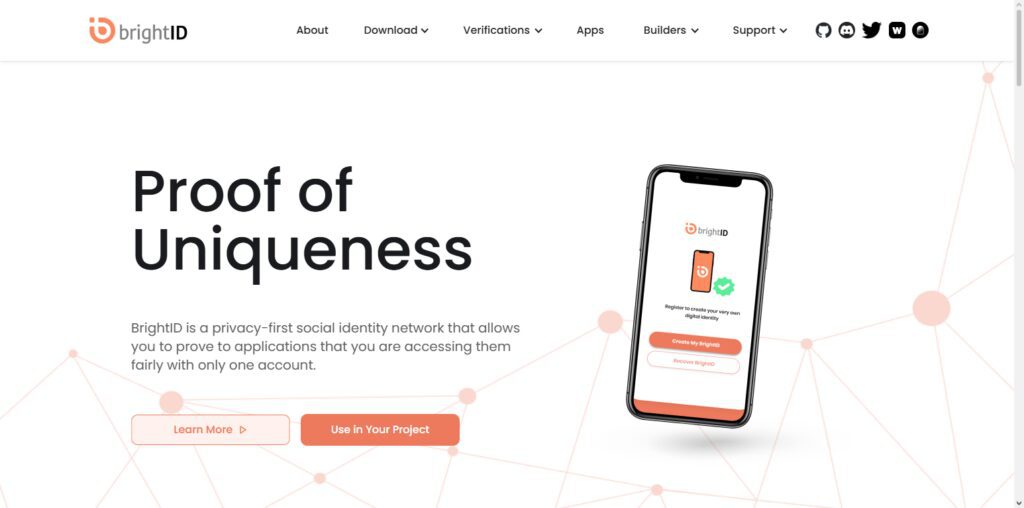
Because of its real relationships, BrightID is perfect for airdrops, governance, and fair distribution. BrightID verification is as easy as throwing a verification party or connecting to a trusted user.
In our opinion, BrightID is one of the best community-driven Web3 decentralized identity solutions, creating a one-person-one-account system, eliminating centralized identity solutions, and protecting the users’ privacy.
Importance of BrightID
- Unique human verification to prevent Sybil attacks
- One person, one identity for DAOs
- Improves fairness in voting and governance
- Uses social verification over centralized data
- Builds trust in Decentralized Communities
BrightID Characteristic, Pros & Cons
| Characteristic | Pros | Cons |
|---|---|---|
| Social graph verification | Strong Sybil attack resistance | Requires social connections for verification |
| Human uniqueness validation | No personal data needed | Slow onboarding process |
| Community-based trust system | Highly privacy-friendly | Not suitable for enterprise KYC |
| Decentralized identity proof | Free to use | Scalability challenges |
4. Polygon ID
Polygon ID is a highly privacy-friendly system based on zero-knowledge (ZK) proofs and cryptographic identity. It is perfect for Web3 solutions prioritizing privacy since users can prove they are of a certain age, hold a citizenship or are a member of a certain organization without having to show who they are.
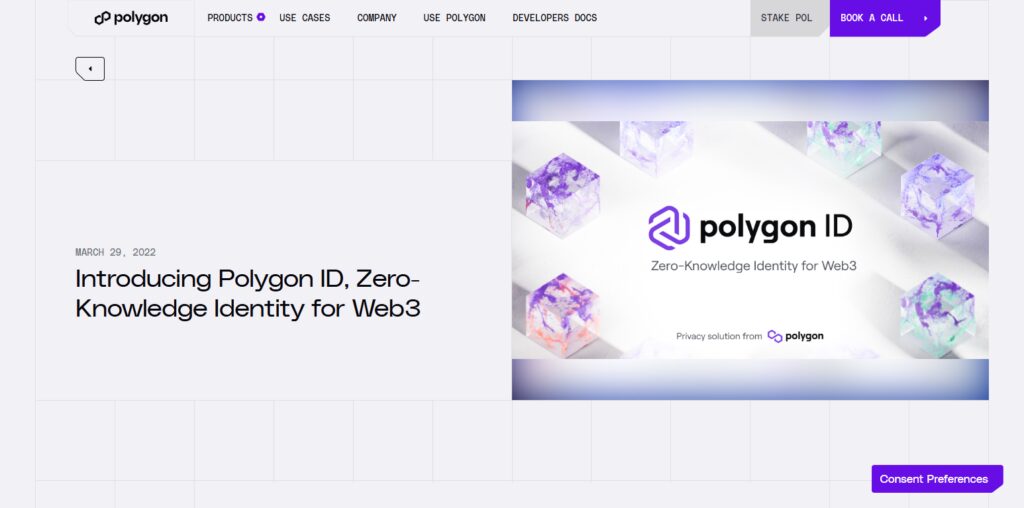
Using Polygon ID, developers can ensure a private and secure authentication system on-chain used for validating votes in a DAO or for performing a compliance check. Because of the advanced zero-knowledge cryptography, Polygon ID is one of the best decentralized identity (DID) solutions for Web3. It truly ensures privacy and scalability.
Importance of Polygon ID
- Identity verification that employs zero-knowledge proofs on the Polygon blockchain
- Allows users to verify their identity without revealing sensitive data
- Scalable and offers authentication to Web3 applications
- Aids DeFi, gaming, and the metaverse
Polygon ID Characteristic, Pros & Cons
| Characteristic | Pros | Cons |
|---|---|---|
| Zero-knowledge proofs | Maximum privacy protection | Complex cryptographic setup |
| On-chain identity verification | No data exposure required | Limited mainstream adoption |
| Selective disclosure | Flexible identity sharing | Requires developer expertise |
| Blockchain-based credentials | Highly secure authentication | Still early-stage ecosystem |
5. Lit Protocol
Lit Protocol, a decentralized key management system, allows users to configure access for encrypted data by programming conditions on the blockchain, such as ownership of a wallet, or possession of an NFT.

This brings programmable, identity-based access control to all Web3. For a content creator, or a programmer building with the Lit Protocol, this cuts out the need to use a centralized data store to send and receive protected content, NFTs, and datasets.
For a user, Lit Protocol provides access to numerous private, gated, decentralized, and token-based Web3 systems. Lit Protocol is a vital component of the Best Decentralized Identity (DID) Solutions for Web3, as it bridges identity and encryption, enabling secure programmable access control in decentralized ecosystems.
Importance of Lit Protocol
- Focuses on decentralized access and secure key controls
- Offers programmable wallets with gated access
- Privacy of data is improved via cryptography
- Cross-chain access and identity are supported
Lit Protocol Characteristic, Pros & Cons
| Characteristic | Pros | Cons |
|---|---|---|
| Decentralized key management | Strong encryption control | Complex implementation |
| Token/NFT-based access control | Enables gated content systems | Limited non-crypto adoption |
| Programmable encryption | Highly flexible use cases | Requires technical knowledge |
| Wallet-based permissions | No central authority risk | Still developing ecosystem |
6. Dock
Dock provides a framework for building decentralized credential systems to issue, hold, and verify credentials. At its core, Dock aims to create trustless credential systems for education and employment, and enterprise onboarding.
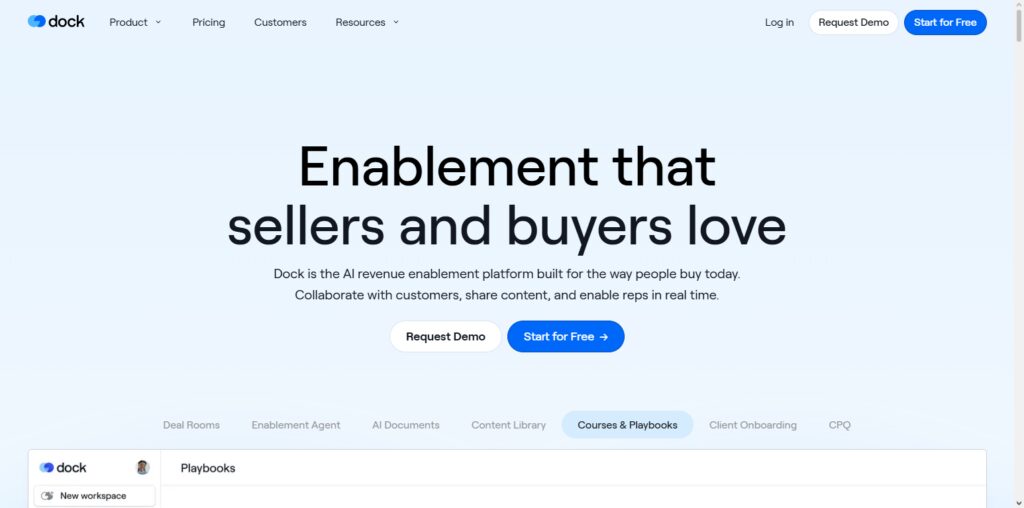
For the end user, Dock securely stores credentials in self-sovereign digital wallets. For credential issuers, Dock eliminates intermediary verifications. Dock solves many compliance, KYC, and certification use cases in Web3.
Dock is part of the Best Decentralized Identity (DID) Solutions for Web3, as it enables a secure and tamper-proof credential verification system in every industry and elevates cross-institution and cross-blockchain collaboration.
Importance of Dock
- Provides tools for managing verifiable credentials
- Helps companies offer secure digital identities
- KYC and compliance within Web3 supported
- Simplifies the incorporation of blockchain applications
- Leads to better collaboration of identity systems
Dock Characteristic, Pros & Cons
| Characteristic | Pros | Cons |
|---|---|---|
| Verifiable credential issuance | Enterprise-ready identity system | Less popular in consumer Web3 |
| Identity wallet support | Easy credential sharing | Limited ecosystem visibility |
| Blockchain-backed verification | High trust and authenticity | Integration complexity |
| Interoperability features | Works across platforms | Slower adoption rate |
7. SelfKey
SelfKey provides a self-sovereign identity ecosystem through which individuals can keep their digital identity, KYC documents, and financial accounts in one secure location. They can also control the identity data they wish to share with various banks, exchanges, and Web3 platforms.

Additionally, SelfKey provides services such as company incorporation and citizenship by investment. Because the system is decentralized, participants keep full control over their information.
With regard to Best Decentralized Identity (DID) Solutions for Web3, SelfKey provides a streamlined solution for onboarding, with an emphasis on privacy, compliance, and the control of digital identity resources.
Importance of SelfKey
- Full control of digital identity data
- Offers secure identity storage and management wallet
- Streamlined KYC for crypto and financial services
- Less reliance on centralized identity providers
- Identity marketplace for document verification
SelfKey Characteristic, Pros & Cons
| Characteristic | Pros | Cons |
|---|---|---|
| Self-sovereign identity wallet | Full user data control | Interface can feel outdated |
| KYC document storage | Easy onboarding for exchanges | Limited advanced Web3 features |
| Identity marketplace | Additional financial services | Smaller developer ecosystem |
| Secure credential sharing | Reduces repeated verification | Not fully decentralized ecosystem-wide |
8. Serto
Serto provides advanced decentralized identity resources for the construction of DID and verifiable credential infrastructures. With the APIs, SDKs, and identity infrastructures of Serto, secure identity systems can be integrated into Web3 applications.

Complementing the design of decentralized and scalable systems of identity management, Serto also addresses interoperability among multiple blockchains. Its design and functionality give it broad use in enterprise authentication, supply chain verification, and frameworks for decentralized logins.
Within Best Decentralized Identity (DID) Solutions for Web3, Serto allows enterprises to incorporate decentralized identity systems, while preserving the frameworks of their existing systems, effectively allowing a seamless integration of Web2 identity systems with the standards of Web3.
Importance of Serto
- Decentralized identity and identity infrastructure and APIs
- Build SSI systems (Self-Sovereign Identity)
- Endorses verifiable credentials and the DID standards
- Enhanced interoperability for Web3
- Decentralized identity options for enterprises
Serto Characteristic, Pros & Cons
| Characteristic | Pros | Cons |
|---|---|---|
| DID infrastructure APIs | Developer-friendly tools | Mostly enterprise-focused |
| Verifiable credentials support | Scalable identity systems | Limited retail user adoption |
| Cross-chain compatibility | Works across ecosystems | Requires technical setup |
| Enterprise integration tools | Bridges Web2 and Web3 | Not end-user focused |
9. Bloom
Bloom helps increase trust in digital systems and helps decrease fraud with their decentralized identity and credit scoring design. Users create identity profiles on the blockchain and are able to share them privately in order to receive credit or verification.

This solution has a large impact on the inclusion of decentralized credit reputation systems, which Bloom caters to. Lending solutions, Web3 identity-verifying solutions, and fintech onboarding solutions,
Bloom is a popular choice. In the realm of the Best Decentralized Identity (DID) Solutions for Web3, Bloom helps provide a trust-centered ecosystem in which users have full control over their identity and reputation, abstaining from the use of centralized credit bureaus.
Importance of Bloom
- Decentralized identity verification and credit scoring
- Financial identity safety
- Allows selective sharing of personal data
- Less fraud in finance and lending
- Financial inclusion in Web3
Bloom Characteristic, Pros & Cons
| Characteristic | Pros | Cons |
|---|---|---|
| Decentralized credit scoring | Helps financial inclusion | Limited modern Web3 updates |
| Identity verification system | Fraud reduction | Smaller active ecosystem |
| Blockchain identity profiles | User-controlled data | Adoption has slowed over time |
| Lending support tools | Useful for DeFi credit systems | Less developer traction |
10. Ontology ONT ID
Ontology ONT ID is a framework for decentralized identity solutions on the Ontology blockchain. ONT ID helps maintain decentralized identity management through data privacy and allows interoperability across different chains and Web3 solutions.
With their framework, digital identities are linked to blockchain addresses, and users maintain privacy by ther use of privacy cryptography. This framework also supports decentralized enterprise and compliance and interoperability solutions for DeFi.
As one of the Best Decentralized Identity (DID) Solutions for Web3, Ontology ONT ID helps provide a trust-centered solution for users as well as seamless portability of identity across different decentralized frameworks.
Importance of Ontology ONT ID
- Digital identity framework on blockchain
- Verify identity across chains
- Control your data and privacy
- Tools to easily add identity solutions to your business
- Confidence in enterprise and Web3 solutions
Ontology ONT ID Characteristic, Pros & Cons
| Characteristic | Pros | Cons |
|---|---|---|
| Cross-chain identity system | Strong interoperability | Ecosystem dependency on Ontology chain |
| On-chain identity management | High security | Limited mainstream Web3 use |
| Privacy-preserving verification | Data protection focused | Requires ONT ecosystem integration |
| Enterprise identity tools | Suitable for business adoption | Less consumer visibility |
Future of Decentralized Identity in Web3
The coming years of Decentralized Identity (DID) in Web3 is thought to impact the management and control of digital identities across the web. Web3 and DID systems promote the sovereignty of personal data in addition to allowing users to verify credentials and interact across multiple systems in a secure manner with a single decentralized identity.
Thanks to the developments in blockchain technology, zero-knowledge proofs, and some of the many expanding interoperability standards, decentralized identity systems will be more private, scalable and user-friendly.
In the years to come, DID will be introduced to DeFi, gaming and the metaverse, as well as enterprise applications and other systems to replace the traditional identity systems.
Conclusion
Transforming how users prove their identity across decentralized ecosystems, Web3 Decentralized Identity (DIDs) Solutions are changing how users access services and interact with different modules.
Unlike traditional systems, users are empowered to have self-sovereign control of their personal data, which increases the security, the privacy and the trust of the user. Using Spruce ID, Civic, Polygon, and Bright ID among others, new systems integrated with zero-knowledge proofs, social verification, and other methods, verifiable credentials and fraud KYC will diminish.
As Web3 expands, DID systems will build onboarding security, cross-platform authentication, and digital reputation systems. Decentralized DID systems will continue building a new usable, owner, and portable identity for the decentralized internet.
FAQ
What are Decentralized Identity (DID) solutions in Web3?
Decentralized Identity (DID) solutions are blockchain-based systems that let users create, own, and control their digital identity without relying on centralized authorities. They use cryptographic keys and verifiable credentials for secure authentication across Web3 platforms.
Why are DID solutions important for Web3?
They are important because they improve privacy, reduce identity fraud, and eliminate dependence on centralized databases. DID solutions also enable seamless onboarding, secure logins, and cross-platform identity verification in decentralized ecosystems.
How do DID solutions protect user privacy?
DID systems use techniques like zero-knowledge proofs and selective disclosure, allowing users to verify specific information without revealing their full personal data. This ensures maximum privacy and data control.
What are some popular Best Decentralized Identity (DID) Solutions for Web3?
Popular solutions include Spruce ID, Civic, BrightID, Polygon ID, Lit Protocol, Dock, SelfKey, Serto, Bloom, and Ontology ONT ID, each offering unique identity and verification features.