In this article, I will share some of the Leading Low-Code FinTech Platforms to Build Bespoke Payment Applications and how they are modernizing the construction of financial applications.
With these platforms, businesses are empowered to build secure, scalable, and feature-rich payment applications with very low coding effort. Here, you will discover some of the best tools, their advantages, and the ways they improve the pace of FinTech in the digital payment space.
Why Low-Code Platforms Are Transforming Payment App Development
Development Agile Manifestation: Visual development and drag-and-drop components, as well as pre-fabricated templates, reduce development time. Payment apps can be released rapidly to satisfy market needs.
Cost-Effective Development: Low-code platforms function with less demand for developers, reducing the development cost and the cost to maintain the app. Payment apps can be developed without a significant cost for developers.

Payment System Integration: Low-code platforms provide a means to integrate payment gateways, banking APIs, and payment systems with pre-fabricated APIs and connectors.
Security and Compliance Concerns: Payment applications developed on low-code platforms have compliance and built-in storages for requirements like PCI DSS and GDPR, along with other built-in security features like encryption and authentication.
Growth of Business Capability: Low-code solutions enable scalability of payment systems along with the growth of the business in order to accommodate a growing number of/payment transactions and financial data.
Developer Dependence: Reduction of reliance on developers is accomplished with the ability of users and non-technical business teams to create and control the applications.
Cross-Functional Teams: Low-code development platforms allow collaboration of IT teams and business and finance professionals in the development of payment applications.
Rapid Prototyping and Testing: FinTech organizations are better positioned to build and deploy early-stage payment app prototypes and provide an opportunity to improve system features through iterative design before the complete and large-scale deployment of the payment system. This increases accuracy and reduces risk.
Key Features to Look for in Low-Code FinTech Platforms
Easy Payment Gateway Integration: Low-code FinTech solutions should allow the integration of payment gateways such as Stripe, PayPal, Razorpay, etc., and should integrate banking APIs to allow seamless banking transactions.
Security and Compliance Features: Solutions should have multilayer built-in security features, such as encryption, multi-factor authentication, role-based access, and PCI DSS, GDPR, and other financial compliance and security regulatory standards.
API Integration and Flexibility: Low-code solutions that support REST and GraphQL APIs allow the easy integration of financial and banking tools and other enterprise and business applications such as CRMs and ERPs.
Automation of Workflows: Workflow automation facilitates the automation of payments, approvals, invoicing, refunds, reconciliation, and financial reporting.
Scalability and Performance: Any good low-code FinTech solution should ensure smooth operations for any of the financial applications that experience high loads, regardless of the financial application’s users or the volume of transactions.
Cloud Deployment Solution: Flexible, easier control of financial applications at a global scale allows faster updates with a financial application deployed on the cloud.
Drag-and-Drop Development: The low-code drag-and-drop development accelerates the design and development of FinTech solutions.
Real-Time Transaction Monitoring: Low-code solutions that allow businesses to track transactions in real time and analyze and generate reports assist businesses in making financial decisions in a timely manner.
Responsive Design: Low-code FinTech solutions should design and develop applications that ensure a seamless user experience across all devices.
Custom Payment Solutions: Low-code solutions that offer further customization of their payment systems allow businesses to design payment systems across multiple financial domains.
Use Cases of Low-Code Payment Apps
Digital Wallets: Low-code systems allow organizations to create secure digital wallets. These systems allow money to be stored, moved, and transacted on all through a system using low-code to develop the backend.
Subscription Payments: Automated subscription payments can be built to SaaS and streaming systems by using low-code to build the billing, invoicing, and payment systems.
Invoice and Payment Reconciliation: Low-code systems allow organizations to take control of their finances by building invoice generation, expense tracking, approval, and payment reconciliation systems.
Merchant Payments: Merchant payment dashboards can be created using low-code to allow businesses to take payments and see their sales data and refunds.
P2P Payment Apps: Low-code systems allow the secure and rapid transfer of funds between two parties through a low-code app.
Loans and Credit: Low-code systems allow organizations to automate the process of applying and approving loans and the tracking of the repayment.
Financial Dashboards: Organizational dashboards can be built to measure cash, revenue, and transactions using low-code dashboards and visualizations.
Fraud Prevention: Low-code systems allow the purchasing of advanced fraud systems to minimize the risk of financial fraud.
Payment Approvals: Internal payment systems can be built to automate the approval of payments and bills of goods and services.
Best Low-Code FinTech Platforms for Custom Payment Apps List
- OutSystems FinTech
- Mendix Payments
- Microsoft Power Apps
- Zoho Creator FinTech
- Appian Payments
- Salesforce Financial Services Cloud
- Bubble.io FinTech
- Retool Payments
- FlutterFlow FinTech
- Quickbase Payments
10 Best Low-Code FinTech Platforms for Custom Payment Apps
1. OutSystems FinTech
Organizations using OutSystems FinTech can develop and deploy secure enterprise payment, digital banking, and lending applications faster than with traditional coding methods. Developers can use visual development methods and a variety of built-in workflows to automate, manage, and secure application deployment to the cloud.
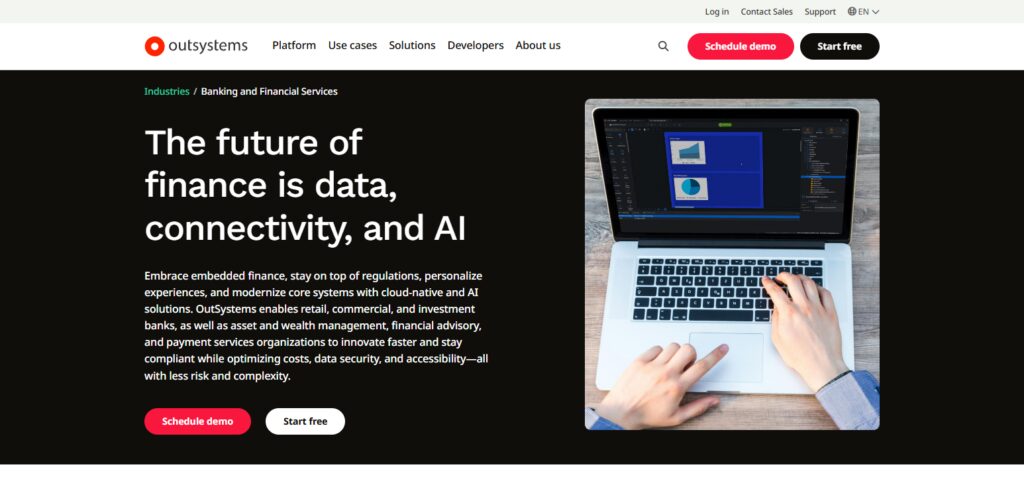
Best Low-Code FinTech Platforms for Custom Payment Apps – OutSystems FinTech claims that OutSystems FinTech simplifies the integration of payment processors, banking APIs, KYC and fraud detection solutions, and enterprise resource planning (ERP) tools.
Combining all of these features with AI-driven automation and role-based security makes the OutSystems platform the ideal choice for fintechs, banks, payment service providers, and enterprise financial institutions.
OutSystems FinTech
| Core Strengths | Best For |
|---|---|
| Enterprise-grade application development | Large banks and financial institutions |
| High-performance cloud deployment | Digital banking platforms |
| Advanced security and compliance | PCI DSS and regulated payment systems |
| AI-assisted development tools | Complex FinTech applications |
| Extensive API integrations | Custom enterprise payment solutions |
2. Mendix Payments
Mendix Payments is a comprehensive low-code application development platform that offers minimal coding effort to develop tailor-made payment solutions. Developers can quickly construct merchant payment portals, digital wallets, subscription-based payment services, and other payment-related administrative applications.
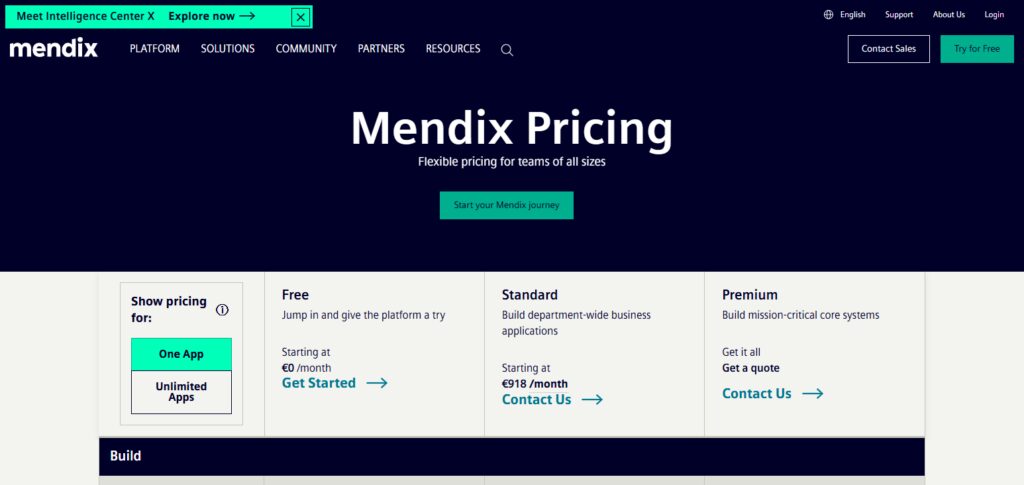
Built with a cloud-native, microservices architecture, Mendix Payments allows ample integration and automation. Best Low-Code FinTech Platforms for Custom Payment Apps – Mendix Payments cites that Mendix Payments maintains the highest security standards while offering complete flexibility to facilitate integration to payment gateways, banking APIs, CRM, and ERP systems.
Combining all of these features with AI-driven automation and role-based security makes the Mendix platform the ideal choice for banks and payment service providers interested in providing flexible payment solutions.
Mendix Payments
| Core Strengths | Best For |
| Rapid low-code application development | Payment service providers |
| Cloud-native architecture | Enterprise payment automation |
| Collaborative development environment | Large development teams |
| Strong workflow automation | Financial process optimization |
| Microservices and API support | Scalable payment ecosystems |
3. Microsoft Power Apps
Businesses can use the Power Apps low-code ecosystem to build customized financial applications. Using Microsoft Power Apps, businesses can build their own payment approval applications, expense management applications, invoice processing applications, customer payment applications, and financial dashboard applications.
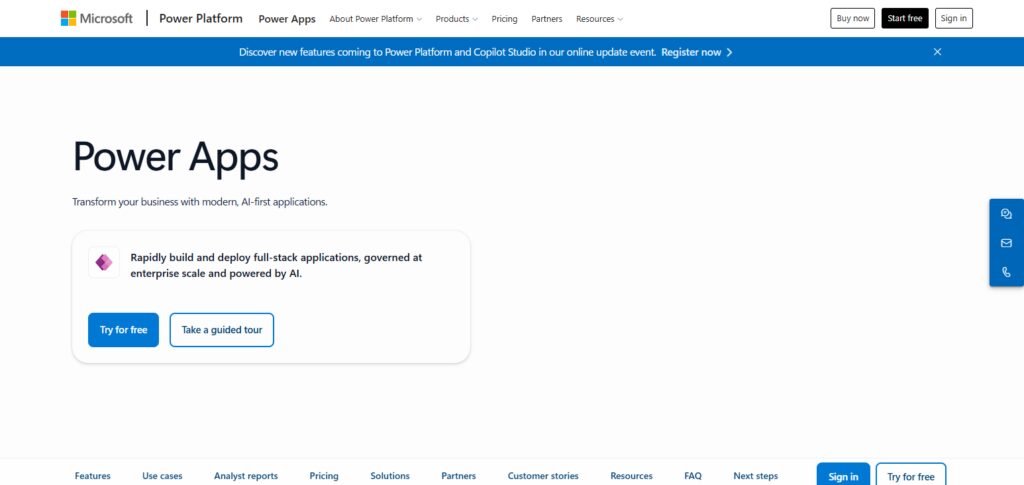
Using Microsoft Power Apps, businesses do not need to have extensive knowledge of programming in order to build applications. Power Apps integrates with Microsoft 365, Azure, Power Automate, Dynamics 365, SQL Server, and hundreds of third-party connectors.
The Low-Code FinTech Platforms for Custom Payment Apps Microsoft Power Apps adds additional simplicity to the payment workflow and enterprise-level security and compliance requirements. The combination of AI Builder, automation, analytics, and the mobile construct makes Microsoft Power Apps a powerful tool for Payment App construction
Microsoft Power Apps
| Core Strengths | Best For |
| Deep Microsoft ecosystem integration | Microsoft 365 users |
| Power Automate workflow support | Payment approval workflows |
| AI Builder capabilities | Business automation |
| Hundreds of built-in connectors | Internal financial applications |
| Secure Azure infrastructure | Enterprise organizations |
4. Zoho Creator FinTech
Zoho Creator FinTech is a low-code platform for the automation of financial processes and the construction of customized payment applications. Using Zoho Creator FinTech, businesses can create their own applications to track payments, bill customers, manage subscriptions, make payments to vendors, and manage financial approval workflows.
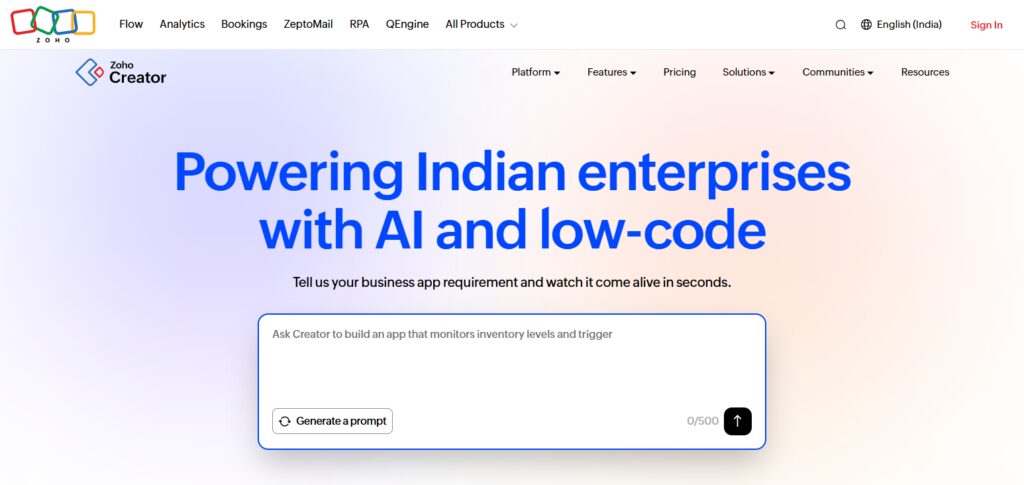
Zoho Creator FinTech provides businesses with a combination of cloud hosting, automated workflows, and a customizable mobile application. The Low-Code FinTech Platforms for Custom Payment Apps Zoho Creator FinTech offers seamless integration with Zoho’s ecosystem and Suite, payment gateways, accounting applications, CRMs, and third-party APIs.
Complimentary advanced reporting, customizable permissions, and a secure cloud environment make Zoho Creator FinTech an excellent platform for small to medium enterprises and growing FinTech application service providers.
Zoho Creator FinTech
| Core Strengths | Best For |
| Affordable low-code platform | Small and medium businesses |
| Easy drag-and-drop builder | Custom payment tracking apps |
| Native Zoho ecosystem integration | Existing Zoho users |
| Mobile application support | Mobile financial solutions |
| Workflow automation | Business payment management |
5. Appian Payments
Appian Payments is a low-code automation platform for enterprise financial services built on a combination of business process automation, workflow management, artificial intelligence, and case management.
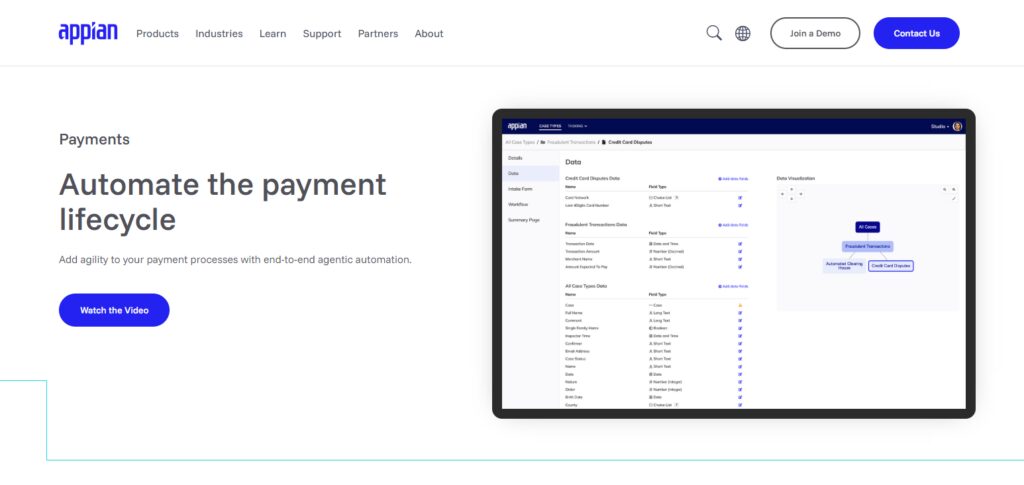
With a low-code approach, Appian Payments can be used to build loan processing systems, payment processing systems, digital onboarding systems, fraud and compliance systems, and more. Appian Payments offers intelligent document processing, robotic process automation, and monitoring.
Best Low-Code FinTech Platforms for Custom Payment Apps – Appian Payments offers a secure connection with banking and enterprise systems, payment processors, and compliance and regulatory systems. Coupled with its automation, Appian Payments is tailored for banks, insurance providers, and large enterprises.
Appian Payments
| Core Strengths | Best For |
| Intelligent business process automation | Financial enterprises |
| AI-powered workflow management | Compliance automation |
| Robotic Process Automation (RPA) | Banking operations |
| Enterprise case management | Loan and payment processing |
| Strong governance framework | Regulated financial sectors |
6. Salesforce Financial Services Cloud
Salesforce Financial Services Cloud enables financial enterprises to build payment and financial applications with a customer-centric design on a low-code platform. Payment management systems and client onboarding systems and financial services and relationship management systems can all be built using salesforce’s ecosystem.
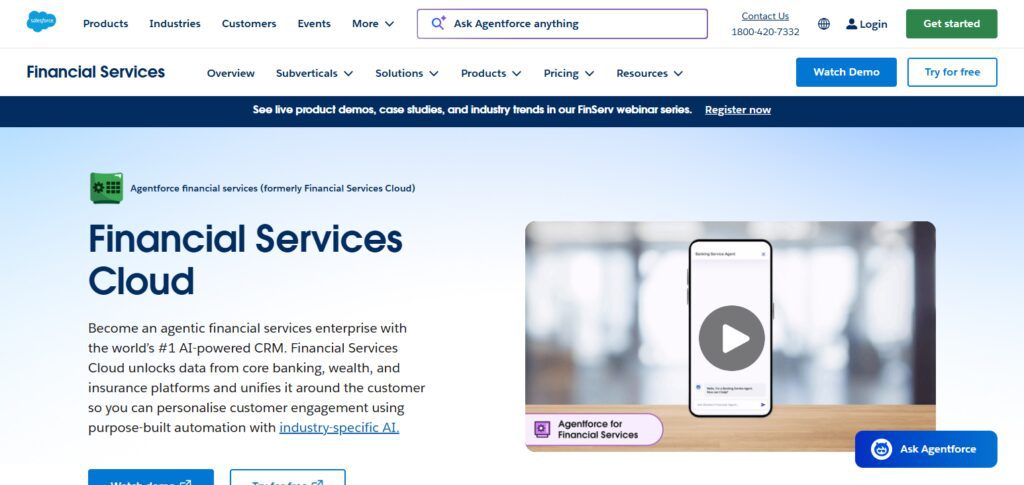
Financial Services Cloud customers gain automation, artificial intelligence customization, advanced analytics, and secure management of customer data with Salesforce’s advanced platforms.
Best Low-Code FinTech Platforms for Custom Payment Apps – Salesforce Financial Services Cloud provides secure integration of payment systems, banking APIs, CRMs and third-party FinTech solutions, while ensuring compliance. With its extensive automation and customer engagement, Financial Services Cloud is built for enterprise financial institutions.
Salesforce Financial Services Cloud
| Core Strengths | Best For |
| Customer relationship management | Financial advisors |
| AI-driven customer insights | Personalized payment experiences |
| Extensive AppExchange integrations | Enterprise financial services |
| Advanced analytics and reporting | Customer lifecycle management |
| Secure cloud platform | Large financial organizations |
7. Bubble.io FinTech
Bubble.io FinTech allows budding entrepreneurs to build payment solutions like digital wallets, payment systems, or fintech applications quicker, thanks to its drag-and-drop development features. Users can build applications on Bubble using digital design tools and workflows.
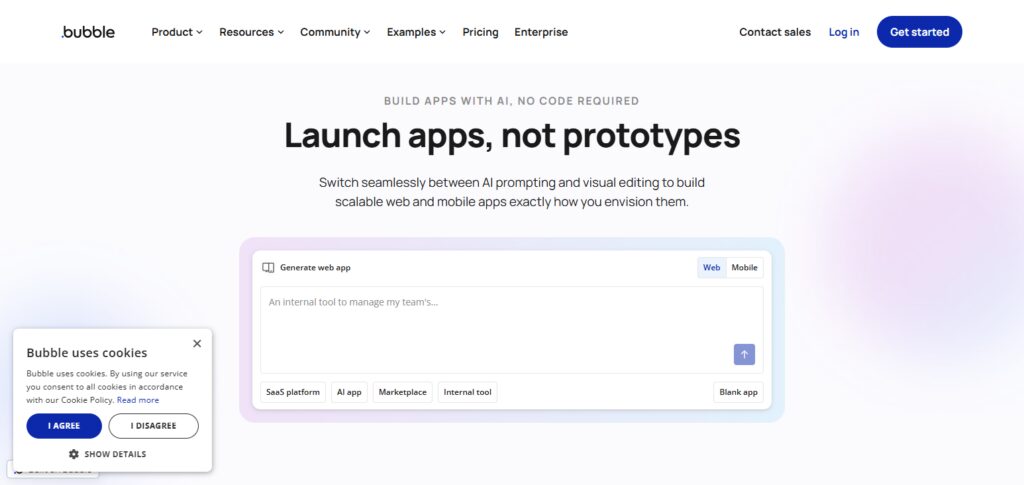
Bubble FinTech covers integration of APIs and offers authentication, database setups, and plugins. Users can build financial systems and workflow tools on Bubble FinTech by integrating payment systems such as Stripe or PayPal to their applications.
Being a fast cloud solution that offers financial API integration, Bubble FinTech is a great option for developing financial solutions and minimum viable products (MVPs) for startups.
Bubble.io FinTech
| Core Strengths | Best For |
| No-code visual development | FinTech startups |
| Fast MVP creation | Entrepreneurs |
| Flexible plugin marketplace | Marketplace payment apps |
| Responsive web applications | Startup product launches |
| Affordable development costs | Budget-friendly projects |
8. Retool Payments
Retool Payments builds low-code fintech tools to help companies build their own internal payment systems. Users can build tools such as payment dashboards, reconciliation systems, or payment administration by using Retool to connect their APIs and low-code tools to finance systems.
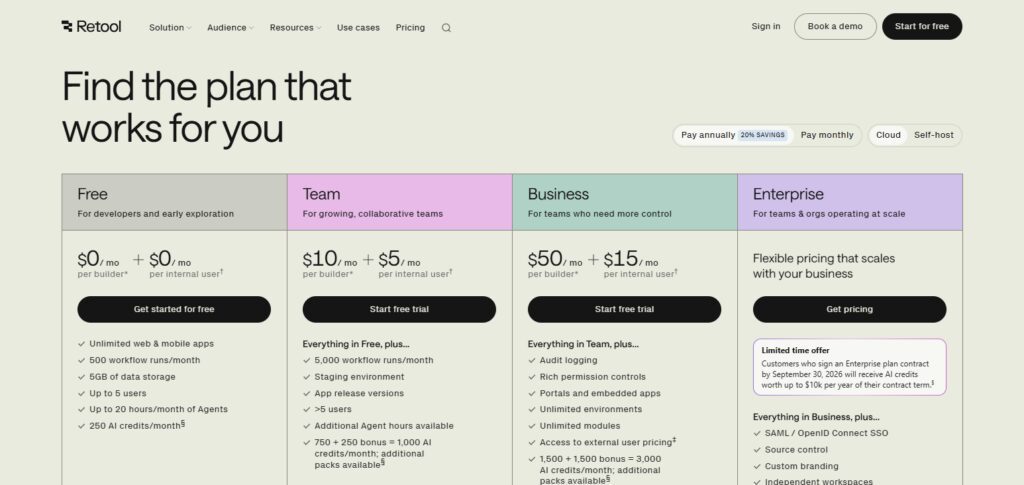
Retool Payments uses tools such as SQL, GraphQL, REST APIs, cloud services, and token-based authentication. For low-code fintech tools, Retool Payments is a great option for building payment systems with low-code tools for your internal systems.
Features like real-time data visualization with automated workflows and extensive integrations can help financial services teams improve their operational efficiency and payment management tasks.
Retool Payments
| Core Strengths | Best For |
| Internal tool development | Operations teams |
| Database connectivity | Payment administration |
| Custom dashboard creation | Financial reporting |
| API-first architecture | Internal payment management |
| Fast deployment | Enterprise operations |
9. FlutterFlow FinTech
Based on Google’s Flutter framework, FlutterFlow FinTech is a contemporary low-code app builder enabling businesses to create high-performance cross-platform financial apps. With low-code tools, users can build digital payment apps, digital banking apps, digital expense apps, digital investment apps, and digital wallet apps. FlutterFlow FinTech supports Firebase, APIs, authentication, and responsive design.
Best Low-Code FinTech Platforms for Custom Payment Apps – FlutterFlow FinTech helps build apps quickly and ensures the apps perform well on mobile devices. The app builder’s features and support for advanced FinTech APIs and services make it an ideal app builder for advanced and growing FinTechs.
FlutterFlow FinTech
| Core Strengths | Best For |
| Flutter-based development | Mobile payment apps |
| Cross-platform deployment | Android and iOS applications |
| Firebase integration | Real-time financial apps |
| Beautiful UI builder | Customer-facing FinTech apps |
| Rapid mobile prototyping | Startup mobile products |
10. Quickbase Payments
Quickbase Payments is a low-code app building platform for business operations that offers the opportunity to build custom financial apps and apps that help manage payment workflows. Businesses can build apps for payment request management, vendor management, payment approval, financial reporting, and compliance, with little to no coding.
Quickbase Payments has workflow automation, database management, role-based access control, reporting, and API management. Best Low-Code FinTech Platforms for Custom Payment Apps – Quickbase Payments has integrations for payment gateways,
ERP, accounting, CRM, and cloud services, all while maintaining an enterprise-grade security. Its flexibility and automation features paired with advanced personalization for business process improve payment management for enterprises.
Quickbase Payments
| Core Strengths | Best For |
| Business workflow automation | Payment operations management |
| Custom database applications | Financial process tracking |
| Enterprise collaboration | Operations teams |
| Low-code business platform | Internal financial workflows |
| Powerful reporting tools | Compliance and audit management |
Conclusion
What constitutes the ‘best’ low-code FinTech platform differs for each organization developing custom payment apps. Some considerations include your goals, technical and integration requirements, and flexibility. OutSystems, Mendix, Microsoft Power Apps, Zoho Creator, Appian, Salesforce Financial Services Cloud, Bubble.io, Retool, FlutterFlow, and Quickbase offer large-scale, secure, and compliant enterprise visual development.
They greatly reduce the need for custom code. These platforms also provide necessary automation needed within the workflows along with payment gateways, APIs, cloud services, and real-time data financial applications demand.
The right low-code platforms can help companies build payment applications quicker and cheaper while improving the performance of the internal operations with greater security, scalability, and usability.
FAQ
What is a low-code FinTech platform?
A low-code FinTech platform is a software development environment that allows businesses to build financial and payment applications using visual tools, drag-and-drop components, and minimal coding. These platforms speed up development while maintaining security, scalability, and compliance.
Why should businesses use low-code platforms for payment apps?
Low-code platforms reduce development time, lower costs, simplify maintenance, and enable faster deployment of payment applications. They also support integrations with payment gateways, banking APIs, and third-party financial services.
Which low-code platform is best for enterprise payment applications?
OutSystems, Mendix, Appian, and Salesforce Financial Services Cloud are among the best choices for enterprise payment applications because they offer advanced security, workflow automation, scalability, and enterprise-grade integrations.
Can low-code FinTech platforms integrate with payment gateways?
Yes. Most leading low-code platforms support integration with popular payment gateways such as Stripe, PayPal, Square, Adyen, Razorpay, and other banking and financial APIs through built-in connectors and REST APIs.