The article outlines the real estate firms that utilize security tokens for fractional property and the impact of blockchain technology on property investment.
These firms afford their clients the ability to purchase fractional shares of real estate through digital security tokens. This increases accessibility, transparency, and liquidity for the client. We will analyze the significant platforms and their features, benefits, and effects on the forthcoming real estate markets.
Why Choose Real Estate Firms Using Security Tokens for Fractional Property
Lower Barriers to Entry: Security Tokens for Fractional Property allow investors to purchase only a fraction of a property. Compared to going through Security Tokens to purchase an entire property, going through this option requires a lot less capital, making it much easier for the general public to get involved with real estate.
Liquidity Challenges Mitigated: Real Estate through Security Tokens provides a more liquid investment compared to regular property investments. With the use of Blockchain, fractional ownership of property can be transferred and traded with ease compared to the traditional way of selling physical property.

Ownership Transparency: When property ownership is recorded through Blockchain, it creates a safe and transparent system. With the use of decentralized digital systems, Investors can verify ownership of the token and view the transaction history and details of the asset.
International Investments: With Tokenized Real Estate, investors can purchase real estate in virtually any country without the usual restraints present.
Security and Compliance: With security token systems, Blockchain, and Smart Contracts, security and compliance of all transactions are ensured. Many of these systems take the extra step of verifying the identity of the investors and implementing the necessary regulatory requirements.
Smart Contracts: Smart Contracts aid in the transfer and distribution of ownership and income, as well as the automation of investment. Smart Contracts greatly reduce the amount of paperwork and manual work that is required.
Portfolio Diversification: Using Fractional Property Tokens gives investors the option to invest in a number of different properties, as opposed to a single property. This provides a more well-rounded investment for the investor.
Greater Accessibility to Premium Properties: Investors can purchase commercial buildings, rental properties, and other high-end real estate assets that typically require a significant amount of money to purchase through traditional means of investment.
Faster and More Efficient Transactions: Reduced Intermediaries and improved record management will enable property transactions to be processed faster, and will reduce administrative costs.
Future Growth Potential: This model of investment will grow with the increase of security token adoption. Notably, Real Estate Firms Utilizing Security Tokens for Fractional Property are likely to be the firms that offer the leading services to a further digitized and more accessible property market.
Key Point & Real Estate Firms Using Security Tokens for Fractional Property
| Platform/Firm | Key Points |
|---|---|
| RealT | • Offers fractional ownership of real estate properties through blockchain-based tokens. • Allows investors to buy small shares of income-generating properties. • Provides token holders with rental income distribution. • Uses smart contracts for transparent ownership management. • Makes real estate investment accessible with lower entry costs. |
| Harbor | • Provides blockchain infrastructure for tokenized securities and real estate assets. • Helps businesses issue compliant digital securities. • Focuses on investor verification and regulatory compliance. • Enables easier transfer and management of tokenized assets. • Supports institutional adoption of security token solutions. |
| tZERO Real Estate | • Uses blockchain technology to support digital securities trading. • Enables compliant trading of tokenized real estate investments. • Provides a regulated marketplace for security tokens. • Improves liquidity for traditionally illiquid property assets. • Connects investors with blockchain-based real estate opportunities. |
| Propellr | • Offers tokenization solutions for real estate and alternative assets. • Helps companies create compliant security token offerings (STOs). • Provides investor management and asset digitization tools. • Uses blockchain for transparent ownership records. • Supports efficient fundraising for property projects. |
| Securitize Real Estate | • Provides a regulated platform for issuing digital securities. • Enables fractional ownership of real estate assets. • Supports compliance, investor onboarding, and token lifecycle management. • Improves access to institutional-quality property investments. • Uses blockchain to increase transparency and efficiency. |
| Tokeny Solutions | • Provides tokenization infrastructure for real-world assets. • Helps real estate firms issue compliant security tokens. • Supports investor identity verification and regulatory requirements. • Enables automated asset management through smart contracts. • Improves global access to tokenized property investments. |
| Brickken | • Offers a platform for businesses to tokenize real estate assets. • Simplifies security token creation without complex coding. • Provides tools for compliance and investor management. • Enables fractional ownership models for properties. • Helps companies raise capital through blockchain technology. |
| INX Real Estate | • Provides regulated infrastructure for digital securities trading. • Supports tokenized asset issuance and secondary market trading. • Enhances liquidity for real estate-backed digital assets. • Focuses on compliance and investor protection. • Bridges traditional finance with blockchain-based investments. |
| Polymath Real Estate | • Provides blockchain technology for issuing security tokens. • Helps tokenize real estate and other physical assets. • Offers compliance-focused token creation solutions. • Enables automated ownership tracking through blockchain. • Supports institutional adoption of digital securities. |
| SolidBlock | • Specializes in blockchain-based real estate tokenization. • Enables fractional ownership of high-value properties. • Helps investors access global real estate markets digitally. • Provides asset-backed token solutions with transparency. • Reduces barriers for property investment through blockchain. |
1. RealT
RealT is a platform that uses blockchain technology to allow customers to purchase a fractional share of a real estate investment through digital tokens. RealT allows clients to purchase a share of commercial and residential property instead of purchasing the entire property.
Each token correlates with a property and allows the token holder to receive a share of the rental income. Real Estate Firms Using Security Tokens for Fractional Property is a platform that uses blockchain technology to change property investments, and RealT is a supporter of this model.
RealT provides customers with the ability to invest in real estate with a limited amount of capital and helps provide a liquidity solution to the real estate market. RealT helps transform the real estate investing crowd by providing accessibility, transparency, and liquidity.
RealT Features, Pros & Cons
Features
- Ownership of properties via blockchain is facilitated by RealT.
- Shares of income properties are available to be purchased.
- Ownership and transactions are simplified via smart contracts.
- Token holders can receive rental income.
- RealT allows investors to fund international real estate.
Pros
- Significantly less capital than traditional real estate is required.
- The use of a blockchain creates transparent ownership.
- Rental returns create a passive income.
- Investments can be made in a number of real estate projects.
- Integrated management of digital property.
Cons
- The service may be unavailable due to regional laws.
- The value of a token is reliant on other sale transactions.
- Users are subject to the risks of the property markets.
- To use the service an understanding of blockchain is required.
- There are costs to using the service that may decrease yields.
2. Harbor
Harbor, now out of business, was a blockchain-based infrastructure company that created compliant security token solutions for real assets, including real estate. Harbor allowed companies to create digital securities from their physical assets while still being compliant with security laws.
Real Estate Firms Using Security Tokens for Fractional Property is a platform derived from companies like Harbor because they allow companies to create a security token, take care of compliance issues, and provide investor verification.
Harbor simplified the creation of asset-backed securities while also providing a clear ownership structure. By combining the security of blockchain with the other supporting compliance structures, Harbor allowed a more efficient way to manage digital assets and fractional ownership of real estate.
Harbor Features, Pros & Cons
Features
- Compliant security tokens are enabled by harbor’s blockchain.
- Real world assets, real estate included, can be made into tokens.
- User verification is provided in a compliant manner.
- Digital records are maintained by harbor.
- Companies can create compliant tokens via harbor.
Pros
- Safety and compliance are prioritized.
- Faster asset tokenization is a result.
- Improved record keeping is a result of blockchains.
- Digital securities can be adopted by aid of harbor.
- Investment management is automated.
Cons
- Services may be altered or be unavailable.
- The use of harbor requires compliance with many laws.
- Widespread use of tokens relies on investors.
- The market for tokens may be limited.
- There may be issues relating to the use of blockchains.
3. tZERO Real Estate
tZERO Real Estate develops the blockchain-based trading infrastructure for the future of digital securities and token-based investments. They target illiquid assets like real estate, which are typically difficult to trade.
Real Estate Firms Using Security Tokens for Fractional Property utilize blockchain marketplaces (such as tZERO) to grant their investors direct access to property-based digital assets.
tZERO partners with issuers and investors and streamlines both transparency and the trading process through their regulated trading systems.
tZERO’s technology promotes the creation of liquidity to secondary markets for the trading of tokenized real estate, which may prove to be easier than trading real estate in the traditional sense.
tZERO Real Estate Features, Pros & Cons
Features
- Offers a blockchain trading system for digital securities.
- Offers a way for investors to access tokenized real estate.
- Allows trading on the secondary market in a regulated environment.
- Allows participants to view digital asset transactions.
- Merges the worlds of traditional finance and blockchain.
Pros
- Offers a way for participants to trade digital assets in a regulated environment.
- Offers a way to access liquidity for tokenized assets.
- Provides a way for participants to view the transactions made in digital assets.
- Offers investment opportunities that are geared towards institutions.
- Merges the worlds of real estate and blockchain.
Cons
- Trading in the secondary market may have inconsistent liquidity.
- There are a few tokenized properties.
- Participants may be subject to strict regulations.
- The platform may be difficult for beginner investors to navigate.
- Adoption of the platform is still developing.
4. Propellr
Propellr creates the infrastructure for security tokens and assists in the tokenization of alternative assets, such as real estate. This platform allows businesses to create compliance-based, blockchain investment products while controlling the investor onboarding and asset management processes.

Real Estate Firms Using Security Tokens for Fractional Property depend on services like Propellr to automate the creation of digital securities for real property.
Propellr’s use of smart contracts and blockchain further aid the control and management of digital assets and the operations of investment firms. In addition, Propellr’s platform presents real estate developers and investors modern ways to raise funds, while offering investors a clear and affordable means to own a fraction of a property.
Propellr Features, Pros & Cons
Features
- Offers security tokens for real estate.
- Offers a way for businesses to launch compliant token offerings.
- Offers a way to onboard investors and manage the asset.
- Uses blockchain for verification of ownership.
- Offers blockchain for fundraising.
Pros
- Provides a way to tokenize real estate.
- Improves transparency through logs on the blockchain.
- Provides businesses with a way to access other funding options.
- Supports compliant investment models.
- Reduces administrative tasks.
Cons
- Offers a way to access real estate token, but the tokens still have limited adoption.
- The platform requires advanced knowledge to navigate.
- The platform may have limited liquidity.
- The platform may have limited availability.
- The platform may be affected by changes in regulation.
5. Securitize Real Estate
Securitize Real Estate provides a digital securities platform allowing the tokenization of real-world assets, including commercial and residential real estate, within a regulated framework.
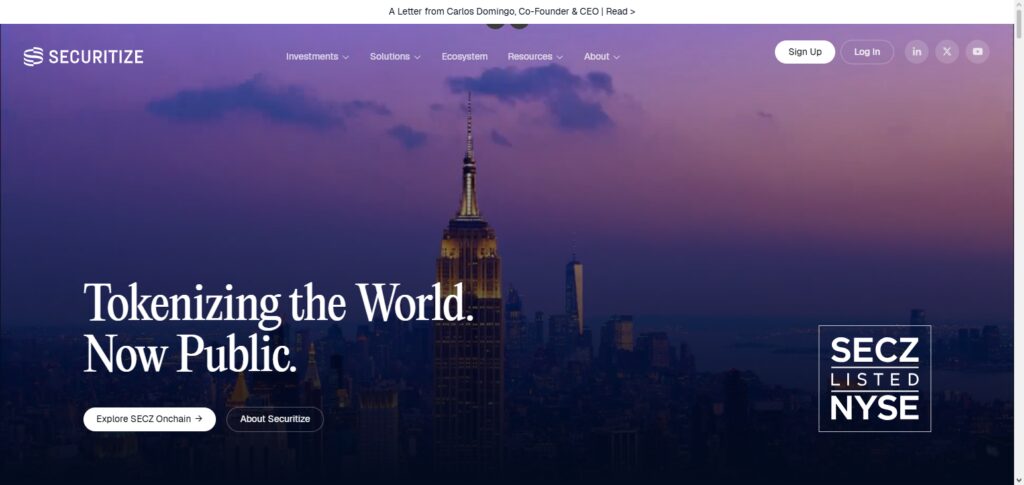
The platform manages the myriad security token operations, including compliance and investor registration. Real Estate Firms Using Security Tokens for Fractional Property find Securitize useful in making real estate investment easier and more efficient.
Securitize uses Blockchain to increase transparency, simplify administrative burdens, and enable fractional ownership. Thus, digital securities allow investors direct access to real estate and offers improved recordkeeping and market access.
Securitize Real Estate Features, Pros & Cons
Features
- Allows participants to issue regulated digital securities.
- Offers a way for investors to access fractional ownership of real estate.
- Offers a way for investors to verify their identity.
- Supports regulatory compliance of tokenized securities.
- Supports the entire lifecycle of a token.
Pros
- Primarily focuses on regulatory compliance.
- Offers tokenization infrastructure of an institutional level.
- Increases accessibility for investors.
- Asset management transparency is improved.
- Supports digital investments worldwide.
Cons
- Compliance may require more complexity.
- Investments are highly subjected to regulations.
- Tokens may not be made liquid.
- Services may come at a cost.
- Investors may need to be verified.
6. Tokeny Solutions
Tokeny Solutions uses blockchain to provide compliant security token issuance and management infrastructure for real estate and other tokenized asset classes. This platform provides services for tokenization, investor verification, compliance, and digital assets.
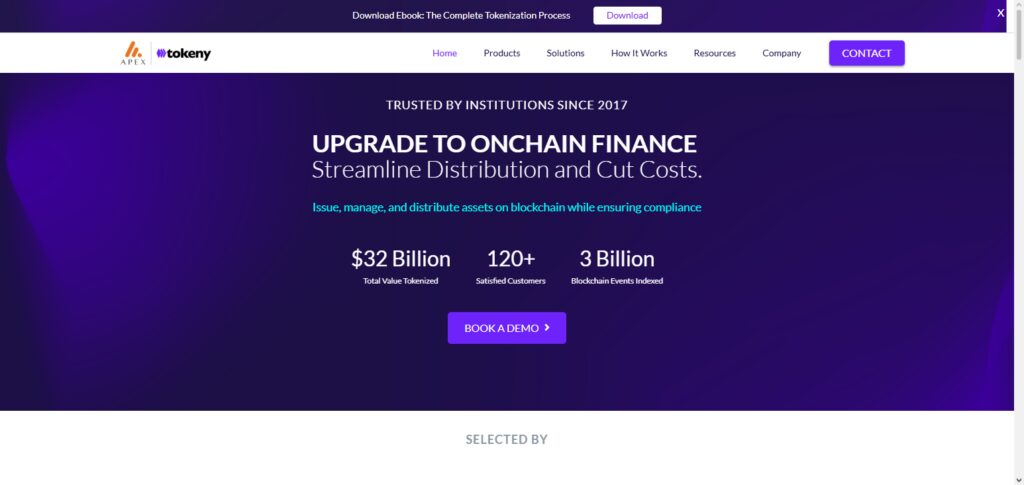
Real Estate Firms Using Security Tokens for Fractional Property find Tokeny Solutions useful for the simplified digital legal framework for the regulated conversion of physical real estate to digital investments.
Tokeny’s technology offers custodial services combined with a transparent ownership structure for simplified access, thus enabling more efficient fundraising for real estate and fractional property ownership on a global scale.
Tokeny Solutions Features, Pros & Cons
Features
- Provides blockchain infrastructure for Security Token creation.
- Tokenization of Real Estate Assets is offered.
- Includes Compliance and Investor Management Tools.
- Automated Smart Contracts are enabled.
- Supports Digital Securities management for businesses.
Pros
- Offers enterprise grade tokenization solutions.
- Transparent and efficient systems are provided.
- Supports frameworks of Regulatory Compliance.
- Lessens the need for Manual Asset Management.
- Regions of Investment may be extended.
Cons
- Solutions are highly B2B and B2B focused.
- Regulatory knowledge is required.
- May be a complex system to implement.
- Adoption to the market is still ongoing.
- May be highly subjective to requirements.
7. Brickken
Brickken is a platform for businesses to create RWA security tokens. Brickken works with commercial real estate, providing a no-code solution for companies to manage investors, maintain compliance, and digitize their assets.
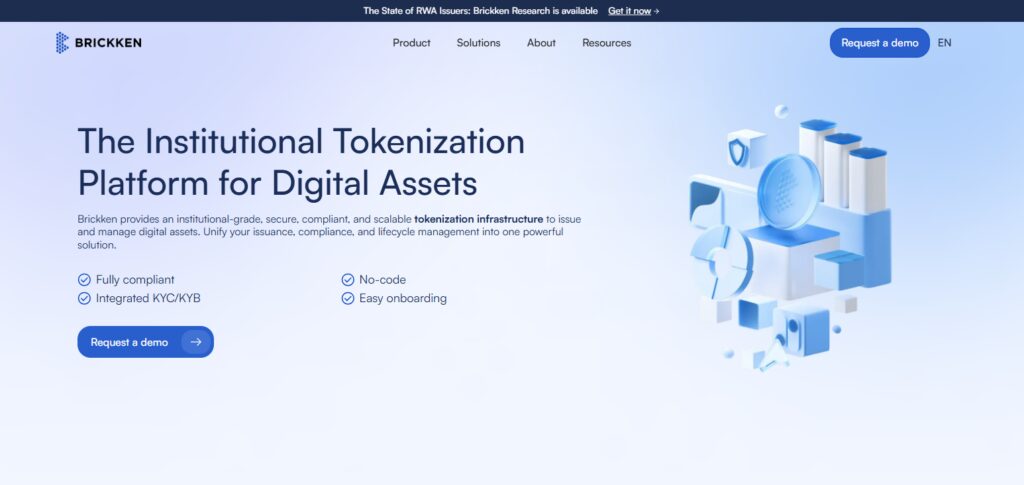
Real Estate Firms Using Security Tokens for Fractional Property use Brickken’s platform to simplify security token creation and reduce technology hurdles. Brickken’s use of distributed ledger technology offers enhanced transparency and support for fractional ownership models.
The property owners and developers are enabled by the platform to raise capital more easily, and the marketplace is created for investors to purchase digital securities representing fractional ownership of real estate.
Brickken Features, Pros & Cons
Features
- Supports no-code tokenization for real estate assets.
- Simplifies the Security Token creation for companies.
- Includes Compliance and Investor Management Tools.
- Supports fractional ownership.
- Transparent transactions through blockchain.
Pros
- Simple tokenization system.
- Reduces the gap of tech knowledge for the business.
- Digital Assets can be created promptly.
- Real estate investment is easier.
- Ownership is managed automatically.
Cons
- Newest of the systems.
- Liquidity is based on investor interest.
- Varied regulations may impact use.
- Limited historical data.
- Requires knowledge of Blockchain.
8. INX Real Estate
INX Real Estate offers tokenized digital assets and services built on a regulated framework for blockchain-based finance. The platform offers compliance-assured services for the issuance, management, and trading of security tokens.
Real Estate Firms Using Security Tokens for Fractional Property can choose to use regulated token security platforms like INX to offer digital securities backed by real estate.
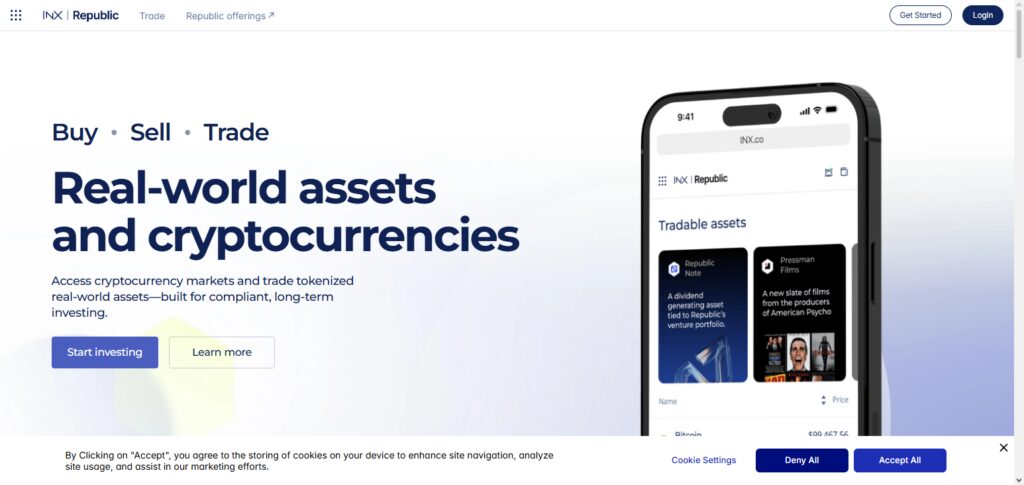
As with other blockchain built platforms, the transparency of the system increases trust in the transaction and ownership as well as the accessibility of investors.
INX’s goal is to offer infrastructure for real estate deals to integrate with the digital finance ecosystem, bringing trust and improved liquidity for the modern investment structures built upon highly efficient means of managing tokenized property.
INX Real Estate Features, Pros & Cons
Features
- Regulated framework for Digital Securities.
- Token creation and trading infrastructure.
- Management of digital assets on Blockchain.
- Safeguarding investors with Compliance focus.
- Bridging traditional finance with digital solutions.
Pros
- Regulated trading provision.
- Transaction clarity.
- Adoption of security tokens.
- Solutions for Institutions.
- Enhanced accessibility of digital assets.
Cons
- Tokenized Real Estate is in infancy.
- Low Market Liquidity.
- Regulation may limit use.
- Complexity of the platform for novice users.
- Uneven availability of investment.
9. Polymath Real Estate
Polymath Real Estate implements blockchain technology to create security tokens that represent ownership of real assets.
The platform offers the flexibility to issue compliant digital securities and assist the company in managing tokenized investments. Real Estate Firms Using Security Tokens for Fractional Property utilize Polymath’s platform in the design of a model for the ownership of property via the blockchain.
Polymath addresses the automation of smart contracts, the management of assets with a clear disposition, and more. Polymath has positioned itself to allow the digital representation of real estate ownership and offers the ability of fractional investments to the user via increased efficiency.
Polymath Real Estate Features, Pros & Cons
Features
- Infrastructure for tokenized securities on Blockchain.
- Digitization of Real Estate on Blockchain.
- Ownership via Smart Contracts on Blockchain.
- Compliance for tokenized securities.
- Assist firms in creation of compliant digital securities.
Pros
- Blockchain and Compliance Security.
- Automated Compliance Features.
- Ownership Records Transparent.
- Fractional Listening.
- Modernization of Asset Markets.
Cons
- Understanding of Blockchain is mandatory.
- Adoption is Gaining.
- Regulatory Impediments.
- Liquidity is Market Dependent.
- Tokenization may require Tech Expertise.
10. SolidBlock
SolidBlock offers the ability to tokenize property by allowing property owners to subdivide their property into digital shares. The platform offers the ability to make previously untokenable properties of very high economic value to the digital investment market and, therefore, movably valued to a greater number of potential players.
Real Estate Firms Using Security Tokens for Fractional Property are building investment opportunities and are providing greater liquidity and transparency in property markets with the use of SolidBlock.
SolidBlock provides property owners the ability for digitization, tracking, and management of their property and investments. The traditional barriers of the real estate property market are broken, and fractional ownership of property to a global audience is offered.
SolidBlock Features, Pros & Cons
Features
- Tokenization of Real Estate on Blockchain.
- Fractional Ownership of High Value Real Estate.
- Asset-Backed Tokens.
- Models for Investment in Digital Real Estate.
- Utilizes blockchain for tracking ownership in an unequivocal manner.
Pros
- Allows for greater access to high value real estate.
- Facilitates investment in real estate globally.
- Better transparency in ownership.
- New ways to raise capital.
- Investment in property becomes easier.
Cons
- Developing token markets in real estate.
- Property liquidity can be worse than other assets.
- Each jurisdiction has its own rules.
- Property can lose its value.
- Knowledge of blockchain is required to invest.
Conclusion
Real estate firms utilizing security tokens for fractional property are integrating blockchain and digital ownership innovations to modernize traditional real estate investment systems. Framed to enhance transparency, decrease investment thresholds, and increase liquidity, fractional real estate platforms, such as RealT, Securitize,
Tokeny Solutions, and SolidBlock, are a growing trend in the marketplace. Automated compliance and tokenization solve many challenges investors and real estate owners face. As tokenization and blockchain technologies advance, the real estate industry will benefit with global investment and security.
FAQ
Are security tokens for real estate legally regulated?
Yes, security tokens are generally designed to comply with financial regulations. Platforms usually include investor verification, compliance checks, and legal frameworks to ensure secure transactions.
Can investors earn income from tokenized real estate?
Yes, many tokenized real estate platforms allow investors to receive rental income or potential returns based on their ownership share in the property.
How does blockchain improve real estate investment?
Blockchain improves real estate investment by providing transparent ownership records, reducing paperwork, automating transactions through smart contracts, and increasing efficiency in asset management.
What types of properties can be tokenized?
Commercial buildings, residential properties, rental assets, hotels, office spaces, and other income-generating real estate assets can be converted into security tokens.