


When selecting the best fintech app development agencies, I look at their ability to combine the user experience with compliance and innovation. I do not see this as the development of apps. I see this as the development of trust in digital finance. Securing user data, integrating scalable solutions that also incorporate AI to detect fraud and provide personalization, and the use of global delivery combined with mobile‑first design are what attract me to these agencies. These capabilities make these agencies truly growth partners to me.
What Makes a Fintech App Development Agency Stand Out?
Exceptional fintech app development agencies offer the perfect blend of industry expertise and innovation. They can combine all of these elements with compliance and user-centric design. Most agencies build apps that support banking, payments, or capital markets. However, the top agencies build secure, scalable ecosystems.
They also build those ecosystems directly into the development lifecycle to embed regulatory compliance frameworks like PCI DSS, PSD2, and GDPR to build trust and resiliency. Some even use AI and automation for fraud detection, predictive analytics, and personalization to build better customer experiences.
These agencies have an exceptional reputation due to global delivery, proven track records, mobile UX, and a strong focus on user experience innovation. These agencies strike a balance of compliance, scalability, and a creative UX to design powerful fintech solutions.

How We Selected These Fintech App Development Agencies?
Customer Success – Delivering measurable ROI along the way with digitally-born banking and payments apps that scale and succeed in the compliance challenged financial services sector.
Expertise in Mobile and Payments – Offering deep technological fintech expertise for development of mobile banking, payments, API-based integration, and other cloud-based fintech platforms.
Security and Regulation – Incorporation of the PCI DSS, GDPR, AML, and PSD2 compliance frameworks in their development pipelines to provide regulatory compliance security for their customers in the FinTech industry.
AI and Process Automation – Offering deep expertise in advanced automation with a focus on fraud detection and robotic process automation, predictive analytics, and intelligent customer engagement.
Sector Focus – Offering high level fintech solutions to address the specific challenges of regulated industries including banking, insurance, capital markets, and payments.
Global Delivery Networks – Possessing a global delivery presence and scale to support the adoption of fintech solutions across multinational and mid market enterprises.
Innovation and Customer Centricity – High user experience with an innovative approach focused on FinTech and development of super-wallets within customer-centric compliance and FinTech.
| Agency | HQ Location | Specialization | Key Point |
|---|---|---|---|
| Thoughtworks | USA | Secure engineering-led delivery | Continuous discovery + automated quality gates |
| Endava | UK | API-led fintech integration | Best value for payments + identity connectivity |
| EPAM Systems | USA/EU | Secure SDLC + automation | Strong for high-risk fintech releases |
| TCS | India | Enterprise fintech delivery | End-to-end mobile + digital banking modernization |
| Accenture | Global | Strategy + UX + cloud | Best for regulated banks needing full-stack engineering |
| Capgemini | France/Global | Cloud + data platforms | Regulatory-grade security for digital channels |
| Cognizant | USA/India | Payments + banking systems | Strong integration + managed support |
| Wipro | India | Fintech modernization | Scalable app builds + compliance |
| Empat | USA | Mobile-first fintech apps | High client satisfaction + UX excellence |
| FINANTEQ | Poland | Mobile banking solutions | Innovation in mobile banking + proactive delivery |
1. Thoughtworks
Thoughtworks is a global technology consultancy specializing in agile delivery and services. In Fintech, Thoughtworks can build digital banking services and secure payment infrastructures. Other core competencies in Fintech include: API-centered development, microservices, and cloud-based solutions.
Thoughtworks has security and compliance baked into their SDLC to ensure that the requirements for PCI DSS and GDPR are satisfied. Thoughtworks also integrates AI-based services for compliance in customer services, anti-fraud techniques, and automated personalization.
Thoughtworks has extensive experience with agile transformations and helping modernize the Fintech services while maintaining compliance. Their AI and automation tools improve the efficiency of business operations, and its operational services help financial services organizations ideate resilient frameworks. Thoughtworks has extensive services in consulting to maintain compliance.
Thoughtworks
- Founded Year: 1993
- Headquarters: USA, Chicago
- Team Size: ~10,000
- Global Presence & Best For: 47 offices in 18 countries. Best for agile fintech modernization and AI driven delivery.
Pros
- Excellent agile fintech engineering culture
- Extensive experience in fintech compliance
- Fraud detection AI technology
- Successfully executed legacy modernization
Cons
- Premium cost for consulting services
- Limited offshore delivery at scale
- Preferred to work with larger enterprise clients
- May require a long-term commitment for transformation
2. Endava
Endava focuses on digital transformation for financial services in the UK. It has substantial fintech experience in payments, digital wallets, and open banking. Endava has tiered API design and custom app development for fintech as well as cloud-based services.
Endava’s development center focuses on open banking and fintech with a number of compliance frameworks including PSD2 and GDPR. Security Frameworks are incorporated into Endava’s development.
Endava also has development for advanced analytics and automation for fraud prevention. They have the ability to build intelligent systems for customer payments and targeted marketing. Endava is the preferred partner for banks and payment services and startup fintechs because of the balance they strike with innovation and securing compliance.
Endava
- Founded Year: 2000
- Headquarters: UK, London
- Team Size: ~11,200
- Global Presence & Best For: Strong in Europe & Americas. Best for payments, open banking and API first fintech solutions.
Pros
- Strong delivery of fintech API
- Open banking and payments
- Compliant with PSD2, GDPR
- Fintech solutions that are agile and mobile-friendly
Cons
- Limited delivery outside of Europe
- Less automation AI
- Less focus in the US and Asia
- Less enterprise-scale support
3. EPAM Systems
EPAM Systems is a fintech heavyweight in the US and the EU. They concentrate on payment systems, electronic banking, and trading platforms. EPAM Systems has devised solutions for fintech Microservices, API Integrations, and mobile banking applications. EPAM systems have security control units and measures embedded into the SDLC to ensure continued compliance with PCI DSS, GDPR, and AML.
Their AI and Automation services focus on Smarter Interaction Frameworks, Predictive Analytics, and Fraud Detection. Their expertise in retail banking, capital markets, and insurance crosses financial services with depth. With their rigor focused engineering, they provide scalable, secure, and compliance-friendly fintech services for global enterprises.
EPAM Systems
- Founded Year: 1993
- Headquarters: USA, Newtown, Pennsylvania
- Team Size: ~62,850
- Global Presence & Best For: 55+ countries. Best for enterprise grade fintech engineering and AI native transformation.
Pros
- Engineering best practices and secure SDLC
- Fintech and trading
- Strong predictive analytics
- Deliver across fintech globally
Cons
- High cost for more custom work
- Less consulting compared to Accenture
- Focused more on engineering vs UX design
- Needs more collaboration with IT
4. TCS
Tata Consultancy Services (TCS) is India’s largest IT services company with a focus on fintech globally. TCS specialises in digital banking, payments and enterprise fintech platforms. It offers marketing leading mobile banking, API and cloud based fintech ecosystems. TCS helps clients deliver fintech offerings with compliance to RBI and PCI DSS requirements and other global laws.
TCS’ AI and automation offerings include intelligent process automation, fraud detection and customer personalization. TCS’s fintech industry expertise spans retail banking, insurance and capital markets. With strong enterprise delivery, TCS is a trusted partner for most global banks and fintech companies for innovative force combined with secure operations at scale.
TCS
- Founded Year: 1968
- Headquarters: India, Mumbai
- Team Size: ~584,500
- Global Presence & Best For: 55+ countries. Best for enterprise scale fintech modernization and AI led banking solutions
Pros
- Large scale enterprise fintech delivery
- RBI/PCI DSS compliance
- Insurance and banking
- Robust automation with AI
Cons
5. Accenture
- Slow innovation focus
- Long bureaucratic delivery
- Prefer larger clients
- Long onboarding
Accenture is a leading global provider of consulting and technology services with strong fintech services. Accenture focuses on strategy, UX and cloud native fintech services. Accenture offers digital banking and payments modernization and enterprise grade fintech applications. Accenture embeds security and compliance for global financial regulations in all its offerings.
Accenture’s AI and automation services include intelligent automated fraud detection, customer analytics and automation of business processes. Accenture provides its services across retail banking, capital markets and insurance. Accenture’s combination of consulting and engineering integration helps regulated banks and fintech firms deliver services at scale in an innovative manner.
Accenture
- Founded Year: 1989
- Headquarters: Ireland, Dublin
- Team Size: ~779,000
- Global Presence & Best For: 120+ countries. Best for regulated banks needing full stack consulting + fintech engineering.
Pros
- Integrates global consulting and engineering
- Fintech UX design and cloud services
- Compliance for regulated banking services
- Advanced AI and RPA technologies
Cons
- Premium pricing for enterprise clients
- Complex organizational structure
- Strategy vs execution may be overemphasized
- Limited flexibility for smaller fintechs
6. Capgemini
Capgemini is a French firm that provides global IT services, especially in fintech. The company specializes in building cloud and data-centric, competitive fintech solutions as well as building flexible/modular fintech solutions. Capgemini offers mobile-centric fintech applications and bank-grade digital banking. The company assists clients in meeting the security mandates of regulatory frameworks like PSD2, GDPR, and PCI DSS.
Further, it embeds security frameworks in its delivery offerings. Capgemini provides automation in building fraud detection systems and customer engagement systems as well as in performing predictive analytics. Capgemini supports approaching clients in retail banking, payments, and insurance. Robust consulting and engineering Differentiation enable Capgemini to build secure, compliant fintech solutions balancing innovation and regulation around the world.
Capgemini
- Founded Year: 1967
- Headquarters: France, Paris
- Team Size: ~423,400
- Global Presence & Best For: 50+ countries. Best for cloud native fintech platforms and compliance driven delivery.
Pros
- Strong cloud-native fintech expertise
- Deep compliance with PSD2/GDPR
- Predictive analytics and fraud detection
- Global banking and insurance coverage
Cons
- Innovation project costs are higher
- Less boutique agility than smaller firms
- Stronger in Europe than U.S.
- Potentially longer contracts required
7. Cognizant
Cognizant, a US-based company with deep roots in India, offers specialized fintech modernization services. The company has deep knowledge of digital payments, banking systems, and digital wallets. Its core services include mobile banking and modern banking integration, as well as the development of APIs to support fintech solutions. Cognizant also offers services that assist clients in meeting security and compliance needs such as PCI DSS, AML, and GDPR by embedding security in their SDLC.
Cognizant has further developed automation and tools to assist in customer analytics, intelligent payments routing, and fraud detection. Cognizant offers its services to modernize retail banking, capital markets, and insurance. With deep delivery capabilities, Cognizant supports modern secure fintech services. Trusted for its secure, compliant solutions, Cognizant helps clients balance operational resilience with fintech innovation.
Cognizant
- Founded Year: 1994
- Headquarters: USA, New Jersey, Teaneck
- Team Size: ~350,000
- Global Presence & Best For: 40+ countries. Best for payments, healthcare fintech and compliance heavy industries.
- Global Presence & Best For: Scalable fintech modernization and AI-driven compliance in 65+ countries
Pros
- Strong payments and banking experience
- Secure compliance with PCI DSS/AML
- AI-based fraud detection and analytics
- Global delivery with enterprise scale
Cons
- Innovation focus is limited
- Stronger in integration than UX design
- Potentially enterprise client focus
- Offshore-heavy delivery
8. Wipro
As an Indian IT services provider focused on fintech, Wipro provides digital banking, payments, and enterprise fintech services. Wipro’s core services cover building mobile-based fintech applications, API-based and cloud-based fintech services, and product integrated services. Wipro provides services that are compliant with the RBI and PCI DSS regulations and other global financial regulations. Wipro combines security across its services and SDLC processes.

Wipro’s AI and automation extensions include intelligent automation for fraud prevention and sophistication in customer service. Wipro’s experience across the fintech spectrum includes retail banking, insurance, and trading. With Wipro’s strong delivery focus for enterprise clients, Wipro’s focused fintech presence serves global clients seeking secure, innovative, compliant solutions.
Wipro
- Founded Year: 1945
- Headquarters: Bengaluru, India
- Team Size: ~242,000
- Global Presence & Best For: 65+ countries; best for scalable fintech modernization and AI‑driven compliance
Pros
- Strong fintech modernization capabilities
- Secure compliance with RBI/PCI DSS
- AI-based fraud detection and RPA
- Trusted by global banks
Cons
- Bureaucratic delivery
- Less boutique innovation focus
- Potentially enterprise client focus
- Long customer onboarding process
9. Empat
Based in the US, Empat is a focused app development agency serving the fintech space. Empat’s core services encompass app development with strong digital banking and payment systems to fintech integration services based on cloud technology. Empat offers services that are compliant with the PCI and GDPR regulations and covers security within solutions. Empat’s automation offerings include intelligent customer service and response systems.

Empat’s experience across the fintech value chain includes neobanks and payment service providers. Empat’s focus on design and user experience combined with a strong service focus makes Empat an excellent partner for fintech clients seeking secure, scalable and user-centric mobile solutions.
Empat
- Founded: 2021
- HQ: Madrid, Spain
- Team: ~170
- Global Presence & Best For: Spain, UK, Germany, Ireland; mobile-first fintech apps and treasury automation
Pros
- Deep UX and customer satisfaction focus
- Agile startup and neobank delivery
- AI-based personalization and analytics
- Mobile-first fintech focus
Cons
- Limited enterprise support
- More constrained global presence
- Increased risks of resource constraints
- Limited compliance focus
10. FINANTEQ
FINANTEQ, an app development agency from Poland specializes in mobile banking solutions. FINANTEQ’s banking applications are mobile-centric and can be integrated with APIs, as well as be built using a cloud native approach. FINANTEQ is also able to comply with the PSD2 standard in EU banking, the GDPR, and the PCI DSS standard in the field of data security.
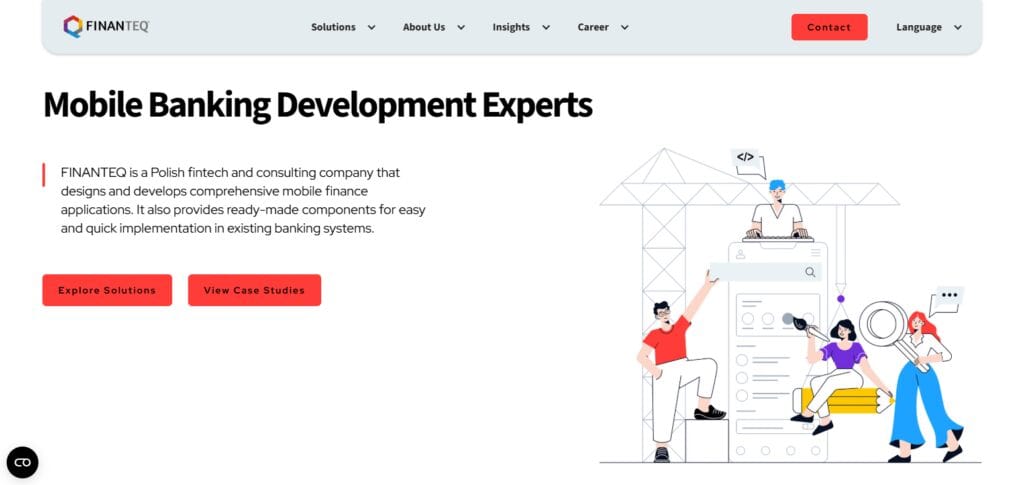
Services offered by FINANTEQ incorporate artificial intelligence and automation, for instance, through the use of machine learning to detect and prevent fraud, and to analyze customer behavior.
Additionally, FINANTEQ supports retail banking, neobanks, and digital payment service providers. Because of its strong focus on mobile banking, FINANTEQ is an ideal partner to weigh off the balance in compliance vs. innovation for financial services firms seeking secure, scalable, and user-centric mobile banking solutions.
FINANTEQ
- Founded: 2014
- HQ: Lublin, Poland
- Team: ~200
- Global Presence & Best For: Global banks (Santander, Raiffeisen, Danske); mobile banking and superwallet
Pros
- Specialization in mobile banking
- Deep compliance with PSD2/GDPR
- Innovative mobile-first fintech options
- AI-based fraud detection and analytics
Cons
- Limited presence outside of Europe
- More constrained delivery compared to enterprise firms
- Potential lack of consulting breadth
- More mobile engineering and less full-stack engineering focused
Comparison table of the Top Fintech App Development Agencies (2026)
| Agency | Best For | Expertise | Technologies | Pricing Model |
|---|---|---|---|---|
| Thoughtworks | Agile fintech modernization | Secure SDLC, compliance, AI-first | Microservices, APIs, Cloud-native | Premium consulting, project-based |
| Endava | Payments & open banking | API-first fintech, mobile-first | Cloud-native, APIs, DevOps | Flexible contracts, mid-range pricing |
| EPAM Systems | Enterprise fintech engineering | Trading, capital markets, analytics | Microservices, AI, Cloud-native | Enterprise pricing, outcome-based |
| TCS | Enterprise-scale modernization | Digital banking, insurance, payments | APIs, Cloud-native, AI automation | Large enterprise contracts, scalable pricing |
| Accenture | Regulated banks & enterprises | Strategy, UX, full-stack fintech | Cloud-native, AI, RPA | Premium consulting, retainer-based |
| Capgemini | Cloud-native fintech platforms | Data-driven banking, compliance | APIs, Cloud-native, AI analytics | Enterprise pricing, long-term contracts |
| Cognizant | Payments & compliance-heavy fintech | Banking systems, wallets, integration | APIs, Cloud-native, AI fraud detection | Mid-range enterprise pricing |
| Wipro | Scalable fintech modernization | Banking, insurance, capital markets | APIs, Cloud-native, RPA | Enterprise pricing, flexible contracts |
| Empat | Mobile-first fintech apps | UX-driven fintech, treasury automation | Mobile engineering, APIs, Cloud-native | Startup-friendly, project-based |
| FINANTEQ | Mobile banking innovation | Superwallets, mobile-first fintech | Mobile engineering, APIs, AI analytics | Mid-range pricing, project-based |
Conclusion
The best fintech app development firms effectively combine innovation, compliance, and scalability in their solutions. Examples of such firms include Empat and FINANTEQ, as well as the large firms like Accenture, TCS, and Capgemini. Each firm has its own strengths in mobile-first design, artificial intelligence and automation, and security at a regulation level.
Their solid reputation in the banking, payments, and capital markets sectors illustrates why clients trust these firms in their digital transformation. Beyond the development of apps, these firms build secure and user-centric ecosystems for fintech firms to operate in a competitive market that is in an obligatory compliance state.
FAQ
What makes these agencies the best?
They combine secure engineering, compliance expertise, and scalable fintech delivery with innovation in mobile-first design and AI-driven automation.
Which agencies are global leaders?
Accenture, TCS, and Capgemini dominate enterprise-scale fintech modernization worldwide.
Which agencies focus on mobile-first innovation?
Empat and FINANTEQ specialize in mobile banking and UX-driven fintech apps.
How important is compliance expertise?
Critical — agencies embed PCI DSS, PSD2, GDPR, and AML frameworks to ensure regulatory-grade security.
Which agencies excel in AI and automation?
Thoughtworks, EPAM Systems, and Cognizant lead with fraud detection, predictive analytics, and robotic process automation.