

I will cover the Top Jito Competitors for Solana MEV Bundles, including their infrastructure, Solana support, bundle capabilities, how to submit, fee models, latency, and key features. We’ll compare providers such as Temporal (Nozomi), Helius Sender, Astralane, Lil-JIT, Triton One, QuickNode, Chainstack, RPC Fast, Dysnix and AllenHark.
What Are Jito Competitors?
Jito competitors are Solana-focused infrastructure providers offering alternative or complementary solutions for MEV, transaction routing, bundle submission, and low-latency execution. These providers are MEV relays, transaction senders, RPC platforms, validator-connected networks and specialized trading infrastructure.
Competitors, such as Jito, which maintain a dedicated Block Engine and bundle auction system, may focus on different layers of the transaction lifecycle. Platforms like Helius Sender, Astralane, Temporal (Nozomi), Lil-JIT, Triton One, RPC Fast, and AllenHark are attacking Solana applications with fast transaction propagation, bundle delivery, leader-aware routing, gRPC data access, and reliable transaction landing.
Key Points
| Platform | Primary Focus | Why It Competes with Jito |
|---|---|---|
| Temporal (Nozomi) | Private transaction relay | Provides MEV-protected transaction routing and private execution paths as an alternative to bundle submission. |
| Helius Sender | Protected transaction delivery | Offers private transaction forwarding and MEV-protection features for Solana traders. |
| Astralane | Transaction landing network | Used by professional searchers as an alternative relay path alongside Jito for bundle execution. |
| Lil-JIT | Low-latency transaction routing | Provides additional transaction-submission infrastructure used in parallel with Jito. |
| Triton One | MEV infrastructure & streaming | Delivers low-latency Solana infrastructure, Yellowstone gRPC, and validator-adjacent services. |
| QuickNode | Solana trading infrastructure | Supports low-latency RPC access for MEV bots, arbitrage systems, and searchers. |
| Chainstack | Dedicated Solana nodes | Enterprise-grade Solana infrastructure supporting MEV, trading, and high-performance workloads. |
| RPC Fast | MEV-focused RPC services | Markets Solana RPC infrastructure specifically for MEV searchers and high-frequency trading systems. |
| Dysnix | Managed MEV infrastructure | Provides Solana MEV infrastructure and evaluates providers for latency-sensitive searchers. |
| AllenHark | Transaction landing & ShredStream | Offers dedicated Solana transaction landing, gRPC feeds, and low-latency infrastructure for MEV workloads. |
1. Temporal (Nozomi)
Temporal (Nozomi) is a no-frills Solana transaction-delivery and MEV infrastructure platform with a focus on low-latency execution. Its infrastructure is designed for fast transaction propagation, leader-aware routing and MEV-sensitive workloads.

Founded: Nozomi initially launched as a Solana infrastructure company, before developing its Temporal/Nozomi transaction-routing stack. **Infrastructure type: ** low-latency relay and transaction-delivery infrastructure. Solana support: native Solana Bundle Support: Provides support for bundle-oriented transaction delivery through its infrastructure. Fee Model: Usage based or service based.
| Attribute | Details |
|---|---|
| Provider | Temporal (Nozomi) |
| Infrastructure Type | Low-latency Solana transaction-landing and validator infrastructure |
| Solana Support | Native Solana |
| MEV Focus | Transaction landing, MEV infrastructure and execution |
| Bundle Support | Designed for MEV-sensitive transaction workflows |
| Submission Method | Low-latency transaction-landing infrastructure |
| Validator Connectivity | Validator infrastructure and network-level connectivity |
| Primary Focus | Fast and reliable transaction inclusion |
| Best Suited For | MEV searchers, traders, HFT systems and latency-sensitive applications |
| Key Differentiator | Nozomi is Temporal’s transaction-landing infrastructure, while Temporal also operates across validator infrastructure and proprietary trading systems. |
2 Helius Sender
Helius Sender is a Solana-native transaction-submission service that is designed for fast transaction landing rather than conventional RPC reads. Founding: 2022. Infrastructure Type: Low-latency submission layer and staked transaction sender.

Solana Support: native Solana. Bundle Support: Sender Max supports atomic bundles of up to 4 transactions. Fee Model: no API credits for the send; transactions use SOL tips, with Sender Max requiring a 0.001 SOL minimum tip, SWQoS-only starting at 0.000005 SOL. Submission Method: routes transactions through high-speed gateways in seven regions.
| Attribute | Details |
|---|---|
| Provider | Helius Sender |
| Infrastructure Type | Ultra-low-latency transaction submission |
| Solana Support | Native Solana |
| MEV Focus | Fast transaction landing and trading infrastructure |
| Bundle Support | Sender Max supports bundles of up to 4 transactions; Helius SDK documentation also supports ordered bundles up to 5 |
| Submission Method | High-speed transaction pathways and staked validator connectivity |
| Global Regions | 7 |
| Default TPS | 50 TPS |
| Fee Model | SOL tip; no API credits for Sender |
| Minimum Tip | 0.000005 SOL for SWQoS-only; 0.001 SOL for Sender Max |
| Best Suited For | HFT, trading bots, wallets and DeFi applications |
| Key Differentiator | Routes transactions across available high-speed pathways and provides regional endpoints. ( |
3. Astralane
Astralane is a Solana-focused transaction infrastructure built on low-latency transaction propagation and execution for trading and MEV applications. Founded: Astralane was founded as a high-performance transaction delivery infrastructure provider for Solana. Infrastructure Type: transaction relay, propagation and MEV infrastructure.
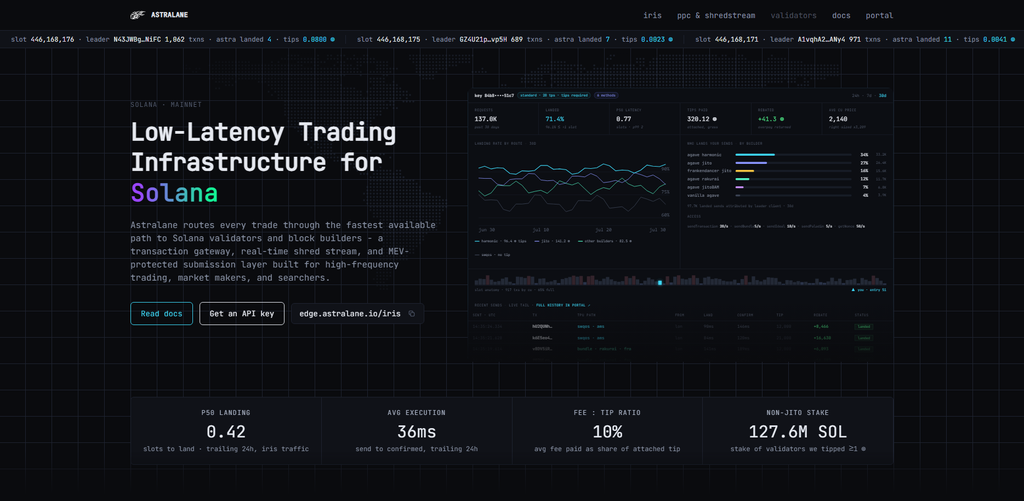
Solana support: solana native. Bundle Support: aimed at advanced transaction delivery workflows, including MEV-oriented submission. Fee Model: primarily usage or infrastructure dependent, not a standard consumer RPC model. Submission Method: optimized low-latency/private transaction pathways to minimize propagation delay Its purpose is more execution-infrastructure focused than a general purpose developer RPC.
| Attribute | Details |
|---|---|
| Provider | Astralane |
| Infrastructure Type | Low-latency transaction and data-relay infrastructure |
| Solana Support | Native Solana |
| MEV Focus | HFT, market making and latency-sensitive execution |
| Bundle Support | Supports advanced transaction-execution workflows |
| Submission Method | Transaction relay, direct validator integration and leader-aware routing |
| Relay Architecture | Dual transaction and shred relay system |
| Connectivity | SwQoS-enabled connections and direct stake peering |
| Network | Global private fiber network |
| Key Technology | Binary-optimized protocol and dynamic leader-aware routing |
| Best Suited For | HFTs, market makers and high-frequency Solana operators |
| Key Differentiator | Astralane documents sub-slot transaction propagation, dual relays and direct validator integration. |
4. Lil’JIT
Lil-JIT is a QuickNode add-on designed specifically to bring Jito bundle functionality directly into a QuickNode Solana endpoint. QuickNode was founded in 2017. Infrastructure Type: RPC integrated Jito bundle submission layer Solana Support: Yes, via QuickNode Solana endpoints.

Bundle Support: up to 5 transactions can be executed atomically and sequentially in a single slot. Fee Model: QuickNode endpoint / add-on pricing + applicable Jito bundle tips and standard Solana fees. Submission Method: JSON-RPC methods including sendBundle, sendTransaction, and simulateBundle with regional routing options.
| Attribute | Details |
|---|---|
| Provider | QuickNode Lil-JIT |
| Infrastructure Type | Jito bundle add-on for QuickNode Solana endpoints |
| Solana Support | Native Solana |
| Bundle Support | Up to 5 transactions per bundle |
| Execution | Atomic and ordered within the same slot |
| Submission Method | JSON-RPC through an existing QuickNode endpoint |
| Main Methods | sendBundle, sendTransaction, simulateBundle |
| Monitoring | Bundle status and in-flight bundle status |
| Tip Information | Tip accounts and current tip percentiles |
| Regional Routing | Multiple Jito routing regions |
| Best Suited For | Developers wanting Jito bundle functionality without separate searcher infrastructure |
| Key Differentiator | QuickNode manages the connection to the Jito Block Engine through the existing endpoint. |
5. Triton-One
Triton One Triton One is a Solana infrastructure company providing high-performance RPC, validator connectivity and Yellowstone gRPC infrastructure. Founded: Triton One was built on Solana-native infrastructure development. Infrastructure Type: RPC, gRPC streaming, transaction relay, validator connected infrastructure.
Solana Support: specialized and native. Bundle Support: Provides infrastructure for Jito bundle simulation and transaction delivery, unlike a generic RPC. Fee Model: metered infrastructure pricing with query and bandwidth charges; dedicated infrastructure is also available. Submission Method: direct-to-leader and validator-connected paths, including QUIC.
| Attribute | Details |
|---|---|
| Provider | Triton One |
| Infrastructure Type | Solana RPC, gRPC and validator-connected infrastructure |
| Solana Support | Native Solana |
| MEV Focus | High-performance trading and transaction infrastructure |
| Bundle Support | Jito-related bundle simulation and MEV workflows |
| Submission Method | High-performance RPC and validator-connected pathways |
| Data Streaming | Yellowstone gRPC |
| Infrastructure | Dedicated and performance-focused Solana infrastructure |
| Primary Users | Traders, market makers, validators and developers |
| Key Differentiator | Strong focus on Solana-native infrastructure and high-performance data/transaction access |
6. QuickNode
QuickNode is a multi-chain blockchain infrastructure provider offering Solana RPC, transaction delivery, streaming and MEV-related services. Founded: 2017. Infrastructure Type: managed RPC, dedicated nodes, gRPC, transaction routing and add-on infrastructure. Solana Support: yes. Bundle Support: Up to five atomic transactions are supported, through the Lil-JIT add-on.
Fee Model: subscription/credit based infrastructure pricing + applicable add-on costs + network/Jito fees Submission Type: standard Solana RPC, stake weighted QoS pathways and Jito routing via Lil-JIT. This makes QuickNode particularly relevant for teams that want bundle functionality without running separate Jito infrastructure.
| Attribute | Details |
|---|---|
| Provider | QuickNode |
| Infrastructure Type | Managed blockchain RPC and Web3 infrastructure |
| Solana Support | Yes |
| MEV Focus | Transaction submission and Jito integration through Lil-JIT |
| Bundle Support | Available through Lil-JIT |
| Submission Method | Solana RPC and Jito-integrated transaction routing |
| Bundle Size | Up to 5 transactions through Lil-JIT |
| Simulation | Supported through simulateBundle |
| Monitoring | Bundle status tracking |
| Fee Model | QuickNode infrastructure/add-on pricing plus applicable network/Jito costs |
| Best Suited For | Developers and trading teams wanting managed infrastructure |
| Key Differentiator | Provides Jito bundle functionality without requiring users to maintain a separate block-engine connection. |
7. Chainstack
Chainstack is a multi-chain blockchain infrastructure provider providing managed RPC and dedicated infrastructure for production applications and trading systems. Established: 2019. Infrastructure Type: managed RPC, dedicated nodes, node infrastructure and blockchain APIs. Solana Support: yes, including infrastructure designed for trading loads.
Bundle Support: Solana transaction and MEV workflows can be plugged into specialized routing infrastructure, but Chainstack is primarily an RPC/node provider, not a Jito-style block engine. Pricing Model: subscription and usage-based plans, enterprise pricing available. Submission Method: managed Solana RPC and dedicated-node txn delivery.
| Attribute | Details |
|---|---|
| Provider | Chainstack |
| Infrastructure Type | Managed blockchain nodes and RPC infrastructure |
| Solana Support | Yes |
| MEV Focus | Trading, RPC performance and blockchain connectivity |
| Bundle Support | MEV workflows can be integrated through supported infrastructure |
| Submission Method | Managed Solana RPC and dedicated infrastructure |
| Node Type | Managed and dedicated blockchain infrastructure |
| Fee Model | Usage/subscription-based infrastructure pricing |
| Primary Users | Developers, Web3 applications, trading teams and enterprises |
| Best Suited For | Teams requiring managed Solana infrastructure |
| Key Differentiator | Broader multi-chain infrastructure provider rather than a dedicated Solana-only MEV relay |
8. Fast RPC
RPC Fast is a Solana-focused infrastructure platform by Dysnix for HFT, MEV, arbitrage and latency sensitive applications. Founded: RPC Fast is the product of Dysnix’s experience in blockchain infrastructure. Infrastructure type: low-latency RPC, Yellowstone gRPC, ShredStream, transaction streaming and submission infrastructure.
Solana Support: native Solana support. Bundle Support: supports submitting Jito-related bundles, and integrates with MEV infra. Fee Model: SaaS tiers with a free option, with paid and dedicated setups for higher-performance infrastructure. Submission Method: JSON-RPC, WebSocket, gRPC, ShredStream, and custom transaction-delivery channels.
| Attribute | Details |
|---|---|
| Provider | RPC Fast |
| Infrastructure Type | High-performance Solana RPC and transaction infrastructure |
| Solana Support | Native Solana focus |
| MEV Focus | MEV, arbitrage, HFT and trading |
| Bundle Support | Supports MEV-related bundle workflows |
| Submission Method | JSON-RPC, gRPC and specialized transaction-delivery infrastructure |
| Data Access | Yellowstone gRPC and ShredStream |
| Latency Focus | Low-latency transaction and market-data delivery |
| Fee Model | SaaS/free and paid infrastructure tiers |
| Best Suited For | MEV searchers, trading bots, market makers and HFT |
| Key Differentiator | Combines RPC access with low-latency streaming and transaction infrastructure for Solana trading workloads |
9. Dysnix
Dysnix is a blockchain infrastructure and DevOps company building RPC Fast with infrastructure designed for high-performance Web3 workloads. Founded: 2016. Started as a DevOps company and later extended to blockchain infrastructure. Infrastructure Type: DevOps, RPC infrastructure, blockchain nodes and Solana performance infrastructure. Solana Support: Yes, via its RPC Fast platform and related infrastructure.
Bundle Support: MEV-focused workflows are supported via Jito integration and transaction-delivery stack of RPC Fast. Fee Model: service-specific, from managed infrastructure to RPC Fast SaaS and dedicated deployments. How to Submit: Solana RPC, gRPC, ShredStream and optimized transaction routes.
| Attribute | Details |
|---|---|
| Provider | Dysnix |
| Founded | 2016 |
| Infrastructure Type | DevOps, blockchain infrastructure and managed node services |
| Solana Support | Yes |
| MEV Focus | Solana performance infrastructure through RPC Fast |
| Bundle Support | Available through its Solana transaction infrastructure stack |
| Submission Method | RPC, gRPC, ShredStream and transaction-delivery pathways |
| Infrastructure Model | Managed and dedicated infrastructure |
| Fee Model | Service-specific and infrastructure-based |
| Primary Users | Web3 companies, trading teams and enterprises |
| Best Suited For | Organizations needing customized blockchain infrastructure |
| Key Differentiator | Dysnix provides the broader infrastructure expertise behind RPC Fast rather than functioning solely as a Solana bundle relay |
10. AllenHark
AllenHark provides ultra low latency Solana infrastructure to MEV searchers, HFT systems, bots, market makers and validators. Founded: 2014 Infrastructure Type: staked RPC, Yellowstone gRPC, ShredStream, transaction relay, bare metal infrastructure, and leader-aware routing. Solana Support: highly specialized infrastructure for Solana.
Bundle Support: its relay submits atomic bundles via the Jito Block Engine, and Slipstream also has atomic bundle functionality. Fee Model: Free and pay-as-you-go relays. Enterprise infrastructure also available. Submission Method: QUIC, TPU, UDP, RPC fan-out, Jito/custom relayers, leader-proximity routing.
| Attribute | Details |
|---|---|
| Provider | AllenHark |
| Founded | 2014 |
| Infrastructure Type | Ultra-low-latency Solana infrastructure |
| Solana Support | Native Solana |
| MEV Focus | MEV, HFT, arbitrage and market making |
| Bundle Support | Atomic bundle submission through supported relay infrastructure |
| Submission Method | QUIC, TPU, UDP, RPC fan-out and relay pathways |
| Data Infrastructure | Yellowstone gRPC and ShredStream |
| Routing | Leader-aware and low-latency routing |
| Fee Model | Free/pay-as-you-go options plus enterprise infrastructure |
| Best Suited For | MEV searchers, HFT firms, validators and trading systems |
| Key Differentiator | Combines transaction relaying, high-speed data feeds and validator/leader-aware infrastructure in a Solana-focused stack |
Comparison Table: Top Jito Competitors for Solana MEV Bundles
| Provider | Infrastructure Type | Solana Support | Bundle Support | Submission Method | MEV Focus | Fee Model | Key Attribute |
|---|---|---|---|---|---|---|---|
| Temporal (Nozomi) | Low-latency transaction and validator infrastructure | Native Solana | MEV-oriented transaction workflows | Low-latency transaction routing | MEV, trading, execution | Service/infrastructure based | Transaction landing and validator connectivity |
| Helius Sender | Low-latency transaction sender | Native Solana | Yes; Sender Max supports bundles | Staked connections and high-speed regional routing | HFT, trading, MEV | SOL tips | Fast transaction landing with multiple regions |
| Astralane | Transaction and data relay infrastructure | Native Solana | MEV-oriented workflows | Private relay, leader-aware routing | HFT, market making, MEV | Infrastructure dependent | Low-latency propagation and validator connectivity |
| Lil-JIT | Jito bundle add-on | Native Solana | Yes; up to 5 transactions | JSON-RPC through QuickNode | MEV bundles | QuickNode/add-on + Jito/network costs | Jito functionality through QuickNode endpoints |
| Triton One | RPC, gRPC and validator infrastructure | Native Solana | Jito-related workflows | RPC and validator-connected pathways | Trading and MEV | Usage/infrastructure based | Yellowstone gRPC and Solana-native infrastructure |
| QuickNode | Managed RPC and Web3 infrastructure | Yes | Yes through Lil-JIT | RPC and Jito-integrated routing | Transaction delivery and MEV | Subscription/usage based | Managed infrastructure with Jito integration |
| Chainstack | Managed RPC and blockchain nodes | Yes | MEV integration possible | Managed RPC/dedicated nodes | Trading and blockchain infrastructure | Subscription/usage based | Multi-chain managed infrastructure |
| RPC Fast | High-performance Solana RPC | Native Solana | MEV-related workflows | RPC, gRPC and transaction infrastructure | MEV, arbitrage, HFT | Free and paid tiers | RPC + Yellowstone gRPC + ShredStream |
| Dysnix | Blockchain infrastructure and DevOps | Yes | Through related Solana infrastructure | RPC, gRPC and specialized infrastructure | MEV and performance | Service-specific | Broader infrastructure behind RPC Fast |
| AllenHark | Ultra-low-latency Solana infrastructure | Native Solana | Atomic bundle support | QUIC, TPU, UDP, RPC and relays | MEV, HFT, arbitrage | Free, pay-as-you-go and enterprise | Leader-aware routing and high-speed data infrastructure |
Conclusion
The Jito competitors you choose for Solana MEV bundles depends on your application’s infrastructure layer, transaction speed, support for bundles, how they are submitted and the fee structure you need. Providers such as Temporal (Nozomi), Helius Sender, Astralane, Lil-JIT, Triton One, QuickNode, Chainstack, RPC Fast, Dysnix and AllenHark have different approaches to delivering Solana transactions.
Some are on low-latency relays and leader connectivity. Others are a mix of RPC, gRPC, streaming and bundle infrastructure. Before choosing a provider, evaluate the real bundle capabilities, APIs supported, routing architecture, pricing, latency, and integration needs to decide which infrastructure is best suited to your Solana MEV strategy and operational requirements.
FAQ
What are Jito competitors for Solana MEV bundles?
Jito competitors are infrastructure providers that offer alternative or complementary services for Solana MEV execution, transaction routing, bundle submission, low-latency RPC, private relays, and validator connectivity.
Do all Jito competitors support Solana bundles?
No. Some providers offer direct bundle submission, while others focus on RPC, transaction propagation, gRPC, ShredStream, or low-latency infrastructure that can support MEV workflows without providing a Jito-style bundle engine.
What is the difference between Jito and a Solana RPC provider?
Jito provides specialized MEV infrastructure, including bundle submission and auction-based execution. A Solana RPC provider primarily gives applications access to blockchain data and transaction submission. Some providers combine both functions.
What is Helius Sender used for?
Helius Sender is designed for fast Solana transaction submission and landing. It provides specialized transaction-delivery infrastructure for applications where execution speed and reliable submission are important.
What is QuickNode Lil-JIT?
Lil-JIT is a QuickNode add-on that provides Jito bundle functionality through QuickNode Solana endpoints. It allows developers to submit and simulate bundles without separately building the entire submission infrastructure.