

As companies embrace blockchain technology, having the right infrastructure to protect data privacy, ensure security, and maintain reliable business operations has become crucial. Private blockchain nodes give organizations the ability to manage access to the network, handle sensitive transactions, and develop applications that satisfy specific business needs.
But it can be tricky to find a provider that offers the right mix of performance, scalability, security and cost. This guide will review the best private blockchain node providers for enterprises, including key features, benefits, limitations, and criteria for selection.
Why Do Enterprises Need Private Blockchain Nodes?
Data Privacy and Confidentiality: Private blockchain nodes allow enterprises to store private business data in a controlled environment that is accessible only to authorized participants. It also enables confidential transactions between trusted organizations.
Improved security. Permissioned access, identity verification, and network-level security controls can be used by companies to secure the blockchain infrastructure against unauthorized access and data tampering.

Regulatory Compliance: The private blockchain infrastructure allows businesses to define access policies, keep transaction records, and satisfy audit requirements in accordance with relevant industry regulations and internal governance standards.
Improved Performance: Dedicated node infrastructure enables predictable resource provisioning, minimizes dependency on shared endpoints and supports uniform transaction processing for enterprise applications with high performance requirements.
Better Control of Infrastructure: Enterprises can manage node configurations, control network permissions, define operational policies and customize the blockchain infrastructure based on their technical requirements and internal security standards.
Reliable Business Operations Enterprise-grade nodes can support monitoring, redundancy, backup strategies and recovery planning. It can help organizations maintain blockchain connectivity and reduce disruptions during infrastructure failures.
Scalability to Support Business Growth: Private blockchain nodes allow enterprises to scale infrastructure capacity, support increasing transaction volumes, and add more business applications as operational requirements change.
Secure Business Collaboration: Private blockchain networks allow authorized partners, suppliers and departments to share authenticated records, collaborate on transactions and maintain consistent information, without exposing sensitive data to the public.
How to Choose the Right Private Blockchain Node Provider?
Supported Blockchain Frameworks Pick a provider that supports your enterprise blockchain framework, for example Hyperledger Fabric or private Ethereum networks, and ensure that it is compatible with your existing business applications and workflows.
Security & Privacy: Evaluate authentication, control of access, encryption, identity management and network isolation to ensure the provider can protect sensitive enterprise data and limit access to authorized participants.
Performance and Reliability: Review transaction throughput, latency, uptime commitments, monitoring features, and redundancy options to confirm that the infrastructure can reliably support business workloads without unnecessary operational interruptions.
Deployment Flexibility: Choose a provider that can offer the cloud, on-premises, private cloud, or hybrid deployment options that your organization’s infrastructure policies and data residency requirements require.
Scalability & Resource Management: Assess if the provider can scale up to accommodate more transactions, new nodes, growing storage needs, and shifting workloads without significant performance degradation or complex infrastructure migrations.
Pricing and Total Costs: Assess subscription prices, node hosting fees, storage, bandwidth, support, and other service costs to forecast long-term costs and avoid unexpected infrastructure budget hikes.
Compliance & Governance – Make sure the provider has the right certifications, auditing capabilities, contractual requirements, and regulatory support so they can meet your organization’s specific industry compliance and governance needs.
Technical Support and SLAs: Think about support availability, incident response procedures, documentation, escalation channels and service-level agreements to make sure support is there when infrastructure problems affect critical enterprise operations.
Key Points
1. Alchemy
Alchemy is the leading blockchain infrastructure platform, enabling developers to build, scale and operate decentralized applications without having to run their own nodes. It has wide multi-chain support with over 100 blockchain networks such as Ethereum, Polygon, Arbitrum, Optimism, Base, and Solana.
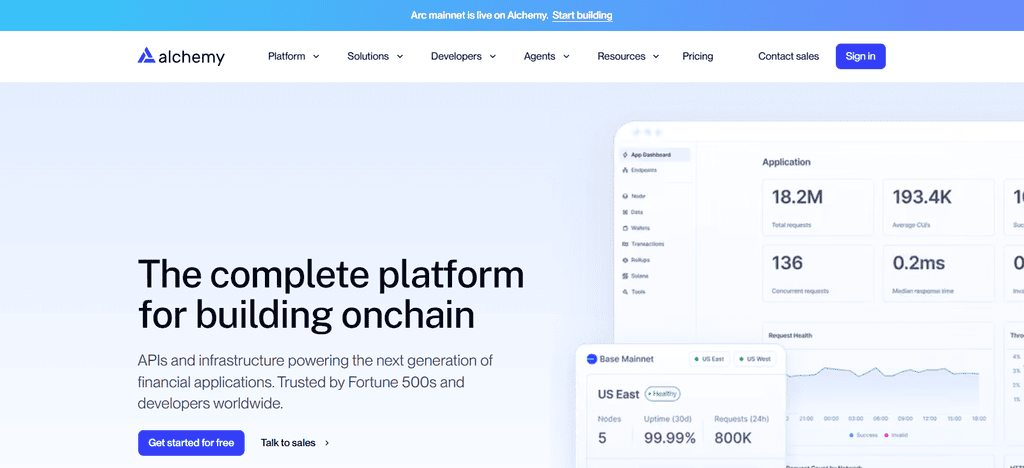
Alchemy is very performance driven and uses global infrastructure and smart routing to ensure low latency and high availability. It provides managed node infrastructure, advanced APIs, analytical tools, Webhooks, and premium blockchain data services.
Enterprise-grade infrastructure puts security first, with dedicated infrastructure options, compliance-oriented services, and professional enterprise support for large organizations.
Pros
- Web3 applications on dependable managed blockchain infrastructure.
Works with various popular blockchain networks. - Offers developer-friendly APIs and development tools.
- Delivers infrastructure designed to scale as application traffic grows.
- Reduced overhead of running your own blockchain nodes.
Drawbacks
- Expensive at large request volumes for advanced usages.
- Free-tier limits may not be appropriate for large enterprise workloads.
- Less direct control for enterprises than fully self-hosted nodes.
- Network availability and features vary by supported chain and plan.
2. QuickNode
QuickNode is a blockchain developer platform that offers high-performance RPC endpoints, dedicated clusters, live data streaming, and blockchain analytics services. The platform supports over 70 major blockchain networks including Ethereum, Solana, Avalanche, Polygon, Base, Arbitrum and BNB Chain. QuickNode also places a strong emphasis on reliability, with globally distributed infrastructure and enterprise-grade uptime commitments.
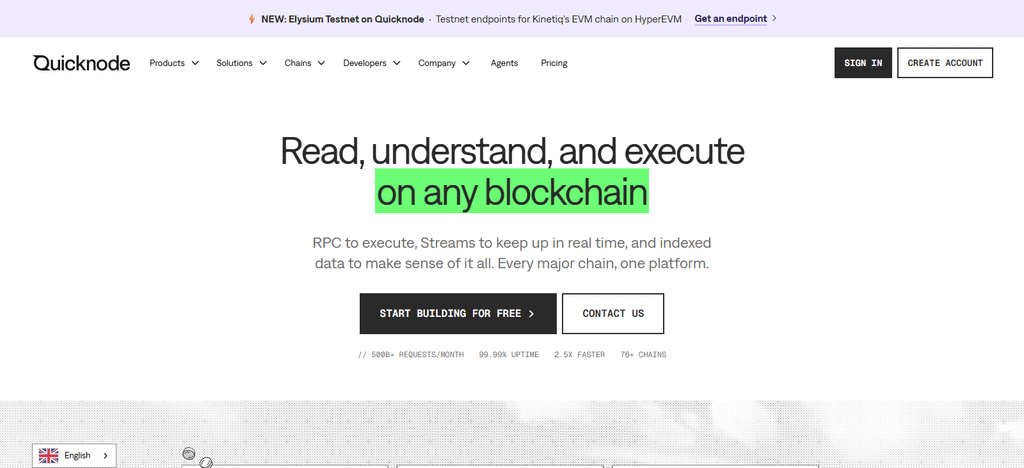
Its managed node services remove the need for infrastructure maintenance and provide scalability for growing applications. Dedicated environments, private clusters, further increase the data security.
Service-level agreements, advanced monitoring, compliance-focused integrations, and dedicated customer support are available for enterprise clients, making QuickNode a preferred option for large-scale Web3 projects.
Pros
- supports multiple blockchain networks.
- Offers managed RPC endpoints and dedicated infrastructure options.
- Offers tools for creating blockchain applications.
- Simplifies node deployment and ongoing maintenance.
- Enables applications that require blockchain connectivity that can scale.
cons
- More requests can mean more infrastructure costs.
- Some advanced features require paid plans.
- Managed services provide less low level control than running your own nodes.
- Network specific features and limits may vary depending on the plan
3. Ankr
Ankr is a decentralized, enterprise-grade Web3 infrastructure that makes it easy to connect to many blockchains. The platform supports over 60 blockchain ecosystems including Ethereum, Polygon, Solana, BNB Chain, Avalanche, Optimism and many more.
Ankr provides fast RPC services, advanced APIs, staking infrastructure, and distributed node access through a globally deployed infrastructure. Performance is improved with geographically distributed nodes and high-availability systems that provide reliable access under heavy network demand.
Ankr offers project controls, endpoint whitelisting, analytics and enterprise-grade support services to ensure security. Custom deployments, dedicated resources, service guaranties and technical expertise tailored for production-scale blockchain applications.
Pros
- Allows access to multiple blockchain ecosystems.
- Managed RPC infrastructure for decentralized applications
- Reduces the need to operate internal nodes.
- Supports connectivity to blockchains for a variety of Web3 workloads.
- Offers infrastructure choices for scaling applications.
Cons
- Enterprise features can differ depending on the network and service plan.
- Costs can be higher for high-volume workloads.
The provider takes care of the infrastructure, so you don’t have direct control over node configuration. - Check the support and service guaranties, especially for enterprise deployments.
4. Chainstack.
Chainstack is a blockchain infrastructure provider that provides reliable, low latency and scalable node services for decentralized applications. The platform supports over 70 blockchain networks such as Ethereum, Solana, Polygon, Avalanche, Bitcoin, Arbitrum and BNB Smart Chain.
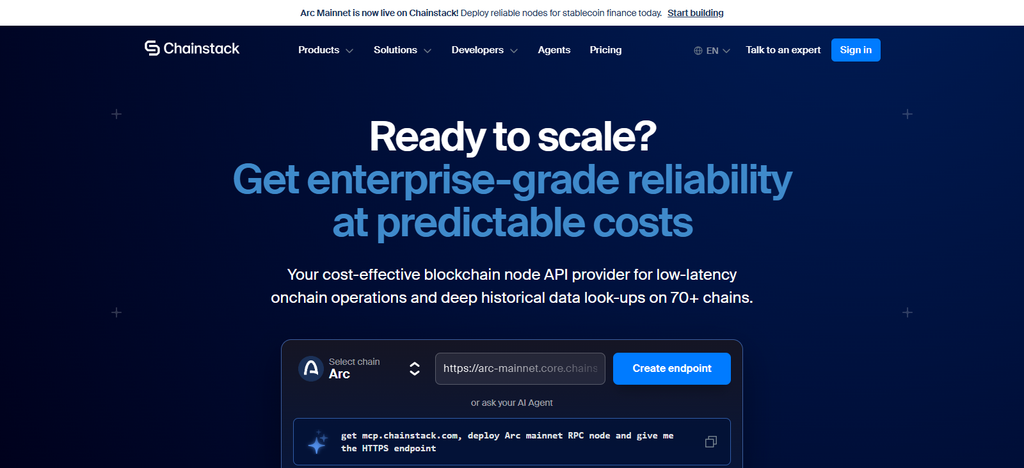
For organizations that want more control, Chainstack offers managed nodes, dedicated nodes, global RPC endpoints as well as self-hosted deployment options. Self-hosted environments and dedicated infrastructure options improve data privacy.
Performance is guarantyd with geo-balanced routing and enterprise-grade uptime standards. Compliance certifications, monitoring tools, automated maintenance and technical support help businesses easily manage blockchain infrastructure while maintaining operational reliability and scalability. Flexible deployment models are also offered.
Benefits
- Protocols and multi-blockchain networks.
- Managed infrastructure of nodes for enterprise applications.
- Dedicated node options available on some supported networks.
- Deployments, monitoring and infrastructure maintenance made easy.
- Supports blockchain projects with different workload needs.
Downsides
- Dedicated infrastructure can be more expensive than shared endpoints.
- Blockchain networks support different features.
- Technical know-how may be required for some configurations.
- Enterprise service guaranties vary by chosen plan and contract.
5. Infura
Infura is one of the most popular providers of blockchain infrastructure, providing scalable access to Ethereum and a number of other EVM compatible chains. Supported blockchains include Ethereum, Polygon, Arbitrum, Optimism, Avalanche, Starknet and much more.
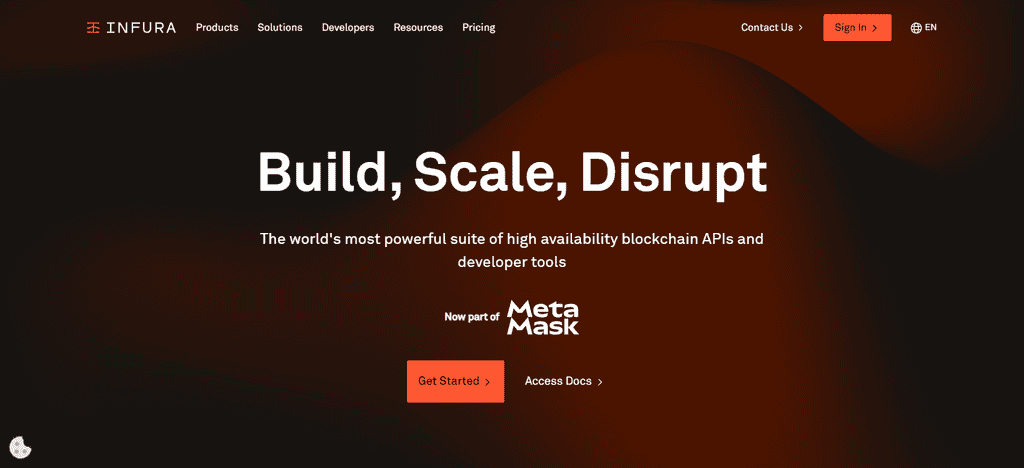
Node synchronization, monitoring, scaling, and maintenance are handled by the platform, allowing developers to concentrate on application development. Infura is known for reliability, high availability and consistent performance for both startup and enterprise users.
Security features include controlled access, API authentication and operational monitoring. Enterprise clients are provided with dedicated support, sophisticated infrastructure options, and integration with broader Web3 development environments. Its strong infrastructure serves as a trusted base for wallets, DeFi apps and blockchain services.
Benefits
- Provides a tried and tested infrastructure for Ethereum apps.
- Provides managed APIs for easier blockchain connectivity.
- Eliminates the need to run separate blockchain nodes.
- Supports workflows for decentralized application development.
- Access to blockchain data and services to submit transactions.
Disadvantages
- Costs may increase with application traffic.
- High request volume applications may be subject to usage limits.
- Developers have limited control of underlying node operations.
- Network coverage and capabilities will vary depending on the service supported
6. dRPC
dRPC is a decentralized RPC infrastructure platform that improves the accessibility, reliability, and resilience of blockchains with distributed node networks. It supports more than 130 blockchain ecosystems and hundreds of networks including Ethereum, Solana, Polygon, Avalanche, Base and BNB Chain. AI-driven load balancing and smart routing ensure performance optimization and downtime reduction on the platform.
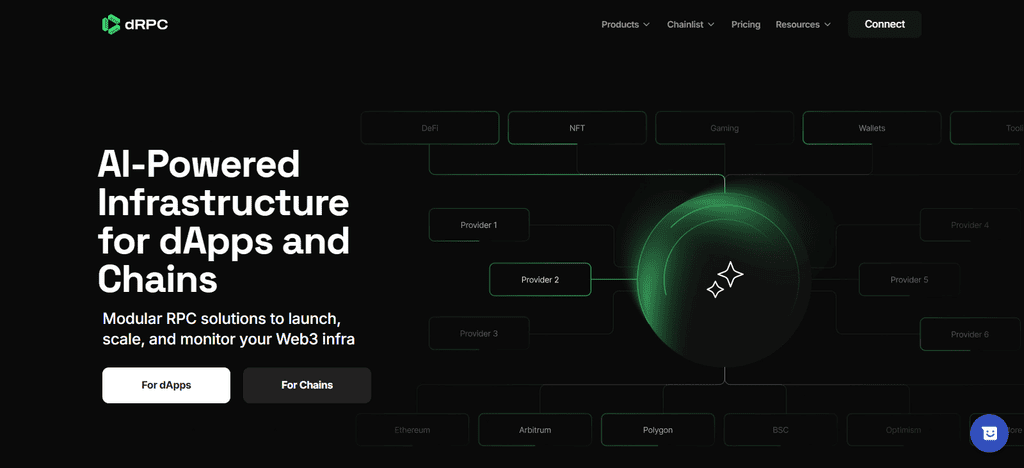
dRPC improves availability by distributing requests across multiple providers, as well as minimizing dependence on a single source of infrastructure. Security and privacy are key priorities thanks to decentralized architecture and advanced monitoring tools. Enterprise users have access to high throughput infrastructure, flexible scalability, analytics, customizable routing and professional support services .
Advantages
- Offers a common RPC access layer for multiple providers.
- Reduces reliance on a single RPC endpoint.
- supports infrastructure redundancy and request routing.
- Can increase resilience via provider switching and failover.
-simplifies multi-chain connectivity for Web3 applications
Cons
- Performance is partially dependent on the underlying node providers.
- Routing is another layer of infrastructure to deal with.
- Provider availability and supported methods may vary.
- It might not substitute dedicated nodes where direct control of the infrastructure is needed.
7. GetBlock.com
GetBlock is a blockchain infrastructure platform providing access to more than 130 blockchain networks via managed RPC and node services. Supported ecosystems: Ethereum, Solana, Polygon, Bitcoin, Avalanche, BNB Chain, Arbitrum, TON and many others. GetBlock provides shared nodes, dedicated nodes, archive nodes and enterprise infrastructure for different operational needs.
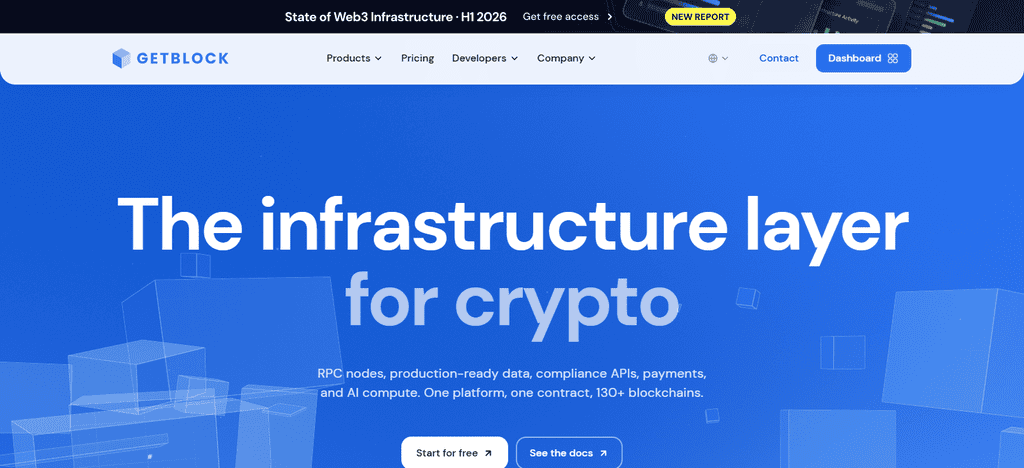
Data security on the platform is achieved through compliance programs, infrastructure controls and secure API access mechanisms. It offers high performance with worldwide distributed infrastructure and automatic failover.
Enterprise clients get their own dedicated environments, advanced analytics, compliance-focused services, service level agreements and expert support. This enables stable blockchain integration at scale.
Benefits
- Access to blockchain nodes that are managed.
Works with various blockchain networks and protocols. - Offers shared and dedicated infrastructure to the supported services.
- Makes it easier to retrieve blockchain data and transaction requests.
- Cuts down on the burden of maintenance of self-hosted nodes.
Cons
- Dedicated nodes can raise operational expenses.
- Shared endpoints may provide less isolation than dedicated infrastructure.
- Network features and historical data availability is patchy.
- Enterprises need to check uptime commitments and support terms before deployment.
8. OnFinality
OnFinality is a multi-chain blockchain infrastructure provider, offering RPC services, dedicated nodes, indexing solutions and developer-focused tools. The platform supports more than 130 blockchains across EVM, Substrate, Cosmos, Solana and Bitcoin ecosystems. OnFinality takes care of node deployment, monitoring, upgrades and scaling so teams can focus on building and not worry about managing infrastructure.
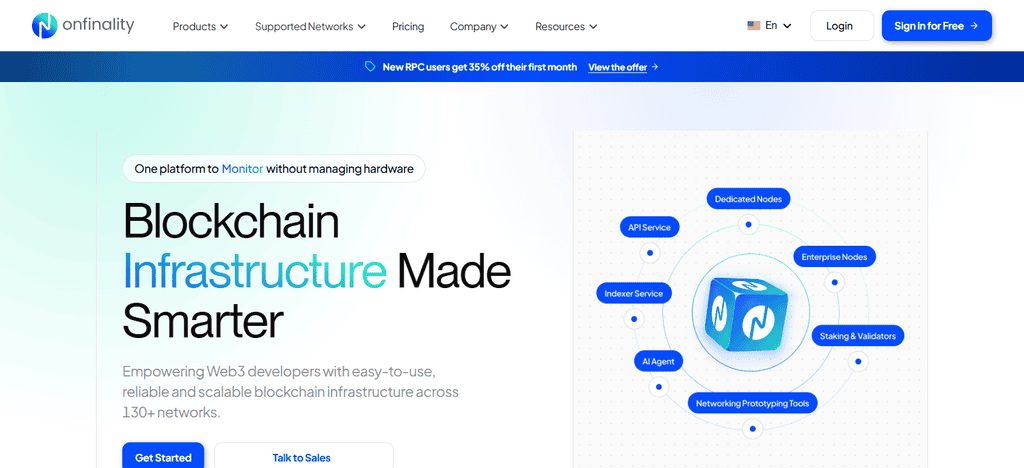
Its globally distributed infrastructure provides reliable performance and strong uptime for production applications. Security features include dedicated deployments, monitoring systems, control of access and enterprise infrastructure management.
Organizations may take advantage of archive nodes, indexing, analytics, and custom deployment environment. Because of its enterprise-grade support and flexible scalability, OnFinality is a good option for Web3 startups and large organizations alike.
Benefits
- Provides managed blockchain infrastructure and node hosting.
-supports multiple blockchain ecosystems - Enables node deployment and maintenance.
- API access for developing blockchain applications.
- Provides infrastructure needs for different types of blockchain workloads.
Drawbacks
- More limited coverage of the network for particular enterprise needs.
- Building a dedicated infrastructure may be more costly.
Supported networks vary in capabilities. - Enterprises should review service guaranties and support coverage before committing.
9. BlockPI
BlockPI is a global web3 infrastructure company providing high-performance RPC services, dedicated nodes, validator services and blockchain connectivity. The platform is compatible with over 70 blockchain networks, such as Ethereum, Polygon, BNB Chain, Solana, Avalanche and other major ecosystems.
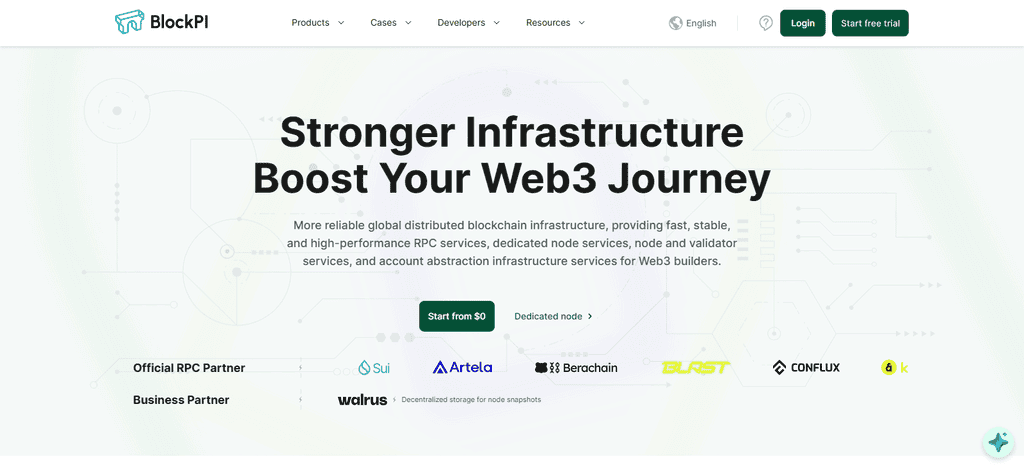
BlockPI is built on globally distributed infrastructure with smart routing and dynamic load balancing to keep latency low and availability high. Dedicated environments, API key management, team collaboration tools and enterprise-grade service architecture all reinforce security.
Organizations can deploy flexible, high-throughput infrastructure with sophisticated APIs, 24/7 technical support, and enterprise-grade performance guaranties for mission-critical blockchain applications.
Benefits
- provides RPC infrastructure for blockchain apps.
- Supports various blockchains.
- Gives developers access to blockchain data through managed endpoints.
- Offers infrastructure that is designed to accommodate application traffic.
- Eliminates the need to keep all nodes internally.
Drawbacks
- Heavy traffic can drive up the cost of services.
- Enterprise features vary depending on the plan and the network you use.
- Managed RPC access provides less control of the node underneath.
- Enterprises must independently verify compliance documentation and service-level commitments.
10. Uniblock
Uniblock offers a single integration to access hundreds of blockchain networks and dozens of infrastructure providers through a unified blockchain API layer. The platform supports more than 300 blockchain networks and integrates with more than 55 infrastructure providers.
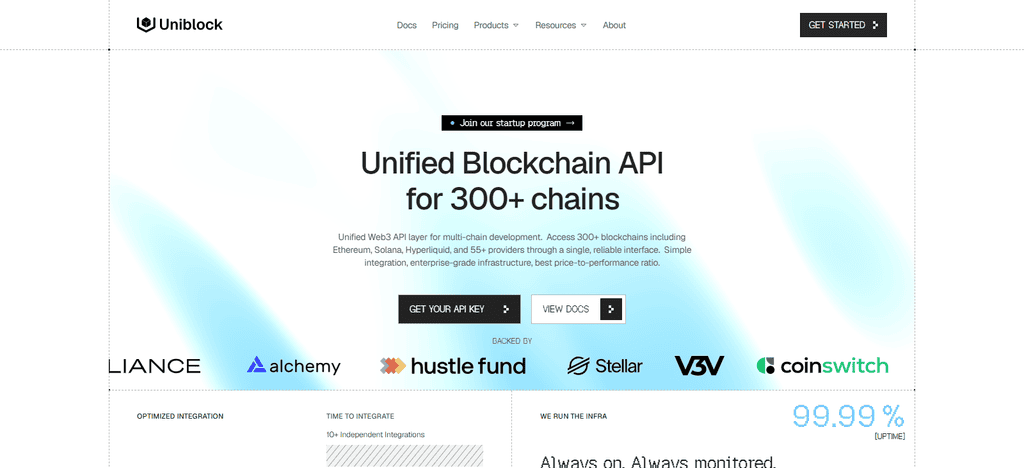
Uniblock aims to reduce vendor lock-in by intelligently routing requests to the best provider for the job based on reliability, cost and performance. “Better security and reliability with intelligent failover, automated retries, and 24/7 infrastructure monitoring.
Uniblock is not just a traditional node provider but an orchestration platform that provides better resilience and scalability. Enterprise users get simplified deployments, multi-chain flexibility, performance optimization and centralized operational management.
Benefits
- Provides a single integration layer for Web3 infrastructure.
- Makes it easy to access multiple blockchain services.
- Can make it easier to bring in individual providers.
- Supports multi-chain application development workflows.
- Can help teams reduce complexity of infrastructure management and provider integration.
Cons
- Real network coverage depends on integrated providers.
- Underlying infrastructure services may affect performance.
- More integration layers can make troubleshooting more complex.
- Enterprises should review the security, service guaranties, and support arrangements at the provider level
Conclusion
Private blockchain node providers help enterprises to build secure, reliable and scalable blockchain infrastructure for business operations. When choosing the right provider, you should look at supported blockchain frameworks, data privacy, security controls, transaction performance, deployment flexibility and long-term costs. Organizations also need to consider regulatory compliance, technical support, service-level agreements and disaster recovery capabilities before making a decision.
Managed infrastructure can simplify the operation of nodes, but companies should check whether the provider supports private or permissioned blockchain networks — not just public blockchain RPC access. At the end of the day, the best provider is one that can meet enterprise requirements, protect sensitive information, support future growth, and provide reliable infrastructure.
FAQ
What is a private blockchain node provider?
A private blockchain node provider offers infrastructure and services for operating or accessing blockchain nodes within controlled environments, helping enterprises manage transactions, network access, and blockchain data.
Why do enterprises need private blockchain nodes?
Enterprises use private blockchain nodes to improve data confidentiality, control network participation, manage sensitive transactions, support compliance requirements, and maintain reliable blockchain infrastructure for business applications.
Which are the best private blockchain node providers for enterprises?
Alchemy, QuickNode, Ankr, Chainstack, Infura, dRPC, GetBlock, OnFinality, BlockPI, and Uniblock offer blockchain infrastructure services. However, enterprises should verify private-network support before selecting a provider.
What features should enterprises consider when choosing a provider?
Important features include security controls, supported blockchain frameworks, deployment flexibility, performance, scalability, pricing, regulatory compliance, monitoring tools, and technical support.
Are private blockchain nodes more secure than public blockchain nodes?
Private nodes can provide greater control over network participation and data access. However, security depends on proper configuration, encryption, identity management, and ongoing infrastructure maintenance.