


Business lending platforms are offering new opportunities for investors to earn potential returns while helping businesses in need of funding to grow. These platforms offer a range of ways to get involved in alternative lending markets, including small business loans and SME financing, property-backed loans and business bonds.
But to choose the right platform, one has to research the investment options, expected returns, minimum investment, repayment terms and security arrangements in detail. In this article, I will discuss the best business lending platforms for investors in 2026 and their important features, benefits and risks.
Why Should Investors Use Business Lending Platforms?
Potential to Earn Interest Income: By funding business loans, business lending platforms enable investors to earn interest income. Borrowers repay the loans over an agreed investment period, providing opportunities for regular income.
Portfolio Diversification: Investors can diversify their portfolio by investing capital in different businesses, industries, loan categories, and geographical markets instead of traditional investments.
Access to SMEs: These platforms offer opportunities to fund small and medium-sized businesses that need capital for growth, equipment purchases, working capital, and operational improvements.
Flexible Investment Options: Investors can select varying loan amounts, repayment terms, investment durations, and financing types based on their financial objectives and personal risk tolerance.
Alternative Investment Opportunities: Business lending is an alternative asset class, moving away from traditional stocks, bonds and savings products, allowing investors to explore different income-generating investment opportunities.
Transparent Loan Information: Numerous platforms provide information about the borrower, financials, loan purpose, interest rates and repayment terms, allowing investors to assess the opportunities before committing their capital.
Collateral-Backed Opportunities: Some platforms offer property-backed or asset-secured business loans, giving investors an additional recovery option in case of borrower default, however, collateral does not guaranty repayment.
Convenient Online Access: Some of the digital lending platforms that make it easy for you to control your investments include online registration and loan selection, portfolio monitoring, repayment tracking, and business financing opportunities.
How to Choose the Best Business Lending Platform?
Make sure they play by the rules: Only use platforms that operate under the right financial regulations. Make sure you know what licenses they have, how they are registered, who can invest through them and what their regulatory status is before investing any money.
Minimum Investment Comparison Compare the minimum deposit requirements across platforms to ensure that their investment opportunities align with your available funds, financial objectives, and portfolio allocation strategy.
Evaluate Potential Returns: Look into the interest rates available, the expected returns, the frequency of payments and any fees involved. Remember, these are just estimates and actual returns will depend on the repayments made by the borrowers. 4. Understand Borrower Evaluation: See how each platform assesses the financial statements, creditworthiness, ability to repay, trading history and outstanding debt of businesses before listing them as lending opportunities for individual businesses.
Review Security Arrangements: Determine whether loans are backed by property, personal guaranties, business assets or other forms of enforceable security, and the implications of these in the event of borrower default.
Know the Length of Loans: Compare maturity periods, repayment schedules, interest payment frequency and early withdrawal restrictions to match lending commitments with your financial timeline and liquidity needs.
Analyze Platform Fees: Review management fees, transaction fees, servicing fees, withdrawal fees and any other fees that may apply. These fees can eat into your overall investment returns.
Explore Diversification Options: Choose platforms that allow access to a variety of borrowers, industries, loan types and geographical locations to diversify your exposure and reduce dependence on repayments from any one business.
Key Points
| Platform | Key Investor Opportunity |
|---|---|
| Honeycomb Credit | Invest in community-based business loan offerings and potentially earn interest. |
| SMBX | Access small-business bond offerings and earn interest from eligible investments. |
| Folk2Folk | Participate in property-secured business lending. |
| CrowdProperty | Invest in property development loans through a peer-to-peer model. |
| rebuildingsociety.com | Fund secured or unsecured business loans through peer-to-peer lending. |
| Crowd2Fund | Access business investment and lending opportunities through its platform. |
| Proplend | Participate in commercial property-backed lending. |
| CapitalStackers | Access property development finance and debt investment opportunities. |
| Maclear | Invest in business loans, including asset-backed financing opportunities. |
| Capitalia | Access SME financing and invoice-financing investment opportunities. |
1. Honeycomb Credit
Honeycomb Credit is a U.S. community-investment crowdfunding platform that allows individuals to lend directly to locally owned small businesses such as restaurants, breweries and retailers. It was founded in 2018 and it is a Regulation Crowdfunding debt platform. Investors typically purchase fixed-income notes that represent small-business loans.

The minimum investment is often $100, and the interest rate is advertized at between 6% and 14%. Repayment terms vary by offering, although in general loans are repaid quarterly. Recent open offerings have used terms of up to 60 months.
The borrowers are mostly local small businesses, Main Street-style businesses looking for capital for growth, equipment or expansion. Investor fees include a transaction fee based on a percentage, which is reported as 3% by ACH and capped at $75 on newer offerings. Card investments may cost more. Honeycomb Wallet funded investments can carry 0%.
Main Features
- Small Business Financing: Links investors to small businesses in need of capital for growth, expansion, equipment, and operational requirements.
- Community Investment: Enables people to invest in local businesses through community-based investment campaigns.
- Investment Offerings: Access to business financing offerings based on debt securities.
- Interest Returns: Receive interest according to the terms of the particular investment offerings.
- Business Discovery: Lets investors look up business profiles, funding goals, and offering details before investing.
Security & Risk
- Investing Transparency: Investors should read offering documents, financial information, repayment terms and risks.
- Business Default Risk: Borrowers do not make scheduled payments, which could result in financial losses.
- Illiquidity Risk: Investment may not have a liquid secondary market for an early exit.
- Capital Loss Risk: There is no guaranty of principal and interest payments and investors may lose some or all of their invested capital.
2. SMBX
SMBX is a marketplace in the United States that enables everyday investors to buy “Small Business Bonds” which are amortizing debt securities issued by vetted small businesses. The company was founded in 2016, though some sources say that its platform was launched in 2019. This is a Regulation Crowdfunding fixed-rate business debt with a very low $10 minimum investment.

Advertized returns vary from roughly 5% to 11.5% depending on the bond and market conditions. Most bonds are amortized monthly . Terms vary from about 3 years to 10 years , or 36 to 120 months .
Borrowers are independent small and local businesses substituting or supplementing bank financing. SMBX does not charge investors a platform fee for bank-transfer investments, but a 4% non-refundable surcharge applies to credit-card investments, and issuers pay a percentage of funds raised.
Main Features
- Small Business Bonds: Offers investment opportunities in bonds from eligible small businesses.
- Business Finance: Helps businesses raise money to grow, buy equipment, stock inventory and meet other business needs.
- Interest Payments. Investors may receive interest in accordance with the terms of individual bond offerings.
- Selection of Investment: It allows investors to assess the business bond offerings available before investing.
- Alternative to Ownership of Business: Allows investment in debt rather than requiring investors to take an ownership share in a business.
Security & Safety
- Bond Documentation: Investors need to review bond contracts, issuer disclosures, maturity dates, and payment terms.
- Issuer Credit Risk: Companies may experience financial difficulties and be unable to pay back their bonds.
- Limited Liquidity: Investors might have to hold bonds until maturity as there may not be many opportunities to resell.
- No Collateral: Not all offerings are collateralized, so recovery can be difficult after issuer default.
3. Folk2Folk
Folk2Folk is a UK peer-to-peer lending platform that focuses on property-backed loans to British SMEs and property owners. The platform connects investors with borrowers in need of secured business finance. The minimum investment on the platform is quite high at £20,000 per loan which is more suited to bigger investors.

The business-loan investment product provides monthly fixed income of 8.50% per annum on average, but the rate varies according to the loan. Loan terms range from six months to five years.
Investors invest their money for the duration of the loan unless they are involved in the secondary market. Borrowers are usually UK SMEs, often using property as collateral. There’s no fee to invest or receive income, but a flat fee of £250 to list an investment for early sale on the secondary market.
Main Features
- Property Secured Business Loans: Connects investors to businesses seeking finance secured against UK commercial property or land.
- First Legal Charge Generally secures first legal charge security over the property supporting each loan.
- Business Borrower Network: Target mature companies needing capital for growth, acquisitions and working capital.
- Property Valuation: Utilizes independent professional property valuations to determine the value of loan security.
- Loan-to-Value Assessment: As a rule, it limits borrowing to around 60% of the property value as determined by an independent party.
Risk & Security
- Property Collateral: First legal charges offer a way to reclaim property in the event of default by borrowers.
- Independent Valuation Risk: Property valuations are subject to market conditions and economic events.
- Borrower Default: Late payment or insolvency of the borrower may affect repayment of principal and interest.
- Recovery Risk: Legal action, property sales and enforcement costs may reduce the amount recovered by investors.
4.Crowd Property
CrowdProperty is a UK-based property development finance platform launched in 2013 that combines retail investment with institutional capital to fund SME property developers across England and Wales. It provides peer-to-peer loans secured against property projects, usually development projects, rather than unsecured consumer or small business loans. Minimum investment is £500 per loan.

Returns are target income returns, specific to the project and not a single guarantyd rate. The platform focuses on the loan level terms, security and risk. Loans are usually for 6-24 months with interest at the end of the term although some projects pay monthly.
The borrowers are property professionals and SME property developers. Investors pay no platform or investment fees, with CrowdProperty earning arrangement fees, interest margin, exit fees and other fees associated with default, all paid by the borrower.
Main features
- Property Development Finance: We focus on providing finance to residential property developers and property development projects throughout the UK.
- Project-Based Investing: Investors are able to pick and choose specific property development loans based on project details.
- First Charge Security: First legal charge on funded projects, or senior lender in the event of multiple charges.
- Professional Due Diligence: Leverages property valuations, legal opinions and development tracking to evaluate investment opportunities.
- Returns Based on Interest: Investors receive contractual interest, usually when the borrower repays the loan.
Risk & security
- First Legal Charge – This is first in line to recover the property. This does not mean the whole amount will be recovered.
- Development Risk Construction delays, unforeseen costs, and planning issues can impact project completion.
- Risk in the property market: A decline in property prices may reduce the amount recoverable in respect of outstanding loans.
- Liquidity Risk: Investments usually cannot be withdrawn early because there is no active secondary market.
5. Rebuildingsociety.com
Rebuildingsociety.com is a UK peer-to-business lending platform offering investors the chance to lend to UK SMEs via loan-based crowdfunding. It markets itself as a means of supporting businesses while earning a return. £10 is the minimum bid on the platform, meaning smaller investors can also get involved.

The website claims to have an average net return of 15.5% per annum across the platform, although a previous claimed average net return was more than 8%. Actual results depend on the loans you choose, defaults and reinvestment.
Loan terms vary for each borrower and loan listing, and some P2P loans can last for a few years. “Loans are predominantly to UK small and medium-sized businesses for working capital or growth funding. The platform states there are no fees to get your money and its investor model is built on direct P2P business lending.
HIGHLIGHTS
- Peer-to-Business Lending: Links individual investors with UK businesses looking for alternative business finance.
- Select Individual Loans: Allows investors to view and select individual business loans.
- Commercial Credit Assessment: Scrutinizes financial statements, transaction history, credit reports, repayment ability.
- Various Security Options: Personal guaranties, corporate guaranties, debentures and property charges.
- Risk-Based Loan Ratings: Offers borrower risk assessments to help investors compare individual lending opportunities.
Security & Risk
- Personal Guarantees: Requires personal guaranties that give you potential recovery options against the guarantors.
- Risk of Asset Security: Property charges and business debentures may not guaranty sufficient recovery after default.
- Borrower Credit Risk: Weak financial performance of companies may lead to issues in repayment.
- Risk of Capital Loss: Investors may lose their entire investment and there is no guaranty of returns.
6. Crowd2Fund –
Crowd2Fund is a UK based online investment platform that connects private investors with selected growing businesses through loans, equity and other crowdfunding formats. It provides debt based P2P business lending, with investors providing funding for businesses listed on the platform.

Its investor fees are pretty simple: Crowd2Fund takes 1% per year on interest and capital repayments made to investors, effectively deducted from each repayment. The platform’s examples show investments like £5,000 over 24 months at 8.7%, indicating that the investor fee cuts into the headline interest.
The loan lengths can be multi-year ; their example has a loan for 24 months, and their performance material says that some P2P loans are multi-year. The borrowers will be private UK businesses looking for finance, some of which may qualify for tax relief via EIS. Companies pay an 8% fee on the amount raised.
Main Features
- Business Loan Investments: Enables investors to fund eligible UK businesses via lending opportunities.
- Monthly Repayments: Provides loan products with monthly repayments, where investors receive principal and interest.
- Credit Risk Assessment: Evaluates business proposals and creditworthiness of the borrower before listing opportunities.
- Innovative Finance ISA: For eligible investors wanting to invest in tax-efficient lending, there’s the IFISA.
- Investment Diversification: Provides different investment products and risk classes to allocate in the portfolio.
Security & Safety
- Owner Guarantees: Personal guaranties open up more options for collecting a debt if the borrowers default.
- Default Risk: Companies may default on the payment of outstanding principal or interest payments when due.
- Risk of Recovery: Legal enforcement and debt collection may not recover the total outstanding investment.
- Investment Fees: Investors might see their overall return reduced by a 1% fee for managing repayments.
7. Proplend
Proplend is a UK peer to peer lending platform that connects investors with loans secured against income producing commercial property in England and Wales. It’s focused on property-backed business lending, not general unsecured SME loans. Minimum investment per loan is £1,000 in multiples of £1,000.
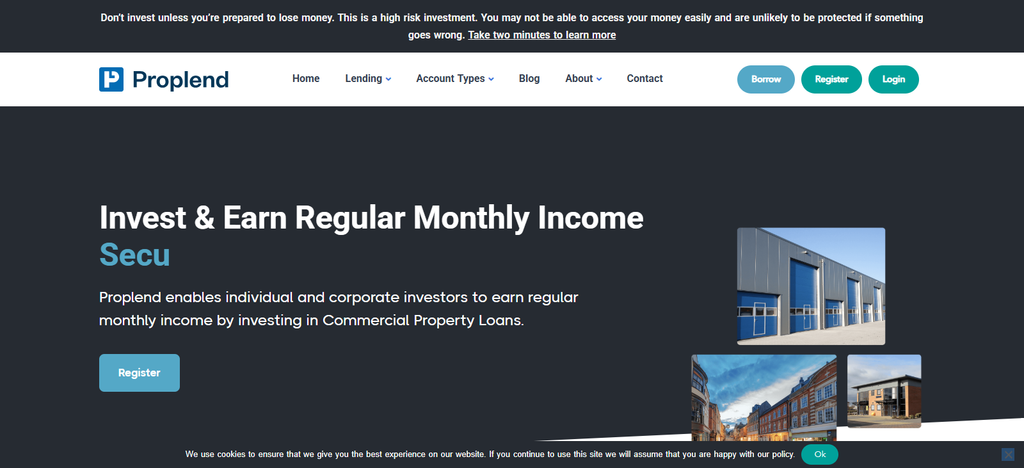
Proplend’s model is based on interest-bearing secured property loans not a single quoted portfolio rate and returns vary depending on the particular loan. The platform links investors directly to the borrowers on a loan by loan basis.
The duration of the loans varies depending on the property and the borrower. Borrowers are usually owners of commercial property or businesses using an income-producing property as collateral. Investors pay a 10% Lender Fee on the interest they actually receive, which reduces the net returns for investors.
Main Features
- Commercial Property Lending – links investors with those looking to finance UK commercial property.
- Type of Loans Offered: Offers term loans, bridging loans and short-term VAT loans to qualifying borrowers.
- Property-Backed Investments: Enables loans backed by commercial property.
- Monthly Interest Payments: Make monthly interest payments in accordance with the terms of individual loan agreements.
- Interest Reserve: Maintains an interest reserve equal to no less than three months of interest payments on eligible loans.
Security and Risk Management
- First Legal Charge: The term and bridging loans are usually secured by a first legal charge on the secured property.
- Further Guarantees: Borrowers can offer personal guaranties and corporate debentures as further security.
- Property Valuation Risk: Declining commercial property values can lead to lower recoveries in the event of a default.
- Default and Recovery Risk: Delay or reduction in repayment of investors due to receiver appointments and costs of enforcement and sale of properties.
8. CapitalStackers
CapitalStackers is a UK property-finance crowdfunding platform that allows investors to invest in structured property-development loans, usually with different risk-and-return layers. It concentrates on financing property development and provides investors with different levels of risk positions.

The minimum investment is £500, however £2,500 applies in the Primary Market. The advertized rates of return range from about 5% to over 20% depending on the level of risk the investor is prepared to take. Investors get a fixed rate because loan terms are fixed for the life of the loan.
The borrowers are property developers who want development finance. Investors pay no platform fee. CapitalStackers receives a margin fee and, where applicable, an exit fee from the borrower after payment to investors.
Main features
- Property Development Finance: Links investors with professional property developers who require more funding for their projects.
- Senior Lender Partnerships: Partners with banks and other senior lenders to fill property development funding gaps.
- Invest in Individual Projects: Allows investors to invest in individual property development transactions.
- Loan-to-Value Assessment: Evaluates development financing options using loan-to-value and loan-to-cost metrics.
- Investment Transparency: Provides information on specific deals to help investors evaluate project structure, financing and potential returns.
Risk & Security
- Security of Property: The investments are backed by property-related lending and the security arrangements disclosed for each transaction.
- Development Cost Risk: Increases in construction costs and project delays can impact the developer’s repayment capacity.
- Risk of Property Valuation: Declining property values can reduce the financial safety net for investors.
- Capital Loss Risk: Financial losses can arise from borrower default, insufficient recovery proceeds, and lengthy project completion.
9. Maclear
Maclear is a crowdlending platform, licensed by the Swiss Financial Market Supervisory Authority, launched in 2020, to connect private investors with European SMEs looking for finance. Investment type: peer to business crowdlending. Fixed monthly income and collateral protection are touted as part of its model.
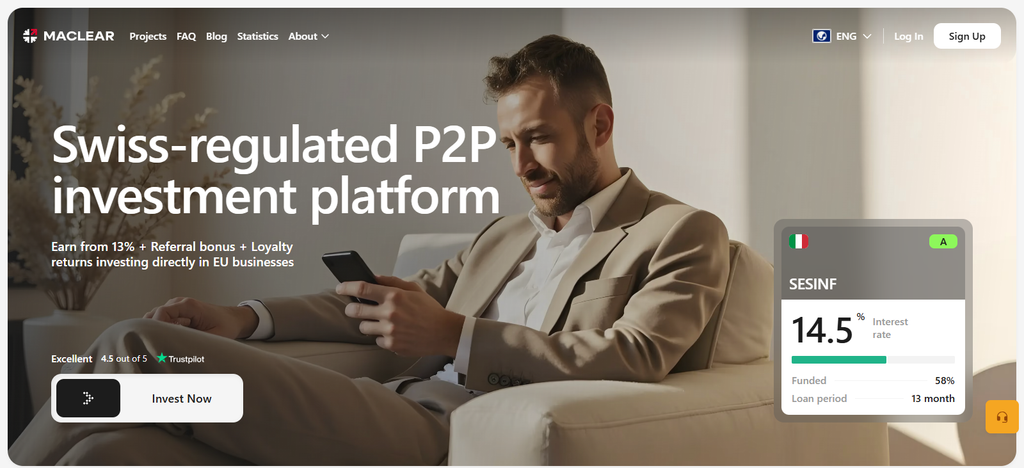
The minimum investment is €50, which makes it one of the more accessible platforms on this list. Maclear offers fixed annual returns of up to 16.5% but actual results depend on the performance and defaults of its borrowers.
The platform stresses that business loans will bring regular monthly income. Loan terms are not stated consistently in the available material. The borrowers are vetted European SMEs. No commissions, no hidden investment fees for investors – Maclear’s commission is baked into the borrower’s rate.
Highlight Features
- Focus on Small Business Lending: Focuses on lending to small and medium-sized enterprises.
- Business Loan Investments: Offers an investment model through participation in business financing opportunities.
- Diversifying investments: Investors need to look for opportunities with different borrowers and financing projects.
- Return on loans: The return for investors is based on the interest and repayment terms of the individual loan agreements.
- Access to digital investments: Online platform to review investment opportunities and manage your investment activity.
Risk & Security
- Collateral Verification: Investors should verify the legal ownership, valuation, and enforceability of any collateral offered.
- Risk of Default by Borrower: Financial difficulties of the business may delay repayments or result in investment losses.
- Platform and Jurisdiction Risk: It is the investor’s responsibility to independently verify the operating entity, the relevant regulator and the legal jurisdiction.
- Liquidity Risk: Early withdrawal or resale may be limited depending on the investment agreement.
10. Capitalia
According to reports, Capitalia is a European SME-focused debt and P2P lending platform, founded in 2007. It connects investors to business borrowers through debt-based crowdfunding and P2P lending opportunities. The minimum to invest is €200. It has a targeted return of 12.24% advertized but this is a target across the platform and not a guarantyd return.

The average loan term is 12 months, which is relatively short compared to several UK property-lending platforms. Borrowers are SMEs looking for debt finance. According to the platform’s overview, Capitalia does not charge investors regular fees.
Characteristics
- Baltic SME Financing: Connects investors to small and medium enterprises in Latvia, Lithuania, Estonia and Finland.
- Investment in Business Loans: Offers opportunities to invest in loans to businesses needing capital.
- Automated Investing: Provides automated investment strategies based on the investor’s preferences and risk needs.
- Selective Investment: Investors can choose particular business loans and determine the amount of investment.
- Portfolio Management: Offers eligible investors portfolio management services and diversification solutions.
Risk & Security
- Credit Risk Evaluation: Assigns risk categories to business loan opportunities based on its internal credit assessment methodology.
- Borrower Default Risk: Companies may encounter financial difficulties and fail to repay loans.
- Loss exposure of portfolio: Loss potential can be increased by concentration in specific risk categories or borrowers.
- Capital Protection Risk: Investments are not guarantyd and investors may lose some or all of their invested capital.
Conclusion
Business lending platforms offer an alternative way for investors to earn interest while helping small businesses, SMEs and property development projects. Different platforms like Honeycomb Credit, SMBX, Folk2Folk, CrowdProperty and Proplend have different investment models, loan structures and security arrangements.
However, investors need to carefully consider the minimum investment amounts, projected returns, repayment terms, platform fees, regulatory compliance and the creditworthiness of the borrowers.
It is also important to understand the risks of collateral protection, default and liquidity restrictions. Ultimately, selecting the right business lending platform involves doing your homework, having realistic expectations of returns and a proper diversification strategy to deal with any potential investment losses.
FAQ
What Are Business Lending Platforms for Investors?
Business lending platforms connect investors with businesses seeking financing. They allow investors to fund business loans, SME financing, or property-backed projects in exchange for potential interest-based returns.
How Do Business Lending Platforms Make Money for Investors?
Investors earn money primarily through interest payments made by borrowers. Returns depend on loan terms, interest rates, repayment schedules, platform fees, and the borrower’s ability to repay.
Are Business Lending Platforms Safe for Investors?
These platforms carry risks, including borrower defaults, liquidity restrictions, and potential capital losses. Investors should evaluate regulatory compliance, borrower creditworthiness, collateral, and platform security before investing.
What Is the Minimum Investment Required?
Minimum investment requirements vary by platform and individual loan offering. Investors should check the specific investment terms and eligibility conditions before committing funds.
Can Investors Lose Money Through Business Lending Platforms?
Yes. Investors can lose some or all of their invested capital if borrowers default, collateral recovery proves insufficient, or businesses experience financial difficulties.