Discovering the Best Small Business Investment Platforms can empower investors to explore avenues beyond stocks and bonds. These platforms offer diverse ways to be part of business growth, from supporting local businesses to investing in promising startups via equity, debt and crowdfunding models.
But to pick the right option, you need to understand the investment requirements, fees, potential returns and financial risks. In this article, I will talk about the 10 best small business investment platforms and their key features, benefits and important factors to consider before investing.
What Are Small Business Investment Platforms?
Small Business Investment Platforms are online services that match investors with small businesses, startups and growing private companies that are looking for funding. These platforms allow people to invest via different models, such as equity crowdfunding, debt financing and business bonds.
Investors can browse business opportunities, read investment terms, compare potential profits and choose companies to invest in based on their financial objectives and risk profile. They also provide small businesses with access to capital from a wider range of investors, rather than just traditional bank loans.
How to Choose the Best Small Business Investment Platform?
Investment Model: Select a platform that provides appropriate investment types such as equity crowdfunding, debt financing, or business bonds according to your financial objectives and preferred investment structure.
Minimum Investment: Check minimum investment requirements on different platforms to ensure their opportunities fit your available budget without putting undue pressure on your financial resources.
Platform Fees: Look at fees for investors, transaction fees, and other expenses to understand how costs will impact your potential returns and overall investment profitability before you put your money in.
Investment Opportunities: Think about the types of businesses offered, such as startups, local businesses, technology companies, and established small businesses, to identify opportunities that align with your investment interests.
Risk & Security: Evaluate the level of protection and financial uncertainty by analyzing business disclosures, regulatory compliance, investment structures, and potential risks of losing capital.
Potential Returns: This includes interest rates, dividend prospects, profit-sharing plans, and possible stock growth. Remember that expected returns are never a sure thing.
Liquidity and Exit Options: Before you invest, make sure you understand the holding periods, maturity dates and any exit restrictions. Also check to see if there are any opportunities to transfer, resell or redeem your investments.
Who May Invest: Check residency requirements, accreditation rules, age limits and applicable investment rules to ensure your eligibility for the offerings available on the platform.
Key Points Comparison Table
| Platform | Key Features |
|---|---|
| 1. Wefunder | Startup and small-business investments, community funding, multiple investment opportunities |
| 2. Honeycomb Credit | Small-business loans, fixed-interest opportunities, community-focused financing |
| 3. StartEngine | Startup investments, Regulation Crowdfunding, diverse private-company offerings |
| 4. Republic | Curated investment opportunities, private startups, technology-focused businesses |
| 5. Netcapital | Online fundraising, private-company securities, startup investment opportunities |
| 6. MicroVentures | Startup funding, private placements, early-stage investment opportunities |
| 7. DealMaker | Online securities offerings, digital fundraising infrastructure, investor management |
| 8. PicMii Crowdfunding | Small-business fundraising, securities offerings, online investment access |
| 9. SMBX | Small-business bonds, debt-based investing, business financing |
| 10. Climatize | Climate-focused projects, clean-energy investments, renewable-energy financing |
1. Wefunder
Wefunder is a U.S. based crowdfunding platform that allows everyday investors to invest in startups, small businesses and community projects through equity, convertible notes, revenue-share agreements and other securities. Its main investment model is Regulation Crowdfunding, but some deals are limited to accredited investors.
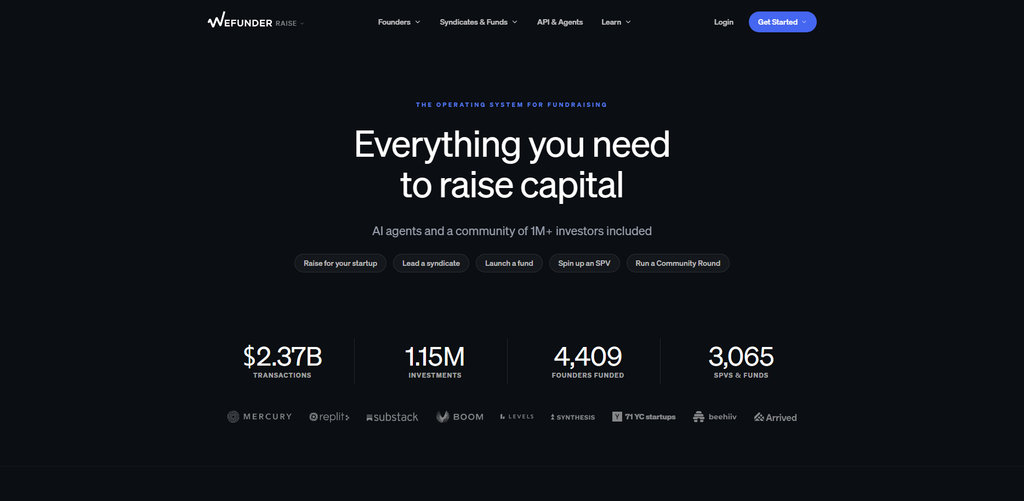
Each company sets its own minimums, which can be low. Reg CF limits for non-accredited investors are based on annual income or net worth; accredited investors generally do not have a Reg CF limit. Startup equity is risky and illiquid, so there’s a wide range of expected returns. Wefunder fees differ by offering and investors should read the terms of each deal.
Safety & Risk
- Investing in startups carries a high risk of loss and may result in partial or total loss of your capital invested.
- Private company shares have poor liquidity and resale opportunities.
- Business performance is driven by management, revenue growth and market conditions.
- Terms of investment, ownership rights and financial disclosures vary per offering.
- Investors should read company disclosures and understand the risks before they commit funds.
Best For
- Investors looking for early stage startups and emerging businesses.- Individuals looking for equity crowdfunding options.
- Investors who can live with illiquidity in the long run.
- people who want to support companies they believe in.
2. Honeycomb Credit
Honeycomb Credit is a community-investment marketplace that connects investors with local small businesses and, in some cases, climate or renewable energy projects. It invests mainly in fixed term debt, so investors lend money and get regular interest payments, rather than buying equity in start-ups.
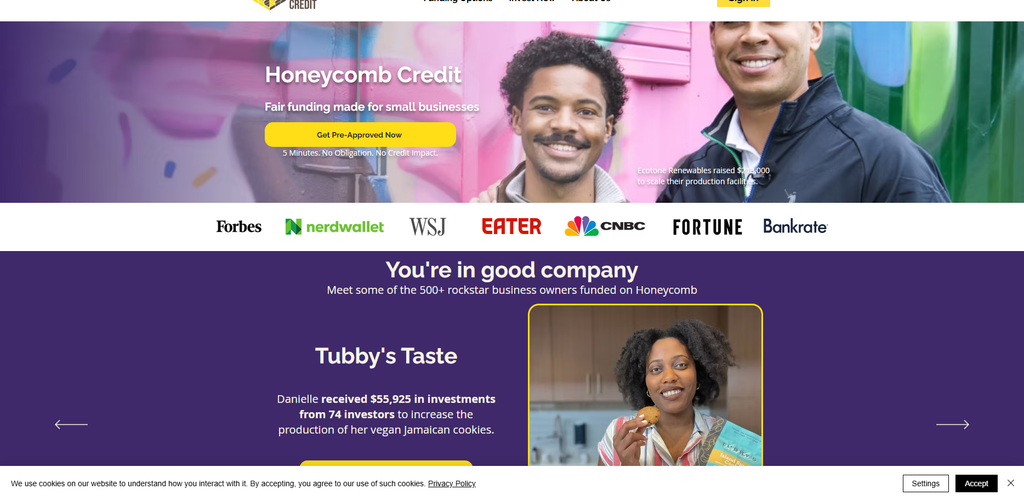
Investors can begin with $100 and potentially earn up to 15.25% on investments, although the platform notes that actual returns, maturity, and default risk will vary by loan. Investors must be 18 years old or older, a U.S. citizen or resident, have a Social Security number or tax ID and be willing to take on credit risk. Honeycomb’s main fees to businesses are a posting fee and a loan-origination fee.
Risk & Security Management
- Loans to small businesses come with risks of borrower default and repayment.
- The interest and principal payments depend on the business’s financial results.
- It may not be easy to sell investments before maturity.
- Loan terms, repayment schedules and security arrangements will vary per offering.
- Investors need to pay close attention to borrower financial information and repayment terms.
Best For
- Investors interested in supporting local businesses.
- Those researching debt-based crowdfunding.
- Business investment opportunities with fixed interest for investors.
- those interested in community-based business financing.
3. StartEngine
StartEngine is a major U.S. equity crowdfunding marketplace for startup, real estate and select pre-IPO investment opportunities. It uses Regulation Crowdfunding for a lot of public offerings, and Regulation A+ or accredited-only offerings for the balance. Most startup investments begin in the $100 to $500 range.
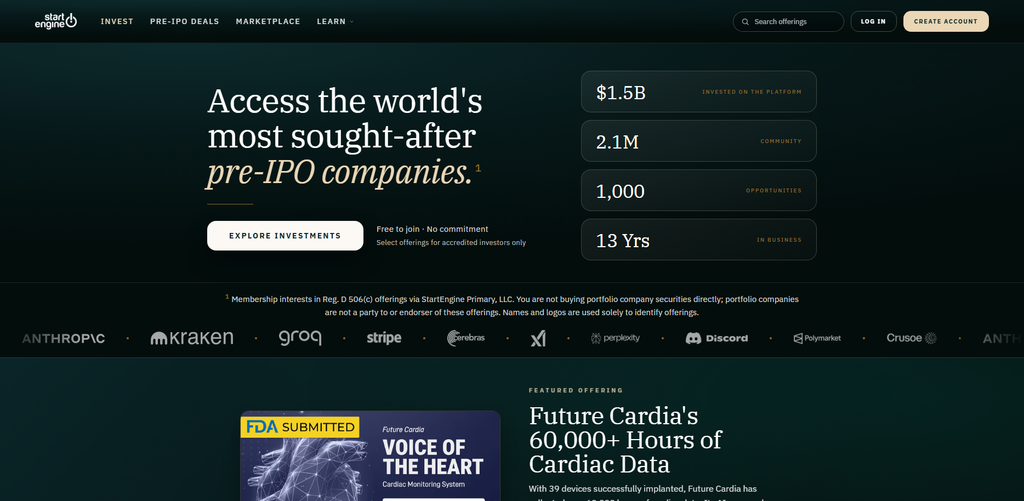
But pre-IPO deals usually require $15,000 or more. Investors may pay a 3.5% processing fee on some transactions, and secondary-market trades may have fees for buyers and sellers. Most offerings are available to anyone age 18 and older, but some may be limited to accredited investors. Returns are uncertain as early-stage companies can fail and shares are typically illiquid.
Safety & Risk
- If you invest in a startup, there is a risk that you may lose your entire investment.
- Illiquidity and Limited Resale Private-company securities may be illiquid .
- The valuation of businesses may not reflect future business performance.
- Security and investor rights vary with each individual offering.
- Investors must refer to financial disclosures, offering documents and applicable investment restrictions.
Great For
- Investors considering startup equity crowdfunding.
- Individuals looking for new consumer brands and technology companies.
- Investors who want to access offerings from private companies.
- Investors with a long-term horizon.
4. Republic
Republic is a general purpose investment platform for startups, real estate, crypto-related ventures, funds, and other private market offerings. It provides Regulation Crowdfunding offerings to non-accredited investors and Regulation D deals to accredited investors. Minimums vary by deal and can start at around $100 to $150, while some accredited-only deals require $5,000 or more.
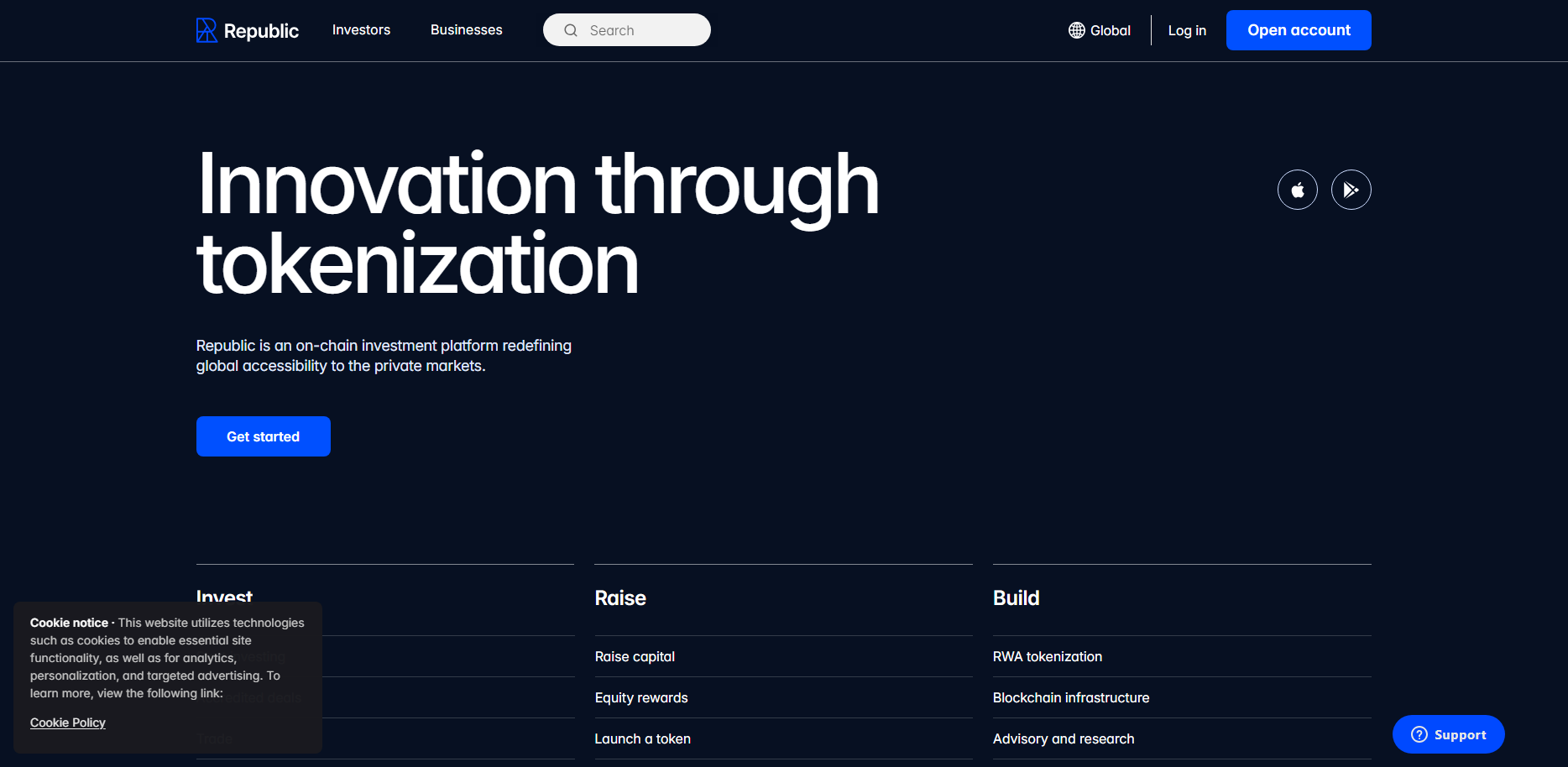
Republic typically charges investors an administrative fee, generally 2.5% with a $5 minimum and $250 cap, but there are deal-specific terms. The return is entirely dependent on the underlying company or asset and many investments are long term and illiquid and may result in a total loss. You must be 18+ to invest. Eligibility rules vary by offering and your country of residence.
Risk & Security
- Investments at this stage are exposed to a high risk of business failure and loss of capital.
- Illiquidity. Private securities can be illiquid for long periods of time.
- The investment structures and shareholder rights vary from opportunity to opportunity.
- Some investment options have additional requirements to qualify.
- Investors should examine company disclosures, valuations and exit conditions prior to investing.
TOP CHOICE FOR
- investors looking for private start-ups and emerging companies.
- Investors with an interest in technology and innovation.
- Access to a wide range of private market opportunities for investors.
- Those comfortable with higher risk investment opportunities.
5. Netcapital “
Netcapital is an online investment platform that focuses on early-stage startups, providing retail investors exposure to Regulation Crowdfunding offerings. Its model usually involves the purchase of equity or securities in a company’s future value, though the terms vary by campaign. The minimum investment is as little as $99 which is pretty easy for new investors.
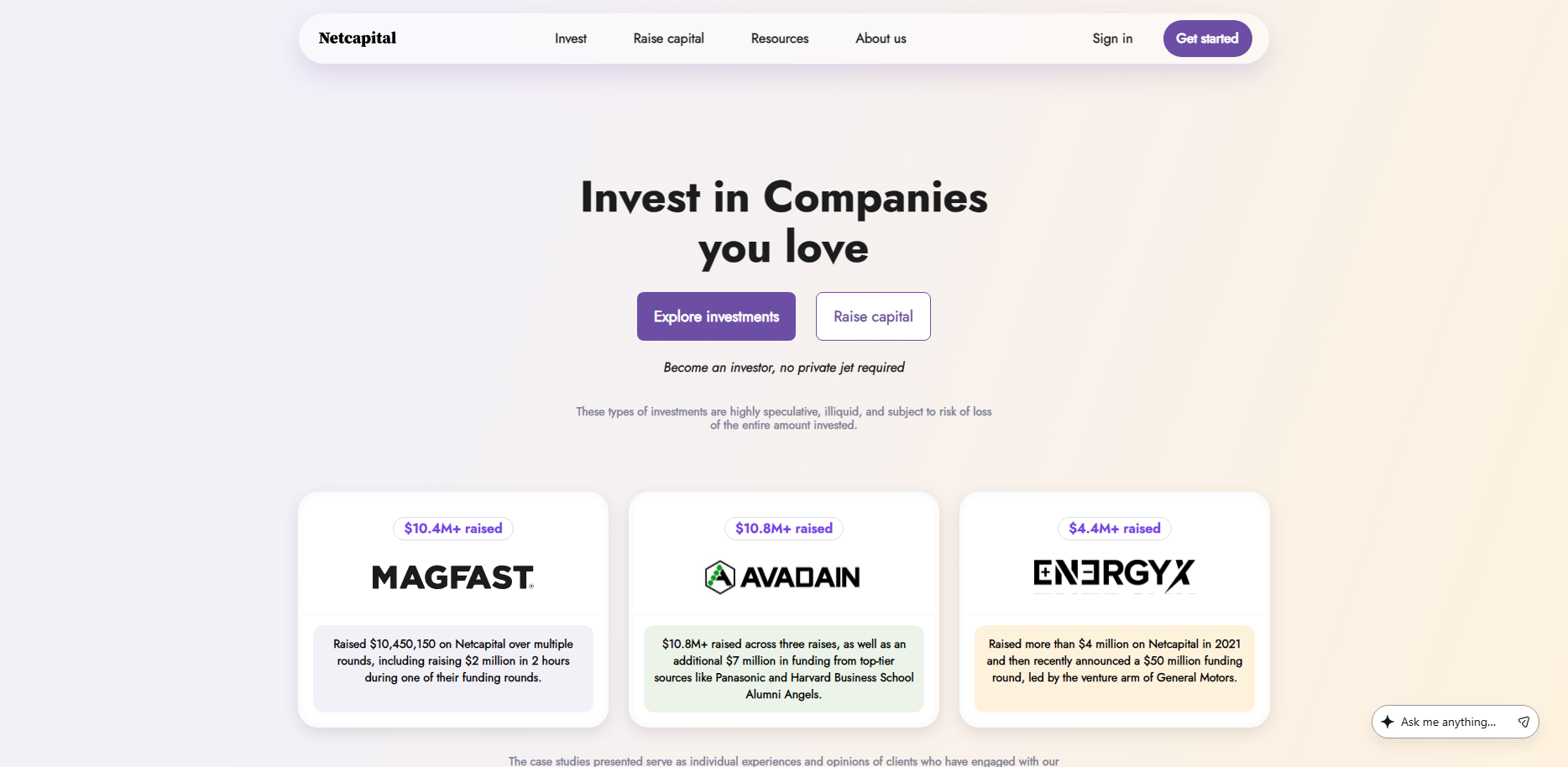
Federal Reg CF investment limits for non-accredited investors are based on income and net worth. Accredited investors can have broader access, depending on the deal. Startups may never exit or pay dividends, so the returns are very uncertain. Investors should review the valuation, dilution, fees and lock-up provisions carefully before investing.
Risk & Security
- Startup equity investments can lose some or all of their value.
- The private securities may not be liquid and may be difficult to resell.
- Business growth is driven by market demand and company execution.
- The investment terms and ownership rights differ for each offering.
- Investors should review company disclosures, financials and offering terms.
Ideal Fo
- Interested investors in emerging private companies.- Individuals looking for equity crowdfunding opportunities.
- Investors who want to get exposure to startup investment offerings.
- People comfortable with long-term private investments.
6. MicroVentures
MicroVentures is a platform for venture capital, private equity, startups and select secondary market opportunities. It has Regulation Crowdfunding offerings that non-accredited investors can invest in, and Regulation D and late-stage offerings that are typically restricted to accredited investors. Minimums for Reg CF are often around $100, while Reg D offerings typically start at $3,000 and secondary or late stage deals might start at $10,000.
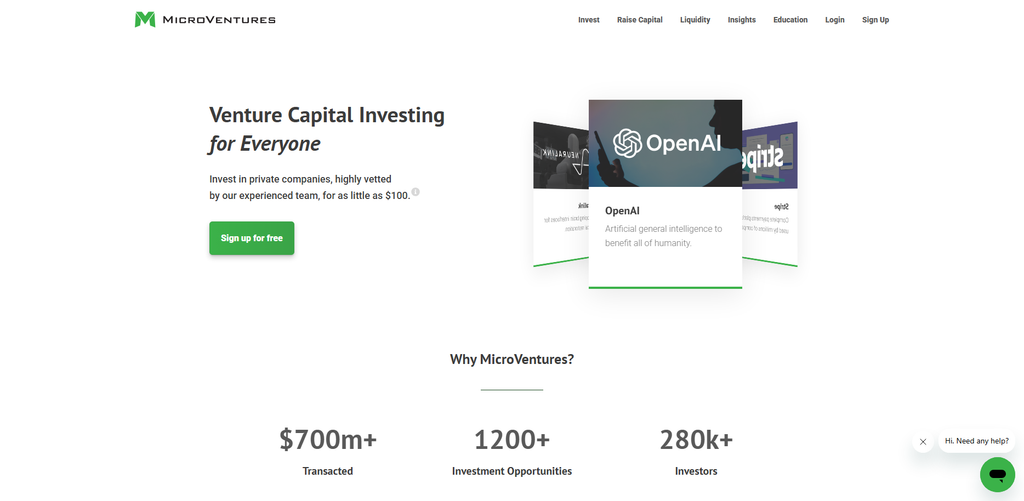
Returns are driven by the performance of the portfolio companies, their exit or dividends. It can take years for a startup investment to show a return—or it may never return at all. In most cases non-U.S. residents are eligible for MicroVentures, but may be limited by local securities laws or the eligibility rules of a specific offering.
Security & Risk
- Private company and early stage investments are risky. Money-wise.
- Some private securities may have limited resale or transferability.
- Past company valuations and future results are no guaranty.
- Some investment opportunities may require accredited investor status.
- Investors must read offering documents, company performance and eligibility criteria.
Best suited for
- Investors who are interested in startups and private companies.
- Private market opportunities for qualified investors.
- People who want to invest early.
Investors are comfortable with higher risk long-term investments.
7. Deal Maker
DealMaker is a capital-markets technology platform that enables online securities offerings for companies, including Regulation Crowdfunding, Regulation A+ and private placements. Investors may access equity, debt, funds, real estate and other private market deals, but opportunities and terms differ across issuers. Each offering has a minimum dollar amount and minimum number of shares.

Non-accredited investors can invest under Reg CF, but there are limits on annual income and net worth. Some offerings are limited to accredited investors. DealMaker says Reg CF deals include an 8.5% fee to cover processing and broker-dealer costs, but investors should check whether the issuer or the investor pays the fee. Returns based on underlying security.
Risk and Security
- Securities offered by individual campaigns are subject to loss of capital.
- Private company investments may have limited resale and exit opportunities.
- Investment risk is influenced by the financial condition and business model of the issuer.
- The offerings have different terms for investor rights and security.
- Investors should read the offering documents, regulatory disclosures and the terms of the transaction.
Best For
- Investors interested in on-line securities offerings.
- Individuals reviewing private company fundraising campaigns.
- Investors who want to get exposure to different business investment opportunities.
- Individuals who are comfortable evaluating individual securities offerings. ## **9. PicMii Crowdfunding
8. PicMii Crowdfunding
PicMii Crowdfunding is a FINRA/SEC Registered Funding Portal that facilitates Regulation Crowdfunding offerings for startups and small businesses. Depending on the campaign, investors may receive equity, convertible securities or other investment instruments. PicMii aims to keep minimum investments low, often between $100 and $500, but minimums may change depending on the offering.
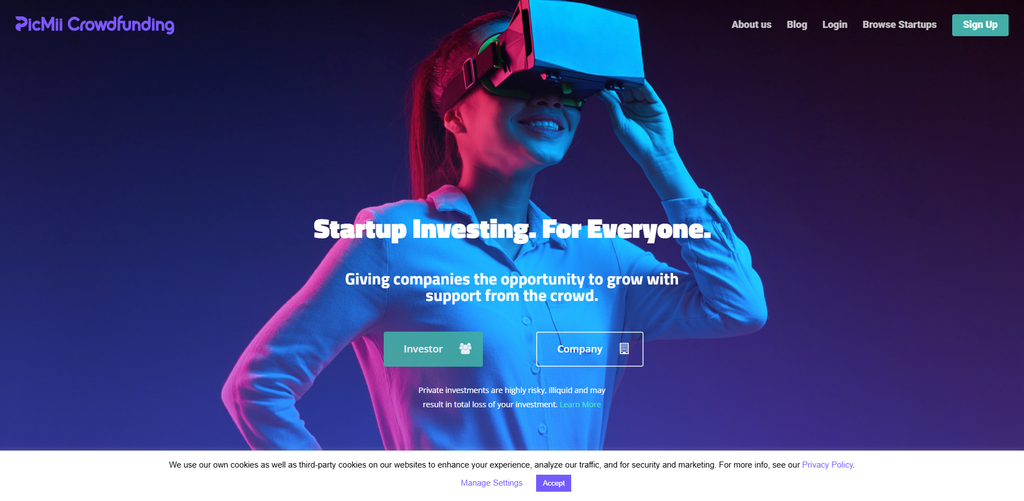
Both non-accredited and accredited investors can invest in Reg CF deals, but are subject to annual limits. The platform charges an upfront fee and takes a percentage of funds raised. In one example of a Form C , 3.50% of securities sold. Issuers pay certain transaction and escrow fees. There is no guaranty of a return, which is contingent upon the success of each company.
Risk and Security
- There is a great risk of losing your capital when you start a new business.
- Shares of private companies may be hard to trade.
- Business performance is influenced by management and market conditions.
- Investment terms and ownership rights will differ from campaign to campaign.
- Investors are encouraged to read company disclosures and offering documents prior to investing.
Best For:
- Investors interested in investing in small business equity crowdfunding.
- Investors interested in emerging companies.
- Investors seeking opportunities via online fundraising campaigns.
- People comfortable with the risks of investing in private companies.
9. SMBX
SMBX is the Small Business Bonds Marketplace where investors can purchase bonds from small businesses. Its investment model is debt-based: investors receive contractual interest payments and repayment of principal according to the bond’s terms, not ownership of company equity.
With a minimum investment of just $10, it’s one of the most accessible platforms out there. SMBX says it’s free to invest through a linked bank account, but credit-card investments carry a 4% processing fee.
Businesses pay a service fee on successful raises. Investors must be 18 or older, have a U.S. address, bank account, government-issued photo ID and U.S. SSN or ITIN to be eligible; no accreditation required. Returns are a function of the bond coupon and risk of repayment.
Security & Risk
- Small-business bonds have the risk of default, or the borrower not making the payment.
- Investors can lose some or all of their investment.
- Resale opportunities may be restricted for bond investments.
- The repayment is subject to the issuing business meeting its financial obligations.
- Investors should review the bond’s terms, repayment schedule and the issuer’s financial disclosures.
Best For
- Investors in small business bonds
- People looking for investment opportunities related to debt
- Investors wanting to invest in local business financing.
- Those who like to know the repayment terms in advance before investing.
10. Climatize
Climatize is a climate-finance platform that connects investors to renewable-energy and sustainability projects such as solar installations and energy-efficiency initiatives. Usually , its investment model is debt on a project basis or structured financing . Investors invest in a project and receive a return on their investment through interest or scheduled repayments rather than startup equity .

Different projects will have different minimum investments, expected returns, loan length and risk, so investors should look at each offering’s term sheet and disclosures. The platform is looking to bring climate investing to the retail investor, but projects can also be exposed to construction risk, technology risk, borrower and repayment risk. Before investing, investors should check eligibility, jurisdictional restrictions, fees and whether returns are fixed or projected.
Risk and Security
- Clean energy projects carry construction, operating, and financial risks.
- Delays in projects could impact the expected repayment timelines.
- There is a risk of partial or total loss of capital due to borrower default.
- Investments may be illiquid and there may be limited exit opportunities.
- Investors should review project disclosures, financing arrangements and payment terms.
Ideal For
- Investors eyeing renewable energy projects
- Individuals seeking investment opportunities in the climate.
- Investors who want to gain exposure to clean-energy financing.
- People who want to invest their money and do some good for the environment at the same time.
Conclusion
The best small business investment platforms provide investors with the opportunity to invest in startups, local businesses, and private companies in growth through equity, debt, and crowdfunding models. Wefunder, Honeycomb Credit, StartEngine, Republic, and SMBX are just a few platforms that offer different investment approaches to suit different financial objectives.
Before you invest, compare minimum investments and fees, potential returns, and who can invest and liquidity options. It is as important to understand business performance, regulatory compliance and investment risks. Ultimately, the best platform for you will depend on your budget, risk tolerance, investment preferences and long-term financial objectives.
What are the best small business investment platforms?
Some popular small business investment platforms include Wefunder, Honeycomb Credit, StartEngine, Republic, Netcapital, MicroVentures, DealMaker, PicMii Crowdfunding, SMBX, and Climatize.
How do small business investment platforms work?
These platforms connect businesses seeking funding with investors. Individuals can invest through equity crowdfunding, debt financing, or business bonds, depending on the available offerings.
Can beginners invest through small business investment platforms?
Yes, some platforms accept non-accredited investors and offer accessible investment opportunities. However, beginners should understand investment terms, financial risks, and eligibility requirements before participating.
What types of investments do these platforms offer?
Common investment options include startup equity, small-business loans, business bonds, private-company securities, and renewable-energy project financing.
Are small business investment platforms safe?
These platforms may operate under applicable securities regulations, but investments are not risk-free. Business failure, borrower defaults, and capital losses remain possible.