
Demand for climate tech is increasing as businesses and governments seek to cut carbon emissions and build a sustainable future. Investment funds in climate technology invest in cutting-edge companies in renewable energy, battery storage, carbon capture, electric mobility and industrial decarbonization. In this article I will discuss the Best Climate Technology Investment Funds for 2026 including their investment strategies, technology focus, key differentiators and major opportunities for investors.
Why Invest in Climate Technology Investment Funds?
Growing Market for Climate Technology : Climate technology funds offer exposure to industries that are growing as a consequence of their focus on renewable energy , carbon reduction , energy storage and other sustainable technologies to fight global environmental issues .
Opportunities in Renewable Energy: The money goes to companies working on solar, wind, geothermal and other clean energy technologies, creating investment opportunities as global demand for renewable electricity continues to grow.
Carbon Emission Reduction: Investing in climate funds means backing companies that are building technologies for carbon capture, carbon removal and industrial decarbonization – all of which help reduce greenhouse gas emissions.
Advanced Technology Innovation: Climate investment funds give investors the opportunity to invest in innovative startups that are developing advanced batteries, green hydrogen, smart grids, and artificial intelligence solutions for energy efficiency.
Portfolio Diversification: These funds cover various sectors such as clean transportation, sustainable agriculture, energy infrastructure, and industrial technology, offering investors an opportunity to diversify their climate-related investment options.
Long-Term Growth Potential: Climate technology companies can capitalize on increasing demand for sustainability, infrastructure development, technological advancements, and government support, presenting potential long-term business and investment opportunities.
Institutional and Corporate Support: Increased participation from governments, corporations, and institutional investors can bolster climate technology ecosystems and facilitate the commercialization of innovative environmental solutions.
Positive Environmental Impact: Investing in climate technology allows investors to support companies developing real-world solutions for clean energy, emissions reductions, resource efficiency and sustainable economic development.
Key Technologies Supported by Climate Investment Funds
Renewable Energy Technology: Climate investment funds support solar, wind, geothermal, and hydropower technologies that produce clean electricity, reduce reliance on fossil fuels, and speed up the global transition to sustainable energy systems.
Battery & Energy Storage: These include investments in advanced battery technologies, long-duration storage systems and grid-scale energy solutions that enhance the reliability of renewable electricity, energy distribution and the overall efficiency of the power system.
Carbon Capture and Removal: Investment supports technologies that capture and store carbon, including direct air capture and industrial carbon capture, to remove carbon dioxide from the atmosphere and reduce emissions from hard-to-decarbonize industries.
Electric Vehicles and Mobility: Climate-focused funds invest in electric vehicles, charging infrastructure, battery innovation, and sustainable transportation technologies that reduce fuel use and help build cleaner mobility systems.
Green Hydrogen and Clean Fuels: The funds are for the production of green hydrogen, electrolyzers, fuel cells and alternative fuels to decarbonize transportation, industrial processes and energy intensive applications.
Industrial Decarbonization: Investment is focused on low-carbon manufacturing, sustainable materials, electrified industrial processes and energy efficient equipment that reduces emissions in steel, cement, chemicals and other industrial sectors.
Sustainable Agriculture Technology: Climate investment funds back precision farming, alternative proteins, methane reduction, agricultural biotechnology, and soil management technologies that improve food production while lowering environmental impact.
Energy Management & Smart Grids: These investments are for smart grid infrastructure, artificial intelligence, energy management software, and demand response systems that improve the distribution of electricity, optimize its use and support the integration of renewable energy.
Key Points
| Investment Fund | Key Point |
|---|---|
| Breakthrough Energy Ventures | Supports breakthrough technologies with significant potential to reduce global greenhouse gas emissions. |
| Energy Impact Partners | Combines investment capital with industry partnerships to accelerate the global energy transition. |
| Lowercarbon Capital | Focuses on technologies that can substantially reduce or remove greenhouse gas emissions. |
| World Fund | Prioritizes European technologies with measurable potential to deliver substantial emissions reductions. |
| Clean Energy Ventures | Invests in scientifically advanced technologies with significant commercial and climate impact potential. |
| Congruent Ventures | Supports innovative companies developing solutions for a more sustainable economy. |
| ArcTern Ventures | Invests in technologies that combine artificial intelligence, industrial innovation, and emissions reduction. |
| Energize Capital | Focuses on software and technology companies accelerating sustainability across essential industries. |
| Prelude Ventures | Backs innovative startups developing technologies with strong climate-change mitigation potential. |
| Transition VC | Supports engineering-led Indian startups building technologies for the country’s energy transition. |
1. Breakthrough Energy Venture
Breakthrough Energy Ventures (BEV) is the venture arm of Breakthrough Energy, a group founded by Bill Gates in 2015 to accelerate the technologies needed for net-zero emissions. It invests globally in science-driven companies across manufacturing, electricity, agriculture, transport and buildings, looking for solutions that could avoid at least 1% of annual global greenhouse gas emissions, or about 0.5 gigatonnes a year.
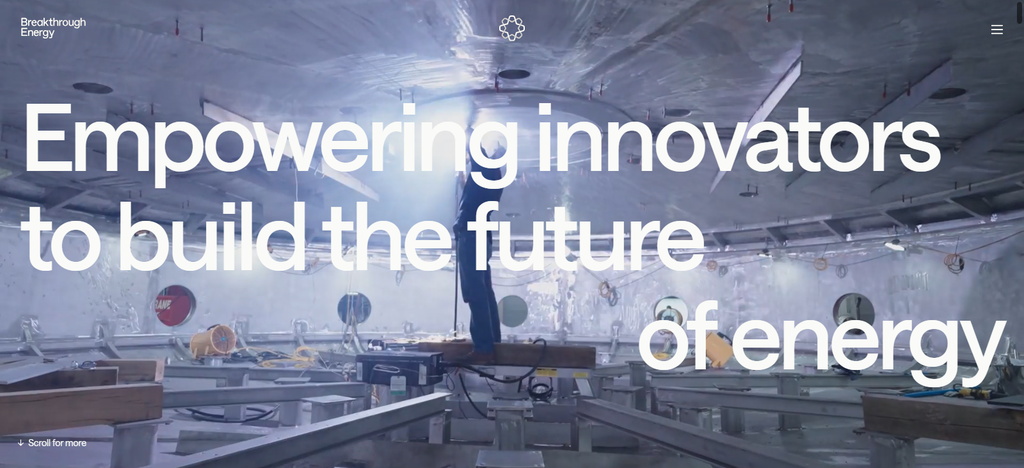
BEV typically invests from seed to growth stage companies, with a preference for breakthrough technologies that are ultimately competitive on cost and performance. It has committed more than $3.5 billion in capital and has supported more than 130 companies. Funding range varies broadly with stage but is typically several hundred thousand dollars in early rounds to $15M+ in later financings.
Tech Focus
- Clean power generation, including advanced solar, wind, geothermal and fusion technologies.
- Long-duration energy storage and next generation battery technologies.
- carbon capture, carbon removal and direct air capture solutions.
- Sustainable agriculture, low emission food systems and methane mitigation technological solutions.
- Industrial Decarbonization, Clean Manufacturing and Low Carbon Transport .
Differentiators
- Focuses on science-driven technologies with the potential to deliver significant reductions in greenhouse gas emissions.
- It invests in five main sectors: electricity, manufacturing, agriculture, transportation and buildings.
- Marries financial investment with technical, entrepreneurial, market and policy expertise.
- Supports breakthrough technologies to make clean alternatives commercially competitive at scale.
2. Energy Impact Partners
Energy Impact Partners (EIP) is a global investment platform that was started in 2015 to focus on the transition to clean energy. It combines venture capital, growth equity, credit and infrastructure strategies and connects startups with utilities, industrial companies and other strategic partners that can speed up commercial adoption.
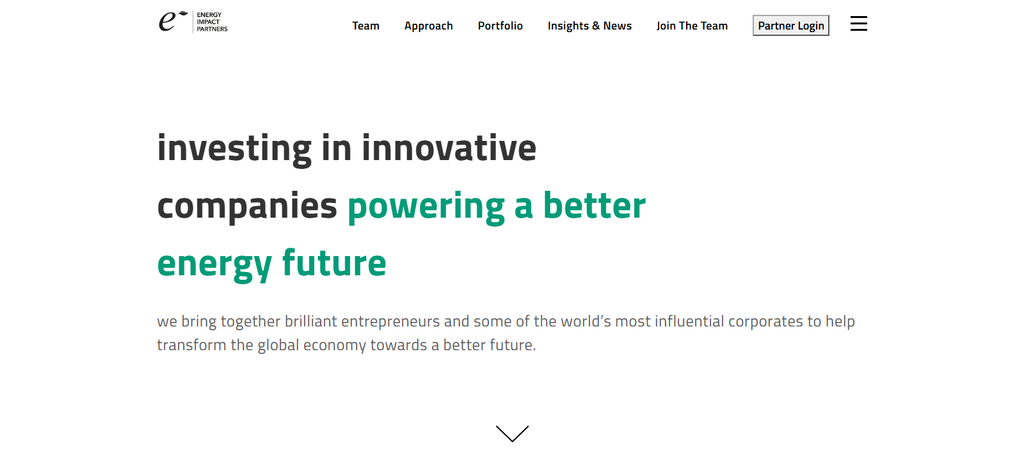
EIP’s main investment focus is North America and Europe, with a strong emphasis on energy software, grid modernization, electrification, storage, industrial decarbonization, and sustainable infrastructure. Its venture-stage investments can be in early or growth companies and its flagship strategies usually target proven technologies at an inflection or growth stage.
The typical first round of checks is often in the $2 million to $10 million range, although larger growth investments are possible. EIP’s differentiated model also emphasizes commercial partnerships and market access in addition to capital.
Technology Focus
- Renewable energy generation and decarbonized electricity supply.
- Energy storage, battery innovation and grid flexibility solutions.
- Intelligent grids, transmission infrastructure and intelligent energy management.
- Electrification technologies for buildings, transport and industrial processes.
- Carbon capture and energy efficiency and industrial emissions cuts.
Key Differentiators
- Investments in venture capital combined with a strategic network of leading energy and industrial companies.
- It is focused on three areas of investment: decarbonized supply, smart infrastructure and sustainable demand.
- Connects portfolio companies with corporate partners for commercial adoption.
- Integrates environmental impact assessment into investment and business development strategies
3. Lowercarbon Capital
Lowercarbon Capital is a climate-focused venture capital firm, founded in 2019 by Chris Sacca, Crystal Sacca and others to fund technologies that cut emissions or remove carbon from the atmosphere. It invests very early, mostly pre-seed, seed and Series A, and is known for large, conviction-led early checks and rapid follow-on support.
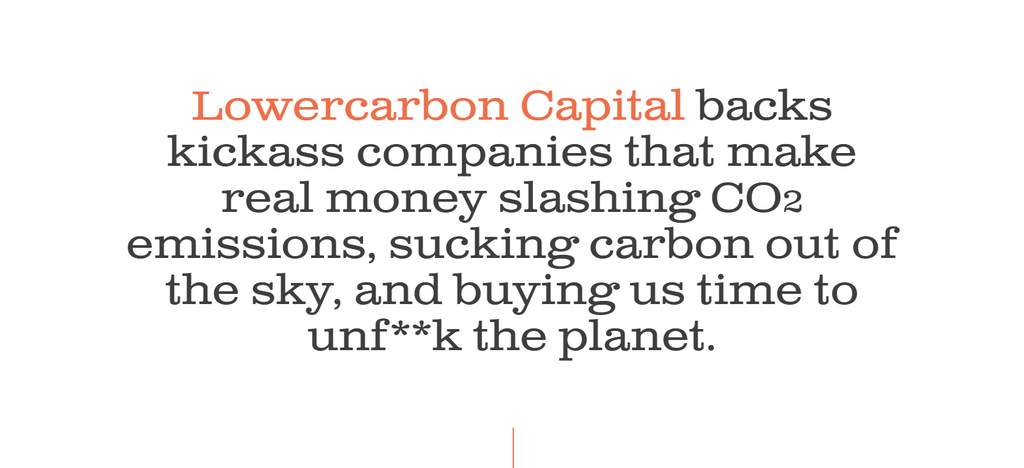
It focuses on technologies including clean power, energy storage, fusion, industrial decarbonization, carbon removal, agriculture, transportation, and climate software. Lowercarbon is headquartered in the United States but invests globally, having backed companies in North America, Europe and elsewhere.
Its funds have raised billions for climate solutions. Initial investments can be on the order of some $500,000 to several million dollars with space for much larger follow-on rounds.
Tech Focus
- Direct Air Capture (DAC): technologies that remove carbon dioxide directly from the air.
- Renewable electricity solutions, such as advanced solar and wind technology.
- Industrial decarbonization via low-carbon materials and sustainable chemical manufacturing.
- Reduction of methane and technologies for preventing new greenhouse gas emissions.
- Cooling technologies and climate intervention aimed at reducing climate-related risks.
Key Differentiators
- Focuses on companies that are directly reducing emissions or removing existing carbon from the atmosphere.
- Supports bold science and engineering innovations with high climate potential.
- Invests across multiple climate sectors, not just renewable electricity
- Combines climate investing with a sharp focus on commercially viable business models
4. WORLD FUND
World Fund is a European climate-tech venture capital firm founded in 2021 by Dario Schöler, Tim Rehder, Danijel Višević and Craig Douglas. It backs companies whose technologies deliver deep, measurable cuts in greenhouse gasses, notably in energy, food and agriculture, industry and manufacturing, transport, and buildings.

World Fund focuses on multi-stage opportunities from Seed to Series B with a heavy focus on deep-tech, engineering-intensive businesses that have the ability to scale globally. Its main geographic focus is Europe, but it will invest outside the region where a company’s climate impact and commercial opportunity justifies this.
The firm’s first fund was €300 million, and the initial investments tend to range from €1 million to €10 million with follow-on investments. Its investment process explicitly focuses on emissions reduction potential.
Technology Focus
- Renewable energy generation technologies supporting clean electricity systems.
- Energy storage and solutions that improve the reliability of renewable energy.
- Industrial decarbonization and low-carbon manufacturing processes.
- Sustainable food production, agriculture technology and resource efficiency.
- Building efficiency, heating, cooling and low carbon construction technologies.
Unique Selling Points
- It focuses on European climate technology companies with high potential for emission reductions.
- Gives preference to technologies that can deliver measurable climate impact.
- Supports startups developing solutions for hard to decarbonize sectors.
- Integrates climate-focused venture capital with a niche approach to investing in climate tech.
5. Clean Energy Ventures
Clean Energy Ventures (CEV) is a climate-tech venture firm founded in 2017 by experienced clean energy investors and operators. It supports companies that are turning proven science into commercially scalable products, with a particular focus on helping engineering-led startups navigate commercialization, manufacturing and market entry.

CEV invests from seed through Series B in North America, Europe and Israel, across grid and storage, fuels and generation, buildings and cooling, industry, carbon and minerals, materials, transportation and climate resilience.
The firm manages $400+ million across two funds and typically makes initial investments of $1 million to $5 million with the ability to invest follow-on capital as portfolio companies scale. The investment thesis rests on the pillars of strong technical differentiation, large addressable markets and credible paths to emissions reduction.
Technology focus
- Modernization of the power grid, electricity transmission and sophisticated storage systems;
- clean fuels, renewable energy generation and alternative energy technologies.
- Technologies for carbon capture, carbon management and critical minerals.
- Sustainable manufacturing and building technologies and low carbon industrial materials.
- Solutions for e-mobility, climate adaptation and resilient infrastructure.
Key Differentiators
- Focuses on technologies that could reduce greenhouse gas emissions at the gigaton scale.
- Invests mainly in Seed, Series A and Series B companies.
- Assesses scientific feasibility, advantages of proprietary technology and commercial market potential.
- Technical due diligence with focus on experienced entrepreneurial teams.;
6. Congruent Ventures
Founded in 2017 by Joshua Posamentier and Abe Yokell, Congruent Ventures is a climate and sustainability venture firm. Headquartered in San Francisco, it primarily backs North American founders from seed to Series A, frequently serving as the first institutional investor.

Matching back atoms, bits and business models – hardware, software and novel commercial models – across mobility and urbanization, energy transition, food and agriculture, and sustainable production and consumption.
Its Fund III closed in 2023, with $275 million of capital to support early-stage companies from inception through to scaling. Typical first checks range from around $500,000 to $3 million, with follow-on reserves for breakout companies. The firm’s focus is on founder quality, technical feasibility, market timing and potential for venture-scale returns, plus climate impact.
Technological-focus
- Clean energy generation, renewable power and distributed energy solutions.
- Energy storage technologies; grid infrastructure and electricity management.
- Sustainable transport, electric mobility and electrification of vehicles.
- Agricultural technology, sustainable food systems and resource efficiency.
- Industrial decarbonization, advanced materials, circular economy solutions.
What Makes Us Different
- Focuses on early-stage climate technology and sustainability investments.
- Assists entrepreneurs in developing solutions in various climate-related industries.
- Brings together climate investment expertise with startup support.
- Targets technologies that solve important environmental and economic problems.
7. ArcTern Ventures
Founded in 2012, ArcTern Ventures is a Toronto-based venture firm focused on climate-tech with offices in San Francisco and Oslo. It invests in companies developing what it calls “sustainable intelligence”: clean electrons for energy supply, clean bits for efficient computing and AI, and clean atoms for industrial decarbonization.

ArcTern is focused on early-growth companies in North America and Europe that are raising Series A or Series B rounds of financing. The fund is focused on technologies that can deliver significant lifetime greenhouse-gas abatement.
Its Fund III closed in 2024 with approximately $335 million, taking the firm’s total committed capital to over $500 million. The initial investment is typically between $2 million and $10 million with reserves set aside for follow-on financing. The firm combines climate impact underwriting with commercial scaling support for energy, compute and heavy industry.
Technology Focus
- Renewable Energy, Clean Power Generation and Smart Energy Systems.
- Advanced electricity management solutions, grid software, and energy storage.
- Energy-efficient computing, semiconductor technology and high-performance cooling systems.
- AI in the physical world: AI in robotics and manufacturing
- Sustainable materials, infrastructure monitoring and industrial decarbonization.
Major Differentiators
- Adopts a sustainable intelligence investment strategy linking climate technology and AI.
- Based on three pillars: Clean Energy, Clean Computing and Clean Industry.
- Supports technologies that improve energy efficiency and cut industrial emissions.
- Merges digital ingenuity with solutions for carbon-intensive industries
8. Energize Capital
Energize Capital, formerly known as Energize Ventures, is a Chicago-based multi-stage investor that was launched in 2016 with founding support from Invenergy. It invests in asset-light, software-enabled technologies that make energy and industrial systems more affordable, reliable, secure and sustainable.

Its Ventures strategy invests in early-stage digital solutions; its Endurance strategy invests in later-stage private companies. Sectors include energy software, grid technology, industrial digitization, construction, cybersecurity and climate-related enterprise software.
Energize is primarily a North American and European investor, investing in companies selling into complex energy and industrial markets. Its Ventures Fund III closed at $430 million in 2025 and typical initial venture investments range from about $1 million to $10 million, with larger growth-stage investments accessible through its broader platform.
Focus on Technology
- Digital technologies for renewable energy and energy transition infrastructure
- Grid software and solutions for grid visibility and electricity interconnection.
- Artificial intelligence in energy and industrial applications.
- Technologies of industrial digitization, automation and operational effectiveness.
- Software for critical infrastructure that supports energy resilience and modernization.
Major Diffs
- Combines strategies for investing in venture capital and private equity.
- Specializes in asset-light software and technology businesses in mission-critical industries.
- Offers operational and commercial assistance via its portfolio services platform.
- Invests across energy transition, industrial digitization and critical infrastructure
9. Prelude Ventures
Gabriel Kra and Ira Ehrenpreis launched Prelude Ventures, a San Francisco-based climate-tech venture firm, in 2013. It invests in early stage companies developing technologies and business models that can materially reduce greenhouse-gas emissions while building durable, venture scale businesses.

Prelude’s target sectors include clean energy generation and storage, transportation, food and agriculture, industrial decarbonization, carbon removal and climate intelligence software. Typically, it invests in pre-seed, seed and Series A rounds, often leading or co-leading a company’s first institutional round and continuing to support strong portfolio companies in later rounds.
Prelude invests principally in North America but considers compelling opportunities worldwide. Initial checks are typically in the $500,000 to $5 million range with meaningful follow-on capacity for companies demonstrating commercial traction and scalable climate impact.
Focus on Technology
- Technologies for carbon capture, removal and long-term sequestration.
- Renewable electricity generation, energy storage and smart grid technologies.
- Sustainable food production, agricultural innovation and food waste management.
- Low carbon manufacturing, advanced materials, and reducing industrial emissions.
- Sustainable transport and low-carbon logistics solutions, including electric mobility.
Unique Selling Points
- Climate-related investment opportunities and environmental innovation only.
- Backs early stage startups developing technology to fight climate change.
- Invests in seven areas including energy, mobility, compute and carbon management.
- Mixes venture investment with founder support to scale emerging climate technologies
10. Transition VC
Transition VC is a climate-technology venture firm that invests in founders building solutions for the global transition to a low carbon economy. Invests in early-stage companies in clean energy, electrification, industrial decarbonization, transportation, built environment, carbon management and enabling digital infrastructure.

The firm typically seeks pre-seed, seed and Series A deals where it can offer capital, strategic advice and access to industry networks as it moves toward commercialization. Transition VC takes a global investment approach, targeting companies with the ability to scale across key decarbonization markets in North America, Europe and Asia.
Its investment approach focuses on technically credible products, large markets, clear unit economics and measurable emissions impact. The initial round is usually in the $500k-$5M range, with the follow-on reserved for those companies that have demonstrated product-market fit.
Technology Focus
- Battery technologies, energy storage and advanced power management systems.
- Electrical mobility, EV components and vehicle electrification.
- Technologies for renewable energy and infrastructure for clean electricity.
- Efficiency, energy and decarbonization of industry and sustainable production.
- Alternative fuels, power electronics and low-carbon industrial solutions.
What Makes Us Different
- Only focuses on India’s energy transition and climate tech ecosystem.
- Provides catalytic capital at the early stages to engineering-led technology companies.
- It invests across mobility, industrial, buildings, renewable technology and energy storage.
- Help companies to develop technologies suitable to India’s energy infrastructure and industrial needs
Conclusion
Climate technology investment funds are important to support innovative businesses developing solutions to global environmental issues. Renewable energy, battery storage, carbon capture, electric mobility, green hydrogen and industrial decarbonization technologies are backed by funds like Breakthrough Energy Ventures, Energy Impact Partners, Lowercarbon Capital, World Fund and other leading investors.
Their investment strategies accelerate technology development, commercialization and sustainable infrastructure. However, investors should consider carefully the investment focus, portfolio, geographical coverage, funding strategy and potential risks of each fund. Investing in the right climate technology investment fund gives you access to emerging innovations and long-term sustainability opportunities.
FAQ
What are climate technology investment funds?
Climate technology investment funds are investment vehicles that provide capital to companies developing technologies focused on renewable energy, carbon reduction, energy storage, sustainable transportation, and environmental protection.
Which are the best climate technology investment funds in 2026?
Some notable climate technology investment funds include Breakthrough Energy Ventures, Energy Impact Partners, Lowercarbon Capital, World Fund, Clean Energy Ventures, Congruent Ventures, ArcTern Ventures, Energize Capital, Prelude Ventures, and Transition VC.
What technologies do climate investment funds support?
These funds support renewable energy, advanced batteries, carbon capture, electric vehicles, green hydrogen, industrial decarbonization, sustainable agriculture, and smart grid technologies.
Why should investors consider climate technology investment funds?
Investors may consider these funds for exposure to emerging technologies, renewable energy opportunities, portfolio diversification, potential long-term growth, and businesses addressing environmental challenges.
How do climate technology investment funds make money?
Venture capital climate funds generally generate returns through equity appreciation, company acquisitions, mergers, and public market listings of portfolio companies.