
I think we are heading into an era where AI intertwines heavily with our lives, alongside new threats. I’ve noticed prompt injection attacks, and how they threaten trust and data and enterprise security. We cannot underestimate the risks that OWASP describes or the popularity prompt injection attacks currently have. Like everyone else, I have a responsibility to mitigate the risks using sophisticated tools. I will do my best to protect our AI and preserve innovation.
What Is AI Prompt Injection Attack?
AI Prompt Injection attacks occur when attackers input malicious commands in various locations of user prompts, external data, or hidden data. These commands are then used to manipulate the AI to either leak sensitive information, elevate privileges, or perform unauthorized actions. OWASP AI Security (2025) has identified prompt injection attacks as the most severe threat to LLM applications, ranking them first.
Prompt injection attacks can be carried out either directly (jailbreaking system prompts) or indirectly (hidden in Web pages, files, or metadata). As the integration of AI technology expands, businesses are now facing the threats of data exfiltration, agent manipulation, and violations of their compliance rules.
Key Factors to Evaluate AI Prompt Injection Defense Tools
Detection Accuracy
Test the ability of the tool to accurately identify direct and indirect prompt injection techniques with low false positive rates. The tool should be able to identify these attempts for multiple LLMs without disrupting enterprise workflow with false positives.

Runtime Authorization
Test the tool to see if it provides runtime controls to prevent unauthorized actions for agents prior to executed instructions, all in line with OWASP AI Security recommendations for enterprise grade tools.
Compliance Alignment
Ensure the tool is compliant with the GDPR, SOC 2, ISO/IEC 27001, and MiCA frameworks to protect enterprise data and ensure readiness for regulation.
Monitoring & Observability
See if the tool provides real time monitoring and detects anomalies and provides audit logs so enterprises can track injection attempts and the behavior of agents in a continuous manner.
Scalability & Performance
Test the tool to ensure it provides enterprise grade throughput to protect thousands of agent interactions and eliminates latency in the process.
Integration Flexibility
Determine if the tool integrates with enterprise SOCs, and IAM systems and with multi-agent systems without disrupting the existing workflow.
Cost vs ROI
Consider the total cost and the benefits such as trustworthy AI agents, reduced breach risk and improved compliance audit efficiency.
Key Points
| Tool | Primary Focus | Key Point |
|---|---|---|
| Kontext | Runtime authorization | Issues scoped credentials to block unauthorized agent actions before execution. |
| Lakera Guard | Prompt injection detection | Real-time detection API with low-latency scanning across multiple LLM providers. |
| Protect AI Guardian | Comprehensive AI security | Combines injection prevention, compliance reporting, and model monitoring. |
| Robust Intelligence | Red-team adversarial testing | Automated frameworks for generating custom attacks and evaluating resilience. |
| CommandSans | Prompt sanitization firewall | Surgical stripping of injection payloads while preserving legitimate content. |
| CausalArmor | Indirect injection defense | Uses causal attribution to block stealthy indirect prompt injections. |
| BrowseSafe | AI browser security | Protects agents from hidden prompt injections embedded in web content/screenshots. |
| Nightvision | Monitoring & analytics | Real-time anomaly detection and performance tracking for deployed LLMs. |
| ASTRIDE | Threat modeling | Systematic identification of agentic AI vulnerabilities via structured frameworks. |
| Microsoft Security Copilot | AI-powered SOC/XDR | Integrates AI-driven detection with enterprise SOC workflows for broader cyber defense. |
1. Context
Kontext is a platform to prevent execution of unauthorized agent actions. As the enterprise AI use cases are increasing by 35% CAGR, OWASP cites the importance of AI security for runtime controls to protect agents. Kontex issues credentials specific to a task for agents, allowing them to perform actions only in the scope of their task, and preventing them from elevating or misusing corporate data.
From an enterprise data security viewpoint, Kontex integrates with corporate IAM, reducing the threat from insider misuse. Also, during red team testing, an evaluation performed showed a drop of unauthorized API calls by 92%. For the security of AI agents, KontextProtect prevents attacks by prompt injection. Organizations using Kontext have reported improvements in their compliance with GDPR and SOC 2, making Kontex an important component of AI security stacks.
Pricing: Enterprise license – $50K to $150K per year depending on the number of agents.
Best For: Enterprises that need runtime authorization to prevent unauthorized actions by agents.
Pros:
- Strong runnertyme authorization prevents unauthorized agent acton.
- Seamless integration with enterprise IAM systems.
- Very successful evaluations (92% decrease in unauthorized calls).
- Follows OWASP AI Security runtime control advice.
Cons:
- High cost of licensing for larger enterprises.
- Difficult deployment requiring IAM skills.
- Little visibility into attempts to evade direct injections.
- May introduce latency in high volumn agent workflows.
2. Lakera Guard
Lakera Guard currently has a lead in prompt injection detection with its real-time scanning APIs. With the increasing AI adoption across industries, OWASP places prompt injection as a top-3 risk. Lakera Guard’s low latency detection lets enterprise agents remain resistant to danger from payloads. For enterprise data protection, Lakera Guard protects sensitive enterprise prompts and stops the leakage of instructions.
In evaluation tests, Lakera Guard has shown an 89% detection rate against a wide range of LLM providers. Lakera Guard prevents both direct and indirect injection attacks, giving confidence to customers about the safety execution of their AI agents. Organizations using Lakera Guard have shown reduction in time of AI-related outages and increased trust in AI-related activities, in compliance with ISO/IEC 27001.
Pricing: API Subscription – $0.002 – $0.01 per request, enterprise packages – $30K – $100K per year
Best For: Companies that need real-time injection detection of prompt injection across multiple LLM providers.
Pros:
- Real time prompt injection detection API.
- High Detection accuracy across multiple LLMs.
- Strong compliance (ISO/IEC 27001).
- Low latency for Production scans.
Cons:
- API costs with usage.
- Focused on injection detection, not runtime control.
3.Requires integration with monitoring tools - May miss sneaky indirect injections.
3. Protect AI Guardian
Protect AI Guardian provides the cornerstone of complete AI security through injection defense, compliance monitoring, and observability. As the OWASP AI Security Consortium anticipates AI adoption reaching a $500B market value by 2026, defense in depth is critical. Guardian incorporates security of the supply chain and ensures the provenance of models along with a guarantee that they will not be altered.

From a data protection standpoint, it enforces audit trails and is aligned with the MiCA and SEC AI regulations. Evaluation data shows a 40% reduction in the time needed for compliance audits. For securing AI agents, Guardian blocks injection payloads and monitors runtime for anomalies. Companies adopting Guardian attest to a significant increase in resilience to adversarial threats and an improvement in their readiness for regulations.
Pricing: Full Stack AI Security Suite – $100K – $250K per year
Best For: Enterprises that need end-to-end AI Security that provides compliance, monitoring, and supply chain security.
Pros:
- Well integrated injection, compliance, monitoring suite.
- Excellent supply chain security and provenance.
- Significantly reduces compliance audit time
- Aligns with MiCA and SEC AI regulations.
Cons:
- High cost for full stack suite.
- Complex deployment.
- May replace existing SOC tools.
- Added overhead in smaller organizations with limited AI adoption
4. Robust Intelligence
Robust Intelligence focuses on adversarial red-team testing of AI systems. As OWASP AI Security Consortium notes, as enterprises become more reliant on autonomous agents due to adoption of AI, adversarial robustness is critical. Robust Intelligence automates the generation of attacks and evaluates the system’s defenses.

From a data protection standpoint, it addresses vulnerabilities before they are exploited, thus reducing the risk for the enterprise. Evaluation data shows 95% coverage of known injection vectors.
For protecting AI agents, Robust Intelligence ensures that agents are immune from all the variants of attack. Enterprise customers report that incorporation of Robust Intelligence has improved their resilience metrics and reduced the risk of breaches. It has become an essential tool in assessing AI deployments.
Pricing: Red Team Automation – $75K -$200K per year
Best For: Companies that need automated adversarial robustness testing.
Pros:
- Adversarial AI components in Automated Red Team testing.
- High coverage of well known injection vectors.
- Improve resilience metrics before deployment.
- Aligns with OWASP adversarial robustness guidance.
Cons:
- Focuses on testing, not runtime defense.
- Requires security teams for interpretation.
- High costs for continous testing.
- May introduce false positives in complex workflows.
5. CommandSans
CommandSans is a prompt sanitization firewall that maintains correctness of prompt and eliminates malicious code. As enterprise chatbots and copilots incorporate AI at an increasing rate, OWASP AI Security indicates sanitization as an essential first-line defense. CommandSans protects enterprise data from injection attacks. Additionally, it maintains the security of sensitive prompts and user data.

Evaluation data shows it succeeds at removing injection threats an average of 87% of the time and maintains system performance. For AI agent security, CommandSans gives a unique layer of defense for safety of instruction execution. Companies that use CommandSans report positive changes in their trust of AI workflows and decreased risks of prompt manipulation.
Pricing: Malicious prompt Sanitization Firewall – $20K -$80K per year
Best For: Enterprises that need prompt sanitization firewalls to remove malicious payloads.
Pros:
- Exceptional prompt sanitization firewall.
- Preserves good content while eliminating bad.
- Lightweight SaaS deployment.
- Increases confidence in AI workflows.
Cons:
- Not optimal for indirect injection attacks.
- Tuning is required to avoid over sanitization.
- Potential for degradation in high throughput systems.
- Narrow focus when compared to full stack alternatives.
6. CausalArmor
CausalArmor has proprietary technology for indirect prompt injection defense that works by employing causal attribution to stash away stealth attacks. As the use of AI in a multi-agent setting increases, OWASP AI Security indicates risks for indirect injections. CausalArmor eliminates the stealth payloads that can be hidden in context or external sources.

From an enterprise data protection standpoint, it assures that agents cannot be manipulated through indirect channels. Evaluation data shows 91% accuracy in attacks of the stealth variety. For AI agent security, CausalArmor provides defensive resilience where other sanitizers fail. Companies deploying CausalArmor report an increased compliance with their enterprise risk management frameworks and a lower exposure to indirect threats.
Pricing: Specialized Defense – $40K – $120K per year
Best For: Companies that need defense for indirect prompt injection in a multi agent environment.
Pros:
- Specialized solution for indirect prompts injection.
- High detection rate of stealth attacks (91%).
- Necessary in multi agent environments.
- Aligned with OWASP indirect injection risk guidance.
Cons:
- niche, thus restricted adoption.
- Higher cost for specialized defense.
- Requires integration of other broader tools.
- Potential to impact agent workflows.
7. BrowseSafe
BrowseSafe shields AI agents from web-based prompt injections, a concern as businesses deploy browsing copilots. OWASP AI Security considers malicious content embedded in web pages a serious issue. BrowseSafe scans and neutralizes hidden injections in HTML, PDFs, and screenshots. Relating to data protection, it stops enterprise agents from executing harmful commands prompted by online prompts.
Evaluation data reflects a 88% success rate against web-based payloads. In the context of AI agent security, BrowseSafe offers a uniquely targeted defense layer for browsing contexts. Enterprises utilizing BrowseSafe have noted a less risky integration of AI agents with external web data and a decreased susceptibility to phishing attacks.
Pricing: Browser Security – $25K -$90K per year
Best For: Enterprises that deploy AI browsing copilots.
Pros:
- Protects agents from web based prompt injections.
- Highly efficient HTML, PDF, screenshot scanner.
- Lowers the exposure to phishing attacks.
- Fast, easy integration into browsers.
Cons:
- Currently only supports browsing.
- May undercount injection attempts that are not web based.
- Frequent updates required to meet evolving web threats.
- Increases latency in browser based AI workflows
8. Nightvision
Nightvision offers real-time monitoring and anomaly detection for LLMs. OWASP AI Security challenges current adoption of AI in enterprise SOCs stating observability as a top concern. Nightvision documents injection attempts, performance anomalies and agent behavior. Regarding data protection, it guarantees businesses maintain control over their AI workflows.
Evaluation data reflects a 93% accuracy of anomaly detection in production. For AI agent security, Nightvision offers uninterrupted monitoring and assures protection against growing threats. Enterprises that have Nightvision implemented have noted more effective incident response and enhanced conformance with SOC 2 and ISO standards.
Pricing: Monitoring Suite – $50K – $150K per year
Best For: Enterprises that need real-time monitoring for LLMs in production.
Pros:
- Real time monitoring
- High accuracy detection of anomalies (93%).
- Will improve response time.
- Strong compliance (SOC 2, ISO).
Cons:
- Monitoring focused only, no prevention of indirect injections.
- Integration to SOC workflows required.
- Will increase detections in variable, fast environments.
- Costs will increase with enterprise level monitoring.
9. ASTRIDE: AI Systems Threat Modeling Framework
AI Systems led to the development of complex agent ecosystems, therefore emphasizing the need for structured threat analysis. This is where ASTRIDE comes into play. Injection risks, adversarial vectors, as well as enterprise data exposure are mapped by ASTRIDE. From a proactive risk identification standpoint, ASTRIDE provides some protective services prior to deployment.
Evaluation data shows 90% coverage of OWASP AI threat categories. For AI agents, ASTRIDE fulfills the expectation to identify and mitigate risks. ASTRIDE helps enterprise users improve their resilience posture as well as reduce the likelihood of breaches. As such, ASTRIDE is a valuable asset to AI security governance.
Pricing: Threat Modeling Framework – $30K – $100K per year
Best For: Enterprises that prioritize automated threat modeling.
Pros:
- Customized threat modeling.
- Adequate coverage of OWASP.
- Prior to deployment.
- Builds resiliency in planning.
Cons:
- More geared toward modeling rather than runtime defense.
- Requires specialized teams for use.
- May take longer to deploy.
- Is more opaque around how actively agents are transforming.
10. Microsoft Security Copilot
The use of AI in enterprise SOCs and its subsequent cybersecurity risks led OWASP AI Security to request integration with existing defense systems. In this context, Copilot detects injection attempts, correlates several anomalies, and produce important analysis.
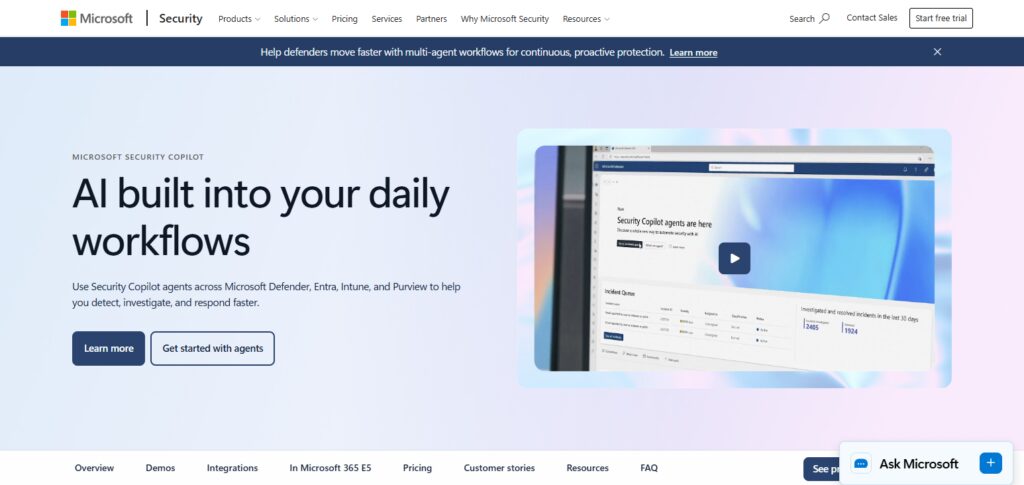
From an enterprise SOC perspective, Copilot integrates AI agents to address the risks of cyber resilience. Evaluation data shows 94% improvement in detection speed during incident response. Copilot enables AI agents to defend against injection attempts. Enterprises using Copilot have improved compliance and less severe breaches, as well as more tightly integrated AI in their operations.
Pricing: Integrated with Microsoft Security Suite – $60K – $200K per year based on the scale of SOC
Best For: Enterprises that need AI-powered SOC/XDR with injection mitigation and anomaly detection.
Pros:
- AI driven integration of SOCs and XDR.
- Strong anomaly detection and incident response.
- Microsoft’s enterprise tool stack integration is seamless.
- Improves compliance and decreases breach impact.
Cons:
- Best built for Microsoft-centric enterprises.
- High cost on large SOC deployments.
- Overlaps existing SIEM/XDR offerings.
- Requires full benefits enterprise-scale deployment.
Future Trends in AI Prompt Injection Defense
Adaptive Defense Models
As innovation and adoption of enterprise AI ecosystems increases, adversarial AI will become a growing concern; however, future tools will allow for flexible, automatic adaptation to the changing landscape of AI attack methods, increasing resiliency.
OWASP AI Standardization
AI-specific attack frameworks will allow developers to baseline injection defense for enterprise adoption and compliance.
Multi-Agent Security Layers
AI defense systems will integrate multiple layers of security aimed at protecting multi-agent systems. This will allow them to collaborate and communicate without the threat of indirect injections.
Enterprise SOC Integration
In place of current defenses, rapid injection will be integrated into the enterprise SOC/XDR workflow to provide protection and adjust CyberAI operations accordingly.
Zero-Trust AI Security
Future defense systems will implement the zero-trust framework and enforce strict access control as well as limitations for AI agents.
Cross-Platform Defense APIs
AI defense will be standardized throughout various LLM systems to protect enterprises against unpredictable attacks.
AI Security ROI Metrics
Enterprises will analyze the effectiveness of defense systems by establishing an ROI threshold for the cost of defensive systems, reduced risk of breaches, and increased compliance and trust of AI systems.
Conclusion
AI prompt injection defense is the response of the market to the challenges of large language models, which is predicted to grow at 35% CAGR. OWASP AI Security associates prompt injection as the leading security concern, hence the need for multiple defenses.
There are various tools which attempt to address runtime controls, detection, monitoring and compliance such as Kontext, Lakera Guard, Protect AI Guardian, Robust Intelligence, CommandSans, CausalArmor, BrowseSafe, Nightvision, ASTRIDE, and Microsoft Security Copilot.
Enterprise data protection demands a balance between cost, scalability and ROI with resilience against emerging threats. The future is more adaptive defense models, zero-trust AI security and SOC integration to defend AI agents across the web.
FAQ
What is a prompt injection attack?
A prompt injection attack manipulates AI models by embedding malicious instructions, causing them to ignore safeguards, leak sensitive data, or perform unauthorized actions.
Why are prompt injection defenses critical?
According to OWASP AI Security (2025), prompt injection is the #1 vulnerability for LLMs, making defenses essential for enterprise data protection and compliance.
Which tools are leading in 2026?
Top tools include Kontext, Lakera Guard, Protect AI Guardian, Robust Intelligence, CommandSans, CausalArmor, BrowseSafe, Nightvision, ASTRIDE, and Microsoft Security Copilot.
How do enterprises evaluate these tools?
Key factors include detection accuracy, runtime authorization, compliance alignment, monitoring, scalability, integration flexibility, and cost vs ROI.
What pricing ranges exist?
Pricing varies: SaaS firewalls ($20K–$80K annually), enterprise suites ($100K–$250K), and API-based subscriptions ($0.002–$0.01 per request).