


The Best SMS APIs for Developers and Enterprises will be explored in this article. Different SMS services will be examined in an effort to discern which is best for your company.
We will analyze the top SMS API platforms and their offerings, worldwide reach, price, safety, flexibility, and how simple the platform is to integrate. Building out customer notifications, OTP verification and campaigns necessitates informed decisions around SMS API services, and this research will help.
What Is an SMS API?
An SMS (Short Message Service) API (Application Programming Interface) refers to an SMS-related programming code that allows a programmer the ability to send and manage text messages via a business system, mobile app or website without the use of a standard SMS app.
An SMS API sends and receives messages over mobile networks using a secure API. Companies can automate process flows, conduct customer service and support SMS messaging, and send marketing and transactional messages to their customers using an SMS API.

Other SMS API functions include two-way SMS, SMS delivery reports, SMS business analytics, SMS scheduling, webhooks, and SMS support communication services.
Why Use SMS APIs for Developers and Enterprises?
Quick Messages: Communicate with customers directly through mobile messages about alerts, updates, reminders, and notifications.
Safer Accounts: SMS APIs can send OTPs faster and more reliably than emails. SMS APIs can also send 2FA codes.
Better Delivery: SMS communication is more reliable than email. Send time-sensitive messages and rest assured that your audience will receive them.
Wide Availability: Reach customers around the world. Many of the popular SMS APIs can send messages to 180–220+ countries.
Simple Setup: APIs and SDKs can help developers add SMS capabilities to their apps, websites, or enterprise software. Most SMS APIs also have extensive documentation.
Manual Intervention Not Needed: Automatically send messages for confirmations, alerts, notifications, and reminders.
Mass Messaging: Easily send messages for marketing, announcements, and business communications.
Enhance Communication: Customers can respond to messages. Collect feedback through messages and surveys.
Flexible APIs: SMS APIs can be used for small and large businesses.
Track Messages: Receipt and analytics help report and troubleshoot communications.
Save While You Message: Spend money on messaging when it is needed with pay-as-you-go or usage models.
Improved Customer Experience – SMS communication that is quick and reliable means customers stay in the loop and engaged. Trust is built from updates that are on time.
Key Features to Look for in an SMS API
Worldwide SMS Accessibility – An API with multiple country connections and reliable carriers is a good option to guarantee dependable overseas communications.
Convenient API Integration – REST APIs, SDKs, and step-by-step documentation are examples of user friendly resources to assist API integration into web, mobile, or enterprise applications.
Reliable Delivery – An API with direct carrier connections and smart routing guarantees messaging will be sent and received with speed and reliability.
Interactive SMS – The sending and receiving of SMS enables businesses to address customer responses and requests and facilitates two-way interactions.
Mass SMS Sending – Large volume SMS sending is a must for enterprise level alerts and particularly for marketing campaigns.
Reporting and SMS Analytics – Tracking messages and analyzing data and performance help diagnose SMS delivery issues as campaigns run.
Verification SMS and OTP – Pre-built SMS One Time Password (OTP) and 2-factor authentication support boosts the security of the API and related applications.
Flexible Infrastructure – The API should easily accommodate an increasing SMS volume.
Security and Compliance – API security should include HTTPS, API authentication, GDPR compliance, and protection against fraud.
Event Based Messaging – Real-time notifications are made possible through the use of webhooks, while design tools simplify messaging and system integrations.
Sender ID and Number Control – The API should enable the management of virtual numbers, short codes, long codes, and Flexible SMS Sender IDs.
Key Point & Best SMS APIs for Developers and Enterprises
| SMS API | Best For | Key Features | Global Coverage | Developer Support | Pricing Model |
|---|---|---|---|---|---|
| Twilio SMS API | Enterprise messaging & scalable apps | Programmable SMS, MMS, verification, webhooks, analytics | 180+ countries | Excellent SDKs, REST API, detailed documentation | Pay-as-you-go |
| Vonage SMS API | Omnichannel business communication | Two-way SMS, delivery receipts, virtual numbers, SMS automation | 200+ countries | REST API, SDKs for multiple languages | Pay-per-message |
| Plivo SMS API | Cost-effective enterprise messaging | Bulk SMS, number masking, delivery tracking, scalable APIs | 190+ countries | Simple REST API, extensive documentation | Usage-based pricing |
| MessageBird SMS API | Customer engagement platforms | SMS, WhatsApp, voice, omnichannel messaging, reporting | 220+ countries | Developer-friendly API, SDKs, webhooks | Pay-as-you-use |
| Sinch SMS API | Global business messaging | High-deliverability SMS, verification, two-way messaging, analytics | 180+ countries | REST API, SDKs, technical support | Consumption-based |
| Telnyx SMS API | Telecom-grade messaging solutions | SMS, MMS, programmable messaging, number management | 200+ countries | REST API, SDKs, API testing tools | Pay-as-you-go |
| Infobip SMS API | Enterprise communication & notifications | Bulk SMS, omnichannel messaging, delivery analytics, security | 190+ countries | Comprehensive APIs, SDKs, enterprise support | Usage-based pricing |
| ClickSend SMS API | Marketing campaigns & notifications | Bulk SMS, scheduling, automation, contact management | 220+ countries | Easy REST API, sample code, documentation | Pay-per-message |
| Karix SMS API | Customer engagement in Asia | Transactional SMS, OTP, campaign management, analytics | 190+ countries | RESTful API, SDKs, integration guides | Volume-based pricing |
| Routee SMS API | Multi-channel enterprise messaging | SMS, voice, verification, workflow automation, reporting | 200+ countries | REST API, SDKs, developer portal | Pay-as-you-use |
1. Twilio SMS API
The Twilio SMS API offers reliable, easily scalable messaging at an affordable price, all while providing excellent global outreach. Founded in 2008, Twilio boasts SMS availability in over 180 countries, allowing developers to access Programmable SMS, MMS, WhatsApp, and verification services all via a single API.
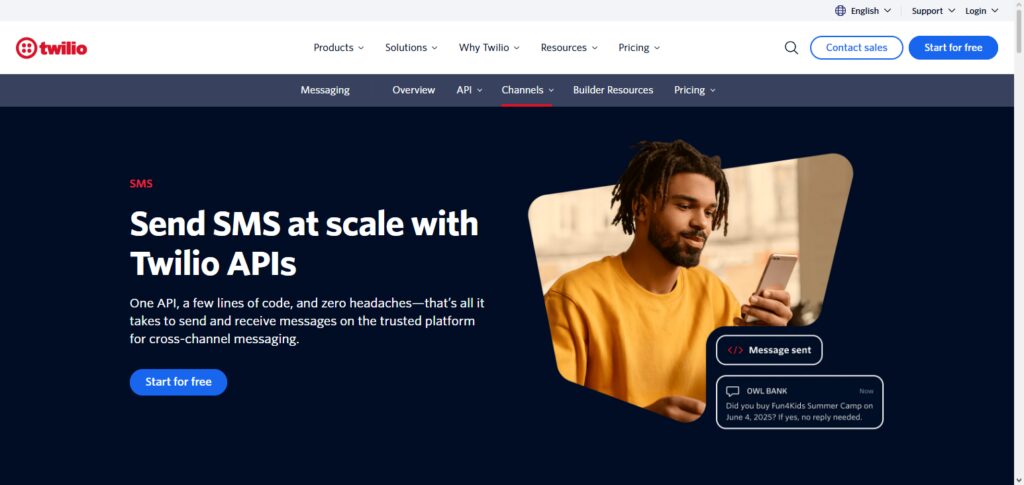
Available REST API SDKs for developers using Python, Java, PHP, Node.js, C#, Ruby, and Go enable rapid API integration.
Twilio’s API is feature rich, offering intelligent message routing, web hooks, delivery reporting, and phone number management all in a single API. Twilio’s API security is top tier, boasting both authentication and encryption, and it is also scalable from a single developer to an enterprise level.
Twilio SMS API Features, Advantages & Disadvantages
Features
- Global SMS delivery in 180+ countries
- SMS, MMS & WhatsApp
- Delivery reports with webhooks
- SDKs available
- Scalable with enterprise infrastructure
Advantages
- Great dev docs and APIs
- Uptime and delivery assurance
- Complex messaging made simple
- Pay-as-you-go
- Security & compliance
Disadvantages
- Costs more in certain regions
- Price scales with volume
- Some features require learning
- Number rental costs
- Expensive support
2. Vonage SMS API
Vonage SMS API provides one of the finest SMS services for developers and enterprises. It provides a global messaging network that easily integrates with other systems. Vonage SMS API began in 2001 as Nexmo. It is one of the earliest players in the SMS API market.
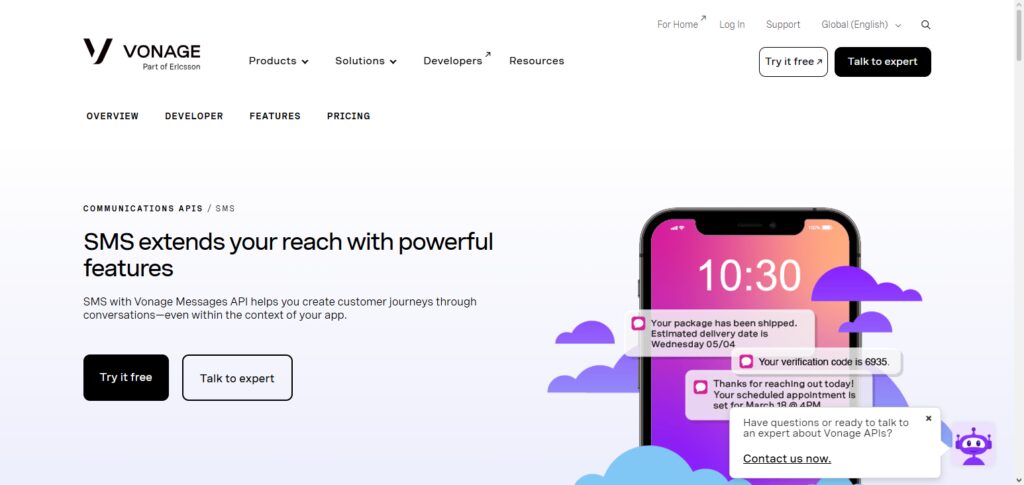
It allows businesses to send two-way SMS, as well as, promotional and transactional SMS in over 200 countries. Vonage SMS API provides delivery receipts, virtual numbers, and Unicode messaging. Developers can use the Vonage SMS API to quickly send SMS as they have provided REST APIs, SDKs, SMS API documentation, and even code samples in multiple programming languages.
Vonage SMS API has a direct integration with telecommunication carriers that ensures delivery of SMS at high rates. It has an enterprise grade security and compliance. Pay-per-usage messaging ensures that users are only charged for messages sent.
Vonage SMS API Features, Advantages & Disadvantages
Features
- SMS in 200+ countries
- Two-way SMS
- Virtual numbers
- SMS delivery and receipts
- REST API with SDKs
- Unicode and long SMS
Advantages
- Great international coverage
- API is simple
- Global SMS at great prices
- Reliable connections
- Great dev resources
Disadvantages
- Some tools need extra services
- Regional pricing
- Support costs are higher
- Dashboard can be complex
- Speed of delivery can vary per region
3. Plivo SMS API
Plivo is one of the better-reviewed SMS APIs and offers one of the most affordable APIs. Established in 2011, Plivo offers global SMS to 190 countries. Their carrier connectivity is laudable. They offer a variety of messaging solutions.
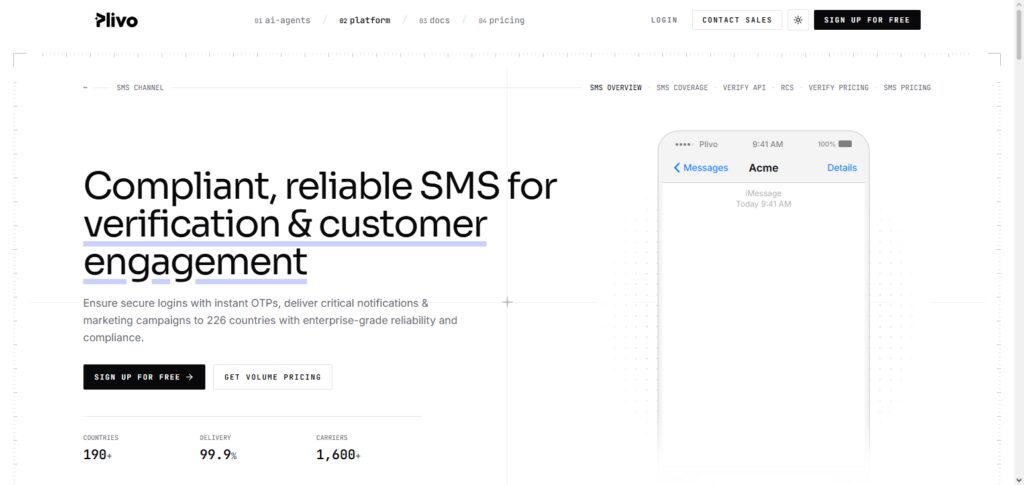
Developers can also utilize their REST APIs and SDKs for Java, Python, PHP, Node.js, Ruby, and .NET to assist with a quicker integration. Plivo also leads the industry in analytics with detailed metrics, message logs, webhooks, and real-time updates.
While many companies contact customers with notifications, many companies utilize it for their authentication solutions. Their pricing models make them an excellent choice, especially for bulk messaging, OTP verification, two-way SMS, and delivery tracking and masking solutions.
Plivo SMS API Features, Advantages & Disadvantages
Features
- Global SMS and MMS messaging
- Bulk SMS support
- OTP and verification messaging
- Delivery tracking and analytics
- RESTful APIs with SDKs
Advantages
- Affordable pricing
- Easy-to-use developer tools
- High message delivery reliability
- Scalable cloud infrastructure
- Fast API implementation
Disadvantages
- Smaller ecosystem than Twilio
- Limited built-in marketing features
- Fewer third-party integrations
- Premium support may cost extra
- Some advanced capabilities require customization
4. MessageBird SMS API
Developers and enterprises often favor MessageBird SMS API as one of the best SMS APIs due to its unique integration of SMS with omnichannel communications. Founded in 2011, MessageBird specializes in multichannel communication, spanning SMS, WhatsApp, Voice, Email, and chat communications sent to 220+ countries.
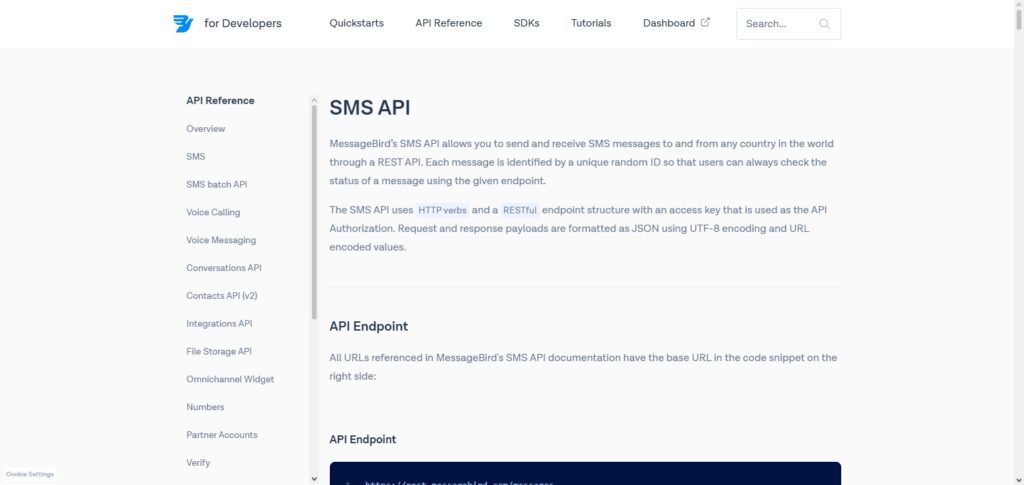
For SMS, developers can utilize REST APIs, SDKs, webhooks, and automation tools. Additionally, the platform provides analytics for delivery, two-way messaging, and a management system for high-volume messaging.
MessageBird provides the security of communication that enterprises require, thanks to intelligent routing and pay-as-you-go pricing that accommodates both enterprises and start-up clients.
MessageBird SMS API Features, Advantages & Disadvantages
Features
- Omnichannel messaging
- APIs for SMS, WhatsApp, Voice, Email
- Global network of carriers
- Analytic reports in real-time
- Automation of workflows
Advantages
- Great global coverage
- Unified platform for communications
- Scalable for businesses
- Easy integration for all channels
- Excellent security
Disadvantages
- Expensive for large enterprises
- Can seem confusing at first
- Advanced automation is time consuming
- Learning curve associated with some APIs
- Cost is higher for other services
5. Sinch SMS API
Sinch SMS API provides reliable global messaging infrastructure and advanced communication features, making it one of the best SMS APIs. Established in 2008, Sinch SMS is one of the faster SMS services with great carrier partnerships in 180+ countries.
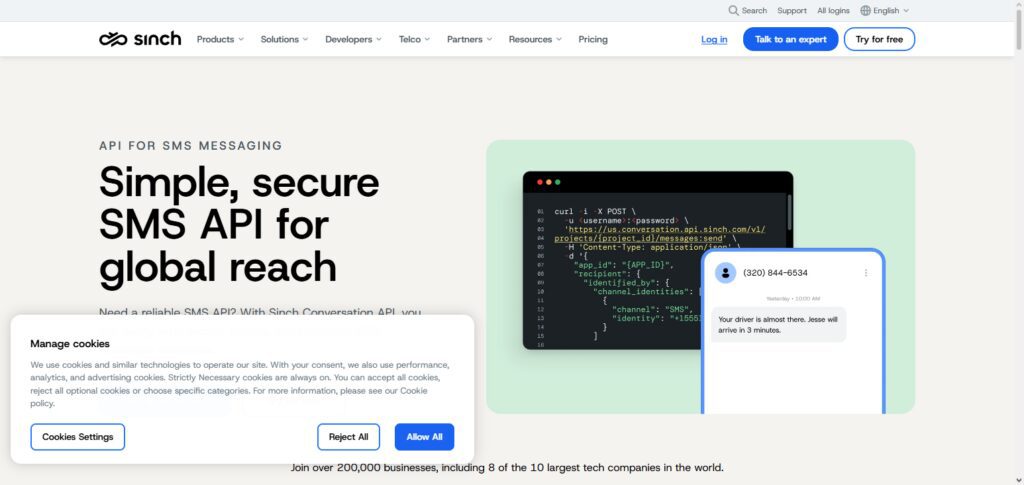
Developers get REST APIs and SDKs for integrated transactional SMS, OTP verification, notifications, and promotional campaigns at their fingertips. Added features include delivery tracking, message reporting dashboards, and message scheduling with two-way message support.
Sinch offers enterprise security with encrypted communications of authenticated and compliance SMS. The infrastructure is enterprise level, scalable, and consumes SMS at a pay as you go level.
Sinch SMS API Features, Advantages & Disadvantages
Features
- Global SMS with two-way messaging
- OTP verification
- Delivery reports and analytics
- REST APIs and SDKs
Advantages
- Incredibly successful SMS delivery
- Excellent security for enterprises
- Strong carriers
- Scalable
- Customer support is responsive
Disadvantages
- Price is not consistent globally
- Smaller community of developers
- Enterprise plans needed for many features
- Limited free trials
- Set up can take a long time
6. Telnyx SMS API
The Telnyx SMS API is an excellent SMS API option for developers and large businesses that need messaging and communication services of a telecommunications standard. Telnyx was founded in 2009 and supports messaging in over 200 countries via their global private network.
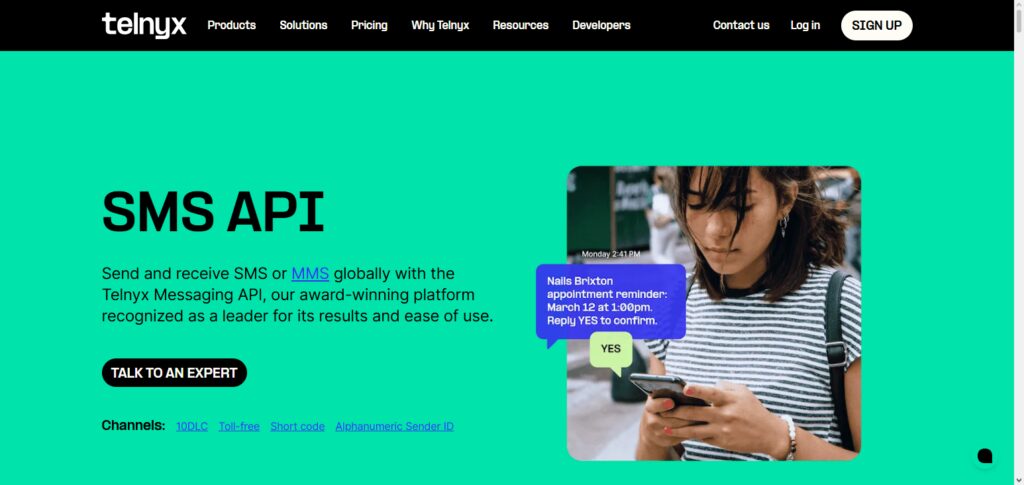
Programmable SMS and MMS, number management and messaging profiles, and web hooks are provided to developers. Telnyx also employs REST APIs and offers analytics and delivery reports within their platform.
Telnyx also provides fraud protections and automated routing. Telnyx APIs are documented and accompanied by SDKs that allow a quick and easy integration, all of which are built upon a pricing model that employs ongoing payment for services rendered, which is advantageous for both enterprises and startups.
Telnyx SMS API Features, Advantages & Disadvantages
Features
- Telecom-grade SMS and MMS
- Number management tools
- Programmable messaging
- Delivery reports
- Webhooks and REST APIs
Advantages
- Transparent pricing
- High-quality network infrastructure
- Excellent API performance
- Strong scalability
- Reliable global messaging
Disadvantages
- Smaller marketplace than Twilio
- Limited beginner tutorials
- Some enterprise features require configuration
- Fewer third-party integrations
- Advanced telecom concepts may confuse new users
7. Infobip SMS API
Many developers and businesses regard the Infobip SMS API as one of the best enterprise messaging SMS APIs available with its global reach. Founded in 2006, Infobip built direct carrier partnerships and sends SMS in over 190 countries.
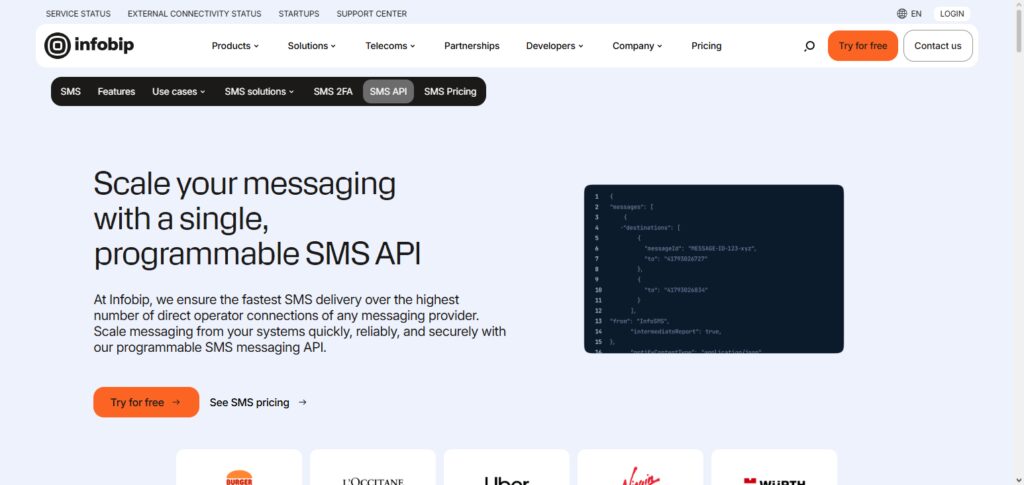
The platform covers everything from transactional SMS, marketing campaigns, OTP verification, and two-way messaging to omnichannel messaging through a unified dashboard.
Developers have access to a variety of tools like REST APIs, SDKs, and automation tools, as well as delivery reports and real-time analytics. Infobip SMS API gives enterprise messaging services high throughput as well as enterprise security and compliance. It has a pay-as-you-grow pricing model and a scalable cloud architecture.
Infobip SMS API Features, Advantages & Disadvantages
Features
- Global SMS
- Omnichannel messaging
- SMS in Bulk
- Analytics
- OTP and Authentication
Advantages
- Large carrier network
- Enterprise reliability
- Compliance and security focused
- Great assistance for large enterprises
- Superior advanced reporting
Disadvantages
- High enterprise pricing
- Complicated platform
- Some features need custom contracts
- Pricing lacks transparency
- Steep learning for complex tools
8. ClickSend SMS API
One of the best SMS APIs on the market for sending bulk messages and notifications is ClickSend SMS API. Established in 2013, ClickSend has profitable carrier partnerships that lend to SMS pass through to 220+ countries. Using their bulk SMS service, developers can send, schedule, and manage contacts and OTPs with a REST API and/or SDKs.
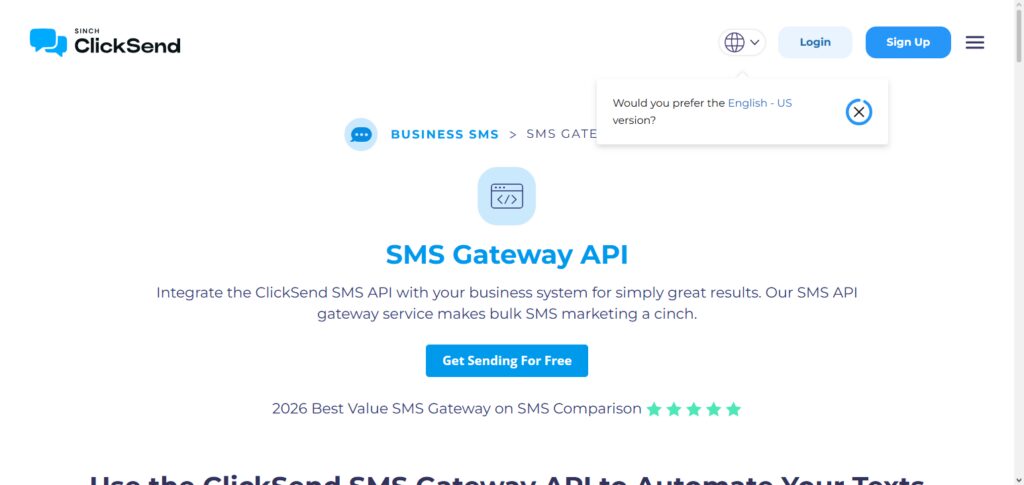
They can also set up automated business workflows. ClickSend has delivery status tracking and reporting, along with webhooks and easy API integrations to CRM and business apps. They also have an infrastructure built with security and reliability.
Their documentation is straightforward and implementation is fast. For businesses with a transactional messaging focus, ClickSend has a pay-per-message pricing model. Their infrastructure is built to handle a business’s messaging campaigns.
ClickSend SMS API Features, Advantages & Disadvantages
Features
- Bulk SMS
- SMS Scheduling
- Contact Lists
- REST API
- Delivery Tracking
Advantages
- Budget-friendly pay-per-message
- Quick integration
- Simple UI
- Global delivery
- Made for small business
Disadvantages
- Basic automation
- Most enterprise features missing
- Basic analytics vs competition
- Smaller developer community
- Less omnichannel
9. Karix SMS API
Among APIs for sending SMS, Karix is one of the best SMS APIs for developers and enterprises, notably for businesses focused on Asia and emerging markets. Established in 2001, Karix boasts of strong enterprise-grade carrier connections with messaging services in over 190 countries.

Developers get many RESTful APIs for transactional SMS, OTP verification, promotional SMS, two-way SMS, and automated notifications. The platform provides delivery reports, campaign analytics, intelligent routing, and secure authentication.
Karix uses flexible volume-based pricing which is perfect for large enterprises and growing businesses. Karix excels in SMS delivery performance and supports high-volume enterprise messaging.
Karix SMS API Features, Advantages & Disadvantages
Features
- Transactional and promotional SMS
- OTP
- Campaigns
- Delivery Reports
- REST API
Advantages
- Strong in Asia
- Large volume messaging
- Highly competitive pricing
- Carrier partnerships
- Secure messaging
Disadvantages
- Less global recognition
- Less documentation
- Less international integrations
- Some advanced features in enterprise plans
- Smaller developer community
10. Routee SMS API
The Routee SMS API grants developers and businesses alike one of the best SMS APIs by offering messaging solutions and highly developed opportunities for communications automation.
Founded in 2016, Routee spans SMS in 200+ countries and also provides voice and verification support across channels. Thanks to their REST APIs, SDKs, and workflow automation, the platform’s delay reports, scheduler, two-way messaging, address book, analytic messaging, and intelligent cloud routing and design, are all easily integrated.
With enterprise-level security, consistent service from their cloud infrastructure, and a convenient pay-as-you-go model, their SMS API is appropriate for any size enterprise from startups to SaaS to large corporations.
Routee SMS API Features, Advantages & Disadvantages
Features
- SMS and Voice APIs
- Two-way messaging
- Workflow automation
- Delivery reports
- REST APIs with SDK support
Advantages
- Easy API integration
- Flexible pay-as-you-use pricing
- Good international coverage
- Enterprise-grade security
- Supports communication automation
Disadvantages
- Smaller global market share
- Fewer third-party integrations
- Limited learning resources
- Advanced workflows require configuration
- Premium features may increase costs
Conclusion
It is important to consider your messaging volume, costs, integration requirements and worldwide coverage when identifying the best SMS APIs for developers and businesses. Reliable APIs with high delivery rates, great security and solid infrastructure are offered by industry leaders like Twilio, Vonage, Plivo, MessageBird, Sinch, Telnyx, Infobip, ClickSend, Karix and Routee.
These SMS APIs are developed for businesses of every size. You can send everything from transactional alerts and OTP verifications to SMS for marketing campaigns and enterprise communications. Compare features and pricing and identify the best reachable options to fit your application. Ensure your long term objectives for communication are considered.
FAQ
What is an SMS API?
An SMS API is a programming interface that allows developers to send and receive SMS messages directly from websites, mobile apps, or business software without using a traditional messaging application.
Which is the best SMS API for developers?
Twilio, Vonage, Plivo, MessageBird, and Telnyx are among the best SMS APIs for developers due to their comprehensive documentation, SDKs, reliable infrastructure, and easy integration.
What features should I look for in an SMS API?
Key features include global SMS coverage, high delivery rates, two-way messaging, OTP verification, delivery reports, webhooks, REST APIs, SDK support, analytics, and enterprise-grade security.
Are SMS APIs suitable for enterprise businesses?
Yes. Most enterprise SMS APIs are designed to handle high-volume messaging, provide global carrier connectivity, offer compliance with security standards, and integrate with CRM, ERP, and customer support platforms.
How much do SMS APIs cost?
Most SMS API providers use a pay-as-you-go or usage-based pricing model. Costs vary depending on the destination country, message volume, and additional services such as phone numbers or verification APIs.