
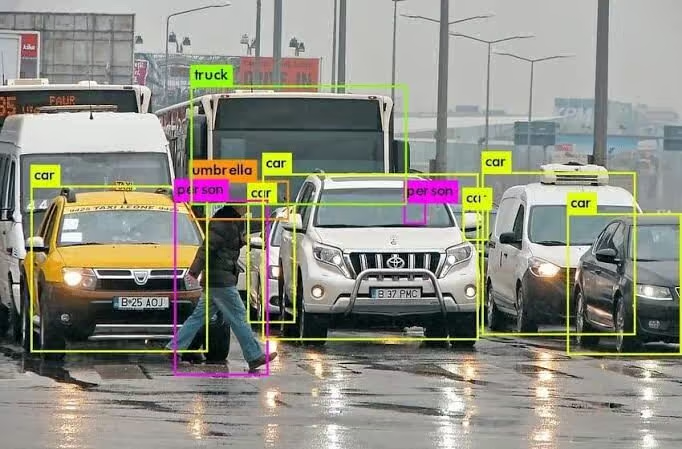
In this article, I review the Best Image Recognition APIs for AI Projects. The goal of these reviews is to help developers, enterprises, and AI consumers identify the best fit for their use case and for the providers of CV solutions.
Review the best APIs and learn the most notable features, costs, pros, cons, and recommended use cases. By analyzing this, you will build better, more accurate, more intelligent, scalable AI solutions in 2026.
What is Image Recognition APIs?
Image Recognition APIs are AI-driven, ML-powered, and computer vision-based APIs that are available either on the cloud or on-premises.
They analyze and interpret images automatically. These APIs can recognize different objects, faces, and even texts, landmarks, logos, and products among countless other visual elements. Developers don’t need to build complicated AI models if they use these APIs. There are countless powerful and intelligent visual features that recognize and tag images.

Some of these features are facial recognition, OCR (Optical Character Recognition), content moderation, and image tagging. Image Recognition APIs are used in plenty of industries such as healthcare, retail, manufacturing, security, automotive, agriculture, and eCommerce.
They help in increasing the accuracy of the systems and improve the overall experience for the end-user.
Why Use Image Recognition APIs for AI Projects
High Recognition Accuracy – Quick and accurate recognition of concepts in images is a core advantage of APIs using sophisticated Machine Learning Algorithms.
Faster Development – Using an Image Recognition API in your project takes a fraction of the time of developing the whole computer vision application yourself.
Very Affordable – Using APIs saves building, training, and hosting a cost.
Smart API Design – The APIs are designed to integrate.
High Scalability – Use the API with a small image set, then scale to a million images analysis.
Instantaneous Analysis – The image recognition APIs can process images and videos at the moment for analytics and many other applications.
Custom AI Models – Some of the APIs allow you to custom train AI Models.
Built-in Text Recognition – Automate the processing of typed and hand-written documents.
Improved Security – APIs improve the security of your application and data.
Versatility – APIs can be used in practically all industries.
Continuous Improvement of AI – The API improves your AI Model automatically.
Multi-Environment Use – The APIs can be used in a multitude of devices and applications.
Risk & Considerations
Data Privacy – Compliance to privacy legislation may be required if sensitive information is embedded in the traditional data.
Security of Image Data – Consider APIs with secure image upload channels, safe authentication, secure access, and image data encryption.
Recognition Accuracy – Given the variety of images, AI models may produce inaccurate results if the images are low quality or contain rare objects.
Costs to API Usage – Most Image Recognition API providers charge based on the number of images processed or API calls, and costs may become significant.
Vendor Lock-In – Designing the application ecosystem around one provider’s API may make using other systems and providers more expensive and difficult.
API Dependency – Robust APIs may be unsuitable for remote or offline locations, as they require a reliable internet connection.
Rate Limit and Quota – In the Free and limited Tier plans, API usage is highly restricted, and application performance may be negatively impacted.
Bias AI Models – AI Image Recognition systems may generate erroneous results and inequity, as all have some bias.
Integration Complexities – Although most traditional APIs are simple to invoke, the more advanced API integrations may require additional configuration and technical knowledge.
Latency – This request may be an issue, especially if volume or size is large, in real-time applications where rapid response is critical.
Customization Needs – Specialized industries may struggle to get value from off-the-shelf, pre-trained models, as more tailored custom models may be the only way to achieve reasonable accuracy.
Key Point & Best Image Recognition APIs for AI Projects
- Microsoft Azure Computer Vision API – Best for enterprise-grade image analysis, OCR, object detection, and AI-powered vision applications.
- Amazon Rekognition API – Ideal for facial recognition, object detection, content moderation, and video analysis at scale.
- IBM Watson Visual Recognition API – Designed for custom image classification and AI-powered visual content analysis.
- DeepAI Image Recognition API – A developer-friendly API offering image tagging, object recognition, and computer vision capabilities.
- Clarifai API – Known for advanced AI models, custom image recognition, visual search, and multimodal AI workflows.
- Viso Suite API – Built for enterprise computer vision, edge AI deployment, and real-time visual analytics.
- Chooch AI API – Specializes in industrial AI, object detection, anomaly detection, and automated visual inspection.
- Sighthound Cloud API – Provides fast image and video recognition with accurate vehicle, person, and object detection.
- SkyBiometry API – Focuses on face detection, facial recognition, emotion analysis, and biometric image processing.
- Ximilar API – Best for visual search, product recognition, image tagging, and eCommerce image classification.
10 Best Image Recognition APIs for AI Projects (2026)
1. Microsoft Azure Computer Vision API
Microsoft offers developers some of the best cloud-based AI services available with the Computer Vision API. Highly recognized for its optical character recognition (OCR), advanced image analysis, object detection, image captioning, facial analysis, brand recognition, and landmark recognition, the Computer Vision API is a REST API that integrates with the other Azure AI services.

Computer Vision API is ideal for enterprise app development, healthcare, retail, manufacturing, document automation, and is one of the most powerful services for developing AI-based apps. Computer Vision API is also one of the most advanced services.
The Computer Vision API, in addition to the other Azure services, is highly secure, scalable and compliant, and is constantly developed with AI to improve its accuracy. If you are developing an AI app based on image recognition, you can highly rely on the Azure Computer Vision API.
Microsoft Azure Computer Vision API Features, Pros & Cons
Features
- Object and scene recognition powered by AI
- Handwritten and printed OCR
- Image captioning and tagging
- Detection of faces, landmarks, and brands
- REST API with Azure cloud support
Pros
- High accuracy for image recognition
- Enterprise level scalability
- Strong compliance and security
- Several programming language support
- AI services integration via Azure
Cons
- Azure premium features tend to be pricey
- Steep learning curve for Azure beginners
- Lower pricing tiers impose rate limits
- Requires constant internet access
- High level customization will likely incur additional costs on Azure
2. Amazon Rekognition API
Amazon Rekognition API allows developers to embed advanced image and video analysis using computer vision within applications with little effort. It is a managed service and uses machine learning models to analyze images. It can identify objects, scenes, faces, texts, and inappropriate content.
It also has the ability of classifying and comparing faces (celebrity and regular) and custom labeling. The Rekognition API can be a pivotal part of an AI workflow. It can be combined with other AWS services like S3, Lambda, and SageMaker.
It is extensively and affordably used in industries like Smart Surveillance, Security, Media and Celebrity Management, Identity Verification, Retail Industry, and Analytics.
Amazon Rekognition API Features, Pros & Cons
Features
- Object and scene analysis
- Facial recognition and analysis
- Real-time video analysis
- Automated content moderation
- Custom industry models via Custom Labels
Pros
- Highly scalable AWS infrastructure
- Rapid video and image analysis
- Simplified services integration via AWS
- Enterprise grade reliability
- Custom AI models training
Cons
- Costs will increase with larger workloads
- Beginners will find AWS setup to be confusing
- Facial recognition laws may impact regions
- Management of AWS accounts is necessary
- Custom models will incur additional costs
3. IBM Watson Visual Recognition API
IBM Watson Visual Recognition API utilizes artificial intelligence to facilitate image analysis for companies while enabling the creation of specialized image classification models.
The platform accurately identifies various objects, scenes, products, and patterns. It also allows tailored AI training for the healthcare sector, manufacturing, agriculture, and quality inspections. Being a part of IBM Cloud services, the API allows companies to develop automated, intelligent, secure, and governed processes.
Companies get the advantage of flexible machine learning models, easy implementation, and large cloud services that can use complex artificial intelligence for advanced image recognition.
IBM Watson Visual Recognition API Features, Pros & Cons
Features
- Image classification
- Custom AI model training
- Object and scene recognition
- Cloud-based visual analysis
- Integration with IBM Cloud
Pros
- Strong enterprise AI capabilities
- Supports industry-specific training
- Secure cloud infrastructure
- Reliable documentation
- Flexible deployment options
Cons
- Fewer updates than some competitors
- Higher pricing for enterprise plans
- Limited free usage
- Smaller developer community
- Advanced features require IBM ecosystem
4. DeepAI Image Recognition API
DeepAI Image Recognition API is an image tagging service utilizing easy REST technology also capable of object recognition and visual classification.
This API is intended for the less experienced, cash-strapped customer such as students and developers. This API provides ease of integration for both web based and mobile applications.
This API is highly cited for usage in image recognition, content moderation, auto tagging, and artificial intelligence research. It’s easy to understand documentation complemented by its fast implementation and very low cost makes this API optimal for small operating firms and for AI based research.
DeepAI Image Recognition API Features, Pros & Cons
Features
- Image Tagging
- Object Recognition
- REST API
- Image Analysis via AI
- Developer Docs
Pros
- Great API for beginners
- Good pricing
- Easy to implement
- Thin cloud service that is good for prototypes and startups
Cons
- Limited advanced AI features
- Less accurate than enterprise APIs
- Less customizable
- Limited analytics
- Not suitable for large enterprise projects
5. Clarifai API
Clarifai API is a top tier platform in advanced AI recognition. Developers use Clarifai API for a number of tasks including object detection or visual search. Developers also have the option of going a more custom route by creating their own machine learning model tailored to the needs of their business.
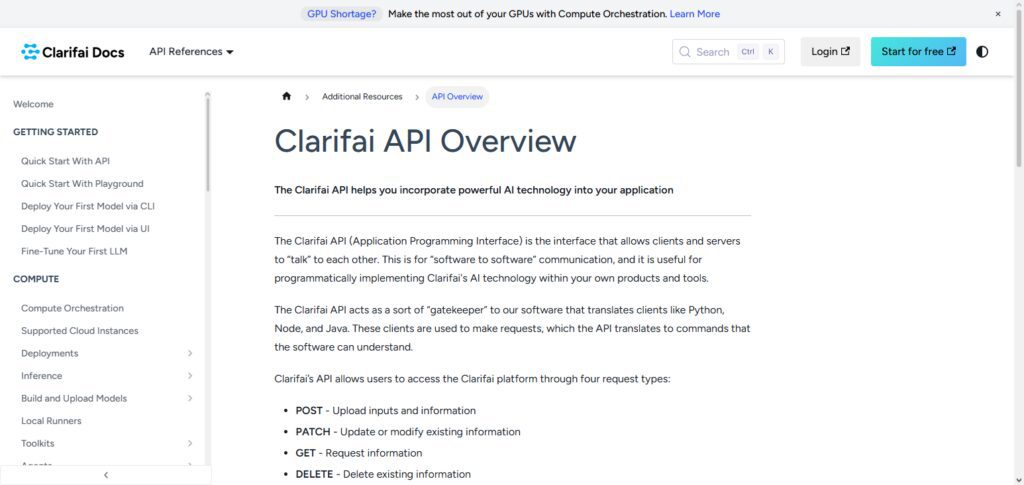
Clarifai API, being an advanced AI platform, provides machine learning capabilities for processing images, videos, texts, and even audio. Because of clarity API’s high performance, flexible and advanced AI models, the platform is used for a wide range of industries including retail, health care, security, manufacturing, and media.
Clarifai also provides flexible SDK. Cloud deploying aids in the workflow automation. Coupled with its flexible and scalable design, Clarifai API is also used by startups and large designs for enterprise AI projects.
Clarifai API Features, Pros & Cons
Features
- Object Detection
- Custom AI Model
- Visual Search
- Image and Video Recognition
- Multimodal AI
Pros
- Custom model support is excellent
- Recognition is very accurate
- SDKs are plentiful
- Enterprise ready
- Multiple AI workflows
Cons
- Costly premium plans
- Can be complex to initially setup
- Some advanced features are training based
- API costs increase with usage
6. Viso Suite API
The Viso Suite API is a Computer Vision platform for enterprises. It allows businesses to build and manage visual applications powered by AI. It offers many features including object detection and image classification. The platform is designed for edge AI and includes functionalities for people counting and defect detection.

The API enables businesses to control deployed AI models in industrial settings from a central location. Viso Suite API is used in a variety of industries including manufacturing and logistics. It is also used in smart cities and projects in the retail and healthcare industries.
The combination of enterprise security and management, along with remote and scalable deployment of the platform, assists many businesses in the commercial use of AI with the platforms no-code and low-code features.
Viso Suite API Features, Pros & Cons
Features
- Computer Vision Platform for Enterprises
- AI at the Edge
- Object Detection
- Visual Analytics in Real-Time
Pros
- Great for AI in Industry
- Edge and Cloud deployment are supported
- AI management is centralized
- Strong enterprise security
- Scalable architecture
Cons
- Enterprise pricing
- Not for small projects
- Needs deployment prep
- Few beginner resources
- Technical skills needed for deployment and advanced features
7. Chooch AI API
Chooch AI API develops an enterprise-grade visual AI platform that uses deep learning for industrial automation, public safety, healthcare, manufacturing, and logistics applications. Its advanced capabilities include intelligent video analytics, custom object detection, quality inspection, anomaly detection, and facial recognition.

Organizations can tailor the AI models using the datasets relevant to their industry, which also helps the models to be more accurate and to automate more tasks.
Chooch AI API offers support for cloud, edge, and hybrid deployments. Its AI infrastructure, customizable workflows, and real-time processing of images make it capable of complex enterprise computer vision applications that are highly critical.
Chooch AI API Features, Pros & Cons
Features
- Custom object detection
- Visual anomaly detection
- Industrial image analysis
- Video analysis
- Edge and cloud AI
Pros
- Highly accurate AI for industrial applications
- Great for healthcare
- Works with custom datasets
- Image analysis in real-time
- Different deployment methods
Cons
- High price
- Better for large companies
- Setup requires knowledge of AI
- Small developer community
- Limited paid access
8. Sighthound Cloud API
Sighthound Cloud API offers a fast and accurate means to identify people, vehicles, objects, faces, and license plates with image recognition and video analysis. With simple APIs, developers can add advanced visual recognition to security services, traffic analysis and monitoring, parking management, retail analysis, and components of smart cities.
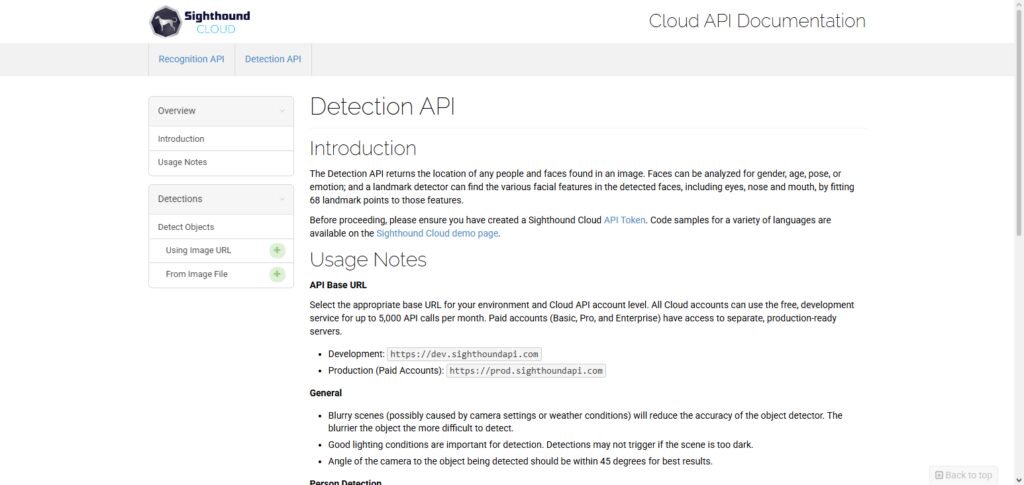
With an emphasis on ease of use for the developer, Sighthound Cloud API focuses on speed and accuracy with a real-time reliable performance. The AI models on the platform are hosted in the cloud with an infrastructure that supports the scalable needs of the developer.
Because of this cloud infrastructure and a focus on improvement, Sighthound is the preferred solution of those that need automated monitoring and visual recognition that are accurate across a broad application.
Sighthound Cloud API Features, Pros & Cons
Features
- Person detection
- Vehicle detection
- Face recognition
- License plate recognition
- Cloud-based object detection
Pros
- Fast processing
- Accurate vehicle detection
- Great for surveillance
- Easy API integration
- Good cloud reliability
Cons
- Low AI customization
- Smaller ecosystem than Azure or AWS
- Enterprise pricing
- Limited advanced analytics
- Dependent on the internet
9. SkyBiometry API
SkyBiometry API offers services on emotions, age, and gender. It can also analyze faces and recognizes individuals. Its APIs are designed for easy integration. The REST APIs help developers create applications on any platform.
Many businesses use SkyBiometry for user verification and attendance recording. It also helps analyze customer interactions and creates immersive apps.
SkyBiometry API provides cloud services and facial comparison algorithms that are both fast and easy to implement. Many organizations use SkyBiometry to create secure systems that integrate authentication and user experience.
SkyBiometry API Features, Pros & Cons
Features
- Face detection
- Facial recognition
- Emotion analysis
- Age and gender recognition
- REST API
Pros
- Easy integration for facial recognition
- Fast processing
- Easy API documentation
- Low price for facial AI
- Good biometrics
Cons
- Primarily focused on facial recognition
- Limited object detection
- Fewer features than competitors
- Less ideal for enterprise AI
- Reduced integration capabilities
10. Ximilar API
Ximilar API is an advanced API on the computer vision platform that features multiple services, including automated image tagging and object detection. Companies who use this API in their eCommerce platform and other services that utilize visual aids to conduct business transactions have been known to drive tremendous growth in sales.
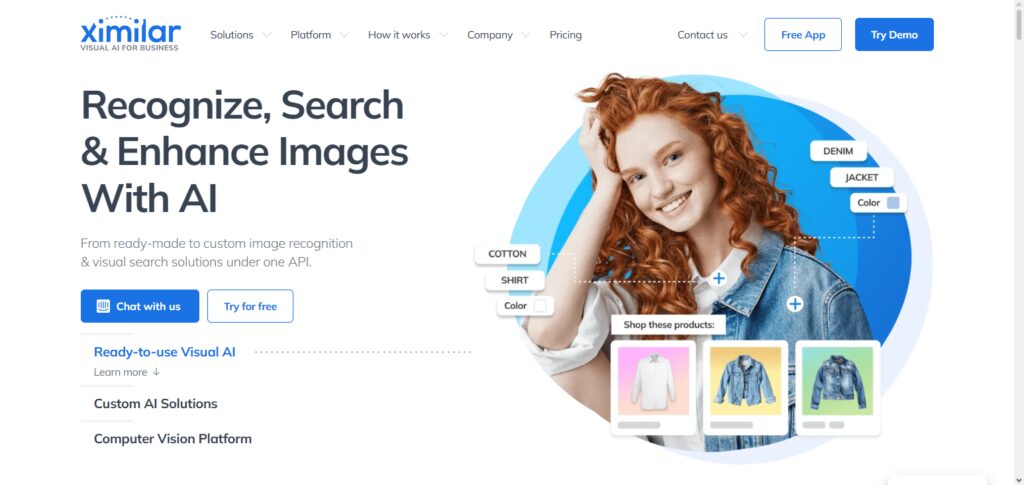
Developers can build custom AI models that can detect various objects and visual similarities on the Internet.
This API even offers users a reverse image search capability, and tools for duplicate image detection and metadata extraction. This API is perfect for almost any AI application. This is even noted in several testimonials by various users.
Ximilar API Features, Pros & Cons
Features
- Visual search
- Product recognition
- Image classification
- Reverse image search
- Custom AI model training
Pros
- Great for eCommerce
- Visual search tech is a standout
- Good models can be built with ease
- Great recognition for products
- Cloud infrastructure that grows with demand
Cons
- Generally focused outside of computer vision
- Some advanced tiers of service can be pricey
- Training data needs to be of good quality
- Offers little in terms of facial recognition
- Compared to large cloud infrastructure, offers a small global ecosystem
Conclusion
When deciding on an image recognition API for AI projects in 2026, first list out tech specs, finances, and breadth of your plans. If it’s an enterprise grade AI project, both Microsoft Azure Computer Vision and Amazon Rekognition are great options. For sophisticated projects, Clarifai and IBM Watson are great for customization.
Those on a budget will find DeepAI to be a good option. For those projects in defense, retail, security, healthcare, or manufacturing, Viso Suite, Chooch AI, Sighthound, SkyBiometry and Ximilar have excellent alternatives. For the appropriate image recognition API, consider the features, pricing, accuracy, and the ease of integration and you will be able to design more efficient, and smarter, AI applications.
FAQ
What is an image recognition API?
An image recognition API is a cloud-based service that uses artificial intelligence and computer vision to identify objects, faces, text, landmarks, and other visual elements within images or videos.
Which is the best image recognition API in 2026?
Microsoft Azure Computer Vision API, Amazon Rekognition API, and Clarifai API are among the best image recognition APIs in 2026 due to their high accuracy, scalability, and enterprise-grade features.
Are image recognition APIs free to use?
Many providers offer free tiers or trial credits. However, advanced features and high-volume usage typically require a paid subscription based on API requests or processing volume.
Which image recognition API is best for beginners?
DeepAI Image Recognition API is a great choice for beginners because it offers simple integration, clear documentation, and affordable pricing for small AI projects.
Can image recognition APIs detect faces?
Yes. APIs such as Amazon Rekognition, SkyBiometry, and Microsoft Azure Computer Vision support face detection, facial recognition, emotion analysis, and identity verification features.